Home Blog Page 8

Ethereum vs Solana vs Polygon vs TON — Chain Metrics Compared

In the fast-evolving world of blockchain technology, choosing the right network can make all the difference for developers, investors, and users. Ethereum, Solana, Polygon, and TON (The Open Network) are four prominent blockchains, each with unique strengths in scalability, cost-efficiency, and ecosystem growth. This article compares their key chain metrics—such as Total Value Locked (TVL), Transactions Per Second (TPS), gas fees, active users, and decentralization—to help beginners understand the differences without overwhelming technical jargon.

We’ll use verified data from reliable sources like CoinGecko, DefiLlama, and blockchain analytics platforms to ensure accuracy. Whether you’re new to crypto or exploring options for dApps, NFTs, or DeFi, this comparison will break down the essentials in simple terms. By the end, you’ll have a clear picture of how these chains stack up in 2025.

For a DeFi-focused breakdown of these chains, see our detailed comparison — Ethereum vs Solana vs Polygon: Which Blockchain Wins for DeFi?.

What Are Chain Metrics and Why Do They Matter?

Chain metrics are like vital signs for a blockchain—they show how healthy, efficient, and popular the network is. Here’s a quick beginner-friendly explanation:

Total Value Locked (TVL): This measures the total amount of crypto assets “locked” in the chain’s smart contracts, often for DeFi apps like lending or trading. A higher TVL indicates more trust and activity. Note that TVL methodologies differ across platforms and aren’t perfectly standardized.

Transactions Per Second (TPS): How many transactions the chain can handle in one second. Faster TPS means quicker confirmations, ideal for gaming or payments.

Gas Fees: The cost to perform actions on the chain, like sending tokens. Low fees make the network accessible to everyday users. For more on how sidechains help reduce transaction costs, see Understanding Ethereum Sidechains

Active Users (DAU/MAU): Daily Active Users (DAU) and Monthly Active Users (MAU) count unique addresses interacting with the chain. High numbers signal strong adoption.

Decentralization Metrics: Things like node count and validator numbers. More decentralization means better security and resistance to control by a few entities.

These metrics help compare blockchains objectively. For instance, Ethereum is like a bustling city with high traffic (and sometimes high costs), while Solana is a high-speed highway designed for volume. Now, let’s overview each chain.

Overview of the Blockchains

Ethereum: The Pioneer

Ethereum, launched in 2015, is the original smart-contract platform. It’s home to most DeFi and NFTs, with a market cap around the mid-$400–$500B range in mid-October 2025. Ethereum has used Proof-of-Stake (PoS) since 2022, making it energy-efficient. However, its base layer can get congested, leading to Layer 2 solutions for scaling — see our complete Ethereum Layer-2 guide for 2025. Learn more at ethereum.org.

Solana: The Speed Demon

Solana, started in 2020, focuses on high throughput using Proof-of-History (PoH) combined with PoS. It’s popular for fast, cheap transactions, attracting gaming and meme-coin projects. Solana’s token, SOL, has a market cap of roughly $90–$105B in mid-October 2025. It’s known for handling massive volumes without slowing down. Why their growth still doesn’t dethrone Ethereum — Solana and TON Can’t Kill Ethereum. More details at The Block.

Polygon: The Ethereum Scaler

Polygon (formerly Matic) is a network that scales Ethereum; the widely-used Polygon PoS chain launched in 2019. It uses PoS to offer faster, cheaper alternatives while anchoring to Ethereum. To understand how these sidechains enhance Ethereum scalability, read Understanding Ethereum Sidechains. As of mid-October 2025, POL’s market cap is around $2B. Polygon excels in DeFi and enterprise apps and bridges to Ethereum seamlessly. Visit Artemis Analytics for detailed metrics.

TON: The Telegram-Integrated Network

The Open Network (TON), originally from Telegram and independent since 2020, uses PoS and sharding concepts for scalability. Integrated with Telegram’s massive user base, TON targets mass adoption through mini-apps and payments. As of mid-October 2025, TON’s market cap is in the $5–7B range. Explore more at polygon.technology and TON documentation. For more context on TON’s rise and Ethereum’s resilience, see this analysis.

Comparing Total Value Locked (TVL)

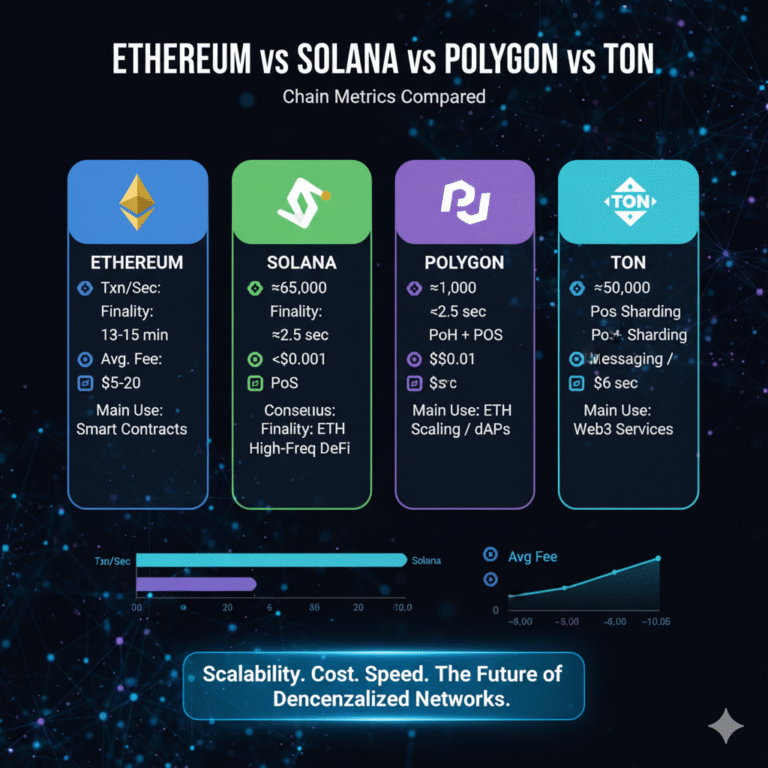
TVL is a top indicator of a chain’s economic activity. As of October 2025, Ethereum dominates with a TVL of approximately $81–83B, capturing the largest market share across all blockchains. This reflects its mature ecosystem, with billions in DeFi protocols like Aave and Uniswap. For a direct head-to-head look at DeFi dominance, read Ethereum vs Solana — Who Leads DeFi Today?

Solana follows with a strong TVL of around $12B, ranking among the top chains, driven by DEXs and high-volume apps.

Polygon, as an Ethereum scaler, has a TVL around $1.2–1.5B.

TON’s TVL shows a smaller, still-growing DeFi footprint in the low-hundreds of millions. TON experienced a spike above $600M in June 2024, but it has since retraced. Check current data at DefiLlama.

For beginners: Imagine TVL as money in a bank’s vault—the more there, the more services the bank (chain) can offer reliably.

Snapshot (approx., Oct 2025)

  • Ethereum: ~$81–83B — DeFi, NFTs, institutional use
  • Solana: ~$12B — DEXs, gaming, high-volume apps
  • Polygon: ~$1.2–1.5B — L2-style scaling for Ethereum
  • TON: Low-hundreds of millions — Telegram integration, mini-apps (peaked >$600M in 2024)

Transactions Per Second (TPS): Speed Showdown

Speed is crucial for real-world use. Ethereum’s base layer handles approximately 15 TPS, with dozens possible through optimizations; practical throughput scales via Layer 2 solutions. Learn how L2 solutions boost throughput and cut costs in Ethereum Layer-2 Solutions 2025.

Solana shines here with real-time throughput often hovering around 1,000 TPS. On September 5, 2025, it processed approximately 91M transactions in a day, averaging around 1,050 TPS for that day. Peaks above 4,700 TPS have been observed.

Polygon (PoS) sustains approximately 50–60 TPS today, with recent data showing around 4.7–4.9M transactions per day. While claims for higher “theoretical” TPS exist, observed peaks are much lower. View current stats at Polygon Blockchain Explorer.

TON is optimized for social-app bursts. Public, consistent “real TPS” figures vary by source. Marketing materials sometimes cite very high theoretical ceilings via sharding, but these are design-targets rather than steady real-world throughput. More information at TON docs.

If TPS is like cars on a road, Solana is a multi-lane freeway; Ethereum is a busy city street that uses side roads (L2s) to avoid jams.

Gas Fees: Cost Efficiency Breakdown

High fees can deter users, especially in developing regions.

Ethereum: Average L1 fees in 2025 are well below $1 much of the time, with recent averages often around $0.4–$0.9. The Dencun upgrade primarily slashed L2 costs by over 90%, while L1 fees are now frequently sub-$1. See detailed comparisons in Ethereum Layer-2 Solutions 2025: Complete Guide to Fees and Speed. Data available at YCharts and BitInfoCharts.

Solana: Fees are fractions of a cent. The base fee is 0.000005 SOL per signature, with small priority fees during congestion. Real-world estimates typically fall between approximately $0.0001 and a few tenths of a cent. Learn more at Solana.com and Helius.

Polygon (PoS): Typical fees are in the $0.0005–$0.01 range, with recent analytics placing the average around $0.002–$0.01 depending on demand. Check Token Terminal for updated data.

TON: Fees are low (small TON-denominated amounts). Reliable USD-denominated averages vary by payload and are not consistently published. More details at TON docs.

Beginner tip: Low fees mean you can experiment without losing much—like buying coffee versus a fancy dinner.

Active Users: Adoption and Engagement

User metrics show real-world traction. Daily active addresses (DAU) are more consistently tracked than MAU across chains:

  • Solana: Approximately 2.6M active addresses (24h) recently
  • Ethereum: Approximately 0.5M active addresses (24h) recently
  • Polygon (PoS): Approximately 0.6–0.7M active addresses (24h)
  • TON: Daily actives are commonly reported in the low-hundreds-of-thousands. One synthesis places DAU around 155k with approximately 1.7–1.8M MAU, though methodologies differ

Source: CoinLaw

For novices: High user counts mean a lively community, like a popular social app versus a quiet forum.

Decentralization: Security and Distribution

Decentralization prevents single-point failures.

Ethereum: Over 1M active validators (crossed this milestone in 2024 and still rising in 2025), plus thousands of nodes. Decentralization is reflected in validator count and client diversity.

Solana: Approximately 6,000+ nodes and 1,400 validators across approximately 49 countries, with a Nakamoto coefficient around 20 according to the Solana Foundation (2025).

Polygon (PoS): Approximately 100 validators for the PoS chain’s validator set size. Data available at YCharts.

TON: Public sources put active validators in the 300–350 range. Exact counts vary by cycle. Check CoinGecko for current data.

Simple analogy: More validators are like more guards at a vault—harder to breach.

Other Metrics: Fees, Revenue, and Ecosystem

Daily fees and revenue highlight profitability. Ethereum still generates the most fee revenue among these chains, though averages have fallen versus peak years. Recent sources place a typical 2025 average transaction fee around $0.4–$0.9, with variability by day. L2 fees fell much more post-Dencun. Data at YCharts.

Stablecoins: Ethereum holds the largest stablecoin float. Solana and Polygon have grown their shares, while TON’s stablecoin footprint is developing (for example, USDT expansion). Composition changes frequently, so check dashboards for current splits.

Market-Cap-to-TVL: With ETH’s market cap in the $450–550B area and TVL around $81–83B, the ratio is closer to approximately 6:1. Source: CoinLaw.

Conclusion: Which Chain Wins?

No single winner exists. Ethereum excels in TVL and security, Solana in speed and current DAU, Polygon in cost-effective Ethereum-aligned scaling, and TON in Telegram-native distribution and mobile UX.

For beginners, start where your use case lives: Polygon or Solana for low-cost experimentation; Ethereum when you need the deepest liquidity and composability; TON if your product distribution is Telegram-first. Why SOL and TON can’t replace Ethereum — read the full breakdown. As blockchain evolves in 2025, monitor these metrics via DefiLlama and CoinGecko—numbers move.

Key Resources:
How Gas Optimization is Revolutionizing DeFi Fees: A Beginner’s Guide

0

In the world of decentralized finance (DeFi), transaction costs can make or break user experience. High fees often deter newcomers and frustrate seasoned users alike. But what if there was a way to slash these costs without compromising security or functionality? Enter gas optimization—a technical strategy that’s transforming how DeFi operates on blockchains like Ethereum. This article explores how gas optimization works, its techniques, and its profound impact on DeFi fees. We’ll break it down in simple terms, using real examples, so even beginners can grasp it. By the end, you’ll understand why this innovation is key to making DeFi more accessible and efficient.

Whether you’re swapping tokens on Uniswap or lending assets on Aave, gas fees are the “toll” you pay for using the network. As DeFi grows, optimizing these fees isn’t just a nice-to-have—it’s essential for scalability and adoption. Poor UX and high costs remain key barriers, as explored in our DeFi UX analysis. Let’s dive in.

What Are Gas Fees and Why Do They Matter in DeFi?

Gas fees — the backbone of Ethereum’s transaction system — are covered in detail in our beginner’s guide to Ethereum gas fees. Think of them as the fuel needed to power your car’s engine—except here, the “car” is a smart contract execution on the blockchain. Every action, from sending ETH to interacting with DeFi protocols, requires computational resources. These are measured in “gas units,” and users pay for them in ETH.

Ethereum’s gas system prevents spam and ensures fair resource allocation. Since EIP-1559 (August 2021), total fee is effectively calculated as: (Base fee + Priority fee) × Gas units used; the base fee is burned and the priority fee (tip) goes to validators. This made fees more predictable than the old first-price auction, as detailed in Decentralized Thoughts research.

In DeFi, fees add up quickly. For instance, approving a token spend, swapping assets, and claiming rewards might involve multiple transactions, each incurring gas costs. High fees can eat into profits, especially for small trades. During the 2021 DeFi summer, average Ethereum transaction fees often exceeded $50, peaking around $70 on May 12, 2021.

This is where gas optimization comes in: by reducing the gas units needed per transaction, it directly lowers costs, making DeFi more inclusive.

Demystifying Gas Optimization: The Basics

Gas optimization is the process of writing and deploying smart contracts that use fewer gas units to perform the same tasks. It’s like streamlining a recipe to use fewer ingredients without changing the final dish.Developers achieve this by tweaking code in languages like Solidity — the foundation of smart contracts on Ethereum.

Why optimize? Unoptimized contracts waste gas on unnecessary operations, inflating fees. For DeFi apps, which handle billions in value, even small savings per user multiply across thousands of transactions. Optimization doesn’t change the blockchain’s base rules but makes interactions more efficient within them.

A key update influencing this is EIP-1559, implemented in 2021. It introduced a base fee (burned) plus a priority fee (tip) for faster inclusion—improving predictability, while actual cost still depends on gas units consumed.

Key Techniques for Gas Optimization

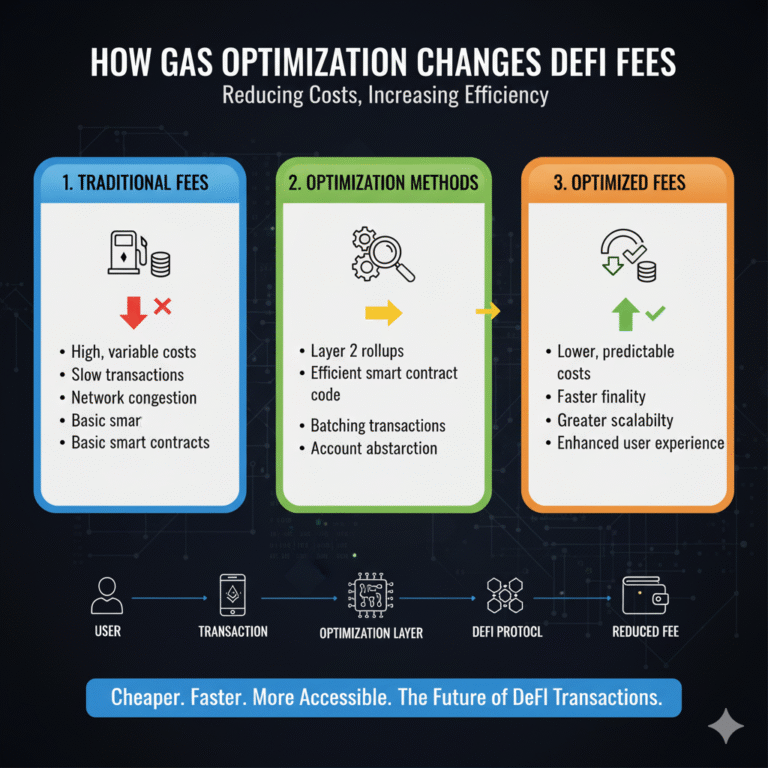
Developers use several proven strategies to cut gas consumption. Here’s a breakdown in simple steps:

Storage Optimization: On-chain storage is expensive—reading or writing data costs gas. Techniques include using smaller data types (e.g., uint8 where appropriate) and packing variables so multiple small values fit into one 32-byte storage slot, as outlined in the Solidity documentation.

Minimizing On-Chain Operations: Keep heavy computations off-chain and store less state when possible (emit events instead of storage for logs; use oracles or calldata-efficient designs). Post-Cancun/Dencun, rollups gained cheaper “blob” data, further favoring L2 off-chain batching, according to Polygon Technology research.

Loop and Function Efficiency: Loops can be gas hogs. Prefer mappings over arrays for direct lookups to avoid iteration and bounds checks where iteration isn’t required. Inline tiny functions when it materially reduces overhead, as recommended by RareSkills.

Error Handling: Custom errors (Solidity ≥0.8.4) are more gas-efficient than require with long strings, reducing both deploy and revert costs, per the Solidity Programming Language documentation.

Layer 2 Integration: While not pure code optimization, moving activity to Optimism, Arbitrum and other L2s that batch transactions and settle to Ethereum typically yields over 90% lower user fees—especially after the 2024 Dencun upgrade (EIP-4844), as analyzed by Polygon Technology. Some protocols also explore alternative ecosystems like BNB Chain, which we compared in detail here, to balance cost, scalability, and user access.

These methods can reduce gas usage materially depending on the contract—think of it as decluttering your home: less stuff means easier, cheaper maintenance.

How Gas Optimization Directly Impacts DeFi Fees

The magic happens when optimization scales to DeFi protocols. Lower gas per transaction means users pay less overall, encouraging more activity. This creates a virtuous cycle: more users lead to higher liquidity, better prices, and sustained growth.

Take yield farming: in unoptimized farms, staking and unstaking might cost 200,000 gas units each. Optimization could drop this to 100,000, halving fees at the same gas price. That said, fee markets allocate scarce blockspace; research shows demand for blockspace adjusts with cost, so network-wide fees don’t necessarily fall permanently just because individual contracts get cheaper.

High fees also deter small investors. Optimization lowers the entry barrier, boosting adoption in emerging markets where $5 fees are prohibitive.

Real-World Examples of Gas Optimization in DeFi

Let’s look at practical cases to illustrate the change.

Uniswap v3: v3’s concentrated liquidity massively improves capital efficiency versus v2; however, per-swap gas on v3 is often higher than on v2 (efficiency shows up in price impact/liquidity usage, not always in gas). So the earlier “up to 30% cheaper gas than v2” framing is inaccurate; v3 trades can cost more gas depending on the path/pools, as documented in ResearchGate studies.

Aave v3: Aave v3 introduced contract-level gas optimizations (roughly 20–25% in many functions per the technical paper) and added L2-specific calldata-optimized L2Pool to reduce user costs on rollups. That’s a structural optimization—not a blanket “gas refund” to users, according to GitHub documentation.

Route/Aggregator Optimizations: 1inch Router v5 and updates to its Pathfinder algorithm focus on reducing gas and failed trades through smarter routing; CoW Swap uses off-chain order-matching and batch auctions to avoid MEV and offer gasless approvals, cutting effective costs for many users, as reported by Levex.

Shibarium / “Delhi” Upgrade Context: The “Delhi” hardfork is a Polygon PoS upgrade that smoothed base-fee spikes. The Shiba Inu team later announced Shibarium adopts the Polygon-aligned “Delhi” changes to stabilize fees on its network. (It’s not an Ethereum L1 change.), per Yahoo Finance coverage.

Challenges and Limitations of Gas Optimization

No solution is perfect. Over-optimization can introduce bugs or reduce readability, making audits harder. And even with highly optimized code, macro factors (congestion, market cycles) still swing fees. As networks evolve—e.g., the 2024 Dencun upgrade that cut L2 data costs—optimizations must adapt to new fee dynamics, as discussed by Polygon Technology.

The Future of Gas Optimization in DeFi

Looking ahead, intents-based trading and smarter routing (as seen with CoW/1inch) and improved fee markets will automate more of the cost-savings. On the network side, proto-danksharding (EIP-4844) already dropped L2 fees significantly, and further roadmap steps aim to push costs even lower. Wallets such as MetaMask also guide users via EIP-1559 fee estimations (base + priority fee), improving UX without users hand-tuning gas, according to Polygon Technology research.

Conclusion: A More Affordable DeFi Ecosystem

Gas optimization is quietly revolutionizing DeFi by slashing fees and enhancing efficiency. From basic code tweaks (storage packing, mappings, custom errors) to L2 deployments and smarter order-routing, it’s making blockchain interactions cheaper and faster. For beginners, this means dipping into DeFi without fear of high costs; for experts, it amplifies profits.

As DeFi matures, expect optimization to become standard. If you’re new, start with L2 platforms and reputable protocols that actively optimize execution. And remember: always DYOR and use well-audited code and trusted aggregators.

DeFi isn’t just for whales—it’s for everyone. Lower fees will fuel the next wave of innovation.


Related Resources:

DeFi UX: Why Mass Adoption Is Still Stuck in 2025

1

Decentralized Finance (DeFi) promised to revolutionize banking by eliminating intermediaries and giving individuals direct control over their money. Despite impressive growth—with the market valued at approximately $51.2 billion in 2025 and projected to reach around $78.5 billion by 2030—mainstream adoption remains frustratingly elusive. The problem isn’t the technology itself. It’s the user experience.

While DeFi offers unique financial freedom, its complexity erects barriers that deter ordinary users. This article examines the real reasons DeFi hasn’t achieved mass adoption and what must change to bring decentralized finance to the mainstream.

The Complexity Crisis: Understanding DeFi’s Usability Problem

What Makes DeFi So Difficult to Use?

DeFi platforms force users to engage with technical concepts alien to most traditional banking experiences. Rather than logging in with a username and password, DeFi requires grasping concepts like blockchain networks, wallet setups, and fluctuating transaction fees.

The learning curve is steep. Newcomers must decode technical jargon, manage wallets, and assume knowledge many lack. The user experience often demands a level of technical literacy far above that required in conventional finance.

The Wallet Management Challenge

One of the biggest hurdles newcomers face is crypto wallet management. Traditional finance doesn’t demand memorizing a 12- or 24-word phrase that, if lost, means permanent loss of funds. In DeFi, you do.

Seed phrases are the master key to controlling your wallet. They’re typically 12 to 24 words drawn from a standardized list of 2,048 words defined in BIP39. If someone learns your phrase, they may steal your funds. Unlike a forgotten bank password, there is no “reset” or customer support line. Lose it, and the funds are likely gone forever.

Some newer wallet designs, smart wallets, and account-abstraction schemes (such as passkey-based recovery, social recovery, and biometrics) are beginning to remove the need for users to manage seed phrases directly. But these solutions are not yet ubiquitous across the DeFi landscape.

The Gas Fee Barrier: When Transactions Cost More Than Expected

Understanding Gas Fees

Gas fees are the costs paid to blockchain validators to process and secure transactions. Every action on Ethereum, such as swapping tokens or interacting with protocols, consumes gas, which is measured in Gwei. The price of gas fluctuates with network demand, transaction complexity, and priority choices.

The Unpredictability Problem

The biggest gripe about gas fees is how volatile they are. In 2025, average Ethereum transaction fees have often hovered around $0.40, thanks to upgrades like EIP-1559. But during network congestion—major token launches or NFT drops—gas prices have previously spiked into the tens or even $80+ range for complex transactions.

For someone trying to swap $50 in tokens, paying a $15–$20 gas fee can render the transaction nonsensical. That unpredictability erodes trust and usability. While Layer-2 scaling solutions like Arbitrum, Optimism, and Base can offer fees often below $0.01, users still must monitor gas and choose the right layer.

The Multi-Chain Gas Problem

Interacting with multiple blockchains adds another layer of friction. Each chain uses its own native token (ETH, MATIC, BNB, etc.) for gas. Users must maintain small balances across networks just to facilitate transactions. Some projects are experimenting with gas abstraction, allowing fees to be paid in stablecoins or alternate tokens, but adoption remains spotty.

Security Fears: The Human Cost of DeFi Vulnerabilities

The Scale of the Problem

Security remains one of DeFi’s greatest challenges. In the first half of 2025 alone, more than $2.17 billion was lost to exploits and hacks. These are not hypothetical losses—real people and protocols lost real funds.

The Shift from Technical to Human Vulnerabilities

While early DeFi security concerns focused on bugs in smart contracts, today the weakest link is often human error. In 2024, the largest share of losses came from compromised keys or user accounts. Even a perfectly audited protocol can’t save you if a user clicks the wrong link or shares a private key.

Common Security Vulnerabilities

Smart contract exploits persist, especially via improper validation or unchecked inputs (estimated in some industry reports to account for approximately 34% of contract-level exploits). Resources like Consensys Diligence and OpenZeppelin provide crucial security auditing services.

Flash-loan attacks and price oracle manipulations remain frequent vectors, though precise percentages vary by year. These attacks exploit the composability of DeFi protocols to manipulate prices and drain funds within a single transaction.

Key theft and infrastructure compromises are sadly routine, with large-scale incidents occurring often. The burden falls entirely on users to secure their private keys and seed phrases.

Why Security Concerns Prevent Adoption

Mass-market users expect safety nets like dispute resolution or fraud protection. In traditional finance, stolen funds can sometimes be recovered through FDIC insurance or bank fraud protection. In DeFi, they are typically lost forever. The burden of security lies entirely on the user. Many DeFi protocols still don’t default to best practices like multisignature or cold storage, making the risk even greater.

The Cross-Chain Complexity Problem

Bridging Assets Between Blockchains

To access DeFi across ecosystems—Ethereum, Solana, Polygon, Avalanche, and others—users must use bridging protocols to move assets. Each bridge comes with its own UI, trust assumptions, costs, and risks, multiplying complexity.

Security Risks of Bridges

Bridges have historically been prime targets. The Wormhole hack in February 2022 famously resulted in $320–$326 million in losses. Such events highlight how “connecting networks” is often the weakest point in a multi-chain architecture. Bridge security remains a critical concern for cross-chain DeFi operations.

The Missing Safety Nets

No Customer Support

Unlike banks or payment apps, DeFi offers no one to call when things go wrong. Send to the wrong address? That’s it. Transaction fails? You still pay gas. There’s no traditional recourse or rollback.

This lack of customer support creates a hostile environment for newcomers who are accustomed to the protections of traditional financial institutions.

Regulatory Uncertainty

Legal frameworks for DeFi remain unclear in most jurisdictions. While MiCA (Markets in Crypto-Assets) in the EU is a meaningful step, it doesn’t fully address how truly decentralized protocols are governed or who can be held responsible. For risk-averse users and institutions, this ambiguity is a strong deterrent.

What’s Being Done to Improve DeFi UX

Simplified Interfaces

Developers are hiding complexity behind cleaner interfaces. Uniswap and others are offering simpler modes (such as “one-click swaps”) and layered UX that progressively reveals advanced controls only when needed.

AI-Powered Assistance

Some platforms are integrating AI agents to guide users through transactions, optimize gas timing, or evaluate risks in plain language. The approach is ambitious, and it’s still early days for widespread implementation.

Mobile-First Development

Given that many users access the internet first via smartphones, DeFi apps are prioritizing mobile-friendly design, responsive layouts, and smoother in-app wallets to meet users where they are.

Account Abstraction

With ERC-4337 and similar paradigms, wallets become smart accounts. Users can recover via passkeys or social recovery mechanisms, and pay gas fees in tokens like USDC via paymasters. This greatly reduces dependence on traditional seed phrases and native gas tokens.

Layer 2 Solutions

L2 networks like Arbitrum, Optimism, and Base now handle millions of daily transactions and often deliver ultra-low fees (less than $0.01). They relieve congestion from Ethereum’s mainnet while preserving core security guarantees through various rollup technologies.

The Path Forward: What Needs to Happen

Education and Onboarding

DeFi platforms need to assume users know nothing. Interactive tutorials, sandbox modes with testnet tokens, and “first transaction safety nets” can lower fear and error rates. Educational resources must be built directly into the user experience.

Security Standards

Baseline standards must become universal: mandatory audits from reputable firms, default multisignature and cold storage practices for protocol treasuries, robust bug bounty programs through platforms like Immunefi, and rapid incident response protocols.

Insurance Mechanisms

Protocols for insuring smart contract or exploit risk are emerging through platforms like Nexus Mutual and others. As they mature, these “safety nets” can boost trust for cautious users who need protection similar to traditional financial products.

Regulatory Clarity

Regulators need balanced, clear frameworks—protection for users without stifling innovation or decentralization. The lines around truly decentralized protocols must be defined with nuance, distinguishing between centralized platforms and genuinely decentralized autonomous organizations.

Improved Cross-Chain Infrastructure

Bridges and interoperability solutions must feel seamless, not like a technical chore. Users should move value across networks as naturally as switching apps, without extra complexity or trust risk. Cross-chain messaging protocols and unified liquidity solutions are key to this future.

Conclusion: The Promise and the Challenge

DeFi offers powerful benefits: financial inclusion, transparency, censorship resistance, and potentially better yield opportunities. The core technology is viable; use cases are compelling. But the user experience—driven by seed phrase friction, gas ambiguity, security anxiety, cross-chain complexity, and lack of safety nets—remains a blocker for mass adoption.

The gap between vision and reality comes down to design. Those DeFi protocols that succeed won’t just be technically elegant—they’ll feel as simple, intuitive, and trustworthy as the best banking apps, without giving up decentralization. Until then, DeFi remains an exciting frontier for enthusiasts, not a safe harbor for average users.

The path to mainstream adoption requires bridging the gap between technical sophistication and user-friendly design. Only when DeFi becomes as accessible as traditional finance—while maintaining its core values of decentralization and self-sovereignty—will it achieve the mass adoption its creators envisioned.

Read also: Tokenization of Real-World Assets.

DAO Treasury Management in 2025: A Comprehensive Guide for Beginners

1

As decentralized autonomous organizations continue to reshape digital collaboration, effective treasury management has emerged as a critical factor for their long-term success. With over 13,000 DAOs collectively managing around $20–21.5 billion in assets, understanding how these organizations handle their finances is essential for anyone interested in decentralized governance.

What Is DAO Treasury Management?

DAO treasury management refers to the strategic oversight and allocation of a decentralized autonomous organization’s financial resources. Unlike traditional companies where a board of directors controls the budget, DAOs manage their funds through community-driven decision-making powered by blockchain technology and smart contracts.

The treasury serves as the financial backbone of a DAO, providing resources for operational expenses, project development, contributor payments, and strategic investments. Every financial decision typically requires approval from token holders who vote on proposals, ensuring transparency and collective ownership.

Why Treasury Management Matters

Effective treasury management directly impacts a DAO’s ability to survive and thrive. Well-managed treasuries sustain operations by covering expenses like developer salaries and infrastructure costs, fuel innovation through project funding and research initiatives, and enable organizations to seize emerging opportunities by maintaining readily available resources.

Conversely, poor financial stewardship can lead to devastating consequences. Financial strain from depleted funds can cripple a DAO’s functionality, while poorly planned investments that result in losses erode member trust and damage the organization’s reputation. Perhaps most critically, inadequate security protocols expose treasuries to hacks and exploits that could drain resources entirely.

Core Components of DAO Treasury Management

Multi-Signature Wallets: The Foundation of Security

Multi-signature wallets have become the standard security measure for DAOs, requiring multiple approvals before any transaction can be executed. Even if one keyholder acts maliciously or becomes unavailable, the community treasury remains protected.

Safe (formerly Gnosis Safe) has emerged as one of the most widely used multi-signature smart-account solutions for Ethereum and EVM-compatible chains. Typical configurations like 3-of-5 or 4-of-7 are common in practice and have been proven effective through years of audits and use by top DAOs.

Multi-signature setups reduce single points of failure by requiring multiple participants to approve transactions — meaning even if one private key is compromised, attackers cannot move funds without additional approvals.

Diversification Strategies: Reducing Risk

A frequent oversight across DAOs is over-concentration in their native governance tokens. Empirical research shows that, on average, around 67% of DAO treasury assets are held in their governance tokens — exposing them to severe volatility risk.

To mitigate this, many DAOs in 2025 are adopting explicit diversification mandates, often formalized via Investment Policy Statements (IPS). A practical heuristic used by some DAOs: maintain 12–24 months of operating expenses in stablecoins or low-volatility assets, while allocating smaller percentages to BTC/ETH or yield-bearing DeFi positions.

Stablecoins play a crucial role by minimizing exposure to market fluctuations and providing predictable liquidity for day-to-day operations. Tools like DeepDAO, DeFiLlama, and karpatkey dashboards help track and analyze treasury diversification in real time.

Generating Yield: Making Treasuries Work Harder

Smart DAOs don’t just store their assets — they deploy them using risk-aware on-chain strategies. Common approaches include allocating stablecoins to lending protocols such as Aave, Compound, Morpho, and Euler v2, which relaunched in 2024 after a major security upgrade.

A benchmark example comes from the Ethereum Foundation’s Treasury Policy, published in June 2025. It establishes a 2.5-year operational expense buffer in low-risk, liquid assets while deploying part of its holdings through conservative DeFi strategies — including yield farming and tokenized real-world assets. In October 2025, the Ethereum Foundation also allocated funds into Morpho as part of its renewed on-chain strategy.

Governance and Decision-Making

The decentralized nature of DAOs creates unique challenges for treasury management. Token-based governance structures determine how decisions are made, with voting power distributed among participants. Some DAOs introduce staking or lockups to align long-term incentives.

Transparency remains paramount: most leading DAOs now publish on-chain analytics dashboards showing treasury balances, inflows, and outflows in real time.

Best Practices for 2025

Maintain Adequate Reserves

A resilient standard in 2025 is to hold at least 1–2 years of operating expenses in non-speculative assets. The Ethereum Foundation’s own policy sets a 2.5-year buffer as a model for sustainable treasury management.

Implement Risk Management

Sound risk management involves identifying and mitigating financial, operational, and liquidity risks. DAOs increasingly adopt Investment Policy Statements (IPS) and quarterly reporting to ensure oversight and stability.

Use Professional Tools

The DAO tooling landscape has expanded rapidly. Popular platforms include:

  • Yearn Finance for yield optimization
  • Hedgey for token vesting and diversification
  • Balancer for liquidity and treasury structuring
  • Llama and karpatkey for analytics and strategic asset allocation

Plan Strategically

A simple strategic goal for DAOs is to secure stable, multi-year funding before engaging in riskier yield-generating activities. This approach ensures operational continuity while maintaining decentralized governance integrity.

Real-World Applications

DAO treasuries now fund innovation across multiple industries:

Finance: Decentralized investment funds governed by token holders enable community-driven capital allocation without traditional intermediaries.

Healthcare: Collaborative research DAOs fund medical innovation by pooling resources from global contributors interested in advancing specific treatments or research areas.

Supply Chains: DAOs improve transparency in logistics and payments by creating shared governance frameworks for supply chain participants.

The Road Ahead

As of Q3 2025, DeFi’s Total Value Locked (TVL) rebounded to around $160–170 billion, marking a new multi-year high according to DeFiLlama. The stablecoin market continues to grow, highlighting confidence in on-chain liquidity instruments for treasury management.

Meanwhile, traditional finance is taking notice. In mid-2025, Visa expanded its stablecoin settlement program (including USDG, PYUSD, and EURC) via Visa Direct, enabling programmable treasury flows. J.P. Morgan’s Kinexys unit launched a deposit token (“JPMD”) pilot on Base, designed for institutional on-chain settlements. Both developments underscore a merging of traditional finance and DAO treasury infrastructure.

Conclusion

DAO treasury management in 2025 represents a sophisticated blend of security, diversification, and strategic foresight. By implementing multi-signature wallets, risk-diversified holdings, sustainable yield strategies, and transparent governance, DAOs can build resilient financial ecosystems that support long-term innovation.

While challenges remain — from coordination hurdles to market volatility — the frameworks and policies emerging in 2025 provide DAOs with the structure to thrive. Organizations that embrace sound treasury management will be best positioned to achieve their missions and strengthen the broader decentralized economy.


Sources & References

  1. DeepDAO – Discovery Engine for DAO Ecosystem
  2. An Evaluation of Native Governance Token Reporting Practices, JBBA Journal
  3. Cointelegraph – DAO Treasuries Top $25 Billion
  4. Safe (formerly Gnosis Safe)
  5. DeepDAO Asset Composition Report
  6. Balancer x karpatkey: Treasury Management Framework
  7. Euler v2 Relaunch Report
  8. Ethereum Foundation Treasury Policy, June 4, 2025
  9. Coindesk: Ethereum Foundation Allocates Funds into Morpho
  10. DeepDAO Transparency Dashboards
  11. Llama DAO Tooling
  12. Arbitrum DAO Treasury Diversification Proposal 2025
  13. DeFiLlama TVL Tracker, Q3 2025
  14. Visa Expands Stablecoin Settlement to USDG, PYUSD, and EURC, July 2025
  15. J.P. Morgan Launches JPMD Deposit Token Pilot on Base, September 2025

Read also: Ethereum Gaming.

Read also: Ethereum in Business.

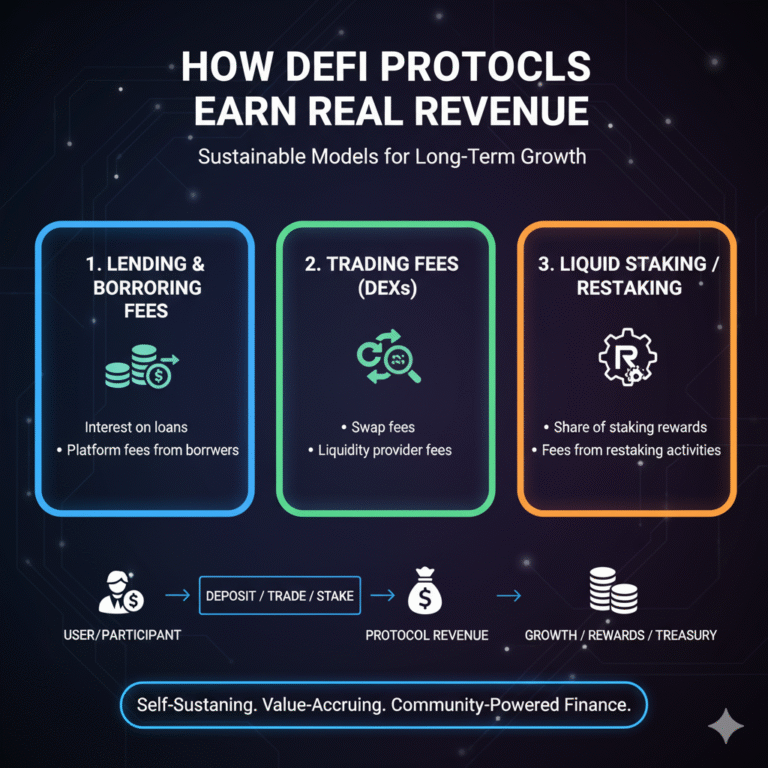
How DeFi Protocols Earn Real Revenue: A Comprehensive Guide for Beginners

1

In the world of cryptocurrency and blockchain, Decentralized Finance (DeFi) has emerged as a revolutionary way to handle money without traditional banks or intermediaries. DeFi protocols are essentially software programs built on blockchains like Ethereum that offer services such as lending, borrowing, trading, and earning interest on digital assets. But how do these protocols stay operational and grow? The answer lies in their ability to generate real revenue—actual income from user activities, not just speculative token values.

This comprehensive guide explores how DeFi protocols earn real revenue in simple terms, using verified facts from reliable sources. We’ll break it down step by step, with examples to make it easy for beginners to understand. Whether you’re new to crypto or curious about blockchain economics, you’ll learn the key mechanisms behind DeFi’s financial sustainability. You’ll discover why revenue matters for these protocols to thrive in a competitive market.

What is DeFi and Why Does Revenue Matter?

Understanding Decentralized Finance

DeFi stands for Decentralized Finance. It’s a system that uses smart contracts—self-executing code on the blockchain—to provide financial services openly and transparently. Unlike traditional finance, where banks profit from fees and interest, DeFi protocols are often community-governed. They aim to distribute value back to users.

However, to survive and innovate, they need revenue. This covers operational costs like development, security audits, and network fees.

Why Revenue is Critical for Protocol Success

Revenue in DeFi ensures long-term viability and sustainability. Without consistent income streams, protocols can’t fund improvements. They can’t incentivize participants or maintain competitive advantages. This leads to stagnation or failure.

Sustainable income allows protocols to attract more users. They can offer better yields or features. This creates a positive cycle of growth and adoption.

Tracking DeFi Revenue Performance

For tracking and analyzing protocol performance, specialized platforms provide invaluable data. DeFiLlama and Token Terminal offer real-time metrics on fees and revenue.

As a concrete example, MakerDAO’s annualized revenue reached approximately $165.4 million in August 2023. This occurred during a favorable rate-hike environment. However, this represents a point-in-time, annualized run-rate rather than a guaranteed full-year total.

The DeFi Revenue Philosophy

Think of DeFi protocols as online marketplaces. Users pay small fees for convenience. Those fees fund platform operations and development.

This model makes DeFi inclusive. Anyone with an internet connection can participate. Revenue isn’t just about profits. It’s about building trust, ensuring security, and maintaining efficiency in a decentralized ecosystem.

Common Revenue Models in DeFi

DeFi protocols earn revenue through various user-paid fees and strategic mechanisms. These are considered “real” revenue because they’re based on actual usage and economic activity. They don’t rely on token inflation or speculative hype. Let’s explore the main revenue models with straightforward examples for beginners.

Transaction and Trading Fees

How DEX Trading Fees Work

One of the most straightforward ways DeFi protocols generate revenue is by charging fees on trades or token swaps. Decentralized Exchanges (DEXs) like Uniswap allow users to swap one cryptocurrency for another. No central authority or intermediary is required.

Every time a user executes a trade, a small percentage fee is deducted from the transaction.

A Simple Example for Beginners

Imagine swapping $100 worth of ETH for USDC on a DEX. If the trading fee is 0.3%, you pay $0.30 for that transaction. Part of this typically goes to liquidity providers. These are people who deposit funds into pools to enable trades. Portions may flow to the protocol’s treasury for development and operations.

Uniswap’s Fee Structure

Uniswap v3 supports multiple fee tiers. Common options include 0.05%, 0.30%, and 1%. This allows liquidity providers to choose appropriate fee structures. The choice depends on expected volatility and trading volume.

However, by default, the protocol fee switch that would divert a portion to the DAO treasury is generally not active. Fees typically go entirely to liquidity providers. Governance has debated activating a “fee switch” for protocol-level revenue. But it isn’t broadly enabled at the time of writing.

Comparing Different DEX Fee Models

Other popular DEXs have different fee structures. PancakeSwap typically charges around 0.25% per swap on its v3 implementation. It offers dynamic tiers ranging from approximately 0.17% to 0.25%. These are split between liquidity providers and the platform according to each pool’s configuration.

Trader Joe, another prominent DEX, retained approximately 15% of trading fees in 2023. Roughly 85% went to liquidity providers. This demonstrates how protocols can capture a slice as “protocol-side” revenue. This funds operations and development.

Lending and Borrowing Fees

How Lending Protocols Generate Revenue

Lending protocols represent another major revenue stream in DeFi. They allow users to deposit cryptocurrency assets to earn interest. Meanwhile, others borrow those same assets. Revenue is generated through the interest rate spread and designated protocol fees.

The Simple Mechanics of Lending Revenue

Here’s how it works simply. Lenders deposit assets like DAI or USDC into lending pools. They earn interest paid by borrowers. Most lending protocols route a configurable share of borrower interest to the protocol treasury.

This happens via a “reserve factor”—a percentage set per asset that captures value for the protocol. On platforms like Aave, reserve factors often range from 10% to 25%. This depends on the specific asset and market conditions. These parameters are adjusted by governance.

Compound’s Dynamic Approach

Compound, another leading lending platform, similarly uses per-market reserve factors. There’s no flat percentage across all markets. Borrowers pay interest rates based on real-time supply and demand dynamics. This ensures market-driven pricing that adjusts to utilization levels.

MakerDAO’s Unique Revenue Model

MakerDAO operates with a slightly different model. It earns revenue through “stability fees” charged on DAI debt positions. Its annualized protocol revenue peaked near $165.4 million in August 2023.

Additionally, Maker’s real-world asset (RWA) strategy involves investing in U.S. Treasury bills. This has typically yielded approximately 4-5% returns. The protocol also briefly set its DAI Savings Rate (DSR) to 8% in 2023 as a promotional rate. This was separate from Treasury yields.

Flash Loan Fees

Understanding Flash Loans

Flash loans represent a unique and innovative DeFi feature. Users can borrow substantial amounts without providing collateral. However, they must repay the entire loan plus fees within the same blockchain transaction. Protocols charge fees for providing this instant liquidity access.

How Flash Loans Work in Practice

In simple terms, a sophisticated trader might borrow $1 million worth of ETH. They use it for a quick arbitrage opportunity across different exchanges. Then they repay the loan immediately—all within seconds. They pay a small fee for the privilege.

On Aave v3, the flash loan premium is initialized at 0.05%. It can be adjusted by governance. Earlier configurations on some markets referenced 0.09% fees. If the borrower cannot repay within the same transaction, the entire transaction reverts. This protects the protocol from default risk.

This mechanism generates revenue from sophisticated market participants and arbitrageurs. It maintains zero default risk—a truly innovative financial primitive unique to blockchain technology.

Liquidation and Penalty Fees

How Liquidation Fees Work

When borrowers fail to maintain required collateral levels, their positions are liquidated. For example, if the price of ETH drops significantly, collateral is sold off to repay the outstanding loan. Protocols charge penalty fees on these liquidation events. This creates another revenue stream.

A Beginner’s Guide to Liquidations

If you borrow assets against collateral and its value falls below a safety threshold, the protocol acts automatically. It auctions off your collateral to repay lenders. The protocol takes a fee called a “liquidation incentive” in the process.

In Compound v2 and v3, liquidation incentives typically range from approximately 5% to 8%. This depends on the specific asset and market configuration. A portion of these fees may flow to protocol reserves or the treasury. This depends on the mechanism design.

These liquidation processes protect lenders while generating protocol revenue. They also incentivize third-party liquidators to maintain system solvency.

Performance and Management Fees in Yield Aggregators

How Yield Aggregators Earn

Yield aggregators optimize returns by automatically moving user assets across different DeFi protocols. They capture the best available yields. These platforms charge fees on the profits they generate for users.

Understanding Vault Fees

Simply put, you deposit funds into an automated “vault.” The protocol implements sophisticated strategies—such as lending across multiple platforms or yield farming—to maximize returns. The protocol takes a percentage cut of profits generated.

Yearn Finance’s classic fee structure includes approximately 20% performance fees taken from profits. It also charges 2% annual management fees. However, these rates can vary by specific vault and governance decisions over time.

This model aligns incentives. The protocol only earns substantial fees when it successfully generates profits for depositors. This encourages continuous optimization of strategies.

Staking and Liquidity Provider Fees

Liquid Staking Revenue Models

Liquid staking protocols like Lido allow users to stake ETH for network validation. At the same time, they maintain liquidity through tokenized representations like stETH (staked ETH). Revenue comes from taking a percentage cut of the staking rewards earned by validators.

Lido’s Fee Structure

Lido retains a 10% fee on ETH staking rewards. This is split between node operators who run the validators and the Lido DAO treasury. Lido’s market share of total staked ETH has fluctuated significantly. It reached over 30% at points during 2023-2024. But it sat closer to approximately 24% in September 2025.

Market share and total value locked figures are time-sensitive. They fluctuate with ETH price movements and overall staking adoption.

This model has proven highly successful. It generates substantial protocol revenue while providing users with liquid, composable staking tokens. These can be used throughout DeFi.

Other Models: Insurance, Partnerships, and Ecosystem Incentives

Diversifying Revenue Streams

Beyond the core revenue models, some protocols explore additional income streams. Insurance protocols like Nexus Mutual charge premiums to users seeking protection. This covers smart contract hacks or protocol failures, similar to traditional insurance models.

Strategic Partnerships and Grants

Strategic partnerships and ecosystem grants can also boost protocol activity. They indirectly increase fee generation. For instance, GMX received substantial ARB incentive grants from the Arbitrum DAO. This included 12 million ARB in the 2023 STIP program, with additional tranches in 2024.

While such grants represent ecosystem incentives rather than operating revenue, they can significantly boost trading activity. This increases the resulting fee generation.

These diverse revenue models demonstrate the creativity and innovation occurring in DeFi. Protocols experiment with sustainable business models.

Real-World Examples of DeFi Protocols Earning Revenue

Let’s examine specific leading protocols to see these revenue models in action. We’ll understand their real-world implementation.

Uniswap: The Leading DEX Model

Uniswap primarily earns fees paid by traders executing swaps. These currently accrue almost entirely to liquidity providers. Protocol-level fee sharing to the DAO or UNI token holders is under active governance discussion. However, it’s generally not enabled system-wide.

Consequently, there is no standing protocol-funded UNI buyback program at present. Uniswap operates across numerous blockchain networks. V4 deployments span approximately a dozen networks. Its total value locked has hovered in the multi-billion dollar range throughout 2025.

The UNI-denominated treasury, tracked by platforms like DeepDAO, typically shows holdings in the low single-digit billions. These are mostly in UNI tokens. They fluctuate with token price movements.

Aave: Multi-Stream Lending Revenue

Aave combines multiple revenue streams. These include interest rate spreads captured through reserve factors, flash loan fees, and liquidation-related flows. The exact reserve factor varies significantly by asset and market. It’s governed through on-chain governance proposals.

These reserve factors represent material revenue, often double-digit percentages. They’re adjusted by governance based on market conditions and protocol needs.

Lido: Liquid Staking Dominance

Lido captures 10% of all staking rewards. This is split between node operators who maintain validators and the Lido DAO treasury. Its market share of total staked ETH recently stood at approximately 24%. This is down from peaks exceeding 30% in earlier periods.

Revenue scales directly with the total amount of ETH staked through Lido. It also depends on the underlying network staking reward rates.

GMX: Real Yield Pioneer

GMX operates a “real yield” model. It distributes approximately 30% of trading fees to GMX token stakers. Roughly 70% goes to liquidity providers (GLP holders) in its v1 implementation. Exact fee splits and v2 mechanics can differ over time based on governance decisions.

The protocol is widely cited as demonstrating genuine “real yield.” Distributions come directly from actual trading fees collected, not from token inflation or emissions.

MakerDAO: Stability Fee Innovation

MakerDAO generates revenue through multiple channels. These include stability fees charged on DAI debt positions, liquidation penalties, and income from real-world assets. The protocol particularly invests in U.S. Treasury bills.

Annualized revenue reached approximately $165.4 million in August 2023. This occurred during favorable interest rate conditions. The protocol’s Treasury bill investment strategy has typically targeted yields around 4-5%. This is separate from the temporary 8% DAI Savings Rate promotional period in 2023.

Tracking Protocol Performance

These real-world examples demonstrate how diverse revenue models adapt to different service offerings. Protocols calculate earnings as gross revenue minus user incentives and operational costs.

For current data on protocol revenues and fees, refer to Token Terminal and DeFiLlama. They provide comprehensive, regularly updated metrics.

Challenges in Generating Real Revenue

Competitive Pressure on Fees

Despite notable successes, DeFi protocols face significant hurdles in generating and maintaining sustainable revenue streams. Intense competition among protocols often compresses fee margins. Users naturally gravitate toward platforms offering the lowest costs.

This creates a challenging environment. Protocols must balance competitive pricing with revenue needs.

Regulatory Uncertainties

Regulatory uncertainties present another substantial challenge. As governments worldwide develop frameworks for digital assets, protocols must adapt to evolving compliance requirements. They must maintain their decentralized nature.

This tension can impact operational costs and business models.

Security Risks and Trust

Security vulnerabilities and hacks can severely erode user trust and protocol value. Even with extensive audits, smart contract risks remain. Major exploits can devastate both user confidence and treasury reserves built from fee revenue.

Balancing Incentives and Sustainability

Protocols must also carefully balance user rewards with treasury needs. Over-incentivizing users with token emissions can dilute token value. It creates unsustainable “mercenary capital” that leaves when rewards decrease.

Finding the right equilibrium between growth incentives and protocol profitability remains an ongoing challenge.

Evolving Valuation Models

Valuation models for DeFi protocols also remain actively debated within the industry. While traditional finance focuses on revenue and earnings multiples, DeFi has historically emphasized metrics like Total Value Locked (TVL).

The shift toward revenue-based valuation represents a maturation of the space. However, it creates uncertainty during the transition period.

The Future of DeFi Revenue Models

Real-World Asset Tokenization

Looking ahead to 2025 and beyond, several innovations show promise for enhancing DeFi revenue streams. The tokenization of real-world assets could substantially boost protocol revenue. This includes U.S. Treasury bills, private credit, real estate, and other traditional financial instruments.

It attracts institutional capital and traditional finance participants seeking blockchain-based exposure.

Next-Generation Yield Engines

Emerging protocols like Ethena and Pendle are pioneering new yield generation mechanisms. These are designed to provide stable, attractive returns through innovative financial engineering. These “yield engines” represent the next evolution in DeFi revenue models.

They potentially create more sustainable and predictable income streams.

Traditional Finance Integration

Integration between DeFi and traditional finance continues accelerating. Major financial institutions are exploring blockchain-based settlement, tokenized securities, and DeFi infrastructure. This convergence could dramatically expand the addressable market.

It creates new revenue opportunities for leading protocols.

Data-Driven Protocol Analysis

Rather than relying on aggregate market-size projections, the industry increasingly tracks protocol-level fees and revenue. These projections often vary inconsistently across sources and lack reliable methodology.

Token Terminal and DeFiLlama provide the most comprehensive, standardized metrics. They enable accurate comparison of protocol economics and revenue generation.

Conclusion: Understanding DeFi Revenue for Smarter Participation

Key Takeaways

DeFi protocols earn real revenue through user fees collected on trades, loans, staking services, and numerous other financial activities. This revenue ensures protocols can continuously innovate, enhance security, and reward their communities for participation.

From Uniswap’s trading fees to Lido’s staking fee splits, these diverse business models make blockchain-based finance increasingly accessible. They’re potentially profitable for participants worldwide.

Getting Started Safely

For beginners exploring DeFi, start by investigating low-fee, battle-tested protocols. Look for proven track records and extensive security audits. Always verify current parameters—including fee structures, reserve factors, yields, and governance decisions.

These change regularly through community governance processes.

Essential Resources for Research

Dashboards like DeFiLlama and Token Terminal help you compare protocols accurately. Make informed decisions based on real data rather than marketing claims.

As the DeFi ecosystem matures, revenue-generating protocols with sustainable business models will likely emerge as long-term leaders. They’ll drive the decentralized finance revolution.

Key Resources for Further Research

By understanding how DeFi protocols generate revenue, you can better evaluate projects. You can assess sustainability and make more informed decisions. This helps you allocate your capital wisely in the decentralized finance ecosystem.

The Future of DeFi Insurance: Spotlight on InsurAce and Nexus Mutual

0

In the fast-paced world of decentralized finance (DeFi), where billions of dollars flow through smart contracts and blockchain networks, risks like hacks, exploits, and market failures are ever-present. DeFi insurance has emerged as a critical tool to protect users’ assets, offering coverage against these threats without relying on traditional insurance companies. This article explores the future of DeFi insurance, with a focus on two leading protocols: InsurAce and Nexus Mutual. We’ll break down their current offerings, key achievements, and how broader market trends are shaping the sector. Whether you’re a beginner dipping your toes into crypto or an experienced investor, understanding DeFi insurance can help safeguard your portfolio in this volatile space.

How DeFi Insurance Protects Your Digital Assets

DeFi insurance works by pooling funds from users to create mutual protection funds. Instead of a central authority deciding claims, blockchain technology ensures transparency and automation. As of 2025, DeFi’s total value locked (TVL) hovers around the $150–170 billion range, with platforms like DefiLlama tracking global TVL at approximately $157 billion in October 2025.

Market-sizing reports project strong growth for decentralized insurance: from roughly $3.5 billion in 2025 to approximately $16.94 billion by 2029, representing a compound annual growth rate (CAGR) of about 48.4% according to The Business Research Company. This explosive growth reflects the increasing recognition that DeFi participants need robust protection mechanisms.

On the security front, reputable trackers estimate crypto losses in 2024 at around $2.2 billion, underscoring the critical need for insurance solutions in this space.

Understanding DeFi Insurance Basics

DeFi insurance protocols allow users to buy “covers” – essentially policies – that pay out if specific risks materialize, such as a smart contract hack or a stablecoin losing its peg to the dollar. These covers are funded by premiums paid into shared pools, where liquidity providers earn yields in return for backing the risks. Unlike traditional insurance, everything happens on-chain, meaning transactions are verifiable and claims can be processed quickly without intermediaries.

For beginners, think of it like car insurance: You pay a small fee upfront to protect against big losses. Premium rates vary widely depending on the specific risk profile and provider. Platforms like InsurAce and Nexus Mutual have established track records of paying out claims, building trust in the system.

According to Nexus Mutual’s documentation, the protocol has paid out more than $18 million in claims to date and issued over 10,000 covers, with more than $5.8–6 billion of assets historically protected.

Key Benefits of DeFi Insurance

Transparency: All data, from pool balances to claims history, is public on the blockchain, allowing anyone to verify the protocol’s financial health and claims performance.

Accessibility: Anyone with a crypto wallet can buy coverage, often across multiple chains like Ethereum and BNB Chain, as noted by platforms like Alchemy.

Efficiency: Smart contracts and standardized processes can accelerate payouts compared to traditional insurers, eliminating weeks or months of paperwork and bureaucracy.

However, challenges remain, such as relatively low adoption rates compared to the broader DeFi ecosystem and the need for better user interfaces that make these products more intuitive for newcomers. Despite these hurdles, trends like real-world asset (RWA) tokenization and institutional involvement point to a brighter future for the sector.

Nexus Mutual: Pioneering Mutual Protection in DeFi

Nexus Mutual stands out as one of the earliest and most trusted DeFi insurance providers, launched in 2019. It operates as a decentralized mutual fund where members pool capital to cover risks, governed by holders of its NXM token. The protocol focuses on protecting against smart contract failures, exchange and custody events, governance attacks, and more.

By 2025, Nexus Mutual reports more than 10,000 covers issued and over $5.8 billion in assets protected, according to research published in ScienceDirect.

Current Products and Coverage Options

Nexus Mutual offers several product lines designed to meet diverse risk protection needs:

Fund Portfolio Cover and institutional or bespoke solutions for complex operations, catering to larger players in the DeFi space.

Custody, Exchange, and Halted-Withdrawal Coverage, which proved particularly valuable during incidents like the FTX collapse, where users who had purchased coverage were able to file claims.

Payment Methods and Process

Users can purchase covers using ETH or supported ERC-20 tokens such as USDC. Covers become active after payment and policy issuance, as detailed in Nexus Mutual’s documentation. It’s worth noting that Bitcoin (BTC) is not currently supported as a payment asset.

Proven Claims Track Record

Nexus Mutual has established credibility through its consistent claims payouts. The platform highlights more than $18 million paid across major incidents, including:

  • Rari Capital exploit: Approximately $5 million in payouts
  • FTX halted withdrawals: Around $4.9 million distributed to affected users
  • Euler hack: Roughly $2.4 million in claims honored

In July 2025, the DAO also approved a payout of approximately $250,000 for victims of the Arcadia Finance incident, demonstrating ongoing commitment to protecting users.

Future Direction and RWA Integration

A recent governance proposal, NMPIP-262, explores connecting Nexus’s capital pool—estimated to be in excess of $100 million according to CoinGecko—to off-chain insurance opportunities via partners like Edge Capital and Fasanara. This initiative aims to grow capacity and bridge DeFi with traditional markets.

As RWA tokenization has accelerated—with DeFiLlama tracking the category crossing approximately $10 billion in March 2025 and reaching around $16–17 billion by October 2025—Nexus-style on-chain underwriting could extend to insuring tokenized treasuries, real estate, or bonds. This represents a significant expansion opportunity as reported by CoinDesk.

InsurAce: Multi-Chain Coverage for Broader Accessibility

InsurAce, launched in 2021, differentiates itself with comprehensive multi-chain support, making it easier for users on networks beyond Ethereum to obtain insurance coverage. The protocol offers protection against smart contract vulnerabilities, centralized exchange risks, IDO failures, stablecoin de-pegs, and more.

InsurAce describes itself as a decentralized multi-chain insurance protocol with portfolio-based products. According to its official documentation, the platform emphasizes multi-chain coverage and cost optimization as core differentiators.

Key Features and Product Offerings

Full-Spectrum Coverage: InsurAce offers bundled coverage across multiple risks, a feature also referenced by aggregators like Bright Union. This allows users to protect multiple positions with a single policy rather than purchasing separate covers for each risk.

Stablecoin De-Peg Protection: InsurAce was among the early movers in offering stablecoin de-peg cover, a product category that became standard across the ecosystem starting in 2021–2022. This protection proved prescient given subsequent stablecoin volatility events. Details can be found on InsurAce’s website.

Multi-Chain Compatibility: The protocol supports major blockchain networks including Ethereum, BNB Chain, and Polygon, as documented by Alchemy, enabling users to protect assets wherever they choose to deploy capital.

Ecosystem and Partnerships

InsurAce has built an extensive ecosystem of integrations and partnerships across various protocols and blockchain networks. The platform announced numerous collaborations throughout 2021–2022, establishing itself as a key infrastructure provider across the DeFi landscape, as documented in various Medium announcements.

Strategic Positioning for Future Growth

Looking ahead, InsurAce’s multi-chain strengths align well with cross-chain interoperability, identified as a top 2025 DeFi theme. The protocol is also positioned to benefit from industry-wide advances in risk-pricing automation, which could bring more consistent and accurate underwriting over time.

Real-World Asset (RWA) Tokenization

On-chain RWAs have scaled rapidly—from approximately $10 billion TVL in March 2025 to around $16–17 billion by October 2025, driven by tokenized treasuries from major players like BlackRock’s BUIDL fund, Ethena’s USDtb, and Ondo Finance. This growth trajectory is tracked by CoinDesk and represents a natural expansion opportunity for DeFi insurance protocols.

Insurance for RWAs is a logical next step, as institutional players bringing traditional assets on-chain will demand robust protection mechanisms that match or exceed traditional insurance standards.

Cross-Chain Interoperability

Broader coverage across Layer-1 and Layer-2 blockchains enables protocols to underwrite risks wherever users actually deploy their capital. This is particularly advantageous for platforms like InsurAce that have built multi-chain capabilities from the ground up, as noted by Alchemy.

AI and Smart Contract Innovation

The industry is moving toward more parametric products that enable automatic payouts triggered by oracle data, eliminating the need for manual claims assessment in certain scenarios. AI-assisted risk pricing represents another frontier, with potential to dramatically improve underwriting accuracy and efficiency, as discussed in analyses by 1inch.

Institutional Adoption and Reinsurance Bridges

Nexus Mutual’s NMPIP-262 proposal represents one pathway for institutional integration. Reinsurance bridges from platforms like Re Protocol and OnRe promise access to real-world, uncorrelated yield opportunities. Public sources cite potential returns ranging from low-double-digit to approximately 25% APY in certain structures, though these are naturally risk-dependent, as documented by CoinGecko.

Market Trajectory and Long-Term Projections

Beyond the 2029 projections of approximately $16.94 billion, some market research firms model the DeFi insurance market reaching around $17.76 billion by 2033, representing a CAGR of roughly 39.7% according to DataIntelo. While long-dated forecasts should be treated with appropriate caution, the directional trend toward substantial growth appears well-established.

Challenges and Opportunities Ahead

Despite significant progress, the DeFi insurance sector faces several hurdles:

Regulatory Uncertainties: The regulatory landscape for DeFi insurance remains unclear in many jurisdictions, with prediction markets and insurance hybrids potentially raising legal questions.

Scalability Limits: Capital pools remain relatively small compared to the total value at risk in DeFi, limiting the size of positions that can be fully insured.

User Demand: Adoption rates remain below what the sector’s fundamentals might suggest, partly due to complexity and partly due to cost considerations.

However, significant opportunities exist:

Parametric Insurance: Oracle-triggered automatic payouts can dramatically reduce claims processing time and costs while improving user experience.

Aggregation Layers: Platforms that simplify shopping for coverage across multiple providers can drive adoption by reducing complexity, as noted by OpenCover.

Institutional Bridges: Connections to traditional reinsurance markets can bring substantial new capital while maintaining on-chain transparency and efficiency.

Building a Safer DeFi Ecosystem

The future of DeFi insurance looks promising, with InsurAce and Nexus Mutual leading the charge in different but complementary ways. Nexus Mutual excels in providing deep, institutional-grade protection with a strong claims history and proven track record. InsurAce prioritizes accessibility across multiple blockchain networks, making protection more readily available to users wherever they operate.

As the market scales—helped by RWA integration, better risk models, and bridges to traditional reinsurance—these protocols will play pivotal roles in building trust and stability in the DeFi ecosystem. For beginners, starting with a simple, well-scoped cover on your DeFi positions can prevent catastrophic losses that might otherwise end your crypto journey.

The key takeaway: as DeFi matures and institutional capital flows in, insurance will transition from optional to essential infrastructure. The protocols building this infrastructure today—particularly those with proven claims records and innovative approaches to multi-chain coverage—are positioning themselves as foundational layers for the next generation of decentralized finance.

Always conduct your own research and use verified platforms. The blockchain’s inherent transparency is your best ally in this evolving space, allowing you to verify claims histories, pool capitalizations, and protocol performance before committing your premium payments.


Related Resources:

Liquid Restaking Tokens (LRTs) Explained: A Beginner’s Guide to Maximizing Your Crypto Yields

0

In the fast-evolving world of decentralized finance (DeFi), new innovations are constantly emerging to help users make the most of their cryptocurrency holdings. One such breakthrough is Liquid Restaking Tokens (LRTs), which are gaining traction for their ability to boost yields while keeping assets liquid. If you’re new to crypto or staking, don’t worry—this guide will break it down step by step in simple terms.

By the end of this article, you’ll understand why LRTs are being called the next big thing in Ethereum staking and DeFi. Whether you’re interested in earning extra rewards on your ETH or exploring advanced yield strategies, LRTs could be a game-changer.

Understanding the Basics: What Are Liquid Staking Tokens (LSTs)?

Before we get to LRTs, it’s essential to start with the foundation: Liquid Staking Tokens (LSTs). In traditional staking on networks like Ethereum, you lock up your ETH to help secure the blockchain and earn rewards. However, this locks your assets, meaning you can’t use them elsewhere while they’re staked.

LSTs solve this problem by providing liquidity. When you stake ETH through a liquid staking protocol, you receive an LST in return, such as stETH from Lido or rETH from Rocket Pool. This token represents your staked ETH and its accruing rewards, but it’s tradable and usable in DeFi applications like lending or trading. Essentially, your ETH keeps earning staking yields (typically around 3–5% annually, depending on conditions and setup) while you maintain flexibility.

According to Coinbase, this innovation has made staking more accessible and efficient, with billions of dollars now locked in LSTs.

Think of LSTs like a receipt for your staked assets—you can sell the receipt without unstaking the original ETH. This concept paved the way for more advanced tools like LRTs.

What Is Restaking?

Restaking takes staking to the next level. Introduced by protocols like EigenLayer, restaking allows you to reuse your already staked ETH (or LSTs) to secure additional blockchain services beyond just Ethereum. These services are called Actively Validated Services (AVSs), which could include oracles, rollups, or other decentralized networks that need security.

In simple terms, instead of your staked ETH sitting idle after securing Ethereum, you “restake” it to support these AVSs and earn extra rewards. This increases capital efficiency because the same ETH generates yields from multiple sources. However, traditional restaking still locks your assets, limiting liquidity—until LRTs came along.

Restaking has exploded in popularity. According to The Block, EigenLayer’s total value locked (TVL) surpassed $15 billion on April 23, 2024, and crossed $20 billion on June 6, 2024. It’s like putting your money to work in multiple jobs simultaneously.

What Are Liquid Restaking Tokens (LRTs)?

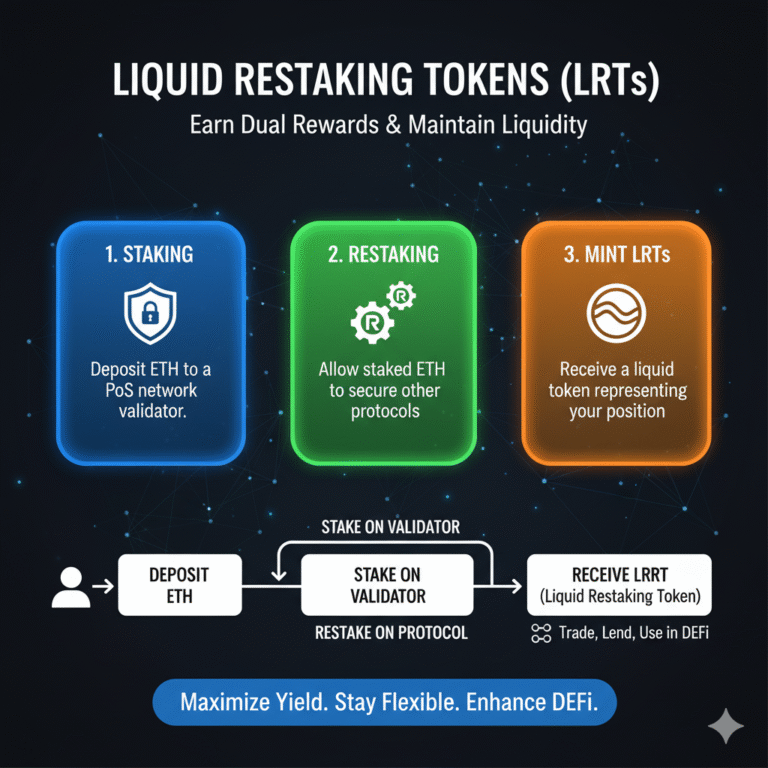
Liquid Restaking Tokens (LRTs) are the liquid, tradable versions of restaked assets. They build directly on LSTs and restaking by allowing you to restake your ETH (or LSTs), earn compounded rewards, and still use a tokenized representation in DeFi without unstaking.

In essence, an LRT is a token you receive when depositing into a liquid restaking protocol. It represents your restaked position, including the original staking rewards plus additional yields from AVSs. Unlike locked restaked assets, LRTs can be traded, lent, or used as collateral, making your capital highly efficient.

For beginners, imagine your ETH as a worker: With staking, it has one job (securing Ethereum). With restaking, it takes on side gigs (AVSs). LRTs give you a “liquid worker” token that you can sell or redeploy while the original keeps earning. Popular LRTs include weETH/eETH from Ether.fi, ezETH from Renzo Protocol, and pufETH from Puffer Finance.

EigenLayer’s mainnet rollout started in June 2023 (Stage 1), with Stage 2 in April 2024, according to InceptionLRT documentation, which catalyzed the LRT wave. By 2025, the LRT market represented a meaningful slice of DeFi TVL.

How Do LRTs Work? A Step-by-Step Breakdown

Understanding how LRTs operate is key to using them safely. Here’s a simple step-by-step process:

Deposit Your Assets: Start by depositing ETH or an LST (like stETH) into an LRT protocol, such as Ether.fi or Renzo. The protocol handles the restaking for you, typically via EigenLayer. As documented in Ether.fi’s GitBook, users simply connect their wallet and deposit.

Restaking Happens: Your deposited assets are staked on Ethereum (if not already) and then restaked to secure AVSs. This can involve delegating to node operators who validate these services, as explained by Coinbase’s liquid staking guide.

Receive Your LRT: In exchange, you get an LRT token (e.g., ezETH). Reward-bearing and auto-compounding mechanics are common; for example, according to Renzo Protocol documentation, ezETH’s exchange rate reflects accrued rewards over time. Base staking yields are typically in the low single-digits, with restaking adding additional percentage points depending on protocol, market conditions, and incentives.

Use It in DeFi: While holding the LRT, you can trade it, provide liquidity, or use it as collateral. Ether.fi’s weETH and Renzo’s ezETH have growing integrations. According to Aave governance forums, Compound governance, and Enzyme Finance documentation, these LRTs are being integrated across major DeFi platforms.

Redeem When Ready: When you want to exit, you redeem for the underlying asset plus accrued rewards. Some protocols offer instant or flash exit features, such as Renzo’s Instant Withdrawals and InceptionLRT’s Flash Unstake.

Technical Implementation: LRTs can use EigenPods for native restaking, where validators set withdrawal credentials to an EigenPod. According to Kiln documentation and Bedrock documentation, this method is used by protocols like Bedrock for its uniETH LRT.

Benefits of Using LRTs

LRTs offer several advantages that make them appealing for both beginners and experienced users:

Higher Yields: By stacking staking and restaking rewards, LRTs can offer higher returns than plain staking. Base staking yields are approximately 2–5% depending on MEV and network conditions according to Coinbase and Blocknative, and restaking plus protocol incentives can push realized yields higher during certain periods. However, these figures are context-dependent rather than guaranteed.

Capital Efficiency: Your ETH isn’t locked—it’s working across multiple protocols while remaining liquid, as noted by Cube Exchange.

Liquidity & Flexibility: Use LRTs across DeFi platforms. Some protocols add instant or flash exits to bypass unbonding queues, though typically with a small fee according to Renzo documentation.

Ecosystem Security: Restaking extends Ethereum’s security to additional services (AVSs), strengthening the broader ecosystem as explained by Coinbase.

Accessibility: User-friendly interfaces, support for small deposits, and wallet integrations with MetaMask and other popular wallets make LRTs accessible to beginners, as shown on Ether.fi’s platform.

As an example, Puffer Finance issues pufETH and emphasizes anti-slashing design features. Third-party risk reviews discuss its mechanics and TVL according to Puffer Finance documentation.

Risks and Considerations with LRTs

While promising, LRTs aren’t without downsides:

Smart Contract Risk: You’re relying on several contracts simultaneously (EigenLayer plus the LRT protocol plus DeFi integrations). Bugs or logic errors can cause losses. Always verify that protocols have undergone professional audits, as recommended in GitHub security best practices.

Slashing Exposure: Depending on the phase and configuration, slashing penalties may apply to restaked validators and AVSs. EigenLayer phased slashing in after earlier stages. Users should track the current slashing status and AVS terms according to Crypto.com’s help documentation.

Peg and Discount Risk: LRTs aim for a predictable exchange rate versus ETH, but secondary-market prices can deviate, especially during market stress or mass exits. Platform FAQs and market pages on sites like CoinGecko cover this dynamic.

Systemic and Centralization Risk: Concentration of node operators or widely used middleware can create correlated risks across protocols, as discussed in Coinbase’s protocol overviews.

Complexity & Fees: Extra layers add fees and operational complexity. Yields can be reduced by gas costs and protocol fees according to InfStones Documentation.

DYOR Tip: Prefer audited, widely integrated protocols and monitor governance forum updates on platforms like Aave governance.

Several protocols lead the LRT space in 2025:

Ether.fi: Issues eETH and weETH with multi-chain support and wide DeFi integrations. According to InfStones, Ether.fi’s TVL exceeded $7 billion by July 2025.

Renzo Protocol: Offers ezETH (reward-bearing) with deep DeFi integrations and an instant-withdrawal option as documented on Renzo’s platform.

Puffer Finance: Issues pufETH with native liquid restaking focus and security features. Active integrations and risk assessments are available on Puffer Finance.

Kelp DAO: Provides rsETH, accepts multiple LSTs, and emphasizes broad DeFi access according to Kelp DAO.

InceptionLRT: Offers inETH with isolated restaking and Flash Unstake for rapid exits, as shown on Etherscan.

Bedrock: Issues uniETH with explicit EigenPod native restaking documented on Bedrock’s platform.

Note that emerging protocols should be approached with caution. Always verify track records, audits, and independent reviews before depositing funds.

The Future of LRTs in Crypto

Looking ahead, LRTs are poised to play a bigger role in DeFi. As more AVSs launch on EigenLayer, yields may improve via additional fee streams. There’s active work on cross-chain and Layer 2 restaking solutions. Ether.fi has discussed extending weETH-based restaking to L2s and potentially other chains like BNB Chain, with plans surfacing in technical posts on Medium during 2024.

The LRT ecosystem continues to grow rapidly. The Defiant reports that EigenLayer already exceeded $20 billion in TVL during 2024, demonstrating strong market adoption. While forward projections are speculative, the trajectory suggests continued expansion of the LRT market.

Conclusion: Should You Try LRTs?

Liquid Restaking Tokens (LRTs) represent a powerful evolution in crypto staking, offering liquidity, higher yields, and capital efficiency for your ETH. They’re ideal for users looking to maximize returns without locking up assets, but they require understanding the risks involved.

If you’re a beginner, start with a small deposit in a reputable protocol like Ether.fi or Renzo, and track your position closely. Remember, crypto is volatile—never invest more than you can afford to lose.

LRTs are transforming how we think about staking and DeFi. As the ecosystem grows, staying informed will help you capitalize on these opportunities. For more on crypto innovations, explore resources like EigenLayer’s documentation and reputable DeFi analytics platforms like DeFi Llama and Dune Analytics.

Additional Resources:


Disclaimer: This article is for educational purposes only and does not constitute financial advice. Cryptocurrency investments carry significant risk. Always do your own research and consult with a qualified financial advisor before making investment decisions.

How Lending Protocols Manage Risk in DeFi

0

In the world of decentralized finance (DeFi), lending protocols have revolutionized how people borrow and lend digital assets without traditional banks. Platforms like Aave, Compound, and MakerDAO allow users to lend cryptocurrencies to earn interest or borrow against their holdings. However, with great innovation comes significant risk—volatility in crypto prices, smart contract vulnerabilities, and market fluctuations can lead to losses. So, how do these protocols manage risk to protect users and maintain stability? This article explores the key mechanisms behind risk management in DeFi lending protocols, explained in simple terms for beginners.

DeFi lending protocols operate on blockchain networks like Ethereum, using smart contracts to automate transactions. Lenders deposit assets into pools, earning interest from borrowers who provide collateral. The core challenge is ensuring the system remains solvent even during market crashes. Effective risk management is what separates successful protocols from those that fail, as seen in historical events like the 2022 crypto winter where poor risk controls led to cascading liquidations.

Understanding the Main Risks in DeFi Lending

Before diving into solutions, it’s essential to know the problems. DeFi lending faces several risks that require sophisticated management strategies.

Market Risk represents one of the most significant challenges. Crypto prices can swing wildly within minutes or hours. If collateral value drops below the borrowed amount, the protocol could face bad debt that threatens the entire system’s solvency.

Smart Contract Risk stems from potential bugs in code that might allow exploits, leading to hacks and stolen funds. Even thoroughly audited protocols must remain vigilant as new vulnerabilities can emerge.

Oracle Risk occurs because protocols rely on external data feeds (oracles) for asset prices. Inaccurate or manipulated data can trigger unfair liquidations or allow exploitation. Leading protocols use decentralized oracle networks like Chainlink that aggregate prices from multiple sources to mitigate manipulation risks.

Liquidity Risk emerges when too many users withdraw or borrow simultaneously. The pool might dry up or interest rates spike dramatically. Utilization-based rate models are specifically designed to respond to these conditions by making borrowing more expensive as liquidity decreases.

Counterparty/Protocol Risk exists because DeFi uses a peer-to-pool model rather than peer-to-peer lending. The protocol’s parameters and logic act as the intermediary, meaning over-leveraged positions can threaten the entire system rather than just individual lenders.

These risks aren’t hypothetical. Historical events have demonstrated that DeFi lending protocols must implement comprehensive strategies like overcollateralization and automated liquidations to survive. Without proper controls, events like flash crashes can cause widespread losses that ripple through the entire ecosystem.

Core Mechanism: Overcollateralization

At the heart of risk management in DeFi lending is overcollateralization. This means borrowers must deposit more value in collateral than they borrow. For example, if you want to borrow $100 worth of stablecoins, you might need to lock up $150 in Ethereum (ETH). This buffer protects lenders if the collateral’s price falls.

In protocols like Aave and Compound, overcollateralization ratios are set per asset. Volatile assets like ETH require higher collateral compared to stablecoins. Aave sets per-asset Loan-to-Value (LTV) and liquidation thresholds for each market. Compound sets “collateral factors” per market that cap how much you can borrow against a given asset. MakerDAO, which mints its stablecoin DAI against collateral, uses similar principles, requiring users to maintain a minimum collateralization ratio to avoid penalties.

Think of it like a pawn shop: You bring in a watch worth $200 to borrow $100. If you don’t repay, the shop sells the watch to recover the loan. In DeFi, automation makes this process instant and trustless, executing without human intervention.

Risk Parameters: Fine-Tuning the Safety Net

Lending protocols use adjustable “risk parameters” to control exposure. These are like dials that governance communities tweak based on market conditions and asset characteristics. Understanding these parameters is crucial for anyone participating in DeFi lending.

Loan-to-Value (LTV) Ratio determines the maximum you can borrow against your collateral. Aave sets LTVs per asset based on risk assessment. Compound’s analogous control is the per-asset collateral factor, which serves a similar function in limiting borrowing capacity.

Liquidation Threshold defines the point at which your collateral value triggers liquidation eligibility. If your collateral value falls below this level, your position becomes eligible for liquidation. Compound calls this the “collateral factor,” which similarly defines borrow limits and liquidation conditions.

Liquidation Penalty/Bonus creates incentives for liquidators to act quickly. Exact percentages vary by asset and market and are typically single-digit on major assets in Aave. Liquidators receive a bonus (discount) on collateral to incentivize timely action, ensuring positions are closed before bad debt accumulates.

Debt Ceilings / Caps limit total borrowing per asset to avoid overexposure to any single token. MakerDAO sets per-collateral debt ceilings through governance votes. Aave v3 also employs supply and borrow caps to contain risk and prevent any single asset from dominating protocol exposure.

These parameters are not static. In Aave, specialized risk partners like Gauntlet and Chaos Labs run simulations and recommend updates that governance votes on. This data-driven approach helps optimize risk-reward ratios across different market conditions.

Price Oracles: The Eyes of the Protocol

Accurate pricing is crucial for calculating collateral values and triggering liquidations at the right time. DeFi protocols use decentralized oracles to fetch real-time prices from multiple sources, reducing manipulation risks and single points of failure.

Aave integrates Chainlink price feeds for reliable, tamper-resistant pricing data. Compound v2 uses a price feed maintained by governance that pulls from Chainlink and Open Oracle reporters, creating redundancy in price discovery.

For beginners: Imagine oracles as referees in a game—they provide unbiased scores (prices) so everyone plays fair. Without trusted oracles, the entire system could be manipulated by actors who artificially influence prices to trigger favorable liquidations.

Liquidation Mechanisms: Automated Enforcement

When a borrower’s position becomes undercollateralized, the protocol doesn’t wait—it automates liquidation. Anyone can act as a liquidator, repaying part of the loan to seize collateral at a discount. This open liquidator model ensures swift action even during volatile periods.

Aave v3 introduced a variable liquidation close factor for enhanced risk management. Normally up to 50% of a position can be liquidated at once. However, if the position’s Health Factor deteriorates below approximately 0.95, up to 100% can be liquidated to remove potential bad debt more quickly and protect the protocol.

Compound v2 uses a close factor (commonly 50% in v2) to limit how much of a loan can be liquidated in one event. The liquidation incentive grants liquidators a discount on collateral, making the activity profitable while protecting the protocol.

MakerDAO applies stability fees and runs Dutch auctions (Liquidations 2.0) for collateral, executed by specialized participants called “keepers.” This auction mechanism helps maximize collateral value recovery during liquidation events.

This system prevents “bad debt” from building up, as liquidators profit from keeping the protocol healthy. However, during extreme volatility, cascading liquidations can occur, where one liquidation drops prices further, triggering more—a risk managed by conservative parameters. Aave also includes an “oracle sentinel” on Layer 2 networks to pause liquidations and borrowing if price feeds or sequencers misbehave.

Interest Rate Models: Balancing Supply and Demand

Interest rates in DeFi aren’t fixed; they’re algorithmic, adjusting based on pool utilization (how much is borrowed versus supplied). This manages liquidity risk by encouraging balance between lenders and borrowers.

Compound uses supply and borrow rates as functions of utilization. These models can include a “kink” where rates rise more steeply beyond an optimal utilization point, discouraging excessive borrowing that could drain liquidity.

Aave uses per-reserve interest-rate strategies with similar utilization targets and responsive curves. The protocol adjusts rates dynamically to maintain healthy liquidity levels across all markets.

MakerDAO sets the stability fee (variable) per collateral type via governance to control DAI supply and demand dynamics. This governance-driven approach allows for flexible response to market conditions.

For example, if 80% of a pool is borrowed, rates might jump materially, prompting users to add liquidity or repay loans. This self-balancing mechanism helps prevent liquidity crises without centralized intervention.

Governance and Community Oversight

Risk management isn’t just technical—it’s governed by decentralized autonomous organizations (DAOs). Most major protocols use community governance to adapt risk parameters over time.

Compound uses the Comptroller to enforce risk rules. Governance can update markets and parameters through community proposals and votes, ensuring the protocol evolves with market conditions.

Aave DAO votes on risk parameters and features across multiple blockchain networks, often informed by detailed analyses from Gauntlet and Chaos Labs. This professional risk assessment combined with community voting creates balanced decision-making.

MakerDAO empowers MKR token holders to set liquidation ratios, stability fees, and debt ceilings per collateral type. This gives the community direct control over risk exposure and protocol economics.

This community-driven approach allows adaptation to changing market conditions, but also introduces governance risks such as voter apathy or potential capture by large token holders.

Additional Safeguards: Reserves, Audits, and Insurance

Beyond core mechanics, protocols build extra layers of protection to enhance security and resilience.

Protocol Reserves are created by diverting a portion of borrower interest to reserves via a per-market reserve factor. The exact percentage varies by asset and market, creating a buffer for unexpected losses. Compound explicitly documents this mechanism in their technical documentation, while Aave maintains per-reserve parameters and collectors.

Audits & Bug Bounties provide ongoing security assessment. Major protocols have undergone multiple audits from firms like OpenZeppelin, which has audited both Aave and Compound. Bug bounty programs incentivize white-hat hackers to discover and report vulnerabilities before malicious actors can exploit them.

Insurance / Backstops offer additional protection layers:

Aave’s Safety Module and newer Umbrella architecture let stakers backstop the protocol. Staked assets can be slashed to cover shortfalls, socializing risk among those who opt into this protection role.

External DeFi insurance platforms like Nexus Mutual provide optional cover for users across protocols including Aave, MakerDAO, and Compound. Users can purchase coverage against smart contract failures or other specified risks.

Best practices emphasize diversification across multiple protocols, regular monitoring of positions, and stress-testing with simulations to understand potential outcomes during extreme market events.

Case Studies: Real-World Examples

Aave focuses on modular risk with parameters optimized via data-driven models. Version 3 added supply and borrow caps, an oracle sentinel, and variable close factor to improve incident response and liquidation efficiency. The backstopping mechanism has transitioned toward the new Umbrella architecture for automated slashing when needed, enhancing capital efficiency while maintaining protection.

Compound emphasizes economic security through utilization-based rate curves and a Comptroller that enforces per-market collateral factors and close factor rules. This proven design has persisted through multiple market cycles, demonstrating resilience during both bull and bear markets.

MakerDAO uses per-asset debt ceilings, stability fees, and Dutch auctions to manage risk comprehensively. As of 2025, the protocol manages billions in collateral backing, illustrating both its scale and the critical importance of conservative parameters at such size.

These examples show how combining multiple mechanisms creates robust systems that can withstand various market conditions and attack vectors.

Conclusion: Why Risk Management Matters for DeFi’s Future

DeFi lending protocols manage risk through a sophisticated blend of overcollateralization, dynamic parameters, automated liquidations, reliable oracles, and community governance. These tools ensure lenders get paid, borrowers stay accountable, and the system survives turbulence.

For beginners entering this space, start small and take time to understand the parameters governing your positions. Monitor your collateral ratios regularly using protocol dashboards and DeFi tracking tools. Set up alerts for liquidation thresholds and maintain conservative collateralization levels, especially during volatile periods.

As DeFi grows and matures, improved risk management will drive broader adoption and integration with traditional finance. However, remember that no system is foolproof. Smart contracts can have bugs, market conditions can change rapidly, and governance decisions can have unexpected consequences.

Always conduct thorough research before depositing funds, understand the specific risks of each protocol, and use only what you can afford to lose. By learning from established protocols like Aave, Compound, and MakerDAO, you can participate in DeFi lending with greater confidence and understanding of the sophisticated risk management systems protecting your assets.

The future of decentralized finance depends on continuing to refine these risk management practices, making protocols more resilient while maintaining the transparency and accessibility that make DeFi revolutionary.


Additional Resources:

Read also: Yield Farming on Ethereum.

Decentralized Derivatives: GMX vs dYdX vs Kwenta – A Comprehensive Comparison

0

In the world of cryptocurrency, decentralized finance (DeFi) has revolutionized how people trade assets. Among the most exciting innovations are decentralized derivatives, which allow traders to speculate on price movements without owning the underlying assets. Platforms like GMX, dYdX, and Kwenta lead this space, offering perpetual futures contracts with leverage. These tools enable beginners to amplify their trades while maintaining control through self-custody wallets.

This article breaks down decentralized derivatives in simple terms, compares GMX, dYdX, and Kwenta based on verified facts, and helps you decide which might suit your needs. Whether you’re new to DeFi trading or exploring perpetual futures, we’ll use easy examples to explain concepts like leverage and liquidity. All information is drawn from reliable sources as of October 2025.

What Are Decentralized Derivatives?

Decentralized derivatives are financial instruments built on blockchain technology, mimicking traditional derivatives like futures but without central authorities like banks. In DeFi, they often take the form of perpetual futures – contracts that don’t expire and let you bet on whether an asset’s price will rise (long) or fall (short).

For beginners: Imagine you think Bitcoin’s price will go up. Instead of buying BTC, you open a long position with 10x leverage. If BTC rises 5%, your profit could be 50% (minus fees). But if it drops, losses amplify too. Decentralized platforms use smart contracts for transparency and security, reducing risks like hacks on centralized exchanges.

Key benefits include 24/7 access, no KYC requirements, and global participation. However, volatility and liquidation risks are high – always start small.

The decentralized derivatives market in 2025 regularly records tens of billions of dollars in daily trading volume, according to CoinGecko and DefiLlama trackers. Popular in 2025, the DeFi derivatives market has seen trading volumes exceed trillions of dollars cumulatively across platforms. GMX, dYdX, and Kwenta are top players, each with unique models: liquidity pools, order books, and synthetics.

Overview of GMX: The Permissionless Perpetual Exchange

GMX is a decentralized perpetual exchange launched in 2021 on Arbitrum, expanding to Avalanche and Solana in March 2025. It allows trading over 70 assets with up to 100x leverage directly from your wallet, emphasizing low fees and deep liquidity.

Learn more at gmx.io.

How GMX Works

GMX uses an automated market maker (AMM) model with liquidity pools. In version 1 (V1), it featured a multi-asset pool called GLP, where providers earn fees from trades. In version 2 (V2), GMX switched to isolated GM Pools for each asset pair and removed the GLP basket. Prices come from Chainlink oracles for fairness.

Example for beginners: Deposit USDC into a GM pool for BTC/USD. Open a 50x long position with $100 collateral – if BTC rises 2%, you might profit $100 (before fees). But a 2% drop could liquidate your position.

Key Features

  • Supported Chains: Arbitrum, Avalanche, Solana (multichain access expanding; Base chain support announced for Q4 2025)
  • Trading Instruments: 70+ perpetuals like BTC, ETH, AVAX
  • Fees (V2): 0.04%–0.06% for opening/closing positions – lower than V1’s 0.1%
  • Liquidity Model: Permissionless GM Pools with hundreds of millions in liquidity
  • Governance: Community-driven via GMX token staking
  • Stats: Lifetime volume ~$300–350 billion (combined V1 + V2), over 1 million users, open interest around $150–200 million

Security update: GMX V1 was exploited in July 2025, causing approximately $40 million in losses; V2 contracts were unaffected.

GMX rewards liquidity providers with real yields from trading fees, making it appealing for passive income.

Overview of dYdX: DeFi’s Pro Trading Platform

dYdX, founded in 2017, evolved from an Ethereum Layer 2 to its own Cosmos-based chain (v4) in 2023 for full decentralization. It’s known for professional tools, deep liquidity, and over 220 markets with up to 50x leverage.

Visit dydx.exchange for more information.

How dYdX Works

Unlike AMMs, dYdX uses an on-chain order book and matching engine for CEX-like speed. Traders connect wallets, deposit via six chains, and trade perpetuals. The MegaVault provides liquidity (around $12 million TVL as of late 2025).

Beginner example: Connect MetaMask, deposit $50 USDC from Ethereum. Open a 20x short on ETH/USD. If ETH falls 3%, your $50 could yield $30 profit (net of fees). Advanced orders like TWAP add precision.

Key Features

  • Supported Chains: Deposits from Ethereum, Base, Optimism, Avalanche, Polygon, Arbitrum; native on dYdX Chain
  • Trading Instruments: 220+ markets
  • Fees: Low trading fees; periodic deposit promos (e.g., instant & free over $100 in mid-2025)
  • Liquidity Model: Decentralized validators and community-driven listings
  • Governance: DYDX token for staking and proposals
  • Stats: $1.4 trillion+ lifetime volume, ~$200 million open interest

Update 2025: dYdX acquired Pocket Protector in July 2025 to integrate Telegram-based trading; rollout began in August.

Note: dYdX is unavailable to U.S. residents.

Overview of Kwenta: Synthetics-Powered Derivatives

Kwenta, built on Optimism since 2022, leverages the Synthetix protocol for synthetic assets. In late 2024, Synthetix DAO voted to acquire Kwenta, fully merging the two ecosystems. It offers perpetual contracts using synthetic assets with deep liquidity.

Explore more at kwenta.io.

How Kwenta Works

Using Synthetix’s debt pool, Kwenta mints synthetics (Synths) backed by SNX collateral. Traders access assets like crypto, fiat, or commodities via perpetuals.

Simple example: Stake SNX to mint sUSD. Trade a long on sBTC (synthetic BTC) with leverage. No actual BTC needed – profits settle in sUSD. Synthetix stakers counterbalance positions.

Key Features

  • Supported Chains: Optimism (Ethereum Layer 2)
  • Trading Instruments: Synthetics for crypto, fiat, commodities, equities
  • Fees: Variable based on Synthetix; low slippage due to shared debt pool
  • Liquidity Model: Overcollateralized Synthetix pool
  • Governance: KWENTA token for DAO decisions
  • Stats: Lower volume than peers; KWENTA market cap approximately $15 million (as of October 2025)

Clarification: “Infinite liquidity” refers to Synthetix’s pooled model, not literally unlimited depth.

Key Comparisons: GMX vs dYdX vs Kwenta

Features and User Experience

  • GMX: Simple 1-click trading; best for high-leverage seekers (100x)
  • dYdX: Pro tools, API, mobile and Telegram apps; ideal for advanced traders (50x max)
  • Kwenta: Broad synthetic asset access; good for non-crypto exposure

dYdX leads in markets (220+), GMX in leverage, Kwenta in asset diversity.

Fees and Costs

All have low fees: GMX V2 0.04–0.06%, dYdX offers rebates periodically, Kwenta uses Synthetix spreads. GMX and dYdX are most cost-effective for high volume.

Liquidity and Volume

dYdX and GMX dominate: dYdX $1.4 trillion lifetime, GMX $300–350 billion combined. Kwenta trails but has shared liquidity through Synthetix.

Supported Blockchains and Accessibility

  • GMX: Arbitrum, Avalanche, Solana, Base (announced)
  • dYdX: Cross-chain deposits, native Cosmos chain
  • Kwenta: Optimism only

Leverage and Risk

  • GMX: Up to 100x (high risk/reward)
  • dYdX: 50x
  • Kwenta: Up to 50x (some markets lower)

Governance and Tokens

All use native tokens: GMX (for staking rewards), DYDX (for validators and governance), KWENTA (for DAO votes).

Pros and Cons of Each Platform

GMX

Pros: High leverage, low fees, multichain expansion

Cons: July 2025 hack ($40 million loss), AMM price impact in volatile markets

dYdX

Pros: CEX-like experience, high volume, Telegram integration

Cons: Lower max leverage; restricted in U.S.

Kwenta

Pros: Diverse synthetics, low slippage

Cons: Dependent on Synthetix; lower adoption and volume

Recent Updates in 2025

GMX expanded to Solana and announced Base integration (September 2025). dYdX acquired Pocket Protector in July and launched Telegram features in August. Kwenta finalized Synthetix acquisition in 2024 and rolled out v4 perps upgrades.

Market context: Perp DEX daily volumes in October 2025 regularly reach $50–60 billion range, showing sector growth.

Conclusion: Which Decentralized Derivatives Platform to Choose?

  • For beginners seeking simplicity and high leverage, start with GMX
  • Experienced traders might prefer dYdX’s tools and volume
  • If you want synthetic exposure to traditional assets, Kwenta is ideal

Always DYOR (Do Your Own Research), use small amounts, and consider risks. As DeFi evolves in 2025, these platforms could dominate centralized exchanges. Track updates via official sites for the latest information.


Additional Resources:

Read also: NFT Marketplaces.

Perpetual Trading Explained Simply: A Beginner’s Guide to Perpetual Futures in Crypto

1

In the fast-paced world of cryptocurrency trading, perpetual trading has become a powerful tool for both novices and experienced traders. If you’re new to crypto and asking “What is perpetual trading?” or “How do perpetual futures work?”, you’re in the right place. This article breaks down perpetual trading in plain terms, using real-world examples like ETH/USD to help you understand it. We’ll cover the mechanics, benefits, risks, and steps to get started—anchored in verified sources.

Perpetual trading, sometimes called perpetual futures or “perps,” allows you to speculate on the price movements of assets like Bitcoin (BTC) or Ethereum (ETH) without owning the underlying crypto. Unlike traditional futures, perpetual contracts use leverage to enhance potential gains (and losses). They were first introduced into crypto by BitMEX in 2016. Today, major exchanges such as Binance offer perpetuals widely; others like Coinbase or Kraken provide them only under certain jurisdictions or account types. Perpetual contracts commonly see daily trading volumes in the billions of dollars.

Why Perpetual Trading Matters for Beginners

In volatile markets like crypto, perpetual trading gives you flexibility to profit whether prices go up or down. For example: if you think ETH will fall versus USD, you can short it without actually holding ETH. But it’s not gambling—it’s a derivative contract whose price behavior is carefully managed through mechanisms like funding rates. By the end of this guide, you’ll understand the fundamentals of perpetual trading and whether it’s suitable for you.

What Are Perpetual Futures?

At their essence, perpetual futures are derivative contracts that let you wager on the future price of an asset, but without any expiration date. Traditional futures (in commodities, for instance) require settlement at a predetermined date—if you don’t close your position, the contract is settled or rolled over.

Perpetual contracts invert that: there is no expiration, so you can hold your position indefinitely (assuming you maintain required margin). This design fits crypto’s 24/7 market model, where there’s no closing bell, weekends, or holidays. Think of it as an ongoing bet on a price, but all settled in cash (no physical delivery).

In crypto, perps are typically quoted against stablecoins (e.g. BTC/USDT or ETH/USD). They aim to closely track the spot price, thanks to an internal mechanism that nudges their price alignment. Eliminating expiry removes the “basis risk” you’d see in traditional futures (where futures and spot converge at expiry). This makes perps appealing for both hedging and speculation.

A useful metaphor for beginners: perpetual trading is like renting a car with no due return date—there is a recurring “fee” (funding) to keep it, but you can stop anytime. Because of their simplicity and alignment, perps now command a major share of crypto derivatives liquidity.

How Perpetual Trading Works

Perpetual trading builds on three pillars: margin, leverage, and open positions.

Opening an Account and Depositing Collateral

First, you need to use a crypto exchange that supports perps in your jurisdiction (e.g. Binance is broadly available; Coinbase or Kraken may restrict access depending on location/verification). You deposit collateral (margin), often in USDT or another base asset. This margin is your “skin in the game.”

Leverage

Leverage magnifies your exposure. For example, with 10× leverage, $1,000 of margin controls $10,000 worth of position. If the price moves 5% in your favor, you gain $500 (a 50% return on your margin). But the downside is symmetric—if the price moves against you, you lose fast and can be liquidated quickly.

Long and Short Positions

You can go long (betting the price rises) or short (betting it falls). You enter via market or limit orders. No one transfers actual ETH or BTC—you’re only speculating on price moves.

Funding Rate Mechanism

Because there’s no expiry, there must be a mechanism to tether the perpetual contract price to the spot price. That’s where funding rates come in. Exchanges typically charge or pay funding at fixed intervals (often every 8 hours) depending on whether the perpetual price is above or below spot. If the perp trades at a premium over spot, longs pay shorts; if it trades at a discount, shorts pay longs. This incentivizes traders to push the price back into alignment.

This mechanism is standard on many platforms including Gate.io, as explained in Investopedia’s perpetual futures guide, and Kraken’s documentation.

Exiting and Liquidation

To close out, you reverse your position (i.e. if you were long, sell). Profit (or loss) is computed as (exit price – entry price) × position size, adjusted for leverage, fees, and funding payments. If your margin falls below a maintenance threshold, exchanges will automatically liquidate your position to prevent negative balances. In extreme volatility, some systems use auto-deleveraging (ADL) to close positions even if they’re in your favor.

ADL is more common in high-leverage, high-volatility markets, as documented on Wikipedia and Gate.io’s trading guide.

In real life, perpetual trading is 24/7, with high liquidity especially in major pairs like ETH/USD. Tools like stop-loss, take-profit orders, and position size rules help manage risk—but always begin cautiously as a beginner.

The Role of Funding Rates in Perpetual Futures

Funding rates are the “secret sauce” that keeps perpetual futures anchored to spot prices. Without them, perps could drift far from fundamentals due to market pressure.

Here’s how they work:

At each funding interval (commonly every 8 hours, though this can vary by exchange) a payment is made between longs and shorts, as detailed on Binance’s funding rate explanation, Gate.io’s guide, and Investopedia.

The size and direction of the funding rate depend on the spread between the perpetual contract price and spot, plus an interest component. The exact formula is exchange-specific (there is no universal formula), as noted by Gate.io, Investopedia, and Kraken.

When the funding rate is positive (perp > spot), longs pay shorts. When negative (perp < spot), shorts pay longs. This encourages market participants to take positions that push the price back to equilibrium, as explained on Binance, Kraken, and Investopedia.

On Binance, for example, a fixed interest rate component is built in: 0.03% per day by default, split across the three 8-hour funding intervals (i.e. ~0.01% per interval).

In extreme volatility or extended trends, funding can spike and significantly erode profitability for one side.

For beginners: treat funding as a “rental fee” for holding leveraged exposure. It prevents risk-free holding and encourages traders to adjust in line with market conditions.

Advantages of Perpetual Trading

Perpetual trading offers several advantages—especially in a crypto context:

No expiration date — you can hold as long as you maintain margin.

Leverage — control larger positions with smaller capital.

24/7 access — matches the always-on nature of crypto markets.

Hedging flexibility — e.g. shorting ETH perps even if you hold ETH in spot, as a hedge.

High liquidity — major pairs get tight spreads and fast execution.

Profit in any direction — go long or short easily based on your forecast.

These features make perps extremely popular in crypto.

Risks and Key Considerations

Perpetual trading is not risk-free. Major pitfalls include:

Leverage magnifies losses — a small adverse move can wipe your margin.

Funding rate costs — ongoing payments can eat your gains, particularly in one-sided markets.

Volatility risk — crypto is notoriously volatile, making liquidation frequent.

Liquidation and ADL risk — you can be force-exited, possibly even in a position that would have been profitable under different conditions.

Counterparty and exchange risk — depending on your jurisdiction and platform, you face operational, regulatory, or solvency risks.

Psychological stress — leverage induces emotional swings; manage position sizes, use risk rules, and avoid overtrading.

For beginners, it’s wise to paper-trade or simulate first to internalize mechanics without risking real money.

Example: ETH/USD Perpetual

Let’s do a simple illustration:

Suppose ETH spot is $3,000, and you expect it to rise to $3,200.

With $1,000 margin and 10× leverage, you open a long position worth $10,000 (≈ 3.33 ETH).

If ETH goes to $3,200 (+6.67%), your notional P&L is ~$667 → that’s a 66.7% return on margin (before fees and funding).

If ETH drops to $2,800 (−6.67%), you lose $667 (≈ two-thirds of your margin).

If your margin falls below maintenance threshold, your position is automatically liquidated.

Funding costs apply depending on the 8-hour intervals and the rate at that time (which varies by exchange).

This example shows leverage is a double-edged sword: powerful for gains, devastating for missteps.

How to Get Started with Perpetual Trading

  1. Choose a reputable exchange (e.g. Binance; ensure perps are available and legal in your jurisdiction).
  2. Complete verification and deposit collateral.
  3. Explore the interface (many exchanges offer demo or testnet mode).
  4. Start small — use low leverage, maybe 1× to 5×, just to get the feel.
  5. Monitor key indicators — price charts, funding rates, open interest.
  6. Apply risk rules — e.g. never risk more than 1–2% of margin per trade.
  7. Regularly review and adapt — as you gain experience, gradually scale strategies, but always stay disciplined.

Conclusion

Perpetual trading demystified: it’s a flexible, leveraged way to trade crypto price movements without expirations, all anchored by funding payments to keep prices in line. For beginners eyeing ETH/USD or similar pairs, it can be exciting—but discipline, strategy, and risk control are nonnegotiable. Always educate yourself, test first, and trade responsibly. In the evolving crypto ecosystem, perps remain a cornerstone of speculation, hedging, and market structure.


Related Resources:

DYOR: Do Your Own Research

Before diving into perpetual futures, always DYOR — Do Your Own Research.
Perpetual trading combines leverage, derivatives, and round-the-clock markets — powerful tools that demand understanding before use. Every exchange has its own funding rate formula, liquidation rules, and margin requirements. Read their documentation carefully, test strategies on demo accounts, and never rely on advice from influencers or anonymous “trading groups.”

Study basic risk-management principles:

  • Limit leverage while learning (1×–3× max).
  • Set clear stop-loss and take-profit levels.
  • Track funding rates and open interest to avoid crowded trades.
  • Keep emotions out — no “revenge trading.”

In crypto, knowledge is your real edge. DYOR isn’t just a slogan — it’s how you stay solvent, disciplined, and in control while others get liquidated.