
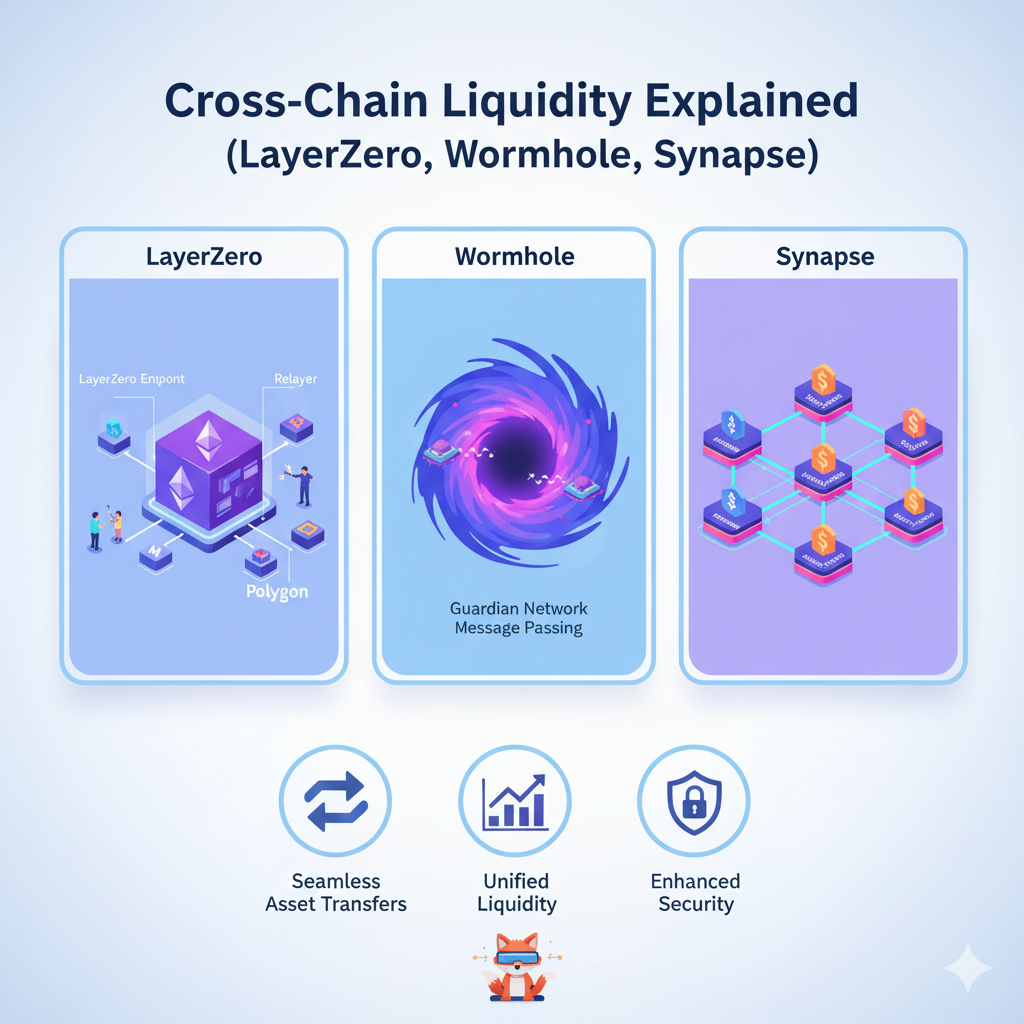
Cross-chain liquidity enables movement of value and messages between blockchains. In 2025, three dominant approaches have emerged: message-passing with pluggable security (LayerZero), guardian-secured messaging and bridging (Wormhole), and liquidity-pool-driven bridging with RFQ capabilities (Synapse). Currently, total 24-hour bridge volume across all protocols hovers around $1.36 billion, demonstrating the critical role interoperability plays in the blockchain ecosystem.
Understanding Cross-Chain Liquidity Fundamentals
Different blockchains operate as isolated ecosystems with distinct protocols and rules. Therefore, cross-chain solutions function as connective infrastructure, enabling token transfers and verified message transmission across networks. As a result, three primary design patterns have emerged:
Lock-and-Mint Architecture: First, assets are locked on the source chain. Then, a corresponding representation is minted on the destination chain. Finally, the process reverses for return transfers.
Liquidity-Based Bridging: Initially, users withdraw from pre-funded liquidity pools on destination chains. Subsequently, backend settlement occurs separately.
Generalized Messaging: In this approach, verified messages pass between smart contracts. Consequently, applications can define custom execution logic upon receipt.
Without these interoperability solutions, liquidity and users remain isolated within single ecosystems. However, cross-chain infrastructure enables arbitrage opportunities, access to lower transaction costs, and composable DeFi applications spanning multiple blockchains. For a comprehensive look at how different blockchain ecosystems achieve interoperability, explore our guide on how IBC actually connects blockchains in the Cosmos ecosystem.
External Resources:
LayerZero: Omnichain Messaging with Configurable Security
Protocol Architecture
LayerZero provides general-purpose messaging capabilities through “OApps” (Omnichain Applications). Specifically, these enable smart contracts to read and write state across multiple blockchains. Moreover, Version 2 introduces modular security through Decentralized Verifier Networks (DVNs). As a result, applications can select their message verification providers.
Technical Implementation
The system operates through three core components. First, an Oracle relays block headers. Second, a Relayer supplies transaction-specific proofs. Third, the destination endpoint verifies and executes messages.
Historically, Chainlink and Google Cloud provided oracle services. In fact, Google Cloud served as the default configuration in version 1 as of September 2023. However, Version 2 shifted to app-selected DVNs instead of single oracle dependencies.
Furthermore, Omnichain Fungible Tokens (OFTs) represent a token standard using mint-and-burn mechanics. Therefore, they maintain unified supply across chains, enabling native unwrapped cross-chain assets.
Network Coverage
Currently, LayerZero v2 operates on Solana Mainnet Beta with published endpoints and Solana programs. Initially, it connects to a subset of chains. Nevertheless, planned expansion will follow additional audits. For developers building on Ethereum’s scaling solutions, understanding the complete landscape of Layer 2 networks is essential when designing cross-chain applications.
Optimal Use Cases
Overall, LayerZero excels at application-level messaging, omnichain token implementations, and scenarios requiring custom security configurations. However, security effectiveness depends critically on verifier selection, executor choices, path configurations, and confirmation requirements.
External Resources:
- LayerZero Protocol Documentation
- LayerZero v2 DVN Guide
- LayerZero OFT Standard
- LayerZero Solana Integration
Wormhole: Guardian-Secured Cross-Chain Messaging
Security Model
Wormhole implements cross-chain messaging secured by 19 guardians. Essentially, these guardians observe source chain events and sign Verifiable Action Approvals (VAAs). Subsequently, applications and the Portal interface consume these VAAs on destination chains to mint or unlock assets and process messages.
Operational Flow
The process follows four steps. First, an event occurs on the source chain. Next, guardians sign a VAA. Then, the VAA is relayed to the destination chain. Finally, the destination contract verifies the VAA before executing operations such as minting, unlocking, or contract calls.
User Interface
Portal serves as Wormhole’s token bridge interface. Notably, it supports numerous Layer 1 and Layer 2 blockchains across multiple runtime environments including EVM, Solana, and Sui. Additionally, Wormhole provides Queries for decentralized data reads.
USDC Integration
For native USDC transfers, many routes now utilize Circle’s Cross-Chain Transfer Protocol (CCTP). In some cases, CCTP is integrated within other bridge interfaces including Wormhole. Consequently, this offers “USDC (CCTP)” options for canonical burn-and-mint transfers. Generally, native routes are preferable when available.
Optimal Use Cases
Overall, Wormhole provides comprehensive runtime coverage across EVM and non-EVM environments. Additionally, it offers straightforward token transfers through Portal and messaging capabilities to diverse ecosystems. However, security relies on the 19-guardian Proof-of-Authority model. Therefore, this represents different trade-offs compared to light-client or DVN-based verification.
External Resources:
Synapse: Liquidity-Based Bridging with RFQ Integration
Protocol Design
Initially, Synapse originated as a stableswap automated market maker combined with bridging functionality. Specifically, it transfers assets through liquidity pools on each blockchain. Since then, the protocol has expanded to include RFQ (Request-for-Quote) and intent-based components. As a result, professional market makers can quote and settle larger or customized orders. Notably, Synapse focuses on EVM-compatible chains.
Transfer Mechanism
First, users deposit on the source chain. Then, they receive funds from a destination pool on the target chain. However, this is subject to pool depth and fee structures. Meanwhile, the protocol handles rebalancing separately. For larger or specialized transfers, RFQ and intent-based flows match users with professional fillers across chains.
User Experience
The platform offers stablecoin and ETH pools, plus bridge interfaces optimized for low slippage. Additionally, intent-based and RFQ routes are increasingly prevalent for competitive quotes and faster settlement. Furthermore, liquidity providers earn swap and bridge fees. However, rewards and incentives are governed by DAO decisions that may change over time. For those participating as liquidity providers, understanding the evolving landscape of DeFi user experience is crucial to anticipating platform adoption and liquidity dynamics.
Optimal Use Cases
Overall, Synapse excels at capital-efficient swaps across EVM Layer 1 and Layer 2 networks. In particular, it performs well for stablecoins and blue-chip assets where pool liquidity is substantial. Nevertheless, rates depend on pool liquidity and market conditions. Moreover, liquidity providers face exposure to impermanent loss.
External Resources:
Comparative Analysis: LayerZero vs Wormhole vs Synapse
| Dimension | LayerZero | Wormhole | Synapse |
|---|---|---|---|
| Architecture | Generalized messaging with Oracles and Relayers (v2: DVNs) | Guardian-signed VAAs (PoA multi-signature) | Liquidity pools combined with RFQ and Intent mechanisms |
| Security Approach | Application-configurable (select DVNs, executors, path parameters) | Fixed guardian set of 19 validators | Liquidity plus off-chain fillers; bridge security combined with pool economics |
| Token Handling | OFT mint-and-burn mechanism unifies supply | Primarily lock-and-mint (plus messaging capabilities) | Withdrawal from destination pools with subsequent rebalancing |
| Network Coverage | Broad support including Solana endpoints | Extensive reach across 30+ blockchains and 6 runtime environments | EVM-focused Layer 1 and Layer 2 coverage |
| Primary Use Case | Omnichain applications and tokens with custom security requirements | Wide runtime reach with user-friendly Portal interface | Low-slippage EVM routes and large quote handling |
Critical Risk Factors in Cross-Chain Operations
Smart Contract and Bridge Exploits
Historical incidents highlight significant vulnerabilities. For example, the 2022 Wormhole exploit resulted in approximately 120,000 wETH loss exceeding $320 million. Subsequently, Jump backstopped this loss. Similarly, the Ronin/Axie Infinity hack exceeded $620 million. Notably, this attack was attributed to North Korea’s Lazarus Group.
Therefore, best practices include utilizing battle-tested routes and verifying official front-end interfaces. Additionally, initiate transfers with small test amounts. For an in-depth analysis of bridge security measures, check out our ranking of the top 10 most secure cross-chain bridges in 2025.
Economic Risks
Liquidity-based bridges experience slippage and fees dependent on pool depth. Meanwhile, liquidity providers face impermanent loss exposure. Furthermore, RFQ and intent-based routes depend on solver competition and prevailing market conditions for execution quality.
Operational Assumptions
Proof-of-Authority multi-signature configurations represent governance and configuration risks. Similarly, oracle and DVN selections carry operational concerns. Consequently, users should thoroughly review documentation to understand verification mechanisms and upgrade control procedures.
External Resources:
Protocol Selection Framework
Building Cross-Chain Applications: First, select LayerZero for OFT implementations and custom verification through DVNs. Additionally, verify DVN availability on source and destination chains.
Multi-Runtime Token Transfers: In this case, Wormhole and Portal provide comprehensive coverage including Solana and Sui. Moreover, for USDC transfers, prioritize CCTP routes when available.
EVM-to-EVM Optimal Rates: Generally, Synapse’s AMM and RFQ routes frequently offer competitive pricing. In particular, this applies to stablecoins and major assets, subject to pool liquidity. Users staking ETH across multiple chains should also consider the trade-offs between Lido and Rocket Pool when maintaining liquidity positions.
Emerging Trends: Intents, Light Clients, and Zero-Knowledge Proofs
Intent-Based Interoperability
Intent-based systems allow users to specify desired outcomes. For instance, users can request “deliver X on chain B within Y cost.” Then, competitive solvers fulfill these requests. Notably, standards like ERC-7683 and protocols like Across advance this approach.
Consequently, benefits include improved user experience. However, trade-offs involve solver power dynamics and MEV considerations.
Zero-Knowledge Light-Client Bridges
Systems including Succinct’s Telepathy and Polyhedra’s zkBridge validate consensus and state using zkSNARKs. As a result, this reduces dependence on multi-signature schemes and off-chain trust assumptions. Currently, these technologies remain in early development stages. Nevertheless, they show significant promise.
External Resources:
Security Checklist for Cross-Chain Transfers
- First, verify official application URLs from project documentation
- Next, prioritize native routes such as USDC CCTP where supported
- Then, test with minimal amounts first and confirm receipt before increasing transfer size
- Additionally, check status pages and blockchain explorers including WormholeScan and LayerZero Scan for specific route information
- Finally, review the security model including DVN and Oracle-Relayer configurations (LayerZero), guardian set composition (Wormhole), or pool and RFQ assumptions (Synapse)
Additional Resources
Protocol Documentation
- LayerZero Protocol Overview
- LayerZero V2 and DVNs
- LayerZero OFT Standard
- LayerZero Solana Endpoints
- Wormhole Guardians and VAAs
- Wormhole Portal UI
- Wormhole Queries