
In the world of decentralized finance (DeFi), lending protocols have revolutionized how people borrow and lend digital assets without traditional banks. Platforms like Aave, Compound, and MakerDAO allow users to lend cryptocurrencies to earn interest or borrow against their holdings. However, with great innovation comes significant risk—volatility in crypto prices, smart contract vulnerabilities, and market fluctuations can lead to losses. So, how do these protocols manage risk to protect users and maintain stability? This article explores the key mechanisms behind risk management in DeFi lending protocols, explained in simple terms for beginners.
DeFi lending protocols operate on blockchain networks like Ethereum, using smart contracts to automate transactions. Lenders deposit assets into pools, earning interest from borrowers who provide collateral. The core challenge is ensuring the system remains solvent even during market crashes. Effective risk management is what separates successful protocols from those that fail, as seen in historical events like the 2022 crypto winter where poor risk controls led to cascading liquidations.
Understanding the Main Risks in DeFi Lending
Before diving into solutions, it’s essential to know the problems. DeFi lending faces several risks that require sophisticated management strategies.
Market Risk represents one of the most significant challenges. Crypto prices can swing wildly within minutes or hours. If collateral value drops below the borrowed amount, the protocol could face bad debt that threatens the entire system’s solvency.
Smart Contract Risk stems from potential bugs in code that might allow exploits, leading to hacks and stolen funds. Even thoroughly audited protocols must remain vigilant as new vulnerabilities can emerge.
Oracle Risk occurs because protocols rely on external data feeds (oracles) for asset prices. Inaccurate or manipulated data can trigger unfair liquidations or allow exploitation. Leading protocols use decentralized oracle networks like Chainlink that aggregate prices from multiple sources to mitigate manipulation risks.
Liquidity Risk emerges when too many users withdraw or borrow simultaneously. The pool might dry up or interest rates spike dramatically. Utilization-based rate models are specifically designed to respond to these conditions by making borrowing more expensive as liquidity decreases.
Counterparty/Protocol Risk exists because DeFi uses a peer-to-pool model rather than peer-to-peer lending. The protocol’s parameters and logic act as the intermediary, meaning over-leveraged positions can threaten the entire system rather than just individual lenders.
These risks aren’t hypothetical. Historical events have demonstrated that DeFi lending protocols must implement comprehensive strategies like overcollateralization and automated liquidations to survive. Without proper controls, events like flash crashes can cause widespread losses that ripple through the entire ecosystem.
Core Mechanism: Overcollateralization
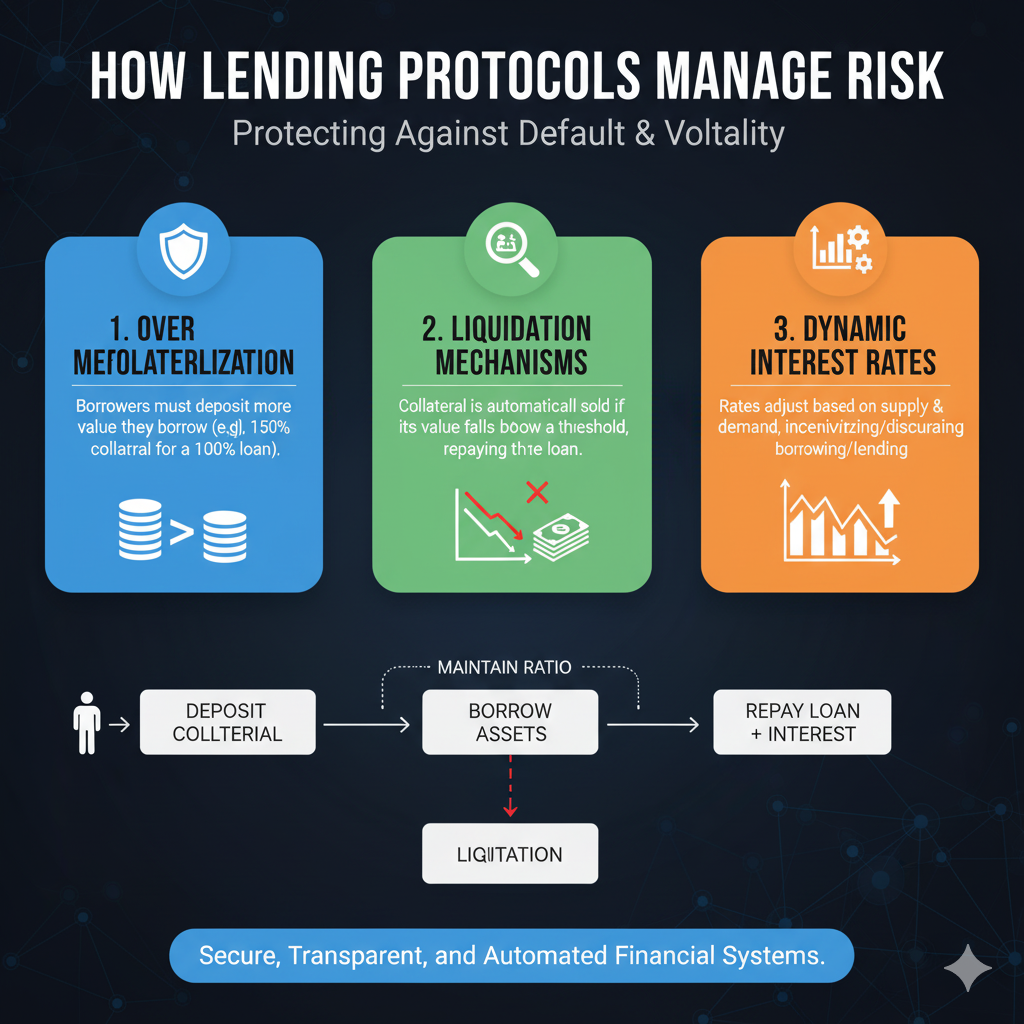
At the heart of risk management in DeFi lending is overcollateralization. This means borrowers must deposit more value in collateral than they borrow. For example, if you want to borrow $100 worth of stablecoins, you might need to lock up $150 in Ethereum (ETH). This buffer protects lenders if the collateral’s price falls.
In protocols like Aave and Compound, overcollateralization ratios are set per asset. Volatile assets like ETH require higher collateral compared to stablecoins. Aave sets per-asset Loan-to-Value (LTV) and liquidation thresholds for each market. Compound sets “collateral factors” per market that cap how much you can borrow against a given asset. MakerDAO, which mints its stablecoin DAI against collateral, uses similar principles, requiring users to maintain a minimum collateralization ratio to avoid penalties.
Think of it like a pawn shop: You bring in a watch worth $200 to borrow $100. If you don’t repay, the shop sells the watch to recover the loan. In DeFi, automation makes this process instant and trustless, executing without human intervention.
Risk Parameters: Fine-Tuning the Safety Net
Lending protocols use adjustable “risk parameters” to control exposure. These are like dials that governance communities tweak based on market conditions and asset characteristics. Understanding these parameters is crucial for anyone participating in DeFi lending.
Loan-to-Value (LTV) Ratio determines the maximum you can borrow against your collateral. Aave sets LTVs per asset based on risk assessment. Compound’s analogous control is the per-asset collateral factor, which serves a similar function in limiting borrowing capacity.
Liquidation Threshold defines the point at which your collateral value triggers liquidation eligibility. If your collateral value falls below this level, your position becomes eligible for liquidation. Compound calls this the “collateral factor,” which similarly defines borrow limits and liquidation conditions.
Liquidation Penalty/Bonus creates incentives for liquidators to act quickly. Exact percentages vary by asset and market and are typically single-digit on major assets in Aave. Liquidators receive a bonus (discount) on collateral to incentivize timely action, ensuring positions are closed before bad debt accumulates.
Debt Ceilings / Caps limit total borrowing per asset to avoid overexposure to any single token. MakerDAO sets per-collateral debt ceilings through governance votes. Aave v3 also employs supply and borrow caps to contain risk and prevent any single asset from dominating protocol exposure.
These parameters are not static. In Aave, specialized risk partners like Gauntlet and Chaos Labs run simulations and recommend updates that governance votes on. This data-driven approach helps optimize risk-reward ratios across different market conditions.
Price Oracles: The Eyes of the Protocol
Accurate pricing is crucial for calculating collateral values and triggering liquidations at the right time. DeFi protocols use decentralized oracles to fetch real-time prices from multiple sources, reducing manipulation risks and single points of failure.
Aave integrates Chainlink price feeds for reliable, tamper-resistant pricing data. Compound v2 uses a price feed maintained by governance that pulls from Chainlink and Open Oracle reporters, creating redundancy in price discovery.
For beginners: Imagine oracles as referees in a game—they provide unbiased scores (prices) so everyone plays fair. Without trusted oracles, the entire system could be manipulated by actors who artificially influence prices to trigger favorable liquidations.
Liquidation Mechanisms: Automated Enforcement
When a borrower’s position becomes undercollateralized, the protocol doesn’t wait—it automates liquidation. Anyone can act as a liquidator, repaying part of the loan to seize collateral at a discount. This open liquidator model ensures swift action even during volatile periods.
Aave v3 introduced a variable liquidation close factor for enhanced risk management. Normally up to 50% of a position can be liquidated at once. However, if the position’s Health Factor deteriorates below approximately 0.95, up to 100% can be liquidated to remove potential bad debt more quickly and protect the protocol.
Compound v2 uses a close factor (commonly 50% in v2) to limit how much of a loan can be liquidated in one event. The liquidation incentive grants liquidators a discount on collateral, making the activity profitable while protecting the protocol.
MakerDAO applies stability fees and runs Dutch auctions (Liquidations 2.0) for collateral, executed by specialized participants called “keepers.” This auction mechanism helps maximize collateral value recovery during liquidation events.
This system prevents “bad debt” from building up, as liquidators profit from keeping the protocol healthy. However, during extreme volatility, cascading liquidations can occur, where one liquidation drops prices further, triggering more—a risk managed by conservative parameters. Aave also includes an “oracle sentinel” on Layer 2 networks to pause liquidations and borrowing if price feeds or sequencers misbehave.
Interest Rate Models: Balancing Supply and Demand
Interest rates in DeFi aren’t fixed; they’re algorithmic, adjusting based on pool utilization (how much is borrowed versus supplied). This manages liquidity risk by encouraging balance between lenders and borrowers.
Compound uses supply and borrow rates as functions of utilization. These models can include a “kink” where rates rise more steeply beyond an optimal utilization point, discouraging excessive borrowing that could drain liquidity.
Aave uses per-reserve interest-rate strategies with similar utilization targets and responsive curves. The protocol adjusts rates dynamically to maintain healthy liquidity levels across all markets.
MakerDAO sets the stability fee (variable) per collateral type via governance to control DAI supply and demand dynamics. This governance-driven approach allows for flexible response to market conditions.
For example, if 80% of a pool is borrowed, rates might jump materially, prompting users to add liquidity or repay loans. This self-balancing mechanism helps prevent liquidity crises without centralized intervention.
Governance and Community Oversight
Risk management isn’t just technical—it’s governed by decentralized autonomous organizations (DAOs). Most major protocols use community governance to adapt risk parameters over time.
Compound uses the Comptroller to enforce risk rules. Governance can update markets and parameters through community proposals and votes, ensuring the protocol evolves with market conditions.
Aave DAO votes on risk parameters and features across multiple blockchain networks, often informed by detailed analyses from Gauntlet and Chaos Labs. This professional risk assessment combined with community voting creates balanced decision-making.
MakerDAO empowers MKR token holders to set liquidation ratios, stability fees, and debt ceilings per collateral type. This gives the community direct control over risk exposure and protocol economics.
This community-driven approach allows adaptation to changing market conditions, but also introduces governance risks such as voter apathy or potential capture by large token holders.
Additional Safeguards: Reserves, Audits, and Insurance
Beyond core mechanics, protocols build extra layers of protection to enhance security and resilience.
Protocol Reserves are created by diverting a portion of borrower interest to reserves via a per-market reserve factor. The exact percentage varies by asset and market, creating a buffer for unexpected losses. Compound explicitly documents this mechanism in their technical documentation, while Aave maintains per-reserve parameters and collectors.
Audits & Bug Bounties provide ongoing security assessment. Major protocols have undergone multiple audits from firms like OpenZeppelin, which has audited both Aave and Compound. Bug bounty programs incentivize white-hat hackers to discover and report vulnerabilities before malicious actors can exploit them.
Insurance / Backstops offer additional protection layers:
Aave’s Safety Module and newer Umbrella architecture let stakers backstop the protocol. Staked assets can be slashed to cover shortfalls, socializing risk among those who opt into this protection role.
External DeFi insurance platforms like Nexus Mutual provide optional cover for users across protocols including Aave, MakerDAO, and Compound. Users can purchase coverage against smart contract failures or other specified risks.
Best practices emphasize diversification across multiple protocols, regular monitoring of positions, and stress-testing with simulations to understand potential outcomes during extreme market events.
Case Studies: Real-World Examples
Aave focuses on modular risk with parameters optimized via data-driven models. Version 3 added supply and borrow caps, an oracle sentinel, and variable close factor to improve incident response and liquidation efficiency. The backstopping mechanism has transitioned toward the new Umbrella architecture for automated slashing when needed, enhancing capital efficiency while maintaining protection.
Compound emphasizes economic security through utilization-based rate curves and a Comptroller that enforces per-market collateral factors and close factor rules. This proven design has persisted through multiple market cycles, demonstrating resilience during both bull and bear markets.
MakerDAO uses per-asset debt ceilings, stability fees, and Dutch auctions to manage risk comprehensively. As of 2025, the protocol manages billions in collateral backing, illustrating both its scale and the critical importance of conservative parameters at such size.
These examples show how combining multiple mechanisms creates robust systems that can withstand various market conditions and attack vectors.
Conclusion: Why Risk Management Matters for DeFi’s Future
DeFi lending protocols manage risk through a sophisticated blend of overcollateralization, dynamic parameters, automated liquidations, reliable oracles, and community governance. These tools ensure lenders get paid, borrowers stay accountable, and the system survives turbulence.
For beginners entering this space, start small and take time to understand the parameters governing your positions. Monitor your collateral ratios regularly using protocol dashboards and DeFi tracking tools. Set up alerts for liquidation thresholds and maintain conservative collateralization levels, especially during volatile periods.
As DeFi grows and matures, improved risk management will drive broader adoption and integration with traditional finance. However, remember that no system is foolproof. Smart contracts can have bugs, market conditions can change rapidly, and governance decisions can have unexpected consequences.
Always conduct thorough research before depositing funds, understand the specific risks of each protocol, and use only what you can afford to lose. By learning from established protocols like Aave, Compound, and MakerDAO, you can participate in DeFi lending with greater confidence and understanding of the sophisticated risk management systems protecting your assets.
The future of decentralized finance depends on continuing to refine these risk management practices, making protocols more resilient while maintaining the transparency and accessibility that make DeFi revolutionary.
Additional Resources:
- Aave Documentation
- Compound Finance Docs
- MakerDAO Documentation
- Chainlink Price Feeds
- Gauntlet Risk Platform
- OpenZeppelin Security
- Nexus Mutual Insurance
Read also: Yield Farming on Ethereum.