
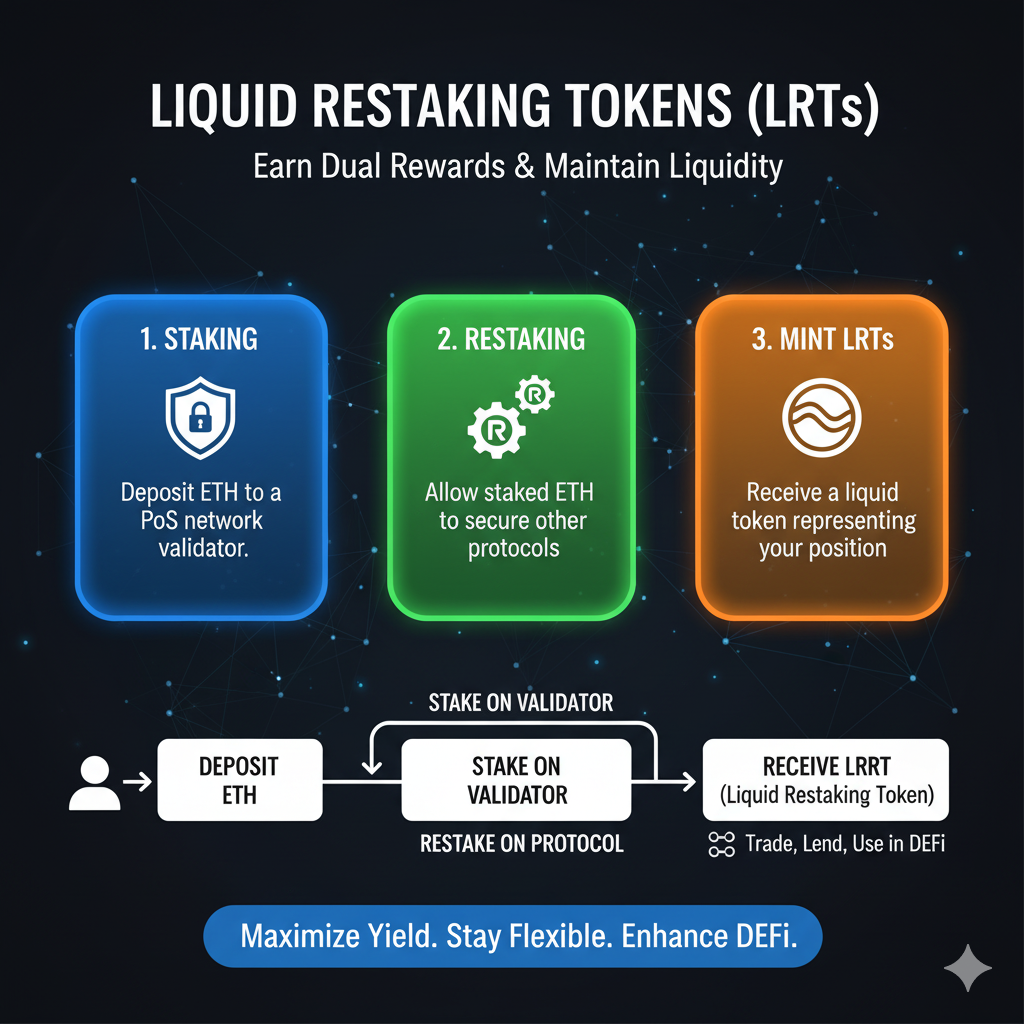
In the fast-evolving world of decentralized finance (DeFi), new innovations are constantly emerging to help users make the most of their cryptocurrency holdings. One such breakthrough is Liquid Restaking Tokens (LRTs), which are gaining traction for their ability to boost yields while keeping assets liquid. If you’re new to crypto or staking, don’t worry—this guide will break it down step by step in simple terms.
By the end of this article, you’ll understand why LRTs are being called the next big thing in Ethereum staking and DeFi. Whether you’re interested in earning extra rewards on your ETH or exploring advanced yield strategies, LRTs could be a game-changer.
Understanding the Basics: What Are Liquid Staking Tokens (LSTs)?
Before we get to LRTs, it’s essential to start with the foundation: Liquid Staking Tokens (LSTs). In traditional staking on networks like Ethereum, you lock up your ETH to help secure the blockchain and earn rewards. However, this locks your assets, meaning you can’t use them elsewhere while they’re staked.
LSTs solve this problem by providing liquidity. When you stake ETH through a liquid staking protocol, you receive an LST in return, such as stETH from Lido or rETH from Rocket Pool. This token represents your staked ETH and its accruing rewards, but it’s tradable and usable in DeFi applications like lending or trading. Essentially, your ETH keeps earning staking yields (typically around 3–5% annually, depending on conditions and setup) while you maintain flexibility.
According to Coinbase, this innovation has made staking more accessible and efficient, with billions of dollars now locked in LSTs.
Think of LSTs like a receipt for your staked assets—you can sell the receipt without unstaking the original ETH. This concept paved the way for more advanced tools like LRTs.
What Is Restaking?
Restaking takes staking to the next level. Introduced by protocols like EigenLayer, restaking allows you to reuse your already staked ETH (or LSTs) to secure additional blockchain services beyond just Ethereum. These services are called Actively Validated Services (AVSs), which could include oracles, rollups, or other decentralized networks that need security.
In simple terms, instead of your staked ETH sitting idle after securing Ethereum, you “restake” it to support these AVSs and earn extra rewards. This increases capital efficiency because the same ETH generates yields from multiple sources. However, traditional restaking still locks your assets, limiting liquidity—until LRTs came along.
Restaking has exploded in popularity. According to The Block, EigenLayer’s total value locked (TVL) surpassed $15 billion on April 23, 2024, and crossed $20 billion on June 6, 2024. It’s like putting your money to work in multiple jobs simultaneously.
What Are Liquid Restaking Tokens (LRTs)?
Liquid Restaking Tokens (LRTs) are the liquid, tradable versions of restaked assets. They build directly on LSTs and restaking by allowing you to restake your ETH (or LSTs), earn compounded rewards, and still use a tokenized representation in DeFi without unstaking.
In essence, an LRT is a token you receive when depositing into a liquid restaking protocol. It represents your restaked position, including the original staking rewards plus additional yields from AVSs. Unlike locked restaked assets, LRTs can be traded, lent, or used as collateral, making your capital highly efficient.
For beginners, imagine your ETH as a worker: With staking, it has one job (securing Ethereum). With restaking, it takes on side gigs (AVSs). LRTs give you a “liquid worker” token that you can sell or redeploy while the original keeps earning. Popular LRTs include weETH/eETH from Ether.fi, ezETH from Renzo Protocol, and pufETH from Puffer Finance.
EigenLayer’s mainnet rollout started in June 2023 (Stage 1), with Stage 2 in April 2024, according to InceptionLRT documentation, which catalyzed the LRT wave. By 2025, the LRT market represented a meaningful slice of DeFi TVL.
How Do LRTs Work? A Step-by-Step Breakdown
Understanding how LRTs operate is key to using them safely. Here’s a simple step-by-step process:
Deposit Your Assets: Start by depositing ETH or an LST (like stETH) into an LRT protocol, such as Ether.fi or Renzo. The protocol handles the restaking for you, typically via EigenLayer. As documented in Ether.fi’s GitBook, users simply connect their wallet and deposit.
Restaking Happens: Your deposited assets are staked on Ethereum (if not already) and then restaked to secure AVSs. This can involve delegating to node operators who validate these services, as explained by Coinbase’s liquid staking guide.
Receive Your LRT: In exchange, you get an LRT token (e.g., ezETH). Reward-bearing and auto-compounding mechanics are common; for example, according to Renzo Protocol documentation, ezETH’s exchange rate reflects accrued rewards over time. Base staking yields are typically in the low single-digits, with restaking adding additional percentage points depending on protocol, market conditions, and incentives.
Use It in DeFi: While holding the LRT, you can trade it, provide liquidity, or use it as collateral. Ether.fi’s weETH and Renzo’s ezETH have growing integrations. According to Aave governance forums, Compound governance, and Enzyme Finance documentation, these LRTs are being integrated across major DeFi platforms.
Redeem When Ready: When you want to exit, you redeem for the underlying asset plus accrued rewards. Some protocols offer instant or flash exit features, such as Renzo’s Instant Withdrawals and InceptionLRT’s Flash Unstake.
Technical Implementation: LRTs can use EigenPods for native restaking, where validators set withdrawal credentials to an EigenPod. According to Kiln documentation and Bedrock documentation, this method is used by protocols like Bedrock for its uniETH LRT.
Benefits of Using LRTs
LRTs offer several advantages that make them appealing for both beginners and experienced users:
Higher Yields: By stacking staking and restaking rewards, LRTs can offer higher returns than plain staking. Base staking yields are approximately 2–5% depending on MEV and network conditions according to Coinbase and Blocknative, and restaking plus protocol incentives can push realized yields higher during certain periods. However, these figures are context-dependent rather than guaranteed.
Capital Efficiency: Your ETH isn’t locked—it’s working across multiple protocols while remaining liquid, as noted by Cube Exchange.
Liquidity & Flexibility: Use LRTs across DeFi platforms. Some protocols add instant or flash exits to bypass unbonding queues, though typically with a small fee according to Renzo documentation.
Ecosystem Security: Restaking extends Ethereum’s security to additional services (AVSs), strengthening the broader ecosystem as explained by Coinbase.
Accessibility: User-friendly interfaces, support for small deposits, and wallet integrations with MetaMask and other popular wallets make LRTs accessible to beginners, as shown on Ether.fi’s platform.
As an example, Puffer Finance issues pufETH and emphasizes anti-slashing design features. Third-party risk reviews discuss its mechanics and TVL according to Puffer Finance documentation.
Risks and Considerations with LRTs
While promising, LRTs aren’t without downsides:
Smart Contract Risk: You’re relying on several contracts simultaneously (EigenLayer plus the LRT protocol plus DeFi integrations). Bugs or logic errors can cause losses. Always verify that protocols have undergone professional audits, as recommended in GitHub security best practices.
Slashing Exposure: Depending on the phase and configuration, slashing penalties may apply to restaked validators and AVSs. EigenLayer phased slashing in after earlier stages. Users should track the current slashing status and AVS terms according to Crypto.com’s help documentation.
Peg and Discount Risk: LRTs aim for a predictable exchange rate versus ETH, but secondary-market prices can deviate, especially during market stress or mass exits. Platform FAQs and market pages on sites like CoinGecko cover this dynamic.
Systemic and Centralization Risk: Concentration of node operators or widely used middleware can create correlated risks across protocols, as discussed in Coinbase’s protocol overviews.
Complexity & Fees: Extra layers add fees and operational complexity. Yields can be reduced by gas costs and protocol fees according to InfStones Documentation.
DYOR Tip: Prefer audited, widely integrated protocols and monitor governance forum updates on platforms like Aave governance.
Popular LRT Protocols and Examples
Several protocols lead the LRT space in 2025:
Ether.fi: Issues eETH and weETH with multi-chain support and wide DeFi integrations. According to InfStones, Ether.fi’s TVL exceeded $7 billion by July 2025.
Renzo Protocol: Offers ezETH (reward-bearing) with deep DeFi integrations and an instant-withdrawal option as documented on Renzo’s platform.
Puffer Finance: Issues pufETH with native liquid restaking focus and security features. Active integrations and risk assessments are available on Puffer Finance.
Kelp DAO: Provides rsETH, accepts multiple LSTs, and emphasizes broad DeFi access according to Kelp DAO.
InceptionLRT: Offers inETH with isolated restaking and Flash Unstake for rapid exits, as shown on Etherscan.
Bedrock: Issues uniETH with explicit EigenPod native restaking documented on Bedrock’s platform.
Note that emerging protocols should be approached with caution. Always verify track records, audits, and independent reviews before depositing funds.
The Future of LRTs in Crypto
Looking ahead, LRTs are poised to play a bigger role in DeFi. As more AVSs launch on EigenLayer, yields may improve via additional fee streams. There’s active work on cross-chain and Layer 2 restaking solutions. Ether.fi has discussed extending weETH-based restaking to L2s and potentially other chains like BNB Chain, with plans surfacing in technical posts on Medium during 2024.
The LRT ecosystem continues to grow rapidly. The Defiant reports that EigenLayer already exceeded $20 billion in TVL during 2024, demonstrating strong market adoption. While forward projections are speculative, the trajectory suggests continued expansion of the LRT market.
Conclusion: Should You Try LRTs?
Liquid Restaking Tokens (LRTs) represent a powerful evolution in crypto staking, offering liquidity, higher yields, and capital efficiency for your ETH. They’re ideal for users looking to maximize returns without locking up assets, but they require understanding the risks involved.
If you’re a beginner, start with a small deposit in a reputable protocol like Ether.fi or Renzo, and track your position closely. Remember, crypto is volatile—never invest more than you can afford to lose.
LRTs are transforming how we think about staking and DeFi. As the ecosystem grows, staying informed will help you capitalize on these opportunities. For more on crypto innovations, explore resources like EigenLayer’s documentation and reputable DeFi analytics platforms like DeFi Llama and Dune Analytics.
Additional Resources:
- EigenLayer Official Website
- Coinbase Learn: Liquid Staking Guide
- Ether.fi Documentation
- Renzo Protocol Documentation
- Aave Governance Forum
- The Block Research
- CoinGecko Market Data
Disclaimer: This article is for educational purposes only and does not constitute financial advice. Cryptocurrency investments carry significant risk. Always do your own research and consult with a qualified financial advisor before making investment decisions.