
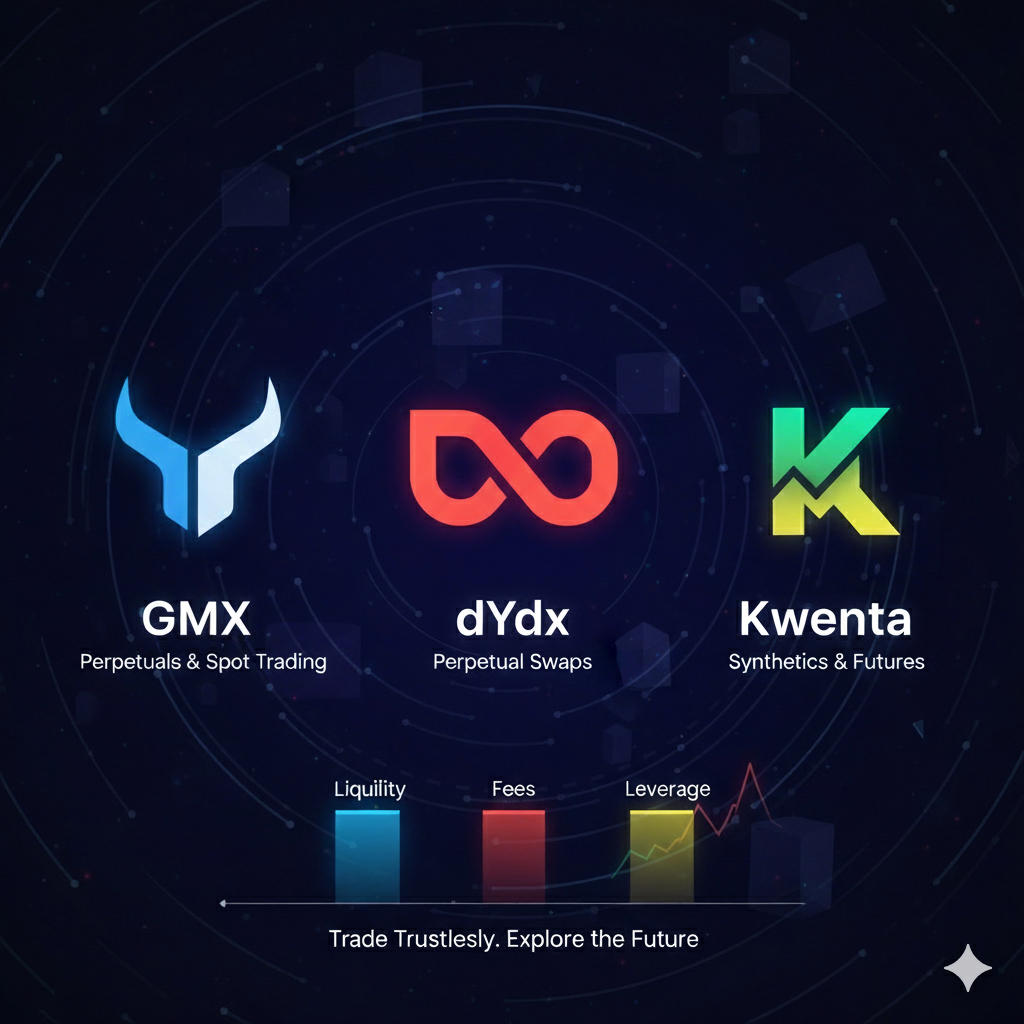
In the world of cryptocurrency, decentralized finance (DeFi) has revolutionized how people trade assets. Among the most exciting innovations are decentralized derivatives, which allow traders to speculate on price movements without owning the underlying assets. Platforms like GMX, dYdX, and Kwenta lead this space, offering perpetual futures contracts with leverage. These tools enable beginners to amplify their trades while maintaining control through self-custody wallets.
This article breaks down decentralized derivatives in simple terms, compares GMX, dYdX, and Kwenta based on verified facts, and helps you decide which might suit your needs. Whether you’re new to DeFi trading or exploring perpetual futures, we’ll use easy examples to explain concepts like leverage and liquidity. All information is drawn from reliable sources as of October 2025.
What Are Decentralized Derivatives?
Decentralized derivatives are financial instruments built on blockchain technology, mimicking traditional derivatives like futures but without central authorities like banks. In DeFi, they often take the form of perpetual futures – contracts that don’t expire and let you bet on whether an asset’s price will rise (long) or fall (short).
For beginners: Imagine you think Bitcoin’s price will go up. Instead of buying BTC, you open a long position with 10x leverage. If BTC rises 5%, your profit could be 50% (minus fees). But if it drops, losses amplify too. Decentralized platforms use smart contracts for transparency and security, reducing risks like hacks on centralized exchanges.
Key benefits include 24/7 access, no KYC requirements, and global participation. However, volatility and liquidation risks are high – always start small.
The decentralized derivatives market in 2025 regularly records tens of billions of dollars in daily trading volume, according to CoinGecko and DefiLlama trackers. Popular in 2025, the DeFi derivatives market has seen trading volumes exceed trillions of dollars cumulatively across platforms. GMX, dYdX, and Kwenta are top players, each with unique models: liquidity pools, order books, and synthetics.
Overview of GMX: The Permissionless Perpetual Exchange
GMX is a decentralized perpetual exchange launched in 2021 on Arbitrum, expanding to Avalanche and Solana in March 2025. It allows trading over 70 assets with up to 100x leverage directly from your wallet, emphasizing low fees and deep liquidity.
Learn more at gmx.io.
How GMX Works
GMX uses an automated market maker (AMM) model with liquidity pools. In version 1 (V1), it featured a multi-asset pool called GLP, where providers earn fees from trades. In version 2 (V2), GMX switched to isolated GM Pools for each asset pair and removed the GLP basket. Prices come from Chainlink oracles for fairness.
Example for beginners: Deposit USDC into a GM pool for BTC/USD. Open a 50x long position with $100 collateral – if BTC rises 2%, you might profit $100 (before fees). But a 2% drop could liquidate your position.
Key Features
- Supported Chains: Arbitrum, Avalanche, Solana (multichain access expanding; Base chain support announced for Q4 2025)
- Trading Instruments: 70+ perpetuals like BTC, ETH, AVAX
- Fees (V2): 0.04%–0.06% for opening/closing positions – lower than V1’s 0.1%
- Liquidity Model: Permissionless GM Pools with hundreds of millions in liquidity
- Governance: Community-driven via GMX token staking
- Stats: Lifetime volume ~$300–350 billion (combined V1 + V2), over 1 million users, open interest around $150–200 million
Security update: GMX V1 was exploited in July 2025, causing approximately $40 million in losses; V2 contracts were unaffected.
GMX rewards liquidity providers with real yields from trading fees, making it appealing for passive income.
Overview of dYdX: DeFi’s Pro Trading Platform
dYdX, founded in 2017, evolved from an Ethereum Layer 2 to its own Cosmos-based chain (v4) in 2023 for full decentralization. It’s known for professional tools, deep liquidity, and over 220 markets with up to 50x leverage.
Visit dydx.exchange for more information.
How dYdX Works
Unlike AMMs, dYdX uses an on-chain order book and matching engine for CEX-like speed. Traders connect wallets, deposit via six chains, and trade perpetuals. The MegaVault provides liquidity (around $12 million TVL as of late 2025).
Beginner example: Connect MetaMask, deposit $50 USDC from Ethereum. Open a 20x short on ETH/USD. If ETH falls 3%, your $50 could yield $30 profit (net of fees). Advanced orders like TWAP add precision.
Key Features
- Supported Chains: Deposits from Ethereum, Base, Optimism, Avalanche, Polygon, Arbitrum; native on dYdX Chain
- Trading Instruments: 220+ markets
- Fees: Low trading fees; periodic deposit promos (e.g., instant & free over $100 in mid-2025)
- Liquidity Model: Decentralized validators and community-driven listings
- Governance: DYDX token for staking and proposals
- Stats: $1.4 trillion+ lifetime volume, ~$200 million open interest
Update 2025: dYdX acquired Pocket Protector in July 2025 to integrate Telegram-based trading; rollout began in August.
Note: dYdX is unavailable to U.S. residents.
Overview of Kwenta: Synthetics-Powered Derivatives
Kwenta, built on Optimism since 2022, leverages the Synthetix protocol for synthetic assets. In late 2024, Synthetix DAO voted to acquire Kwenta, fully merging the two ecosystems. It offers perpetual contracts using synthetic assets with deep liquidity.
Explore more at kwenta.io.
How Kwenta Works
Using Synthetix’s debt pool, Kwenta mints synthetics (Synths) backed by SNX collateral. Traders access assets like crypto, fiat, or commodities via perpetuals.
Simple example: Stake SNX to mint sUSD. Trade a long on sBTC (synthetic BTC) with leverage. No actual BTC needed – profits settle in sUSD. Synthetix stakers counterbalance positions.
Key Features
- Supported Chains: Optimism (Ethereum Layer 2)
- Trading Instruments: Synthetics for crypto, fiat, commodities, equities
- Fees: Variable based on Synthetix; low slippage due to shared debt pool
- Liquidity Model: Overcollateralized Synthetix pool
- Governance: KWENTA token for DAO decisions
- Stats: Lower volume than peers; KWENTA market cap approximately $15 million (as of October 2025)
Clarification: “Infinite liquidity” refers to Synthetix’s pooled model, not literally unlimited depth.
Key Comparisons: GMX vs dYdX vs Kwenta
Features and User Experience
- GMX: Simple 1-click trading; best for high-leverage seekers (100x)
- dYdX: Pro tools, API, mobile and Telegram apps; ideal for advanced traders (50x max)
- Kwenta: Broad synthetic asset access; good for non-crypto exposure
dYdX leads in markets (220+), GMX in leverage, Kwenta in asset diversity.
Fees and Costs
All have low fees: GMX V2 0.04–0.06%, dYdX offers rebates periodically, Kwenta uses Synthetix spreads. GMX and dYdX are most cost-effective for high volume.
Liquidity and Volume
dYdX and GMX dominate: dYdX $1.4 trillion lifetime, GMX $300–350 billion combined. Kwenta trails but has shared liquidity through Synthetix.
Supported Blockchains and Accessibility
- GMX: Arbitrum, Avalanche, Solana, Base (announced)
- dYdX: Cross-chain deposits, native Cosmos chain
- Kwenta: Optimism only
Leverage and Risk
- GMX: Up to 100x (high risk/reward)
- dYdX: 50x
- Kwenta: Up to 50x (some markets lower)
Governance and Tokens
All use native tokens: GMX (for staking rewards), DYDX (for validators and governance), KWENTA (for DAO votes).
Pros and Cons of Each Platform
GMX
Pros: High leverage, low fees, multichain expansion
Cons: July 2025 hack ($40 million loss), AMM price impact in volatile markets
dYdX
Pros: CEX-like experience, high volume, Telegram integration
Cons: Lower max leverage; restricted in U.S.
Kwenta
Pros: Diverse synthetics, low slippage
Cons: Dependent on Synthetix; lower adoption and volume
Recent Updates in 2025
GMX expanded to Solana and announced Base integration (September 2025). dYdX acquired Pocket Protector in July and launched Telegram features in August. Kwenta finalized Synthetix acquisition in 2024 and rolled out v4 perps upgrades.
Market context: Perp DEX daily volumes in October 2025 regularly reach $50–60 billion range, showing sector growth.
Conclusion: Which Decentralized Derivatives Platform to Choose?
- For beginners seeking simplicity and high leverage, start with GMX
- Experienced traders might prefer dYdX’s tools and volume
- If you want synthetic exposure to traditional assets, Kwenta is ideal
Always DYOR (Do Your Own Research), use small amounts, and consider risks. As DeFi evolves in 2025, these platforms could dominate centralized exchanges. Track updates via official sites for the latest information.
Additional Resources:
- Arbitrum Network
- Optimism
- Avalanche
- Cosmos Network
- CoinGecko – DeFi Derivatives Data
- DefiLlama – Derivatives Analytics
Read also: NFT Marketplaces.