
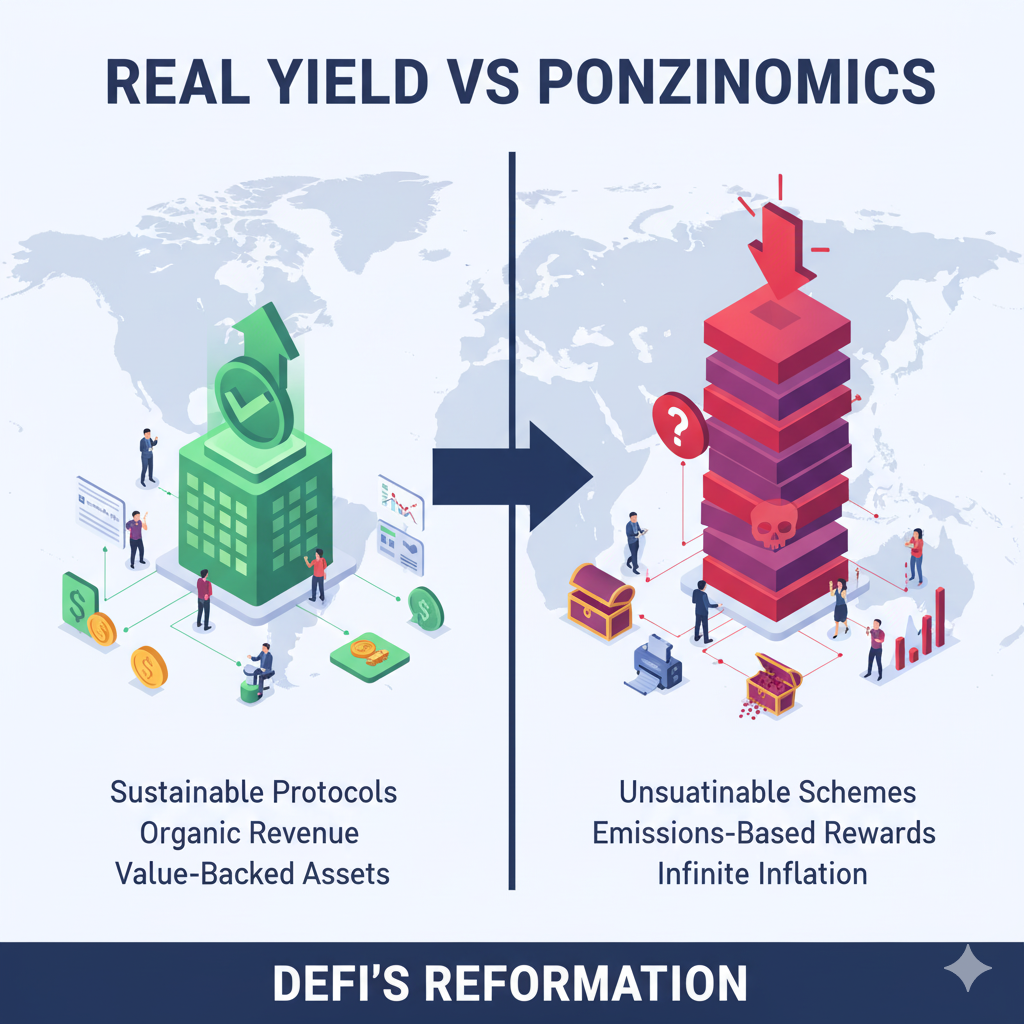
In Decentralized Finance (DeFi), where anyone with an internet connection can lend, borrow, or trade crypto without banks, two ideas have defined how people earn returns: Ponzinomics and real yield. Think of DeFi as a digital finance playground with exciting opportunities and potential pitfalls. Ponzinomics relies on constant new money to pay old promises. Real yield shares revenue from genuine economic activity like trading fees, borrower interest, and real-world asset income. The industry’s pivot from the former to the latter represents DeFi’s reformation — a fundamental move from hype-driven models to durable, sustainable finance.
If you’re new to this space: Ponzinomics is essentially borrowing from tomorrow to pay today. Real yield functions like dividends from a business that actually generates revenue. Below, we break down both models, examine why the shift is happening, and identify which protocols are implementing real yield correctly.
What Is Ponzinomics in DeFi?
Ponzinomics describes systems that offer extraordinarily high annual percentage yields (APYs) powered mainly by token emissions — essentially printing new tokens — rather than by actual profits. The classic pattern unfolds as follows:
A new protocol launches with 1,000% APY or higher to attract deposits and liquidity providers. Rewards are paid in the protocol’s own token, freshly minted through inflationary mechanisms. The token price pumps while new users continue to arrive. Once growth slows, selling pressure intensifies as early participants exit. Yields collapse and the protocol loses credibility.
This dynamic was particularly common during “DeFi Summer” in 2020–2021, when protocols competed aggressively for total value locked (TVL). The fundamental lesson: if the source of yield is token emissions rather than revenue from actual economic activity, the mathematics usually breaks down when capital inflows slow or reverse.
The Rise and Fall of Ponzi-Like Yields
DeFi experienced explosive growth in 2020–2021 as “yield farming” became the primary customer-acquisition tool across the ecosystem. Protocols offered unsustainable incentives to bootstrap liquidity, often resulting in temporary success followed by inevitable contraction. When broader market liquidity tightened in 2022, many emissions-driven designs collapsed spectacularly.
The most infamous example remains Terra/UST and the Anchor protocol. Anchor offered approximately 20% yield on UST, which was marketed as a stablecoin, but this yield wasn’t backed by durable cash flows or revenue-generating activity. The eventual unwind erased tens of billions in market capitalization and triggered broader deleveraging across crypto markets. The fundamental conclusion from this period: high APY does not equal sustainable APY.
According to DeFiLlama, total value locked across DeFi protocols peaked above $180 billion in late 2021 before declining sharply throughout 2022 as unsustainable yield models collapsed.
What Is Real Yield?
Real yield represents income distributed from actual protocol revenue rather than token inflation. Think of it as profit-sharing from genuine business operations:
DEX fees: Liquidity providers earn a percentage cut of swap fees, typically ranging from 0.05% to 0.30% depending on the pool and protocol design.
Lending interest: Capital suppliers earn interest paid by borrowers, with rates adjusting dynamically based on supply and demand within each market.
RWA income: On-chain funds and tokenized products pass through yields from Treasury bills, corporate credit, or other real-world assets to token holders, subject to legal terms and KYC requirements.
Real yield is typically in the single-digit to low double-digit range and demonstrates greater stability because it derives from actual usage and productive assets rather than from printing tokens.
Quick verification test: If income comes from fees, interest, or asset income, it’s likely real yield. If income comes mainly from emissions or newly minted tokens, it’s likely Ponzinomics.
Real-Yield Protocols in Practice
Several major DeFi protocols have successfully implemented real yield models:
Uniswap (LP fees): Liquidity providers earn swap fees from genuine trading activity. No token emissions are required for fee payouts, though UNI governance tokens exist separately. According to Uniswap’s analytics, the protocol has generated billions in cumulative fees distributed to liquidity providers.
Aave (credit markets): Lenders earn interest from borrowers in a dynamic, utilization-based system. Interest rates adjust algorithmically based on supply and demand within each lending pool, creating market-driven yields rather than arbitrary emissions.
GMX (perpetual DEX): Stakers of GMX and GLP receive direct shares of protocol fees generated by traders, distributed in ETH and AVAX rather than inflationary tokens. The protocol has maintained consistent fee generation through perpetual futures trading activity.
Synthetix (derivatives platform): Trading fees from perpetual contracts and synthetic assets flow to SNX stakers in stablecoins. The protocol has progressively reduced reliance on inflationary rewards while increasing revenue-based distributions.
Tokenized Treasuries (examples include OUSG from Ondo Finance and BUIDL from BlackRock): On-chain vehicles that pass through short-duration U.S. Treasury income to token holders, representing canonical “real-world” yield brought on-chain. According to RWA.xyz, tokenized Treasury products have grown to billions in assets under management.
These examples share a defining trait: payouts are tied directly to cash-generating activity rather than new token issuance.
Why the Shift to Real Yield?
Several converging factors have driven DeFi’s reformation toward sustainable yield models:
Sustainability: Token emissions function as marketing expenses, not genuine business models. Once user growth slows, the underlying promises become mathematically impossible to maintain.
Institutionalization: Tokenized funds, real-world assets, and institutional participants demand predictable, compliant, revenue-backed income streams rather than speculative yield farming.
User Preference: Both experienced traders and newcomers increasingly prefer steady 5–12% returns grounded in fees or productive assets over “four-digit APY” fireworks that inevitably collapse.
Market Maturity: Protocol builders now compete on fundamental unit economics including fees, volumes, and risk controls rather than purely on incentive programs. This mirrors the maturation trajectory of traditional financial markets.
Benefits and Challenges
Benefits of Real Yield
Stability: Fee-based, interest-based, and RWA-based income streams persist through market cycles rather than evaporating during downturns.
Transparency: On-chain accounting and open-source smart contracts allow anyone to verify where cash flows originate and how they’re distributed.
Accessibility: Global users can access diverse income streams without traditional financial gatekeepers, geographic restrictions, or minimum investment requirements.
Challenges
Lower headline APYs: Real yield delivers sustainable returns, but it won’t advertise 1,000% APYs. This creates a marketing disadvantage against newer Ponzinomic schemes.
Smart-contract and market risk: Code vulnerabilities, oracle manipulation, and liquidity shocks remain persistent risks regardless of yield sustainability.
Complexity: Users must develop skills to audit revenue sources, understand tokenomics, and evaluate protocol fundamentals rather than chasing headline yields.
Compliance requirements: RWA products often require KYC verification and have legal constraints that vary by jurisdiction, reducing the permissionless nature that originally defined DeFi.
How to Distinguish Real Yield From Ponzinomics: Verification Checklist
When evaluating any DeFi protocol offering yields, apply this systematic checklist:
Source of income: Are returns generated from trading fees, borrower interest, or RWA coupons? Or do they come primarily from emissions, “points,” or inflationary token issuance?
Payout asset: Are revenues distributed in established assets like ETH, USDC, or T-bill yields? Or only in the protocol’s own token?
Sustainability mathematics: Would the current payout structure survive if user growth remained flat for 12 months? Run the numbers.
Incentive design: Does the protocol use limited, strategically targeted incentives? Or does it depend on perpetual high emissions to maintain APYs?
Risk disclosures: Are there clear documentation, third-party audits from firms like Trail of Bits or OpenZeppelin, and transparent metrics dashboards? Or vague promises and unclear documentation?
The Future: Sustainable, Boring (in a Good Way), and Potentially Transformative
DeFi’s reformation represents a fundamental shift from speculative carnival to functional financial infrastructure layer. Expected developments include:
Expanded RWA rails bringing treasuries, corporate credit, real estate, and other productive assets on-chain to feed sustainable income streams. According to Boston Consulting Group, tokenized assets could represent a multi-trillion dollar market by 2030.
Derivatives and trading venues continuously optimizing fee structures and implementing transparent revenue-sharing mechanisms with stakers and liquidity providers.
Lending markets emphasizing sophisticated risk pricing, collateralization requirements, and credit assessment rather than rewards-driven user acquisition.
Users increasingly treating protocols like traditional businesses, evaluating revenue, operating costs, profit margins, and competitive moats rather than purely narrative-driven speculation.
Bottom line: Real yield isn’t merely a buzzword or temporary trend — it represents DeFi growing up and potentially achieving mainstream adoption. If you verify where returns originate and confirm the underlying economics function without continuous new capital inflows, you’re positioning yourself on the sustainable side of crypto finance. The reformation from Ponzinomics to real yield may ultimately determine which protocols survive the next decade and which become cautionary tales.