
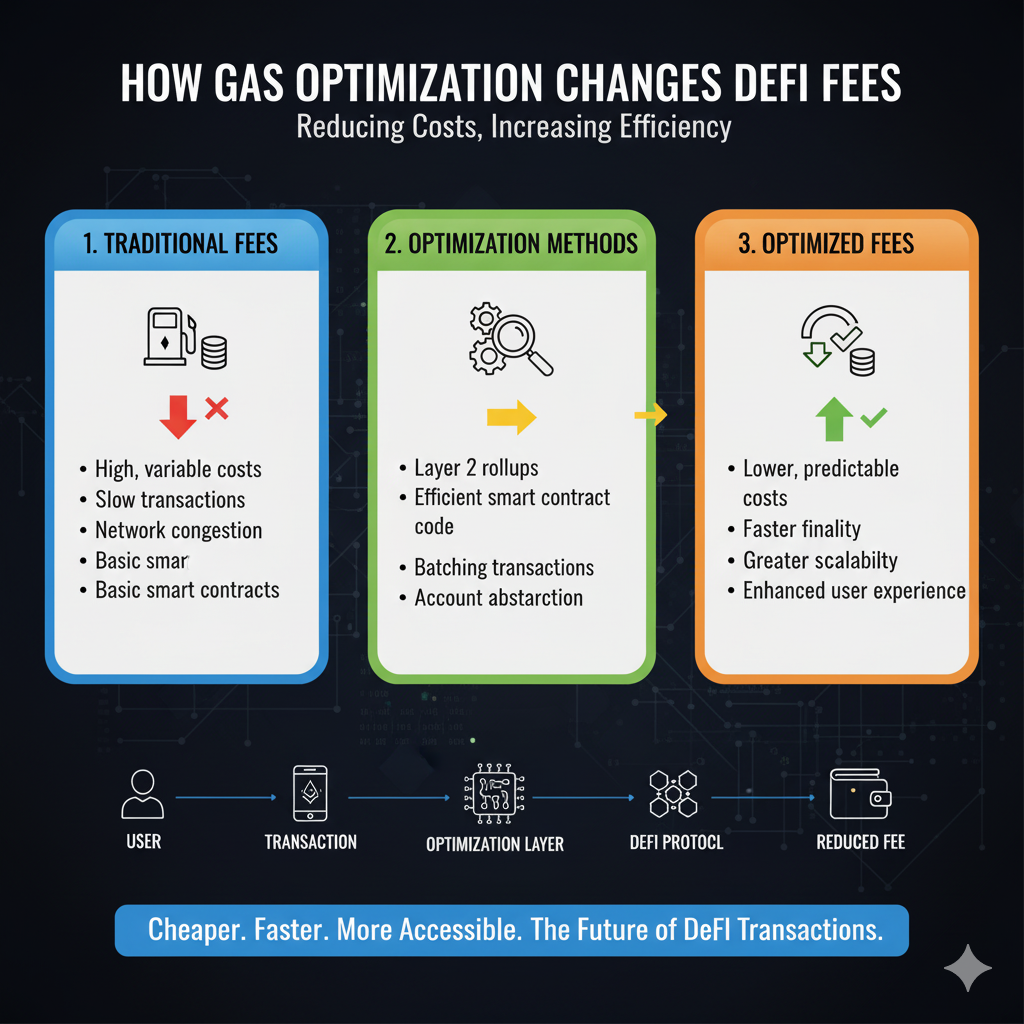
In the world of decentralized finance (DeFi), transaction costs can make or break user experience. High fees often deter newcomers and frustrate seasoned users alike. But what if there was a way to slash these costs without compromising security or functionality? Enter gas optimization—a technical strategy that’s transforming how DeFi operates on blockchains like Ethereum. This article explores how gas optimization works, its techniques, and its profound impact on DeFi fees. We’ll break it down in simple terms, using real examples, so even beginners can grasp it. By the end, you’ll understand why this innovation is key to making DeFi more accessible and efficient.
Whether you’re swapping tokens on Uniswap or lending assets on Aave, gas fees are the “toll” you pay for using the network. As DeFi grows, optimizing these fees isn’t just a nice-to-have—it’s essential for scalability and adoption. Poor UX and high costs remain key barriers, as explored in our DeFi UX analysis. Let’s dive in.
What Are Gas Fees and Why Do They Matter in DeFi?
Gas fees — the backbone of Ethereum’s transaction system — are covered in detail in our beginner’s guide to Ethereum gas fees. Think of them as the fuel needed to power your car’s engine—except here, the “car” is a smart contract execution on the blockchain. Every action, from sending ETH to interacting with DeFi protocols, requires computational resources. These are measured in “gas units,” and users pay for them in ETH.
Ethereum’s gas system prevents spam and ensures fair resource allocation. Since EIP-1559 (August 2021), total fee is effectively calculated as: (Base fee + Priority fee) × Gas units used; the base fee is burned and the priority fee (tip) goes to validators. This made fees more predictable than the old first-price auction, as detailed in Decentralized Thoughts research.
In DeFi, fees add up quickly. For instance, approving a token spend, swapping assets, and claiming rewards might involve multiple transactions, each incurring gas costs. High fees can eat into profits, especially for small trades. During the 2021 DeFi summer, average Ethereum transaction fees often exceeded $50, peaking around $70 on May 12, 2021.
This is where gas optimization comes in: by reducing the gas units needed per transaction, it directly lowers costs, making DeFi more inclusive.
Demystifying Gas Optimization: The Basics
Gas optimization is the process of writing and deploying smart contracts that use fewer gas units to perform the same tasks. It’s like streamlining a recipe to use fewer ingredients without changing the final dish.Developers achieve this by tweaking code in languages like Solidity — the foundation of smart contracts on Ethereum.
Why optimize? Unoptimized contracts waste gas on unnecessary operations, inflating fees. For DeFi apps, which handle billions in value, even small savings per user multiply across thousands of transactions. Optimization doesn’t change the blockchain’s base rules but makes interactions more efficient within them.
A key update influencing this is EIP-1559, implemented in 2021. It introduced a base fee (burned) plus a priority fee (tip) for faster inclusion—improving predictability, while actual cost still depends on gas units consumed.
Key Techniques for Gas Optimization
Developers use several proven strategies to cut gas consumption. Here’s a breakdown in simple steps:
Storage Optimization: On-chain storage is expensive—reading or writing data costs gas. Techniques include using smaller data types (e.g., uint8 where appropriate) and packing variables so multiple small values fit into one 32-byte storage slot, as outlined in the Solidity documentation.
Minimizing On-Chain Operations: Keep heavy computations off-chain and store less state when possible (emit events instead of storage for logs; use oracles or calldata-efficient designs). Post-Cancun/Dencun, rollups gained cheaper “blob” data, further favoring L2 off-chain batching, according to Polygon Technology research.
Loop and Function Efficiency: Loops can be gas hogs. Prefer mappings over arrays for direct lookups to avoid iteration and bounds checks where iteration isn’t required. Inline tiny functions when it materially reduces overhead, as recommended by RareSkills.
Error Handling: Custom errors (Solidity ≥0.8.4) are more gas-efficient than require with long strings, reducing both deploy and revert costs, per the Solidity Programming Language documentation.
Layer 2 Integration: While not pure code optimization, moving activity to Optimism, Arbitrum and other L2s that batch transactions and settle to Ethereum typically yields over 90% lower user fees—especially after the 2024 Dencun upgrade (EIP-4844), as analyzed by Polygon Technology. Some protocols also explore alternative ecosystems like BNB Chain, which we compared in detail here, to balance cost, scalability, and user access.
These methods can reduce gas usage materially depending on the contract—think of it as decluttering your home: less stuff means easier, cheaper maintenance.
How Gas Optimization Directly Impacts DeFi Fees
The magic happens when optimization scales to DeFi protocols. Lower gas per transaction means users pay less overall, encouraging more activity. This creates a virtuous cycle: more users lead to higher liquidity, better prices, and sustained growth.
Take yield farming: in unoptimized farms, staking and unstaking might cost 200,000 gas units each. Optimization could drop this to 100,000, halving fees at the same gas price. That said, fee markets allocate scarce blockspace; research shows demand for blockspace adjusts with cost, so network-wide fees don’t necessarily fall permanently just because individual contracts get cheaper.
High fees also deter small investors. Optimization lowers the entry barrier, boosting adoption in emerging markets where $5 fees are prohibitive.
Real-World Examples of Gas Optimization in DeFi
Let’s look at practical cases to illustrate the change.
Uniswap v3: v3’s concentrated liquidity massively improves capital efficiency versus v2; however, per-swap gas on v3 is often higher than on v2 (efficiency shows up in price impact/liquidity usage, not always in gas). So the earlier “up to 30% cheaper gas than v2” framing is inaccurate; v3 trades can cost more gas depending on the path/pools, as documented in ResearchGate studies.
Aave v3: Aave v3 introduced contract-level gas optimizations (roughly 20–25% in many functions per the technical paper) and added L2-specific calldata-optimized L2Pool to reduce user costs on rollups. That’s a structural optimization—not a blanket “gas refund” to users, according to GitHub documentation.
Route/Aggregator Optimizations: 1inch Router v5 and updates to its Pathfinder algorithm focus on reducing gas and failed trades through smarter routing; CoW Swap uses off-chain order-matching and batch auctions to avoid MEV and offer gasless approvals, cutting effective costs for many users, as reported by Levex.
Shibarium / “Delhi” Upgrade Context: The “Delhi” hardfork is a Polygon PoS upgrade that smoothed base-fee spikes. The Shiba Inu team later announced Shibarium adopts the Polygon-aligned “Delhi” changes to stabilize fees on its network. (It’s not an Ethereum L1 change.), per Yahoo Finance coverage.
Challenges and Limitations of Gas Optimization
No solution is perfect. Over-optimization can introduce bugs or reduce readability, making audits harder. And even with highly optimized code, macro factors (congestion, market cycles) still swing fees. As networks evolve—e.g., the 2024 Dencun upgrade that cut L2 data costs—optimizations must adapt to new fee dynamics, as discussed by Polygon Technology.
The Future of Gas Optimization in DeFi
Looking ahead, intents-based trading and smarter routing (as seen with CoW/1inch) and improved fee markets will automate more of the cost-savings. On the network side, proto-danksharding (EIP-4844) already dropped L2 fees significantly, and further roadmap steps aim to push costs even lower. Wallets such as MetaMask also guide users via EIP-1559 fee estimations (base + priority fee), improving UX without users hand-tuning gas, according to Polygon Technology research.
Conclusion: A More Affordable DeFi Ecosystem
Gas optimization is quietly revolutionizing DeFi by slashing fees and enhancing efficiency. From basic code tweaks (storage packing, mappings, custom errors) to L2 deployments and smarter order-routing, it’s making blockchain interactions cheaper and faster. For beginners, this means dipping into DeFi without fear of high costs; for experts, it amplifies profits.
As DeFi matures, expect optimization to become standard. If you’re new, start with L2 platforms and reputable protocols that actively optimize execution. And remember: always DYOR and use well-audited code and trusted aggregators.
DeFi isn’t just for whales—it’s for everyone. Lower fees will fuel the next wave of innovation.
Related Resources: