Home Blog Page 9

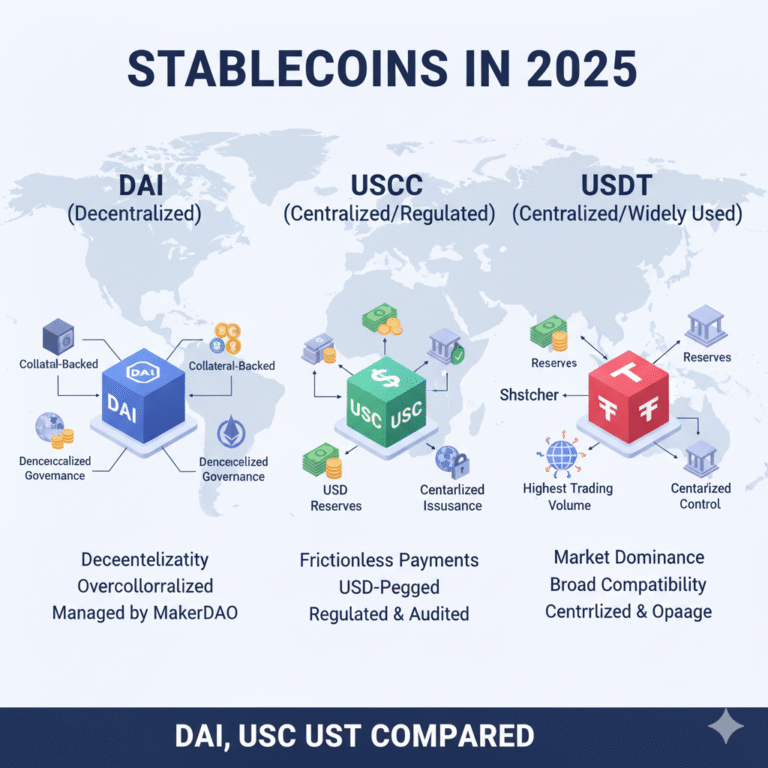
Stablecoins in 2025: DAI, USDC, USDT Compared

0

In the fast-evolving world of cryptocurrency, stablecoins have become essential tools for bridging traditional finance and digital assets. As of 2025, the stablecoin market has surged past $300 billion in total market capitalization, reflecting their growing role in payments, trading, and decentralized finance (DeFi). Among the top players, DAI, USDC, and USDT stand out as the most prominent dollar-pegged stablecoins.

This article compares these three leading stablecoins—USDT (Tether), USDC (USD Coin), and DAI—focusing on their features, backing, adoption, and outlook in 2025. Whether you’re a beginner exploring crypto or an experienced trader, understanding these stablecoins can help you navigate the market more effectively.

Stablecoins like DAI, USDC, and USDT offer stability in a volatile crypto landscape, maintaining a value close to $1 USD. They enable seamless transactions without the price swings of assets like Bitcoin or Ethereum. In 2025, with regulatory frameworks solidifying worldwide—including the EU’s MiCA regulation and the U.S. GENIUS Act—these stablecoins are more reliable than ever.

What Are Stablecoins?

Stablecoins are cryptocurrencies designed to hold a steady value, typically pegged to a fiat currency like the US dollar. Unlike volatile coins, they minimize risk, making them ideal for everyday use in crypto ecosystems. There are different types of stablecoins:

  • Fiat-collateralized: Backed by reserves of real-world assets like cash or bonds. USDT and USDC fall into this category.
  • Crypto-collateralized: Backed by other cryptocurrencies, often over-collateralized to handle volatility. DAI is a prime example.
  • Algorithmic: Maintained through smart contracts and supply adjustments, though these are less common due to past failures.

In 2025, stablecoins facilitate trillions in annual transaction volume, powering everything from remittances to DeFi lending. Their appeal lies in combining blockchain’s speed and security with the predictability of traditional money.

The Role of Stablecoins in Crypto

Stablecoins act as a “safe haven” during market downturns, allowing users to park funds without exiting crypto entirely. They’re widely used for trading pairs on exchanges, cross-border payments, and earning yields in DeFi protocols. For beginners, think of them as digital dollars that move instantly across borders at low cost. In 2025, with global adoption rising, stablecoins are integral to institutional finance, including payroll and treasury management.

Overview of USDT (Tether)

USDT, issued by Tether, is the oldest and most dominant stablecoin, launched in 2014. It’s pegged 1:1 to the US dollar and backed by a mix of cash, cash equivalents, and other assets, including receivables from loans. Tether emphasizes full reserves, meaning the value of its holdings always meets or exceeds the circulating supply.

History and Backing

Tether started on the Bitcoin blockchain but now operates on multiple networks like Ethereum, Tron, and Solana. Its backing includes traditional currency and short-term investments, ensuring liquidity. Despite past controversies over reserve transparency, Tether now provides daily circulation and reserve metrics, and publishes quarterly attestation reports by BDO Italy.

Market Position in 2025

As of October 2025, USDT’s market cap is approximately $178 billion, capturing roughly 60%+ of the stablecoin market. Reported 24-hour trading volumes frequently exceed $170 billion on busy days. Source: CoinMarketCap

In emerging markets, USDT is particularly popular for remittances due to its widespread availability on exchanges worldwide.

Overview of USDC (USD Coin)

USDC, launched in 2018 by Circle in partnership with Coinbase, is another fiat-backed stablecoin pegged to the USD. It’s fully reserved with cash and cash equivalents, primarily held in U.S. Treasury securities and managed via regulated structures like the Circle Reserve Fund.

History and Backing

USDC was created to offer a transparent alternative in the stablecoin space. Circle provides monthly third-party attestations by Deloitte & Touche LLP and frequent reserve disclosures, helping to ensure 1:1 backing. USDC is natively supported on 28 blockchains including Ethereum, Solana, Base, and Stellar, reflecting its emphasis on compliant, multi-chain reach.

Market Position in 2025

With a market cap of approximately $75 billion in October 2025, USDC ranks second among stablecoins and has grown roughly 90% year-over-year, driven by institutional demand. Source: CoinMarketCap

USDC is favored for regulatory alignment, including integrations and settlement pilots with Visa and Mastercard networks.

Overview of DAI

DAI, created by MakerDAO in 2017, is a decentralized stablecoin backed by crypto collateral rather than fiat. Users generate DAI by locking assets like ETH in smart contracts, with over-collateralization—typically 150% or more—to maintain stability.

History and Backing

Governed by a DAO (Decentralized Autonomous Organization), DAI relies on community votes for decisions. Its collateral set includes cryptocurrencies and significant real-world asset (RWA) exposure, such as short-dated U.S. Treasuries via RWA structures. This setup avoids central control, appealing to DeFi enthusiasts who value decentralization.

Market Position in 2025

DAI’s market cap is approximately $5.3 billion in 2025, placing it among the largest decentralized stablecoins and making it integral to DeFi usage on platforms like Aave. Source: CoinMarketCap

Key Comparisons: DAI vs. USDC vs. USDT

When comparing DAI, USDC, and USDT in 2025, several factors highlight their differences. Here’s a comprehensive breakdown:

Backing and Stability

  • USDT: Fiat-backed with a diverse reserve portfolio featuring large U.S. Treasury exposure and quarterly attestations. Maintains a peg near $1 with only brief deviations.
  • USDC: Cash and cash-equivalents held primarily in Treasuries via the Circle Reserve Fund with monthly attestations; generally trades very close to $1.
  • DAI: Crypto and RWA-backed with over-collateralization; typically holds close to $1, with on-chain mechanisms absorbing shocks.

Key Insight: All three have proven resilient, but DAI’s decentralized design can face added stress in extreme crypto downturns due to its reliance on cryptocurrency collateral.

Transparency and Regulation

Regulatory clarity improved significantly in 2025. In the United States, the GENIUS Act establishes a federal framework for payment stablecoins, including reserve and disclosure requirements. In the European Union, MiCA licensing favors compliant issuers, with Circle becoming the first to comply in July 2024.

  • USDC leads on formal disclosures and assurance with monthly attestations
  • USDT provides daily circulation data and quarterly attestations
  • DAI’s transparency is on-chain, though outside traditional issuer regulation

Adoption and Use Cases

  • USDT: Dominates trading and remittances, with unmatched exchange liquidity across global markets
  • USDC: Preferred for institutional and enterprise use including treasury management and payments, with integrations and pilots with Visa and Mastercard
  • DAI: Excels in DeFi applications for lending, borrowing, and yield farming

In 2025, USDT and USDC handle most global transaction volume, while DAI thrives in decentralized applications and protocols.

Risks

No stablecoin is risk-free. USDT and USDC face issuer, counterparty, and regulatory risks, though these are mitigated by disclosures and oversight. DAI can face liquidation cascades if collateral values drop sharply during market crashes. Beginners should diversify their stablecoin holdings and monitor reserve reporting regularly.

Future Outlook for Stablecoins in 2025 and Beyond

The stablecoin market is projected to grow further in 2025, driven by institutional adoption and regulatory clarity. USDT will likely maintain dominance in liquidity and trading volume, USDC in compliance-focused sectors and enterprise adoption, and DAI in DeFi innovations and decentralized applications.

Emerging trends include expanded multi-chain support and increased real-world asset (RWA) integration, expanding use cases like tokenized payments and institutional treasury management. With the total market cap now around $300 billion, stablecoins are set to keep reshaping global finance.

Conclusion

In 2025, DAI, USDC, and USDT each offer unique strengths:

  • USDT for broad accessibility and trading liquidity
  • USDC for regulatory trust and institutional compliance
  • DAI for decentralization and DeFi integration

For beginners, start with small holdings and research based on your needs—whether for trading, saving, or participating in DeFi. As the crypto space matures, these stablecoins will continue to play a pivotal role in the digital economy.

Important: Always verify the latest data from reliable sources like CoinMarketCap, CoinGecko, and official issuer websites to make informed decisions. Market caps and trading volumes change rapidly in the cryptocurrency market.


Additional Resources:

Read also: Stablecoins on Ethereum.
How DEX Aggregators Work: A Beginner’s Guide to 1inch, Matcha, and CowSwap

0

Introduction

In the world of decentralized finance (DeFi), trading cryptocurrencies doesn’t have to involve centralized exchanges like Binance or Coinbase (Binance Tutorial). Instead, DEX aggregators and decentralized exchanges (DEXs) allow peer-to-peer swaps directly on the blockchain, keeping you in full control of your funds. However, with liquidity spread across many DEXs—such as Uniswap, Sushiswap, and Curve Finance—finding the best price for a trade can be challenging. This is where DEX aggregators come in. These powerful tools act like smart shopping assistants, scanning multiple DEXs simultaneously to secure the optimal deal, minimizing costs, and reducing risks like price slippage.

If you’re new to crypto trading, think of a DEX aggregator as a travel booking site like Expedia. Just as Expedia checks airlines for the cheapest flight, DEX aggregators check various DEXs for the best token swap rate. Moreover, this guide explains how DEX aggregators work, focusing on three popular platforms: 1inch, Matcha, and CowSwap. Furthermore, we’ll use simple language, real-world analogies, and verified facts to make it easy for beginners while providing expert insights. By the end, you’ll understand how DEX aggregators optimize trades like ETH to USDC.


The Basics of DEX Aggregators

DEX aggregators are platforms that consolidate liquidity from multiple decentralized exchanges to offer users better trading conditions. In essence, these aggregators solve a key DeFi problem: liquidity fragmentation. In traditional finance, stock exchanges like the New York Stock Exchange have centralized order books, but in DeFi, each DEX operates independently with its own liquidity pools. Consequently, this can lead to poor prices on a single DEX, especially for large trades or less popular tokens.

DEX aggregators pull data from dozens of sources, including automated market makers (AMMs) like Uniswap and order book-based DEXs. They use sophisticated algorithms to analyze real-time prices, liquidity depth, and fees, then route your trade accordingly. As a result, you get better rates than trading on one DEX alone—often low single-digit improvements (e.g., ~1–3% in many cases), depending on market conditions and gas fees.1

Why Use DEX Aggregators?

For beginners, DEX aggregators simplify trading: no need to hop between apps or compare prices manually. For experts, these tools optimize efficiency in a multi-chain world, supporting networks like Ethereum, Binance Smart Chain (BSC), and Polygon. Additionally, popular DEX aggregators like 1inch, Matcha, and CowSwap have processed billions in volume, proving their reliability in 2025’s DeFi landscape.23

Key Benefits of DEX Aggregators

When you use DEX aggregators, you unlock several advantages:

  • Better pricing: These platforms compare prices across multiple DEXs simultaneously
  • Time efficiency: No manual checking of different exchanges
  • Reduced slippage: Smart routing minimizes price impact on large orders
  • MEV protection: Advanced features protect against front-running attacks
  • Multi-chain support: Access to various blockchain networks from one interface

How DEX Aggregators Work: The Core Mechanism

At their heart, DEX aggregators follow a straightforward process, but with sophisticated technology under the hood. Therefore, understanding this mechanism helps you appreciate why DEX aggregators consistently deliver better results than single-DEX trading. Here’s a step-by-step breakdown:

1. User Input

First, you connect your wallet (e.g., MetaMask) and specify the trade, like swapping 1 ETH for USDC. Then, you set parameters like slippage tolerance (e.g., 0.5%) to protect against price changes during execution.

2. Liquidity Scanning

Next, the DEX aggregator queries multiple DEXs in real time. It checks liquidity pools for available tokens and calculates potential prices, including gas fees and network congestion. This comprehensive scanning is what makes DEX aggregators so effective.

3. Smart Order Routing (SOR)

This is where DEX aggregators truly shine. Advanced algorithms split your order across DEXs if needed. For example, 60% might go through Uniswap for low slippage, and 40% through Curve for stablecoin efficiency. Furthermore, multi-hop routing could involve intermediate tokens (e.g., ETH to DAI to USDC) if direct paths are suboptimal.

4. Optimization for Fees and Risks

DEX aggregators minimize gas costs and protect against Maximal Extractable Value (MEV), like front-running where miners/validators manipulate trades. Additionally, some platforms use off-chain computations for efficiency (e.g., RFQ/solvers).

5. Execution

Once approved, the trade executes via smart contracts. You receive the tokens directly in your wallet, with no intermediaries holding your funds. This trustless execution is a cornerstone of why DEX aggregators are preferred by DeFi users.4

Understanding Slippage in DEX Aggregators

This mechanism ensures minimal slippage—the price impact from large trades—and better overall returns. For a $10,000 ETH/USDC swap, DEX aggregators can save you anywhere from basis points to a few percentage points; however, savings are not guaranteed and depend on liquidity and gas costs.5


Deep Dive into 1inch: The Pathfinder Pioneer

1inch is one of the most established DEX aggregators, launched in 2019 during a hackathon. It’s known for its Pathfinder algorithm, which discovers optimal swap routes across a large set of DEXs on chains like Ethereum, BSC, and Polygon—and has been updated in 2025 with further rate improvements.6

How 1inch Works

When you initiate a trade, this leading DEX aggregator scans sources like Uniswap V3, Balancer, and Curve. Pathfinder splits orders dynamically—for a 1 ETH to USDC swap, it might route 70% via Uniswap and 30% via Balancer to avoid slippage. Unique features include:

Chi Gas Token (Deprecated)

CHI is deprecated on Ethereum after EIP-1559; however, it may still work on BSC, but it no longer offsets gas on Ethereum.7

Fusion Mode

This innovative feature enables gasless trades using off-chain resolvers who compete to fill orders, providing MEV protection. Launched in late 2022 and covered in 2023–2025 documentation, Fusion Mode represents a significant advancement in how DEX aggregators protect users.89

Limit Orders

Set specific prices, like buying USDC only if ETH drops below $2,000. This feature is implemented via the 1inch Limit Order Protocol, which has multiple audits by OpenZeppelin and others.10

1inch Performance in 2025

For beginners: Imagine trading 5 ETH for USDC. On a single DEX, you might get worse execution due to slippage; however, 1inch and other DEX aggregators can improve the outcome by splitting across pools. In 2025, 1inch reports better swap rates (up to ~6.5% improvement) from its latest Pathfinder update, and its contracts are widely audited.11


Exploring Matcha: User-Friendly Aggregation by 0x

Matcha, built by the 0x Protocol team, emphasizes simplicity and transparency among DEX aggregators. Launched in 2020, it aggregates from many exchanges across numerous chains. Furthermore, in April 2025, Matcha added Solana and cross-chain support, expanding beyond EVM networks.12

Core Mechanism of Matcha DEX Aggregator

Matcha uses Smart Order Routing (SOR) and RFQ (Request for Quote) from off-chain market makers. For MEV protection, this DEX aggregator supports private orderflow/MEV-aware execution (e.g., via Matcha Auto/RFQ and private channels, including Flashbots-style protections).1314

Example Trade Scenario

Consider swapping $10,000 USDC for ETH. Matcha might route 70% through a deep Balancer pool and 30% via RFQ for a fixed price, avoiding volatility. Features include:

Limit Orders

These prevent execution below your limit price (so effective zero slippage vs. your set limit); however, execution isn’t guaranteed if the market never reaches the price.15

Transparent Fees

Unlike some platforms, this DEX aggregator displays costs upfront so you know exactly what you’re paying.

Cross-Chain Support

Seamless swaps with integrated bridging and Solana support added in 2025.16

Matcha’s 2025 Expansion

For novices: Matcha’s interface is straightforward—connect your wallet, select tokens, confirm. As of 2025, this DEX aggregator advertises support for “22M+ tokens across 180+ DEXes and 14+ chains, now including Solana,” a major expansion beyond earlier figures.17


Understanding CowSwap: Batch Auctions and MEV Resistance

CowSwap, developed by Gnosis (CoW Protocol), stands out among DEX aggregators with its batch auction model for MEV protection. It processes orders in frequent short-interval batches where solvers compete to execute orders, and it can match “Coincidence of Wants (CoWs)“—direct peer-to-peer swaps—before routing to DEXs. Notably, batching time is on the order of seconds (not minutes), with auctions giving solvers a short window to submit solutions.18

How CowSwap Operates

Users sign off-chain orders (gasless), specifying rates and deadlines. Solvers compete to settle batches at a uniform clearing price. If a CoW exists (e.g., your ETH sell matches someone’s USDC sell for ETH), it’s direct and cheap; otherwise, solvers aggregate from Uniswap, Balancer, etc. Moreover, CoW Protocol has also introduced Fair Combinatorial Batch Auctions (2025) to further improve fairness and MEV resistance.19

Key Features of CowSwap DEX Aggregator

Batch Auctions

These prevent sandwich attacks by grouping orders and clearing at a uniform price, making CowSwap one of the most secure DEX aggregators available.20

Gasless Signatures

Approve via messages; fees can be paid in the sell token and failed trades don’t cost users gas.21

Programmatic Orders

Advanced automation (e.g., TWAP – Time-Weighted Average Price).22

Network Support and Scale

Networks: CowSwap now spans Ethereum, Gnosis Chain, Arbitrum, Base, Polygon, Avalanche (and more as deployments roll out)—it’s no longer “primarily Ethereum (Ethereum vs Solana).”2324

Scale: In the last 7 days (as of October 12, 2025), CowSwap processed ~$3.13B in DEX-aggregated volume, demonstrating that DEX aggregators handle significant trading volumes (>$2B per week).25


Comparing 1inch, Matcha, and CowSwap

When evaluating DEX aggregators, it’s essential to understand how these three platforms differ. Each DEX aggregator has unique strengths that make it suitable for different trading scenarios.

Routing Algorithm Comparison

Different DEX aggregators use distinct approaches:

MEV Protection

MEV protection is crucial when choosing among DEX aggregators:

  • 1inch: Fusion offers gasless, MEV-aware fills via resolvers29
  • Matcha: Private/MEV-protected execution via RFQ/Matcha Auto; can use Flashbots-style private channels30
  • CowSwap: Strong MEV resistance via batch auctions and uniform clearing31

Gas and Execution

How DEX aggregators handle gas fees varies:

  • 1inch: Fusion mode removes user gas for eligible orders; traditional swaps still pay gas32
  • Matcha: Transparent gas/fees; RFQ can reduce volatility and failed-tx risk33
  • CowSwap: Gasless order signing; fees handled at settlement; failed orders don’t cost gas34

Supported Chains

Multi-chain support differs across DEX aggregators:

Bottom Line

1inch leads in deep multichain liquidity and aggressive pathfinding among DEX aggregators; Matcha shines in UX and RFQ transparency (now with cross-chain + Solana); CowSwap is the go-to DEX aggregator for MEV-sensitive or large orders thanks to batch auctions and CoW matching.


Advantages and Considerations for Using DEX Aggregators

Advantages of DEX Aggregators

DEX aggregators offer better prices vs. single DEX execution (often 1–3% improvements where fragmentation is high), convenience, cross-chain access, and reduced slippage through smarter routing and RFQ/auction models. Therefore, most serious DeFi traders now prefer DEX aggregators over single-DEX trading.38

Important Considerations When Using DEX Aggregators

Oracle Usage

DEX aggregators generally do not rely on external price oracles for swap pricing—they compute quotes from on-chain DEX states and RFQ quotes; however, some integrated venues may use oracles internally.39

Settlement Timing

CowSwap’s batching introduces short seconds-long settlement windows (not minutes), which can slightly delay immediate fills but enhances MEV protection. This trade-off is common among DEX aggregators that prioritize security.40

Smart Contract Risk

Even the best DEX aggregators involve smart contract interactions. Use audited platforms and stay alert; even mature protocols have seen isolated incidents historically.4142

Security Best Practices for DEX Aggregators

When using DEX aggregators, always verify contracts and official domains, prefer hardware wallets like Ledger or Trezor, start with small test swaps, and consider MEV-protected routing where available (e.g., Fusion, RFQ/private relays, batch auctions).43


Conclusion: Empowering Your DeFi Journey with DEX Aggregators

DEX aggregators like 1inch, Matcha, and CowSwap transform fragmented DeFi into a seamless experience, offering best-in-class prices with minimal effort. Whether you’re swapping ETH/USDC or exploring altcoins, these DEX aggregators help optimize execution. Start with a small test swap on their dApps—connect your wallet and see the difference. As DeFi evolves, DEX aggregators will only get smarter, but always DYOR (Do Your Own Research) and trade responsibly.

Getting Started with DEX Aggregators

When choosing among DEX aggregators, consider:


Frequently Asked Questions About DEX Aggregators

What is a DEX aggregator?

A DEX aggregator is a platform that searches multiple decentralized exchanges simultaneously to find the best price for your cryptocurrency trade, similar to how flight comparison sites work for travel bookings. DEX aggregators are essential tools for efficient DeFi trading.

Which DEX aggregator is best for beginners?

Matcha is often recommended for beginners due to its user-friendly interface and transparent fee display. However, 1inch and CowSwap are also accessible DEX aggregators with straightforward wallet connections.

Do DEX aggregators charge fees?

Most DEX aggregators charge small protocol fees (typically 0.1-0.3%) in addition to blockchain gas fees. However, some features like CowSwap’s gasless signatures or 1inch’s Fusion mode can reduce or eliminate certain fee types.

Is it safe to use DEX aggregators?

Established DEX aggregators like 1inch, Matcha, and CowSwap have undergone multiple security audits and processed billions in trading volume. Nevertheless, always verify official domains, use hardware wallets when possible, and start with small test transactions.

What is MEV protection and why does it matter in DEX aggregators?

MEV (Maximal Extractable Value) protection prevents traders from having their transactions front-run or sandwiched by bots, which can result in worse prices. Among DEX aggregators, CowSwap’s batch auctions and 1inch’s Fusion mode offer strong MEV protection.

Can I use DEX aggregators on mobile?

Yes, all three major DEX aggregators (1inch, Matcha, and CowSwap) offer mobile-friendly interfaces accessible through mobile wallet browsers like MetaMask Mobile or WalletConnect-enabled apps.

How do DEX aggregators compare to centralized exchanges?

DEX aggregators offer several advantages over centralized exchanges like Binance or Coinbase: you maintain custody of your funds, enjoy greater privacy, and access to a wider range of tokens. However, centralized exchanges may offer simpler interfaces and customer support.

What’s the difference between a DEX and a DEX aggregator?

A DEX (decentralized exchange) like Uniswap is a single platform with its own liquidity pools. In contrast, DEX aggregators scan multiple DEXs to find you the best price across all available options. Think of DEX aggregators as comparison shopping tools for DeFi.

Additional Resources on DEX Aggregators

Official Documentation

Educational Resources

Learn: Top 5 Staking Platforms for ETH.

Security Tools

Real Yield vs Ponzinomics: DeFi’s Reformation — A Shift to Sustainable Finance

0

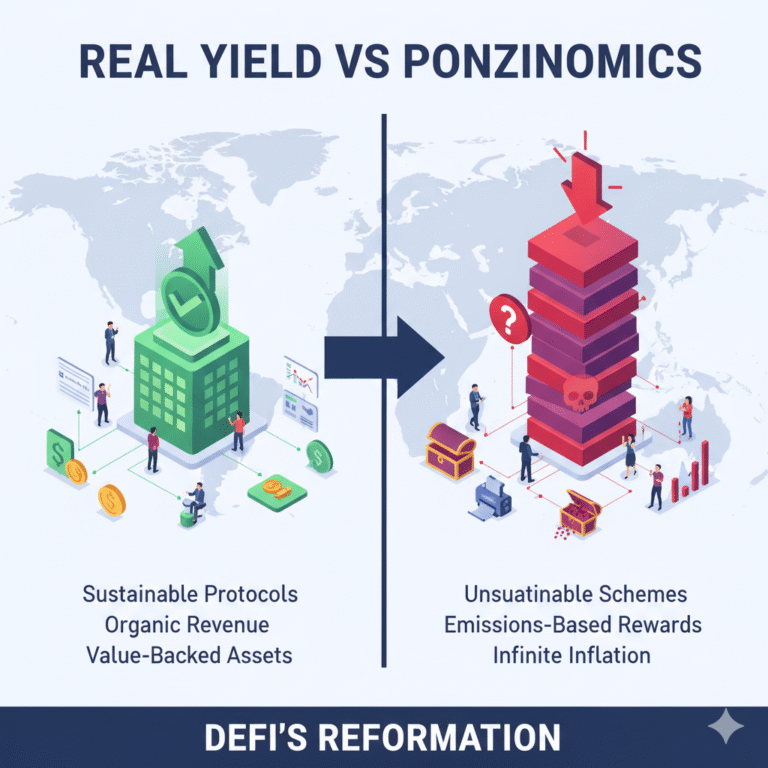
In Decentralized Finance (DeFi), where anyone with an internet connection can lend, borrow, or trade crypto without banks, two ideas have defined how people earn returns: Ponzinomics and real yield. Think of DeFi as a digital finance playground with exciting opportunities and potential pitfalls. Ponzinomics relies on constant new money to pay old promises. Real yield shares revenue from genuine economic activity like trading fees, borrower interest, and real-world asset income. The industry’s pivot from the former to the latter represents DeFi’s reformation — a fundamental move from hype-driven models to durable, sustainable finance.

If you’re new to this space: Ponzinomics is essentially borrowing from tomorrow to pay today. Real yield functions like dividends from a business that actually generates revenue. Below, we break down both models, examine why the shift is happening, and identify which protocols are implementing real yield correctly.

What Is Ponzinomics in DeFi?

Ponzinomics describes systems that offer extraordinarily high annual percentage yields (APYs) powered mainly by token emissions — essentially printing new tokens — rather than by actual profits. The classic pattern unfolds as follows:

A new protocol launches with 1,000% APY or higher to attract deposits and liquidity providers. Rewards are paid in the protocol’s own token, freshly minted through inflationary mechanisms. The token price pumps while new users continue to arrive. Once growth slows, selling pressure intensifies as early participants exit. Yields collapse and the protocol loses credibility.

This dynamic was particularly common during “DeFi Summer” in 2020–2021, when protocols competed aggressively for total value locked (TVL). The fundamental lesson: if the source of yield is token emissions rather than revenue from actual economic activity, the mathematics usually breaks down when capital inflows slow or reverse.

The Rise and Fall of Ponzi-Like Yields

DeFi experienced explosive growth in 2020–2021 as “yield farming” became the primary customer-acquisition tool across the ecosystem. Protocols offered unsustainable incentives to bootstrap liquidity, often resulting in temporary success followed by inevitable contraction. When broader market liquidity tightened in 2022, many emissions-driven designs collapsed spectacularly.

The most infamous example remains Terra/UST and the Anchor protocol. Anchor offered approximately 20% yield on UST, which was marketed as a stablecoin, but this yield wasn’t backed by durable cash flows or revenue-generating activity. The eventual unwind erased tens of billions in market capitalization and triggered broader deleveraging across crypto markets. The fundamental conclusion from this period: high APY does not equal sustainable APY.

According to DeFiLlama, total value locked across DeFi protocols peaked above $180 billion in late 2021 before declining sharply throughout 2022 as unsustainable yield models collapsed.

What Is Real Yield?

Real yield represents income distributed from actual protocol revenue rather than token inflation. Think of it as profit-sharing from genuine business operations:

DEX fees: Liquidity providers earn a percentage cut of swap fees, typically ranging from 0.05% to 0.30% depending on the pool and protocol design.

Lending interest: Capital suppliers earn interest paid by borrowers, with rates adjusting dynamically based on supply and demand within each market.

RWA income: On-chain funds and tokenized products pass through yields from Treasury bills, corporate credit, or other real-world assets to token holders, subject to legal terms and KYC requirements.

Real yield is typically in the single-digit to low double-digit range and demonstrates greater stability because it derives from actual usage and productive assets rather than from printing tokens.

Quick verification test: If income comes from fees, interest, or asset income, it’s likely real yield. If income comes mainly from emissions or newly minted tokens, it’s likely Ponzinomics.

Real-Yield Protocols in Practice

Several major DeFi protocols have successfully implemented real yield models:

Uniswap (LP fees): Liquidity providers earn swap fees from genuine trading activity. No token emissions are required for fee payouts, though UNI governance tokens exist separately. According to Uniswap’s analytics, the protocol has generated billions in cumulative fees distributed to liquidity providers.

Aave (credit markets): Lenders earn interest from borrowers in a dynamic, utilization-based system. Interest rates adjust algorithmically based on supply and demand within each lending pool, creating market-driven yields rather than arbitrary emissions.

GMX (perpetual DEX): Stakers of GMX and GLP receive direct shares of protocol fees generated by traders, distributed in ETH and AVAX rather than inflationary tokens. The protocol has maintained consistent fee generation through perpetual futures trading activity.

Synthetix (derivatives platform): Trading fees from perpetual contracts and synthetic assets flow to SNX stakers in stablecoins. The protocol has progressively reduced reliance on inflationary rewards while increasing revenue-based distributions.

Tokenized Treasuries (examples include OUSG from Ondo Finance and BUIDL from BlackRock): On-chain vehicles that pass through short-duration U.S. Treasury income to token holders, representing canonical “real-world” yield brought on-chain. According to RWA.xyz, tokenized Treasury products have grown to billions in assets under management.

These examples share a defining trait: payouts are tied directly to cash-generating activity rather than new token issuance.

Why the Shift to Real Yield?

Several converging factors have driven DeFi’s reformation toward sustainable yield models:

Sustainability: Token emissions function as marketing expenses, not genuine business models. Once user growth slows, the underlying promises become mathematically impossible to maintain.

Institutionalization: Tokenized funds, real-world assets, and institutional participants demand predictable, compliant, revenue-backed income streams rather than speculative yield farming.

User Preference: Both experienced traders and newcomers increasingly prefer steady 5–12% returns grounded in fees or productive assets over “four-digit APY” fireworks that inevitably collapse.

Market Maturity: Protocol builders now compete on fundamental unit economics including fees, volumes, and risk controls rather than purely on incentive programs. This mirrors the maturation trajectory of traditional financial markets.

Benefits and Challenges

Benefits of Real Yield

Stability: Fee-based, interest-based, and RWA-based income streams persist through market cycles rather than evaporating during downturns.

Transparency: On-chain accounting and open-source smart contracts allow anyone to verify where cash flows originate and how they’re distributed.

Accessibility: Global users can access diverse income streams without traditional financial gatekeepers, geographic restrictions, or minimum investment requirements.

Challenges

Lower headline APYs: Real yield delivers sustainable returns, but it won’t advertise 1,000% APYs. This creates a marketing disadvantage against newer Ponzinomic schemes.

Smart-contract and market risk: Code vulnerabilities, oracle manipulation, and liquidity shocks remain persistent risks regardless of yield sustainability.

Complexity: Users must develop skills to audit revenue sources, understand tokenomics, and evaluate protocol fundamentals rather than chasing headline yields.

Compliance requirements: RWA products often require KYC verification and have legal constraints that vary by jurisdiction, reducing the permissionless nature that originally defined DeFi.

How to Distinguish Real Yield From Ponzinomics: Verification Checklist

When evaluating any DeFi protocol offering yields, apply this systematic checklist:

Source of income: Are returns generated from trading fees, borrower interest, or RWA coupons? Or do they come primarily from emissions, “points,” or inflationary token issuance?

Payout asset: Are revenues distributed in established assets like ETH, USDC, or T-bill yields? Or only in the protocol’s own token?

Sustainability mathematics: Would the current payout structure survive if user growth remained flat for 12 months? Run the numbers.

Incentive design: Does the protocol use limited, strategically targeted incentives? Or does it depend on perpetual high emissions to maintain APYs?

Risk disclosures: Are there clear documentation, third-party audits from firms like Trail of Bits or OpenZeppelin, and transparent metrics dashboards? Or vague promises and unclear documentation?

The Future: Sustainable, Boring (in a Good Way), and Potentially Transformative

DeFi’s reformation represents a fundamental shift from speculative carnival to functional financial infrastructure layer. Expected developments include:

Expanded RWA rails bringing treasuries, corporate credit, real estate, and other productive assets on-chain to feed sustainable income streams. According to Boston Consulting Group, tokenized assets could represent a multi-trillion dollar market by 2030.

Derivatives and trading venues continuously optimizing fee structures and implementing transparent revenue-sharing mechanisms with stakers and liquidity providers.

Lending markets emphasizing sophisticated risk pricing, collateralization requirements, and credit assessment rather than rewards-driven user acquisition.

Users increasingly treating protocols like traditional businesses, evaluating revenue, operating costs, profit margins, and competitive moats rather than purely narrative-driven speculation.

Bottom line: Real yield isn’t merely a buzzword or temporary trend — it represents DeFi growing up and potentially achieving mainstream adoption. If you verify where returns originate and confirm the underlying economics function without continuous new capital inflows, you’re positioning yourself on the sustainable side of crypto finance. The reformation from Ponzinomics to real yield may ultimately determine which protocols survive the next decade and which become cautionary tales.

EigenLayer and the Rise of Restaking: Unlocking New Potential in Ethereum Staking

0

In the ever-evolving world of blockchain technology, Ethereum has long been a cornerstone for decentralized applications and finance. But what if the assets you stake to secure the network could do more? Enter restaking—an innovative concept that’s transforming how users earn rewards and how networks build security. At the forefront of this shift is EigenLayer, a protocol that’s not just enhancing Ethereum’s ecosystem but redefining staking efficiency.

Whether you’re a beginner or a seasoned crypto investor, think of staking as parking your car in a garage to earn a fee, and restaking as using that same parked car to deliver packages for extra cash—without moving it. This comprehensive guide explores EigenLayer’s mechanics, benefits, risks, and why restaking is gaining massive traction in 2025.

What Is Staking and Why Does It Matter?

In proof-of-stake (PoS) blockchains like Ethereum, staking means locking up cryptocurrency (like ETH) to help validate transactions and secure the network. In return, stakers earn rewards—similar to interest on a savings account—but instead of a bank, the network relies on your stake to keep participants honest.

After Ethereum’s monumental shift to PoS in September 2022, known as “The Merge”, staking became central to the network’s security model. Validators who stake at least 32 ETH run nodes and process transactions. If they act maliciously, part of their stake can be slashed—a penalty mechanism that reinforces honest behavior and network integrity.

Traditional staking, however, has inherent limitations: your ETH is locked and only earns Ethereum’s base rewards, typically ranging from 3-5% APR depending on network conditions. Meanwhile, new blockchain networks often must bootstrap their own validator sets from scratch, requiring significant time and capital to establish robust security.

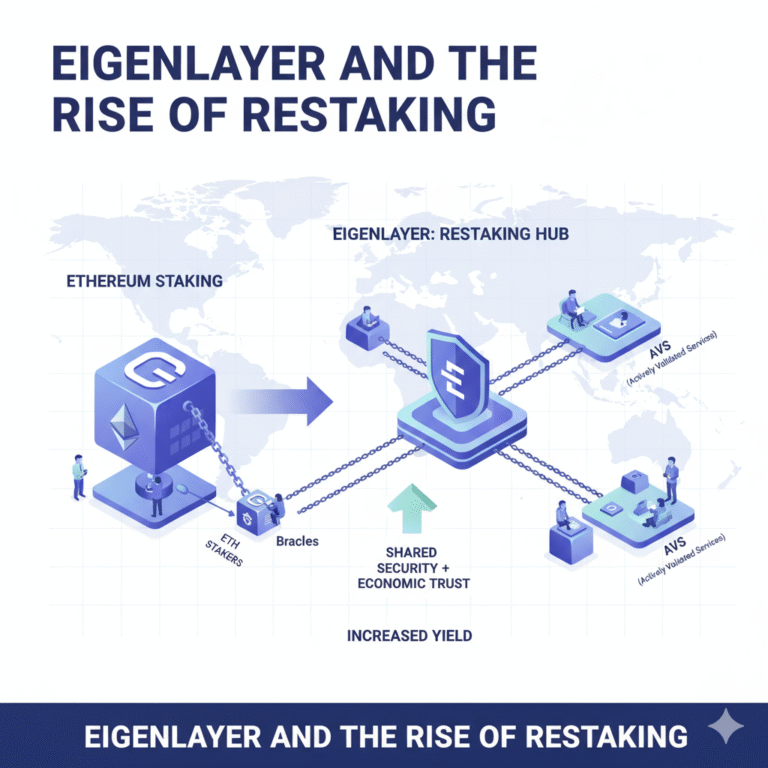
Restaking fundamentally changes this dynamic by allowing staked ETH to be reused to secure additional protocols simultaneously. Your stake can help protect sidechains, oracles, bridges, data-availability layers, and layer-2 networks—all while continuing to secure the Ethereum mainnet. This dramatically improves capital efficiency because the same stake performs multiple functions.

Introducing EigenLayer: The Pioneer of Restaking

EigenLayer is a groundbreaking middleware protocol built on Ethereum that transformed restaking from concept to reality. The protocol launched its restaking contracts on mainnet in 2023, followed by a comprehensive operator and AVS (Actively Validated Services) rollout throughout 2024.

EigenLayer functions as a decentralized marketplace connecting two key parties:

  • Stakers (security providers) who supply cryptoeconomic security through their restaked assets
  • AVSs (Actively Validated Services)—protocols requiring protection, including data availability layers, oracles, bridges, and specialized services

As of October 2025, EigenLayer has achieved remarkable growth metrics:

  • Total Value Locked (TVL): Approximately $16.8 billion (source)
  • Cumulative incentives distributed: Over $130 million
  • Active AVSs: Around 40 live services
  • AVSs in development: Approximately 190 protocols building on the platform

The protocol supports a diverse range of Ethereum derivatives through LSTs (Liquid Staking Tokens) like Lido’s stETH and Rocket Pool’s rETH, as well as LRTs (Liquid Restaking Tokens). Additionally, EigenLayer introduced EIGEN, its native token designed to handle intersubjective faults—disputes that cannot be easily proven through on-chain data alone.

For those new to the space, imagine EigenLayer as a shared security hub: instead of every application building its own fortress from the ground up, they can leverage Ethereum’s established security infrastructure, creating a more interconnected and resilient ecosystem.

How EigenLayer Works: A Technical Deep Dive

Step 1: Deposit and Restake

Users begin by depositing native-staked ETH or LSTs (such as stETH from Lido or rETH from Rocket Pool) into EigenLayer’s smart contracts. Alternatively, users can deposit LRTs like eETH from ether.fi.

For native Ethereum validators, EigenLayer employs a withdrawal credential delegation mechanism. For LST and LRT holders, the process involves directly depositing tokens into the protocol’s smart contracts, which then manage the restaking process.

Step 2: Opt-In to AVSs

Restakers maintain control by choosing which AVSs to support. Operators—specialized node runners—provide validation services using the restaked collateral as security. This creates a pooled security model where multiple stakers combine their economic weight to secure services more efficiently than they could individually.

Step 3: Earn Stacked Rewards

The reward structure in EigenLayer is additive: participants earn Ethereum’s base staking yield (typically 3-5% APR) plus AVS-specific fees and incentives. These additional rewards vary by service but can significantly boost overall returns.

For example, EigenDA—EigenLayer’s flagship data-availability AVS—now targets throughput of approximately 100 MB/s on mainnet, helping layer-2 networks scale more cost-effectively while providing additional yield to restakers.

Step 4: Slashing and Security Mechanisms

EigenLayer implements a sophisticated dual-slashing system:

Objective Faults: Violations that can be cryptographically proven (like double-signing) trigger automatic ETH slashing through Ethereum’s consensus layer, following the same mechanisms used by standard validators.

Intersubjective Faults: Disputes that are difficult to prove purely on-chain (such as data withholding) are handled through EIGEN’s innovative token-forking mechanism, where the community can fork the token to resolve disputes while maintaining security.

Practical Example

Consider this scenario: You stake 32 ETH on Ethereum, then restake it via EigenLayer to secure a bridge protocol while holding an LRT like eETH to maintain liquidity. You now earn base Ethereum staking rewards (approximately 4% APR) plus bridge protocol incentives (potentially 2-6% additional APR), while your eETH position remains usable across DeFi protocols for lending, liquidity provision, or other yield strategies.

The Compelling Benefits of Restaking with EigenLayer

Enhanced Capital Efficiency

The primary advantage of restaking is maximized capital utilization. A single stake can simultaneously secure multiple networks, potentially generating stacked yields from Ethereum’s base layer plus multiple AVS incentives. This efficiency is unprecedented in crypto staking models.

Dramatically Lower Barriers for New Protocols

Emerging blockchain projects face a significant challenge: bootstrapping validator sets requires substantial capital and time. EigenLayer enables teams to effectively “rent” Ethereum-grade security rather than building from scratch, accelerating product launches across DeFi, gaming, AI infrastructure, and beyond.

This shared security model can reduce launch timelines from months to weeks while providing institutional-grade security from day one.

Strengthened Network Security Through Pooling

Pooled security raises the economic cost of attacking AVSs by leveraging Ethereum’s massive collateral base. Rather than targeting smaller, isolated networks, attackers would need to overcome the combined economic weight of restaked Ethereum—a vastly more expensive proposition.

Flexible Liquidity Options

LRTs such as ether.fi’s eETH allow users to maintain liquidity on their restaked positions. These tokens can be deployed across DeFi protocols for additional yield strategies, used as collateral for loans, or traded on decentralized exchanges—providing flexibility that traditional staking cannot match.

Critical Risks and Considerations in Restaking

Amplified Slashing Risk

Supporting multiple AVSs means exposure to multiple sets of slashing conditions beyond Ethereum’s base protocol. In worst-case scenarios involving simultaneous failures across multiple services, a substantial portion of your stake could be at risk. This represents the trade-off for earning additional yields.

Potential Centralization Pressures

The operational complexity of running nodes for multiple AVSs can favor large, sophisticated operators with extensive infrastructure. While public estimates suggest approximately 12-16% of all staked ETH has been restaked through EigenLayer—material but not dominant—ongoing monitoring of operator concentration is essential for long-term decentralization.

EigenLayer has implemented safeguards including 33% caps (per-token and per-entity limits) to mitigate excessive centralization risks.

Extended Unbonding and Exit Delays

Withdrawing from EigenLayer involves multiple waiting periods:

  • Escrow/cooldown period: Currently around 7 days, moving toward approximately 14 days with upcoming slashing mechanism upgrades
  • Standard Beacon Chain validator exit time: The normal Ethereum validator exit queue

These delays can create challenges during market volatility when rapid position adjustments might be desired. Users should factor these timelines into their risk management strategies.

AVS Incentive Variability

Rewards from individual AVSs fluctuate based on network demand, token prices, and protocol-specific economics. Best practices include:

  • Starting with modest position sizes
  • Diversifying across multiple AVSs
  • Selecting operators with strong track records and transparent operations
  • Continuously monitoring performance metrics

The Explosive Rise of Restaking in 2025

Restaking’s adoption trajectory has been nothing short of remarkable. EigenLayer’s TVL experienced explosive growth:

  • December 2023: Approximately $250-350 million
  • March 2024: Surpassed $10 billion as deposit caps were lifted and institutional integrations multiplied

LRT platforms like ether.fi posted outsized growth during this period, capturing significant market share within the liquid restaking segment. On the AVS side, infrastructure builders such as Brevis are launching production services leveraging EigenLayer’s security layer, while numerous other protocols actively advertise EigenLayer integrations as a key differentiator.

The ecosystem now features native support for major LSTs including those from Lido Finance and Rocket Pool. Major cryptocurrency exchanges and wallets, including OKX and institutional partners, have rolled out educational resources and native integrations for EigenLayer and LRT products.

This growth occurs against the backdrop of DeFi’s broader recovery, with total value locked across the ecosystem exceeding $100 billion in 2025, providing a strong tailwind for restaking adoption.

Future Outlook: The Emerging Restaking Economy

Restaking is evolving into what industry observers call a “restaking economy”—a fundamental infrastructure layer fueling modular blockchain architectures, specialized data layers, and verifiable compute for AI agents and other advanced applications.

Expansion into Verifiable Computing

EigenLayer’s vision extends beyond securing blockchain protocols. The platform is actively developing infrastructure for what it calls the “verifiable cloud”—using cryptoeconomic security to validate off-chain computation and AI model execution with on-chain assurances. This could extend Ethereum-grade trust to traditionally centralized computing tasks.

Key Growth Areas

  • Modular blockchain infrastructure: Security for specialized execution layers, data availability networks, and settlement layers
  • Oracle networks: Decentralized data feeds backed by restaked collateral
  • Bridge protocols: Cross-chain communication secured by shared economic security
  • AI and machine learning: Verifiable inference and model execution

Remaining Challenges

Despite strong momentum, several challenges require ongoing attention:

  • Regulatory clarity: Evolving frameworks around staking derivatives and yield-bearing tokens
  • Slashing mechanism design: Balancing security guarantees with operator risk tolerance
  • Operator decentralization: Maintaining distributed validation as operational complexity increases
  • Smart contract risk: Continuous security audits and formal verification efforts

Conclusion: Embrace the Restaking Revolution Responsibly

EigenLayer and the restaking paradigm represent a fundamental evolution in how blockchain networks achieve security and how crypto holders generate yield. By enabling the reuse of Ethereum’s battle-tested security infrastructure, these innovations empower both users seeking enhanced returns and builders launching new protocols—all while striving to preserve the decentralization principles core to blockchain technology.

With TVL maintaining strong levels and the AVS ecosystem rapidly expanding, 2025 is shaping up to be restaking’s breakthrough year in mainstream crypto adoption.

Getting Started: Best Practices

For those ready to explore restaking:

  1. Start small: Begin with a modest allocation to understand mechanics and risks
  2. Use established platforms: Consider well-known LSTs and LRTs like Lido’s stETH or ether.fi’s eETH
  3. Understand exit timelines: Factor in 7-14 day cooldowns plus Ethereum validator exit queues
  4. Diversify AVS exposure: Don’t concentrate all restaked assets in a single service
  5. Research operators thoroughly: Select node runners with transparent performance records
  6. Stay informed: Follow EigenLayer’s official documentation and community channels
  7. Read also: Ethereum in Business.

Additional Resources

As EigenLayer continues evolving and the restaking economy matures, this infrastructure could become the backbone of a more verifiable, efficient, and interconnected Web3 ecosystem. The revolution is underway—participate thoughtfully and stay educated.


Disclaimer: This article is for informational purposes only and does not constitute financial advice. Cryptocurrency investments carry substantial risk including potential loss of principal. Always conduct your own research and consult with qualified financial advisors before making investment decisions.

Lido vs Rocket Pool: Who Rules ETH Staking in 2025?

1

In the world of Ethereum (ETH), staking has become a cornerstone for earning passive income while securing the network. But with the rise of liquid staking protocols, users no longer have to lock up their ETH indefinitely. Instead, they can stake and still use their assets in decentralized finance (DeFi). Two giants in this space are Lido and Rocket Pool. If you’re new to crypto, think of staking like depositing money in a high-yield savings account that helps run the bank (Ethereum, in this case). Liquid staking adds flexibility by giving you a token representing your staked ETH, which you can trade, lend, or use elsewhere.

This article compares Lido and Rocket Pool, breaking down their features, performance, and market positions as of 2025. We’ll explore who dominates ETH staking today, using verified data from reliable sources. Whether you’re a beginner wondering “what is ETH staking?” or an experienced user hunting for the “best liquid staking protocol,” this guide will help you decide.

Understanding ETH Staking and Liquid Staking Basics

Ethereum switched to Proof-of-Stake (PoS) in 2022, allowing users to stake ETH to validate transactions and earn rewards. Traditionally, you needed 32 ETH to run a validator node, and your funds were locked until withdrawal was enabled.

Liquid staking solves that lock-up problem by pooling user assets and issuing a token (e.g. stETH or rETH) that accrues rewards automatically. This token can be used in DeFi for lending, trading, or composability. In 2025, liquid staking protocols account for about 29–31% of all staked ETH.

For more on Ethereum’s staking mechanism, visit the official Ethereum Foundation staking guide.

What Is Lido? The Liquid Staking Leader

Lido Finance (launched 2020) is broadly recognized as the pioneer of Ethereum liquid staking. It enables users to stake any amount and receive stETH, which automatically increases in value as rewards accrue (rebasing). A wrapped version, wstETH, offers compatibility in DeFi ecosystems.

How Lido Works

Deposit ETH: Users send ETH to Lido’s smart contract.

Receive stETH: You get an equivalent amount of stETH, which accrues rewards over time.

Node Operators: On Ethereum’s main module, a curated set of up to approximately 39 operators is used; in addition, Lido employs permissionless modules (CSM/DVT), for a combined base of 400+ unique node operators across networks.

Rewards & Fees: Lido takes 10% of validator rewards (split between operators and DAO).

Learn more at Lido Finance’s official documentation.

Strengths of Lido

Deep liquidity: stETH/wstETH is integrated in many major DeFi protocols (Aave, Curve, Uniswap, etc.).

Mature ecosystem and tooling.

A relatively predictable, fixed-fee model.

Supporting advanced capability like restaking (e.g. via EigenLayer) for extra yield.

Typical Returns (2025)

Lido’s APR (post-fee) is around 2.7%, though this fluctuates based on network conditions.

What Is Rocket Pool? Decentralization First

Rocket Pool (launched 2021) focuses strongly on permissionless access and decentralization. Users stake ETH to receive rETH (a non-rebasing token whose value in ETH increases over time). The minimum for retail staking is 0.01 ETH.

How Rocket Pool Works

Deposit ETH: Any amount (starting at 0.01 ETH) can be staked for rETH.

Slashing Protection: Slashing risks are mitigated by requiring node operators hold RPL collateral; the protocol parameters define limits and coverage.

Node Operators: Anyone can become a node operator with 8 ETH of bonded ETH (LEB8 model) plus RPL collateral. This is significantly lower than 32 ETH needed for solo staking.

Rewards & Fees: Reward mechanics are tied to the network; operator commission for new pools is commonly in the 10–14% range (legacy pools may differ).

Explore more at Rocket Pool’s official website.

Typical Returns (2025)

Rocket Pool’s APY is around 2.45%, though this can vary with network activity and pooling dynamics.

Lido vs Rocket Pool — Head-to-Head Comparisons

MetricLidoRocket Pool
Minimum StakeNo protocol minimum (UI may impose small floor)0.01 ETH
Typical Yield (2025)~2.7% APR (after fees)~2.45% APY
Fee StructureFixed 10% of validator rewardsVariable operator commission (commonly 10–14%)
Operator ModelCurated + permissionless modules; combined “400+” operators across networksFully permissionless: open to any qualified operator with 8 ETH + RPL
Market Share~24–25% of all staked ETH~2–3% (by staked ETH)
Best ForUsers seeking maximum liquidity and easeUsers prioritizing decentralization and protocol permissionlessness

Liquidity & Ecosystem Integration

stETH / wstETH see very broad adoption across DeFi. rETH is integrated in many protocols as well (e.g. Aave v3, Balancer), but typically with somewhat less liquidity.

For DeFi protocol integrations, check DeFi Llama’s liquid staking category.

Decentralization & Security

Rocket Pool scores higher on the permissionless/decentralized design front: anyone can become a validator operator (within requirements). Lido’s main module is curated, though its permissionless modules help reduce centralization pressure. Both are noncustodial.

Risk Considerations

Lido’s potential risk: concentration of influence or governance control as it grows.

Rocket Pool’s risks: variability among operators, and slashing protection is not absolute — collateral mechanisms cover some, but not all, cases.

Both are subject to smart contract risk; both maintain audits and bug-bounty programs. Review security audits at Lido’s security page and Rocket Pool’s audits.

Who’s on Top in 2025?

As of late 2025, Lido remains the dominant force in liquid ETH staking by size and integration. Its share, however, has declined to approximately 24–25%, reflecting increased competition and maturation of the field. Rocket Pool continues to grow as the preeminent permissionless alternative, though from a smaller base (around 2–3%). The broader Ethereum staking market has approximately 35.7 million ETH staked in total.

Yield levels across the board have cooled relative to earlier cycles, with 2–3% broadly reflecting real returns after fees and network activity. High double-digit percentages belong to historical outlier periods, not sustainable norms.

Support for restaking (e.g. via EigenLayer) has expanded — both stETH and rETH feature among supported assets — opening additional yield layers (and risks).

Verdict: Which Should You Choose?

Lido: For most users — especially newcomers — it remains the default. Deep liquidity, broad DeFi integrations, and a simple, stable fee structure make it low friction.

Rocket Pool: Best suited for those who care deeply about decentralization, permissionless access, and protocol sovereignty — and who can accept a bit more complexity and slightly lower liquidity.

You don’t have to pick one forever — diversification between protocols is a valid strategy. But always DYOR (Do Your Own Research), use trusted wallets, watch for protocol updates, and understand that staking is as much about network health as it is about yield.

For the latest staking statistics and comparisons, visit Dune Analytics’ Ethereum staking dashboard or Rated Network.

Modular Blockchains: Celestia vs Monad vs EigenLayer – A Comprehensive Comparison

0

In the rapidly evolving world of blockchain technology, modular blockchains are gaining traction as a solution to scalability issues. Traditional networks like Ethereum have struggled with these challenges for years. However, modular blockchains take a different approach. Instead of handling all functions in a single layer, they separate tasks into specialized layers. As a result, this design offers greater flexibility, efficiency, and scalability.

Three projects stand out in this space: Celestia, Monad, and EigenLayer. Each addresses specific challenges in blockchain design. Moreover, they represent different facets of the modular ecosystem. Whether you’re a beginner curious about crypto or an enthusiast exploring blockchain innovations, this guide will help you understand their unique contributions.

What Are Modular Blockchains?

First, let’s establish the fundamentals. Traditional monolithic blockchains, such as Bitcoin or early Ethereum versions, perform all core functions on one chain. Consequently, this integrated approach creates significant bottlenecks. As more users join the network, transaction speeds slow down. Additionally, fees skyrocket, and overall scalability suffers.

Modular blockchains solve these problems by “unbundling” blockchain functions into specialized layers:

Execution: This layer runs smart contracts and processes transactions. Essentially, it serves as the computational engine that powers decentralized applications.

Consensus: This mechanism determines how nodes agree on the blockchain’s current state. Therefore, it ensures all participants maintain a synchronized view of the network.

Settlement: This layer finalizes transactions and resolves any disputes. Ultimately, it provides the final source of truth.

Data Availability (DA): This component ensures that transaction data remains accessible and verifiable. Importantly, it achieves this without requiring every node to download the entire blockchain history.

By specializing these functions, modular designs enable horizontal scaling. In other words, networks can add more layers or chains instead of overloading a single network. For example, Ethereum is transitioning toward modularity with rollups. These Layer 2 solutions offload execution while relying on the main chain for security and data availability.

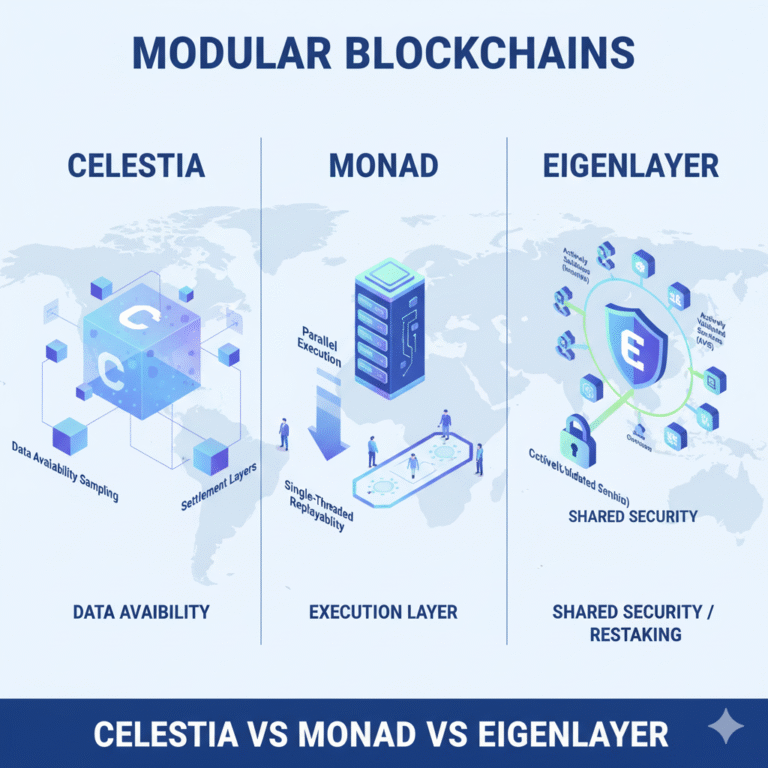
Notably, Celestia focuses exclusively on data availability. Meanwhile, Monad enhances execution in a high-performance Layer 1 environment. At the same time, EigenLayer provides shared security through an innovative restaking mechanism. These projects complement each other rather than compete directly.

Celestia: The Data Availability Specialist

Celestia launched in 2023 as a pioneering modular blockchain. Specifically, developers designed it for data availability and consensus. Furthermore, it makes launching new blockchains or rollups significantly easier. The platform decouples data availability from execution. As a result, developers can build sovereign rollups that handle their own logic while relying on Celestia for secure data storage.

Key Features of Celestia

Data Availability Sampling (DAS): Nodes don’t need to download full blocks. Instead, they sample small portions to verify data integrity. Consequently, this makes the network lightweight and scalable. Even resource-limited devices can participate in network verification thanks to this innovative approach.

Consensus Mechanism: Celestia uses proof-of-stake (PoS) with CometBFT (formerly Tendermint). Additionally, it maintains an average block time of around 5–6 seconds. This consensus model successfully balances speed with security and decentralization.

TIA Token: Users stake the TIA token, participate in governance, and pay for data availability (“blobspace”) via PayForBlobs. Moreover, the token creates economic incentives that align network participants toward maintaining data availability.

Integrations: Celestia works with Ethereum rollups and Cosmos-SDK chains. For instance, Blobstream makes Celestia’s data availability usable for Ethereum-settled rollups. Similarly, platforms like Dymension integrate with Celestia for data availability and Rollup-as-a-Service (RaaS).

Think of Celestia as a massive, secure cloud storage system for blockchain data. Unlike monolithic chains where every node stores everything, Celestia ensures data remains available without overwhelming network resources. This proves particularly crucial for rollups, which post transaction data to Celestia to prove validity without congesting Ethereum.

Celestia fits perfectly into the modular narrative by focusing solely on data availability. Meanwhile, it leaves execution to other layers. As of 2025, the platform has integrated with projects like Dymension for rollup deployment.

Learn more: Celestia Documentation | Celestia Blog

Monad: High-Performance Execution in an EVM-Compatible L1

Monad represents an EVM-compatible Layer 1 blockchain that emphasizes extreme performance. At the same time, it maintains decentralization. Unlike pure modular layers, Monad sparks debate in the modular versus monolithic discussion. While it functions as a single-shard Layer 1, it uses modular software architecture. Specifically, it decouples consensus and execution via pipelining and parallelism.

Key Features of Monad

EVM Compatibility: Monad maintains bytecode compatibility with Ethereum. Therefore, developers can deploy existing smart contracts without changes. This compatibility removes technical barriers for developers migrating from Ethereum.

Performance Claims: Monad targets approximately 10,000 transactions per second (TPS). Furthermore, it aims for block times around 0.4 seconds and finality of approximately 800 milliseconds. Simultaneously, it maintains low fees. These performance targets represent a significant improvement over traditional blockchain networks.

MonadDB: The platform uses a custom database with a Patricia Trie structure. This structure organizes state and enables efficient access. Notably, developers optimized this specialized database architecture for blockchain-specific data patterns.

Parallel & Asynchronous Execution: Transactions execute in parallel with sequential verification. As a result, this boosts throughput while preserving determinism. This approach maximizes hardware use without sacrificing the predictability that smart contracts require.

Ecosystem Programs: Monad supports builders through residencies and hackathons. For example, Monad Madness offers $1 million in prizes.

Think of Monad as a supercharged version of Ethereum. While Ethereum can experience high fees during peak usage periods, Monad redesigns the underlying engine for speed. Nevertheless, it maintains compatibility. This resembles upgrading from a single-core to a multi-core processor.

In the modular ecosystem debate, Monad argues that monolithic designs can scale effectively if developers properly optimize execution. Consequently, this challenges the pure modularity approach. As of October 2025, mainnet remains pending with testnet live. Additionally, developers scheduled a token airdrop claims portal for October 14, 2025.

Learn more: Monad Official Website | Monad Documentation

EigenLayer: Shared Security Through Restaking

EigenLayer differs from the previous two platforms. Rather than being a standalone blockchain, it functions as a restaking protocol on Ethereum. Specifically, it enables “shared security” for modular networks. The platform launched in phases since 2023–2024. Moreover, it allows users to restake staked ETH (or liquid staking tokens) to secure other services. Therefore, it extends Ethereum’s security to sidechains, rollups, and more.

Key Features of EigenLayer

Restaking Mechanism: Users can restake ETH or liquid staking tokens (such as stETH) to secure Actively Validated Services (AVSs). These services include oracles or bridges. This innovative approach lets Ethereum stakers earn additional yields. Simultaneously, they support the broader ecosystem.

EigenDA: EigenDA provides a data availability service. Currently, operators run it via a committee/DAC-style model. However, developers published a version 2 design. This design aims for a more decentralized data availability network and higher throughput.

Operators & Slashing: Operators run AVS software. If they misbehave, the system can slash them (now live on mainnet). Consequently, this aligns incentives with security. This economic mechanism ensures that participants have skin in the game.

EIGEN Token: Users employ the EIGEN token for governance and intersubjective security. For instance, it enables fork-based slashing for non-objective faults. Thus, it complements ETH restaking for objectively verifiable faults. Notably, it is not a gas or fee token.

Integrations: Many projects use EigenLayer to back Ethereum Layer 2 solutions and services. For example, Aevo uses EigenDA for data availability.

Think of EigenLayer as renting out your staked ETH for additional jobs. Normally, staking secures Ethereum. However, restaking allows it to secure other networks simultaneously. As a result, users earn more rewards while bootstrapping new chains with Ethereum-level economic security.

EigenLayer enhances modularity by providing economic security. Importantly, it does this without requiring each chain to build its own validator set from scratch. Therefore, it addresses the fragmented security issue that can arise in modular designs.

Learn more: EigenLayer Documentation | EigenLayer Official Website

Key Differences Between Celestia, Monad, and EigenLayer

Understanding how these three platforms differ is essential. Consequently, let’s examine their roles in the blockchain ecosystem:

Core Function:

  • First, Celestia serves as a data availability and consensus layer
  • Second, Monad functions as an execution-optimized Layer 1 with a full stack
  • Third, EigenLayer operates as a security layer via Ethereum restaking

Architecture:

  • Celestia follows a pure modular design with no execution layer
  • In contrast, Monad represents a monolithic Layer 1 that decouples consensus and execution in its software architecture
  • Meanwhile, EigenLayer exists as a protocol built on Ethereum that enables shared security for Actively Validated Services

Performance & Use:

  • Celestia provides scalable data availability for rollups. Additionally, it maintains approximately 5–6 second blocks
  • Monad targets high throughput (around 10,000 TPS) for decentralized applications
  • Similarly, EigenLayer offers low-cost shared security. Furthermore, EigenDA provides high-throughput data availability via its committee design

Ecosystem Fit:

  • Celestia and EigenLayer often integrate within Ethereum ecosystems. For example, they work through Blobstream and EigenDA pathways
  • On the other hand, Monad stands alone as a performant EVM-compatible alternative

Pros and Cons: A Balanced View

Celestia

Pros: First, Celestia offers lightweight, cost-effective data availability. Second, it enables easy blockchain launches. Third, it provides security via Data Availability Sampling.

Cons: Since Celestia focuses only on data availability, it needs other layers for execution and settlement. Additionally, it maintains block times of approximately 5–6 seconds.

Monad

Pros: First, Monad delivers high speed and low fees. Second, it offers full EVM compatibility. Third, developers designed it to run on consumer-grade hardware.

Cons: As of October 2025, mainnet is still pending. Moreover, the performance figures represent targets from public materials.

EigenLayer

Pros: First, EigenLayer boosts yields via restaking. Second, it provides shared security. Third, slashing is now live on mainnet. Finally, EigenDA offers high-throughput data availability.

Cons: The committee-style data availability approach introduces potential centralization trade-offs. Furthermore, the concept can be complex for beginners to understand.

Use Cases and Future Outlook

Different platforms excel in different scenarios. For instance, Celestia shines in rollup ecosystems. Specifically, it powers sovereign chains for DeFi or NFTs. Meanwhile, Monad proves ideal for high-frequency trading applications or games needing low latency. At the same time, EigenLayer secures bridges, oracles, and Layer 2 solutions. Consequently, it reduces bootstrap costs.

As blockchain adoption accelerates, modular designs like these could become the dominant architecture. Notably, Ethereum is leading this transition. However, debates continue within the blockchain community. Is pure modularity always superior? Or can optimized monolithic designs like Monad effectively compete?

The answer likely depends on specific use cases and requirements. For applications requiring maximum decentralization and composability, pure modular approaches may prove preferable. Conversely, for applications demanding the highest performance, optimized monolithic designs might offer advantages.

Conclusion: The Future of Modular Blockchains

Celestia, Monad, and EigenLayer each advance modular blockchain architecture in unique ways. Specifically, they contribute through data availability specialization, performance-optimized execution, and shared security mechanisms respectively. These platforms demonstrate that blockchain design doesn’t have a one-size-fits-all solution.

For those new to the space, consider exploring their documentation first. Additionally, participate in testnets or make small initial investments to learn more. The future of cryptocurrency and blockchain technology lies in innovations like these. Ultimately, they make blockchains faster, more affordable, and increasingly accessible to users worldwide.

As the modular blockchain landscape continues to evolve, these three platforms will likely play significant roles. Indeed, they will shape how developers build and scale decentralized networks in the years ahead.

Additional Resources:

Read also: DeFi 2025: Top 10 Protocols Across All Chains.

Cross-Chain Bridges 2025: Top 10 Most Secure

1

Cross-chain bridges have become the backbone of blockchain interoperability, enabling seamless asset transfers and communication between different networks. However, security remains paramount—the bridge sector has witnessed significant exploits over the years, making due diligence essential. This comprehensive guide examines the ten most secure cross-chain bridges currently operating in 2025, based on their architecture, security models, and track records.

Understanding Cross-Chain Bridge Security

Before diving into specific protocols, it’s important to understand what makes a bridge secure. Security architectures generally fall into several categories: committee-based attestation, light-client verification, optimistic validation with dispute periods, and modular verification networks. Each approach has distinct trade-offs between trustlessness, speed, and cost.

The bridges listed here have been selected based on verifiable security features, transparent documentation, comprehensive audit histories, and—where applicable—how they’ve responded to past incidents.

Chainlink’s Cross-Chain Interoperability Protocol stands out for its defense-in-depth approach to cross-chain security. The protocol implements an independent Risk Management Network (RMN) that provides an additional verification layer beyond the core oracle networks.

How It Works: The RMN independently reconstructs cross-chain messages and must “bless” them before execution. This creates a dual-verification system where both the primary oracle network and the separate RMN must validate transactions, significantly reducing the attack surface.

Real-World Adoption: CCIP is being deployed in institutional pilots, including Hong Kong’s e-HKD+ program where Visa and ANZ are using it for simulated cross-border tokenized fund settlement. This institutional confidence speaks to the robustness of its security model.

For Beginners: Think of CCIP as a bridge with an independent second set of eyes checking each batch of transactions before they’re executed. That extra verification layer is the core security innovation.

Learn More: Chainlink Documentation | Chainlink Blog

2. LayerZero

LayerZero has built a modular security framework that gives applications control over their verification parameters. The protocol’s version 2 introduces Decentralized Verifier Networks (DVNs) alongside its Oracle and Relayer system, plus Pre-Crime simulation capabilities.

Security Architecture: Rather than imposing a single security model, LayerZero allows applications to select multiple independent verifiers for cross-chain message validation. The Pre-Crime feature enables simulation and implementation of guardrails before message execution, catching potential issues before they materialize.

Modular Approach: Applications can configure their own security stack by choosing which DVNs to trust, creating a customizable trust model that balances security, speed, and cost based on specific requirements.

For Beginners: Instead of trusting one gatekeeper, you can pick multiple independent verifiers and test-run messages before they go live, similar to having several experts review an important document.

Learn More: LayerZero Documentation

3. Axelar

Axelar provides secure cross-chain messaging through a decentralized validator set that has undergone extensive security audits. The network connects dozens of blockchains and supports both asset transfers and arbitrary data routing.

Validator Network: Axelar operates with a permissionless validator set that must reach consensus on cross-chain transactions. This decentralization removes single points of failure common in centralized bridge designs.

Programmable Flows: Beyond simple asset transfers, Axelar enables complex programmable interactions across chains, allowing developers to build sophisticated cross-chain applications with security baked in.

For Beginners: Imagine a postal service where each message is routed and checked by independent couriers working together—no single courier can alter the mail without agreement from the majority.

Learn More: Axelar Network | Axelar Documentation

4. Wormhole (Portal Token Bridge)

Wormhole rebuilt its security infrastructure following a significant 2022 exploit that resulted in $320 million in losses (subsequently restituted by Jump Crypto). The protocol’s response and subsequent hardening make it a notable case study in security evolution.

Current Architecture: Wormhole now operates with 19 Guardians who must attest to cross-chain messages. This Guardian network provides distributed verification, requiring a supermajority to approve transactions before execution.

Post-Incident Improvements: The protocol has implemented multiple security audits, enhanced monitoring systems, and transparent incident response procedures. The Jump Crypto restitution demonstrated stakeholder commitment to security.

For Beginners: Think of 19 independent sentries standing guard—a supermajority must sign off before any message moves across chains, making it extremely difficult for bad actors to compromise the system.

Learn More: Wormhole Docs

5. Cosmos IBC (Inter-Blockchain Communication)

The Inter-Blockchain Communication protocol represents one of the most trust-minimized approaches to cross-chain communication. IBC is native to the Cosmos ecosystem and uses light-client verification rather than trusted intermediaries.

Light-Client Architecture: IBC enables chains to verify the state of other chains directly using cryptographic proofs. This eliminates the need for multisignature committees or external validators, creating a more trustless model.

Ecosystem Scale: As of late 2024, approximately 119 chains are connected via IBC, with transfer finality typically achieved in seconds to tens of seconds depending on the specific chains involved.

For Beginners: Neighboring chains communicate directly using cryptographic proofs—like having a direct phone line instead of going through an operator who could potentially listen in or interfere.

Learn More: IBC Protocol | IBC Documentation

6. Polkadot XCM + Snowbridge

Polkadot offers a unique security model through XCM (Cross-Consensus Messaging) for parachain communication and Snowbridge for Ethereum connectivity.

XCM Architecture: XCM is a messaging format that enables cross-consensus communication between parachains, all of which inherit shared security from Polkadot’s Relay Chain. This shared security model means parachains benefit from the economic security of the entire network.

Snowbridge for Ethereum: For bridging to Ethereum, Snowbridge provides a trustless light-client bridge with on-chain governance. Critically, it operates without multisigs or trusted relayers, maintaining trustlessness across both ecosystems.

For Beginners: Parachains message each other via XCM under the protective umbrella of the Relay Chain’s shared security, while Snowbridge adds a trustless path to Ethereum using light-client technology.

Learn More: Polkadot Wiki | Snowbridge Documentation

7. Across Protocol

Across takes a different approach to cross-chain bridging through intent-based architecture secured by UMA’s optimistic oracle system.

Intent-Based Design: Users express their desired outcome (intent), and relayers compete to fulfill it by fronting liquidity on the destination chain. Settlement verification happens optimistically afterward, reducing gas costs and improving user experience.

UMA Security: The optimistic oracle model provides economic security through dispute mechanisms. If a relayer acts maliciously, honest parties can dispute and correct the transaction, with the malicious party losing their bond.

Speed Advantage: Across reports sub-minute average fill times in its published materials, making it one of the faster bridging options without compromising security through optimistic verification.

For Beginners: You request an outcome, a relayer fulfills it quickly, and UMA’s oracle verifies and settles everything afterward—fast user experience with economic security guarantees.

Learn More: Across Protocol Docs | UMA Blog

8. deBridge

deBridge differentiates itself through a zero-TVL architecture that eliminates the pooled liquidity model common to many bridges.

deBridge Liquidity Network (DLN): By avoiding pooled liquidity, deBridge significantly reduces the attack surface. There’s no large vault sitting idle that could be drained in an exploit—the primary vulnerability that has plagued many bridge hacks.

Security Through Design: The zero-TVL approach means assets are only at risk during active transfer periods, not sitting in smart contracts waiting to be exploited. This architectural choice prioritizes security over certain convenience features.

For Beginners: With no big vault to drain, the risk from pool-draining exploits—the most common bridge vulnerability—is materially reduced by the protocol’s core design.

Learn More: deBridge Finance | deBridge Documentation

9. Symbiosis

Symbiosis operates as a non-custodial cross-chain protocol supporting numerous chains and assets with an emphasis on maintaining user control throughout the bridging process.

Non-Custodial Model: Users never relinquish custody of their private keys during cross-chain operations. This eliminates counterparty risk associated with custodial bridge designs.

Multi-Chain Support: Symbiosis abstracts the complexity of interacting with multiple blockchain ecosystems, providing routing that works across many different networks while maintaining security standards.

For Beginners: Cross-chain swaps without giving away your keys, with intelligent routing that handles the complexity of multiple blockchain ecosystems behind the scenes.

Learn More: Symbiosis Finance

10. Stargate

Stargate enables native asset transfers using unified cross-chain liquidity pools built on top of LayerZero’s messaging infrastructure.

Unified Liquidity: Rather than fragmented pools on each chain, Stargate uses unified liquidity that can be accessed from any connected chain. This approach improves capital efficiency while maintaining security through LayerZero’s verification layer.

Native Asset Transfers: Stargate focuses on native asset pathing across chains with broad EVM compatibility, abstracting much of the technical complexity from end users.

For Beginners: One set of shared pools routes native assets across multiple chains, handling most of the technical heavy lifting so users experience simple, straightforward transfers.

Learn More: Stargate Finance

The Future of Cross-Chain Bridge Security

The cross-chain bridge landscape continues evolving rapidly in 2025. Several trends are shaping the future of secure interoperability:

Independent Risk Management: Protocols like Chainlink CCIP are pioneering additional security layers beyond primary verification mechanisms. Expect more bridges to adopt multi-layered security approaches.

Light-Client Bridges: Trust-minimized designs using light-client verification (like IBC and Snowbridge) represent the gold standard for trustlessness where feasible, though they come with technical complexity trade-offs.

Intent-Based UX: Intent-based architectures are maturing, offering improved user experience without sacrificing security. This approach abstracts complexity while maintaining robust verification.

Institutional Adoption: Regulated pilots involving CBDCs and tokenized funds are exploring interoperability between permissioned and permissionless chains. The HKMA e-HKD+ pilots with Visa and ANZ leveraging CCIP demonstrate growing institutional confidence in cross-chain infrastructure.

Metric Caution: Total Value Locked (TVL) metrics can be noisy and vary significantly by source and time period. Focus on architecture, audit history, and incident response rather than vanity metrics alone.

Learn More: Visa CBDC Research | Hong Kong Monetary Authority

Practical Security Tips for Bridge Users

Regardless of which bridge you choose, follow these security best practices:

Verify Contract Addresses: Always confirm you’re interacting with official smart contract addresses from authoritative sources. Phishing sites with fake contracts are common.

Use Hardware Wallets: When bridging significant amounts, use hardware wallets for an additional security layer that protects against software-based attacks.

Start Small: Test any new bridge with small amounts first to ensure you understand the process and verify everything works as expected.

Diversify Routes: Don’t rely exclusively on one bridge. Spreading risk across multiple protocols reduces exposure to any single point of failure.

Understand Trust Models: Learn whether your chosen bridge uses committee attestation, light-client verification, or optimistic validation. Different models have different security properties and trade-offs.

Monitor Transaction Status: Don’t assume transactions complete instantly. Some bridges have deliberate delay periods for security. Track your transactions through completion.

Conclusion

The cross-chain bridge sector has matured significantly, with security innovations addressing past vulnerabilities. From Chainlink CCIP’s dual-verification model to IBC’s trustless light-client approach, each protocol on this list offers distinct security advantages.

The best bridge depends on your specific needs—transaction speed, cost, supported chains, and your personal security preferences. What matters most is understanding the trust model you’re accepting and ensuring it aligns with your risk tolerance and use case.

As blockchain interoperability becomes increasingly critical, these secure bridges are building the infrastructure for a truly connected multi-chain future. The lessons learned from past exploits have driven meaningful security improvements, but vigilance remains essential. Always research, verify, and start small when exploring new cross-chain infrastructure.

The future of decentralized finance depends on secure, reliable bridges connecting disparate blockchain ecosystems. The protocols highlighted here represent the current state of the art in cross-chain security, each contributing unique innovations to this rapidly evolving space.

Read also: How to Buy ethereum Safely.

Read also: Avalanche L1s (formerly Subnets): Modular DeFi in Action.

Sui and Aptos: Revolutionizing Blockchain with Move Language and Next-Gen Performance

0

In the fast-evolving world of blockchain technology, two platforms stand out: Sui and Aptos. Both use the Move programming language for speed, security, and scalability. Facebook’s Diem project originally developed this tool. Furthermore, many experts call this “next-generation” performance.

Think of it like upgrading from a bicycle to a high-speed electric scooter. The new technology is faster, more efficient, and built for modern digital needs. Therefore, this article explores Sui and Aptos in simple terms. We draw on verified facts from reliable sources. Consequently, beginners will understand why these layer 1 blockchains generate buzz in 2025.

Are you curious about blockchain scalability? Do you want to learn about smart contract security? Are you interested in decentralized finance (DeFi)? Sui and Aptos represent a shift toward more user-friendly and powerful networks. Let’s dive in.

What is the Move Programming Language?

Both Sui and Aptos use the Move language at their core. Specifically, developers built this tool for blockchain systems. Meta (formerly Facebook) created Move for the Diem blockchain. As a result, the language helps keep digital assets secure.

Move draws inspiration from Rust. Moreover, it uses “resource types” with move semantics. Digital assets like crypto are unique items. In fact, you cannot copy them by accident. Instead, you can only transfer or manage them on purpose.

Think of Move as a secure vault system. In contrast, old languages like Solidity can have bugs. Assets might get copied or lost by mistake. These are called reentrancy attacks. It’s like leaving a bank door open.

However, Move stops this with strict rules. Assets can’t be copied or lost by accident. As a result, this makes Move perfect for valuable blockchain items. Additionally, the design uses formal proof methods. Developers can prove their code is secure using math. Consequently, this cuts the risk of hacks.

Furthermore, Move has modules for reusable code. It also has scripts for one-time tasks. Therefore, developers build smart contracts faster this way. Initially, Move started with Diem. Now it powers Sui and Aptos too.

According to the Aptos docs, Move focuses on scarcity and access control. Assets exist as resources. Importantly, you cannot duplicate or drop these by accident. Overall, Move is secure and flexible. It runs complex apps without old language problems.

Introducing Sui Blockchain: Speed and Scalability Redefined

Sui is a layer 1 blockchain with a clear goal. Specifically, it makes Web3 as easy as regular web apps. At the same time, it runs fast. Moreover, Sui uses Move to create smart contracts. These contracts are powerful and secure. Notably, they need less code but do more work.

Sui’s design focuses on parallel execution. Indeed, this makes it different from rivals. Traditionally, old blockchains process one transaction at a time. In contrast, Sui handles many operations at once. Specifically, it uses Narwhal and Bullshark parts. These include a DAG-based mempool and BFT consensus.

The Sui docs show that Sui scales horizontally. As a result, network power grows as validators add workers. The result? Low fees even when traffic is high.

Additionally, Sui treats assets as separate “objects” on the chain. This creates dynamic and flexible digital items. Particularly, blockchain games benefit from this a lot. Players can own and trade game items easily.

According to Sui’s website, the platform gives blockchain games what they need. This means good functions, easy abstraction, scaling ability, speed, and low cost. Furthermore, Move’s rules make it secure. Fees stay low and stable.

Notably, reports show Sui handled over 4.58 billion transactions by 2025. These span 18.19 million active accounts. Meanwhile, speed and security stay strong.

Use cases cover gaming and finance. For instance, CCP Games added EVE Frontier to the network. Money features include fast settlements and on-chain order books. Moreover, the Messari Q1 2025 Sui report shows major growth. FanTV brought in over 8 million wallets. Additionally, it handled over 29 million transactions.

Introducing Aptos Blockchain: Institutional-Grade Efficiency

Aptos is another layer 1 blockchain from Diem’s legacy. Similarly, it uses Move for smart contracts too. The Aptos Foundation calls it an independent Layer 1 platform. Specifically, it focuses on safety and scaling. Furthermore, it helps grow a decentralized network and developer community.

Notably, Aptos uses Block-STM for parallel execution. Block-STM means Software Transactional Memory. As a result, it makes transaction processing faster under heavy loads.

The official Block-STM research paper shows impressive speed. Specifically, this engine handles over 160,000 transactions per second in tests. Moreover, the Aptos docs show strong results. By December 2024, Aptos blocks close in 250 milliseconds. Clearly, this proves the platform focuses on speed.

In addition, Move’s built-in guards provide security. The design scales up without losing decentralization. Furthermore, reports show Aptos had nearly 15 million monthly users in Q1 2025.

Impressively, stablecoin trading hit over $200 million. This marks a 1,000%+ growth year-over-year. Additionally, DeFiLlama data and May 2025 reports show Aptos’ DeFi TVL reached $1.16 billion. Consequently, this proves growing trust in the system.

Aptos excels in DeFi and real-world assets (RWAs). Meanwhile, the Petra Wallet makes access easy. Notably, July 2025 reports show Aptos became the third-largest RWA blockchain. It holds $538 million in tokenized real assets. Overall, developers built it for wide use. It offers low fees and fast execution.

Performance Comparison: Sui vs. Aptos

Both Sui and Aptos excel in next-gen performance. However, they approach it differently.

Specifically, Sui’s parallelism uses its object-centric design and DAG-based stack. As a result, this yields strong throughput in benchmarks. It also provides low latency under good conditions. Particularly, the platform suits high-interaction apps well. Gaming and consumer experiences benefit most.

Moreover, the Sui documentation emphasizes important security features. The Move design prevents issues like reentrancy vulnerabilities. Additionally, it stops poison tokens and spoofed token approvals. Notably, attackers have used these methods to steal millions on other platforms.

In contrast, Aptos focuses on efficient, deterministic parallel execution under load. Block-STM provides this capability. Specifically, this approach benefits DeFi where consistency matters. Conflict resolution is crucial in financial applications.

According to research, Block-STM set the standard for parallel execution. It provides both safety and simplicity. For example, projects like Econia emphasize an important point. Their on-chain order book would not have worked on any other network.

In general, Sui often edges ahead in raw lab-benchmark speed in public comparisons. Meanwhile, Aptos emphasizes steady performance across diverse use cases. It also focuses on low latency. Nevertheless, both platforms far exceed base-layer Ethereum’s throughput. Ethereum processes tens of transactions per second on L1. Both keep fees low.

Furthermore, scalability for each platform is largely horizontal. Adding capacity increases throughput. However, the slowdowns are not linear. For beginners, this simply means faster, cheaper transactions.

Currently, in 2025, Sui commands a larger market cap. CoinMarketCap reports a market cap above $12 billion. Meanwhile, Aptos grows steadily and builds depth in DeFi.

Key Differences and Similarities

Similarities: Both platforms stem from Diem. They use Move for security. Additionally, both prioritize parallel execution for scalability. They’re layer 1 networks aiming for mass adoption. Furthermore, they offer low latency and developer-friendly tooling.

Differences:

Data model: Sui’s object model fits dynamic assets well. For instance, think of NFTs and game items. In contrast, Aptos’s Block-STM suits broad app categories. It uses conflict-aware parallelism.

Staking: Sui’s delegation and unstaking work on an epoch basis. Specifically, each epoch lasts roughly 24 hours. On the other hand, on Aptos, lockup and unstaking mechanics vary. They depend on the validator or configuration. There’s no single fixed period network-wide.

Ecosystems: Currently, Sui leans into gaming and consumer apps at present. It focuses on object-centric use cases. For example, projects like BIRDS attracted over 9 million users. Similarly, Pebble City launched as a mobile Web3 social casino game.

Meanwhile, Aptos has strong momentum in DeFi. Stablecoin activity grows rapidly. Furthermore, the platform draws growing attention to RWAs.

Ultimately, there’s no absolute “better” platform. It depends on your needs. Choose Sui for speed-oriented, object-heavy experiences. Alternatively, pick Aptos for institutional-grade, conflict-heavy workloads.

Use Cases and Ecosystems

Sui thrives in gaming and consumer apps. Specifically, it offers dynamic assets for loyalty programs. Royalties and complex item logic work well on the platform. Moreover, the Messari report highlights several examples. These include on-chain trading systems and CLOB-style exchanges.

For instance, platforms like FanTV use Sui’s object-based data structure. Consequently, this powers video content and creator rewards effectively.

In contrast, Aptos excels in DeFi. Stablecoin flows continue to grow. Additionally, lending and DEX activity increase steadily. Notably, the Aptos Foundation committed over $200 million in grants and investments. As a result, this funding expands its DeFi ecosystem.

Furthermore, the money enhances spot trading hubs. It improves automated market makers and concentrated liquidity market makers. Meanwhile, both platforms support cross-chain tooling. Their Move foundations attract specific developers. Particularly, those who prioritize security and formal reasoning choose these platforms.

Future Outlook for Sui and Aptos

Both platforms are ready for continued growth in 2025. Specifically, Sui’s high-throughput architecture positions it well. Mass-market gaming and social apps are prime targets.

Moreover, recent developments show strong progress. For example, the SuiPlay0X1 gaming device supports both traditional and blockchain-native games. Additionally, Talus launched its AI agent platform powered by Sui.

Meanwhile, Aptos could benefit from rising institutional participation. Its DeFi focus and low-latency execution are key advantages. Furthermore, tokenized finance continues to grow. Notably, 21Shares filed for a SUI spot ETF in mid-2025. Plans include listing it on Nasdaq. Consequently, this could open doors to institutional capital.

However, the main challenge remains competition. Ethereum L2s and other performant L1s intensify the race. Nevertheless, Move’s security model gives these chains a distinct edge. Financial-grade apps benefit most from this advantage.

Looking ahead, innovations point to broader uses ahead. Modular designs continue to evolve. Additionally, AI-adjacent tooling emerges on both platforms. These include data-rich, low-latency on-chain services. As blockchain evolves, Sui and Aptos could lead the charge. Ultimately, they push toward a more performant Web3.

Conclusion

In summary, Sui and Aptos redefine blockchain performance. The Move language powers both platforms. Together, they deliver speed, security, and scalability.

For beginners, think of them as upgraded engines in the crypto world. Specifically, they make transactions faster and safer. Sui’s gaming focus appeals to some users. Meanwhile, Aptos’ DeFi strength attracts others. Overall, both offer exciting opportunities.

As layer 1 blockchains, they don’t just compete. Instead, they push the entire industry forward. Therefore, stay informed about these developments. Explore these platforms to see the future of blockchain in action.

Learn More:

NEAR Protocol: The Blockchain That Solved the Sharding Challenge

0

The blockchain industry has long grappled with a fundamental problem: how to scale without sacrificing security or decentralization. Most networks force every node to process every transaction, creating severe bottlenecks. However, NEAR Protocol has implemented a sharding solution that actually works in production.

The Blockchain Scalability Problem

Traditional blockchain architectures face insurmountable limitations. Every validator must process every transaction. Consequently, networks hit hard ceilings in three critical areas: computational capacity, storage requirements, and bandwidth consumption. This creates the infamous blockchain trilemma. Therefore, developers must compromise between security, decentralization, and scalability.

Most attempted solutions have fallen short. Partial sharding implementations only address data availability. Meanwhile, execution bottlenecks remain intact. Other networks sacrifice decentralization by reducing validator counts. Alternatively, they compromise security through weaker consensus mechanisms.

What Makes NEAR Different

NEAR Protocol represents a fundamentally different approach to blockchain architecture. The network was founded by Illia Polosukhin and Alexander Skidanov. Notably, Polosukhin co-authored the groundbreaking Transformer paper that changed artificial intelligence. Similarly, Skidanov brought experience from Microsoft and MemSQL. As a result, the network was built from the ground up with scalability as a core requirement.

NEAR operates as a Layer-1 Proof-of-Stake blockchain. It combines academic rigor with practical engineering. The team recognized an important truth early on. True scalability requires sharding not just data, but also state and execution. Furthermore, this challenge has defeated numerous blockchain projects.

Learn more about NEAR’s founding vision: NEAR Protocol Official Website

Nightshade: Sharding Architecture That Scales

NEAR’s breakthrough comes from Nightshade. This is a sharding architecture that maintains a single canonical chain. At the same time, it enables parallel transaction processing. Unlike systems that create separate shard chains, Nightshade treats the blockchain differently. Specifically, it works like a book where each block represents a page. Each page contains multiple chapters—one chunk per shard.

Core Technical Innovations

The architecture achieves linear scalability through several interconnected mechanisms. Let’s explore each one:

Unified Chain Structure: Every block incorporates chunks from all shards. Consequently, this maintains a single source of truth. Moreover, it avoids fragmenting the network into isolated chains.

Asynchronous Communication: Cross-shard transactions work through a receipt-based system. First, Shard A executes a transaction that affects Shard B. Then, it generates a receipt that Shard B processes later. As a result, this eliminates the need for synchronous cross-shard coordination.

Erasure Coding for Data Availability: Each chunk’s data gets split and distributed across the network. Therefore, this ensures recoverability even if some validators go offline. Additionally, this approach balances data availability with reasonable storage requirements.

Hidden Validator Assignment: Validators don’t know which shards they’ll validate immediately. Instead, they learn this shortly before block production. Consequently, this prevents targeted attacks where bad actors could concentrate resources on corrupting specific shards.

Fisherman Network: Specialized nodes monitor for invalid chunks. They detect and penalize bad behavior. Importantly, this doesn’t require every validator to check every shard.

Since May 2025, this architecture delivers impressive performance. Block times average approximately 600 milliseconds. Furthermore, finality occurs in roughly 1.2 seconds. As a result, these metrics enable genuinely real-time blockchain applications.

Technical deep dive: NEAR Protocol Documentation

Nightshade 2.0: Stateless Validation Revolution

In August 2024, NEAR deployed Nightshade 2.0. This introduced stateless validation—a major shift in how validators operate. Traditional blockchain validators must store complete copies of the blockchain state. Consequently, this requires substantial storage infrastructure. Moreover, it creates barriers to decentralization.

Stateless validation eliminates this requirement. Now, validators fetch only the specific state data needed for transaction validation. They do this on demand. This change reduces hardware requirements dramatically. Additionally, it improves execution performance by an estimated four times.

The implications extend beyond cost reduction. Lower hardware requirements mean more potential validators. Therefore, this strengthens decentralization. Furthermore, faster execution enables the network to scale to more shards without slowing down.

The network has already expanded significantly. It grew from six shards in 2024 to eight shards in 2025. Moreover, the technical foundation now supports continued horizontal scaling.

User Experience Innovations

NEAR Protocol distinguishes itself through features that dramatically improve blockchain usability. Let’s examine the key innovations:

Human-Readable Account Names: Traditional wallets use cryptographic addresses. For example, something like “0x742d35Cc6634C0532925a3b844Bc9e7595f0bEb” is typical. In contrast, NEAR users create accounts such as “alice.near.” Consequently, this simple change removes a major barrier to mainstream adoption.

Predictable Low Fees: Gas prices remain minimal and stable. Therefore, users avoid the fee spikes that plague networks like Ethereum during congestion. Additionally, predictable costs enable developers to build sustainable business models.

Chain Abstraction Technology: This is perhaps the most revolutionary feature. NEAR’s smart contracts can sign transactions on other blockchains. Meanwhile, a multichain gas relayer covers transaction fees on the user’s behalf. As a result, users no longer need to hold multiple different tokens. Furthermore, they don’t need to understand which blockchain they’re using. The complexity simply gets hidden away.

This chain abstraction approach represents a fundamental reimagining of blockchain connectivity. It moves beyond simple token bridges. Instead, it delivers seamless cross-chain functionality.

Explore NEAR’s ecosystem: NEAR Ecosystem

AI Integration and Future Direction

NEAR positions itself as “the blockchain for AI.” This recognizes that artificial intelligence and blockchain technology will increasingly converge. The network supports user-owned intelligent agents. Additionally, it enables intent-based applications. Here, users specify desired outcomes rather than manually executing transactions.

This AI-native direction leverages co-founder Illia Polosukhin’s deep expertise in machine learning. The combination delivers powerful capabilities. Fast finality, low costs, and chain abstraction work together. Consequently, this creates an ideal foundation for AI agents. These agents need to execute numerous small transactions across multiple blockchains.

Comparative Performance Analysis

NEAR’s technical specifications place it among the fastest Layer-1 blockchains. Let’s compare key metrics:

Finality Speed: The approximately 1.2 second finality is impressive. It’s achieved through Doomslug consensus with Ed25519 signatures. Moreover, this rivals or exceeds competing networks. As a result, it enables applications that require near-instant confirmation.

Comprehensive Sharding: Many projects plan to shard only data availability. For instance, Ethereum’s future implementations follow this approach. In contrast, NEAR already shards state, execution, and data. Furthermore, it does this behind a unified chain structure.

Decentralization Metrics: The network maintains approximately 254 active validators as of Q1 2025. Validator sets rotate every 12 hours. Therefore, this ensures fairness and prevents centralization. Additionally, this balance between decentralization and performance exceeds many competing networks.

Cross-Chain Capabilities: Chain abstraction delivers smoother experiences than traditional bridge-based approaches. However, some complex cross-chain state access still requires messaging protocols.

Learn about NEAR staking: NEAR Staking Guide

Security Considerations and Limitations

NEAR Protocol operates under standard Byzantine Fault Tolerance assumptions. The network maintains safety under specific conditions. All honest validators must agree on transaction ordering. This works provided fewer than one-third of validators by stake act maliciously.

Additionally, the network needs liveness. This is the ability to continue processing transactions. It requires at least two-thirds of validators to remain active and honest.

These security guarantees match industry standards for Proof-of-Stake networks. However, like all blockchain systems, NEAR faces inherent tradeoffs:

Performance Variability: Claimed throughput metrics reflect optimal network conditions. Real-world performance varies. This depends on transaction complexity, cross-shard communication patterns, and network congestion.

Chain Abstraction Scope: Chain abstraction dramatically simplifies user experience. Nevertheless, it doesn’t eliminate all technical complexity. Some cross-chain operations still require dedicated messaging layers or bridge protocols.

Validator Centralization Risks: Validators need relatively high performance requirements. This remains true even after stateless validation improvements. Consequently, this could potentially limit geographical and organizational diversity among validators.

The Path Forward

NEAR Protocol demonstrates that theoretical sharding architectures can deliver practical results in production. The progression from initial launch through Nightshade 2.0 shows continuous innovation. Specifically, stateless validation has removed previous scalability bottlenecks.

The network’s trajectory points toward exciting developments. Further horizontal scaling through additional shards is planned. Moreover, deeper AI integration is coming. Additionally, expanded chain abstraction capabilities are in development.

Web3 applications demand higher throughput and better user experiences. Therefore, NEAR’s architectural choices position it well. It serves as infrastructure for the next generation of apps.

For developers building intelligent, interconnected applications, NEAR Protocol offers compelling advantages. It provides fast finality and seamless cross-chain functionality. Furthermore, it’s production-ready. Consequently, it balances the blockchain trilemma more successfully than previous attempts.

Start building on NEAR: NEAR Developer Portal

Conclusion: Practical Innovation Over Theoretical Promises

The blockchain industry has seen countless projects promise revolutionary scalability breakthroughs. Many deliver underwhelming results. Others fail entirely. However, NEAR Protocol stands apart. It ships working technology that delivers measurable improvements in speed, usability, and scalability.

NEAR offers sub-second block times. It provides comprehensive sharding that actually functions in production. Additionally, it includes user experience innovations that remove blockchain complexity. Therefore, NEAR proves that the blockchain trilemma can be addressed. This happens through thoughtful engineering rather than compromised shortcuts.

Decentralized applications grow more sophisticated daily. AI agents require blockchain infrastructure that can keep pace with machine-speed decision making. Consequently, NEAR’s combination of technical performance and developer-friendly design positions it strongly. It serves as foundational infrastructure for practical, modular, and genuinely scalable Web3 innovation.

Join the NEAR community: NEAR Official Blog


Note: Performance metrics and network statistics reflect data current as of Q1 2025. Blockchain networks continuously evolve. Therefore, readers should verify current specifications for the most up-to-date information.

TON Blockchain: From Telegram’s Ambition to a Web3 Super App in 2025

1

Telegram’s blockchain experiment has evolved dramatically. Today, it’s The Open Network (TON). This independent Layer-1 system integrates deeply with Telegram’s ecosystem. Moreover, it includes built-in wallets and crypto-based ad payments. Additionally, it features mini-apps, gaming platforms, and cross-chain bridges. Consequently, TON stands as one of the most ambitious mainstream Web3 projects.

The SEC Confrontation and Telegram’s Exit

Initially, TON began as the Telegram Open Network. The goal was clear: embed payments and DeFi directly into Telegram. In 2018, Telegram raised $1.7 billion through private Gram token sales. This marked one of blockchain’s largest fundraising efforts.

However, trouble emerged in October 2019. The U.S. Securities and Exchange Commission filed suit. They alleged unregistered securities offerings. Eventually, settlement came in June 2020. Telegram returned $1.224 billion to investors. Additionally, they paid an $18.5 million penalty. As a result, Telegram officially ended its involvement.

Nevertheless, community developers revived the project. They renamed it The Open Network (TON). Furthermore, they established the non-profit TON Foundation in Switzerland. The Gram token became Toncoin. Meanwhile, the original technical design remained mostly intact.

Technical Architecture and Performance Capabilities

TON operates as a native Layer-1 blockchain. It uses Proof of Stake consensus. Moreover, it employs dynamic sharding architecture. This includes a masterchain that coordinates multiple workchains and shardchains. Therefore, the network achieves better scalability.

In 2024, a controlled stress test showed impressive results. Specifically, the network processed 104,715 transactions per second. However, this represented ideal conditions. It wasn’t sustained mainnet performance. Nevertheless, this benchmark shows the network’s theoretical capacity. For context on how TON compares to other high-performance chains, see our analysis of Solana and TON: why these chains are rising but still can’t kill Ethereum.

Smart contracts run within the TON Virtual Machine (TVM). Developers use specialized languages like FunC and TACT. Additionally, the Jetton standard makes creating fungible tokens easier.

Technical documentation:

Telegram Integration: The Return to Native Territory

The Telegram-TON relationship evolved through key milestones. Here’s how it unfolded:

@wallet Bot (2022): First, this introduced peer-to-peer Toncoin transfers. Users could send crypto directly within Telegram chats. This marked the initial step toward in-app cryptocurrency features.

TON Space (September 2023): Next, Telegram launched a self-custodial wallet. It embedded directly in the application. Consequently, users no longer needed external wallet apps. For those evaluating wallet options across different blockchains, our guide to the top 10 crypto wallets in 2025 provides comprehensive comparisons.

Cryptocurrency Ad Revenue (2024): Then, Telegram started paying channel owners in Toncoin. This created a direct economic loop. Content creators earned cryptocurrency automatically.

U.S. Market Expansion (July 2025): Subsequently, Telegram launched the TON Wallet mini-app. It reached 87 million U.S. users. The app enabled full crypto functionality. As a result, Toncoin prices rose approximately 3%.

Exclusive Blockchain Partnership (2025): Most significantly, Telegram and TON Foundation expanded their partnership. TON became the exclusive infrastructure for Telegram’s mini apps. Furthermore, all wallet interactions must use TON Connect. This effectively made TON the sole blockchain for Telegram’s in-app economy.

Importantly, this exclusivity requirement had major consequences. Third-party mini apps on other blockchains faced a choice. They could migrate to TON or lose platform support.

Explore TON’s Telegram integration:

Ecosystem Development: DeFi, Gaming, and Applications

Mini Applications: Telegram mini apps support multiple payment methods. These include both cryptocurrency and fiat options. Specifically, users can pay with Google Pay or Apple Pay. Additionally, apps feature push notifications and authorization workflows.

Gaming and User Onboarding: Meanwhile, projects like Notcoin and Hamster Kombat serve key roles. They help onboard non-crypto users into TON. Notably, Hamster Kombat expanded further in 2025. They deployed a Layer-2 solution on TON. Understanding how blockchain games actually work provides valuable context for evaluating these gaming initiatives.

Decentralized Finance: Furthermore, protocols like STON.fi and DeDust operate as primary exchanges. They offer liquidity pooling services. Additionally, users can stake tokens and trade freely.

Cross-Chain Infrastructure: The original TON bridges have been retired. These connected to Ethereum and BNB Chain. Instead, the network now uses LayerZero and Stargate-style solutions. This represents a strategic shift. However, it also introduces bridge security risks.

Ecosystem resources:

Adoption Metrics and Market Position

Telegram’s user base is massive. According to TON Foundation announcements, it reaches 950 million monthly active users. This provides huge potential for blockchain adoption.

Currently, Toncoin’s market cap stands at approximately $7.7 billion. This calculation uses circulating supply and current pricing from CoinGecko. The token trades between $2.70 and $3.50 across exchanges. These figures reflect late 2025 data. For newcomers looking to purchase Toncoin, our guide to the top 10 crypto exchanges for beginners in 2025 covers the best platforms supporting TON trading.

These numbers show meaningful traction. However, market conditions remain dynamic. User adoption patterns continue to evolve. For a detailed comparison with another major Asian blockchain project, read our analysis of TON vs TRON.

Market data sources:

Current Capabilities for Users

The TON ecosystem enables several practical uses:

First, users can hold and transact Toncoin within Telegram. They can also use USDT. This works through TON Space or mini app interfaces. Second, users can stake assets. This generates yield through DeFi protocols. Third, mini apps enable various activities. These include payments, gaming, and buying digital goods. Finally, users can interact with cross-chain assets. Approved solutions like LayerZero make this possible.

However, availability varies by region. Additionally, different clients offer different features. Regulatory limits may restrict full access in some areas.

Risk Factors and Critical Considerations

Regulatory Uncertainty: Telegram’s previous SEC confrontation serves as a warning. Blockchain integrations in mass-market apps face ongoing legal review. Therefore, regulatory risk remains significant.

Bridge Security Vulnerabilities: Cross-chain bridges face frequent attacks historically. They represent major targets in DeFi. Consequently, this creates potential security exposure for users.

Data Transparency: Many published numbers lack independent verification. Wallet user counts and engagement metrics often come from marketing materials. They rarely undergo independent audits. Therefore, treat these figures cautiously.

Centralization Concerns: The mandatory TON Connect requirement raises questions. TON’s exclusive status creates debate. Specifically, does Telegram exercise too much control? Can other blockchains operate fairly within the ecosystem? These remain open questions.

Performance Under Real Conditions: Public tests show high transaction speeds. However, sustained real-world performance differs significantly. Continuous usage under stress presents distinct challenges.

Security resources:

The Path Forward for TON

TON has transformed completely. It evolved from a discontinued Telegram project. Now it’s an independent Layer-1 blockchain. Moreover, it features unique integration within Telegram’s platform. The ecosystem includes embedded wallets and crypto-based ad revenue. Additionally, it offers mini apps, DeFi protocols, and gaming. Consequently, it’s approaching true Web3 super app status.

Success depends on several key factors. First, regulatory clarity must improve. Second, bridge security needs continuous maintenance. Third, user adoption must remain strong. All these factors continue evolving.

Nevertheless, TON represents a practical approach among blockchain projects. It pursues mainstream adoption effectively. The strategy leverages Telegram’s massive user base. Meanwhile, it maintains technical independence. This creates a distinct value proposition.

The infrastructure already exists. The user base is in place. However, one question remains unanswered. Will this integration model successfully bring cryptocurrency to mainstream audiences? Time will tell.

Stay updated: