
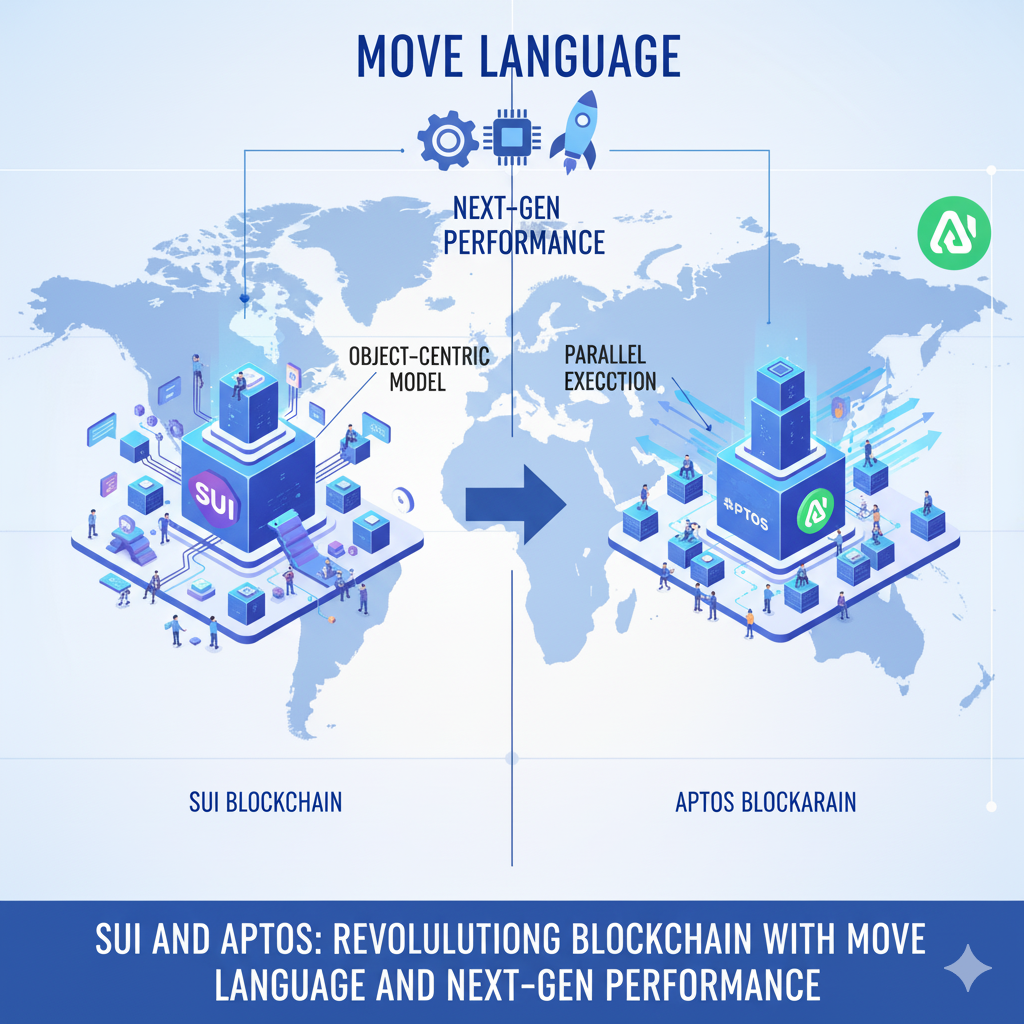
In the fast-evolving world of blockchain technology, two platforms stand out: Sui and Aptos. Both use the Move programming language for speed, security, and scalability. Facebook’s Diem project originally developed this tool. Furthermore, many experts call this “next-generation” performance.
Think of it like upgrading from a bicycle to a high-speed electric scooter. The new technology is faster, more efficient, and built for modern digital needs. Therefore, this article explores Sui and Aptos in simple terms. We draw on verified facts from reliable sources. Consequently, beginners will understand why these layer 1 blockchains generate buzz in 2025.
Are you curious about blockchain scalability? Do you want to learn about smart contract security? Are you interested in decentralized finance (DeFi)? Sui and Aptos represent a shift toward more user-friendly and powerful networks. Let’s dive in.
What is the Move Programming Language?
Both Sui and Aptos use the Move language at their core. Specifically, developers built this tool for blockchain systems. Meta (formerly Facebook) created Move for the Diem blockchain. As a result, the language helps keep digital assets secure.
Move draws inspiration from Rust. Moreover, it uses “resource types” with move semantics. Digital assets like crypto are unique items. In fact, you cannot copy them by accident. Instead, you can only transfer or manage them on purpose.
Think of Move as a secure vault system. In contrast, old languages like Solidity can have bugs. Assets might get copied or lost by mistake. These are called reentrancy attacks. It’s like leaving a bank door open.
However, Move stops this with strict rules. Assets can’t be copied or lost by accident. As a result, this makes Move perfect for valuable blockchain items. Additionally, the design uses formal proof methods. Developers can prove their code is secure using math. Consequently, this cuts the risk of hacks.
Furthermore, Move has modules for reusable code. It also has scripts for one-time tasks. Therefore, developers build smart contracts faster this way. Initially, Move started with Diem. Now it powers Sui and Aptos too.
According to the Aptos docs, Move focuses on scarcity and access control. Assets exist as resources. Importantly, you cannot duplicate or drop these by accident. Overall, Move is secure and flexible. It runs complex apps without old language problems.
Introducing Sui Blockchain: Speed and Scalability Redefined
Sui is a layer 1 blockchain with a clear goal. Specifically, it makes Web3 as easy as regular web apps. At the same time, it runs fast. Moreover, Sui uses Move to create smart contracts. These contracts are powerful and secure. Notably, they need less code but do more work.
Sui’s design focuses on parallel execution. Indeed, this makes it different from rivals. Traditionally, old blockchains process one transaction at a time. In contrast, Sui handles many operations at once. Specifically, it uses Narwhal and Bullshark parts. These include a DAG-based mempool and BFT consensus.
The Sui docs show that Sui scales horizontally. As a result, network power grows as validators add workers. The result? Low fees even when traffic is high.
Additionally, Sui treats assets as separate “objects” on the chain. This creates dynamic and flexible digital items. Particularly, blockchain games benefit from this a lot. Players can own and trade game items easily.
According to Sui’s website, the platform gives blockchain games what they need. This means good functions, easy abstraction, scaling ability, speed, and low cost. Furthermore, Move’s rules make it secure. Fees stay low and stable.
Notably, reports show Sui handled over 4.58 billion transactions by 2025. These span 18.19 million active accounts. Meanwhile, speed and security stay strong.
Use cases cover gaming and finance. For instance, CCP Games added EVE Frontier to the network. Money features include fast settlements and on-chain order books. Moreover, the Messari Q1 2025 Sui report shows major growth. FanTV brought in over 8 million wallets. Additionally, it handled over 29 million transactions.
Introducing Aptos Blockchain: Institutional-Grade Efficiency
Aptos is another layer 1 blockchain from Diem’s legacy. Similarly, it uses Move for smart contracts too. The Aptos Foundation calls it an independent Layer 1 platform. Specifically, it focuses on safety and scaling. Furthermore, it helps grow a decentralized network and developer community.
Notably, Aptos uses Block-STM for parallel execution. Block-STM means Software Transactional Memory. As a result, it makes transaction processing faster under heavy loads.
The official Block-STM research paper shows impressive speed. Specifically, this engine handles over 160,000 transactions per second in tests. Moreover, the Aptos docs show strong results. By December 2024, Aptos blocks close in 250 milliseconds. Clearly, this proves the platform focuses on speed.
In addition, Move’s built-in guards provide security. The design scales up without losing decentralization. Furthermore, reports show Aptos had nearly 15 million monthly users in Q1 2025.
Impressively, stablecoin trading hit over $200 million. This marks a 1,000%+ growth year-over-year. Additionally, DeFiLlama data and May 2025 reports show Aptos’ DeFi TVL reached $1.16 billion. Consequently, this proves growing trust in the system.
Aptos excels in DeFi and real-world assets (RWAs). Meanwhile, the Petra Wallet makes access easy. Notably, July 2025 reports show Aptos became the third-largest RWA blockchain. It holds $538 million in tokenized real assets. Overall, developers built it for wide use. It offers low fees and fast execution.
Performance Comparison: Sui vs. Aptos
Both Sui and Aptos excel in next-gen performance. However, they approach it differently.
Specifically, Sui’s parallelism uses its object-centric design and DAG-based stack. As a result, this yields strong throughput in benchmarks. It also provides low latency under good conditions. Particularly, the platform suits high-interaction apps well. Gaming and consumer experiences benefit most.
Moreover, the Sui documentation emphasizes important security features. The Move design prevents issues like reentrancy vulnerabilities. Additionally, it stops poison tokens and spoofed token approvals. Notably, attackers have used these methods to steal millions on other platforms.
In contrast, Aptos focuses on efficient, deterministic parallel execution under load. Block-STM provides this capability. Specifically, this approach benefits DeFi where consistency matters. Conflict resolution is crucial in financial applications.
According to research, Block-STM set the standard for parallel execution. It provides both safety and simplicity. For example, projects like Econia emphasize an important point. Their on-chain order book would not have worked on any other network.
In general, Sui often edges ahead in raw lab-benchmark speed in public comparisons. Meanwhile, Aptos emphasizes steady performance across diverse use cases. It also focuses on low latency. Nevertheless, both platforms far exceed base-layer Ethereum’s throughput. Ethereum processes tens of transactions per second on L1. Both keep fees low.
Furthermore, scalability for each platform is largely horizontal. Adding capacity increases throughput. However, the slowdowns are not linear. For beginners, this simply means faster, cheaper transactions.
Currently, in 2025, Sui commands a larger market cap. CoinMarketCap reports a market cap above $12 billion. Meanwhile, Aptos grows steadily and builds depth in DeFi.
Key Differences and Similarities
Similarities: Both platforms stem from Diem. They use Move for security. Additionally, both prioritize parallel execution for scalability. They’re layer 1 networks aiming for mass adoption. Furthermore, they offer low latency and developer-friendly tooling.
Differences:
Data model: Sui’s object model fits dynamic assets well. For instance, think of NFTs and game items. In contrast, Aptos’s Block-STM suits broad app categories. It uses conflict-aware parallelism.
Staking: Sui’s delegation and unstaking work on an epoch basis. Specifically, each epoch lasts roughly 24 hours. On the other hand, on Aptos, lockup and unstaking mechanics vary. They depend on the validator or configuration. There’s no single fixed period network-wide.
Ecosystems: Currently, Sui leans into gaming and consumer apps at present. It focuses on object-centric use cases. For example, projects like BIRDS attracted over 9 million users. Similarly, Pebble City launched as a mobile Web3 social casino game.
Meanwhile, Aptos has strong momentum in DeFi. Stablecoin activity grows rapidly. Furthermore, the platform draws growing attention to RWAs.
Ultimately, there’s no absolute “better” platform. It depends on your needs. Choose Sui for speed-oriented, object-heavy experiences. Alternatively, pick Aptos for institutional-grade, conflict-heavy workloads.
Use Cases and Ecosystems
Sui thrives in gaming and consumer apps. Specifically, it offers dynamic assets for loyalty programs. Royalties and complex item logic work well on the platform. Moreover, the Messari report highlights several examples. These include on-chain trading systems and CLOB-style exchanges.
For instance, platforms like FanTV use Sui’s object-based data structure. Consequently, this powers video content and creator rewards effectively.
In contrast, Aptos excels in DeFi. Stablecoin flows continue to grow. Additionally, lending and DEX activity increase steadily. Notably, the Aptos Foundation committed over $200 million in grants and investments. As a result, this funding expands its DeFi ecosystem.
Furthermore, the money enhances spot trading hubs. It improves automated market makers and concentrated liquidity market makers. Meanwhile, both platforms support cross-chain tooling. Their Move foundations attract specific developers. Particularly, those who prioritize security and formal reasoning choose these platforms.
Future Outlook for Sui and Aptos
Both platforms are ready for continued growth in 2025. Specifically, Sui’s high-throughput architecture positions it well. Mass-market gaming and social apps are prime targets.
Moreover, recent developments show strong progress. For example, the SuiPlay0X1 gaming device supports both traditional and blockchain-native games. Additionally, Talus launched its AI agent platform powered by Sui.
Meanwhile, Aptos could benefit from rising institutional participation. Its DeFi focus and low-latency execution are key advantages. Furthermore, tokenized finance continues to grow. Notably, 21Shares filed for a SUI spot ETF in mid-2025. Plans include listing it on Nasdaq. Consequently, this could open doors to institutional capital.
However, the main challenge remains competition. Ethereum L2s and other performant L1s intensify the race. Nevertheless, Move’s security model gives these chains a distinct edge. Financial-grade apps benefit most from this advantage.
Looking ahead, innovations point to broader uses ahead. Modular designs continue to evolve. Additionally, AI-adjacent tooling emerges on both platforms. These include data-rich, low-latency on-chain services. As blockchain evolves, Sui and Aptos could lead the charge. Ultimately, they push toward a more performant Web3.
Conclusion
In summary, Sui and Aptos redefine blockchain performance. The Move language powers both platforms. Together, they deliver speed, security, and scalability.
For beginners, think of them as upgraded engines in the crypto world. Specifically, they make transactions faster and safer. Sui’s gaming focus appeals to some users. Meanwhile, Aptos’ DeFi strength attracts others. Overall, both offer exciting opportunities.
As layer 1 blockchains, they don’t just compete. Instead, they push the entire industry forward. Therefore, stay informed about these developments. Explore these platforms to see the future of blockchain in action.