Home Blog Page 12

Base by Coinbase: The Complete Guide to America’s Leading Ethereum Layer-2 Solution

0

What is Base? Understanding Coinbase’s Revolutionary Layer-2 Network

Base is Coinbase’s groundbreaking Layer-2 (L2) blockchain network that’s transforming how millions of users interact with Ethereum. Built on the proven OP Stack technology from Optimism, Base offers the security of Ethereum with transaction fees that cost mere cents instead of dollars.

As America’s largest regulated cryptocurrency exchange, Coinbase launched Base in August 2023 with a clear mission: make blockchain technology accessible to mainstream users by eliminating the high fees and complexity that have historically plagued Ethereum transactions.

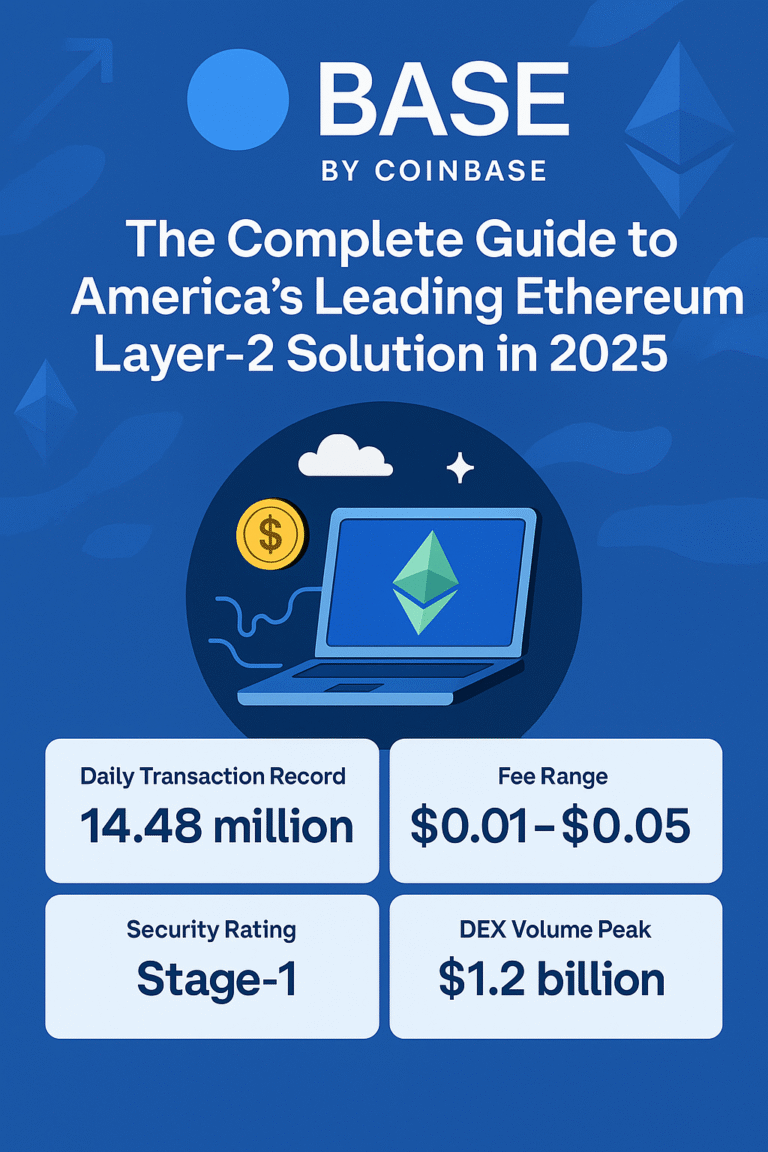
Key Base Statistics (2025):

  • Daily Transaction Record: 14.48 million transactions (September 21, 2025)
  • Fee Range: $0.01-$0.05 per transaction
  • Security Rating: Stage-1 on L2BEAT’s security framework
  • DEX Volume Peak: $1.2 billion in single-day trading volume

How Base Works: Optimistic Rollup Technology Explained

Base operates as an Optimistic Rollup, a Layer-2 scaling solution that processes transactions off-chain before posting transaction data to Ethereum for final settlement. Consequently, this architecture provides several key advantages:

Security Through Ethereum

Most importantly, Base inherits Ethereum’s battle-tested security model. Furthermore, all transactions are ultimately secured by Ethereum’s network of validators, ensuring the same level of security as mainnet Ethereum transactions.

The Challenge Period System

Additionally, withdrawals from Base to Ethereum mainnet require a 7-day challenge period. During this time, anyone can contest incorrect state transitions. However, if no challenges are raised, withdrawals automatically finalize. Moreover, this system, enhanced by the OP Stack’s fault-proof upgrade in 2024, ensures transaction integrity.

Why Fees Are So Low: The EIP-4844 Impact

Remarkably, the March 2024 Dencun upgrade introduced EIP-4844 “blobs,” dramatically reducing data availability costs for Layer-2 networks. As a result, this technical improvement is why Base transactions now cost cents instead of dollars, even during network congestion.

Base vs Ethereum: Performance Comparison

MetricBaseEthereum L1
Daily TransactionsUp to 14.48M1.4-1.9M
Average Fee$0.01-$0.05$2-$50+
Transaction Speed2-3 seconds12+ seconds
Security ModelEthereum-securedNative Ethereum

The Base Ecosystem: DeFi, Social, and Enterprise Applications

DeFi Powerhouse

Notably, Base has become a major DeFi hub, with several standout protocols:

  • Aerodrome Finance: Currently serving as Base’s native liquidity hub and leading DEX
  • Uniswap on Base: Successfully contributing to billion-dollar daily trading volumes
  • Lending Protocols: Similarly, multiple lending platforms offering competitive yields

For those interested in comparing DeFi platforms across different blockchains, check out our analysis of Ethereum vs Solana vs Polygon for DeFi.

Social and Consumer Applications

Meanwhile, Base has fostered innovative social applications:

  • Friend.tech: Initially, the social trading platform that drove massive adoption to Base
  • Farcaster Integration: Subsequently, decentralized social protocol with growing Base activity
  • NFT Marketplaces: In addition, low-cost minting and trading platforms

Enterprise and Commerce Solutions

On the enterprise side, Base Pay represents a breakthrough in crypto commerce, enabling merchants to accept USDC payments with near-zero fees. Furthermore, the Shopify integration allows millions of merchants to accept cryptocurrency payments seamlessly. Learn more about how companies are using Ethereum in business.

Smart Wallets and User Experience: Why Base Feels Different

Coinbase Smart Wallet Innovation

Specifically, the Coinbase Smart Wallet leverages ERC-4337 Account Abstraction to provide:

  • Passkey Authentication: Instead of seed phrases, mainstream users get simplified access
  • Sponsored Gas Fees: Moreover, apps can cover transaction costs for users
  • Batch Transactions: Additionally, multiple operations in a single transaction
  • Social Recovery: Finally, recover wallet access without seed phrases

Developer Tools: OnchainKit

To support developers, OnchainKit provides developers with pre-built components for creating user-friendly blockchain applications. Consequently, this reduces development time and improves user experience across the Base ecosystem.

Base Token: Current Status and Future Plans

Important: Currently, Base does not have a native token. However, in September 2025, Base leadership publicly stated they are “exploring” a potential network token, although no official plans have been announced.

Warning: Importantly, any “BASE” tokens currently trading are unofficial and potentially fraudulent. Therefore, always verify official communications through Base.org and Coinbase channels.

How to Use Base: Complete Beginner’s Guide

Step 1: Set Up a Compatible Wallet

First, choose from these wallet options:

  • Coinbase Wallet (Recommended for beginners)
  • MetaMask (Perfect for advanced users)
  • Rainbow Wallet (Ideal for mobile-friendly option)

For a comprehensive comparison of wallet options, explore our guide to the top 10 crypto wallets in 2025.

Step 2: Get Funds on Base

Next, select your preferred funding method:

  • Direct Purchase: Alternatively, buy crypto directly on Base through Coinbase
  • Bridge from Ethereum: Subsequently, use the official Base Bridge
  • Cross-chain Bridges: Furthermore, for other networks, use Portal Bridge or deBridge

Step 3: Explore Base Applications

Then, start with reputable platforms:

  • Trading: For instance, Uniswap or Aerodrome
  • Lending: Similarly, established lending protocols
  • Social: Additionally, Friend.tech or Farcaster-integrated apps

Step 4: Withdrawing to Ethereum

Finally, choose your withdrawal method:

  • Native Bridge: Specifically, 7-day withdrawal period via Base Bridge
  • Fast Bridges: Alternatively, instant withdrawals through trusted third-party services (higher fees)

Base Security: L2BEAT Assessment and Risk Factors

According to L2BEAT, Base maintains a Stage-1 security rating, which indicates:

Strengths:

Most notably, Base offers:

  • Ethereum-level security inheritance
  • Furthermore, open-source codebase
  • Additionally, active bug bounty programs
  • Moreover, regular security audits

Areas for Improvement:

However, Base still needs improvement in:

  • Sequencer decentralization (currently Coinbase-operated)
  • Similarly, governance token distribution
  • In addition, multi-sig upgrade mechanisms

Base vs Competitors: Layer-2 Comparison

NetworkTechnologyDaily TPSSecurity StageNative Token
BaseOP Stack14.48M peakStage-1None (exploring)
ArbitrumOptimistic~1-2MStage-1ARB
OptimismOP Stack~500K-1MStage-1OP
PolygonPlasma/PoS~3-4MStage-0MATIC

For an in-depth comparison of how these networks stack up, read our comprehensive analysis of the Layer-2 wars: Arbitrum vs Optimism vs Base.

The Future of Base: 2025 Roadmap and Beyond

Technical Improvements

Looking ahead, Base plans to implement:

  • Sequencer Decentralization: Specifically, moving towards a decentralized sequencer network
  • Advanced Fraud Proofs: Additionally, enhanced security mechanisms
  • Interoperability: Furthermore, better cross-chain functionality

Mainstream Adoption

Meanwhile, Base is focusing on:

  • Enterprise Partnerships: Notably, more Fortune 500 integrations
  • Government Adoption: In addition, potential CBDC and government use cases
  • Social Integration: Moreover, deeper Web2 platform integrations

Ecosystem Growth

Finally, Base will prioritize:

  • Developer Incentives: Particularly, grant programs and hackathons
  • Institutional DeFi: Subsequently, enterprise-grade financial products
  • Gaming and NFTs: Ultimately, consumer entertainment applications

Base Trading and Investment Considerations

For Traders:

  • Low Fees: Ideal for high-frequency trading strategies
  • Deep Liquidity: Major DEXs with substantial trading volumes
  • Arbitrage Opportunities: Price differences between Base and other networks

For Developers:

  • Coinbase Integration: Direct access to millions of users
  • Developer Support: Comprehensive documentation and tools
  • Fast Deployment: Quick application launches with familiar tooling

For Institutions:

  • Regulatory Clarity: Backed by regulated exchange
  • Compliance Tools: Built-in compliance and reporting features
  • Enterprise Support: Dedicated institutional support channels

Frequently Asked Questions About Base

Is Base Safe to Use?

Essentially, Base inherits Ethereum’s security and maintains a Stage-1 rating from L2BEAT. Nevertheless, like all Layer-2 solutions, it involves additional smart contract risks and a 7-day withdrawal period for native bridging.

Can I Use Base for Business?

Absolutely, Base Pay enables merchants to accept USDC payments with minimal fees. Moreover, the Shopify integration makes it particularly attractive for e-commerce businesses.

Will Base Launch a Token?

Currently, Base leadership has stated they’re exploring a token but haven’t announced definitive plans. Therefore, any current “BASE” tokens are unofficial.

How Does Base Compare to Other L2s?

Importantly, Base offers the unique advantage of Coinbase integration, making it the most accessible L2 for mainstream users. However, other networks may offer different technical advantages.

Conclusion: Why Base Matters for Crypto’s Future

Ultimately, Base represents more than just another Layer-2 solution—it’s Coinbase’s bet on making blockchain technology accessible to mainstream users. Furthermore, with record-breaking transaction volumes, cent-level fees, and seamless user experiences through smart wallets and integrated payments, Base is positioning itself as the primary on-ramp for Web2 users entering the crypto ecosystem.

Additionally, the combination of Ethereum security, low fees, and enterprise-grade infrastructure makes Base particularly compelling for businesses and developers looking to build consumer-facing applications. Although challenges around decentralization and native token economics remain, Base’s rapid growth and institutional backing suggest it will continue playing a crucial role in Ethereum’s scaling roadmap.

Therefore, for users considering Base, the network offers an excellent introduction to Layer-2 technology with minimal risk and maximum accessibility. As the crypto industry matures, platforms like Base will likely serve as the primary interface between traditional finance and decentralized applications.


Disclaimer: This article is for informational purposes only and should not be considered financial advice. Always conduct your own research before using any blockchain network or cryptocurrency service.

zkSync vs. Starknet (2025): The Ultimate Guide to Ethereum’s Leading ZK-Rollups

4

Executive Summary: zkSync vs Starknet in 2025

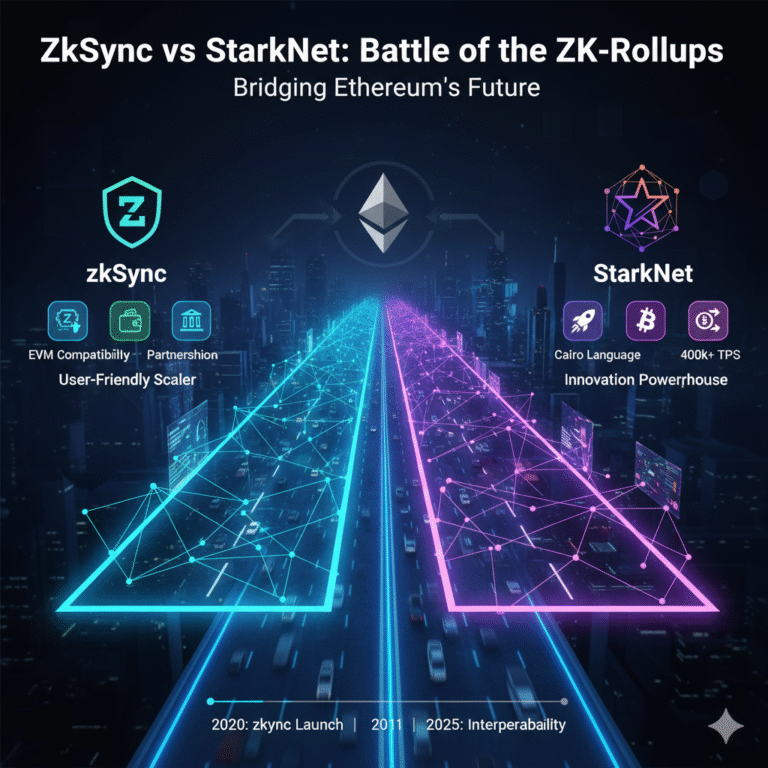
TL;DR: Both zkSync and Starknet leverage cutting-edge zero-knowledge proofs to scale Ethereum, but they take different approaches. zkSync prioritizes EVM compatibility, user experience, and an “Elastic” multi-chain network architecture. Starknet pushes technical boundaries with STARK proofs, native account abstraction, and an innovative 2025 strategy to integrate Bitcoin functionality.

Current Market Position (September 2025):

  • zkSync Era: ~$1.14B Total Value Secured (TVS)
  • Starknet: ~$579M TVS
  • Decentralization: Starknet leads (Stage 1 vs zkSync’s Stage 0)

Choose zkSync for seamless EVM migration and enterprise-ready infrastructure. Choose Starknet for cutting-edge Cairo development, native account abstraction, or Bitcoin-Ethereum interoperability.


Understanding ZK-Rollups: The Foundation

What Problem Do ZK-Rollups Solve?

Ethereum’s mainnet faces the blockchain trilemma: security, decentralization, and scalability. While Ethereum excels at the first two, network congestion and high gas fees limit mainstream adoption.

ZK-rollups solve this by:

  • Batching hundreds of transactions off-chain
  • Generating cryptographic proofs (zero-knowledge proofs)
  • Posting only the proof to Ethereum mainnet
  • Achieving faster finality than optimistic rollups (no 7-day challenge period)

According to L2BEAT, ZK-rollups represent the future of Ethereum scaling, with validity proofs ensuring instant finality. For those new to the technology, our beginner’s guide to ZK-rollups provides a comprehensive introduction.


zkSync Era: The EVM-Compatible Powerhouse

Core Technology & Architecture

zkSync Era is built on the ZK Stack, creating what Matter Labs calls an “Elastic Chain” network. This architecture allows multiple ZK-powered chains to interoperate seamlessly.

Key Technical Features:

  • Full EVM Compatibility: Deploy Solidity contracts without modifications
  • SNARK Proofs: Compact proofs with lower L1 verification costs
  • Account Abstraction: Native paymaster support for gasless transactions
  • ZK Stack Framework: Powers additional chains like Cronos zkEVM

For the latest developments, check out our article on zkSync Era updates and adoption trends in 2025.

Performance Metrics (Independent Data from L2BEAT)

MetriczkSync Era Performance
Total Value Secured$1.14 billion
Stage RatingStage 0
Max Historical UOPS~62
Avg L1 Cost per UOP$0.007
Uptime99.99% (vendor-reported)

Enterprise Adoption & Use Cases

Prividium Initiative: zkSync’s enterprise solution has attracted major financial institutions:

  • UBS Partnership: Tokenized asset pilots
  • Deutsche Bank Integration: Private payment rails
  • Privacy-First Design: Sensitive data stays off public blockchains while settlement occurs on Ethereum

This enterprise focus positions zkSync as the go-to solution for institutional adoption.

User Experience Innovations

Native Account Abstraction Features:

  • Paymaster Integration: dApps can sponsor user gas fees
  • ERC-20 Gas Payments: Pay fees in USDC, not just ETH
  • Social Recovery: Built-in wallet recovery mechanisms
  • Batch Transactions: Execute multiple operations in one transaction

Starknet: The Technical Innovation Leader

Revolutionary STARK Technology

Starknet uses STARK proofs (Scalable Transparent Arguments of Knowledge), offering several advantages over traditional SNARKs:

STARK Advantages:

  • Post-quantum resistant: Future-proof cryptography
  • No trusted setup required: Eliminates ceremony risks
  • Transparent verification: Anyone can verify proofs
  • Superior scalability: Better performance at scale

StarkWare’s Stwo prover delivers significant performance improvements over previous generations.

Cairo Programming Language

Why Cairo Matters:

  • Built for ZK: Native zero-knowledge proof generation
  • Memory-safe: Prevents common smart contract vulnerabilities
  • Expressive syntax: More powerful than Solidity for complex logic
  • Growing ecosystem: Dedicated developer tools and libraries

While not EVM-native, tools like Warp help Solidity developers transition.

2025 Game Changer: Bitcoin Integration

Bitcoin x Starknet Initiative:

Starknet is pioneering Bitcoin-Ethereum interoperability through:

  1. Asset Runes: USDC•Starknet minted as Bitcoin Runes, redeemable trustlessly
  2. LBTC Integration: Lombard’s liquid staked Bitcoin native support
  3. Bitcoin Execution Layer: Positioning Starknet as Bitcoin’s smart contract platform

This strategy could unlock Bitcoin’s $1+ trillion market cap for DeFi applications. Learn more about Starknet’s ambitious plans in our comprehensive roadmap guide.

Performance Metrics & Decentralization

MetricStarknet Performance
Total Value Secured$579 million
Stage RatingStage 1 (more decentralized)
Max Historical UOPS~129
Avg L1 Cost per UOP$0.0013
Native Account Abstraction100% of users

Interoperability Roadmap

IBC Integration: Partnership with Informal Systems to implement Inter-Blockchain Communication protocol, enabling communication with Cosmos ecosystem chains.


Head-to-Head Comparison: zkSync vs Starknet

Technical Architecture

FeaturezkSync EraStarknet
Proof SystemSNARKs (compact)STARKs (transparent)
EVM CompatibilityFull native supportVia transpilers (Warp)
Programming LanguageSolidityCairo
Account AbstractionOptional paymasterNative for all users
Decentralization StageStage 0Stage 1

Performance & Economics

MetriczkSync EraStarknet
TVS (Sep 2025)$1.14B$579M
Throughput (Max UOPS)~62~129
L1 Settlement Cost$0.007/UOP$0.0013/UOP
FinalityInstant (validity proofs)Instant (validity proofs)

For a broader perspective on how these solutions compare to other Layer 2 options, see our guide on how Ethereum Layer 2 works.

Developer Experience

zkSync Advantages:

  • Zero-friction Solidity deployment
  • Familiar tooling (Hardhat, Foundry)
  • Large existing codebase compatibility
  • Rich documentation and tutorials

Starknet Advantages:

  • More expressive programming model
  • Native account abstraction
  • Advanced cryptographic primitives
  • Growing Cairo developer ecosystem

Ecosystem & Partnerships

zkSync Ecosystem:

  • DeFi Protocols: SyncSwap, Mute
  • Enterprise Partners: UBS, Deutsche Bank
  • Elastic Chains: Cronos zkEVM, upcoming launches
  • Infrastructure: Comprehensive paymaster ecosystem

Starknet Ecosystem:


Use Case Analysis: When to Choose Each Platform

Choose zkSync Era If You Need:

1. Fast EVM Migration:

  • Existing Solidity codebase
  • Minimal development overhead
  • Quick time-to-market

2. Enterprise Features:

  • Regulatory compliance (Prividium)
  • Privacy-preserving transactions
  • Institutional-grade infrastructure

3. User-Friendly dApps:

  • Gasless transactions via paymasters
  • ERC-20 gas fee payments
  • Simplified onboarding flows

4. Multi-Chain Strategy:

  • Elastic Chain interoperability
  • Cross-chain asset transfers
  • Unified liquidity across chains

Choose Starknet If You Want:

1. Cutting-Edge Technology:

  • Post-quantum cryptographic security
  • Superior scalability potential
  • Technical innovation leadership

2. Advanced Smart Contracts:

  • Complex DeFi protocols
  • Gaming applications with intricate logic
  • Novel cryptographic applications

3. Native Account Abstraction:

  • Every user gets AA benefits
  • Social recovery mechanisms
  • Flexible transaction authorization

4. Bitcoin-Ethereum Bridge:

  • Asset Runes integration
  • LBTC liquid staking
  • Cross-ecosystem arbitrage opportunities

Security & Decentralization Comparison

Security Models

Both platforms inherit Ethereum’s security through validity proofs, but differ in implementation:

zkSync Security Features:

  • Matter Labs operated (Stage 0)
  • Upgrade mechanisms require governance
  • Emergency pause functionality
  • Regular security audits by leading firms

Starknet Security Features:

  • Further decentralized (Stage 1)
  • Community governance via STRK token
  • Transparent proof verification
  • Open-source prover implementation

Decentralization Progress

According to L2BEAT’s staging framework:

  • Stage 0: Centralized operator, limited decentralization
  • Stage 1: Decentralized validation, some governance
  • Stage 2: Full decentralization with fraud proofs

Starknet’s Stage 1 rating indicates more mature decentralization compared to zkSync’s Stage 0.


Future Roadmaps & Development

zkSync 2025-2026 Roadmap

Planned Developments:

  • ZK Stack Expansion: More Elastic Chains launching
  • Enterprise Growth: Additional banking partnerships
  • UX Improvements: Enhanced account abstraction features
  • Cross-chain Bridges: Improved asset transfer mechanisms

Starknet 2025-2026 Roadmap

Key Initiatives:

  • Bitcoin Integration: Full Asset Runes deployment
  • IBC Implementation: Cosmos ecosystem connectivity
  • Cairo Evolution: Language improvements and tooling
  • Decentralization: Progress toward Stage 2

Economic Analysis & Token Economics

zkSync Token (ZK)

Token Utility:

  • Governance voting rights
  • Fee payment discounts
  • Staking for validation (future)
  • Ecosystem grants and incentives

Current Market Dynamics:

  • Circulating supply influences
  • Staking yield opportunities
  • Governance participation rates

Starknet Token (STRK)

Token Functions:

  • Network governance
  • Transaction fee payments
  • Validator staking
  • Developer grant funding

Tokenomics Considerations:

  • Inflation mechanisms
  • Burn mechanisms from fees
  • Community treasury allocation

Performance Benchmarks & Real-World Usage

Transaction Throughput Analysis

zkSync Performance:

  • Theoretical capacity: 10,000+ TPS
  • Real-world usage: Variable based on transaction complexity
  • Gas optimization: Efficient batch processing

Starknet Performance:

  • Higher proven UOPS capacity (~129 vs ~62)
  • Cairo optimization benefits
  • STARK proof efficiency at scale

Cost Analysis for Different Use Cases

Use CasezkSync Era CostStarknet Cost
Simple Transfer~$0.10-0.50~$0.05-0.25
DEX Swap~$0.50-2.00~$0.25-1.00
NFT Mint~$1.00-5.00~$0.50-2.50
Complex DeFi~$2.00-10.00~$1.00-5.00

Note: Costs vary based on network congestion and L1 gas prices


Developer Resources & Getting Started

zkSync Development Resources

Essential Links:

Development Tools:

Starknet Development Resources

Essential Links:

Development Tools:


Frequently Asked Questions (FAQ)

General Questions

Q: Which is more secure, zkSync or Starknet? A: Both inherit Ethereum’s security through validity proofs. Starknet’s STARK proofs offer post-quantum resistance, while zkSync’s SNARKs are more battle-tested.

Q: Can I use existing Ethereum tools with these platforms? A: zkSync offers full compatibility with Ethereum tooling. Starknet requires Cairo-specific tools but provides transpilers for Solidity migration.

Q: Which has lower transaction fees? A: Starknet generally shows lower L1 settlement costs ($0.0013 vs $0.007 per UOP), but user-facing fees depend on various factors.

Technical Questions

Q: What’s the difference between SNARKs and STARKs? A: SNARKs create smaller proofs but require trusted setup. STARKs are transparent, post-quantum resistant, but create larger proofs.

Q: How does account abstraction work differently on each platform? A: zkSync offers optional paymaster features. Starknet has native AA for all accounts with more flexible authorization models.


Conclusion: Making the Right Choice

Both zkSync and Starknet represent the cutting edge of Ethereum scaling technology, but serve different market needs:

Choose zkSync Era for:

  • Immediate EVM compatibility needs
  • Enterprise and institutional use cases
  • User-friendly consumer applications
  • Multi-chain ecosystem participation

Choose Starknet for:

  • Technical innovation and future-proofing
  • Complex smart contract applications
  • Native account abstraction benefits
  • Bitcoin-Ethereum interoperability

The Bottom Line: Both platforms offer instant finality through validity proofs, making them superior to optimistic rollups for many use cases. Your choice should align with your technical requirements, timeline, and strategic goals.

As the ZK-rollup ecosystem matures in 2025, consider starting development on both platforms to hedge your bets and maximize market reach. The future of Ethereum scaling is bright, and both zkSync and Starknet are leading the charge.


Additional Resources:

Optimism Explained: Fast and Cheap Ethereum Transactions

2

Introduction: Ethereum’s Traffic Jam

Picture a crowded coffee shop at rush hour. One barista, long lines, and rising prices. Ethereum sometimes feels the same way: it’s a global computer for decentralized applications (dApps), but with limited capacity that creates significant user experience challenges.

Ethereum’s Current Limitations:

Throughput Bottleneck: Ethereum mainnet typically handles 15–30 transactions per second (TPS), far below traditional payment networks like Visa, which process over 65,000 TPS

High Transaction Fees: During network congestion, average gas fees have historically spiked above $50-100 per transaction

Slow Confirmation Times: Transaction confirmations can stretch from minutes to hours during peak usage

For everyday users, DeFi participants, or those in emerging markets, these barriers make Ethereum prohibitively expensive. Fortunately, the solution exists in the form of Layer 2 (L2) scaling solutions—networks built on top of Ethereum that process transactions off-chain while inheriting Ethereum’s robust security model.

Among these solutions, Optimism stands as one of the most important and widely-adopted Layer 2 platforms addressing these challenges.

What Are Layer 2 Solutions?

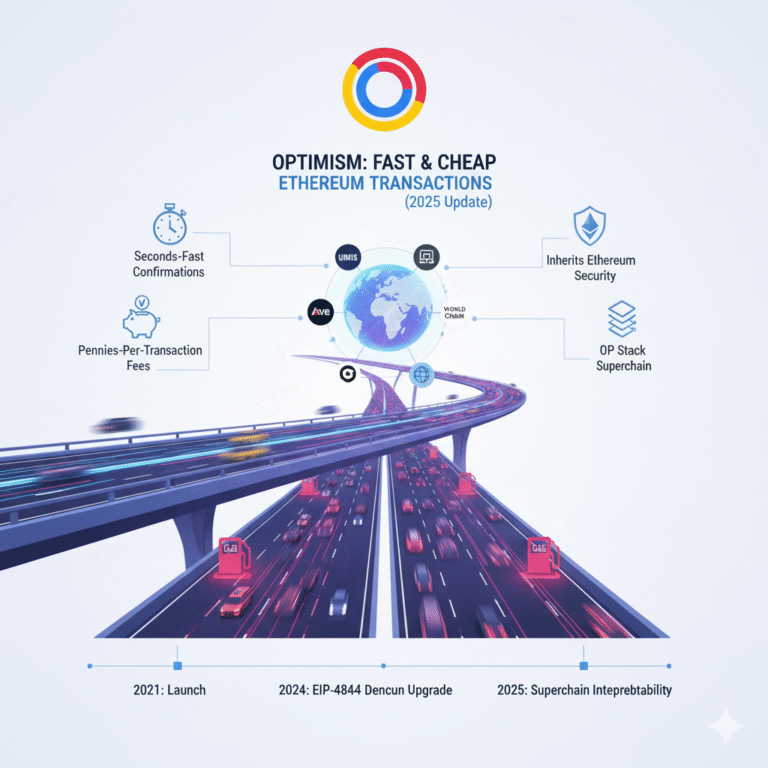
Think of Ethereum as Layer 1 (L1), the secure foundation. In contrast, Layer 2 networks build on top like express lanes above a busy highway, processing transactions faster and cheaper while periodically settling on the main chain.

Two Major Rollup Technologies:

Optimistic Rollups (like Optimism and Arbitrum):

  • Assume transactions are valid by default
  • Allow a challenge period for fraud proofs
  • Examples: Optimism, Arbitrum One, Base

Zero-Knowledge (ZK) Rollups (like Polygon zkEVM and zkSync):

  • Use cryptographic proofs to verify every batch immediately
  • No challenge period required
  • Examples: Polygon zkEVM, zkSync Era, Starknet

Both approaches dramatically reduce costs and increase transaction speed without compromising Ethereum’s security guarantees. For a comprehensive comparison of these technologies, explore our complete guide to Ethereum Layer 2 solutions in 2025.

What Is Optimism?

Optimism is a pioneering optimistic rollup Layer 2 network launched in 2021, now powering one of the largest L2 ecosystems in the cryptocurrency space.

Key Components of the Optimism Ecosystem:

OP Stack: A modular, open-source toolkit enabling developers to launch their own Layer 2 chains with minimal technical overhead (Learn more)

Superchain: A network of 50+ interconnected chains built on OP Stack that share infrastructure, users, and liquidity pools (Superchain overview)

Current Scale: Processing over 17 million daily transactions and securing $22+ billion in total value locked (TVL)

Major Adopters Using OP Stack:

  • BaseCoinbase’s consumer-focused L2 chain
  • World Chain – Worldcoin’s identity-focused blockchain
  • Soneium – Sony’s entertainment and gaming blockchain
  • Unichain – Uniswap’s upcoming dedicated DEX chain

The Optimism Superchain ecosystem represents one of the most ambitious visions for blockchain interoperability and scalability.

How Optimistic Rollups Work

Imagine a party where everyone shares stories. Instead of fact-checking every story immediately, you trust them unless someone disputes a detail. That’s Optimism’s “optimistic” philosophy in action.

The Four-Step Process:

  1. Transaction Execution: Users submit transactions to the Optimism network
  2. Batch Processing: Subsequently, a sequencer collects and bundles transactions into rollup batches
  3. L1 Settlement: Following this, transaction data plus a security bond gets published to Ethereum mainnet
  4. Challenge Period: Finally, anyone has approximately 7 days to submit fraud proofs

If a batch contains invalid transactions, it gets reverted and the sequencer loses their bond. On the other hand, if no challenges occur, the batch achieves final settlement.

This design achieves up to 99% lower fees than Ethereum L1 while maintaining near-instant user confirmations and Ethereum-level security.

Key Benefits

For End Users:

Lightning Speed: Transaction confirmations in under 2 seconds

Minimal Costs: Typical fees range from $0.01-0.10 per transaction

Ethereum Security: All transaction data stored on Ethereum L1

Seamless Experience: Works with existing MetaMask and other Ethereum wallets

For Developers:

EVM Compatibility: Existing Ethereum smart contracts work without modification

Mature Tooling: Full support for Hardhat, Truffle, and other development frameworks

Scalable Infrastructure: Support millions of users without performance degradation

Environmental Benefits: Significantly lower energy consumption per transaction

For DeFi Users:

Affordable Trading: DEX swaps, lending, and yield farming without prohibitive gas fees

NFT Accessibility: Mint, trade, and transfer NFTs for cents instead of dollars

Gaming Integration: Enable blockchain gaming with micro-transactions

Getting Started with Optimism

Step-by-Step Setup Guide:

1. Install a Compatible Wallet

2. Add Optimism Network

  • Visit Chainlist.org and search “Optimism”
  • Click “Add to MetaMask” for one-click network addition
  • Manual setup: RPC URL https://mainnet.optimism.io

3. Bridge Assets to Optimism

4. Explore the Ecosystem

Withdrawing to Ethereum L1

Standard bridge withdrawal takes approximately 7 days for security purposes. However, fast bridges are available with additional trust assumptions. Additionally, always verify official contract addresses.

Security Reminder: Always double-check URLs, start with small amounts, and use official bridges when possible.

The Superchain in 2025

Optimism’s vision extends beyond a single blockchain. Instead, the Superchain represents an interconnected network of OP Stack chains with native interoperability, eliminating the need for third-party bridges between compatible chains.

Recent Major Developments:

EIP-4844 Integration: Proto-danksharding implementation reduced L2 data costs by 90%+

Explosive Growth: Base alone processes over 50 million transactions monthly

Decentralization Progress: Chains advancing from Stage-0 to Stage-1 and Stage-2 rollup maturity

Shared Security Model: All Superchain members benefit from collective security guarantees

Superchain Interoperability Features:

Native Asset Transfers: Move tokens between OP chains without external bridges

Shared Liquidity Pools: Access deeper liquidity across the entire ecosystem

Cross-Chain Contract Calls: Enable complex multi-chain dApp architectures

Unified Developer Experience: Deploy once, scale across multiple chains

As a result, this infrastructure positions the Superchain to onboard the next 100 million crypto users with a seamless, affordable experience.

Risks and Considerations

Technical Risks:

Withdrawal Delays: Standard L1 exits require 7-day challenge period

Sequencer Centralization: Most OP Stack chains currently rely on single sequencers (decentralization roadmap in progress)

Smart Contract Risk: Rollup contracts, though audited, remain complex systems

Bridge Security: Third-party fast bridges introduce additional trust assumptions

Economic Considerations:

Fee Variability: L2 costs still correlate with Ethereum L1 data pricing during extreme congestion

Liquidity Fragmentation: Assets may have different liquidity profiles across chains

Governance Risks: Protocol upgrades controlled by OP token holders

Best Practices:

Start Small: Test with minimal funds before large commitments

Use Official Resources: Verify all contract addresses and bridge URLs

Diversify: Don’t put all assets on a single L2 solution

Stay Informed: Follow Optimism’s official blog for updates

Frequently Asked Questions

Is Optimism Safe?

Optimism inherits Ethereum’s security through its rollup design. All transaction data is stored on Ethereum L1, and the 7-day challenge period allows dispute resolution. Nevertheless, like all crypto protocols, smart contract risks exist.

How Much Does Optimism Cost?

Transaction fees typically range from $0.01-0.10, representing 95-99% savings compared to Ethereum mainnet during congestion periods.

Can I Use My Existing Ethereum Wallet?

Yes! Moreover, Optimism is fully compatible with MetaMask, Coinbase Wallet, and other Ethereum wallets. Simply add the Optimism network.

What’s the Difference Between Optimism and Arbitrum?

Both are optimistic rollups with similar security models. However, key differences include fraud proof mechanisms, sequencer decentralization timelines, and ecosystem focus. For a detailed analysis, check out our Layer 2 comparison: Arbitrum vs Optimism vs Base.

Conclusion

Optimism transforms Ethereum from a congested highway into a high-speed expressway—delivering the same security and functionality without the delays and high costs. It’s like upgrading a single-barista coffee shop with self-service kiosks: the same quality coffee, but without the long waits or premium pricing.

Whether you’re:

  • A newcomer exploring DeFi for the first time
  • An NFT creator looking to mint affordably
  • A DeFi trader seeking lower transaction costs
  • A developer building the next generation of dApps

Optimism provides an accessible gateway to Ethereum’s full ecosystem potential. Furthermore, the Superchain vision of interconnected, interoperable blockchains positions Optimism at the forefront of crypto’s mainstream adoption wave.

Ready to get started? Visit the official Optimism portal, bridge some ETH, and experience Layer 2 scaling firsthand. Start with small amounts, explore the ecosystem, and discover how Optimism unlocks Ethereum’s true potential.

Additional Resources


Sources: Ethereum.org, Optimism.io, Dune Analytics, EIP-4844 Documentation, L2Beat, Official OP Stack and Base announcements (2024–2025).

Arbitrum in 2025: Complete Guide to Ethereum’s Leading Layer-2 Scaling Solution

2

What Is Arbitrum?

Arbitrum stands as Ethereum’s largest Layer-2 scaling solution, processing over 6 million transactions daily while maintaining the security guarantees of the Ethereum mainnet.

Imagine Ethereum as a congested highway during rush hour — Arbitrum creates an express lane that drastically reduces transaction costs and boosts processing speeds.

Launched in 2021 by Offchain Labs, the project has grown into the dominant Layer-2 solution by 2025, securing roughly $19 billion in total value locked (TVL) and capturing 36% of the Layer-2 market, according to L2BEAT.

This continued expansion shows the market’s confidence in optimistic rollup technology.


Key Arbitrum Statistics (2025)

  • Total Value Secured: ~$19 billion (L2BEAT)
  • Daily Transactions: 5.5–6 million+ (Arbiscan)
  • Average Transaction Cost: $0.02–$0.40 (L2Fees.info)
  • Market Share: 36% of all Layer-2 value
  • Supported dApps: 900+ (DeFiLlama)

Ethereum’s Scaling Challenge

Ethereum revolutionized blockchain in 2015 by introducing smart contracts, unlocking a universe of decentralized applications.

Yet, the network still faces scalability bottlenecks that limit its capacity and adoption.

Key constraints include:

  • Limited Throughput: 15–30 TPS
  • High Gas Fees: $50+ during congestion
  • Slow Confirmations: Minutes at peak load
  • Daily Transaction Limit: ~1.8 million

These limitations make Ethereum unsuitable for high-frequency use cases like gaming or real-time DeFi trading.

While upgrades such as Danksharding aim to mitigate these issues, Layer-2 solutions already provide practical relief.


Understanding Layer-2 Solutions

Layer-2 networks handle transactions off-chain while inheriting Ethereum’s security.

Different approaches balance between speed, cost, and trust assumptions.

Optimistic Rollups (Arbitrum’s Approach)

  • Assumption: Transactions are valid unless proven otherwise
  • Dispute Period: ~7 days for withdrawals
  • Examples: Arbitrum, Optimism
  • Advantages: Low computational overhead, quick deployment

Zero-Knowledge (ZK) Rollups

  • Verification: Cryptographic proofs validate transactions
  • Examples: zkSync Era, Polygon zkEVM
  • Advantages: Faster finality, no dispute period
  • Drawbacks: Higher complexity

Learn more about ZK rollups and how they work.

State Channels

  • Examples: Lightning Network
  • Use Case: Application-specific, not general-purpose

Arbitrum’s optimistic rollup design leads the market thanks to its mix of security, cost efficiency, and developer compatibility.


How Arbitrum Works: Technical Overview

Arbitrum’s optimistic rollup architecture processes transactions in batches through four key stages:

  1. Transaction Sequencing – The sequencer (currently run by Offchain Labs) orders and executes transactions almost instantly.
  2. Batch Processing – Transactions are bundled and compressed before submission to Ethereum, cutting costs by up to 100×.
  3. Fraud Proof System – During a 6.4-day challenge period, anyone can dispute invalid transactions via transparent economic incentives.
  4. Settlement on Ethereum – Valid batches are finalized on the Ethereum mainnet, ensuring immutability and full Layer-1 security.

Performance snapshot:


Arbitrum Ecosystem and Key Technologies

Core Networks

Arbitrum One — powers DeFi giants like Uniswap, GMX, and Camelot.

Focus areas:

  • DeFi
  • NFT marketplaces
  • General-purpose dApps

Arbitrum Nova — built for gaming and social platforms.

Features:

  • Ultra-low fees
  • High throughput
  • Data Availability Committee for fast processing

Arbitrum Orbit — a framework to launch custom L2/L3 chains.

Highlights:

  • Block times ≈ 250 ms
  • Customizable governance
  • Seamless interoperability

Advanced Technologies

Stylus Programming Environment

Develop contracts in Rust, C/C++, or WebAssembly (WASM) — not just Solidity.

Stylus documentation

Benefits:

  • Up to 10× cheaper execution
  • Faster contract performance
  • Broader developer base

BoLD (Bounded Liquidity Delay)

Introduced in 2025, BoLD enables:

  • Permissionless validation
  • Faster dispute resolution
  • Reduced centralization risks

BoLD explainer

ARB Token Governance

The ARB token powers on-chain governance, ecosystem grants, and validator incentives.

See also: CoinMarketCap


2025 Milestones and Developments

Market Leadership

Strategic Partnerships

PayPal USD (PYUSD) integration launched mid-2025, unlocking:

Gaming Catalyst Program

Hundreds of millions in ARB allocated to:

  • Game studios
  • Play-to-earn ecosystems
  • NFT platforms

Wallet & Exchange Integrations

Native support on:

Ecosystem metrics available on ChainList and DeFi Pulse.


Arbitrum Strengths and Limitations

Advantages ✅

Cost Efficiency

  • Transfers: <$0.02
  • DeFi swaps: $0.10–$0.40
  • NFT minting: 90% cheaper

Developer Experience

Security & Decentralization

  • Inherits Ethereum consensus
  • Open validation
  • Proven reliability (3+ years)

Ecosystem Depth

  • 900+ dApps
  • $19B+ TVL
  • Continuous innovation

Limitations ⚠️

Withdrawal Delays

Sequencer Centralization

  • Single operator (Offchain Labs)
  • Decentralization planned 2025–2026

Competitive Pressure

  • Base (Coinbase) growing rapidly
  • zkSync with faster finality
  • Polygon expanding multi-chain

For an in-depth comparison, check out the Layer-2 wars analysis.


Future Roadmap and Outlook

Technical Upgrades

Sequencer Decentralization

  • Multiple operators to reduce centralization
  • Global distribution
  • Stronger censorship resistance

Hybrid Rollup Architecture

  • Merges ZK-proofs with optimistic rollups
  • Faster withdrawals & enhanced privacy

Advanced Data Availability

  • Proto-Danksharding compatibility
  • Lower data costs, higher throughput

Market Position

As Ethereum scales post-Merge, Arbitrum aims to:

  • Preserve L2 leadership
  • Attract institutions via PayPal & TradFi links
  • Expand gaming/social use cases via Nova
  • Empower developers via Stylus

Analysts (see Messari Research) project Layer-2 networks will process trillions in annual volume by 2030.

With its strong first-mover advantage and technical maturity, Arbitrum is positioned to remain a top Layer-2 player.


Conclusion: Arbitrum as Ethereum’s Scaling Engine

By 2025, Arbitrum has matured into Ethereum’s primary scaling infrastructure.

Processing more daily transactions than Ethereum mainnet while keeping fees near zero, it achieves an exceptional balance of security, cost, and performance.

Developers get unmatched compatibility and a robust tooling ecosystem.

Everyday users enjoy Ethereum’s full functionality without the pain of high fees.

Across the crypto ecosystem, Arbitrum proves that scaling can preserve decentralization while achieving mass adoption.

As Ethereum’s global settlement-layer vision unfolds, Arbitrum bridges today’s constraints and tomorrow’s web-scale blockchain infrastructure.

Its relentless innovation and leadership make it a cornerstone for anyone serious about blockchain.


Frequently Asked Questions

Q: How much does it cost to use Arbitrum?

A: Typical transfers cost under $0.02; DeFi operations $0.10–$0.40. Mainnet equivalents often exceed $10–$50.

Q: Is Arbitrum safe?

A: Yes. It inherits Ethereum’s security and has secured $19B+ for 3+ years without major exploits.

Q: How long do withdrawals take?

A: ≈ 7 days via native bridge; faster via Hop or Across.

Q: Can I use my Ethereum wallet?

A: Yes — MetaMask, WalletConnect, Rabby are fully compatible.

Q: What’s the difference between Arbitrum One and Nova?

A: Arbitrum One focuses on DeFi with maximum security; Nova targets gaming & social apps with ultra-low fees.


Further Reading


Sources: L2BEAT, DeFiLlama, Arbiscan, L2Fees.info, Offchain Labs, Ethereum.org, CoinGecko, Messari, GitHub, Vitalik Buterin’s Blog, The Block Research, Dune Analytics

Ethereum vs. BNB Chain: Which DeFi Ecosystem Is Stronger

2

Executive Summary

TL;DR: If you prioritize security, neutrality, and deep liquidity, Ethereum remains the DeFi king. For ultra-low fees and high throughput suited for rapid experimentation (memecoins, gaming, micro-DeFi), BNB Chain offers superior performance. Most sophisticated DeFi users leverage both ecosystems strategically.

What is DeFi? Understanding Decentralized Finance

Decentralized Finance (DeFi) represents a paradigm shift in traditional finance, enabling anyone with internet access to lend, borrow, trade, and earn yield through smart contracts—eliminating banks and intermediaries. This open, programmable finance ecosystem runs entirely on blockchain networks, offering unprecedented financial freedom and accessibility.

Ethereum: The Original DeFi Powerhouse

Core Infrastructure & Performance Metrics

Launched in 2015, Ethereum pioneered smart contract functionality and remains the gold standard for DeFi infrastructure. Since The Merge in 2022, Ethereum operates on Proof-of-Stake consensus with 12-second slot intervals.

Key Performance Indicators (September 2025):

  • Total Value Locked (TVL): ~$84.5B on Layer 1 according to DeFiLlama
  • Layer-2 Ecosystem: Additional ~$43.4B TVL across rollups (Arbitrum, Base, Optimism)
  • Transaction Throughput: 10-20 TPS on L1, with L2s handling mass-market volume
  • Gas Fees: Post-Dencun upgrade, often 1-3 gwei (frequently under $1 per transaction)
  • Daily Active Addresses: ~490K users (L1 only)

Ethereum’s Competitive Advantages

  1. Decentralization & Security: Thousands of validators across multiple client implementations
  2. Network Effects: Largest developer ecosystem with comprehensive tooling
  3. Institutional Adoption: Preferred platform for high-value DeFi protocols
  4. Composability: Seamless interaction between protocols (“money legos”)
  5. Layer-2 Scaling: Arbitrum, Polygon, and Base provide cheap, fast transactions

For a comprehensive comparison of how Ethereum stacks up against other major chains, check out our detailed analysis of Ethereum vs. Solana vs. Polygon vs. TON.

BNB Chain: The High-Performance Alternative

Technical Architecture & Speed Optimization

BNB Chain (formerly Binance Smart Chain) launched in 2020 as an EVM-compatible blockchain optimized for speed and low costs. Using Proof-of-Staked Authority (PoSA) consensus with 21 active validators per epoch, it prioritizes performance over maximum decentralization.

Performance Metrics (September 2025):

  • Total Value Locked: ~$7.5B according to DeFiLlama
  • Transaction Throughput: 200-260 TPS measured performance
  • Block Time: ~0.75 seconds (2025 upgrades)
  • Transaction Fees: ~$0.01 per transaction
  • Daily Active Users: ~2.6M addresses (BSC only, excluding opBNB)

BNB Chain’s Strategic Advantages

  1. Ultra-Low Fees: Enable microtransactions and frequent trading
  2. High Throughput: Supports gaming, NFTs, and high-frequency DeFi
  3. Binance Integration: Direct access to world’s largest crypto exchange
  4. Retail-Friendly: Popular for memecoins and speculative trading
  5. Rapid Innovation: Fast upgrade cycles and ecosystem development

Want to dive deeper into BNB Chain’s evolution? Read our comprehensive guide to BNB in 2025 for both beginners and experts.

Head-to-Head Comparison: September 2025 Data

MetricEthereumBNB Chain
Consensus MechanismProof-of-Stake (12s slots)PoSA (21 validators/epoch)
Layer-1 Throughput10-20 TPS200-260 TPS
Average Transaction Fees1-3 gwei (~$0.50-$1.50)~$0.01
DeFi TVL$84.5B (L1) + $43.4B (L2s)$7.5B
Daily Active Addresses~490K~2.6M
Total dApps~5,100~5,800+
Validator Count1M+ validators21 active validators

Sources: DeFiLlama, Ethereum.org, BNB Chain Docs

Market Adoption & Usage Patterns

dApp Ecosystem Growth

According to mid-August 2025 data from multiple blockchain analytics platforms, BNB Chain slightly edges Ethereum in total dApp count (~5,836 vs ~5,096). This metric reflects BNB Chain’s appeal to developers seeking cheap deployment and experimentation costs.

Stablecoin Transaction Dominance

Recent reports from CoinDesk and CryptoRank indicate BNB Chain temporarily overtook Ethereum in USDT transfer share (~30% vs ~27%) during August-September 2025. However, Ethereum maintains dominance in:

  • Average transaction value per user
  • Institutional trading volumes
  • Cross-border settlement flows

Security & Decentralization Analysis

Ethereum’s Security Model

  • Validator Distribution: Over 1 million validators globally
  • Client Diversity: Multiple execution and consensus clients
  • Economic Security: Higher cost of attack due to larger stake
  • Governance: Community-driven improvement proposals (EIPs)

BNB Chain’s Trade-offs

  • Faster Governance: Rapid upgrade deployment and bug fixes
  • Centralization Risk: 21 active validators create potential single points of failure
  • Performance Benefits: Streamlined consensus enables higher throughput
  • Binance Influence: Close ties to centralized exchange governance

For a critical examination of BNB Chain’s centralization concerns and whether it remains viable in 2025, explore our in-depth piece: BNB Smart Chain in 2025: Still a Powerhouse or a Centralized Ghost?

Current Fee Landscape: Reality Check

Ethereum Gas Optimization

Post-Dencun upgrade, Ethereum L1 gas fees have remained surprisingly low throughout 2025:

  • Frequently under 3 gwei during off-peak hours
  • September 2025 saw sustained periods under 1 gwei
  • Layer-2 transactions typically cost $0.05-$0.20
  • EIP-4844 significantly reduced L2 data costs

The dramatic improvements in Ethereum’s fee structure represent one of the most significant developments in DeFi. Learn more about how gas optimization is revolutionizing DeFi fees in our comprehensive beginner’s guide.

Ethereum’s Layer-2 ecosystem has become a game-changer for users seeking both security and low fees. For an in-depth exploration of the best L2 networks, their fee structures, and performance metrics, check out our complete guide to Ethereum Layer 2 solutions in 2025.

BNB Chain Cost Structure

  • Consistent ~$0.01 per transaction regardless of network congestion
  • Enables micro-transactions and gaming applications
  • No significant fee spikes during high usage periods

2025 Roadmap Developments

Ethereum Upgrades

The upcoming Pectra/Fusaka upgrade (targeting late 2025) focuses on:

  • Enhanced rollup user experience
  • Improved data availability economics
  • Account abstraction improvements
  • Validator experience optimization

Track progress via Ethereum Core Dev meetings

BNB Chain Evolution

Ongoing developments include:

  • Further throughput improvements targeting 300+ TPS
  • Sub-second finality optimization
  • Enhanced cross-chain interoperability
  • Ecosystem incentive programs

Investment & Strategy Considerations

Choose Ethereum If You Prioritize:

  • Institutional-grade security for large capital deployment
  • Maximum decentralization and censorship resistance
  • Deep liquidity pools for complex trading strategies
  • Established protocol ecosystems (Uniswap, Aave, Compound)
  • Long-term value storage and wealth preservation

Choose BNB Chain If You Need:

  • Ultra-low transaction costs for frequent trading
  • High throughput for gaming and NFT applications
  • Rapid experimentation with new protocols
  • Memecoin trading and speculative activities
  • Integration with Binance ecosystem services

Multi-Chain Strategy: The Pragmatic Approach

Rather than choosing sides, sophisticated DeFi users increasingly adopt multi-chain strategies:

  1. Capital Allocation: Deploy stable assets on Ethereum for security
  2. Active Trading: Use BNB Chain for high-frequency strategies
  3. Yield Farming: Bridge assets based on current opportunities
  4. Risk Management: Diversify across both ecosystems
  5. Cost Optimization: Match transaction frequency to fee structure

Conclusion: Context-Dependent Strength

Neither Ethereum nor BNB Chain is universally “stronger”—each excels in different contexts:

Ethereum maintains supremacy for institutional DeFi, large-value transactions, and applications requiring maximum security and decentralization.

BNB Chain dominates retail trading, gaming applications, and scenarios where transaction costs must remain minimal.

The future likely belongs to interoperable multi-chain strategies where users seamlessly move assets between ecosystems based on specific use cases, fees, and liquidity requirements.


Frequently Asked Questions

Q: Is BNB Chain secure enough for large investments?
A: While BNB Chain has proven reliable, its 21-validator model introduces centralization risks compared to Ethereum’s distributed validator set. For large investments, consider Ethereum’s enhanced security model.

Q: Can I use the same wallet for both networks?
A: Yes, wallets like MetaMask support both networks. You’ll need to manually add BNB Chain network details or bridge tokens between ecosystems.

Q: Which platform has better DeFi yields?
A: Yields vary constantly. BNB Chain often offers higher APYs due to newer protocols and incentive programs, while Ethereum provides more stable, battle-tested opportunities.

Q: How do I bridge assets between Ethereum and BNB Chain?
A: Use established bridges like Portal Bridge, Synapse, or Binance Bridge, but always research bridge security and fees first.


This analysis reflects market conditions as of September 2025. Cryptocurrency markets remain highly volatile—always conduct your own research before making investment decisions.

Yield Farming on Ethereum: Complete Guide to Risks and Rewards

2

Introduction

Yield farming is the practice of putting your cryptocurrency to work in decentralized finance (DeFi) protocols to earn fees, interest, or token incentives. Ethereum remains the deepest DeFi venue by total value locked (TVL)—approximately 59% of all DeFi capital as of September 2025, according to DeFiLlama.

If you’re new to the space, check out our complete beginner’s guide to DeFi on Ethereum to understand the foundational concepts before diving into yield farming strategies.

Two major context shifts define today’s yield farming landscape:

Key Market Changes in 2025

Ethereum Network Upgrades:

Traditional Finance Integration:

  • U.S. spot Ethereum ETFs began trading on July 23, 2024
  • Drawing traditional investors and increasing on-chain liquidity
  • Enhanced legitimacy for institutional DeFi participation

On Ethereum’s Layer-2 networks (Base, Optimism, Arbitrum), post-Dencun transaction fees typically cost only a few cents, making small-ticket yield farming economically viable.

⚠️ Risk Warning: DeFi is high risk. This article is educational content, not financial advice. Always do your own research (DYOR).

How Yield Farming Works

Yield farming involves supplying digital assets to DeFi protocols so other users can trade or borrow them. In return, liquidity providers earn:

  • Trading fees from automated market makers (AMMs)
  • Interest payments from lending protocols
  • Token incentives such as governance tokens or loyalty points

AMM Liquidity Pools

Popular Platforms: Uniswap, Curve Finance, Balancer

How it works:

  • Deposit two assets into a liquidity pool (e.g., ETH/USDC)
  • Traders swap against your pool and pay fees
  • Liquidity providers (LPs) share proportional fee revenue

Uniswap v3/v4 Features:

  • LP positions are NFTs, not standard ERC-20 tokens
  • Concentrated liquidity – choose specific price ranges
  • Fee tiers: 0.01%, 0.05%, 0.30%, or 1% based on pair volatility
  • Higher capital efficiency compared to v2

For a detailed walkthrough of how Uniswap works, see our complete guide to token swapping on Ethereum.

Lending & Borrowing Protocols

Leading Platforms: Aave, Compound, MakerDAO

Mechanism:

  • Deposit cryptocurrency to earn floating interest rates
  • Interest depends on utilization (percentage of pool borrowed)
  • ETH and major stablecoin rates typically range 1-5% APY
  • Rates increase during high demand periods

If you’re specifically interested in earning yield on ETH, explore our comparison of the top 5 staking platforms for ETH, which covers both traditional staking and liquid staking alternatives.

Automated Yield Strategies

Example Platform: Yearn Finance

Benefits:

  • Vaults automatically move liquidity between optimal opportunities
  • Professional strategy management
  • Reduced gas costs through pooled transactions
  • TVL fluctuates with market conditions (~$500M in late 2025)

Getting Started Safely

Essential Setup Steps

1. Secure Wallet Setup

2. Initial Funding

3. Platform Selection

  • Start with established protocols: Uniswap, Curve, Aave
  • Check protocol audit reports on Code4rena or Immunefi
  • Review TVL and user activity metrics on DeFiLlama

4. Cost Optimization

5. Portfolio Tracking

  • DeFi dashboards: DeFiLlama, Zapper, Zerion
  • Monitor yields, TVL changes, and portfolio performance
  • Set up notifications for significant market movements

Potential Rewards

Income Streams

Fee and Interest Income:

  • Earn from every trade or loan utilizing your capital
  • Revenue directly tied to protocol usage and market activity
  • More sustainable than pure token emissions

Compounding Effects:

  • Reinvest earned rewards to maximize Annual Percentage Yield (APY)
  • Convert simple APR into higher compound returns
  • Automated reinvestment through vault strategies

Risk-Return Profiles

Conservative Strategies (3-8% APY):

  • Major stablecoin pools (USDC/USDT)
  • Blue-chip lending markets (ETH, WBTC)
  • Lower volatility, predictable returns

Active Strategies (8-15%+ APY):

  • Volatile trading pairs
  • Concentrated liquidity positions
  • Higher management requirements and risks

Market Reality Check: The era of unsustainable “100%+ APYs” from token emissions is largely over. Today’s sustainable yields primarily come from genuine trading fees and borrowing demand. Learn more about this shift in our article on Real Yield vs Ponzinomics: DeFi’s Reformation.

Major Risks

Impermanent Loss (IL)

Definition: Portfolio underperformance when token prices diverge significantly

Key Statistics:

  • Studies show approximately 50% of Uniswap v3 LPs underperform simple HODLing
  • More severe in volatile pairs and wide price ranges
  • Partially offset by earned fees over time

Mitigation Strategies:

  • Provide liquidity to correlated assets
  • Use tight price ranges in stable environments
  • Monitor position performance regularly

Smart Contract Exploits

Current Risk Landscape:

  • DeFi hacks exceeded $2-3 billion in losses during 2025 according to Chainalysis
  • Even established protocols face new attack vectors
  • Recent Uniswap v4 hook exploits (e.g., Cork Protocol incident)

Protection Measures:

  • Diversify across multiple protocols
  • Check protocol insurance options (Nexus Mutual, InsurAce)
  • Monitor protocol security reports and updates on DeFi Safety

Market and Operational Risks

Price Volatility:

  • Crypto market corrections reduce USD value of rewards
  • Correlated asset movements affect strategy performance
  • Timing risk for position entries/exits

Leverage Risk:

  • Borrowed capital amplifies both gains and losses
  • Liquidation risk during market downturns
  • Interest rate fluctuations affect profitability

Regulatory Uncertainty:

  • Evolving DeFi regulations globally
  • Potential protocol restrictions or compliance requirements
  • Tax implications for yield farming activities

Layer-2 Ecosystem Growth

Post-Dencun Benefits:

Real Yield Focus

Shift from Token Emissions:

  • Protocols emphasize revenue from actual user fees
  • Sustainable business models over inflationary rewards
  • Focus on cash flow generation and protocol profitability

Tokenized Real-World Assets (RWA)

Emerging Opportunities:

Uniswap v4 Innovation

Custom Hook Functionality:

  • Sophisticated automated strategies
  • Dynamic fee structures
  • Enhanced capital efficiency
  • New security considerations and audit requirements

Conclusion

Yield farming on Ethereum represents a mature but continuously evolving investment opportunity. Current market conditions favor sustainable, fee-based yields over speculative token emissions.

For a broader perspective on where these protocols fit in the larger DeFi ecosystem, explore our guide to the top 10 DeFi protocols across all chains in 2025.

Expected Returns Summary:

  • Conservative strategies: 3-8% APY
  • Active management: 8-15%+ APY with higher risk
  • Leverage strategies: Higher potential returns with liquidation risk

Success Guidelines:

  1. Start with small positions to learn
  2. Research every protocol thoroughly
  3. Diversify across strategies and platforms
  4. Treat smart contract risk as a real cost
  5. Monitor positions actively
  6. Consider yield farming as active investment management

When approached with proper risk management, yield farming can potentially outperform traditional savings accounts and fixed-income investments. However, success requires treating it as an active investment strategy rather than passive income generation.

Frequently Asked Questions

What is the minimum amount needed to start yield farming?

With Layer-2 solutions, you can start yield farming with as little as $100-500. However, $1,000+ allows for better diversification and makes transaction costs more manageable.

How often should I monitor my yield farming positions?

Active monitoring is recommended:

  • Daily: Check major position health and market conditions
  • Weekly: Review strategy performance and rebalance if needed
  • Monthly: Assess overall portfolio allocation and adjust strategies

Are yield farming rewards taxable?

Tax treatment varies by jurisdiction, but generally:

  • Earned rewards may be taxable as income when received
  • Capital gains/losses apply when selling positions
  • Consult with tax professionals familiar with DeFi taxation

What’s the difference between APR and APY in yield farming?

  • APR (Annual Percentage Rate): Simple interest without compounding
  • APY (Annual Percentage Yield): Includes compound effect of reinvesting rewards
  • APY is typically higher and more relevant for comparing strategies

How do I protect against smart contract risks?

Risk mitigation strategies:

  • Use established protocols with strong audit history
  • Consider DeFi insurance products
  • Diversify across multiple platforms
  • Never invest more than you can afford to lose
  • Stay updated on protocol security reports

Disclaimer: This content is for educational purposes only. Cryptocurrency and DeFi investments carry significant risks including potential total loss. Always conduct thorough research and consider consulting financial professionals before making investment decisions.

Stablecoins on Ethereum: USDT vs USDC vs DAI – Complete Guide

Introduction: Why Stablecoins Matter in Cryptocurrency

Stablecoins serve as the backbone of the $200+ billion DeFi ecosystem, providing price stability in volatile crypto markets. In contrast to Bitcoin or Ethereum, which experience significant price swings, stablecoins maintain a stable value typically pegged to the US dollar.

Why focus on Ethereum stablecoins?

The Ethereum blockchain hosts the largest DeFi ecosystem globally. Furthermore, its smart contract functionality enables complex financial applications that traditional finance cannot match. Additionally, over 60% of all stablecoin volume occurs on Ethereum, making it the dominant platform for stable digital assets. Moreover, seamless integration with major DeFi protocols like Uniswap, Aave, and Compound creates a robust financial infrastructure.

The three dominant Ethereum stablecoins – USDT, USDC, and DAI – each offer different approaches to maintaining price stability and serve distinct use cases in the crypto ecosystem.


USDT (Tether): The Market Dominant Stablecoin

How Tether Works

Tether Limited issues USDT tokens backed by a reserve of assets including:

  • Cash deposits
  • US Treasury bonds
  • Corporate bonds and loans
  • Other liquid investments

Minting Process:

  1. Institutional users deposit fiat currency or approved crypto
  2. Subsequently, Tether mints equivalent USDT tokens
  3. These tokens are then distributed across multiple blockchains including Ethereum
  4. Finally, redemption becomes available primarily to qualified institutional clients

USDT Advantages

Massive Liquidity

With over $170 billion market cap as of 2025, USDT dominates the stablecoin landscape. It’s available on 200+ cryptocurrency exchanges and serves as the primary trading pair for most crypto assets. Consequently, traders benefit from the deepest order books and tightest spreads in the market.

Multi-Chain Availability

Native support spans Ethereum, Tron, BSC, and 10+ other blockchains. As a result, users enjoy seamless cross-chain interoperability for their transactions. For those interested in the Binance ecosystem, check out our comprehensive BNB guide.

Market Resilience

Throughout major market crashes, USDT has maintained its peg remarkably well. This resilience, combined with high institutional adoption, has cemented its position as the go-to stablecoin for trading.

USDT Risks and Concerns

⚠️ Transparency Issues

Compared to competitors, Tether offers limited public auditing. While attestation reports provide periodic insights, they lack comprehensive auditing standards. Historically, the company reached regulatory settlements with NYAG regarding reserve disclosures, raising ongoing transparency concerns.

⚠️ Centralization Risk

Through Tether Limited, there exists a single point of failure. The company remains subject to regulatory action and banking restrictions. Additionally, Tether maintains the ability to freeze accounts and blacklist addresses, which contradicts crypto’s decentralization ethos.

⚠️ De-pegging Events

During market stress in 2018 and 2022, brief periods saw USDT drop below $0.95. These concerns resurface during major crypto market selloffs, testing investor confidence.

2025 Market Position

  • Market Cap: $170+ billion
  • Daily Volume: $50-100 billion
  • Reserves: Approximately $127 billion in liquid assets
  • Valuation: According to recent reports, Tether is considering private funding at $500 billion valuation

For more details, visit Tether’s transparency page.


USDC (USD Coin): The Regulated and Transparent Option

How USD Coin Works

The Centre Consortium, a partnership between Circle and Coinbase, manages USDC with focus on regulatory compliance:

Reserve Structure:

  • 100% backed by cash and short-term US Treasury securities
  • Held in regulated banking institutions
  • Monthly attestation reports by major accounting firms
  • Full reserve transparency

USDC Advantages

Regulatory Compliance

Circle operates as a licensed money transmitter in multiple US states. Moreover, it maintains EU compliance under e-money regulations. Consequently, strong KYC/AML procedures and banking partnerships with regulated institutions provide institutional confidence.

Complete Transparency

Monthly attestation reports from Grant Thornton LLP provide verification. In addition, real-time reserve reporting ensures 1:1 fiat backing verification. This open book policy sets the industry standard for transparency.

Institutional Integration

Integration with Visa and Mastercard payment rails opens traditional finance channels. Furthermore, banking API partnerships and enterprise treasury solutions lower barriers for individual redemptions, making USDC accessible to retail users.

USDC Risks

Banking System Exposure

In March 2023, USDC experienced a significant depeg to $0.87 during the Silicon Valley Bank collapse. This event highlighted the reliance on traditional banking infrastructure and counterparty risk with banking partners.

⚠️ Regulatory Dependency

USDC remains subject to changing US financial regulations. Therefore, potential impacts from the GENIUS Act and similar legislation could affect operations. Additionally, geographic restrictions on usage may limit accessibility in certain jurisdictions.

2025 Market Data

  • Market Cap: $50-60 billion
  • Daily Volume: $10-20 billion
  • Regulatory Status: Fully compliant in major jurisdictions
  • Integration: 100+ exchange listings, 50+ DeFi protocols

Learn more at Circle’s official website and view reserve attestations.


DAI: The Decentralized MakerDAO Stablecoin

How DAI Maintains Stability

MakerDAO creates DAI through overcollateralized loans using smart contracts:

Collateralization Process:

  1. Users deposit crypto assets (ETH, WBTC, USDC) as collateral
  2. Next, smart contracts mint DAI against collateral (150%+ overcollateralization required)
  3. Borrowers then pay stability fees (interest) to maintain positions
  4. Finally, liquidation mechanisms protect the peg during market volatility

Peg Stability Module (PSM):

The PSM enables direct USDC ↔ DAI swaps at near 1:1 ratio. Consequently, it provides immediate liquidity during market stress and strengthens peg maintenance mechanisms.

DAI Advantages

True Decentralization

No central authority controls DAI issuance. Instead, MKR token holders govern protocol decisions through a decentralized voting process. As a result, the system remains resistant to single points of failure and maintains censorship resistance.

Complete Transparency

All transactions and collateral remain visible on the Ethereum blockchain. Furthermore, open-source smart contracts allow anyone to audit the system. Real-time collateralization ratios provide continuous transparency, while community-driven governance ensures democratic decision-making.

DeFi Native Design

Seamless integration with DeFi protocols makes DAI the preferred stablecoin for DeFi applications. Additionally, programmable money characteristics enable composability with other smart contracts. Unlike centralized alternatives, DAI has no traditional banking dependencies.

DAI Risks

Collateral Volatility

Crypto market crashes can trigger mass liquidations across the system. Moreover, flash crash vulnerability poses risks during extreme volatility. The complex liquidation mechanics require sophisticated understanding from users.

System Complexity

New users face a steep learning curve when interacting with MakerDAO. The protocol involves multiple moving parts and risk parameters. Additionally, governance token concentration risks could lead to centralized decision-making despite decentralized infrastructure.

Indirect Centralization

Currently, significant USDC backing through the PSM creates dependency concerns. This reliance on centralized stablecoins for stability introduces regulatory risk through collateral assets, potentially undermining DAI’s decentralization thesis.

2025 Position

  • Market Cap: $5-10 billion
  • Collateralization Ratio: 150-200%
  • Real World Assets: Growing integration of tokenized bonds and loans
  • Governance: 100+ active MKR token holders participating in decisions

Explore the ecosystem at MakerDAO’s website and participate in governance.


Complete Stablecoin Comparison Table

FeatureUSDT (Tether)USDC (Circle)DAI (MakerDAO)
Market Cap (2025)$170B+$50-60B$5-10B
Backing TypeMixed reserves (cash, treasuries, loans)100% cash + short-term treasuriesOvercollateralized crypto + RWAs
GovernanceCentralized (Tether Limited)Centralized (Centre Consortium)Decentralized (MKR holders)
TransparencyPeriodic attestationsMonthly audited reportsFull on-chain transparency
RedemptionInstitutional onlyIndividual + institutionalAutomated via smart contracts
Primary Use CaseTrading, liquidity provisionSafe storage, paymentsDeFi borrowing, lending
Regulatory StatusUnder scrutinyFully compliantRegulatory uncertainty
De-peg RiskLow (historical resilience)Medium (banking exposure)Medium (collateral volatility)
Decentralization❌ Fully centralized❌ Fully centralized✅ Decentralized
Audit FrequencyQuarterlyMonthlyReal-time (on-chain)

Which Stablecoin Should You Choose in 2025?

For a comprehensive comparison of these three stablecoins, read our detailed analysis: Stablecoins in 2025: DAI, USDC, USDT Compared.

Choose USDT if you need:

  • Maximum liquidity across exchanges
  • Access to the most trading pairs
  • Multi-blockchain compatibility
  • High-volume trading capabilities

Risk tolerance: Medium-high (regulatory, transparency concerns)

Choose USDC if you prioritize:

  • Regulatory compliance and safety
  • Full transparency and auditing
  • Integration with traditional payment systems
  • Institutional-grade security

Risk tolerance: Low-medium (banking system exposure)

Choose DAI if you value:

  • Decentralization and censorship resistance
  • DeFi-native functionality
  • Community governance
  • Independence from traditional banking

Risk tolerance: Medium-high (complexity, volatility)


Upcoming Regulatory Changes

US GENIUS Act (2025)

This legislation introduces stricter reserve requirements for stablecoin issuers. Additionally, enhanced transparency and auditing standards will impact operations. Consequently, both USDT and USDC face potential operational changes to meet compliance requirements. Learn more about global crypto regulation.

EU Markets in Crypto-Assets (MiCA) Regulation

The comprehensive stablecoin framework includes reserve segregation requirements. Furthermore, operational resilience standards ensure consumer protection across European markets.

Learn more about MiCA regulation from ESMA.

1. Real World Asset Integration

DAI and other protocols are increasingly incorporating RWA collateral. Tokenized treasury bonds and corporate debt create a bridge between traditional finance and DeFi, potentially stabilizing collateral portfolios.

2. Central Bank Digital Currencies (CBDCs)

Competition from government-issued digital currencies creates uncertainty. However, coexistence scenarios may emerge rather than displacement, as private stablecoins offer advantages in speed and innovation.

3. Hybrid Models

Emerging approaches combine centralized backing with decentralized governance. These regulatory-compliant decentralized protocols use multi-collateral approaches to balance security with censorship resistance.


Investment and Usage Recommendations

Diversification Strategy:

  • Don’t rely on a single stablecoin
  • Understand risks of each approach
  • Monitor regulatory developments continuously
  • Consider use case requirements carefully

Due Diligence Checklist:

✅ Review reserve composition and audits
✅ Understand redemption mechanisms thoroughly
✅ Assess regulatory compliance status
✅ Evaluate historical peg stability
✅ Consider platform and exchange support


External Resources and Further Reading

Official Documentation

Regulatory Information

Market Data and Analytics

Additional Learning Resources

For more insights on Ethereum adoption globally, explore our article on Ethereum in emerging markets.


Disclaimer: This content is for educational purposes only and does not constitute financial advice. Cryptocurrency investments involve significant risk, including potential loss of principal. Always conduct your own research and consider consulting with financial professionals before making investment decisions.

Aave & Lending on Ethereum: How to Earn Interest with Your Crypto — Complete Guide

1

What is Aave Protocol? Understanding DeFi Lending

Aave is a decentralized, non-custodial liquidity protocol built on Ethereum and multiple Layer 2 networks. Unlike traditional banks, liquidity providers deposit crypto assets and earn interest while borrowers take over-collateralized loans directly from smart contracts.

Think of it as liquidity pools, not one-to-one lending. The protocol operates across multiple blockchain networks including:

  • Ethereum Mainnet – The original and most liquid market
  • Polygon – Low-cost alternative with MATIC gas fees
  • ArbitrumEthereum Layer 2 with reduced transaction costs
  • Optimism – Another popular L2 scaling solution
  • Avalanche – Fast, low-fee blockchain network
  • Base – Coinbase’s Layer 2 network

Timeline snapshot: Launched as ETHLend in 2017 by Stani Kulechov, rebranded to Aave in 2018, and deployed Aave V3 on Ethereum Mainnet in 2023 after successful testing on other networks.

How Aave Yield Works: The aToken Mechanism

When you supply an asset like USDC to Aave, the protocol mints aTokens (such as aUSDC). These aTokens represent your share of the lending pool and automatically compound interest in real-time.

The balance of aTokens grows continuously—that’s your yield accumulating 24/7. When you decide to withdraw, the aTokens are burned and you receive the underlying asset plus all accumulated interest.

Key advantage: Withdrawals are possible anytime, provided the pool maintains sufficient liquidity (typically 80%+ availability).

Interest rates follow an algorithmic utilization model: higher pool usage drives up borrowing rates, which directly increases supplier yields. This creates a natural balance between supply and demand.

Why Choose Aave for Crypto Lending?

Benefits of Aave Protocol

  • Passive income generation: Variable APY that adjusts to market demand
  • Non-custodial security: You maintain control of your private keys
  • Multi-asset support: Lend DAI, USDT, ETH, and 20+ other tokens
  • Cross-chain flexibility: Deploy capital on the most cost-effective network
  • Complete transparency: All transactions visible on blockchain explorers like Etherscan
  • No lock-up periods: Withdraw funds whenever pools have liquidity

Supported Assets (2025)

Popular lending assets include:

  • Stablecoins: USDC, USDT, DAI, FRAX, LUSD
  • Major cryptocurrencies: ETH, WBTC, LINK, AAVE
  • Network-specific tokens: MATIC (Polygon), AVAX (Avalanche)

Note: Asset availability varies by network and is determined by Aave Governance.

Step-by-Step Guide: Start Lending on Aave

1. Set Up Your Crypto Wallet

Recommended wallets:

When creating a wallet, you’ll receive a Secret Recovery Phrase (12-24 words). Store this securely offline—it’s your only way to recover funds if you lose device access.

2. Purchase Crypto and Prepare for Gas Fees

Where to buy crypto:

  • Coinbase – Beginner-friendly US exchange
  • Binance – Global exchange with low fees
  • Kraken – Security-focused platform

Gas fee requirements:

  • Ethereum: Need ETH for transaction fees ($5-50+ depending on network congestion)
  • Polygon: Need MATIC (usually under $0.01 per transaction)
  • Arbitrum/Optimism: Need ETH (typically $1-5 per transaction)
  • Avalanche: Need AVAX (usually under $1 per transaction)

3. Connect to Aave Protocol

  1. Visit app.aave.com (bookmark this official URL)
  2. Click “Connect Wallet” and select your wallet provider
  3. Choose your preferred network (start with Polygon for lowest fees)
  4. Review available markets and current APY rates

4. Supply Assets and Start Earning

  1. Select the asset with your desired Supply APY
  2. Click “Supply” and enter the amount
  3. Approve the token spending (first-time users need this step)
  4. Confirm the supply transaction
  5. Receive aTokens that immediately start earning yield

5. Monitor and Manage Your Position

Use the Aave dashboard to:

  • Track real-time earnings and APY changes
  • Monitor pool utilization rates
  • Withdraw funds (subject to liquidity availability)
  • Compound earnings by supplying additional assets

Aave Lending Risks: What You Need to Know

Smart Contract Risk

Despite multiple security audits, smart contract vulnerabilities remain possible. The Aave Bug Bounty Program offers up to $250,000 for critical discoveries.

Risk mitigation: Never invest more than you can afford to lose completely.

Liquidity Risk

If a lending pool reaches near-100% utilization, withdrawals may be temporarily paused until borrowers repay loans or new liquidity enters the pool.

Historical context: This occurred during the March 2020 market crash and various DeFi summer events.

Oracle and Price Risk

Aave relies on Chainlink Price Feeds for asset valuations. Oracle failures or extreme price movements can trigger mass liquidations, affecting pool dynamics.

Stablecoin Depeg Risk

Even established stablecoins like USDC or DAI can temporarily lose their dollar peg during market stress. The May 2022 UST collapse demonstrated this risk clearly.

Protocol Backstop Limitations

Aave’s Safety Module (upgraded to “Umbrella” in 2025) provides some deficit coverage through AAVE token staking, but this doesn’t guarantee full protection for all suppliers.

Understanding Aave APY Calculations

Aave uses a dual-slope interest rate model:

Formula: Supply APY = (Borrow Interest × Utilization Rate) – Reserve Factor

Key factors affecting your yield:

  • Utilization rate: Higher borrowing demand = higher yields
  • Reserve factor: Protocol fee (typically 10-25% of interest)
  • Market conditions: DeFi yield farming trends and overall market sentiment

Real-time rates are available on DeFi Pulse and DeFiRate.

Advanced Strategies for Experienced Users

Multi-Chain Yield Optimization

Deploy assets across different networks to maximize returns:

  • Ethereum: Highest liquidity but expensive gas
  • Polygon: Best for frequent transactions and small amounts
  • Arbitrum: Good balance of security and cost efficiency
  • Avalanche: Fast transactions with competitive yields

Recursive Lending (Advanced)

Experienced users can:

  1. Supply ETH as collateral
  2. Borrow USDC against ETH
  3. Supply borrowed USDC to earn additional yield
  4. Repeat the process (carefully managing liquidation risk)

Warning: This amplifies both profits and losses. Only attempt with thorough understanding of liquidation mechanics.

Aave vs Competitors: Why Aave Leads DeFi Lending

FeatureAaveCompoundMakerDAO
Multi-chain✅ 8+ networks✅ Limited❌ Ethereum only
Flash loans✅ Industry leader❌ Not available❌ Not available
Asset variety✅ 25+ assets✅ 15+ assets❌ ETH collateral focus
Governance token✅ AAVE✅ COMP✅ MKR
Protocol maturity✅ 6+ years✅ 5+ years✅ 8+ years

Frequently Asked Questions

Q: Is Aave safe for beginners? A: Aave has the longest track record in DeFi lending with extensive security measures, but all DeFi protocols carry inherent smart contract risk.

Q: What’s the minimum deposit amount? A: No minimum, but consider gas fees. On Ethereum, deposits under $1,000 may not be cost-effective.

Q: Can I lose money lending on Aave? A: Yes, through smart contract exploits, stablecoin depegs, or temporary liquidity crunches preventing withdrawals.

Q: How do taxes work for Aave lending? A: Consult a tax professional. Generally, earned interest is taxable income. Use tools like CoinTracker or TokenTax for tracking.

Getting Started: Beginner Checklist

Set up MetaMask wallet and secure recovery phrase
Purchase stablecoins (USDC recommended for beginners)
Start with Layer 2 networks (Polygon) to minimize gas fees
Begin with small amounts ($100-500) to learn the interface
Bookmark app.aave.com and never share private keys
Join Aave Discord for community support

The Future of Aave: 2025 Roadmap

Aave continues evolving with:

  • GHO Stablecoin: Aave’s native algorithmic stablecoin
  • Aave V4: Enhanced capital efficiency and new features
  • Institutional Products: Permissioned pools for traditional finance
  • Additional Layer 2 deployments: Following user demand and governance decisions

Conclusion: Is Aave Right for Your Crypto Portfolio?

Aave represents the most mature and battle-tested DeFi lending protocol, offering genuine utility for earning yield on crypto assets. With over $10 billion in total value locked and support across 8+ blockchain networks, it provides the infrastructure for decentralized finance to compete with traditional banking.

Bottom line: If you want to earn passive income on crypto holdings without giving up custody, Aave delivers. Just remember the golden rules of DeFi: understand the risks, start small, and never invest more than you can afford to lose.

Ready to start? Visit app.aave.com and begin with a small stablecoin deposit on Polygon to experience the protocol firsthand.


Disclaimer: This article is for educational purposes only and not financial advice. DeFi protocols involve significant risk including total loss of funds. Always do your own research and consider consulting a financial advisor.

Sources:

Uniswap Explained: Complete Guide to Token Swapping on Ethereum

2

What is Uniswap?

Uniswap is the world’s leading decentralized exchange (DEX) built on the Ethereum blockchain, enabling users to trade ERC-20 tokens directly from their wallets without intermediaries. In contrast to traditional centralized exchanges like Binance or Coinbase, this platform operates through smart contracts and automated market makers (AMM).

How Uniswap Works

Instead of traditional order books, Uniswap utilizes liquidity pools. These pools contain pairs of tokens (like ETH/USDC) funded by liquidity providers who earn trading fees. When you swap tokens, you’re trading against these pools at algorithmically determined prices.

Key Benefits

Self-custody: Keep control of your funds at all times

Permissionless: No KYC or account creation required to start trading

24/7 availability: Trade anytime without restrictions or maintenance windows

Massive token selection: Access to thousands of ERC-20 tokens instantly

Why Choose Uniswap Over Centralized Exchanges?

Advantages of Decentralized Trading

True Ownership: Your keys, your crypto—there’s no risk of exchange custody failures affecting your funds.

Privacy: No personal information required for basic trading operations.

Global Access: Available worldwide without geographic restrictions or blocked regions.

Immediate Trading: New tokens can be available instantly upon launch without listing requirements.

Transparency: All transactions are visible on Etherscan for complete verification.

Uniswap vs Traditional Exchanges

FeatureUniswapCentralized Exchanges
CustodySelf-custodyExchange custody
KYC RequiredNoYes
Token Selection10,000+Limited
Downtime RiskNonePossible
Geographic RestrictionsNoneMany

Prerequisites for Uniswap Trading

1) Ethereum-Compatible Wallet

Popular options include:

MetaMask – Most popular browser extension wallet available at metamask.io

Uniswap Wallet – Official mobile wallet from the Uniswap team

Coinbase Wallet – User-friendly mobile option from Coinbase

Trust Wallet – Multi-chain mobile wallet supporting multiple networks

Security Tip: For significant amounts, use hardware wallets like Ledger or Trezor for enhanced protection.

2) ETH for Gas Fees

Ethereum network fees fluctuate based on congestion. Check current gas prices at:

Pro Tip: Consider Layer 2 solutions like Arbitrum, Optimism, Base, or Polygon for cheaper transactions with significantly reduced fees.

3) Tokens to Trade

Common starting tokens:

  • ETH (Ethereum) – Native network token
  • USDC (USD Coin) – Regulated stablecoin
  • USDT (Tether) – Most liquid stablecoin
  • DAI (MakerDAO) – Decentralized stablecoin
  • WBTC (Wrapped Bitcoin) – Bitcoin on Ethereum

Complete Step-by-Step Trading Guide

Step 1: Access Uniswap Safely

Bookmark app.uniswap.org to avoid phishing sites. Always verify the URL before connecting your wallet. Click “Launch App” to enter the trading interface.

Step 2: Connect Your Wallet

Click “Connect Wallet” (top-right corner), choose your wallet (e.g., MetaMask, Coinbase Wallet), approve the connection in your wallet popup, and verify your address displays correctly.

Step 3: Select Trading Network

Ethereum Mainnet: Highest liquidity, higher fees

Layer 2 Options:

  • Arbitrum: Approximately 90% cheaper gas fees
  • Optimism: Fast, low-cost transactions
  • Base: Coinbase’s Layer 2 solution
  • Polygon: Mature sidechain option

Step 4: Choose Your Tokens

In “From,” select the token you’re selling. In “To,” select the token you’re buying. Always verify contract addresses on Etherscan to avoid fakes.

Warning: Scammers create fake versions of popular tokens—double-check contracts before trading.

Step 5: Set Your Amount

Enter the amount to swap, review the estimated output, and check “Minimum received” to protect against slippage.

Step 6: Configure Slippage Tolerance

Via the settings (gear icon):

  • Stablecoins: 0.1–0.5%
  • Major tokens: 0.5–1%
  • Volatile/new tokens: 1–3% (use caution)

Lower slippage equals better pricing but higher chance of a failed transaction.

Step 7: Enable Swap Protection

Keep Swap Protection enabled on Ethereum Mainnet to reduce exposure to:

  • Front-running attacks
  • Sandwich attacks
  • MEV extraction

Step 8: Execute the Trade

If it’s your first time with a token, approve spending (one-time per token). Then click “Confirm Swap.” Review details in your wallet, confirm, and wait for on-chain confirmation. Track the transaction on Etherscan.

Step 9: Verify Receipt

Check your wallet for the new tokens. If they don’t appear, manually add the token using its contract address. Confirm success on a blockchain explorer.

Gas Fee Optimization Strategies

Understanding Ethereum Gas Fees

Gas fees compensate validators for processing transactions. Costs vary with:

  • Network congestion levels
  • Transaction complexity
  • Time of day/week

Money-Saving Tips

Use Layer 2 Networks

Save 80–95% on fees via:

Time Your Trades

  • Lower fees: Weekends and off-peak hours (UTC)
  • Higher fees: Weekdays during US/EU business hours
  • Monitor: Etherscan Gas Tracker

Batch Transactions

Group multiple actions to amortize gas across operations and reduce overall costs.

Essential Security Best Practices

Wallet Security

Never share seed phrases – Store them offline securely in multiple locations

Use hardware wallets – For large balances, hardware wallets provide superior security

Verify URLs – Beware of look-alike domains and phishing attempts

Keep software updated – Regularly update wallets and browsers for security patches

Trading Safety

Start with small test swaps – Practice with minimal amounts first

Verify contracts on Etherscan – Check token contracts before trading unknown tokens

Keep Swap Protection on – Essential for Mainnet trades

Avoid FOMO – Don’t rush during hype or price spikes

Common Scams to Avoid

Fake tokens: Always verify contracts on Etherscan

Phishing sites: Bookmark official URLs and check addresses carefully

Social media scams: Don’t trust unsolicited tips or DMs

Impersonators: Support will never ask for private keys or seed phrases

Uniswap v4: Revolutionary Updates (2025)

Launch Details

  • Official Launch: January 31, 2025
  • Security Investment: $15.5M bug bounty program
  • Audit Process: 9 independent security audits

Game-Changing Features

Native ETH Support

Trade ETH directly (no WETH needed), simplifying user experience and cutting wrap/unwrap costs on ETH pairs.

Singleton Architecture

  • Up to 99.99% cheaper pool creation
  • More efficient multi-hop routing
  • Flash accounting using EIP-1153 transient storage

Hooks System

Developers can attach custom logic:

  • Dynamic fees based on market conditions
  • TWAP oracles for price feeds
  • Custom behaviors for specialized pools

Performance Improvements

Pool creation gas savings up to 99.99%, improved routing efficiency, and faster execution via optimized contracts.

Advanced Uniswap Features

Providing Liquidity

Earn trading fees by depositing token pairs into pools.

Benefits:

  • Passive fee income from trading volume
  • Exposure to pair performance
  • Support for the DeFi ecosystem

Risks:

  • Impermanent loss from price divergence
  • Smart contract risk
  • Market volatility exposure

Learn more at the Uniswap Documentation.

Governance with UNI Token

UNI holders can:

  • Vote on protocol changes
  • Delegate voting power to others
  • Propose new initiatives

Current topics may include:

  • Fee switch activation
  • Treasury management decisions
  • Cross-chain expansion strategies

Multi-Chain Trading

Uniswap is available on:

Layer 2: Arbitrum, Optimism, Base

Sidechains: Polygon, BNB Chain

Frequently Asked Questions

Is Uniswap safe to use?

Uniswap’s contracts have undergone multiple audits and facilitated trillions of dollars in cumulative trading volume across versions. Users should still:

  • Verify token contracts
  • Use official interfaces
  • Enable security features

What are the fees on Uniswap?

  • Pool trading fees: typically 0.01%–1% (varies by pool)
  • Gas fees: variable (network conditions)
  • Interface fee: when using Uniswap Labs’ own interfaces (app/wallet), an additional 0.25% fee may apply to most swaps (not universal across all interfaces/swaps)

Can I trade any token on Uniswap?

Any ERC-20 token with sufficient liquidity can be traded. Always verify token contracts on Etherscan.

How do I bridge tokens to Layer 2?

Use Uniswap’s built-in bridging or the network bridges:

What’s the difference between Uniswap versions?

  • v1: Basic AMM functionality
  • v2: ERC-20↔ERC-20 swaps, price oracles
  • v3: Concentrated liquidity, multiple fee tiers
  • v4: Hooks, singleton architecture, native ETH

Conclusion

Uniswap represents the future of decentralized finance, offering unparalleled access to token trading without intermediaries. With the launch of v4 in 2025, trading has become more efficient, cheaper, and more secure than ever before.

Key Takeaways

Prioritize security over convenience – Protect your funds with proper security measures

Start with small amounts to learn – Practice before committing significant capital

Use Layer 2 for cost savings – Reduce fees dramatically with L2 solutions

Verify token contracts before trading – Avoid scams by checking addresses

Keep up with protocol developments – Stay informed about new features and updates

Ready to start trading? Visit app.uniswap.org and begin your DeFi journey today.


Disclaimer: This guide is for educational purposes only. Cryptocurrency trading involves significant risk. Always do your own research and never invest more than you can afford to lose.

Stay Updated

Additional Resources

Read also: Yield Farming on Ethereum.

Ethereum in Numbers: Key Stats and Charts Every Investor Should Know

Ethereum (ETH) is one of the most exciting names in the world of cryptocurrency and blockchain technology. More than just the second largest cryptocurrency by market cap, it’s a whole ecosystem of decentralized applications (dApps), smart contracts, and blockchain innovation. If you’re beginning to dive into Ethereum investing, understanding Ethereum’s key metrics and statistics helps you see both the opportunities—and the risks.

What Is Ethereum?

Launched in 2015 by Vitalik Buterin and his team, Ethereum is a decentralized blockchain platform that enables developers to create smart contracts—self-executing agreements coded directly on the blockchain. Its native cryptocurrency, Ether (ETH), is used to pay for computation (gas fees), build decentralized applications (dApps), and deploy tokens on the Ethereum network.

In September 2022, Ethereum completed The Merge, transitioning from energy-intensive Proof-of-Work to efficient Proof-of-Stake consensus. This upgrade reduced Ethereum’s energy consumption by approximately 99.95%. Learn more about The Merge at Investopedia.

In May 2025, Ethereum executed the Pectra upgrade (which included EIP-7702), improving wallet abstractions, staking usability, and user experience, with mainnet activation reported for May 7, 2025. Additional details are available at QuickNode and Kraken.

Key Ethereum Statistics (as of September 23, 2025)

Here are the most important Ethereum metrics every investor should track:

Ethereum MetricCurrent Value
ETH Price (USD)~$4,180
All-Time High (ATH)~$4,946 (late August 2025)
Circulating Supply~120.70 million ETH
Market Capitalization~$505–515 billion USD
24-Hour Trading Volume~$25–34 billion USD
Daily Transactions (L1)~1.4–1.6 million transactions
Transaction Speed (TPS)~15–25 transactions per second
Average Transaction FeeFrequently under $1 USD
Energy Usage~0.0026 TWh/year (≈ 2,600 MWh/yr)
Spot ETH ETFs Holdings~6.8 million ETH (~5.6% of supply)
ETF Total AUM~$27.5B across U.S. spot ETH ETFs

Price, supply, and market cap data align with major cryptocurrency trackers around September 23, 2025, including CoinMarketCap and Etherscan. Daily Layer 1 transactions in the 1.4–1.6 million range are consistent with Etherscan and YCharts time series data. Average transaction fees often under $1 are supported by YCharts recent daily averages. Energy usage at approximately 0.0026 TWh/year comes from CCRI’s post-Merge estimate. The all-time high near $4,950 in late August 2025 is reported by multiple cryptocurrency outlets. Spot ETH ETF holdings are approximately 6.8 million ETH, with assets under management totaling roughly $27.5 billion according to recent ETF dashboards and reports.

Track live data at CoinMarketCap, The Block, and Etherscan.

The SEC approved the rule changes (19b-4) for spot ETH ETFs in May 2024, and the first U.S. spot ETH ETFs began trading on July 23, 2024. Read the full announcement at Reuters.

Why These Numbers Matter for Ethereum Investors

Price and Market Cap Analysis

Ethereum’s market capitalization and price movements show the network’s scale and how the cryptocurrency market values it. With ETH approaching its all-time high, this suggests strong institutional and retail demand—but also increases the risk of potential price corrections. Follow market analysis at Axios.

Supply Dynamics and EIP-1559 Impact

Unlike Bitcoin’s fixed 21 million coin supply, Ethereum has no hard cap. However, the EIP-1559 fee burn mechanism means that during periods of high network usage, ETH supply can actually decrease, creating deflationary pressure. Learn more at Consensys.

Liquidity and Trading Volume

High daily trading volume indicates strong market liquidity, allowing large investors to enter and exit positions without excessively moving the market price, with ranges corroborated by major market trackers. Check current volume at CoinMarketCap.

Network Performance Metrics

While Ethereum’s base layer (Layer 1) processes approximately 15–25 TPS, it remains reliable and heavily utilized. Layer 2 scaling solutions offload significant activity from L1, which is visible in falling fees and sustained transaction counts post-upgrades. Monitor network performance at The Block.

Transaction Costs

Lower gas fees (often under $1) improve user experience and encourage more network activity. Recent daily averages confirm sub-$1 levels on many days. Track gas prices at YCharts.

Institutional Adoption via ETFs

Spot Ethereum ETFs, approved by the SEC in 2024 and launched in July 2024, bring traditional finance visibility, easier investment access, and help reduce regulatory friction around cryptocurrency investing. Recent weeks have shown ongoing net inflows and rising AUM. Follow ETF flows at Reuters.

Environmental Impact

For ESG-focused investors, Ethereum’s approximately 99.95% energy reduction post-Merge makes it significantly more energy-efficient than proof-of-work blockchains. Post-Merge electricity consumption is estimated near 2,600 MWh/year (approximately 0.0026 TWh). Read more at Consensys.

Key Ethereum Charts to Watch

ETH/USD Price Chart — Track support/resistance levels, volatility patterns, and bull vs bear market phases on TradingView. Recent ATH set in late August 2025 at approximately $4,950. Check out Axios coverage.

Market Cap and Supply Chart — Monitor valuation versus circulating supply changes due to staking rewards and fee burns on CoinMetrics. EIP-1559 burn contributes to supply pressure. Explore data at Consensys.

Trading Volume Analysis — Volume spikes often coincide with network upgrades or regulatory news, tracked on CoinGecko and major cryptocurrency trackers. Visit CoinMarketCap.

Network Activity Metrics — Track daily L1 transactions and watch L2 rollup dashboards on L2BEAT and The Block. Analyze the data at The Block.

Gas Fee Trends — Check Etherscan Gas Tracker for median fees and gas price patterns. Monitor fees at Etherscan.

ETF Flow and AUM Charts — Analyze money flows and AUM for spot ETH ETFs using CoinShares weekly reports and Reuters roundups. Read updates at Reuters.

Risks to Be Aware Of

Cryptocurrency Volatility — ETH can swing 20–50% over short periods; risk management is essential.

Blockchain CompetitionSolana, Cardano and Layer 2 solutions improve fast; relative performance can shift.

Regulatory Uncertainty — Policy shifts on staking, taxation or ETF rules can move markets.

Technical and Smart Contract Risks — Bugs or upgrade issues can damage confidence and cause losses.

How to Start Investing in Ethereum

Choose a Reliable Platform

Centralized Exchanges: Coinbase, Binance, Kraken

Ethereum ETFs: Traditional brokerage accounts for simpler regulatory exposure

Decentralized Exchanges: Uniswap for direct blockchain interaction

Secure Storage Solutions

Hardware Wallets: Ledger, Trezor

Software Wallets: MetaMask, Trust Wallet

Track Essential Data Sources

Price and Market Data: CoinMarketCap, CoinGecko

Network Analytics: Etherscan

ETF Tracking: CoinShares and Reuters coverage of weekly flows

Risk Management Strategy

Start with smaller position sizes and scale in over time as you become comfortable with cryptocurrency market risks and Ethereum’s price volatility.

Bottom Line

Ethereum demonstrates strong fundamentals with a market capitalization exceeding $500 billion, substantial daily trading volumes, improving network efficiency, and growing institutional adoption through spot ETFs. The network’s future success depends on continued adoption, maintaining reasonable transaction fees, and avoiding major regulatory or technical setbacks.

Investment Disclaimer: This article is for informational and educational purposes only and does not constitute financial advice. Cryptocurrency investments carry significant risks. Always conduct your own research and consider your risk tolerance before investing in Ethereum or any cryptocurrency.

About Ethereum Resources

Official Ethereum Website: ethereum.org

Ethereum Foundation: ethereum.foundation

Developer Documentation: docs.ethereum.org