Home Blog Page 11

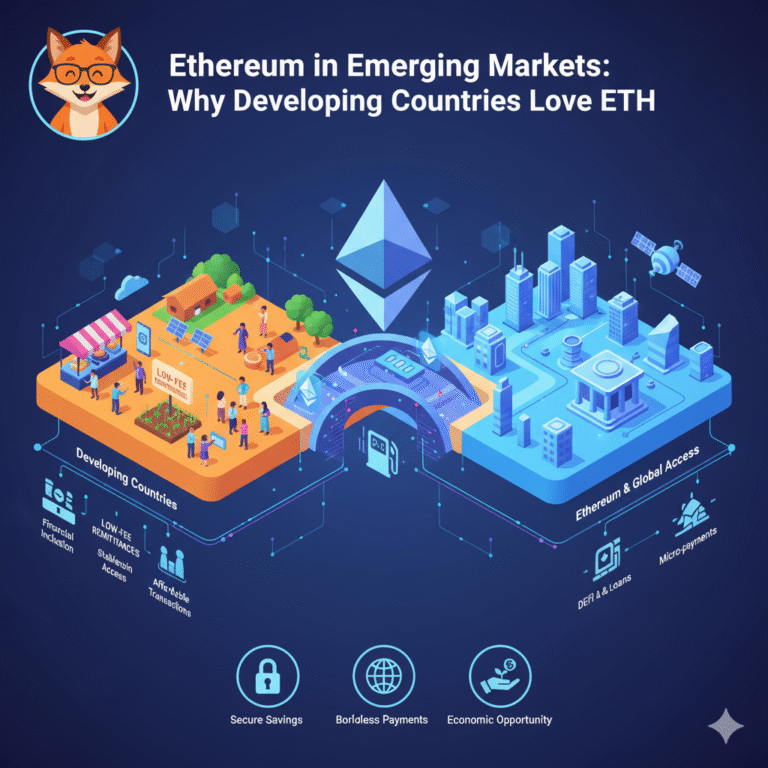
Ethereum in Emerging Markets: Why Developing Countries Love ETH

0

Introduction: Ethereum’s Role in Financial Transformation

Ethereum (ETH) has become more than just a cryptocurrency. In fact, it’s a decentralized platform that is changing how people in developing countries access money, do business, and save their wealth. While Bitcoin remains the most famous digital currency, Ethereum is quickly growing in emerging markets. Specifically, it’s gaining ground across Africa, Latin America, and Southeast Asia.

What Makes Ethereum Different?

First of all, Ethereum is a blockchain platform—a clear, permanent digital record book. Moreover, all transactions are recorded forever and checked by computers around the world. ETH is its native currency. However, Ethereum’s real power comes from smart contracts and decentralized apps (dApps). As a result, these tools remove the need for banks or big companies.

Why Developing Countries Need Ethereum

In countries where banks and government systems are weak or unreliable, Ethereum offers a better option. Therefore, people can access financial services without depending on broken systems.

7 Reasons Why Emerging Markets Are Embracing Ethereum

1. Financial Inclusion: Banking the Unbanked Population

According to the World Bank’s Global Findex Database, approximately 1.4 billion adults worldwide remained unbanked in 2021. In Nigeria, for instance, only around 45% of adults had access to formal financial accounts during that period.

Ethereum’s accessibility advantage: Users need only a smartphone and internet connection to participate in the global financial system. Freelancers and small entrepreneurs can receive payments in ETH or stablecoins instantly—bypassing prohibitive banking fees and lengthy settlement periods that characterize traditional banking.

2. Protection Against Currency Devaluation and Inflation

In nations experiencing hyperinflation—such as Venezuela, Argentina, and Turkey—local currencies can lose significant purchasing power rapidly. While ETH experiences price volatility, it operates independently of any single national economy, providing an alternative store of value.

For everyday transactions, dollar-pegged stablecoins like USDT and USDC running on Ethereum and EVM-compatible networks have become increasingly popular. These digital assets function as portable, stable digital dollars that are easy to transfer across borders.

3. Decentralized Applications and DeFi: Practical Solutions for Real Problems

Ethereum powers thousands of decentralized applications (dApps)—blockchain-based programs operating without central control. These applications are being deployed for humanitarian aid distribution, land registry systems, and microfinance services.

Real-world implementations:

4. Lower-Cost Remittances: Sending Money Home Affordably

Remittances represent a critical financial lifeline for millions of families. In 2023, remittances to low- and middle-income countries reached approximately $669 billion, while the average global transfer fee stood at 6.39% according to World Bank data.

Ethereum’s cost advantage: Sending stablecoins via Layer 2 scaling solutions—such as Arbitrum, Optimism, and Base—costs mere cents and completes within minutes. For migrant workers supporting families abroad, this represents substantial savings compared to traditional services like Western Union or SWIFT bank transfers.

5. Transparency and Trust Through Immutable Records

Blockchain’s public ledger architecture makes corruption and fund misappropriation significantly more difficult. This transparency builds trust in environments where institutional accountability is often lacking.

Humanitarian organizations increasingly leverage Ethereum technology to ensure aid funding reaches intended recipients. Civic applications including transparent land registries demonstrate blockchain’s potential for governance reform and anti-corruption efforts.

6. Growing Grassroots Cryptocurrency Culture

Cryptocurrency adoption has become embedded in youth culture across nations including Nigeria, Brazil, India, and the Philippines. According to Chainalysis’s 2024 Global Crypto Adoption Index, these countries rank among the top globally for grassroots cryptocurrency usage. Local communities, meetups, educational initiatives, and online forums drive awareness, creating organic network effects for Ethereum adoption.

7. Economic Opportunity and Entrepreneurship

Ethereum enables new economic models unavailable through traditional systems:

  • Play-to-earn gaming providing income opportunities
  • NFT marketplaces allowing digital creators to monetize work globally
  • Cross-border freelancing with instant, low-cost payment settlement through cross-chain liquidity solutions
  • Decentralized autonomous organizations (DAOs) enabling collective decision-making and resource pooling

Challenges and Risks: The Complete Picture

While Ethereum offers significant advantages, users in emerging markets face real challenges:

Volatility: ETH price fluctuations can be dramatic, affecting purchasing power

Scams and fraud: Bad actors target newcomers with unrealistic profit promises and phishing schemes

Infrastructure gaps: Internet connectivity remains inconsistent in rural regions

Regulatory uncertainty: Governments in countries like India and Nigeria have implemented restrictions or threatened outright bans on cryptocurrency usage. Learn more about crypto regulation worldwide in 2025.

Despite these obstacles, Ethereum’s decentralized architecture makes complete suppression technically difficult.

The Future: Why Ethereum’s Impact Will Grow

With each protocol upgrade, Ethereum becomes more affordable and efficient. Following the Dencun upgrade, Layer 2 transaction fees dropped to just a few cents. Stablecoins operating on Ethereum and EVM-compatible networks have effectively become the de facto “digital dollar” in economies facing currency instability.

For emerging markets, Ethereum represents more than innovative technology—it’s a practical tool for financial freedom, institutional transparency, and economic opportunity. From smallholder farmers in Kenya to digital freelancers in Indonesia, ETH enables people to bypass dysfunctional legacy systems and exercise greater control over their financial futures.

Getting Started with Ethereum

If you’re interested in exploring Ethereum:

  1. Learn the basics at Ethereum.org’s education portal
  2. Choose a reputable cryptocurrency wallet like MetaMask or Coinbase Wallet
  3. Start with small amounts and research thoroughly
  4. Join local cryptocurrency communities for support and education
  5. Stay informed about regulatory developments in your jurisdiction

Disclaimer: This article is for educational purposes only and does not constitute financial advice. Cryptocurrency investments carry significant risks. Always conduct thorough research and consider consulting with financial professionals before making investment decisions.

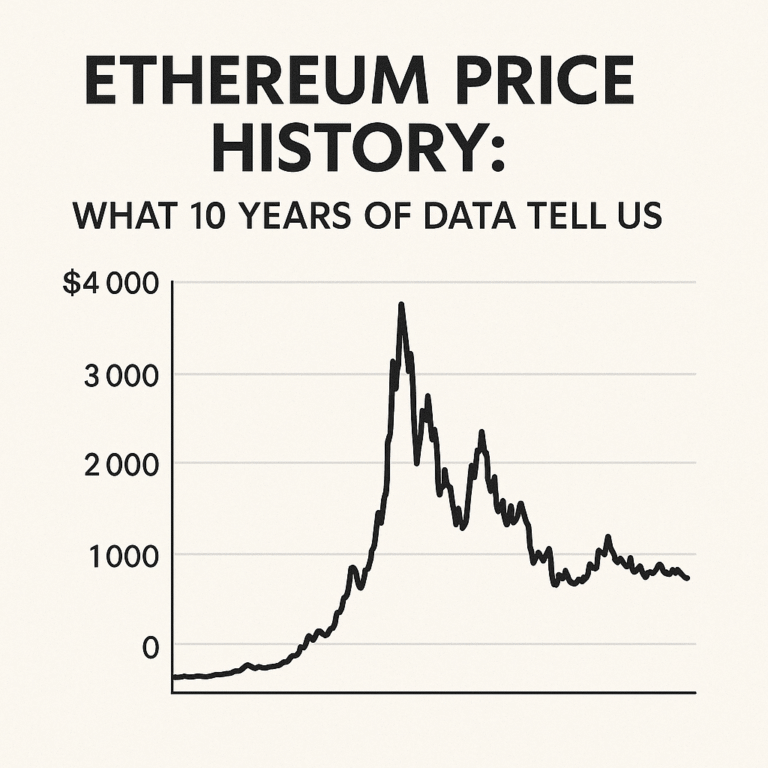
Ethereum Price History: What 10 Years of Data Tell Us (2015-2025)

Imagine owning a piece of a Manhattan skyscraper, a fraction of a Picasso painting, or shares in a Tuscan vineyard—all without millions of dollars or traditional brokers. This is tokenization of real-world assets (RWA), a revolutionary blockchain innovation transforming how we invest in property, art, bonds, and more.

In this comprehensive guide, we’ll explore what asset tokenization is, how Ethereum enables it, why major financial institutions like BlackRock and JPMorgan are investing billions, and what this means for everyday investors in 2025.

What Is Asset Tokenization? A Simple Explanation

Tokenization converts ownership rights of physical or financial assets into digital tokens on a blockchain. In other words, think of it as slicing a valuable asset into thousands of affordable shares that anyone can buy, sell, or trade online.

Real-World Example: Breaking Down a Property Investment

To illustrate this concept, let’s consider a practical example. A $1 million apartment building gets tokenized into 1 million digital tokens, each worth $1. Consequently, you can purchase just 10 tokens for $10, owning a proportional stake in the property. Furthermore, when the building appreciates or generates rental income, your tokens increase in value or pay dividends.

Moreover, these tokens exist on blockchain networks—secure, transparent digital ledgers that track ownership without banks or intermediaries. As a result, you can trade them 24/7 on specialized platforms, similar to stocks on the NYSE or NASDAQ.

Why Tokenization Matters for Modern Investors

Historically, assets like commercial real estate, fine art, and private equity were exclusive to wealthy investors and institutions. However, tokenization democratizes finance by:

  • Lowering investment minimums from millions to just dollars
  • Increasing liquidity in traditionally illiquid markets
  • Reducing transaction costs and settlement times
  • Enabling global access to premium assets

According to Boston Consulting Group, tokenized assets could reach a $16 trillion market by 2030.

Why Ethereum Powers the Tokenization Revolution

Ethereum has emerged as the dominant blockchain for tokenizing real-world assets. Indeed, for investors looking to understand the broader context, check out our complete investment guide comparing Bitcoin vs Ethereum to see why institutions increasingly favor Ethereum for tokenization projects.

Smart Contracts: The Backbone of Tokenization

First and foremost, Ethereum enables smart contracts—self-executing code that automates complex transactions without middlemen. These digital agreements automatically:

  • Transfer ownership when payment is received
  • Distribute rental income or dividends to token holders
  • Enforce compliance with KYC/AML regulations
  • Handle voting rights for governance decisions

In essence, think of smart contracts as vending machines: insert the right input (money), get the guaranteed output (asset tokens) instantly.

Industry-Standard Token Protocols

Additionally, Ethereum supports multiple token standards optimized for different asset types:

  • ERC-20: Fungible tokens for divisible assets (real estate shares, commodities)
  • ERC-721: Non-fungible tokens (NFTs) for unique items (art, collectibles)
  • ERC-1400: Security tokens with built-in regulatory compliance
  • ERC-3643 (T-REX): Advanced standard for permissioned securities with automatic KYC/AML enforcement

The Merge and Layer-2 Scaling Solutions

Notably, the old term “Ethereum 2.0” is outdated. Instead, the actual transformation happened through:

  1. The Merge (2022): Ethereum transitioned to proof-of-stake, reducing energy consumption by 99.95% (Ethereum Foundation)
  2. Dencun Upgrade (EIP-4844, 2024): Dramatically lowered costs for Layer-2 networks

Today, token transfers on Layer-2 solutions like Arbitrum, Optimism, and Base cost mere cents while maintaining Ethereum’s security. To dive deeper into how DeFi protocols utilize Ethereum for tokenization and financial innovation, explore our comprehensive beginner’s guide.

Robust Developer Ecosystem

Beyond the technology itself, Ethereum hosts thousands of developers building tokenization infrastructure:

Wall Street’s Multi-Billion Dollar Bet on Tokenization

Traditional finance initially dismissed blockchain as speculative. However, today, the world’s largest institutions are actively tokenizing assets worth billions. Understanding Ethereum’s key statistics and institutional adoption helps explain why these institutions chose this blockchain over alternatives.

Major Institutional Tokenization Projects (2022-2025)

BlackRock BUIDL Fund (2024)

First, the world’s largest asset manager launched a tokenized U.S. Treasury money market fund on Ethereum. Specifically, the BlackRock USD Institutional Digital Liquidity Fund allows investors to hold shares as on-chain tokens, marking mainstream adoption of public blockchains by a $10 trillion institution.

JPMorgan’s Onyx & Tokenized Collateral (2023)

Similarly, JPMorgan’s Onyx blockchain platform executed the first tokenized collateral transaction: BlackRock tokenized money market fund shares and pledged them to Barclays for an instant repo transaction—settling in minutes rather than days.

Franklin Templeton OnChain U.S. Government Money Fund (FOBXX)

Meanwhile, Franklin Templeton, managing $1.5 trillion, operates a tokenized government money market fund on Stellar and Ethereum blockchains, allowing shareholders to hold and transfer shares 24/7.

Goldman Sachs Digital Asset Platform (GS DAP)

Furthermore, Goldman Sachs issued tokenized bonds, including green bonds for the Hong Kong government, using its proprietary blockchain platform. The bank views tokenization as critical infrastructure for future capital markets.

Coinbase-BlackRock Partnership (2022)

In addition, Coinbase partnered with BlackRock to provide institutional crypto access through Aladdin portfolio management software, connecting thousands of asset managers to digital assets.

Why Wall Street Embraces Tokenization

Ultimately, traditional financial institutions see three major advantages:

  1. Operational Efficiency: Blockchain settlement reduces clearing times from T+2 days to near-instant, cutting costs by up to 80% (Deloitte)
  2. New Revenue Streams: Fractional ownership attracts retail investors and millennials to traditionally exclusive markets like commercial real estate and private credit
  3. 24/7 Markets: Unlike stock exchanges with limited hours, tokenized assets can theoretically trade continuously (though regulated platforms still enforce compliance and trading windows)
  4. Transparency & Auditability: Immutable blockchain records simplify regulatory reporting and reduce fraud risk

According to McKinsey, tokenization could unlock $2-4 trillion in currently illiquid assets by 2030.

How Asset Tokenization Works: Step-by-Step Process

Let’s walk through tokenizing a $10 million commercial office building:

Step 1: Asset Identification and Valuation

Initially, independent appraisers from firms like CBRE or Cushman & Wakefield assess the property’s fair market value, condition, and income potential.

Next, legal counsel establishes a Special Purpose Vehicle (SPV)—typically an LLC or trust—that owns the asset. Subsequently, the SPV issues security tokens under SEC regulations (usually Regulation D for accredited investors or Regulation A+ for public offerings).

Step 3: Token Creation on Blockchain

Following that, developers deploy a smart contract on Ethereum that:

  • Creates 10 million tokens (each representing $1 of ownership)
  • Defines dividend distribution rules (e.g., quarterly rental income payouts)
  • Enforces transfer restrictions (KYC/AML compliance, accredited investor verification)
  • Manages governance rights (voting on major property decisions)

Step 4: Platform Listing

After token creation, tokens are listed on regulated Alternative Trading Systems (ATS) like:

These platforms handle investor onboarding, KYC/AML checks, and ensure securities law compliance.

Step 5: Investment and Trading

Finally, accredited investors (those meeting SEC wealth requirements) can purchase tokens using:

  • Bank transfers (ACH, wire)
  • Stablecoins (USDC, USDT)
  • Credit cards (on some platforms)

As a result, token holders receive:

  • Proportional rental income distributions
  • Rights to appreciation when the property is sold
  • Governance voting power
  • Tax documentation (1099 forms)

Real Example: Banksy Artwork Tokenization (2022)

To demonstrate real-world application, startup Particle fractionalized Banksy’s “Love is in the Air” painting into thousands of tokens, allowing everyday collectors to own shares in the $12.9 million artwork. This project demonstrated tokenization’s potential for democratizing access to blue-chip art.

Benefits of Tokenization for Everyday Investors

Asset tokenization isn’t just for hedge funds and family offices. In fact, here’s how it benefits retail investors:

1. Affordable Access to Premium Assets

First and foremost, invest in Class-A real estate, commercial properties, or fine art with as little as $50-100, compared to traditional minimums of $250,000-$5 million.

2. Portfolio Diversification

Additionally, spread risk across multiple asset classes:

  • Real estate (office buildings, multifamily, industrial)
  • Private credit and loans
  • Fine art and collectibles
  • Venture capital and startups
  • Commodities (gold, silver)

3. Enhanced Liquidity

Moreover, traditionally illiquid investments like real estate can take months to sell. However, tokenized assets trade on secondary markets, though liquidity varies by platform and asset type.

4. Transparency and Security

Furthermore, every transaction is recorded on the blockchain—an immutable, publicly auditable ledger. Consequently, smart contracts eliminate counterparty risk and human error.

5. Global Investment Opportunities

In addition, a teacher in Brazil can invest in New York commercial real estate. Similarly, a retiree in Japan can own fractional shares of European art—assuming platforms permit international investors.

6. Passive Income Streams

Finally, many tokenized real estate projects distribute rental income quarterly or monthly, providing steady cash flow similar to dividend stocks. Unlike unsustainable high-yield schemes, these represent real yield opportunities backed by tangible assets rather than inflationary token emissions.

Risks and Challenges in Asset Tokenization

Despite its promise, tokenization faces significant hurdles:

Regulatory Uncertainty

First, securities laws vary by jurisdiction. In the United States, most tokenized assets qualify as securities under SEC regulations, requiring:

  • Registration or exemption (Regulation D, Regulation A+, Regulation S)
  • Accredited investor verification (net worth exceeding $1 million or income above $200,000)
  • Ongoing disclosure and reporting requirements

Meanwhile, the European Union’s MiCA regulations and other international frameworks add complexity for global investors.

Technology Risks

Additionally, blockchain technology, while secure, isn’t infallible:

  • Smart contract bugs: Coding errors can lead to loss of funds (e.g., The DAO hack in 2016)
  • Oracle failures: If external data feeds malfunction, automated distributions may fail
  • Network congestion: During high demand, Ethereum transaction fees can spike (though Layer-2 solutions mitigate this)

Liquidity Concerns

Furthermore, while tokenization promises improved liquidity, reality varies:

  • Limited trading volumes on secondary markets
  • Wide bid-ask spreads
  • Lock-up periods (some tokens restrict sales for 6-12 months)

Fraud and Scam Risk

Moreover, bad actors issue fake tokens without real asset backing. Therefore, protect yourself by:

  • Only using regulated platforms (Securitize, tZERO)
  • Verifying asset ownership through independent audits
  • Checking if the issuer is registered with financial regulators
  • Avoiding platforms that promise unrealistic returns

Valuation Complexity

Finally, unlike publicly traded stocks with real-time pricing, tokenized real estate or art valuations depend on:

  • Periodic appraisals (may be outdated)
  • Market comparables (limited data for unique assets)
  • Subjective assessments (especially for art and collectibles)

The Future of Tokenization: Market Size and Projections

The tokenization market is growing exponentially. Let’s examine the forecasts:

Market Forecasts from Leading Analysts

According to industry experts:

  • Boston Consulting Group: $16 trillion tokenized assets by 2030
  • McKinsey: $2-4 trillion in real-world assets on blockchain by 2030
  • Citibank: $4-5 trillion tokenized digital securities by 2030

Real Estate: The Biggest Opportunity

Notably, Savills estimates global real estate at nearly $380 trillion (2023). Therefore, even if just 1% moves on-chain, that’s $3.8 trillion in tokenized property.

Early Market Leaders

Early movers include:

  • RealT: Tokenized rental properties in Detroit, allowing global investors to earn rental income
  • Lofty AI: Fractionalized U.S. real estate starting at $50
  • Elevated Returns: Tokenized luxury hotels and resorts

Beyond Real Estate: Emerging Asset Classes

Government Bonds and Treasuries

First, BlackRock, Franklin Templeton, and Goldman Sachs are already tokenizing sovereign debt, making government bonds accessible to retail investors with instant settlement.

Carbon Credits

Similarly, blockchain-based carbon credit markets improve transparency and reduce fraud in offset trading. Platforms like Toucan Protocol and KlimaDAO tokenize verified carbon credits.

Music Royalties and Intellectual Property

Additionally, artists tokenize song rights, allowing fans to invest in music and earn streaming royalties. Royal and ANote Music lead this sector.

Sports Collectibles and Team Ownership

Moreover, platforms explore fractional ownership of sports teams and rare memorabilia. NBA Top Shot popularized sports NFTs, generating over $1 billion in sales.

Private Credit and Loans

Finally, Maple Finance and Centrifuge tokenize corporate loans, allowing lenders to invest in diversified debt portfolios with blockchain transparency.

How to Get Started with Tokenized Assets

Ready to explore tokenization? Follow these steps:

1. Educate Yourself First

Before investing, begin by:

For newcomers to the crypto space, our guide to the top crypto exchanges for beginners will help you set up accounts on platforms where you can acquire ETH and stablecoins needed for tokenized investments.

2. Choose a Regulated Platform

Subsequently, start with established, compliant platforms:

  • Securitize: Largest tokenization platform, handling offerings from KKR and Hamilton Lane
  • tZERO: SEC-registered Alternative Trading System
  • Republic: Crowdfunding platform with tokenized offerings
  • RealT: Focused on rental real estate

3. Complete KYC Verification

Next, prepare documents:

  • Government-issued photo ID
  • Proof of address (utility bill, bank statement)
  • Tax identification number
  • Accreditation verification (if required)

4. Start Small and Test the Waters

After verification, begin with $50-500 to understand the process before committing significant capital. Furthermore, diversify across multiple assets and platforms.

5. Use Secure Custody Solutions

Finally, store tokens in:

Important: Never share your private keys or seed phrases with anyone.

Tokenization and Traditional Finance: The Convergence

The line between blockchain and traditional finance is blurring. In fact, institutional adoption is accelerating, with Ethereum ETFs providing regulated access for pension funds, endowments, and traditional investors seeking exposure to the tokenization revolution.

Central Bank Digital Currencies (CBDCs)

Currently, over 100 countries are exploring CBDCs—government-issued digital currencies that could interoperate with tokenized assets for seamless settlement.

Integration with Banking Systems

Meanwhile, banks like HSBC, BNY Mellon, and State Street offer crypto custody and tokenization services, bridging traditional finance with blockchain infrastructure.

Programmable Money: The Next Evolution

Furthermore, tokenization enables programmable money—payments that automatically execute when conditions are met (e.g., release escrow when property inspection passes). As a result, this transforms industries from real estate to supply chain finance.

Conclusion: The Tokenization Revolution Is Here

Tokenization represents the most significant financial innovation since the internet transformed banking in the 1990s. Indeed, by combining Ethereum’s blockchain technology with Wall Street’s capital markets expertise, tokenization is:

  • Democratizing access to investments once reserved for the ultra-wealthy
  • Increasing liquidity in traditionally illiquid markets
  • Reducing costs through automated, blockchain-based settlement
  • Enabling 24/7 global markets without geographic barriers
  • Improving transparency through immutable, auditable records

Importantly, major institutions—BlackRock, JPMorgan, Goldman Sachs, Franklin Templeton—aren’t experimenting anymore. Instead, they’re deploying billions into tokenization infrastructure because they recognize it as the future of finance.

You don’t need a Wall Street pedigree or a million-dollar fund to participate. However, you do need to:

  • Understand the risks and regulations
  • Choose trustworthy, compliant platforms
  • Start small and diversify
  • Stay informed as the industry evolves

In conclusion, the tokenization revolution isn’t coming—it’s already here. Therefore, the question isn’t whether to pay attention, but whether you’re ready to participate in the next generation of investing.


Additional Resources

Regulatory Bodies

Industry Organizations

Research and News

Educational Platforms


Disclaimer: This article is for educational purposes only and does not constitute financial, legal, or investment advice. Cryptocurrency and tokenized assets are high-risk investments. Always conduct thorough research and consult licensed professionals before investing.

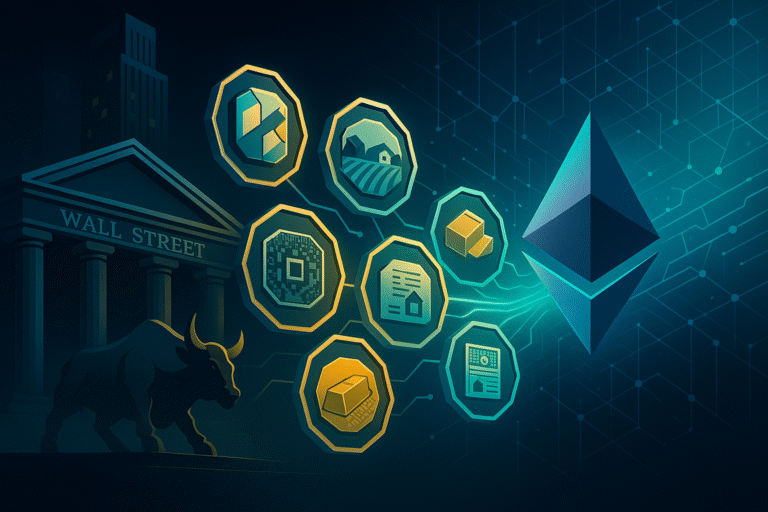
Tokenization of Real-World Assets: How Ethereum and Wall Street Are Revolutionizing Finance

Imagine owning a piece of a Manhattan skyscraper, a fraction of a Picasso painting, or shares in a Tuscan vineyard—all without millions of dollars or traditional brokers. This is tokenization of real-world assets (RWA), a revolutionary blockchain innovation transforming how we invest in property, art, bonds, and more.

In this comprehensive guide, we’ll explore what asset tokenization is, how Ethereum enables it, why major financial institutions like BlackRock and JPMorgan are investing billions, and what this means for everyday investors in 2025.

What Is Asset Tokenization? A Simple Explanation

Tokenization converts ownership rights of physical or financial assets into digital tokens on a blockchain. Think of it as slicing a valuable asset into thousands of affordable shares that anyone can buy, sell, or trade online.

Real-World Example

A $1 million apartment building gets tokenized into 1 million digital tokens, each worth $1. You can purchase just 10 tokens for $10, owning a proportional stake in the property. When the building appreciates or generates rental income, your tokens increase in value or pay dividends.

These tokens exist on blockchain networks—secure, transparent digital ledgers that track ownership without banks or intermediaries. You can trade them 24/7 on specialized platforms, similar to stocks on the NYSE or NASDAQ.

Why Tokenization Matters

Historically, assets like commercial real estate, fine art, and private equity were exclusive to wealthy investors and institutions. Tokenization democratizes finance by:

  • Lowering investment minimums from millions to just dollars
  • Increasing liquidity in traditionally illiquid markets
  • Reducing transaction costs and settlement times
  • Enabling global access to premium assets

According to Boston Consulting Group, tokenized assets could reach a $16 trillion market by 2030.

Why Ethereum Powers the Tokenization Revolution

Ethereum has emerged as the dominant blockchain for tokenizing real-world assets. For investors looking to understand the broader context, check out our complete investment guide comparing Bitcoin vs Ethereum to see why institutions increasingly favor Ethereum for tokenization projects.

Smart Contracts: The Backbone of Tokenization

Ethereum enables smart contracts—self-executing code that automates complex transactions without middlemen. These digital agreements automatically:

  • Transfer ownership when payment is received
  • Distribute rental income or dividends to token holders
  • Enforce compliance with KYC/AML regulations
  • Handle voting rights for governance decisions

Think of smart contracts as vending machines: insert the right input (money), get the guaranteed output (asset tokens) instantly.

Industry-Standard Token Protocols

Ethereum supports multiple token standards optimized for different asset types:

  • ERC-20: Fungible tokens for divisible assets (real estate shares, commodities)
  • ERC-721: Non-fungible tokens (NFTs) for unique items (art, collectibles)
  • ERC-1400: Security tokens with built-in regulatory compliance
  • ERC-3643 (T-REX): Advanced standard for permissioned securities with automatic KYC/AML enforcement

The Merge and Layer-2 Scaling Solutions

The old term “Ethereum 2.0” is outdated. The actual transformation happened through:

  1. The Merge (2022): Ethereum transitioned to proof-of-stake, reducing energy consumption by 99.95% (Ethereum Foundation)
  2. Dencun Upgrade (EIP-4844, 2024): Dramatically lowered costs for Layer-2 networks

Today, token transfers on Layer-2 solutions like Arbitrum, Optimism, and Base cost mere cents while maintaining Ethereum’s security. To dive deeper into how DeFi protocols utilize Ethereum for tokenization and financial innovation, explore our comprehensive beginner’s guide.

Robust Developer Ecosystem

Ethereum hosts thousands of developers building tokenization infrastructure:

Wall Street’s Multi-Billion Dollar Bet on Tokenization

Traditional finance initially dismissed blockchain as speculative. Today, the world’s largest institutions are actively tokenizing assets worth billions. Understanding Ethereum’s key statistics and institutional adoption helps explain why these institutions chose this blockchain over alternatives.

Major Institutional Tokenization Projects (2022-2025)

BlackRock BUIDL Fund (2024)
The world’s largest asset manager launched a tokenized U.S. Treasury money market fund on Ethereum. The BlackRock USD Institutional Digital Liquidity Fund allows investors to hold shares as on-chain tokens, marking mainstream adoption of public blockchains by a $10 trillion institution.

JPMorgan’s Onyx & Tokenized Collateral (2023)
JPMorgan’s Onyx blockchain platform executed the first tokenized collateral transaction: BlackRock tokenized money market fund shares and pledged them to Barclays for an instant repo transaction—settling in minutes rather than days.

Franklin Templeton OnChain U.S. Government Money Fund (FOBXX)
Franklin Templeton, managing $1.5 trillion, operates a tokenized government money market fund on Stellar and Ethereum blockchains, allowing shareholders to hold and transfer shares 24/7.

Goldman Sachs Digital Asset Platform (GS DAP)
Goldman Sachs issued tokenized bonds, including green bonds for the Hong Kong government, using its proprietary blockchain platform. The bank views tokenization as critical infrastructure for future capital markets.

Coinbase-BlackRock Partnership (2022)
Coinbase partnered with BlackRock to provide institutional crypto access through Aladdin portfolio management software, connecting thousands of asset managers to digital assets.

Why Wall Street Embraces Tokenization

Traditional financial institutions see three major advantages:

  1. Operational Efficiency: Blockchain settlement reduces clearing times from T+2 days to near-instant, cutting costs by up to 80% (Deloitte)
  2. New Revenue Streams: Fractional ownership attracts retail investors and millennials to traditionally exclusive markets like commercial real estate and private credit
  3. 24/7 Markets: Unlike stock exchanges with limited hours, tokenized assets can theoretically trade continuously (though regulated platforms still enforce compliance and trading windows)
  4. Transparency & Auditability: Immutable blockchain records simplify regulatory reporting and reduce fraud risk

According to McKinsey, tokenization could unlock $2-4 trillion in currently illiquid assets by 2030.

How Asset Tokenization Works: Step-by-Step Process

Let’s walk through tokenizing a $10 million commercial office building:

Step 1: Asset Identification and Valuation

Independent appraisers from firms like CBRE or Cushman & Wakefield assess the property’s fair market value, condition, and income potential.

Legal counsel establishes a Special Purpose Vehicle (SPV)—typically an LLC or trust—that owns the asset. The SPV issues security tokens under SEC regulations (usually Regulation D for accredited investors or Regulation A+ for public offerings).

Step 3: Token Creation on Blockchain

Developers deploy a smart contract on Ethereum that:

  • Creates 10 million tokens (each representing $1 of ownership)
  • Defines dividend distribution rules (e.g., quarterly rental income payouts)
  • Enforces transfer restrictions (KYC/AML compliance, accredited investor verification)
  • Manages governance rights (voting on major property decisions)

Step 4: Platform Listing

Tokens are listed on regulated Alternative Trading Systems (ATS) like:

These platforms handle investor onboarding, KYC/AML checks, and ensure securities law compliance.

Step 5: Investment and Trading

Accredited investors (those meeting SEC wealth requirements) can purchase tokens using:

  • Bank transfers (ACH, wire)
  • Stablecoins (USDC, USDT)
  • Credit cards (on some platforms)

Token holders receive:

  • Proportional rental income distributions
  • Rights to appreciation when the property is sold
  • Governance voting power
  • Tax documentation (1099 forms)

Real Example: Banksy Artwork Tokenization (2022)

Startup Particle fractionalized Banksy’s “Love is in the Air” painting into thousands of tokens, allowing everyday collectors to own shares in the $12.9 million artwork. The project demonstrated tokenization’s potential for democratizing access to blue-chip art.

Benefits of Tokenization for Everyday Investors

Asset tokenization isn’t just for hedge funds and family offices. Here’s how it benefits retail investors:

1. Affordable Access to Premium Assets

Invest in Class-A real estate, commercial properties, or fine art with as little as $50-100, compared to traditional minimums of $250,000-$5 million.

2. Portfolio Diversification

Spread risk across multiple asset classes:

  • Real estate (office buildings, multifamily, industrial)
  • Private credit and loans
  • Fine art and collectibles
  • Venture capital and startups
  • Commodities (gold, silver)

3. Enhanced Liquidity

Traditionally illiquid investments like real estate can take months to sell. Tokenized assets trade on secondary markets, though liquidity varies by platform and asset type.

4. Transparency and Security

Every transaction is recorded on the blockchain—an immutable, publicly auditable ledger. Smart contracts eliminate counterparty risk and human error.

5. Global Investment Opportunities

A teacher in Brazil can invest in New York commercial real estate. A retiree in Japan can own fractional shares of European art—assuming platforms permit international investors.

6. Passive Income Streams

Many tokenized real estate projects distribute rental income quarterly or monthly, providing steady cash flow similar to dividend stocks.

Risks and Challenges in Asset Tokenization

Despite its promise, tokenization faces significant hurdles:

Regulatory Uncertainty

Securities laws vary by jurisdiction. In the United States, most tokenized assets qualify as securities under SEC regulations, requiring:

  • Registration or exemption (Regulation D, Regulation A+, Regulation S)
  • Accredited investor verification (net worth exceeding $1 million or income above $200,000)
  • Ongoing disclosure and reporting requirements

The European Union’s MiCA regulations and other international frameworks add complexity for global investors.

Technology Risks

Blockchain technology, while secure, isn’t infallible:

  • Smart contract bugs: Coding errors can lead to loss of funds (e.g., The DAO hack in 2016)
  • Oracle failures: If external data feeds malfunction, automated distributions may fail
  • Network congestion: During high demand, Ethereum transaction fees can spike (though Layer-2 solutions mitigate this)

Liquidity Concerns

While tokenization promises improved liquidity, reality varies:

  • Limited trading volumes on secondary markets
  • Wide bid-ask spreads
  • Lock-up periods (some tokens restrict sales for 6-12 months)

Fraud and Scam Risk

Bad actors issue fake tokens without real asset backing. Protect yourself by:

  • Only using regulated platforms (Securitize, tZERO)
  • Verifying asset ownership through independent audits
  • Checking if the issuer is registered with financial regulators
  • Avoiding platforms that promise unrealistic returns

Valuation Complexity

Unlike publicly traded stocks with real-time pricing, tokenized real estate or art valuations depend on:

  • Periodic appraisals (may be outdated)
  • Market comparables (limited data for unique assets)
  • Subjective assessments (especially for art and collectibles)

The Future of Tokenization: Market Size and Projections

The tokenization market is growing exponentially:

Market Forecasts

  • Boston Consulting Group: $16 trillion tokenized assets by 2030
  • McKinsey: $2-4 trillion in real-world assets on blockchain by 2030
  • Citibank: $4-5 trillion tokenized digital securities by 2030

Real Estate: The Biggest Opportunity

Savills estimates global real estate at nearly $380 trillion (2023). Even if just 1% moves on-chain, that’s $3.8 trillion in tokenized property.

Early movers include:

  • RealT: Tokenized rental properties in Detroit, allowing global investors to earn rental income
  • Lofty AI: Fractionalized U.S. real estate starting at $50
  • Elevated Returns: Tokenized luxury hotels and resorts

Beyond Real Estate: Emerging Asset Classes

Government Bonds and Treasuries
BlackRock, Franklin Templeton, and Goldman Sachs are already tokenizing sovereign debt, making government bonds accessible to retail investors with instant settlement.

Carbon Credits
Blockchain-based carbon credit markets improve transparency and reduce fraud in offset trading. Platforms like Toucan Protocol and KlimaDAO tokenize verified carbon credits.

Music Royalties and Intellectual Property
Artists tokenize song rights, allowing fans to invest in music and earn streaming royalties. Royal and ANote Music lead this sector.

Sports Collectibles and Team Ownership
Platforms explore fractional ownership of sports teams and rare memorabilia. NBA Top Shot popularized sports NFTs, generating over $1 billion in sales.

Private Credit and Loans
Maple Finance and Centrifuge tokenize corporate loans, allowing lenders to invest in diversified debt portfolios with blockchain transparency.

How to Get Started with Tokenized Assets

Ready to explore tokenization? Follow these steps:

1. Educate Yourself

For newcomers to the crypto space, our guide to the top crypto exchanges for beginners will help you set up accounts on platforms where you can acquire ETH and stablecoins needed for tokenized investments.

2. Choose a Regulated Platform

Start with established, compliant platforms:

  • Securitize: Largest tokenization platform, handling offerings from KKR and Hamilton Lane
  • tZERO: SEC-registered Alternative Trading System
  • Republic: Crowdfunding platform with tokenized offerings
  • RealT: Focused on rental real estate

3. Complete KYC Verification

Prepare documents:

  • Government-issued photo ID
  • Proof of address (utility bill, bank statement)
  • Tax identification number
  • Accreditation verification (if required)

4. Start Small

Begin with $50-500 to understand the process before committing significant capital. Diversify across multiple assets and platforms.

5. Use Secure Custody

Store tokens in:

Never share your private keys or seed phrases with anyone.

Tokenization and Traditional Finance: The Convergence

The line between blockchain and traditional finance is blurring. Institutional adoption is accelerating, with Ethereum ETFs providing regulated access for pension funds, endowments, and traditional investors seeking exposure to the tokenization revolution.

Central Bank Digital Currencies (CBDCs)

Over 100 countries are exploring CBDCs—government-issued digital currencies that could interoperate with tokenized assets for seamless settlement.

Integration with Banking Systems

Banks like HSBC, BNY Mellon, and State Street offer crypto custody and tokenization services, bridging traditional finance with blockchain infrastructure.

Programmable Money

Tokenization enables programmable money—payments that automatically execute when conditions are met (e.g., release escrow when property inspection passes). This transforms industries from real estate to supply chain finance.

Conclusion: The Tokenization Revolution Is Here

Tokenization represents the most significant financial innovation since the internet transformed banking in the 1990s. By combining Ethereum’s blockchain technology with Wall Street’s capital markets expertise, tokenization is:

  • Democratizing access to investments once reserved for the ultra-wealthy
  • Increasing liquidity in traditionally illiquid markets
  • Reducing costs through automated, blockchain-based settlement
  • Enabling 24/7 global markets without geographic barriers
  • Improving transparency through immutable, auditable records

Major institutions—BlackRock, JPMorgan, Goldman Sachs, Franklin Templeton—aren’t experimenting anymore. They’re deploying billions into tokenization infrastructure because they recognize it as the future of finance.

You don’t need a Wall Street pedigree or a million-dollar fund to participate. But you do need to:

  • Understand the risks and regulations
  • Choose trustworthy, compliant platforms
  • Start small and diversify
  • Stay informed as the industry evolves

The tokenization revolution isn’t coming—it’s already here. The question isn’t whether to pay attention, but whether you’re ready to participate in the next generation of investing.


Additional Resources

Regulatory Bodies

Industry Organizations

Research and News

Educational Platforms


Disclaimer: This article is for educational purposes only and does not constitute financial, legal, or investment advice. Cryptocurrency and tokenized assets are high-risk investments. Always conduct thorough research and consult licensed professionals before investing.

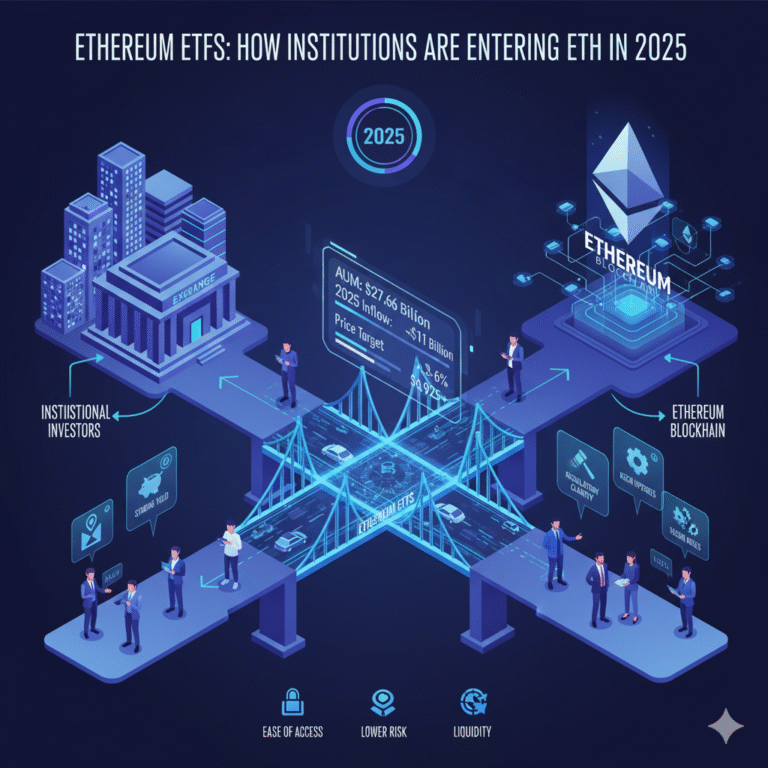
Ethereum ETFs: How Institutions Are Entering ETH in 2025

1

Imagine a world where big banks, hedge funds, and corporations are diving into cryptocurrencies, not just as a side experiment, but as a core part of their investment strategy. That’s exactly what’s happening with Ethereum (ETH) in 2025, thanks to the rise of Ethereum Exchange-Traded Funds (ETFs).

If you’re new to crypto or investing, don’t worry—this article breaks it down in simple terms. We’ll explore what Ethereum ETFs are, why they’re attracting massive institutional interest, and what this means for the future of Ethereum and cryptocurrency investing.

What Are Ethereum ETFs?

An ETF, or Exchange-Traded Fund, is like a basket of investments you can buy and sell on a stock exchange. Instead of owning a single stock, an ETF can hold a mix of assets—stocks, bonds, or, in this case, Ethereum cryptocurrency.

An Ethereum ETF tracks the price of ETH. Instead of buying ETH directly on a crypto exchange like Coinbase or Binance and dealing with digital wallets or private keys, investors can simply buy ETF shares through their traditional brokerage account. These shares represent a slice of ETH held by the fund, making it easier for individuals and institutions to gain exposure to crypto in a safe and familiar way.

Launched in the U.S. in July 2024 following SEC approval, Ethereum ETFs quickly became a game-changer by opening the door for pension funds, banks, and asset managers to participate in Ethereum markets without the technical complexity of cryptocurrency custody.

Why Are Institutions Interested in Ethereum?

1. Ethereum’s Superpowers: Utility and Programmability

Unlike Bitcoin, often viewed as “digital gold,” Ethereum is a programmable blockchain platform—a foundation for decentralized applications (dApps). It powers DeFi (decentralized finance), real-world asset tokenization, and NFTs (non-fungible tokens).

In 2025, institutional adoption accelerated:

  • BlackRock’s BUIDL fund and Sony’s Ethereum-based Layer-2 project Soneium highlight how institutions are using Ethereum for tokenized assets
  • Over $45 billion is locked in DeFi protocols on Ethereum, according to DeFi Llama, demonstrating its role as critical financial infrastructure
  • Major enterprises are building on Ethereum for supply chain management, digital identity, and asset tokenization

2. Staking Rewards – But Not in ETFs

Ethereum’s proof-of-stake consensus mechanism lets participants earn rewards (approximately 3–5% APR) by locking ETH to secure the network. For institutional investors seeking yield, this is attractive. Learn more about the top staking platforms and their APY rates.

⚠️ However, U.S. ETFs cannot stake ETH currently. The SEC prohibits funds from earning staking rewards due to regulatory concerns, so ETF investors get price exposure only—not the staking yield. Still, Ethereum staking strengthens the long-term investment case, even if ETFs don’t directly participate yet.

3. Regulatory Clarity in the United States

For years, regulatory uncertainty kept institutions away from crypto markets. But in 2024–25, clarity dramatically improved:

  • The SEC approved spot Ethereum ETFs in July 2024, a watershed moment
  • In July 2025, the SEC allowed in-kind creations and redemptions, making ETFs more capital-efficient and liquid
  • The CFTC classifies ETH as a commodity, providing additional regulatory clarity
  • While Congress hasn’t passed comprehensive crypto legislation, regulatory frameworks are stabilizing

This regulatory progress gave institutional investors the green light to scale their Ethereum exposure significantly.

4. Technology Upgrades and Network Development

Ethereum isn’t standing still—continuous technological improvements make it more scalable and efficient:

  • Dencun Upgrade (March 2024): Introduced proto-danksharding (EIP-4844), cutting Layer-2 transaction fees by up to 90%
  • Pectra Upgrade (May 2025): Brought wallet improvements (EIP-7702), validator flexibility, and enhanced security features
  • Fusaka Upgrade (planned Q4 2025): Expected to implement PeerDAS and deliver further scalability improvements

These upgrades demonstrate that Ethereum is future-proofing itself for mass institutional adoption and mainstream use cases.

The Numbers Tell the Institutional Adoption Story

The data reveals unprecedented institutional interest in Ethereum ETFs. For a deeper dive into Ethereum’s key statistics and metrics:

  • Total ETH held by ETFs: Approximately 6.3–6.8 million ETH (~5–5.6% of circulating supply)
  • Assets under management (AUM): BlackRock’s iShares Ethereum Trust (ETHA) alone had $15.7 billion as of September 30, 2025
  • Record flows: August 2025 saw record inflows of $1 billion in a single day across ETH ETFs. On August 26, ETHA alone pulled in $323 million
  • YTD Performance: Around $11 billion net inflows into ETH ETFs in 2025, while some Bitcoin ETFs experienced stagnation or outflows
  • Corporate Treasury Adoption: Companies like Bitmine Immersion Technologies (163,000+ ETH) and SharpLink Gaming (hundreds of thousands ETH) are holding Ethereum directly

Together, this represents a massive institutional vote of confidence in ETH’s future as a core financial asset.

Why Ethereum ETFs Appeal to Institutional Investors

Ease of Access and Integration:

  • ETFs trade on traditional stock exchanges like NYSE and Nasdaq
  • Can fit seamlessly into 401(k) retirement plans, IRAs, and pension fund portfolios
  • No need to manage crypto wallets, private keys, or exchange accounts

Trusted Institutional Custody:

Transparency and Liquidity:

  • Daily pricing, NAV reporting, and transparent holdings
  • In-kind redemption mechanisms improve capital efficiency
  • High trading volumes ensure easy entry and exit

Competitive Fee Structures:

  • ETF expense ratios range from 0.19% to 0.25% annually
  • Comparable to traditional index funds and much lower than actively managed funds
  • No custody fees, withdrawal fees, or blockchain gas fees for investors

Important Risks to Consider

Market Volatility: ETH can experience 10–20% price swings in a single week. To understand historical patterns, review 10 years of Ethereum price data. While institutions typically have longer time horizons, individual investors should be prepared for significant short-term fluctuations.

Regulatory Evolution: U.S. regulatory clarity has improved significantly, but global regulations continue to evolve. Europe’s MiCA framework and Asian regulations may differ, potentially impacting international markets.

Layer-2 Network Dependence: Ethereum’s scalability strategy relies heavily on Layer-2 networks like Arbitrum, Optimism, and Polygon. Security failures in major L2 networks could impact the broader ecosystem.

No Staking Rewards: Unlike direct ETH ownership, U.S. ETF investors cannot earn staking yields, potentially underperforming versus direct staking by 3–5% annually.

What Ethereum ETFs Mean for the Future

Supply Pressure and Scarcity: ETFs combined with corporate treasuries are removing millions of ETH from circulation, pushing exchange balances to a 9-year low (~15–16M ETH). This supply crunch could support higher prices long-term.

Market Maturity and Stability: Institutional investors bring longer time horizons and less emotional trading, potentially reducing volatility compared to retail-driven market cycles of previous years.

Mainstream Financial Integration: The entry of BlackRock, Fidelity, VanEck, and major corporate treasuries makes Ethereum a core financial asset class, not just a speculative investment or technological experiment. To explore whether Ethereum will maintain its dominance through 2030, consider the long-term trajectory.

Price Predictions and Market Outlook: While inherently speculative, some analysts forecast ETH could reach $6,900–$13,000 by year-end 2025, depending on broader market conditions, regulatory developments, and continued institutional adoption. The institutional momentum is undeniable.

How New Investors Can Get Involved in Ethereum ETFs

Research Available ETFs: Compare leading options including:

  • BlackRock’s iShares Ethereum Trust (ETHA)
  • Fidelity Ethereum Fund (FETH)
  • VanEck Ethereum ETF (ETHV)
  • Franklin Ethereum ETF (EZET)

Start Small with Dollar-Cost Averaging: ETFs allow fractional share purchases—you can invest as little as $100 and build your position gradually over time to reduce timing risk.

Understand the Risk Profile: Cryptocurrency remains highly volatile. Treat Ethereum ETFs as a high-growth but high-risk allocation within a diversified portfolio (typically 5–10% maximum for most investors).

Stay Informed on Developments:

  • Follow Ethereum’s technology upgrades like the upcoming Fusaka hard fork
  • Monitor ETF flow data on platforms like Bloomberg or CoinDesk
  • Track regulatory developments from the SEC and CFTC

Additional Resources for Learning More

Conclusion: The Institutional Ethereum Era Has Arrived

In 2025, Ethereum ETFs are the bridge between Wall Street and Web3. With regulatory approval, massive institutional inflows totaling billions, and Ethereum’s unique utility powering DeFi, tokenization, and programmable finance, ETH has evolved beyond a speculative asset—it’s becoming critical financial infrastructure.

For institutional investors, Ethereum ETFs provide a regulated, simple, and liquid entry point to gain cryptocurrency exposure. For individual retail investors, they offer an accessible way to participate in Ethereum’s growth story without the technical complexity of handling wallets, private keys, or cryptocurrency exchanges.

If 2021 was the year of retail NFT mania and speculative excess, 2025 is shaping up as the year of institutional Ethereum adoption—and Exchange-Traded Funds are leading the charge.

Ethereum vs Solana NFTs: Which Ecosystem Wins in 2025

1

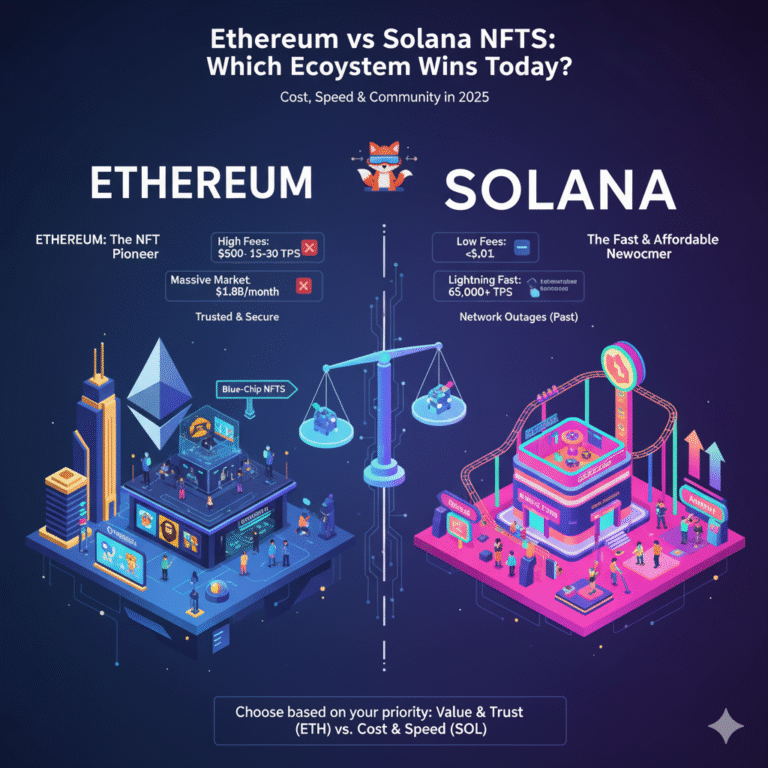
Non-fungible tokens, or NFTs, have revolutionized digital ownership. They’re unique digital assets—like digital art, collectibles, or virtual real estate—stored on a blockchain, which acts as a secure, immutable ledger. If you’re new to NFTs, you might be wondering where to start. Two of the biggest platforms for NFTs are Ethereum and Solana, and each has its own strengths and weaknesses. In this comprehensive guide, we’ll break down the differences between Ethereum NFTs and Solana NFTs so you can decide which ecosystem is better for you in 2025.

What Are NFTs and Why Do They Matter?

Imagine owning a one-of-a-kind trading card, like a rare Pokémon card—but it’s digital. Non-fungible tokens (NFTs) are exactly that: unique digital assets where the blockchain proves your ownership. You can buy, sell, or trade NFTs on specialized marketplaces, and they’re used for digital art, music, in-game items, virtual land in metaverses, and more.

Both Ethereum and Solana are two of the most important blockchains for NFT trading and creation, offering different experiences for creators, collectors, and investors.

Ethereum: The NFT Pioneer and Market Leader

Ethereum is the undisputed pioneer of the NFT space. Since its launch in 2015, it has become the foundation of the NFT world. Most of the famous NFT collections—like CryptoPunks and Bored Ape Yacht Club—originated on this blockchain. Its reputation, massive community, and robust security make it the go-to platform for high-value NFT projects.

Why People Choose Ethereum for NFTs

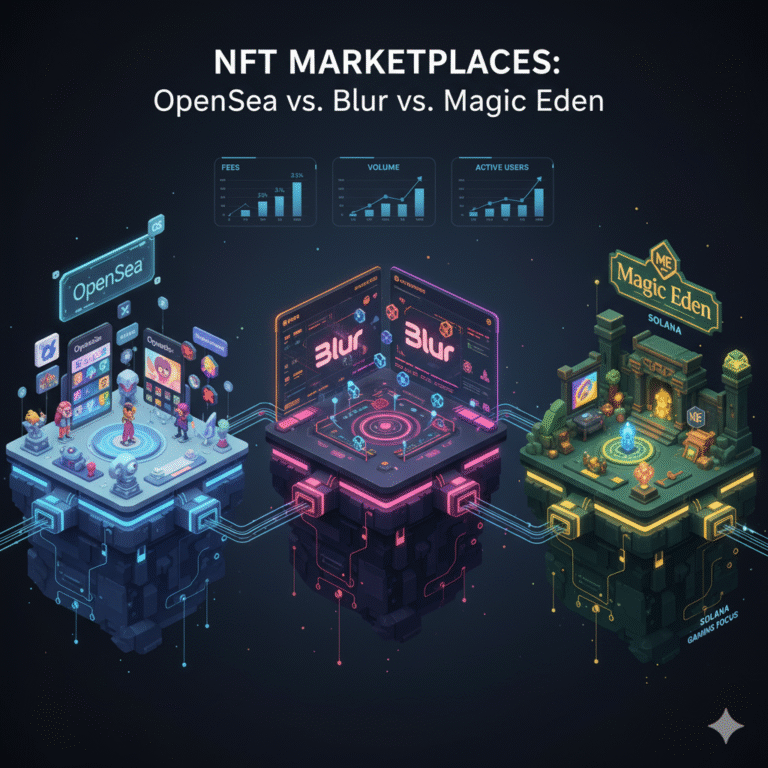
  1. Largest NFT Marketplace: Ethereum boasts the largest NFT ecosystem globally. Major marketplaces like OpenSea, Blur, and Rarible host millions of NFTs and attract the widest pool of buyers and sellers worldwide. For a detailed comparison of these platforms, check out our NFT marketplaces guide.
  2. Trusted and Secure Blockchain: With almost a decade of operational history, Ethereum is considered one of the most reliable and secure blockchains. Moreover, it successfully transitioned from Proof of Work to Proof of Stake in September 2022 (The Merge), cutting energy consumption by over 99.95% while maintaining industry-leading security.
  3. Blue-Chip NFT Projects: Premium collections like Bored Ape Yacht Club, CryptoPunks, and Azuki have sold individual NFTs for millions of dollars. As a result, Ethereum NFTs are often considered “blue-chip” assets—valuable, culturally significant, and more likely to retain long-term value.
  4. Strong Developer Ecosystem: Furthermore, Ethereum’s mature development tools, extensive documentation, and ERC-721 and ERC-1155 NFT standards make it the preferred choice for serious NFT projects.

The Downsides of Ethereum NFTs

  1. Higher Transaction Costs on Layer 1: While significantly lower than during the 2021 bull run, Ethereum’s base layer (L1) transaction fees typically range from $0.40–$2, with occasional spikes during network congestion. Check current Ethereum gas prices.
  2. Slower Transaction Speed: In comparison, Ethereum processes approximately 15–30 transactions per second (TPS) on its main chain, which is modest compared to newer blockchains like Solana. For a deeper dive into these performance differences, see our chain metrics comparison.
  3. Learning Curve for Beginners: To minimize costs, much NFT activity has shifted to Layer-2 solutions like Optimism, Arbitrum, and Base. However, this adds complexity for newcomers navigating the ecosystem.

Solana: The Fast and Affordable Alternative

Solana, launched in 2020, was designed from the ground up for high speed and ultra-low costs. Consequently, it has rapidly become a compelling alternative for NFTs, particularly among beginners, gamers, and traders seeking affordability. Understanding why Solana is rising helps explain its growing appeal in the NFT space.

Why People Choose Solana for NFTs

  1. Ultra-Low Transaction Fees: Solana transactions typically cost less than $0.0025 (a fraction of a cent). Therefore, minting, buying, or trading NFTs is incredibly affordable, making Solana exceptionally beginner-friendly and ideal for frequent traders.
  2. Lightning-Fast Speed: Solana can theoretically process up to 50,000 transactions per second, compared to Ethereum’s ~30 TPS. In practice, transactions feel nearly instantaneous, providing an excellent user experience.
  3. Rapidly Growing NFT Market: Collections like Degenerate Ape Academy and Solana Monkey Business have achieved significant success, with individual NFTs selling for over $1–2 million. Notably, in December 2023, Solana surpassed Ethereum in monthly NFT trading volume ($366.5M vs $353.2M).
  4. Gaming and Web3 Integration: Popular blockchain games like Star Atlas and Aurory leverage Solana’s speed and low costs for seamless in-game item trading. Additionally, Solana excels in profile-picture (PFP) projects, gaming NFTs, and experimental collections.
  5. User-Friendly Wallets: Meanwhile, wallets like Phantom offer intuitive interfaces that simplify NFT collecting for newcomers.

The Downsides of Solana NFTs

  1. Network Reliability Concerns: Unfortunately, Solana has experienced several major outages, including a 17-hour downtime in September 2021 and a five-hour outage in February 2024. Although the network is improving with upgrades like Frankendancer and the upcoming Firedancer client, reliability remains a consideration.
  2. Less Decentralized Network: As of 2025, Solana operates with approximately 1,300 consensus nodes, compared to Ethereum’s over 1 million validators. This makes Ethereum significantly more decentralized and censorship-resistant.
  3. Smaller Prestige Market: While growing rapidly, Solana’s NFT ecosystem still lacks the cultural prestige and established “blue-chip” collections that define Ethereum. For high-value art and collectibles, Ethereum remains the dominant choice.

Ethereum vs Solana NFTs: Head-to-Head Comparison

Cost – Winner: Solana

Solana’s near-zero transaction fees (under $0.0025) make it unbeatable for newcomers, frequent traders, and those minting multiple NFTs. Although Ethereum’s Layer-2 solutions have dramatically reduced costs, Solana still wins on raw affordability.

Speed – Winner: Solana

For raw throughput and instant transaction confirmation, Solana’s 50,000+ TPS capability far exceeds Ethereum’s 15-30 TPS on the main chain.

Market Size & Popularity – Winner: Ethereum

Ethereum hosts the largest NFT community, the most valuable collections, and the highest total trading volume. Furthermore, it remains the gold standard for prestigious NFT projects and attracts institutional collectors.

Security & Reliability – Winner: Ethereum

Ethereum has maintained continuous operation since 2015 without a complete network shutdown. Its massive validator network provides unparalleled security and decentralization. In contrast, Solana is improving but has experienced multiple outages.

NFT Categories – Different Strengths

  • Ethereum: High-value digital art, prestigious collectibles, established brands, virtual real estate
  • Solana: Gaming NFTs, affordable PFP projects, experimental collections, utility-focused NFTs

Beginner-Friendliness – Winner: Solana

Overall, Solana’s simplicity, minimal costs, instant transactions, and user-friendly wallets like Phantom make it more accessible for first-time NFT collectors.

What’s New in 2025? Latest Developments

Ethereum Updates

  • Dencun Upgrade (March 2024): Introduced proto-danksharding (EIP-4844), slashing Layer-2 transaction costs by up to 90%.
  • Pectra Upgrade (May 2025): Brought wallet improvements (EIP-7702), flexible staking (EIP-7251), and further scaling enhancements.
  • Layer-2 Dominance: Subsequently, most Ethereum NFT activity has migrated to L2s like Base, Arbitrum, and Optimism, where fees are just a few cents.

Solana Updates

  • Seeker Smartphone Launch: In 2025, Solana released the Seeker mobile device (formerly Saga Chapter 2), deeply integrating Solana blockchain features into mobile hardware.
  • State Compression Technology: Additionally, advances in compressed NFTs enable ultra-cheap minting for mass-market games and applications.
  • Firedancer Development: Meanwhile, continued progress on the high-performance Firedancer validator client, designed to dramatically increase network throughput and reliability.

Which NFT Ecosystem Should You Choose in 2025?

The answer depends on your specific goals and priorities:

Choose Ethereum NFTs if:

  • You’re seeking prestige, cultural significance, and long-term investment value
  • You want access to the largest, most established NFT marketplace
  • You’re interested in blue-chip collections and high-value digital art
  • Security and decentralization are top priorities
  • You’re willing to use Layer-2 solutions to minimize costs

Ethereum is the “premier art gallery” of NFTs—home to the most famous collections, strongest network effects, and highest liquidity for valuable assets.

Choose Solana NFTs if:

  • You’re a beginner looking for an affordable entry point
  • Transaction speed and minimal costs are crucial
  • You’re interested in gaming NFTs, experimental projects, or frequent trading
  • You want a simpler, more streamlined user experience
  • You’re exploring emerging collections and communities

Solana is the “dynamic, accessible gallery”—offering fast-growing projects, gaming integration, and ultra-low barriers to entry.

The Bottom Line: Both Ecosystems Have Value

In 2025, both Ethereum and Solana occupy important niches in the NFT ecosystem. Indeed, many sophisticated collectors use Ethereum for high-value investments and established collections while leveraging Solana for gaming, experimentation, and affordable trading.

Ultimately, the NFT market is diverse enough to support multiple blockchains, each serving different needs. Your choice ultimately depends on whether you prioritize prestige and security (Ethereum) or speed and affordability (Solana)—or ideally, you can explore both ecosystems to maximize your opportunities. For broader context on how these platforms compare across different use cases, including DeFi, read our comprehensive blockchain comparison.

NFT Royalties in 2025: Complete Guide for Digital Artists & Creators

1

Are NFT Royalties Still Profitable for Artists in 2025?

The NFT marketplace has evolved dramatically since its 2021 peak. While digital artists initially celebrated recurring revenue through NFT royalties, the landscape has shifted. This comprehensive guide explores whether NFT royalties remain viable in 2025 and how creators can maximize their earnings.

What Are NFT Royalties? Understanding the Basics

NFT (Non-Fungible Token) represents a unique digital asset verified on blockchain technology, primarily Ethereum. In essence, creator royalties allow artists to earn a percentage (typically 2.5%–10%) from secondary sales of their work.

Technical Foundation: On the technical side, royalties operate through the EIP-2981 standard on Ethereum, which signals royalty information to marketplaces. Nevertheless, enforcement depends on marketplace policies and smart contract design—it’s not automatically guaranteed by default ERC-721 or ERC-1155 standards.

The Evolution of NFT Royalties: 2021–2025 Timeline

The Golden Era (2021–2022)

During the NFT boom, creator royalties on Ethereum surpassed $1.8 billion in cumulative payments, according to Galaxy Digital research. Consequently, artists enjoyed substantial passive income from secondary market trades.

The Turning Point (2023)

In August 2023, OpenSea—the largest NFT marketplace—announced optional creator fees, effectively ending mandatory royalty enforcement by early 2024. As a result, this policy shift catalyzed industry-wide changes, making royalty payments voluntary on most major platforms.

Current State: NFT Royalties in 2025

Royalties aren’t dead—they’ve transformed. Furthermore, success now requires strategic technical implementation and marketplace selection. For a broader perspective on whether NFTs on Ethereum are still relevant in 2025, market dynamics have fundamentally changed.

Enforcement Mechanisms That Work

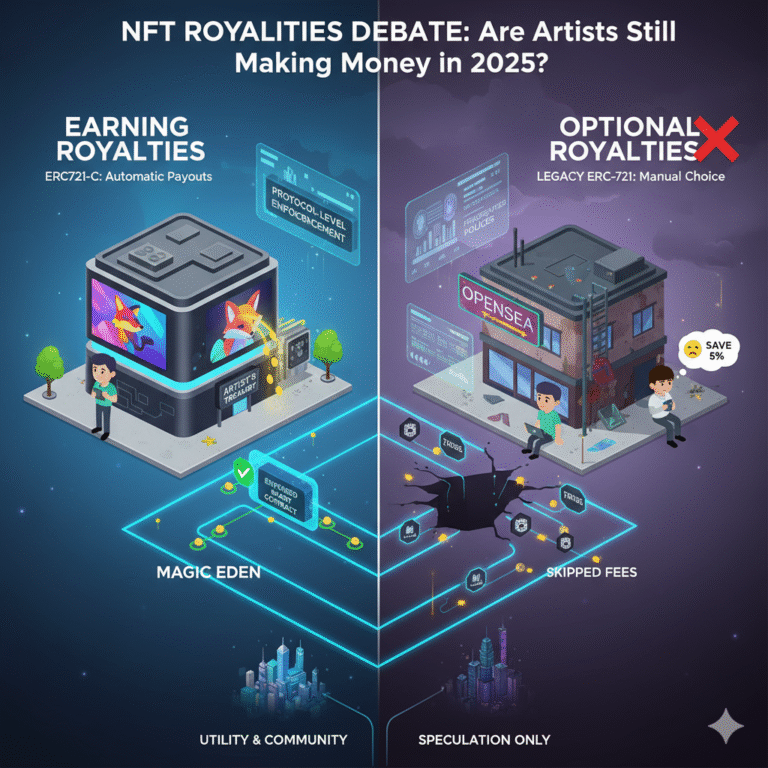
1. Contract-Level Enforcement (EVM Chains)

Modern standards like ERC721-C and ERC1155-C enable smart contract-based royalty enforcement through:

  • First and foremost, allow/deny lists for marketplace addresses
  • Additionally, transfer validators that verify royalty compliance
  • Moreover, on-chain enforcement logic

Notably, platforms like Magic Eden explicitly enforce royalties for ERC721-C collections while making them optional for legacy contracts.

2. Protocol-Level Enforcement (Alternative Chains)

Sui blockchain implements Transfer Policy and Kiosk systems that enforce royalties at the protocol layer—payments cannot be bypassed by switching marketplaces. In fact, this represents the future of guaranteed creator compensation. When comparing Ethereum vs Solana NFTs, protocol-level enforcement capabilities vary significantly across ecosystems.

3. Market Performance Data

July 2025 recorded approximately $574 million in NFT sales across all blockchains, according to Cointelegraph. Although volumes fluctuate, successful projects combine royalties with:

  • Initially, utility-driven value propositions
  • Subsequently, exclusive access and experiences
  • In addition, physical merchandise
  • Furthermore, intellectual property licensing
  • Finally, brand partnerships

How to Actually Earn NFT Royalties in 2025

Artists making money from royalties share these characteristics:

✓ Use enforcement-capable smart contract standards (ERC721-C/1155-C or protocol-native tools)
✓ Subsequently, list on marketplaces respecting enforcement mechanisms
✓ Additionally, build genuine utility and engaged communities
✓ Most importantly, maintain consistent secondary market demand

In contrast, projects using legacy ERC-721/1155 contracts without enforcement mechanisms see royalties approaching zero on optional-fee marketplaces.

Major NFT Marketplace Royalty Policies (2025)

For a detailed comparison of platform features and fee structures, see our comprehensive guide on NFT marketplaces: OpenSea vs Blur vs Magic Eden.

OpenSea (Ethereum)

  • Standard ERC-721/1155: Optional creator fees
  • ERC721-C/1155-C with enforcement: Mandatory royalties
  • Policy implemented August 2023

Magic Eden

  • Ethereum: Enforced for ERC721-C; optional for standard contracts
  • Solana: Supports Open Creator Protocol (OCP) and collection-specific mechanisms
  • Enforcement depends on launch configuration

Blur, LooksRare, X2Y2

  • Primarily zero-royalty or optional-fee models
  • Competitive on trading fees to attract volume
  • Limited creator royalty support

Case Study: Successful Royalty Implementation in 2025

Collections like Good Vibes Club on Ethereum demonstrate the viable path forward:

  • Supply: ~6,969 NFTs
  • Active secondary trading volume
  • Healthy floor price maintenance
  • Technical: Proper enforcement standards + compatible marketplace alignment
  • Revenue: Meaningful royalties from resales

Key takeaway: In essence, demand combined with technical enforcement generates sustainable creator revenue.

Pros and Cons of NFT Royalties (2025 Reality Check)

Advantages

✓ Ongoing passive income for successful creators
✓ Aligns long-term incentives beyond initial mint
✓ Integrates with broader monetization strategies
✓ Rewards community building and sustained value creation

Disadvantages

✗ Optional enforcement trends toward zero on many platforms
✗ High royalty percentages can suppress trading volume
✗ Fragmented policies across chains and marketplaces
✗ Technical complexity for non-technical creators

Actionable Strategy: 7 Steps to Maximize NFT Royalties

1. Choose Enforcement-Ready Technology

To begin with, deploy ERC721-C/1155-C contracts on EVM chains or use protocol-enforced chains like Sui. Importantly, avoid legacy standards if royalties matter to your business model.

2. Strategic Marketplace Selection

Next, list where your contract’s enforcement is respected. Therefore, research platform policies before launch—don’t assume universal support.

3. Build Real Utility

Furthermore, provide tangible value: exclusive access, events, physical products, intellectual property rights, or community experiences. Indeed, speculation alone won’t sustain demand. Similar to how DeFi protocols generate real revenue, NFT projects need sustainable value propositions.

4. Diversify Revenue Streams

Additionally, treat royalties as supplementary income. In particular, primary revenue sources should include:

  • First, initial NFT sales
  • Second, merchandise and physical products
  • Third, licensing deals
  • Fourth, community memberships
  • Finally, brand collaborations

5. Transparent Communication

Moreover, publish clear royalty policies explaining your percentage and the value it funds. Notably, communities support creators who communicate openly.

6. Community Engagement

Similarly, active Discord, Twitter/X, and holder engagement sustains secondary market interest—which drives royalty opportunities.

7. Monitor and Adapt

Lastly, track marketplace policies, technical standards, and community feedback. Consequently, the NFT space evolves rapidly; flexibility matters.

The Future of NFT Creator Compensation

The 2025 reality demands intentionality. Artists still earn meaningful money from NFT royalties—but only through:

  • Technical preparation: First, enforceable smart contracts
  • Strategic platform choices: Then, compatible marketplaces
  • Value creation: Additionally, utility beyond speculation
  • Diversified business models: Finally, multiple revenue streams

In conclusion, the era of automatic, universal royalties has ended. Ultimately, the winners engineer their royalty infrastructure, then earn payments through genuine community value.

Frequently Asked Questions

Q: Can I add royalties to existing NFT collections?
A: Unfortunately, it’s difficult with legacy contracts. Therefore, new deployments with ERC721-C or migration strategies may be necessary.

Q: What’s the optimal royalty percentage in 2025?
A: Generally speaking, 2.5%–5% balances creator compensation with trading volume. However, higher percentages require exceptional utility justification.

Q: Which blockchain offers best royalty enforcement?
A: Currently, Sui provides protocol-level enforcement. Meanwhile, Ethereum with ERC721-C offers strong contract-level options.

Q: Do all marketplaces honor royalties?
A: No. Consequently, research each platform’s policy and ensure technical compatibility before listing.

DAOs Explained Simply: How People Run Companies on Ethereum

1

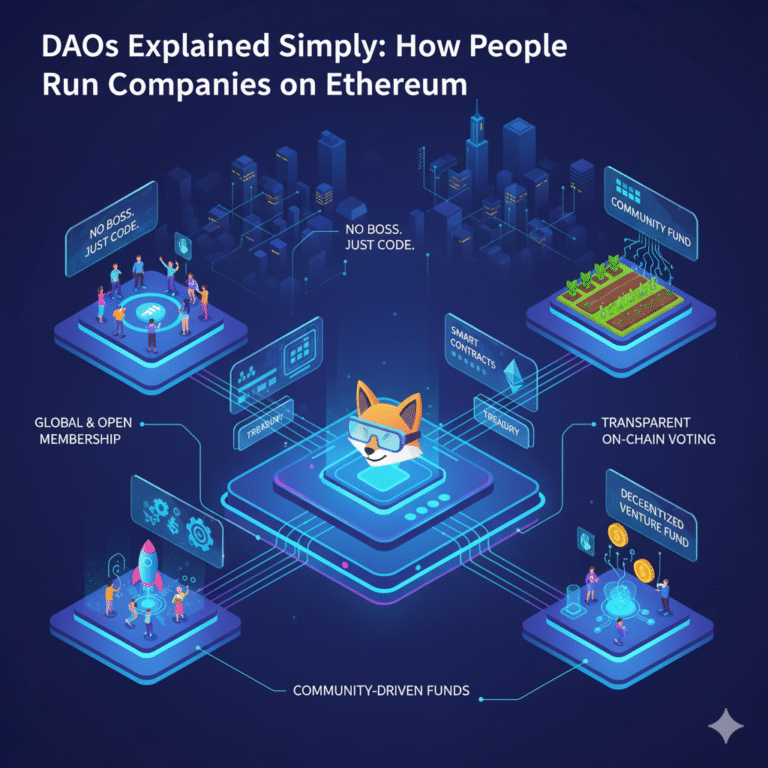
Imagine a company where there’s no boss, no central office, and no traditional hierarchy. Instead, a group of people from all over the world works together, makes decisions as a team, and manages everything using the internet and blockchain technology. This is what a DAO (Decentralized Autonomous Organization) is all about.

In this comprehensive guide, we’ll break down what DAOs are, how they work on the Ethereum blockchain, and why they’re exciting for anyone curious about the future of work and decentralized governance.

What Is a DAO?

A DAO is a digital organization that runs on rules written in computer code called smart contracts. Instead of a CEO or board of directors making decisions, everyone who’s part of the DAO gets a say through voting mechanisms.

Key Characteristics of DAOs:

  • Decentralized: No single person or group controls the organization
  • Autonomous: The organization runs itself using code with minimal human intervention
  • Organization: A group of people working together toward common goals—funding projects, building products, or managing communities

Simple Example:

A group of friends wants to start a community garden. Instead of one person deciding everything, they create a DAO. Everyone contributes funds, votes on what to plant, and the rules are encoded in a smart contract that ensures fairness and transparency.

Why Ethereum?

Ethereum is the primary blockchain that makes most DAOs possible. Unlike Bitcoin, which mainly handles peer-to-peer transactions, Ethereum supports smart contracts—self-executing programs that follow predefined rules automatically.

How Smart Contracts Power DAOs:

A smart contract might specify: “If 60% of members vote yes, automatically release $1,000 from the treasury to buy equipment.” Once deployed, nobody can cheat or secretly rewrite the rules—everything is transparent and immutable.

While DAOs increasingly use Layer-2 networks like Arbitrum or Base for lower transaction costs, Ethereum remains the foundation because it offers:

  • Battle-tested security
  • Largest developer community
  • Most established infrastructure
  • Wide token compatibility (ERC-20, ERC-721)

How Does a DAO Work?

1. Set the Rules

The community codes governance rules into a smart contract. Membership is typically based on:

  • ERC-20 governance tokens
  • NFT passes
  • Shares (like in MolochDAO)

2. Launch the DAO

The smart contract is deployed to Ethereum. It’s publicly visible, and any updates require collective voting approval.

3. Make Decisions Together

Members propose ideas and vote on them. Many DAOs use:

  • Snapshot for off-chain voting (gas-free)
  • SafeSnap for executing results on-chain
  • Tally for on-chain governance tracking

4. Treasury Management

DAO funds typically sit in a Safe (formerly Gnosis Safe) multisignature wallet. This requires multiple signers to approve transactions, adding security.

5. Transparency

All key decisions, rules, and spending are visible on the blockchain. While some discussions happen off-chain (Discord, forums), execution is always on-chain and verifiable.

6. Adapt and Grow

Through governance proposals, members can:

  • Change rules and parameters
  • Add new features
  • Allocate budgets
  • Split into new DAOs if needed

Real-World Examples

The DAO (2016)

The first major DAO, created as a decentralized venture capital fund. It raised approximately $150 million but was exploited due to a smart contract vulnerability, losing $50-60 million. This led to Ethereum’s controversial hard fork, creating Ethereum Classic.

Lesson: Security audits and formal verification are critical.

MakerDAO

MakerDAO manages DAI, a decentralized stablecoin pegged to $1 USD. Governance is conducted by MKR token holders who vote on:

  • Stability fees
  • Collateral types
  • Risk parameters

In 2024, Maker announced its “Endgame” rebrand to Sky, introducing optional upgrades (DAI → USDS, MKR → SKY).

ConstitutionDAO (2021)

ConstitutionDAO raised $47 million in just days to bid on a rare copy of the U.S. Constitution at Sotheby’s auction. Though they lost to billionaire Ken Griffin, the project demonstrated how quickly DAOs can mobilize global communities.

MolochDAO

MolochDAO is a grants-focused DAO funding Ethereum infrastructure projects. Its minimalist design inspired numerous forks and became the foundation for DAOhaus and similar frameworks.

Challenges of DAOs

1. Technical Complexity

Smart contract development is challenging, and bugs can be catastrophic. Regular security audits from firms like Certora, OpenZeppelin, or Trail of Bits are essential.

2. Slow Decision-Making

With thousands of members, reaching consensus takes time. Many DAOs struggle with voter apathy—often less than 10% of token holders participate.

3. Plutocracy Risk

Voting power often concentrates with large token holders (whales). Solutions include:

  • Quadratic voting
  • Reputation-based systems
  • Delegated voting

Governments are experimenting with DAO legislation:

  • Wyoming, USA: Created DAO LLCs in 2021
  • Utah: Introduced the DAO Act effective 2024
  • Marshall Islands: Legalized DAO LLCs in 2022

However, regulators (like the U.S. CFTC in the Ooki DAO case) still treat DAOs as potentially liable entities.

5. Security Risks

Treasury exploits and governance attacks remain common. Best practices include:

  • Multisig wallets (Safe)
  • Timelocks for proposal execution
  • Regular audits
  • Bug bounty programs via Immunefi

How to Get Started with DAOs

1. Learn the Basics

2. Get a Crypto Wallet

Use MetaMask, Rainbow, or Coinbase Wallet to hold ETH and interact with DAOs.

3. Explore DAO Platforms

  • DeepDAO – DAO analytics and rankings
  • DAOhaus – Launch and manage DAOs
  • Aragon – DAO creation toolkit
  • Colony – DAO infrastructure

4. Join and Participate

Find DAOs on:

  • Discord communities
  • Twitter/X crypto communities
  • Commonwealth forums

Some DAOs require token or NFT membership, others are open to contributors.

5. Start Small

Many DAOs welcome contributors with minimal funds or just time and skills. Look for:

  • Working groups needing help
  • Bounty programs
  • Community moderation roles

The Future of DAOs

DAOs are experimental but growing rapidly. They’re central to Web3’s vision of user-owned, transparent, global systems.

Potential Applications:

  • Municipal Governance: Cities using DAOs for participatory budgeting
  • Philanthropic Organizations: Donors directly controlling fund allocation
  • Decentralized Companies: Teams running billion-dollar protocols without traditional corporate structures
  • Creator Economies: Artists and communities co-owning platforms

Notable DAO Frameworks:

DAOs won’t replace all traditional organizations, but they’re proving that the future of coordination can be borderless, transparent, and community-driven.

Conclusion

DAOs are digital democracies running on Ethereum. They enable people to coordinate money, ideas, and projects without CEOs or boards. By using smart contracts, DAOs maintain fair and transparent rules that nobody can unilaterally change.

Whether funding startups through Moloch-style grants, managing DeFi protocols like MakerDAO, or pooling resources to bid at auctions like ConstitutionDAO, DAOs empower communities to act collectively.

Ready to Get Started?

  1. Set up a MetaMask wallet
  2. Explore DAOs on DeepDAO
  3. Join conversations on Discord

Start voting and shaping the future of decentralization today!

Ethereum Gaming: How Blockchain Games Actually Work

0

What is blockchain Gaming?

Imagine playing a video game where the legendary sword you find or the unique character you build isn’t just pixels on a screen—it’s a verifiable digital asset you truly own, like a collectible trading card. You can sell it on OpenSea, trade it with friends, or even use it in another compatible game. This isn’t science fiction; it’s Ethereum-based blockchain gaming.

Blockchain gaming is revolutionizing the gaming industry by transforming digital entertainment into verifiable digital property ownership. In this comprehensive 2025 guide, we’ll explain exactly how these games work, what makes Ethereum the leading blockchain platform for gaming, and explore both the exciting opportunities and potential risks ahead.

What Is Blockchain Technology?

A blockchain functions like an unbreakable, transparent public ledger. Thousands of independent computers called nodes maintain identical copies of every transaction record. Each new “block” of transactions cryptographically links to the previous one, making it virtually impossible to alter any record without rewriting the entire chain.

In gaming applications, blockchain technology can permanently store:

  • Digital asset ownership records
  • Achievement certificates
  • In-game transaction history
  • Player progression data

However, it’s important to understand that most games store artwork, 3D models, animations, and complex gameplay logic off-chain using solutions like IPFS (InterPlanetary File System) or private servers. This means while the blockchain proves you own an item, its visual and functional components could become inaccessible if those external services disappear.

Understanding Ethereum for Gaming

What Makes Ethereum Special?

Launched in 2015 by Vitalik Buterin, Ethereum is far more than just another cryptocurrency—it’s a programmable, decentralized computer network that powers the majority of blockchain games today.

Ethereum’s revolutionary smart contracts are self-executing pieces of code that automatically enforce game rules and execute transactions without requiring a centralized authority. When specific conditions are met in a game, rewards, trades, or other actions happen instantly and transparently.

Ethereum’s Gaming Currency Ecosystem

While Ethereum’s native currency is Ether (ETH), most games create their own tokens:

If you’re wondering about the continued relevance of NFTs on Ethereum, the gaming sector provides one of the strongest use cases for blockchain-based digital assets in 2025.

Environmental Impact and Scalability Solutions

The 2022 Ethereum Merge transitioned the network from energy-intensive Proof-of-Work to efficient Proof-of-Stake, reducing energy consumption by approximately 99.95%. Subsequent upgrades like Dencun (EIP-4844) in 2024 significantly lowered transaction fees on Layer-2 networks.

Popular Layer-2 Solutions for Gaming:

  • Arbitrum – High-speed transactions with Ethereum security
  • Immutable zkEVM – Gaming-focused zero-knowledge rollup
  • Polygon – Widely adopted sidechain solution
  • Ronin – Gaming-optimized blockchain evolving toward L2

Players can now enjoy blockchain gaming with transaction fees often costing just a few cents, compared to the $50+ fees during Ethereum’s peak congestion periods.

Traditional vs Blockchain Games Comparison

Traditional Gaming Limitations

In conventional video games, players face several ownership restrictions:

  • No true ownership: Items exist only on developer servers
  • Account dependency: Losing account access means losing all purchases
  • No transferability: Cannot sell or trade items outside the game
  • Developer control: Companies can modify or remove items at will
  • Server shutdowns: Game closure means total asset loss

Blockchain Gaming Revolution

Ethereum-based games fundamentally change this relationship:

FeatureTraditional GamesBlockchain Games
Asset OwnershipPlatform-controlledPlayer-owned NFTs
TransferabilityLocked to accountTradeable on markets
TransparencyClosed systemsOpen, auditable
InteroperabilityGame-specificCross-game potential
MonetizationDeveloper-onlyPlayer-driven economy

Many modern blockchain games follow a “play-and-earn” or “play-to-own” philosophy, prioritizing engaging gameplay while offering optional earning opportunities. This represents an evolution from the earlier “play-to-earn” model that dominated 2021-2022.

Key Features of Ethereum Gaming

1. True Digital Ownership with NFTs

Non-Fungible Tokens (NFTs) serve as cryptographic certificates of authenticity for unique digital assets. In gaming, NFTs can represent:

  • Rare weapons and armor
  • Unique characters or pets
  • Virtual real estate parcels
  • Achievement badges
  • Cosmetic items and skins

Players can verify ownership through blockchain explorers like Etherscan.

2. Smart Contract Automation

Smart contracts eliminate the need for intermediaries by automatically:

  • Processing battles and determining winners
  • Distributing rewards based on performance
  • Executing trades in decentralized marketplaces
  • Managing tournaments and leaderboards
  • Handling governance voting

3. Play-and-Earn Economics

Unlike traditional games where time investment has no monetary return, blockchain games can offer:

  • Token rewards for completing quests
  • NFT drops for achieving milestones
  • Staking rewards for holding game assets
  • Tournament prizes in cryptocurrency
  • Rental income from lending items to other players

For those interested in leveraging these economic opportunities, understanding what DeFi on Ethereum is becomes essential, as many gaming assets can be integrated into DeFi protocols.

4. Decentralized Autonomous Organizations (DAOs)

Many blockchain games implement DAO governance, allowing token holders to vote on:

  • Game development priorities
  • Economic parameter changes
  • New feature implementations
  • Community fund allocation

Popular DAO platforms include Snapshot for off-chain voting and Aragon for on-chain governance.

5. Cross-Game Interoperability

While still limited, some games are beginning to support asset interoperability through:

  • Shared NFT standards like EIP-2981 royalties
  • Cross-game partnerships and collaborations
  • Universal avatar systems
  • Shared virtual world infrastructure

How Blockchain Gaming Works: Step-by-Step Guide

Step 1: Setting Up Your Gaming Wallet

Popular Wallet Options:

  • MetaMask – Most widely supported browser extension
  • WalletConnect – Connect mobile wallets to games
  • Coinbase Wallet – User-friendly with built-in DApp browser
  • Embedded wallets – Simplified, game-integrated solutions

Step 2: Acquiring Cryptocurrency

Players typically need small amounts of ETH for:

  • Gas fees for blockchain transactions
  • Purchasing starter packs or characters
  • Trading on marketplaces

Where to Buy ETH:

  • Coinbase – Beginner-friendly exchange
  • Binance – Largest global exchange
  • Kraken – Security-focused exchange
  • Uniswap – Decentralized exchange
  • Gemini – Regulated US exchange

For a comprehensive walkthrough of the purchase process, check out our guide on how to buy Ethereum safely in 2025.

Step 3: Minting and Managing NFTs

When players acquire new items:

  1. Minting process creates a unique NFT on the blockchain
  2. Metadata storage links to off-chain assets (images, 3D models)
  3. Ownership transfer updates the blockchain record
  4. Wallet display shows the new asset

Step 4: Hybrid On-Chain/Off-Chain Gameplay

Modern blockchain games use a hybrid architecture:

  • On-chain: Asset ownership, major transactions, governance
  • Off-chain: Real-time gameplay, chat, visual rendering
  • State synchronization ensures consistency between systems

Step 5: Economic Participation

Players can participate in game economies through:

  • Primary markets: Buying directly from game developers
  • Secondary markets: Trading with other players on platforms like OpenSea or Blur
  • DeFi integration: Using game assets as collateral in protocols like Aave, Compound, or MakerDAO

When it comes to comparing NFT marketplaces, each platform offers unique advantages for gaming asset trading, with OpenSea providing the broadest selection and Blur offering lower fees for active traders.

Top Ethereum Games in 2025

Collectible and Breeding Games

CryptoKitties

  • The pioneering NFT game that introduced blockchain gaming to mainstream audiences
  • Features unique cat breeding mechanics with genetic algorithms
  • Operates on Ethereum mainnet with Flow integration for scaling

Axie Infinity

  • Once the flagship play-to-earn title with 2.7M daily users at peak
  • Now runs on Ronin, an EVM-compatible sidechain
  • Features creature collection, battling, and breeding mechanics
  • Continues active development despite reduced user base from 2021 highs

Virtual Worlds and Metaverse

Decentraland

The Sandbox

Competitive Strategy Games

Gods Unchained

  • Competitive trading card game with tournament prize pools
  • Transitioning from Immutable X to Immutable zkEVM for enhanced scalability
  • Features deck building, ranked play, and NFT card ownership
  • Regular expansions and meta updates keep gameplay fresh

Illuvium

Emerging Gaming Projects

Might & Magic: Era of Chaos by Ubisoft

  • Major publisher entry into blockchain gaming
  • Partnership with Immutable for NFT integration
  • Combines traditional gaming polish with blockchain benefits

Pros and Cons Analysis

Advantages of Ethereum Gaming

Financial Benefits

  • True asset ownership with provable scarcity
  • Liquid markets for in-game items
  • Passive income opportunities through staking and lending
  • Investment appreciation potential for rare items

Gameplay Innovation

  • Player-driven economies create emergent gameplay
  • Transparent mechanics prevent developer manipulation
  • Cross-game compatibility expands asset utility
  • Community governance gives players voice in development

Technical Advantages

  • Censorship resistance ensures access regardless of location
  • Immutable records prevent asset duplication or deletion
  • Global accessibility with 24/7 markets
  • Programmable assets enable complex interactions

Challenges and Risks

Economic Volatility

Technical Limitations

  • Gas fees for Ethereum mainnet interactions
  • Transaction speed limitations during network congestion
  • Off-chain dependencies create single points of failure
  • Wallet security requires user education and responsibility

Regulatory Uncertainty

Security Concerns

Future of Blockchain Gaming

The blockchain gaming sector is experiencing significant diversification and maturation:

Market Size Projections:

  • Conservative estimates: $14 billion annual activity
  • Optimistic forecasts: $80+ billion market potential
  • Focus shifting from speculation to sustainable gameplay

Mobile Gaming Integration

Mobile-First Blockchain Games are rising in popularity:

Artificial Intelligence Integration

AI is enhancing blockchain games through:

Virtual and Augmented Reality

VR/AR Integration promises immersive experiences:

Institutional Adoption

Major gaming companies are entering the space:

Technological Advances

Layer-2 Scaling Solutions continue improving:

For those curious about the broader ecosystem competition, our analysis of Ethereum vs Solana NFTs explores how different blockchain platforms are approaching gaming and digital assets.

Getting Started: Your First Steps

1. Educational Foundation

Before diving in, understand the basics:

2. Wallet Setup and Security

Security Best Practices:

3. Start Small and Learn

Recommended Beginner Strategy:

  • Begin with free-to-play blockchain games
  • Invest only what you can afford to lose
  • Learn by doing rather than jumping into expensive games
  • Participate in game communities and Discord servers

4. Research Before Investing

Due Diligence Checklist:

Conclusion: The Decentralized Gaming Revolution

Ethereum gaming represents a fundamental shift in how we conceptualize digital ownership and interactive entertainment. By leveraging blockchain technology, players gain unprecedented control over their digital assets while developers can create new economic models that benefit entire gaming communities.

Whether you’re interested in breeding digital creatures, trading virtual real estate, or competing in skill-based tournaments for cryptocurrency prizes, blockchain gaming offers opportunities previously impossible in traditional gaming.

The key to success in this evolving landscape is balancing entertainment value with economic opportunity. The most sustainable blockchain games prioritize fun, engaging gameplay while incorporating meaningful ownership and earning mechanics.

Ready to start your blockchain gaming journey? Set up a wallet, try a free game, and experience firsthand how true digital ownership transforms the gaming experience. The future of interactive entertainment is decentralized, transparent, and built on the foundation of player empowerment.


Frequently Asked Questions

Q: Do I need technical knowledge to play blockchain games?
A: Modern blockchain games have simplified onboarding significantly. Basic computer skills and willingness to learn wallet usage are sufficient.

Q: Are blockchain games expensive to play?
A: Many games offer free-to-play options with optional purchases. Layer-2 solutions have reduced transaction costs to minimal levels.

Q: Can I really make money playing blockchain games?
A: Yes, but approach it as entertainment first. Earnings depend on skill, time investment, and market conditions.

Q: What happens if a blockchain game shuts down?
A: You retain ownership of NFT assets, though their utility may be limited if game servers close. Some assets may retain value for collecting or use in other games.

Q: Are blockchain games environmentally friendly?
A: Ethereum’s transition to Proof-of-Stake and Layer-2 scaling have made blockchain gaming significantly more energy-efficient than early implementations.

Read also: TON Blockchain.

NFT Marketplaces: OpenSea vs Blur vs Magic Eden – Complete Comparison Guide

0

Introduction to NFT Marketplaces

Non-Fungible Tokens (NFTs) have evolved significantly since their inception, representing unique digital ownership proofs for art, music, virtual land, gaming assets, and collectibles. In 2025, the NFT ecosystem has matured with renewed institutional interest, improved user experience, and enhanced cross-chain functionality.

NFT marketplaces serve as the primary platforms where creators mint, buyers purchase, and collectors trade these digital assets. The three dominant platforms—OpenSea, Blur, and Magic Eden—each cater to different user needs and trading strategies.

Key Factors When Choosing an NFT Marketplace:

  • Transaction fees and gas costs
  • Supported blockchain networks
  • Trading tools and user interface
  • Community size and liquidity
  • Security features and reputation
  • Creator royalty policies

OpenSea: The Industry Leader

Platform Overview

OpenSea remains the largest NFT marketplace by user base and collection diversity. Founded in 2017, it has established itself as the “Amazon of NFTs” with comprehensive discovery tools and broad blockchain support.

2025 Key Features & Updates

OpenSea 2.0 (OS2) Launch:

  • Support for 19+ blockchain networks including Ethereum, Polygon, Solana, Base, and Arbitrum
  • Enhanced user interface with improved batch operations
  • Advanced search and filtering capabilities
  • Mobile app optimization for iOS and Android

Rewards Program:

  • Voyages rewards program for active users
  • Planned $SEA token launch with transaction fee revenue sharing
  • Exclusive access to featured collections and early mints

Fee Structure (2025)

Fee TypeAmountDetails
Marketplace Fee1%Reduced from previous 2.5%
Creator RoyaltiesVariableSet by original creators (0-10%)
Gas FeesBlockchain-dependentHigh on Ethereum, low on Polygon/Solana

OpenSea Pros and Cons

✅ Strengths:

  • Largest selection of NFT collections
  • Excellent discovery and curation tools
  • Strong creator support and minting tools
  • Cross-chain compatibility
  • Institutional partnerships and backing
  • Robust mobile application

❌ Weaknesses:

  • Higher fees compared to competitors
  • Slower transaction processing during peak times
  • Limited advanced trading features
  • Occasional customer support delays

Best for: Beginners, collectors seeking variety, creators launching new projects

Blur: The Pro Trader’s Choice

Platform Overview

Blur has revolutionized NFT trading by focusing on speed, efficiency, and professional trading tools. Launched with a trader-first approach, it quickly gained market share among active NFT flippers and institutional traders.

2025 Platform Features

Advanced Trading Tools:

  • Real-time portfolio analytics with P&L tracking
  • Sweep functionality for bulk purchases across collections
  • Order book-style listings similar to traditional exchanges
  • Advanced filtering by traits, rarity, and price points
  • Mobile-optimized trading interface

Blockchain Support:

  • Primary focus on Ethereum mainnet
  • Blast Layer 2 integration for reduced fees
  • Plans for additional L2 expansions in late 2025

Blur Fee Structure

Fee TypeAmountBenefits
Marketplace Fee0%All proceeds go to sellers
Creator Royalties~0.5%Enforced minimum royalties
Gas FeesStandard EthereumNo additional markup

Blur Pros and Cons

✅ Strengths:

  • Zero marketplace fees maximize profits
  • Lightning-fast execution speeds
  • Professional-grade analytics tools
  • Strong liquidity for popular collections
  • Airdrop rewards for active traders

❌ Weaknesses:

  • Steep learning curve for beginners
  • Limited collection discovery features
  • Primarily Ethereum-focused
  • Less creator-friendly tools

Best for: Active traders, NFT flippers, institutional investors, experienced collectors

Magic Eden: Multi-Chain Gaming Hub

Platform Overview

Magic Eden started as Solana’s premier NFT marketplace and has evolved into a comprehensive multi-chain platform with strong gaming and community focus. It’s particularly popular for trading game assets and utility NFTs.

2025 Expansion & Features

Multi-Chain Support:

  • Solana (dominant position with 60%+ market share)
  • Ethereum (growing presence)
  • Bitcoin Ordinals/Runes (emerging market leader)
  • Base, Berachain, and other Layer 2 solutions

Gaming & Community Features:

  • Launchpad for new gaming projects
  • Community rewards and engagement programs
  • Bulk listing tools for collection management
  • Game asset integration with popular blockchain games
  • Creator tools for gaming studios

Magic Eden Fee Structure

ChainMarketplace FeeTypical Gas Costs
Solana2%<$0.01
Ethereum2%$15-50+
Bitcoin2%$5-15
Base/L22%$1-5

Magic Eden Pros and Cons

✅ Strengths:

  • Extremely low transaction costs on Solana
  • Strong gaming ecosystem integration
  • Active community and social features
  • Bitcoin Ordinals market leadership
  • Developer-friendly APIs and tools

❌ Weaknesses:

  • Higher marketplace fees (2%)
  • Smaller Ethereum collection variety
  • Volume can be inconsistent
  • Less advanced trading analytics

Best for: Gamers, Solana ecosystem participants, Bitcoin Ordinals collectors, cost-conscious traders

Detailed Comparison Table

FeatureOpenSeaBlurMagic Eden
Primary Chains19+ (ETH, SOL, MATIC, BASE)ETH, Blast L2SOL, ETH, BTC, BASE, BERA
Marketplace Fee1%0%2%
Creator RoyaltiesVariable (0-10%)~0.5% minimumOptional/Collection-based
Gas CostsHigh on ETH, Low on altsStandard ETH costsVery low on SOL
Trading ToolsGood discovery, batchingAdvanced analytics, sweepsBulk operations, gaming focus
Market Share (Q3 2025)~37%~27%~10% overall, 62% on Solana
Mobile App★★★★★★★★★☆★★★★☆
Beginner Friendly★★★★★★★☆☆☆★★★★☆
Pro Trading Features★★★☆☆★★★★★★★★☆☆

Which NFT Marketplace Should You Choose?

For Beginners and Casual Collectors

Choose OpenSea if you’re:

  • New to NFTs and want the easiest onboarding
  • Looking for the widest variety of collections
  • Interested in cross-chain NFT exploration
  • Prioritizing user-friendly interface and mobile experience

For Active Traders and Professionals

Choose Blur if you’re:

  • Trading NFTs frequently for profit
  • Need advanced analytics and portfolio tracking
  • Want to minimize fees and maximize returns
  • Comfortable with complex trading interfaces

For Gaming and Solana Enthusiasts

Choose Magic Eden if you’re:

  • Focused on gaming NFTs and utility tokens
  • Active in the Solana ecosystem
  • Want minimal transaction costs
  • Interested in Bitcoin Ordinals trading

Multi-Platform Strategy

Many successful NFT traders use multiple marketplaces:

  • OpenSea for discovery and rare finds
  • Blur for quick flips and bulk operations
  • Magic Eden for Solana gaming assets and low-cost trades

Understanding NFT Royalties Across Platforms

One of the most critical aspects of NFT trading in 2025 is how each marketplace handles creator royalties. OpenSea allows creators to set their own royalty percentages, typically ranging from 0-10%, giving artists maximum control over their secondary market earnings. Blur enforces a minimum royalty of approximately 0.5% to ensure creators receive some compensation, while Magic Eden’s approach varies by collection and blockchain, with some collections maintaining optional royalties.

Blockchain Ecosystem Considerations

When choosing your NFT marketplace, it’s essential to consider the underlying blockchain ecosystem. The debate between Ethereum vs Solana NFTs continues to shape marketplace selection in 2025. Ethereum remains the dominant force for high-value collections and established projects, with OpenSea and Blur providing the most robust support. However, Solana’s dramatically lower transaction costs make Magic Eden an attractive option for frequent traders and gaming enthusiasts.

For those exploring multiple networks, understanding the broader comparison between Ethereum, Solana, Polygon, and TON can inform your marketplace strategy and help you identify where specific collections might offer the best value.

Are NFTs Still Relevant in 2025?

Despite market fluctuations, NFTs on Ethereum remain highly active and continue to evolve with new use cases. The maturation of marketplaces like OpenSea, Blur, and Magic Eden reflects the industry’s shift from speculation to utility, with gaming assets, digital identity, and tokenized real-world assets driving renewed interest.

Frequently Asked Questions

What are the safest NFT marketplaces in 2025?

All three platforms (OpenSea, Blur, Magic Eden) are considered secure with strong track records. Always verify smart contracts and use reputable wallets like MetaMask or Phantom.

Which marketplace has the lowest fees?

Blur offers 0% marketplace fees, while OpenSea charges 1% and Magic Eden charges 2%. However, consider gas fees and overall ecosystem when comparing total costs.

Can I use the same wallet across all marketplaces?

Yes, wallets like MetaMask work across all Ethereum-based platforms. For Solana-based trading on Magic Eden, you’ll need a Solana wallet like Phantom.

How do NFT royalties work in 2025?

  • OpenSea: Creator-set royalties (typically 2.5-10%)
  • Blur: Enforced minimum ~0.5% royalties
  • Magic Eden: Varies by collection and blockchain

Which marketplace is best for new NFT projects?

OpenSea offers the best creator tools and largest audience for launches. Magic Eden is excellent for gaming projects, especially on Solana.

Conclusion

The NFT marketplace landscape in 2025 offers specialized platforms for different trading styles and preferences. Whether you’re a collector, trader, or creator, understanding each platform’s strengths will help you make informed decisions and maximize your NFT experience.

Stay updated with the latest developments by following official channels and always practice safe trading with proper security measures.


Disclaimer: This article is for educational purposes only and does not constitute financial advice. Always conduct your own research before making investment decisions.

Ethereum Layer 2 Solutions 2025: Complete Guide to Fees, Speed & Best Networks

7

What Are Ethereum Layer 2 Solutions?

Ethereum Layer 2 solutions are scaling networks that process transactions off the main Ethereum blockchain while maintaining its security. Think of them as express lanes that reduce traffic on the main highway.

As the world’s largest smart contract platform, Ethereum processes only ~15 transactions per second (TPS). Consequently, when demand spikes, gas fees can reach $50+ per transaction, making simple swaps prohibitively expensive for most users.

Fortunately, Layer 2 (L2) networks solve this by:

  • Processing transactions off-chain in batches
  • Settling final results on Ethereum’s main network
  • Reducing fees by 95%+ compared to Ethereum mainnet
  • Increasing transaction speed by 10-100x

By September 2025, these networks secure over $42 billion in total value locked (L2BEAT data), thereby proving their critical role in Ethereum’s ecosystem.


How Layer 2 Networks Work

To understand the mechanics behind these scaling solutions, it’s helpful to explore how Ethereum Layer 2 works in detail. Layer 2 solutions use two primary approaches to scale Ethereum:

Optimistic Rollups

Examples: Arbitrum, Optimism, Base

These rollups assume transactions are valid unless challenged. Moreover, they feature a 7-day withdrawal period for security (unless using fast bridges). In addition, this battle-tested technology offers extensive DeFi ecosystems with lower technical complexity for developers.

If you’re curious about how Optimism delivers fast and cheap Ethereum transactions, it leverages this optimistic approach to achieve significant cost reductions while maintaining security.

Zero-Knowledge (ZK) Rollups

Examples: zkSync Era, Starknet, Polygon zkEVM

In contrast, ZK rollups use cryptographic proofs to verify transaction validity. As a result, they provide instant finality and faster withdrawals. However, while more complex, they’re theoretically more efficient. Nevertheless, this newer technology comes with evolving developer tools.

For those new to this concept, understanding ZK rollups starts with grasping how zero-knowledge proofs enable scalability without compromising security. Meanwhile, if you want to dive deeper into the technical details, our complete guide to ZK rollups in 2025 covers everything from cryptographic fundamentals to real-world implementations.

Importantly, both approaches inherit Ethereum’s security while dramatically improving performance and cost efficiency.


Key Metrics for Comparing Layer 2 Networks

When choosing a Layer 2 network, focus on these three critical metrics:

Transaction Fees

This metric represents what it costs to use the network:

  • ETH transfers: $0.05-$0.20 typical range
  • Token swaps: $0.15-$0.50 typical range
  • Complex DeFi operations: $0.30-$1.00 typical range

Notably, fees fluctuate based on network congestion and blob space costs after EIP-4844.

Transaction Speed (TPS)

Actual throughput matters more than theoretical maximums. For instance:

  • Live TPS varies significantly from marketing claims
  • Real-world usage patterns affect performance
  • Peak capacity differs from sustained throughput

Total Value Secured (TVS)

Total value locked serves as an indicator of adoption and trust:

  • Amount of crypto assets locked in the network
  • Reflects ecosystem maturity and user confidence
  • Correlates with available DeFi protocols and liquidity

Best Layer 2 Networks in 2025

Complete Performance Comparison

Layer 2 NetworkTypeSend FeeSwap FeeLive TPSTotal Value SecuredKey Strengths
Arbitrum OneOptimistic~$0.09~$0.27~48$19.7BLargest DeFi ecosystem, proven stability
BaseOptimistic~$0.10~$0.20~129$14.7BCoinbase integration, high activity
OptimismOptimistic~$0.14~$0.18~14$3.6BSuperchain foundation, developer focus
zkSync EraZK Rollup~$0.07Variable~0.3$1.1BAccount abstraction, native zkEVM
StarknetZK Rollup~$0.19~$0.57~7.5$0.6BCairo language, innovative VM
Polygon zkEVMZK Rollup~$0.19~$2.75~0.07$0.02BEVM compatibility, Polygon ecosystem

Data sources: L2BEAT, l2fees.info, September 28, 2025


Real-World Performance Analysis

Fee Structure Deep Dive

Several factors explain why fees vary across networks:

  • Blob space demand (post-EIP-4844 upgrade affects all L2s)
  • Network congestion during high-activity periods
  • Transaction complexity (simple transfers vs. multi-step DeFi operations)

Current fee leaders:

  • Cheapest sends: zkSync Era (~$0.07)
  • Cheapest swaps: Optimism (~$0.18)
  • Most consistent: Arbitrum One (stable across operations)

Transaction Throughput Reality

Impressively, Base leads in live TPS (~129) due to several factors:

  • Coinbase’s retail user onboarding
  • High-frequency trading and memecoin activity
  • Optimized OP-stack implementation

Meanwhile, Arbitrum maintains steady performance despite having the highest TVL. Such stability results from:

  • Mature load balancing
  • Established DeFi protocols optimizing gas usage
  • Consistent ~50 TPS with burst capacity

Ecosystem Maturity Rankings

  1. Arbitrum: Most mature DeFi ecosystem, highest liquidity
  2. Base: Fastest growing, strong retail adoption
  3. Optimism: Developer-focused, powering Superchain expansion
  4. zkSync Era: Leading ZK innovation, improving tooling
  5. Starknet: Unique Cairo ecosystem, growing developer interest

Which Layer 2 Should You Choose?

For DeFi Trading and Lending

Recommended: Arbitrum One

When it comes to DeFi, Arbitrum One offers unmatched liquidity depth across major DEXs like Uniswap and SushiSwap. The platform also hosts battle-tested lending protocols including Aave and Compound. During periods of market volatility, its proven stability provides traders with confidence. Extensive yield farming opportunities make it the go-to choice for DeFi power users.

For Retail Users and Beginners

Recommended: Base

Built with user experience in mind, Base delivers seamless Coinbase wallet integration from the start. New users benefit from simplified fiat on-ramps that eliminate common onboarding friction. Transaction throughput reaches impressive levels, ensuring responsive interactions across all dApps. Consumer-focused applications continue growing on the platform, creating an expanding ecosystem for everyday users.

For Developers and Innovation

Recommended: Optimism or zkSync Era

Two excellent options serve the developer community. Optimism features the Superchain ecosystem with standardized tools, and you can learn more about how Optimism explained its approach to fast and cheap Ethereum transactions through its innovative OP-stack architecture.

Alternatively, zkSync Era provides native account abstraction with advanced features. The platform has seen remarkable growth recently, and tracking zkSync Era’s latest updates and adoption trends in 2025 reveals impressive ecosystem expansion and technical improvements.

Both platforms additionally offer developer grants and ecosystem support, making them ideal choices for building next-generation applications.

For Cost-Sensitive Applications

Recommended: zkSync Era

Cost efficiency defines zkSync Era’s value proposition, with the platform delivering the lowest typical transaction fees in the ecosystem. Batch processing happens efficiently, reducing costs even further for high-volume applications. Thanks to native account abstraction, multi-transaction operations become significantly more economical compared to traditional approaches.


Security and Bridge Considerations

For maximum security, consider these official bridges:

Third-Party Fast Bridges

Alternatively, these fast bridges offer quicker transfers:

Important reminder: Always verify contract addresses and start with small amounts.


Future of Ethereum Layer 2 Scaling

What’s Coming in 2025-2026

Technical Improvements:

Major upgrades are reshaping the L2 landscape. Blob space expansion through EIP-4844 extensions will drive blob costs significantly lower. Interoperability protocols under development will enable seamless asset transfers between different L2 networks. Developer tooling for ZK rollups continues maturing toward production-ready quality. On the UX front, account abstraction will simplify blockchain interactions for mainstream users.

Ecosystem Growth:

Beyond technical advancement, ecosystem expansion accelerates across multiple dimensions. Additional OP-stack networks will join the Superchain, creating new use case opportunities. Privacy and computational capabilities will advance through continued ZK innovation. Payment and supply chain solutions are attracting growing enterprise interest across industries. Mobile-first applications will leverage the combination of low fees and instant finality to reach new user segments.


Key Takeaways

Several critical insights emerge from this comprehensive analysis:

Essential technology: Layer 2 has evolved from optional to essential for practical Ethereum usage. ✅

Value leader: With the most mature ecosystem, Arbitrum currently leads in total value secured. ✅

Activity champion: Base demonstrates the highest transaction throughput, driven by retail adoption. ✅

Future potential: ZK rollups continue emerging with compelling long-term efficiency advantages. ✅

Affordable operations: Standard operations now cost under $0.50 on most networks. ✅

Choose your Layer 2 based on your priority:

  • Maximum DeFi options: Arbitrum One delivers the richest ecosystem
  • Best user experience: Base provides the smoothest onboarding
  • Lowest fees: zkSync Era offers the most economical transactions
  • Developer innovation: Optimism or Starknet enable cutting-edge development

Frequently Asked Questions

Q: Are Layer 2 networks safe?

A: Yes, they inherit Ethereum’s security model. Specifically, your funds are protected by Ethereum’s consensus. However, there are different trust assumptions for Optimistic vs. ZK rollups.

Q: Can I move between Layer 2 networks?

A: Yes, using bridges or cross-chain protocols. Furthermore, direct L2-to-L2 transfers are becoming more common. As a result, interoperability continues to improve.

Q: Do I need ETH for gas on Layer 2?

A: Yes, most Layer 2s use ETH for gas fees. However, some networks support fee payment in other tokens. Therefore, check your specific network’s options.


This guide is updated regularly with the latest data from L2BEAT, l2fees.info, and official network sources. Consequently, bookmark this page for the most current Layer 2 comparison.