Home Blog Page 7

Avalanche Subnets vs Polygon Supernets: A Beginner’s Guide to Custom Blockchain Networks

In the fast-evolving world of blockchain technology, scalability remains a major challenge for developers building decentralized applications (dApps). As Ethereum’s ecosystem grows, solutions like Avalanche Subnets and Polygon Supernets have emerged to help create customized, high-performance blockchains. Moreover, these tools allow projects to launch their own “app chains” – dedicated networks tailored to specific needs – without the congestion and high fees of main chains.

If you’re new to blockchain, think of these as specialized highways branching off from a busy freeway. Essentially, they let traffic (transactions) flow smoothly for particular vehicles (apps), improving speed and efficiency. In this article, we’ll break down Avalanche Subnets vs Polygon Supernets in simple terms, highlighting their features, similarities, differences, and real-world uses. Whether you’re a beginner exploring crypto or a developer considering scalability options, this guide will help you understand these powerful tools.

By the end, you’ll grasp how these networks compare in terms of performance, security, and customization – all based on verified facts from reliable sources.

What Are Avalanche Subnets?

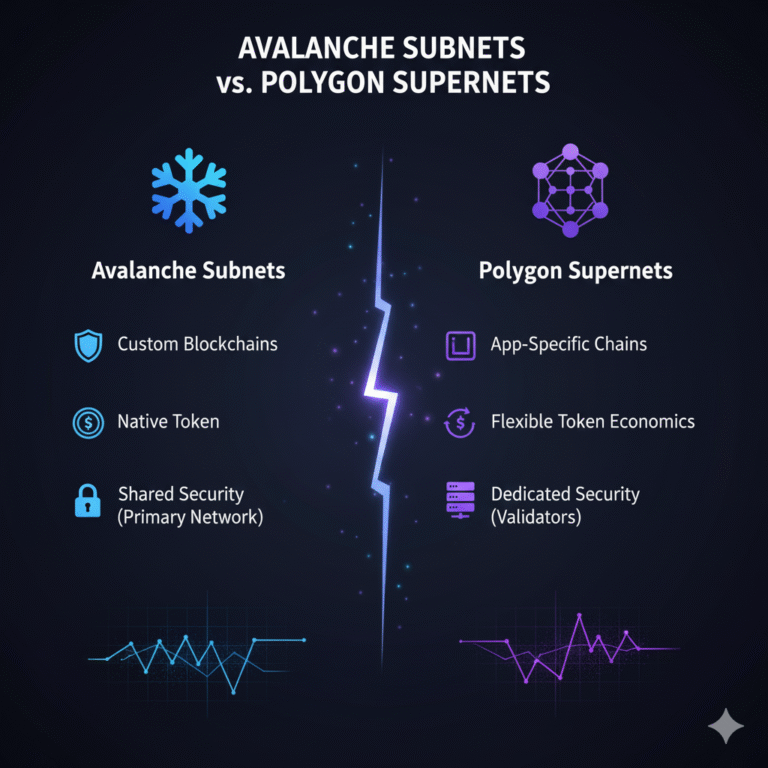
Avalanche Subnets, also known historically as custom L1s within the Avalanche ecosystem, are dynamic groups of validators that work together to secure and process transactions on one or more custom blockchains. Specifically, they build on Avalanche’s architecture of three primary chains: the X-Chain (assets), P-Chain (validators/subnets), and C-Chain (EVM smart contracts). Learn more at Avax.network.

Important Clarification: Since the Etna upgrade, Avalanche now formally distinguishes between “legacy Subnets” and “Avalanche L1s.” Legacy Subnets still require validators to also validate the Primary Network; however, newer Avalanche L1s pay a continuous fee and do not require Primary Network validation. This article uses “Subnets” in the broad sense but notes this change where relevant. For a deeper dive into this evolution, check out our detailed guide on Avalanche L1s (formerly Subnets): Modular DeFi in Action. Additionally, you can find technical details at the Avalanche Developer Hub.

At their core, Subnets allow developers to create sovereign networks with their own rules. For example, you can set custom gas tokens (instead of using AVAX), implement access controls like KYC requirements, or design unique fee structures. Furthermore, each Subnet operates independently but can connect to the broader Avalanche network.

How Avalanche Subnets Work

To join a legacy Subnet as a validator, you must stake at least 2,000 AVAX and validate the Primary Network (X, P, C chains) in addition to the Subnet. Consequently, this ensures security but adds a layer of commitment. For new Avalanche L1s, this Primary Network requirement no longer applies, as noted above. Detailed staking information is available at Avalanche Support.

Subnets use the Snowman family of protocols with Avalanche consensus (proof-of-stake based), which provides probabilistic finality with very low reversal probability when parameters are set appropriately. In other words, the system achieves consensus quickly and reliably. Find architectural documentation at the Avalanche Builder Hub.

Beginners can picture this like a team of guards (validators) agreeing on what’s happening in a secure room (the blockchain). The process is highly configurable: you can choose EVM compatibility for easy smart contract deployment or build custom virtual machines (VMs) in other languages.

Benefits for Beginners

Scalability: Avalanche markets throughput of approximately 4,500+ TPS for its platform; however, actual realized TPS depends on the VM and network configuration of each chain/Subnet. Performance metrics are detailed on Avax.network.

Customization: You can tailor tokenomics, gas tokens, validator requirements, and even your own VM according to your project’s specific needs. This flexibility makes Subnets particularly attractive for specialized use cases.

Security: The system leverages Avalanche’s validator set design; notably, it implements no slashing on the default/primary network (poor performance forfeits rewards rather than stake). As a result, this approach reduces penalties while maintaining network integrity.

For instance, if you’re building a gaming dApp, a Subnet could handle heavy in-game activity without slowing the main network. This separation of concerns ensures optimal performance across all applications.

What Are Polygon Supernets?

Polygon Supernets are application-specific blockchain networks built using Polygon Edge, a modular framework for creating Ethereum-compatible chains. Notably, developers introduced Supernets in April 2022 alongside a $100M ecosystem fund to accelerate adoption. Official information is available at Polygon.technology.

Supernets focus on interconnectivity, allowing seamless communication with Ethereum and other Polygon networks. They come in different flavors: sovereign chains (run by your own validators) and shared security chains (validated by professional operators with POL/MATIC stake). Furthermore, Polygon also offers ZK L2s via Polygon CDK; earlier Supernet materials referenced L2 options as “under development.” To understand how Polygon compares to other major blockchains, read our comprehensive comparison: Ethereum vs Solana vs Polygon: Which Blockchain Wins for DeFi?. Additionally, explore the technical documentation at Polygon Docs.

How Polygon Supernets Work

Supernets use IBFT (PoA/PoS variants), which provides deterministic finality – once a block is finalized, it does not reorganize. In shared security mode, Polygon materials describe validators staking ≥20,000 MATIC (now POL); meanwhile, sovereign Supernets can run with a small validator set for testing. Validator counts on IBFT networks are configurable; however, Polygon’s PoS network itself caps validators at 100, and IBFT performance tends to favor relatively small validator sets. Technical specifications are documented at Polygon Edge Documentation.

Developers typically configure block time on Polygon Edge-based networks around 2 seconds by default (and they can adjust it). Implementation details can be found on GitHub.

Imagine assembling Lego blocks: you pick modules for consensus, data storage, and networking to build a chain that fits your app. Similarly, EVM compatibility means you can deploy Solidity contracts using familiar tools like MetaMask or Hardhat.

Benefits for Beginners

Ease of Use: Certified partners and tooling reduce setup burden, making deployment accessible even for teams with limited blockchain infrastructure experience. Consequently, developers can launch faster with less technical overhead.

Interoperability: Bridges and native Ethereum tooling enable seamless integration with the broader Ethereum ecosystem. For more on cross-chain scalability solutions, see our guide on Understanding ZK Rollups: A Beginner’s Guide to Ethereum’s Scaling Solution.

Cost Efficiency: Supernets offer low fees and fast finality; however, actual TPS depends on configuration and workload rather than a single fixed number. This flexibility allows projects to optimize for their specific requirements.

Real-World Application: Uttarakhand State (India) piloted medical-equipment tracking using a network built with Polygon Edge (the tech behind Supernets). Read about this implementation at Business Standard.

Key Similarities Between Avalanche Subnets and Polygon Supernets

Both solutions enable “app chains” – dedicated blockchains for specific dApps – reducing congestion on shared main chains while offering several common features. In fact, they represent parallel approaches to the same fundamental challenge.

Customization Focus: Both platforms allow you to tune gas tokens, tokenomics, and network rules to meet specific project requirements. This flexibility empowers developers to create truly custom blockchain environments.

EVM Compatibility: Both support Ethereum tooling, making migration and development straightforward for Solidity developers. As a result, teams can leverage existing skills and infrastructure.

Stake-Backed Security: Validators stake native tokens or network-specific stake for security (AVAX/Elastic-Subnet tokens on Avalanche; POL/MATIC-backed professional validators or sovereign sets on Polygon). Therefore, both systems align incentives through economic mechanisms.

Real-World Adoption: Examples include DeFi Kingdoms (DFK Chain) and Crabada on Avalanche Subnets, and SX Network and public-sector pilots on the Polygon Edge/Supernets stack. Documentation for these projects can be found at DeFi Kingdoms Docs and related blockchain analytics platforms like The Tie.

Blockchain-as-a-Service: Tooling abstracts complex setup, making custom blockchain deployment more accessible to projects without deep infrastructure expertise. Consequently, this democratizes access to advanced blockchain technology.

Key Differences: Avalanche Subnets vs Polygon Supernets

Consensus & Finality

Subnets: Avalanche implements consensus (Snowman family) with probabilistic finality (extremely fast, extremely low reorg probability). In practice, this means transactions confirm rapidly while maintaining high security. Technical details at Avalanche Builder Hub.

Supernets: By contrast, IBFT provides deterministic finality, ensuring that once blocks are confirmed, they cannot be reorganized. Specifications at Polygon Edge Documentation.

Validator Model & Requirements

Legacy Subnets: Validators must also validate the Primary Network and stake ≥2,000 AVAX; however, new Avalanche L1s remove that Primary Network requirement (they pay a continuous fee instead). Details at Avalanche Support.

Supernets: Developers can configure validator counts in IBFT, but practice favors smaller sets; Polygon PoS caps validators at 100, which people often cite as an upper bound reference for IBFT-style networks. Additionally, shared security Supernets describe ≥20,000 MATIC/POL per validator. More information at Polygon.technology.

Performance Framing

Avalanche markets approximately 4,500 TPS capability; nevertheless, actual throughput per Subnet/L1 depends on VM/configuration. Fixed “per-Subnet TPS” figures are marketing approximations, not guarantees. For a detailed comparison of blockchain performance metrics, see our analysis: Ethereum vs Solana vs Polygon vs TON: Chain Metrics Compared.

For Supernets, TPS depends on block size/time and workload; therefore, quoting a single “1,500 TPS” figure is not consistently documented in Polygon’s official sources, so treat it as configuration-dependent rather than a hard ceiling. Developers commonly set block time around 2 seconds. Industry analysis available on Medium and Cointelegraph.

Slashing & Incentives

Avalanche (default): The network implements no slashing; instead, misbehavior or downtime forfeits rewards rather than stake. Furthermore, Subnets/L1s can design their own economics according to project needs.

Polygon/IBFT ecosystems: By contrast, projects often adopt slashing or stake-based deterrence aligned with Ethereum-style practices on networks using staking markets.

Interoperability Roadmaps

Both use bridges for cross-chain communication; however, Polygon’s broader stack emphasizes ZK-based L2s via Polygon CDK for cross-ecosystem connectivity (separate from Supernets themselves). For an in-depth exploration of ZK technology, read our complete guide: ZK Rollups Complete Guide 2025: Zero-Knowledge Layer 2 Solutions Explained. Comprehensive information at Polygon Docs.

In short, Subnets/L1s favor raw configurability (including tokenless/private chains) and extremely fast probabilistic finality; meanwhile, Supernets emphasize Ethereum synergy and managed operations with deterministic finality.

Use Cases and Real-World Examples

Avalanche Subnets

DeFi Kingdoms (DFK Chain) uses JEWEL as gas with a documented gas-fee split (50% burned / 25% validators / 25% quest fund); similarly, Crabada’s Swimmer Network recorded average gas fees roughly 1/120th of those on C-Chain, improving user experience. Moreover, enterprises like Deloitte have used Avalanche tech for disaster-relief claims platforms. Case studies available on Medium and DeFi Kingdoms Docs.

Polygon Supernets / Edge

SX Network was an early standalone chain built with Polygon Edge (the foundation for Supernets). Additionally, public-sector pilots like Uttarakhand’s asset-tracking (RFID) leveraged Polygon Edge as well. Project information at Polygon.technology.

These examples show both approaches powering gaming, DeFi, and enterprise/government solutions across diverse industries. Consequently, they demonstrate the versatility of app-chain architecture.

Pros and Cons of Each

Avalanche Subnets / L1s – Pros

  • Developers enjoy high configurability and performance potential (VM choice, custom gas tokens)
  • The platform offers flexibility for private/enterprise use; notably, it implements no slashing by default on the primary network
  • Teams can create fully sovereign blockchains with custom consensus mechanisms

Avalanche Subnets / L1s – Cons

  • Legacy Subnets require Primary Network validation (2,000 AVAX), which adds overhead; however, new Avalanche L1s ease this but add a continuous fee
  • Probabilistic (not deterministic) finality may be a conceptual hurdle for some stakeholders (though developers can tune reorg probability extremely low)

Polygon Supernets – Pros

  • The platform provides deterministic finality (IBFT) and tight Ethereum tooling compatibility
  • Partner support and deployment tooling lower operational burden
  • Projects benefit from strong ecosystem connections to Ethereum and established DeFi protocols

Polygon Supernets – Cons

  • IBFT networks perform best with relatively small validator sets; some view Polygon PoS’s 100-validator cap (often used as a practical reference point) as a decentralization limit
  • Throughput is configuration-dependent; therefore, quoting fixed TPS numbers (e.g., “1,500 TPS”) without context is misleading
  • Bridge Risk (both): Bridging remains a systemic risk; while architecture and validator decentralization help, they don’t eliminate it entirely

Which One Should You Choose?

If you prioritize raw configurability (custom VMs, tokenless/private chains) and ultra-fast probabilistic finality for high-volume apps (e.g., GameFi), then Avalanche Subnets/L1s are compelling. On the other hand, if you want deterministic finality, strong Ethereum tooling, and an easier, partner-supported path, Polygon Supernets fit well.

Consider your team’s expertise: Subnets/L1s suit those comfortable with deeper chain customization; meanwhile, Supernets appeal to Solidity-native teams. Additionally, always evaluate validator set design and operational trust assumptions before making a decision. Understanding these factors will help you choose the right platform for your specific needs.

Conclusion: The Future of Scalable Blockchains

Avalanche Subnets/L1s and Polygon Supernets both represent the shift toward multi-chain worlds, where apps get their own optimized networks. By enabling customization without prohibitive complexity, they empower beginners and experts alike to build scalable dApps. Furthermore, this evolution addresses many of the scalability challenges that have historically limited blockchain adoption.

For the latest specifics (e.g., Avalanche’s Etna changes, Polygon’s CDK rollouts), always consult the official documentation at Avalanche Developers and Polygon Docs – the space moves fast, and staying informed is crucial for success. Additionally, explore our related guides on blockchain comparisons and scaling solutions to deepen your understanding of this rapidly evolving ecosystem.


Key Resources:
Spot Trading vs Futures Trading: What’s the Difference?

0

If you’re new to the world of cryptocurrency trading, you’ve likely come across terms like spot trading and futures trading. These are two fundamental ways to buy and sell digital assets like Bitcoin or Ethereum, but they operate quite differently. Understanding the difference between spot trading and futures trading is crucial for beginners looking to navigate the crypto market safely and effectively. In this article, we’ll break down each type of trading in simple language, highlight their key differences, and provide practical examples to help you decide which might suit your trading style. Whether you’re interested in ETH/USD pairs or general crypto strategies, this guide will equip you with the knowledge to get started.

What is Spot Trading?

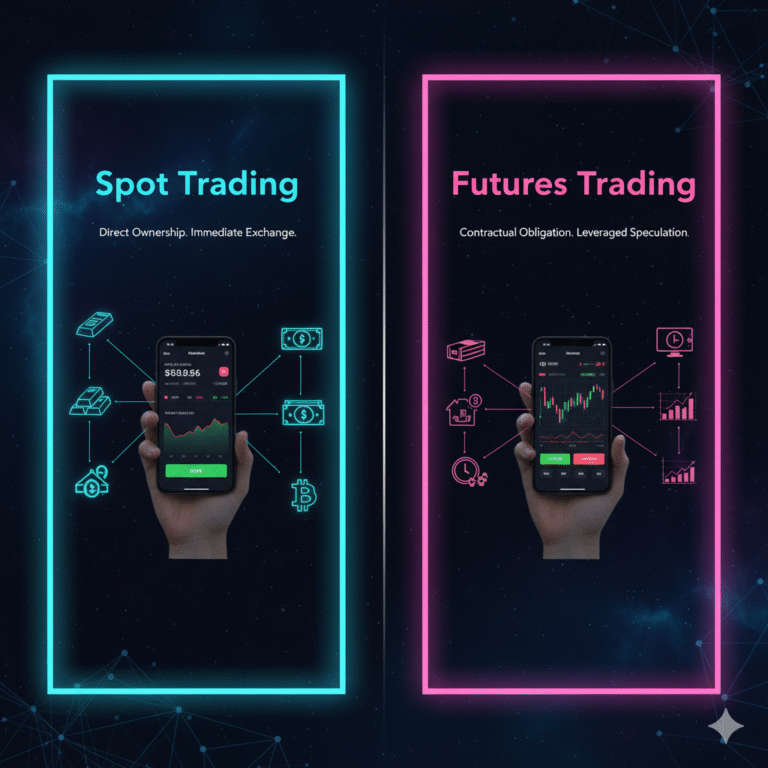
Spot trading is the most straightforward form of trading in the cryptocurrency market. It involves buying or selling an asset at its current market price, with the transaction settling almost immediately. The term “spot” refers to the “on-the-spot” nature of the deal—you pay for and receive the asset right away.

In crypto, spot trading means you’re actually owning the cryptocurrency. For instance, if you buy Bitcoin on a spot market, the BTC is transferred to your wallet or exchange account instantly (or within a short settlement period, usually T+0 on centralized exchanges; note that in traditional securities the U.S. moved to T+1 settlement in May 2024). This is similar to buying goods at a store: you see the price, pay for it, and take it home.

Learn more about spot market fundamentals on Investopedia.

Spot trades occur on exchanges like Binance, Coinbase, or Poloniex, where buyers and sellers match orders in real time. The price is determined by supply and demand, fluctuating constantly based on market conditions. According to the Bank for International Settlements, the overall FX market averaged $7.5 trillion per day in April 2022, but the spot segment itself was about $2.1 trillion/day. View the BIS triennial survey data for detailed market statistics.

How Spot Trading Works in Practice

To execute a spot trade, you typically:

  • Deposit funds (like USD or USDT) into your exchange account. If you’re using Binance, check out our complete step-by-step Binance tutorial for 2025 to learn how to set up your account properly.
  • Select a trading pair, such as ETH/USD.
  • Place a market order to buy or sell at the current price, or a limit order to set your desired price.
  • Once matched, the trade settles, and you own the asset.

For beginners, spot trading is ideal because it doesn’t involve complex contracts or predictions about future prices. However, it requires you to have the full amount of capital upfront. If Ethereum is priced at $3,000, you’ll need $3,000 (plus fees) to buy one ETH. If you’re interested in purchasing Ethereum, our guide on how to buy Ethereum safely in 2025 walks you through the entire process. To learn more about Ethereum’s performance and metrics, explore our article on Ethereum in numbers: key stats and charts every investor should know.

What is Futures Trading?

Futures trading, on the other hand, is more advanced and involves contracts rather than direct asset ownership. A futures contract is an agreement to buy or sell a cryptocurrency at a predetermined price on a specific future date. This allows traders to speculate on price movements without actually holding the underlying asset.

In the crypto world, futures are popular on platforms like Binance Futures or Bybit. Unlike spot trading, futures use leverage, meaning you can control a larger position with a smaller amount of capital. For example, with 10x leverage, a $1,000 deposit could control a $10,000 position. This amplifies both profits and losses. Major venues offer high maximum leverage; for example, Binance lists up to 125x leverage on some pairs.

Futures contracts have expiration dates, after which they settle—either through cash (common for regulated crypto futures like those on CME) or physical delivery (rare). Perpetual futures (no expiration) use funding rates, periodic payments between longs and shorts that help keep the contract price anchored to spot. For a deeper understanding of how perpetual contracts work, read our comprehensive guide on perpetual trading explained simply. Learn more about CME Bitcoin and Ethereum futures and their specifications.

On regulation: in the U.S., the CFTC oversees commodity derivatives (futures, options, swaps), including Bitcoin/Ether futures on registered exchanges; oversight of offshore crypto derivatives varies by jurisdiction.

How Futures Trading Works in Practice

Here’s a basic step-by-step:

  1. Fund your futures account (often separate from spot).
  2. Choose a contract, like BTC/USD perpetual futures.
  3. Decide on long (betting price will rise) or short (betting it will fall).
  4. Apply leverage and set your position size.
  5. Monitor and close the position before or at expiration to realize gains/losses.

Futures are used for hedging (protecting against price drops) or speculation. If you think ETH will rise, you go long; if fall, short. But beware: leverage can lead to liquidation if the market moves against you.

Key Differences Between Spot Trading and Futures Trading

While both involve cryptocurrencies, spot and futures trading differ in several core aspects. Let’s compare them side by side for clarity:

AspectSpot TradingFutures Trading
SettlementImmediate (T+0 or T+1)Future date or perpetual
OwnershipYes, actual asset transferredNo, just a contract
LeverageUsually none (1:1)Yes, up to 100x+ on some venues
Capital RequiredFull value of the assetFraction (margin) due to leverage
Risk LevelLower, limited to invested amountHigher, due to leverage and volatility
Profit OpportunitiesPrimarily in bull markets (long)Bull or bear (long/short)
LiquidityGood, varies by assetOften higher for majors; crypto derivatives comprise the majority of trading volume market-wide
FeesTrading fees onlyTrading fees plus funding rates (for perps)
PurposeHolding or short-term tradingSpeculation, hedging

Important notes:

  • Perpetual futures’ funding payments between longs and shorts are integral to keeping prices near spot. Read more about perpetual futures funding rates on Binance Academy.
  • In crypto, derivatives account for the majority of total trading. According to Kaiko research, derivatives represent over 70% of market share in 2025, with BTC perpetuals comprising approximately 68% of Bitcoin trading volume. This means futures on major pairs often show deeper liquidity than spot.

These differences stem from the fundamental nature of each: spot is about current prices and ownership, while futures focus on future expectations and leverage. For example, in spot trading ETH/USD, you buy ETH at $3,000 and sell later at $3,500 for a $500 profit per ETH. In futures, the same $500 move yields $500 profit per 1-ETH contract—leverage reduces required margin but does not multiply the per-unit price move; it magnifies return on margin and liquidation risk.

Investopedia’s comprehensive guide emphasizes that spot trades are for immediate exposure, while futures suit strategies without direct ownership. In crypto, futures often have better liquidity for pairs like BTC/USDT due to the market’s derivatives dominance.

Pros and Cons of Spot Trading

Pros:

  • Simplicity: Easy to understand—no contracts or expirations.
  • Ownership: You can transfer, stake, or use the crypto (e.g., ETH for DeFi). Once you purchase your cryptocurrency, you’ll need a secure place to store it—check out our guide on the top 10 crypto wallets for beginners in 2025 to find the best wallet for your needs.
  • Lower Risk: No leverage means losses are capped at your investment.
  • No Funding Fees: Unlike futures, no ongoing costs for holding positions.

Cons:

  • Capital Intensive: Need full funds upfront.
  • Limited Profits: Can’t short sell easily; profits mainly from price increases.
  • Market Volatility: Crypto prices can swing wildly, affecting holdings.

For more foundational knowledge, see Investopedia’s guide to spot trading and settlement cycles.

Pros and Cons of Futures Trading

Pros:

  • Leverage: Amplify returns on capital committed (margin).
  • Flexibility: Profit in rising or falling markets.
  • Hedging: Protect spot holdings against downturns.
  • High Liquidity: Easier to enter/exit large positions on major pairs.

Cons:

  • High Risk: Leverage can lead to total loss or liquidation.
  • Complexity: Involves margins, funding rates, and expirations (unless perpetual). If you’re new to perpetual contracts, our beginner’s guide to perpetual futures explains these concepts in detail.
  • Fees: Higher costs from leverage and funding for perps.
  • No Ownership: Can’t use the asset for staking/utility while in the contract.

For detailed explanations of perpetual funding mechanics, visit Binance Academy’s guide to perpetual contracts.

When to Choose Spot Trading vs Futures Trading

Your choice depends on your goals and risk tolerance. Use spot trading if:

  • You’re a long-term holder (HODLer) believing in crypto’s future.
  • You want to own and use the asset (e.g., staking ETH).
  • You’re new and prefer simplicity.

Opt for futures if:

  • You want to speculate on short-term price moves.
  • You’re hedging a portfolio (e.g., short futures to offset spot losses).
  • You have limited capital but want larger exposure (accepting higher risk).

In crypto, many start with spot and later learn futures. Always start small and consider demo/sandbox environments.

Real-World Examples in Crypto Trading

Spot Example: You buy 1 ETH at $3,000 using spot trading. If it rises to $3,500 in a week, you sell for a $500 profit (minus fees). You owned the ETH and could have used it meanwhile.

Futures Example: With a perpetual ETH/USD futures contract at 10x leverage, you post $300 margin to open a 1-ETH long at $3,000 notional. If ETH rises to $3,500, your profit is $500 (same price move per ETH); your return on margin is approximately 167% before fees/funding. If it drops to around $2,700, your unrealized loss is approximately $300 and you approach liquidation (exact price depends on exchange risk parameters and fees). Learn more about leverage trading on Binance.

Hedging: If you hold 10 ETH spot and fear a drop, you can short approximately 10 ETH via futures; a 10% spot loss is partly or fully offset by futures gains. Institutions commonly use cash-settled futures like CME’s crypto derivatives.

Risks and Best Practices for Beginners

Both trading types carry risks due to crypto’s volatility. Spot risks include market crashes; futures add leverage risks and funding costs. Always:

  • Research with reputable primers (e.g., Binance Academy; Investopedia).
  • Use stop-loss orders.
  • Diversify and never invest more than you can lose.
  • Stay updated via reliable news; avoid hype.
  • Remember: In the U.S., derivatives are regulated by the CFTC; globally, crypto rules are uneven, which affects venue safety and recourse.

Conclusion

Spot trading vs futures trading boils down to immediate ownership versus future speculation. Spot is simple and ownership-focused, perfect for beginners building a portfolio. Futures offer leverage and flexibility but come with higher risks, suiting active traders. By understanding these differences, you can make informed decisions in the crypto space, whether trading ETH/USD or other pairs. Remember, education is key—start with spot, experiment with futures demos, and always trade responsibly.


Related Resources:

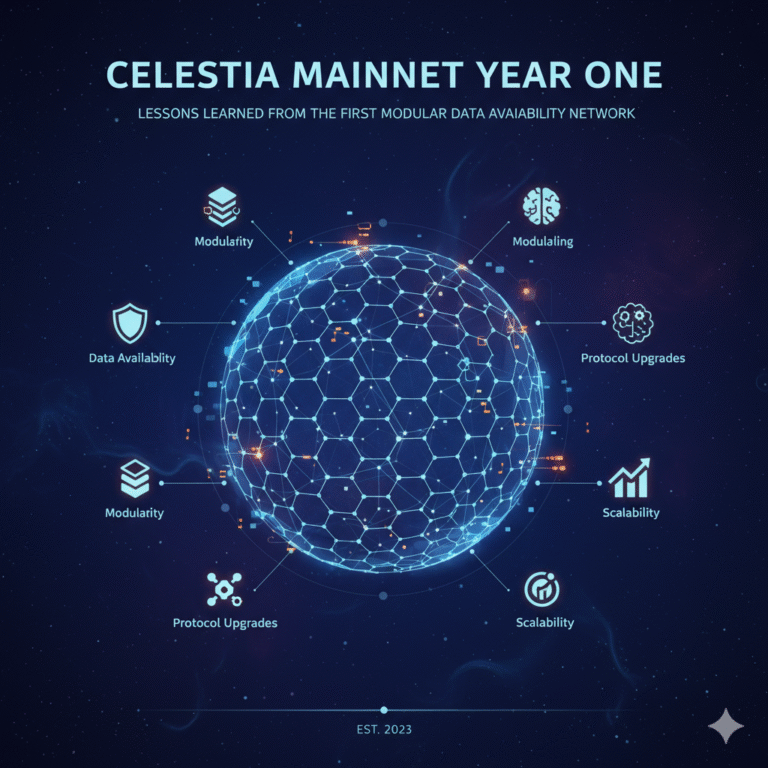
Celestia Mainnet Year One: Lessons Learned from the First Modular Data Availability Network

Celestia Mainnet launched on October 31, 2023. This marked a pivotal moment in blockchain technology. As the first modular data availability (DA) network, it aimed to solve key scaling challenges. The project achieved this by separating data availability from execution and consensus.

This approach allows developers to build custom blockchains more easily. Moreover, it eliminates the overhead of traditional monolithic designs like Ethereum or Solana. In simple terms, think of Celestia as the “data highway.” It ensures transaction information is always accessible and verifiable. As a result, this enables faster, cheaper, and more flexible applications.

One year later, Celestia has grown significantly. The network now hosts over 20 rollups deployed across various sectors. Additionally, more than 200 GB of data was published to the network during 2024. Furthermore, the network captured approximately 40% of total data published in the modular space. This achievement was recorded around September 2024, according to Celestia’s official roadmap post.

This article explores the lessons learned from Celestia Mainnet’s first year. Consequently, we’ll draw from official announcements, community insights, and performance data. To understand how Celestia compares to other solutions, check out our comprehensive comparison of modular blockchains including Celestia, Monad, and EigenLayer.

The Launch: Setting Expectations for a Modular Future

Celestia’s Mainnet Beta, codenamed Lemon Mint, went live at 14:00 UTC on October 31, 2023. This was announced on the official Celestia blog. The launch followed years of development. It all started from the 2019 LazyLedger whitepaper. This document envisioned a blockchain focused solely on data availability and consensus.

Unlike traditional blockchains, Celestia uses a different approach. Traditional chains handle everything in one layer (monolithic architecture). In contrast, Celestia decouples these functions. Therefore, this makes it easier for anyone to deploy their own blockchain.

At launch, the team emphasized three core goals. First, they prioritized verifiability through secure light nodes. Second, they focused on collaboration across the ecosystem. Third, they aimed for abundant blockspace. Additionally, the launch included an airdrop of TIA tokens. Approximately 580,000 eligible wallets received tokens. These rewards went to early contributors from Ethereum rollups, Cosmos stakers, and open-source developers.

Expectations were tempered as an experimental beta. The team warned of potential instability. Furthermore, they encouraged community involvement through staking TIA or running light nodes. This set the stage for a collaborative ecosystem. For instance, events like Modular Summit attracted thousands. Attendees discussed rollups and zero-knowledge proofs.

Engineering Achievements: Scaling Through Innovation

Celestia’s first year showcased remarkable engineering progress. Indeed, it proved the viability of modular blockchain design through several major milestones.

Data Availability Sampling: A Breakthrough Technology

One major milestone was implementing Data Availability Sampling (DAS). Celestia became the first live blockchain to do so. DAS allows light nodes to verify data availability efficiently. Specifically, nodes sample small portions rather than downloading everything.

Imagine checking a book’s availability in a library. Instead of reading the whole book, you read random pages to confirm it’s there. Similarly, this enables scalability without sacrificing security. As a result, light nodes can run even in browsers or wallets. The official Celestia documentation provides more details.

This innovation relates closely to Ethereum’s scaling efforts. To learn more about data availability solutions, read our article on the future of Ethereum sharding, Danksharding, and EIP-4844.

Network Upgrades and Performance Improvements

Major upgrades transformed the network’s capabilities. For example, Lemongrass was the first consensus upgrade. Later, Ginger arrived in late 2024. Together, these upgrades halved block times. Specifically, they reduced times from approximately 12 seconds to 6 seconds. Moreover, they doubled DA throughput.

Meanwhile, Shwap optimizations delivered impressive results. They reduced storage needs approximately 16.5×. Additionally, they sped up sampling roughly 12×. The Mammoth Mini testnet achieved even more. It reached approximately 27 MB/s throughput. This represents roughly 160× improvement over launch conditions.

These achievements pave the way toward 1 GB blocks. This goal is explicitly featured on the public roadmap. Notably, similar modular approaches are being explored elsewhere. For instance, learn about Avalanche L1s (formerly Subnets) and modular DeFi in action.

Blobstream: Bridging to Ethereum

Blobstream represents another major innovation. It was re-architected with zero-knowledge proving. Specifically, it uses Succinct’s SP1 zkVM. Consequently, Blobstream integrates Celestia with Ethereum rollups. These include Arbitrum Orbit and Base.

For beginners, this means Celestia acts as a bridge. Ethereum applications can use cheaper data availability. Furthermore, they don’t need to migrate entirely. This was reported by The Block. To understand more about Ethereum Layer 2 solutions, explore our complete guide to Arbitrum in 2025.

These advancements highlight a key lesson. Modular architectures can iterate faster than monolithic ones. Changes in one layer (like DA) don’t disrupt others.

Ecosystem Growth: From Hype to Real Adoption

Celestia’s ecosystem expanded significantly in year one. Over 20 rollups deployed across various sectors. These include DeFi, NFTs, gaming, and social applications. Notable projects emerged across the landscape.

Movement builds Move-VM rollups. By default, these use Celestia DA. More details are on The Movement Network. Eclipse operates as an Ethereum L2. It uses SVM with Celestia DA. Initia developed interwoven rollups. These leverage Celestia DA effectively. Payy focuses on private payments. It also adopts Celestia technology.

Meanwhile, Astria emerged as a decentralized shared sequencing layer. Details are available at astria.org.

Sovereign Rollups: A New Paradigm

Sovereign rollups emerged as a standout innovation. They outsource DA to Celestia. However, they handle their own execution and settlement. This gives developers full control. Think of it like customizing a car while using a shared engine.

For example, projects like Forma use TIA for gas. They also price NFTs in this model. The Modular Summit drew thousands of attendees. It fostered discussions on chain abstraction and MEV. Overall, data posted to Celestia surpassed 200 GB during 2024. This demonstrates genuine network usage.

The lesson is clear. Targeted airdrops and community incentives drive engagement. However, tying them to utility helps sustain long-term growth. These include staking or governance participation.

Challenges: Navigating Volatility and Community Concerns

No first year is without hurdles. Celestia faced significant challenges. Nevertheless, these tested the project’s resilience and transparency.

Market Volatility and Price Performance

TIA experienced significant price movement. Specifically, it saw a drawdown of over 90%. This occurred from its all-time high of approximately $20.85. Mid-2025 lows reached around $1.3–$1.6. These figures were reported by CoinGecko and other trackers.

This happened amid broader market volatility. Additionally, public allegations emerged about insider and off-market sales. Co-founder Mustafa Al-Bassam publicly addressed the controversy. He cited a $100M+ treasury. Furthermore, he mentioned an approximately 6-year runway. He dismissed the allegations as FUD.

Regardless of the drama, the network operated without disruptions. This was covered by The Block.

Inflation and Governance Debates

Inflation became a significant discussion point. TIA launched with approximately 8% annual inflation. This was designed to decay toward 1.5%. Later, governance changes modified the structure.

For instance, the Lotus upgrade (CIP-29) reduced the then-current rate. It dropped to approximately 5%. This is according to Binance research. Further proposals followed. Matcha (CIP-41) aimed to lower it further. The debated Proof-of-Governance (PoG) went even further.

A 2.5% target was discussed publicly. Meanwhile, PoG concepts proposed rates as low as 0.25%. These details are outlined in Celestia’s governance documentation.

Competition intensified from other projects. EigenLayer, Avail, and others highlighted the need for differentiation. A crucial lesson emerged. In crypto, price volatility is common. However, focusing on infrastructure metrics sustains long-term resilience. These metrics include upgrades, throughput, and uptime.

Key Lessons Learned: Building for Sustainability

Modularity Accelerates Innovation

By focusing on data availability, Celestia enabled rapid ecosystem growth. Rather than claiming a fixed market share, the project reports real data. Celestia publicly cited approximately 40% of total data published. This was around September 2024. Moreover, the network has often led DA usage on various days thereafter.

Other networks are exploring similar approaches. For example, NEAR Protocol solved the sharding challenge through its own innovative methods.

Community and Incentives Matter

Multi-phase airdrops rewarded genuine contributors. Approximately 580,000 eligible wallets received tokens. This is documented in Celestia’s airdrop overview. However, balancing fairness with market sustainability proved crucial. Excessive sell pressure needed to be avoided.

Resilience Through Governance

Proposals demonstrated protocol evolution. For instance, Lotus/Matcha focused on issuance reduction. Meanwhile, the debated PoG showed community engagement. These demonstrate how protocols can evolve amid challenges. Community governance plays a vital role. More details are available on the Celestia blog.

Data Abundance is Key

Data posted exceeded 200 GB during 2024. This shows real network usage. However, addressing fragmentation remains important. Solutions like Lazybridging could unlock additional value. These would benefit the entire ecosystem.

Transparency Builds Trust

Publicly addressing controversies helped maintain focus. This includes the “insider sales” allegations. The approach helped maintain community focus on fundamentals. Even so, debates continued in some circles.

Future Outlook: Toward 1GB Blocks and Beyond

Looking ahead, ambitious goals define the roadmap. Celestia’s roadmap targets 1 GB blocks. This aims for “internet-scale” adoption. Consequently, this would enable on-chain games and AI models.

Native ZK verification for bridging represents another key goal. Lazybridging would reduce fragmentation across rollups. With over $3.2B staked, the network shows strong fundamentals. Additionally, a high staking ratio as of end-2024 indicates community commitment. Therefore, the network is positioned for continued growth.

The vision includes “light nodes on every device.” It also supports very large numbers of rollups. However, specific aspirational figures remain rhetorical. These aren’t firm commitments in official documentation yet.

Conclusion: A Testament to Modular Blockchain Potential

Celestia Mainnet’s first year demonstrated important principles. Specifically, it showed the viability of modular blockchain architecture. Despite challenges, the network achieved significant milestones. These include market volatility, governance debates, and competitive pressures.

Nevertheless, the network’s achievements stand out. Engineering innovation progressed rapidly. Ecosystem adoption grew substantially. Moreover, community resilience proved strong. These offer valuable lessons for the broader blockchain industry.

For newcomers entering the crypto space, Celestia illustrates key concepts. Breaking down complex systems into specialized layers creates opportunities. This leads to broader innovation and accessibility. The project’s focus on abundant, verifiable blockspace continues to matter.

Indeed, this paves the way for a more scalable Web3 ecosystem. Celestia proves that modular design isn’t just theoretical. Instead, it’s practical, functional, and increasingly essential. As blockchain technology evolves, this approach will likely shape the future.

External Resources:

StarkNet Roadmap 2025: A Comprehensive Guide to the Future of Layer 2 Scaling

In the rapidly evolving blockchain ecosystem, StarkNet has emerged as a leading Layer 2 (L2) scaling solution. Moreover, it enhances Ethereum’s capabilities while maintaining robust security and minimal transaction costs. As we progress through 2025, the StarkNet roadmap reveals ambitious plans. Specifically, these center on decentralization, Bitcoin integration, performance optimization, and ecosystem expansion. Therefore, this comprehensive guide examines the key components of the StarkNet Roadmap 2025. Additionally, it provides accessible explanations for newcomers while delivering expert-level insights drawn from official sources.

What is StarkNet? Understanding the Fundamentals

StarkNet, developed by StarkWare, leverages STARK (Scalable Transparent ARgument of Knowledge) proofs. Essentially, these are advanced zero-knowledge cryptographic technology tools. They process transactions off-chain before settling them securely on the Ethereum mainnet. Consequently, this architectural approach enables massive scalability improvements. Furthermore, it does so without compromising the security guarantees that make blockchain technology trustworthy.

For those new to this technology, understanding ZK-rollups as Ethereum’s scaling solution is essential. In fact, StarkNet represents one of the most sophisticated implementations of zero-knowledge technology in production today.

Building upon significant achievements from 2024, StarkNet continues pushing boundaries. For instance, the network reduced fees for simple transfers from approximately $1 to $0.001. Similarly, it demonstrated throughput capabilities of sustained 127 transactions per second (TPS). Notably, peak performance reached 857 TPS during the October 2024 Flippy Flop stress test. Overall, these improvements showcase what Layer 2 solutions can accomplish in terms of scalability and cost efficiency.

Learn more about StarkNet’s technology: Official StarkNet Website

Strategic Priorities for StarkNet in 2025

The overarching vision for StarkNet Roadmap 2025 centers on creating a better network. Specifically, it aims to be faster, more affordable, stronger, and increasingly decentralized. Meanwhile, official announcements from the StarkNet Foundation outline four primary strategic priorities.

Bitcoin Integration and BTCFi Innovation

StarkNet’s expansion into Bitcoin represents one of the most significant developments in the 2025 roadmap. In particular, the network launched “BTCFi on StarkNet” in September 2025. This introduced trustless BTC staking methods backed by 100 million STRK token rewards. Although full settlement on Bitcoin remains an ongoing development effort, several concrete implementations are already working.

Understanding the key differences between these networks is crucial. Indeed, Bitcoin vs Ethereum comparisons reveal why bridging these systems creates unique opportunities.

Broly Protocol enables trust-minimized Bitcoin inscriptions directly from StarkNet wallets. As a result, users don’t need to hold BTC independently. Therefore, this lowers the barrier to entry for Bitcoin-based applications significantly.

Asset Runes provide Bitcoin-native assets offering 1:1 exposure to tokens such as USDC on Bitcoin. Additionally, reserves are locked on StarkNet. Subsequently, these assets are already tradable through platforms like DotSwap.

Lombard LBTC Integration brings liquid Bitcoin staking capabilities to StarkNet. Furthermore, LBTC serves as a productive Bitcoin asset. Consequently, it can be deployed across DeFi protocols while maintaining exposure to Bitcoin’s value.

Custom Bitcoin Bridge development is underway according to 2025 ecosystem updates. Moreover, it works alongside Hyperlane’s StarkNet integration to facilitate seamless asset transfers.

For those new to cryptocurrency, consider this analogy. Bitcoin functions like digital gold—highly valuable but traditionally difficult to utilize in everyday applications. However, StarkNet transforms Bitcoin into a productive asset. In other words, it’s similar to earning interest on gold holdings without giving up custody.

Explore Bitcoin integration: StarkNet BTCFi Announcement

Advancing Network Decentralization

Decentralization stands as a cornerstone priority for the 2025 roadmap. Notably, StarkNet achieved Vitalik Buterin’s “Stage 1” decentralization status in 2025. At the same time, the Security Council became operational, representing a significant milestone in trustless network evolution. Moving forward, the ongoing goal targets “Stage 2” full decentralization through three strategic initiatives.

Protocol Governance: STRK token holders exercise governance authority through voting on network proposals. Specifically, the StarkNet Security Council V1.0 comprises 12 members. It began operations under StarkNet Improvement Proposals (SNIPs) in November 2024. As a result, this provides an additional security layer while maintaining community oversight.

Sequencer Evolution: The transaction sequencer orders network transactions. Currently, it is transitioning toward a distributed and permissionless model. Initially, Staking Phase 1 launched in November 2024. It requires a minimum of 20,000 STRK for validators. By the end of 2024, over 100 million STRK tokens had been staked by the community. Subsequently, expansion continues through 2025 via additional staking phases. Importantly, Phase 3 targets Q3-Q4 2025 to introduce decentralized validation methods. These are outlined in community SNIPs such as SNIP-33.

Ecosystem Empowerment: Open-source infrastructure and permissionless staking capabilities empower developers and network participants. Consequently, this fosters innovation while distributing network control.

Think of centralized systems as having a single traffic controller managing all intersections. In contrast, decentralization distributes this responsibility across multiple participants. Therefore, it creates resilience against failures and censorship while eliminating single points of failure.

Read more about decentralization progress: StarkNet Decentralization Roadmap Community discussions: Starknet Community Forum

Enhancing Adoption and Accessibility

StarkNet prioritizes improving both user experience (UX) and developer experience (DevX). As a result, this accelerates ecosystem adoption. In particular, key initiatives include several important developments.

EVM Wallet Compatibility: RosettaNet and Cartridge are community-driven projects rolling out throughout 2025. Essentially, they enable StarkNet to feel like an Ethereum Virtual Machine (EVM) chain. Therefore, users of popular wallets like MetaMask and Rabby benefit from this. Moreover, Cartridge already provides social login capabilities and EVM wallet access pathways. Consequently, this significantly lowers technical barriers for mainstream users.

Web2-Style Onboarding: Applications like FocusTree demonstrate Web2 user experience combined with Web3 security. Impressively, they successfully onboarded between 100,000 to 500,000 users according to various 2025 reports. Thus, this represents a critical step toward mass adoption. Furthermore, it eliminates the steep learning curve traditionally linked with blockchain applications.

Cross-Chain Connectivity: Hyperlane integration went live in 2025. As a result, it enables StarkNet connectivity to over 140 chains. For example, projects like Daydreams successfully deployed a Solana↔StarkNet DREAMS bridge. Hence, this demonstrates practical cross-chain functionality.

Those comparing different ZK-rollup implementations will find StarkNet’s approach particularly developer-friendly. Indeed, the network balances technical sophistication with accessibility.

Explore ecosystem applications: StarkNet Ecosystem

Performance Optimization and Security Enhancement

Continuous technical improvements ensure StarkNet remains competitive in the rapidly evolving Layer 2 landscape. Specifically, several key developments drive this progress.

Version Updates: The v0.14.0 deployment timeline was updated by the community. Initially, testnet launched on July 7, 2025. Subsequently, mainnet deployment followed on September 1, 2025.

Advanced Proving Technology: The S-two (Stwo) prover represents StarkWare’s next-generation proving system. Notably, it’s designed for faster and more cost-effective proof generation. Furthermore, this prover achieved record-breaking performance metrics. Ultimately, it aims to enable client-side proving on everyday consumer devices. Therefore, this democratizes network participation significantly.

Fee Market and Mempool Enhancements: These improvements were introduced progressively across 2024-2025. Consequently, they reduce transaction costs and optimize transaction handling. Additionally, specific user experience enhancements are tied to version rollouts.

Speed Targets: Sub-second user experience and shorter block times feature prominently in 2025 “Grinta” roadmap messaging. In particular, these represent targets connected to specific technical upgrades.

Consider this automotive analogy. These optimizations function like upgrading a vehicle’s engine for better fuel efficiency and speed. As a result, StarkNet can handle significantly more transactions (passengers) without increasing operational costs.

For a detailed comparison of how StarkNet stacks up against competitors, explore zkSync vs StarkNet analysis. Indeed, both networks offer unique advantages in the ZK-rollup space.

Technical documentation: StarkWare Research

2025 Milestone Timeline and Upcoming Features

Q2 2025 Deliverables

EVM Wallet Compatibility: RosettaNet and Cartridge implementations provide MetaMask and Rabby users with familiar interfaces. Therefore, this reduces friction for Ethereum-native users transitioning to StarkNet.

Hyperlane Integration: This integration is already operational. Moreover, it connects StarkNet to 140+ blockchain networks. For instance, practical implementations like the Daydreams Solana bridge demonstrate real-world utility.

Bitcoin Bridge Development: This infrastructure is referenced in ecosystem communications with tentative deployment timelines. Meanwhile, custom Bitcoin bridging continues progressing through development phases.

Explore integration updates: StarkNet Blog

Q3 2025 and Beyond

Interoperability Projects: Two major cross-chain initiatives are under development according to community communications. Additionally, emerging Solana↔StarkNet bridge implementations include the Daydreams DREAMS bridge via Hyperlane.

IBC Protocol Work: Collaboration with Informal Systems on Inter-Blockchain Communication (IBC) protocol integration exists at the testnet level. As of mid-2025, it connects StarkNet Sepolia with Osmosis testnet. However, mainnet deployment remains forthcoming.

Privacy Enhancements: Advanced privacy features remain on the technical roadmap. Specifically, they build upon StarkNet’s zero-knowledge foundation to provide enhanced transaction confidentiality.

Gaming and AI Applications: The Realms: Eternum gaming platform shipped new seasons in 2025. Furthermore, ecosystem reports cite over 1,000 AI agents operating within the platform. These figures come from project and media sources.

Track development progress: StarkNet GitHub

Thriving Ecosystem and Strategic Partnerships

StarkNet’s ecosystem experienced substantial growth entering 2025. In particular, notable trends emerged across gaming, stablecoin integration, and artificial intelligence applications.

Gaming Sector: Projects like POW and Realms: Eternum showcase blockchain gaming capabilities with mainstream appeal. Consequently, they onboard thousands of users through intuitive interfaces.

Stablecoin Infrastructure: Multiple stablecoin providers are integrating with StarkNet. As a result, this provides essential liquidity for DeFi applications.

Strategic Partnerships: Collaborations with Lombard (LBTC), Hyperlane, and various Bitcoin infrastructure providers strengthen capabilities. Therefore, they enhance StarkNet’s cross-chain functionality and asset diversity.

AI Integration: Emerging applications leverage StarkNet’s computational efficiency for AI-powered decentralized applications. Indeed, this represents a frontier in blockchain utility.

Discover ecosystem projects: StarkNet Community

Why the StarkNet Roadmap 2025 Matters for the Future of Blockchain

The StarkNet Roadmap 2025 positions the network as a frontrunner in Layer 2 scaling solutions. Specifically, it uniquely combines Ethereum’s battle-tested security with Bitcoin’s unmatched liquidity and value proposition. Through strategic focus on decentralization, Bitcoin DeFi (BTCFi), and user-centric technical improvements, StarkNet attracts diverse users. Therefore, both mainstream users seeking affordable, fast crypto experiences and sophisticated developers building next-generation decentralized applications find value here.

For cryptocurrency newcomers, StarkNet’s 2025 developments translate to tangible benefits. These include significantly cheaper transaction costs, faster confirmation times, and more intuitive user interfaces. Moreover, these interfaces rival traditional web applications. For blockchain experts and developers, the network offers robust infrastructure. Additionally, it provides cutting-edge zero-knowledge technology and expanding tooling for building sophisticated decentralized systems.

As StarkNet continues evolving toward its full decentralization target, progress remains steady. Although this aspiration is actively progressing, it is not yet fully achieved. Nevertheless, the network demonstrates consistent advancement toward delivering a secure, scalable, and truly decentralized future. Ultimately, this future encompasses all of blockchain technology. Whether you’re staking STRK tokens, building decentralized applications, or simply exploring blockchain technology, 2025 promises transformative developments. Indeed, these could reshape how we interact with digital assets and decentralized systems.

Stay informed through official channels: Official StarkNet Website Join the community: StarkNet Twitter/X Technical resources: StarkNet Documentation


This article is based on official StarkNet Foundation announcements and community governance proposals (SNIPs). Additionally, it includes verified ecosystem developments as of October 2025. Readers should monitor official StarkNet channels for the latest updates. Meanwhile, the roadmap continues evolving with new developments emerging regularly.

zkSync Era: Latest Updates and Adoption Trends in 2025

In the fast-evolving world of blockchain technology, zkSync Era stands out as a powerful solution for scaling Ethereum. As a Layer 2 protocol using zero-knowledge rollups, it makes transactions faster, cheaper, and more secure. It does this without compromising Ethereum’s core strengths.

Across the broader Elastic Network that zkSync anchors, the team reports $4B+ TVL secured and 700M+ transactions processed. However, on zkSync Era specifically, DeFiLlama shows roughly $40-50M DeFi TVL as of October 20, 2025. Meanwhile, L2BEAT tracks approximately $1.0B in Total Value Secured (TVS).

This article explores recent updates, adoption metrics, and why zkSync Era is becoming a go-to choice. Whether you’re new to crypto or a seasoned enthusiast, we’ll break it down in simple terms while highlighting key facts.

What is zkSync Era? A Beginner-Friendly Overview

Imagine Ethereum as a busy highway during rush hour. It’s reliable but often slow and expensive due to high traffic. zkSync Era acts like a high-speed express lane built on top of it. It’s a Layer 2 scaling solution that bundles multiple transactions into one “rollup.” It uses zero-knowledge proofs (ZK proofs) to verify them efficiently on Ethereum’s main network.

Zero-knowledge proofs are like magic tricks in cryptography. They prove something is true without revealing the details. For example, zkSync can confirm a batch of 1,000 transactions is valid. Ethereum doesn’t need to check each one individually. This reduces gas fees to fractions of a cent. It speeds up processing to seconds, compared to minutes or hours on the main chain.

Understanding how ZK rollups work is key to appreciating zkSync Era’s innovation. Launched by Matter Labs, zkSync Era went live in 2023 as an EVM-compatible platform. This means it works seamlessly with Ethereum’s tools and smart contracts. Developers can build decentralized apps (dApps) using familiar languages like Solidity. Users enjoy features like gasless transactions via paymasters—where apps cover fees for you. It’s part of the broader “Elastic Network,” a collection of interconnected chains. These chains emphasize privacy, compliance, and high performance.

For beginners, think of it this way: If Ethereum is the secure foundation of a house, zkSync Era is the efficient upper floors where most activity happens. This setup is crucial for real-world adoption. It matters especially in areas like decentralized finance (DeFi), gaming, and tokenized assets.

Key Recent Updates in zkSync Era

zkSync Era has seen a flurry of upgrades in late 2024 and 2025. The focus has been on speed, security, and institutional appeal. These aren’t just technical tweaks. They’re designed to make the network ready for massive scale.

Atlas Upgrade: Boosting Performance to New Heights

In October 2025, zkSync announced the Atlas upgrade to its ZK Stack framework. Official materials describe a high-performance sequencer and approximately 1-second ZK finality. Reported throughput ranges from 15,000 to 30,000 TPS, though figures vary by source.

Why does this matter? For users, it means smoother experiences in high-demand apps like trading platforms. For developers, it supports enterprise-grade chains with better interoperability. The upgrade builds on zkSync’s goal of creating a “network of sovereign chains” secured by cryptography. This paves the way for global economic applications.

Airbender: The World’s Fastest RISC-V Prover

Introduced publicly in mid-2025, Airbender is zkSync’s open-source zkVM prover. It’s designed for sub-second proof generation using commodity GPUs. The team describes proof costs as “a fraction of a cent.” By October 2025, zkSync materials highlight near real-time settlement to Ethereum. This reinforces use cases like cross-border payments and high-frequency trading.

Prividium: Privacy-Focused Infrastructure for Institutions

Prividium is presented by zkSync as an Ethereum-secured platform for private, compliant blockchains. It’s aimed at banks and enterprises. The latest design and public materials emphasize selective disclosure and policy controls. This aligns with the institutional push for blockchain adoption.

A concrete example: Memento’s collaboration with Deutsche Bank to build a ZK Chain for asset tokenization. The partnership focuses on fund management using zkSync technology. It has been publicly discussed as part of the broader Project Guardian efforts.

Network Upgrade and Hard Fork in October 2025

Exchanges including Binance announced temporary suspensions for deposits and withdrawals. This was for a zkSync Era network upgrade and hard fork scheduled for October 22, 2025. Earlier 2025 governance items included the V28 precompile upgrade in June 2025. There was also a Protocol Defense ZIP in December 2024. These are documented in zkSync forums and documentation.

Other notable updates include compiler and interpreter work. The EVM Interpreter (v27) added EVM bytecode equivalence on testnets in April 2025. V28 delivered new precompiles to reduce gas for on-chain cryptography. These improvements enhance the developer experience significantly.

zkSync Era Adoption: Metrics and Real-World Impact

Adoption is where zkSync Era truly shines in 2025. From institutional integrations to community growth, the numbers tell a compelling story. For a broader perspective on Layer 2 solutions in 2025, zkSync Era stands among the leading networks.

Impressive Metrics

Network scope versus Era-only: zkSync public pages cite $4B+ TVL secured and 700M+ transactions across the Elastic Network. Meanwhile, zkSync Era’s DeFi TVL is approximately $44M. Its TVS is approximately $1.0B as of October 20, 2025.

Real-world asset (RWA) adoption: Cointelegraph reported $214.8M in institutional funds as part of RWA activity on zkSync. Multiple sources, including RWA trackers and press releases, attribute $1.7B-$2B+ of tokenized private credit to Tradable. This supports the institutional adoption narrative.

Ecosystem revenue and operator payments: Messari’s “State of zkSync” reports cover fee and revenue dynamics into 2025. They provide independent analytics on the network’s economic activity.

Partnerships and Use Cases

Chainlink Integration: Matter Labs joined Chainlink SCALE and integrated CCIP. This enables cross-chain apps and oracle data across ZK Stack chains. The integration brings reliable, tamper-proof data feeds to zkSync Era applications.

Enterprise Adopters: Tradable publicly disclosed $1.7B tokenized, with later coverage citing “a couple of billion.” Deutsche Bank’s Memento ZK Chain has been highlighted in media and partner write-ups. These partnerships demonstrate growing institutional confidence in zkSync technology.

Gaming and Interoperability Chains: XPLA’s Creator Chain and zkXPLA align with the Elastic Network via ZK Stack. zkCandy’s mainnet launch in April 2025 brought gaming-focused infrastructure to the ecosystem. This showcases the versatility of zkSync’s technology.

Data and Oracles for RWAs: RedStone and other oracle providers support real-world asset integration on zkSync Era. They provide the price feeds and data necessary for tokenized securities and commodities.

Aggregators: Rubic has zkSync integrations and ongoing multi-chain aggregation. This makes it easier for users to access zkSync Era’s liquidity.

Benefits for Beginners and Experts Alike

For newcomers, zkSync Era lowers entry barriers with features like passkeys (passwordless logins) and session keys. It also offers paymasters for gasless participation. These user-friendly features make blockchain technology more accessible to mainstream users.

Experts appreciate its EVM-native support, open-source code with audits, and bug bounties up to $1M+. Programs like HackerOne facilitate these security initiatives. A real April 2025 incident involving a compromised admin key was disclosed transparently. Funds were recovered. This demonstrates the team’s commitment to security and accountability.

When comparing zkSync vs competitors like StarkNet, zkSync’s ZK focus offers strong privacy guarantees and fast finality. This is particularly attractive for regulated sectors like finance and healthcare. It also competes favorably with solutions like Optimism and Arbitrum.

Challenges and Future Outlook

No technology is perfect. zkSync faces competition from other Layer 2 solutions. It must navigate token price volatility. ZK token weakness in early 2025 has been widely reported. However, the network continues to develop regardless of market conditions.

Hardware dependencies for proofs and integration complexities remain hurdles. Updates like Airbender and the Atlas stack address them. The 2025 governance track also includes V28 and V29 upgrades. Work toward the ZKsync Gateway is underway.

Vitalik Buterin’s broader push for ZK efficiency and improved metrics is a live theme across the Ethereum ecosystem. It aligns with zkSync’s direction. This reinforces the importance of zero-knowledge technology for Ethereum’s future.

By 2026, expect broader RWA adoption and AI integrations. This will solidify zkSync Era as a cornerstone of Ethereum’s scalability strategy.

Why zkSync Era Matters in 2025

zkSync Era isn’t just another Layer 2. It’s a bridge to blockchain’s mainstream future. With updates like Atlas and Airbender driving performance, adoption is soaring. This includes RWAs (Tradable, Memento/Deutsche Bank), Chainlink CCIP/SCALE integration, and gaming chains (zkCandy, XPLA, Creator Chain). It’s empowering everything from DeFi to institutional finance.

For beginners, it’s an accessible entry to crypto with user-friendly features and low costs. For experts, it’s a robust tool for innovation with strong privacy guarantees and enterprise-grade performance.

As Ethereum evolves, zkSync Era’s focus on privacy, speed, and compliance positions it for explosive growth. The key is understanding the distinction between network-wide Elastic statistics and Era-only TVL/TVS metrics. Once you grasp that, the story becomes even more compelling.


Key Resources:

What Is Crypto Trading? A Complete Beginner’s Guide

0

In the fast-paced world of finance, crypto trading has emerged as one of the most exciting and accessible ways for individuals to engage with digital assets. If you’re new to this space, you might wonder: what exactly is crypto trading, and how can you get started without feeling overwhelmed? This comprehensive beginner’s guide will break it down step by step, using simple language to explain key concepts while drawing on established facts from the cryptocurrency ecosystem. Whether you’re curious about buying Bitcoin or exploring Ethereum futures, we’ll cover the essentials to help you build a solid foundation.

Crypto trading involves buying and selling cryptocurrencies like Bitcoin (BTC), Ethereum (ETH), or Solana (SOL) on specialized platforms called exchanges. Unlike traditional stock trading, crypto markets operate 24/7, offering global accessibility but also higher volatility. According to data from CoinMarketCap, the total cryptocurrency market capitalization has grown from under $1 trillion for most of 2020 to well over $3.8 trillion in 2025, highlighting its mainstream adoption. This guide is designed for absolute beginners, so we’ll avoid jargon where possible and provide real-world examples to illustrate points.

By the end of this article, you’ll understand the basics of crypto trading, how to choose an exchange, key strategies, and common pitfalls. Let’s dive in.

Understanding Cryptocurrencies: The Foundation of Crypto Trading

Before jumping into trading, it’s crucial to grasp what cryptocurrencies are. Cryptocurrencies are digital or virtual currencies secured by cryptography, making them nearly impossible to counterfeit or double-spend. They operate on decentralized networks based on blockchain technology—a distributed ledger that records all transactions across a network of computers.

Bitcoin, created in 2009 by the pseudonymous Satoshi Nakamoto, was the first cryptocurrency. It serves as digital gold, with a fixed supply of 21 million coins. Ethereum, launched in 2015, introduced smart contracts—self-executing contracts with terms directly written into code—enabling decentralized applications (dApps) like decentralized finance (DeFi) platforms.

Other popular cryptos include stablecoins like Tether (USDT), which are pegged to fiat currencies like the US dollar to minimize volatility, and altcoins such as Ripple (XRP) for cross-border payments. As of 2025, there are over 10,000 cryptocurrencies listed on platforms like CoinGecko, but only a handful dominate the market.

Why does this matter for trading? Knowing the fundamentals helps you evaluate an asset’s value. For instance, Bitcoin’s price is influenced by factors like institutional adoption (e.g., Tesla’s past investments) and regulatory news, while Ethereum’s value ties to upgrades like its shift to proof-of-stake in 2022, reducing energy consumption by about 99.95%. Understanding how crypto regulation works globally is essential for traders navigating this evolving landscape.

What Is Crypto Trading? Breaking It Down

Crypto trading is the act of speculating on cryptocurrency price movements to make a profit. Traders buy low and sell high, or vice versa in short-selling scenarios. It’s similar to forex trading (e.g., trading EUR/USD) but with digital assets.

At its core, crypto trading relies on supply and demand. Prices fluctuate based on market sentiment, news events, and economic indicators. For example, if a major company announces support for a crypto payment system, demand might surge, driving up the price.

Unlike holding (or “HODLing” in crypto slang), trading involves active buying and selling. You can trade on centralized exchanges (CEXs) like Binance or Coinbase, which act as intermediaries, or decentralized exchanges (DEXs) like Uniswap, where trades occur peer-to-peer via smart contracts. If you’re interested in learning more about decentralized trading, check out our complete guide to Uniswap and token swapping on Ethereum.

Crypto trading isn’t gambling—successful traders use analysis and strategies. However, it’s high-risk; the market’s volatility means prices can swing 10–20% in a day, as seen during the 2022 crypto winter when Bitcoin dropped from its $69,000 peak to under $20,000.

Types of Crypto Trading: Which One Suits You?

Spot Trading: This is the most straightforward type where you buy and own cryptocurrencies outright. You purchase Bitcoin at the current market price (spot price) and can hold it indefinitely or sell it later. Perfect for beginners who want actual ownership of their digital assets. If you’re ready to start, learn how to buy Ethereum safely in 2025.

Futures Trading: Here, you trade contracts that speculate on future prices without owning the underlying asset. Futures allow traders to profit from both rising and falling markets but involve higher risk due to leverage. Platforms like Binance Futures and CME Group offer these products.

Options Trading: Similar to futures but with more flexibility, options give you the right (not obligation) to buy or sell at a predetermined price. This advanced strategy requires deeper market knowledge.

Margin Trading: Borrowing funds to amplify your position size. While potential profits multiply, so do losses. Margin trading is only recommended for experienced traders who understand liquidation risks.

Day Trading and Scalping: Day trading involves opening and closing positions within the same day to capitalize on short-term price movements. Scalping takes this further with dozens of trades targeting tiny profits. Both require constant market monitoring and quick decision-making.

Choosing a type depends on your risk tolerance and time commitment. Start with spot trading to learn the ropes.

How Crypto Trading Works: Step-by-Step Process

Research and Analysis: Before entering any trade, conduct thorough research. Analyze the cryptocurrency’s fundamentals (technology, team, use case), check recent news, and study price charts. Use resources like CoinDesk for news and TradingView for technical analysis.

Place an Order: Choose your order type based on strategy. Market orders execute immediately at current prices. Limit orders let you set your desired buy/sell price. Stop-loss orders automatically sell when prices hit a certain level to limit losses.

Execute the Trade: Once your order parameters are set, submit it through your exchange. The platform matches buyers with sellers, and your trade executes when conditions are met.

Monitor and Exit: Track your position’s performance and adjust as needed. Set clear profit targets and stick to your exit strategy, whether that’s a predetermined price level or percentage gain.

Fees include trading fees (usually 0.1–0.5% per transaction) and withdrawal fees—always factor these into your calculations. Network fees (gas fees on Ethereum) also apply when moving funds between wallets.

Choosing the Right Crypto Exchange

Selecting the right platform is one of the most important decisions for new traders. Popular choices include Coinbase, Binance, Kraken, and DEXs like Uniswap. For a comprehensive comparison tailored to beginners, see our guide to the top 10 crypto exchanges for beginners in 2025.

Look for exchanges with proper Know Your Customer (KYC) procedures, security features like two-factor authentication (2FA), and proof-of-reserves transparency. The collapse of FTX in 2022 highlighted the critical need to avoid storing large amounts of funds on exchanges long term.

Key factors when selecting an exchange:

  • Security: Cold storage for most funds, insurance coverage, and no history of major hacks
  • Liquidity: Higher trading volumes mean better prices and faster execution
  • Fees: Compare maker/taker fees across platforms
  • Supported Assets: Ensure your desired cryptocurrencies are available
  • Regulation: Choose licensed exchanges in your jurisdiction
  • User Interface: Intuitive platforms reduce costly mistakes

Consider using hardware wallets like Ledger or Trezor for long-term storage rather than keeping all funds on exchanges. For detailed wallet recommendations, explore our guide to the top 10 crypto wallets in 2025.

Setting Up Your Trading Account

Sign Up and Complete KYC: Create an account on your chosen exchange and verify your identity. Most regulated platforms require government-issued ID, proof of address, and sometimes a selfie for verification. This process typically takes 24–48 hours.

Fund Your Account: Deposit funds via bank transfer, debit/credit card, or cryptocurrency transfer from another wallet. Bank transfers usually offer the lowest fees but take longer, while card deposits are instant but cost more.

Enable Security Features: Activate 2FA using apps like Google Authenticator or Authy. Set up withdrawal allowlists to restrict where funds can be sent. Consider email and SMS notifications for all account activity.

Start Small: Begin with a modest amount you can afford to lose. Practice with demo accounts if available, or make small test trades to familiarize yourself with the platform’s interface before committing significant capital.

Essential Analysis Tools for Beginners

Technical Analysis (TA)

This involves studying price charts and patterns to predict future movements. Common indicators include:

  • Moving Averages: Track average prices over specific periods to identify trends
  • Relative Strength Index (RSI): Measures momentum to spot overbought or oversold conditions
  • Candlestick Patterns: Visual representations showing opening, closing, high, and low prices

Platforms like TradingView offer comprehensive charting tools with thousands of indicators. CoinMarketCap provides free basic charts for quick analysis.

Fundamental Analysis (FA)

Evaluate the intrinsic value of cryptocurrencies by examining:

  • Whitepapers: Read the project’s technical documentation on their official website
  • Adoption Metrics: Track active addresses, transaction volumes, and developer activity on Glassnode or Messari
  • News and Events: Follow announcements about partnerships, upgrades, and regulatory developments
  • ETF Approvals: Institutional products like Bitcoin ETFs signal growing mainstream acceptance

Combining both technical and fundamental analysis improves decision-making. TA helps time entries and exits, while FA ensures you’re trading quality assets with long-term potential.

Risk Management: Protecting Your Capital

Crypto trading can be profitable, but 70–80% of retail traders lose money according to industry estimates. Mitigate risks with these strategies:

Diversification: Don’t put all capital into one cryptocurrency. Spread investments across different assets, sectors (DeFi, NFTs, Layer-1 blockchains), and even some stablecoins for stability.

Position Sizing: Never risk more than 1–2% of your total capital on a single trade. This ensures that even a string of losses won’t wipe out your account.

Stop-Loss Orders: Automatically exit positions when prices move against you. Set stop-losses at logical levels based on support/resistance or a fixed percentage (typically 5–10% below entry).

Emotional Control: Avoid FOMO (fear of missing out) and panic selling. Stick to your trading plan regardless of market hysteria. Successful traders remain disciplined even during extreme volatility.

DYOR (Do Your Own Research): Never rely solely on influencers, friends, or headlines—verify fundamentals and sources yourself before entering a position. Check official project websites, GitHub repositories, and verified social media accounts.

Example: If you have $1,000, risk $20 on a trade with a stop-loss 10% below entry. If the stop-loss triggers, you lose only $20 rather than suffering a catastrophic account blow-up.

Common Mistakes Beginners Make

Overleveraging: Using excessive margin amplifies losses. Many beginners get liquidated because they don’t understand leverage mechanics. Start without leverage until you’re consistently profitable.

Ignoring Fees: Transaction costs add up quickly, especially for frequent traders. Calculate how much you need to profit just to break even after fees.

Chasing Hype: Jumping into cryptocurrencies based on social media buzz without research usually leads to buying at peaks and selling at bottoms.

Neglecting Security: Weak passwords, no 2FA, and falling for phishing scams result in permanent loss of funds. Bookmark your exchange’s official URL and never click links in unsolicited emails. Storing your assets properly is crucial—learn more about secure crypto wallet options.

No Exit Strategy: Entering trades without predetermined profit targets and stop-losses turns trading into gambling. Always know when you’ll exit before opening a position.

Overtrading: Making too many trades increases fees and often stems from emotional decision-making rather than analysis.

In the United States, the IRS treats cryptocurrency as property for tax purposes. Short-term capital gains (assets held less than one year) are taxed at ordinary income rates, while long-term gains benefit from lower capital gains rates. Every trade—even crypto-to-crypto swaps—is a taxable event.

In the European Union, the Markets in Crypto-Assets (MiCA) regulation began phased application in 2024–2025, establishing comprehensive rules for crypto service providers and stablecoin issuers. Check the European Commission’s official guidance for updates. For a comprehensive overview of how different countries approach crypto regulation, read our detailed guide on crypto regulation in 2025.

Other jurisdictions have varying approaches:

  • UK: HMRC taxes crypto gains over the annual exemption
  • Australia: ATO treats crypto as a CGT asset
  • Singapore: Generally tax-friendly with no capital gains tax for long-term holders
  • Canada: CRA treats crypto as a commodity for tax purposes

Always report your trades and maintain detailed records of all transactions including dates, amounts, prices, and fees. Use crypto tax software like CoinTracker or Koinly to simplify reporting. Consult a tax professional familiar with cryptocurrency regulations in your jurisdiction.

Your Next Steps in Crypto Trading

Crypto trading offers significant opportunities but demands continuous education and caution. Start by learning from reputable sources like Investopedia’s crypto section, CoinDesk, and official exchange educational resources. Practice with demo accounts or paper trading before risking real money.

Never invest more than you can afford to lose. The crypto market’s 24/7 nature and extreme volatility can test even experienced traders’ discipline. As the market evolves with trends like Web3, layer-2 scaling solutions, and real-world asset tokenization, staying informed is critical.

Begin by choosing a reliable platform from our list of beginner-friendly crypto exchanges, securing your assets with a trusted wallet solution, and understanding the regulatory landscape that governs your trading activities.

Remember, patience pays dividends. While Warren Buffett’s traditional investment advice applies to crypto, the space has its own golden rule: DYOR before every trade, regardless of market mood or hype. Take time to understand the technology, verify information from multiple reliable sources, and make informed decisions based on analysis rather than emotion.

Start small, learn continuously, manage risk rigorously, and gradually build your expertise. The crypto trading journey rewards those who approach it with respect, preparation, and a commitment to ongoing education.

Optimism Superchain: The Ecosystem Play – Scaling Ethereum for the Future

In the fast-evolving world of blockchain technology, Ethereum stands as a powerhouse for decentralized applications (dApps). However, its popularity has led to challenges like high transaction fees and slow processing times. Enter the Optimism Superchain – an innovative network designed to address these issues by creating a unified ecosystem of Layer 2 (L2) chains. This article explores what the Optimism Superchain is, how it works, its key features, and why it’s becoming a game-changer for developers, users, and the broader crypto community.

What is the Optimism Superchain?

The Optimism Superchain is a network of interconnected Layer 2 blockchain networks built on top of Ethereum. Layer 2 solutions, or L2s, are essentially add-ons to the main Ethereum blockchain (known as Layer 1 or L1) that handle transactions more efficiently off the main chain, reducing congestion and costs. Unlike traditional multi-chain setups where each chain operates in isolation, the Superchain standardizes these L2s so they can work together seamlessly.

At its core, the Superchain uses the OP Stack – an open-source, modular toolkit developed by the Optimism team. This stack allows anyone to build and deploy their own L2 chain that plugs into the broader network. Think of it like building blocks: each chain is a custom creation, but they all fit together perfectly because they’re made from the same set.

As of late 2025, the Superchain/OP-Stack family prominently includes OP Mainnet (Optimism’s original chain), Base (built by Coinbase), Zora, Mode, Blast, and newer additions like Soneium. Mantle also runs on a customized OP Stack–based architecture.

For beginners: Imagine Ethereum as a busy highway during rush hour. L2s like those in the Superchain are express lanes that offload traffic, making everything faster and cheaper. The “ecosystem play” refers to how this setup fosters collaboration, turning isolated roads into a connected interstate system.

How Does the Optimism Superchain Work?

Transaction Processing

Users interact with dApps on an L2 chain. Transactions are bundled (or “rolled up”) and submitted to Ethereum for final verification. This keeps the main chain secure while handling most work off-chain. To understand how Optimism delivers fast and cheap Ethereum transactions, it’s essential to grasp this rollup mechanism.

Optimistic Mechanism

Transactions are assumed valid by default (hence “optimistic”). There’s a challenge period where anyone can dispute suspicious activity. If no issues arise, the bundle is confirmed on Ethereum. This balances speed and security without constant checks. This approach differs from other scaling solutions, as explained in our guide on how Ethereum Layer 2 works.

Shared Infrastructure

All chains in the Superchain use the OP Stack, which includes tools for bridging, governance, and upgrades. This standardization means developers can build once and deploy across the network.

Interoperability Layer

A key feature under rollout is the Superchain interoperability protocol (Upgrade 16), which enables standardized cross-chain messaging and bridging governed by the Optimism Collective. Until it’s fully deployed across all chains, apps often rely on existing bridging and messaging solutions.

Recent upgrades, like Bedrock, reduced costs via better data compression and set the path for faster deposits. Permissionless fault proofs were activated on June 10, 2024 on OP Mainnet, bringing the OP Stack to Stage 1 decentralization per the L2BEAT framework. Other OP-Stack chains including Base, Mode, and Zora have been rolling out fault proofs as well.

Analogy: Picture a group of friends sharing a group chat (the communication layer) and a shared toolbox (OP Stack). Each friend can build their own project, but everything integrates effortlessly.

Key Features of the Optimism Superchain

Scalability

By distributing load across multiple chains, the Superchain achieves high throughput at low fees. L2 fees are typically a few cents and can drop lower at times, especially after Dencun/EIP-4844 upgrades.

Interoperability

Chains aren’t silos; a native Superchain interop protocol (including a Superchain bridge and message-passing) is being standardized. A SuperchainERC20 burn-and-mint template exists in this design space, already used by some OP-Stack chains like Unichain.

Modularity

The OP Stack is like Lego – customizable for specific needs, such as DeFi-focused chains or gaming networks. Developers can tailor their chains to their specific use cases while maintaining compatibility with the broader ecosystem.

Security Sharing

OP-Stack chains inherit Ethereum security, and with permissionless fault proofs, withdrawals can be proven without trusted parties.

Developer-Friendly Tools

Rollup-as-a-service and builder programs (such as Base’s Builder Rewards) simplify launching and growing new chains and applications.

Participating Chains in the Superchain Ecosystem

The Superchain’s strength lies in its growing family of chains, each contributing to the ecosystem. The Layer 2 wars of 2025 showcase the competitive landscape where these chains operate.

OP Mainnet: The flagship chain. Various analyses estimate that Optimism’s upgrades have saved users billions in fees over time.

Base: Developed by Coinbase and focused on a low-cost, developer-friendly on-chain economy. In 2025, Base introduced Flashblocks (effective ~200ms sub-blocks), significantly improving user experience, and announced a Solana bridge, deepening cross-ecosystem connectivity. Learn more in our complete guide to Base by Coinbase.

Zora: Aimed at NFTs and creative content, built on the OP Stack.

Mode: A modular DeFi L2 within the Superchain ecosystem, available at superchain.eco.

Blast: An OP-Stack chain listed among OP-Stack ecosystems.

Soneium: Sony’s L2 built on the OP Stack and formally welcomed to the Superchain.

Mantle: Runs on a customized OP-Stack-Bedrock architecture with EigenDA and SP1/OP Succinct.

OP Stack adoption has expanded rapidly, with ecosystem trackers like Messari counting over 30 OP-Stack chains by mid-2025, with more committing to the vision. In the Superchain, member chains share a standardized revenue split with the Optimism Collective (greater of 2.5% of gross revenue or 15% of net on-chain profit), funding public goods and shared infrastructure.

Benefits for Users and Developers

For Users

Lower Costs: L2 fees are commonly cents per transaction, and can be lower depending on load and chain parameters. This represents a significant improvement over mainnet Ethereum gas fees, as detailed in our Layer 2 solutions comparison guide.

Fast User Experience: OP-Stack chains target approximately 2-second block times. Some chains, such as Base with Flashblocks, offer much faster effective confirmations for UI responsiveness.

Growing Interoperability: Native Superchain interoperability is being standardized. Until full rollout, bridging and messaging often uses established solutions like Hop Protocol and Across Protocol.

For Developers

Build Once, Deploy Broadly: Standardized stack and toolchains across OP-Stack chains streamline development.

Grants and Incentives: Retroactive Public Goods Funding (Retro Funding) continues evolving. In the second half of 2025, the Season 8 framework and Superchain-wide grants mechanics were active under the Optimism Collective.

Community Programs: Examples include Base’s community-voted Builder Rewards, such as 2 ETH per week initiatives to top builders in 2025.

This positive-sum approach means one chain’s success lifts the whole network.

Governance and Funding in the Superchain

Governance is decentralized through the Optimism Collective. Superchain member chains commit a fee split back to the Collective treasury — typically the greater of 2.5% of revenue or 15% of net on-chain profit — under the Standard Rollup/Blockspace Charters (sometimes referenced collectively as the “Law of Chains”). Base publicly adopted this model in 2023, and Optimism documents now treat the fee split as the Superchain standard. The Superchain Registry catalogs member chains and configurations.

Challenges and Future Outlook

While promising, the Superchain is still evolving. Liquidity fragmentation remains a hurdle. The Superchain interoperability upgrade set (bridge, message-passing, SuperchainERC20) is designed to mitigate this and is rolling out across devnets, testnets, and into production over time. Until then, apps continue to use proven bridging and messaging where needed.

Looking ahead, the Superchain envisions “internet-level scale” — supporting billions of users with seamless, Ethereum-aligned experiences. With ongoing expansions (including new OP-Stack chains like Soneium) and endorsements across the ecosystem, it’s poised to drive mass adoption in DeFi, gaming, and beyond.

Conclusion

The Optimism Superchain represents a strategic ecosystem play for Ethereum’s future. By uniting L2 chains under a shared framework, it tackles scalability head-on while fostering innovation. For beginners, it’s a gateway to affordable blockchain. For experts, it’s a blueprint for decentralized progress. As the network grows, stay updated via official sources like optimism.io and the Optimism documentation.


Related Resources:

What is Arbitrum Orbit? A Beginner’s Guide to Building Custom Chains on Ethereum

What is Arbitrum Orbit? A Beginner’s Guide to Building Custom Chains on Ethereum

In the fast-evolving world of blockchain technology, scalability remains one of the biggest challenges for Ethereum, the leading smart contract platform. As more users and applications flock to Ethereum, the network often faces congestion, leading to high transaction fees and slower processing times. This is where layer-2 (L2) solutions like Arbitrum come into play, offering ways to offload some of the heavy lifting from Ethereum’s main layer-1 (L1) network. Among Arbitrum’s innovative tools is Arbitrum Orbit, a framework that empowers developers to create their own custom chains.

If you’re new to blockchain or just dipping your toes into Ethereum scaling solutions, this article will break down Arbitrum Orbit and custom chains in simple terms. We’ll explore what it is, how it works, its benefits, customization options, and real-world examples—all based on verified information from official sources. By the end, you’ll understand why Arbitrum Orbit is gaining traction for building performant, tailored blockchains. Let’s dive in.

Understanding the Basics: What is Arbitrum Orbit?

Imagine Ethereum as a busy highway where everyone competes for space, causing traffic jams. Arbitrum Orbit is like creating your own dedicated lane or even a separate road that connects back to the main highway. Officially, Arbitrum Orbit is a permissionless framework that allows developers to launch their own customizable chains using the Arbitrum Nitro technology stack. This stack includes features like interactive fraud proofs for security, advanced data compression to reduce costs, and compatibility with the Ethereum Virtual Machine (EVM), plus extensions via Stylus for languages like Rust.

At its core, Arbitrum Orbit enables the creation of “Arbitrum chains,” which can act as L2 chains settling directly to Ethereum or L3 chains settling to another L2 like Arbitrum One. Unlike public chains like Arbitrum One, which are governed by the Arbitrum DAO, Orbit chains give you full control over governance, allowing you to own and decentralize your chain as needed. This means you can tailor the chain to specific use cases, whether for a single application, multiple apps, or an entire ecosystem.

For beginners, think of it this way: Traditional blockchains are one-size-fits-all, but Orbit lets you build a blockchain that’s as unique as your project. It addresses Ethereum’s congestion by offloading transactions to a dedicated network of nodes, providing dedicated throughput without competing for space on the main network.

Learn more at the official Arbitrum website and Arbitrum documentation.

How Does Arbitrum Orbit Work?

Arbitrum Orbit builds on Arbitrum’s optimistic rollup technology, where transactions are processed off-chain and then batched and posted back to Ethereum for final settlement. This reduces costs and increases speed while inheriting Ethereum’s security. Understanding how rollups differ from sidechains is crucial when evaluating whether Orbit chains are right for your project.

The key innovation is the Nitro stack, which powers Orbit chains. It ensures EVM+ compatibility, meaning your chain supports standard Ethereum smart contracts plus additional features like Stylus’ WebAssembly (WASM) virtual machine for faster execution in non-EVM languages. Orbit chains also benefit from ongoing Arbitrum upgrades (e.g., the BoLD dispute protocol that enables permissionless validation once activated), without needing to fork the code.

Orbit chains can settle to Ethereum L1 or other L2s, promoting a multi-chain ecosystem. Data availability is configurable: Orbit supports (1) Rollup mode posting data to the parent chain (and ultimately Ethereum), (2) AnyTrust using a Data Availability Committee (DAC), and (3) Celestia as an external DA option.

In simple terms, launching an Orbit chain involves configuring the Nitro software to your specs, deploying it via the official Orbit deployment portal, and connecting it to the Arbitrum ecosystem. This setup allows for high performance, with block times marketed as low as ~250 milliseconds.

Note on interoperability: Developers can integrate third-party bridges/routers, but native Orbit-to-Orbit bridging isn’t built-in (you route via the parent chain). Understanding cross-chain liquidity solutions like LayerZero, Wormhole, and Synapse becomes important when planning your chain’s connectivity strategy.

Explore technical details in the Arbitrum Orbit documentation.

Types of Orbit Chains: Rollup vs. AnyTrust

When building with Arbitrum Orbit, you have two main chain types to choose from, each suited to different needs.

Rollup Chains

These post all transaction data directly to the parent chain (like Ethereum or Arbitrum One), ensuring maximum security and decentralization. They’re ideal for high-value applications like decentralized finance (DeFi) where trustlessness is paramount (you can also enable blob-based posting). Costs are higher because of L1 data requirements. If you’re interested in how different Layer-2 solutions work, understanding the tradeoffs between security and cost is essential.

AnyTrust Chains

Designed for high-volume, low-cost scenarios, AnyTrust uses a Data Availability Committee to store data off-chain, relying on a mild trust assumption—commonly explained as “at least 2 honest members” out of the committee (e.g., 2 of 20). This reduces fees significantly, making it attractive for gaming or social apps with frequent transactions. (Historical note: Reddit’s Community Points previously ran on Arbitrum Nova, an AnyTrust chain, before Reddit sunset the program in October 2023.)

Choosing between them depends on your priorities: Rollup for ultimate security, AnyTrust for efficiency and affordability.

Read more about chain types at Arbitrum Docs and Medium.

Key Benefits of Arbitrum Orbit for Custom Chains

Dedicated Throughput and Performance

Your chain gets its own resources, avoiding congestion from other users. Arbitrum markets industry-leading performance with ~250ms block times. This performance advantage is particularly notable when comparing Arbitrum to other Layer-2 solutions like Optimism and Base in the current competitive landscape.

Customization and Autonomy

Tailor governance and economics. Orbit supports custom gas tokens on AnyTrust chains (and on Rollup chains with specific constraints such as BoLD enabled and exchange-rate “pricer” configuration). This flexibility allows projects to create economic models that align with their specific needs, whether that’s using native project tokens for gas or integrating stablecoins.

Interoperability and Ecosystem Access

Leverage Arbitrum tooling, plus partner bridges/routers. Just remember: no native Orbit-to-Orbit bridge; you usually route via the parent chain. For projects requiring seamless cross-chain communication, exploring various cross-chain liquidity protocols becomes essential.

Security Inherited from Ethereum

Optimistic fraud proofs settle disputes on L1; BoLD upgrades unlock permissionless validation for Arbitrum chains, ensuring your custom chain maintains the security guarantees that make Ethereum Layer-2 solutions trustworthy and battle-tested.

Cost Efficiency

Lower fees than L1, with further savings in AnyTrust mode; DA options now include Celestia. The ability to choose between different data availability solutions means you can optimize costs based on your application’s specific requirements.

Visit the Arbitrum Foundation website for ecosystem information.

Customization Options: Making Your Chain Unique

One of Orbit’s standout features is its flexibility. You can customize parameters and, if needed, the State Transition Function by modifying the Nitro code (advanced).

Deployment Configuration

In the official deployment portal you set chain ID, name, challenge period, gas token, stake token, base stake, and owner. These configuration options give you unprecedented control over your blockchain’s fundamental parameters.

Gas and Tokens

  • AnyTrust: You can use a custom ERC-20 for gas if it meets requirements (e.g., 18 decimals; no rebasing/transfer fees; native deployment on the parent chain).
  • Rollup: Custom gas tokens are supported for L2s posting to Ethereum with BoLD enabled; you must configure a fee-token pricer to reimburse the batch poster for L1 costs.

Data Availability

Choose Rollup (L1), AnyTrust (DAC), or Celestia. AnyTrust lets the chain owner select the DAC membership, providing a middle ground between fully trustless rollups and more efficient but trust-minimized solutions.

Performance Tweaks

Arbitrum documents ~250ms block times and discusses considerations below ~100ms. Use Timeboost and related features carefully to optimize performance for your specific use case.

Interop caveat (again): Cross-Orbit messaging isn’t native yet; plan bridging via the parent chain or a third-party solution.

Configure your chain at the Arbitrum Orbit Portal.

Step-by-Step Guide to Launching an Orbit Chain

Prepare Your Wallet

Use the Arbitrum Sepolia testnet (bridge Sepolia → Arbitrum Sepolia; faucets available at the Arbitrum Bridge). Testing on Sepolia allows you to experiment with configurations without risking real assets.

Access the Deployment Portal

Visit orbit.arbitrum.io and connect your wallet to configure and deploy base contracts. The portal provides a user-friendly interface that simplifies the deployment process.

Configure Parameters

Set chain ID, name, challenge period, tokens, etc. For production, use a secure owner (e.g., multisig wallet from Safe). Security should be your top priority when deploying production chains.

Deploy Contracts & Run Nodes

Submit via the portal (your wallet pays L2 gas). If you’re modifying the STF, build custom Nitro images and run nodes with your configuration. The deployment process is streamlined but requires careful attention to security best practices.

Fraud Proofs / Validation

Track and adopt BoLD as it’s rolled out to enable permissionless validation on your chain. This ensures your chain maintains decentralization and security guarantees.

For production launches, many teams use RaaS (Rollup-as-a-Service) providers like QuickNode, Caldera, Conduit, and Gelato listed by Arbitrum. These providers handle infrastructure management, allowing teams to focus on their applications.

Follow the complete guide at Arbitrum Docs.

Real-World Use Cases and Examples

Arbitrum highlights multiple Orbit-powered projects across categories, demonstrating the versatility of the framework:

Gaming

Xai and Proof of Play’s Pirate Nation demonstrate how Orbit enables high-throughput gaming experiences with dedicated blockchain infrastructure. Gaming applications require high transaction volumes and low latency, making Orbit’s performance characteristics particularly attractive.

Social/Consumer

Blackbird leverages Orbit for restaurant loyalty and payments, showcasing real-world blockchain applications beyond traditional crypto use cases. This demonstrates how Orbit can power consumer-facing applications with mainstream appeal.

AI and DePIN

Capx and Huddle01 utilize Orbit’s infrastructure for decentralized AI and physical infrastructure networks. These emerging sectors benefit from dedicated chains that can be optimized for their specific computational and economic requirements.

NFTs and Creators

RARI Chain creates a royalties-centric environment for digital creators, addressing one of the most contentious issues in the NFT space. By running on Orbit, RARI Chain can implement custom logic for creator royalties without being constrained by general-purpose chain limitations.

Ecosystem/Identity

Galxe operates Gravity Alpha mainnet on Orbit infrastructure, powering Web3 identity and credential solutions. Identity applications require high performance and customizable governance, making Orbit an ideal choice.

(Historical Context) Reddit’s Community Points ran on Arbitrum Nova (AnyTrust) before the program was sunset in October 2023, demonstrating early adoption of AnyTrust technology for high-volume social applications.

Discover more projects at Arbitrum.io, CoinMarketCap, and The Block.

The Future of Arbitrum Orbit and Custom Chains

As blockchain adoption grows, tools like Orbit will drive a multi-chain future where projects have sovereign, scalable infrastructure. Upcoming and ongoing upgrades—Stylus (MultiVM) and BoLD (permissionless validation)—expand performance and decentralization capabilities. The Arbitrum Foundation also operates funding programs for ecosystem growth, supporting developers building on Orbit.

In the broader context of Ethereum’s Layer-2 scaling race between Arbitrum, Optimism, and Base, Arbitrum Orbit represents a unique approach that empowers developers to create their own scaling solutions while remaining connected to the Arbitrum ecosystem. This positions Arbitrum not just as a single Layer-2 solution, but as an entire framework for building customized blockchain infrastructure.

The introduction of Stylus enables developers to write smart contracts in languages like Rust and C++, dramatically expanding the developer base beyond Solidity experts. Meanwhile, BoLD (Bounded Liquidity Delay) will enable truly permissionless validation, allowing anyone to challenge invalid state transitions without needing permission from the Arbitrum DAO.

In summary, Arbitrum Orbit democratizes chain creation, making it accessible for beginners while offering expert-level customization. Whether you’re building a game, social app, or DeFi protocol, it provides the tools to scale securely on Ethereum. If you’re ready to start, head to the official docs and portal—your custom chain awaits.


External Resources

How Base by Coinbase Scales Ethereum: A Beginner’s Guide to Layer 2 Blockchain Solutions

In the world of cryptocurrencies, Ethereum stands out as a powerhouse for decentralized applications, smart contracts, and digital assets. However, as its popularity has grown, so have its challenges—high transaction fees and slow processing times during peak usage. This is where scaling solutions come in, and one of the most prominent is Base, developed by Coinbase.

Base is an Ethereum Layer 2 network designed to make transactions faster and cheaper while maintaining the security of the main Ethereum blockchain. Coinbase launched it in 2023, with its public mainnet going live on August 9, 2023. Base has quickly become a key player in addressing Ethereum’s scalability issues. It helps onboard millions of new users into the crypto space.

This comprehensive guide explores how Base works to scale Ethereum. We’ll break down complex concepts into simple terms. We’ll use everyday examples to make it accessible for beginners. Whether you’re new to blockchain technology or curious about Layer 2 solutions, you’ll learn the fundamentals without getting lost in technical jargon. By the end, you’ll understand why Base is a game-changer for Ethereum’s future and the broader cryptocurrency ecosystem.

Why Does Ethereum Need Scaling Solutions?

Ethereum’s Core Functionality

Ethereum, often called the “world computer,” allows anyone to build and run applications without a central authority. It processes everything from simple token transfers to complex DeFi (decentralized finance) protocols. But with millions of users worldwide, the network can get congested. Think of it like a busy highway during rush hour.

Transactions pile up. This leads to high “gas fees”—the costs users pay to miners or validators to process them. Wait times can stretch from seconds to minutes or even hours.

The Technical Limitations

The root issue lies in Ethereum’s fundamental design. Every node in the network must verify and store every transaction to ensure security and decentralization. This architecture limits the blockchain to approximately 15-30 transactions per second (TPS). Global payment systems like Visa process thousands of TPS—far more than Ethereum currently handles.

Upgrades like the 2022 shift to Proof-of-Stake (The Merge) improved energy efficiency. However, they didn’t fully solve the scalability challenge. Developers needed a better solution.

Enter Layer 2 Solutions

To scale Ethereum without compromising its security or decentralization, developers turned to Layer 2 (L2) solutions. These are networks built on top of Ethereum (Layer 1 or L1). They handle most of the computational work off-chain while still leveraging Ethereum’s security guarantees.

Think of Ethereum as the main floor of a building: secure but crowded. L2 solutions like Base act as additional floors connected by elevators. They offload traffic while relying on the foundation’s strength. This approach keeps Ethereum decentralized and secure. At the same time, it dramatically boosts transaction speed and reduces costs for end users.

Base, in particular, uses a technology called optimistic rollups to achieve these improvements. This makes it significantly easier and more affordable for beginners to participate in the cryptocurrency ecosystem.

Learn more about Ethereum scaling: Optimism Documentation

Introducing Base: Coinbase’s Layer 2 Network

The Launch and Vision

Coinbase officially introduced Base on February 23, 2023. The platform started with a testnet environment for developers to experiment and build applications. Coinbase, one of the largest and most trusted cryptocurrency exchanges globally, incubated Base internally. The exchange leveraged its deep expertise in building user-friendly crypto products and services.

The primary goal behind Base’s creation was ambitious yet clear. Coinbase wanted to create a secure, low-cost, and developer-friendly platform for building onchain applications. The ultimate aim? To bring the next billion users into the cryptoeconomy and make blockchain technology accessible to mainstream audiences.

No Native Token Philosophy

Unlike some blockchain networks, Base has stated it has no plans for a native network token. Many other chains issue their own tokens for governance or fees. Base takes a different approach. The focus remains on building an open, inclusive ecosystem. The platform prioritizes accessibility and developer adoption over token economics.

Built on Proven Technology

Coinbase built Base in collaboration with Optimism. The platform leverages their open-source OP Stack technology. This technical foundation makes Base fully compatible with the Ethereum Virtual Machine (EVM). Developers can deploy existing Ethereum smart contracts to Base without needing to rewrite or modify their code. This represents a significant advantage for accelerating adoption.

Rapid Growth and Adoption

As of 2025, Base has experienced rapid growth. The platform now holds multi-billion-dollar total value locked (TVL). Some analyses ranked Base as number one by “ecosystem TVL” in 2025. However, by standard Layer 2 bridge metrics (TVS/TVL), Arbitrum remains the largest Layer 2 network.

The platform has achieved impressive transaction volumes. Base peaked around 10 million daily transactions in 2025. This demonstrates substantial real-world usage and adoption. For a detailed comparison of how Base stacks up against other leading L2s, check out our analysis of the Layer 2 wars between Arbitrum, Optimism, and Base.

Seamless Coinbase Integration

Coinbase seamlessly integrates Base with its platform. This allows easy onramps from traditional fiat currency to cryptocurrency. For beginners, this integration means you can transfer funds from your Coinbase wallet to Base with minimal friction. You’ll enjoy significantly lower fees for activities like NFT trading, DeFi lending, or token swaps.

Cross-Chain Considerations

Base isn’t natively interoperable with other blockchain networks like Solana. Third-party bridge protocols achieve cross-chain interoperability with Solana and other chains. These include Wormhole and Chainlink CCIP. Base doesn’t provide this as a built-in feature.

Official resources:

The Core Technology: Optimistic Rollups Explained

What Are Optimistic Rollups?

At the heart of how Base scales Ethereum is a technology called optimistic rollups. This is a specific type of Layer 2 scaling solution. To understand this concept, think of rollups as a bundling service.

Instead of sending individual packages (transactions) through the mail system (Ethereum mainnet) one at a time, you pack many transactions into one large box. Then you ship it once. This saves both time and money for everyone involved.

Why “Optimistic”?

Optimistic rollups earn their name because they operate on an “optimistic” assumption. They assume all transactions are valid by default. They don’t check each one upfront through complex cryptographic proofs.

This approach contrasts with zero-knowledge (ZK) rollups. ZK rollups immediately prove validity using sophisticated mathematical computations. In optimistic systems, the network processes transactions off-chain on the Layer 2 network. Then it batches them together. Finally, it submits them to Ethereum Layer 1 as a single consolidated “rollup” transaction.

How Optimistic Rollups Work: A Simple Breakdown

Off-Chain Execution: Users send their transactions to Base’s network. The network executes them quickly and at low cost. This doesn’t congest the main Ethereum blockchain.

Batching Process: A component called the sequencer collects and orders these transactions into organized batches. This ensures proper transaction ordering. It also prevents issues like front-running.

Data Posting: The network compresses the batch and posts it to Ethereum Layer 1 as calldata. This ensures data availability. Anyone can verify the transactions if needed.

Challenge Period: After posting, there’s a challenge window. The OP-Stack rollups currently set this at approximately seven days. During this time, anyone can submit fraud proofs if they detect invalid transactions. This security mechanism ensures system integrity.

Settlement on Layer 1: Once the challenge period passes without disputes, the network finalizes the state updates. It settles them on Ethereum. They inherit its robust security guarantees.

The Benefits of This Approach

This methodology dramatically reduces the computational load on Ethereum. It handles transaction execution off-chain. At the same time, it still uses Layer 1 for security, data availability, and final settlement.

Base’s use of the OP Stack ensures Ethereum-grade security. The platform includes additional features like shared upgrades across the Superchain ecosystem. Anyone can audit the fully open-source code.

A Practical Analogy

For a practical analogy, imagine buying coffee. On Ethereum Layer 1, each purchase is like paying a high toll on a congested bridge for every transaction. On Base, multiple coffee purchases from many customers get grouped together. Only one toll gets paid for the entire group. This makes each individual cup significantly cheaper while maintaining the same security guarantees.

Technical documentation: Optimism Docs

Step-by-Step: How Base Processes Transactions

Transaction Initiation

To see how Base scales Ethereum in action, let’s walk through a typical transaction flow. We’ll examine each stage of the process from start to finish.

First, a user initiates a transaction on Base. For example, they might swap ETH for a stablecoin in a decentralized finance (DeFi) application. On Base, users pay gas fees in ETH, just like on Ethereum mainnet. However, the fees are usually much lower—often 10 to 100 times cheaper than Layer 1.

This dramatic cost reduction occurs for a specific reason. Only compressed transaction data (not full computational execution) needs posting to the Ethereum mainnet.

Sequencing and Batching

The sequencer collects incoming transactions. Coinbase currently operates this centralized but progressively decentralizing component. The sequencer orders transactions to prevent manipulation issues like front-running. Then it creates organized batches.

Each batch includes the transaction data and a new state root. Think of the state root as a cryptographic snapshot. It captures the network’s updated state after processing all transactions in the batch.

Submission to Ethereum Layer 1

Next, the system submits the completed batch to Ethereum Layer 1. Base separates execution (which happens on Layer 2) from settlement and data availability (which happen on Layer 1). This ensures complete transparency and verifiability.

The system posts the transaction data as calldata. This is a relatively inexpensive way to store data on Ethereum. It keeps the data accessible to anyone who wants to verify the transactions.

Challenge Period and Fraud Proofs

During the challenge period, verifiers can check the batch for validity. Anyone running a node and monitoring the network can do this. If someone detects fraud, such as an invalid signature or incorrect state transition, they can submit a fraud proof to the Ethereum mainnet.

If the fraud proof proves valid, the network rejects the faulty batch. The sequencer may face penalties. This economic incentive structure keeps the system honest and secure.

Finality and Withdrawals

Transaction finality occurs after the challenge window expires without disputes. For users withdrawing funds from Base back to Ethereum Layer 1, this typically means waiting approximately seven days for complete on-chain security.

Third-party liquidity providers and bridges offer fast exit services. These can shorten the user experience. However, they don’t change the underlying on-chain finality window required for maximum security.

Gas Fees and Security

The network calculates gas fees on Base dynamically. It bases them on Layer 2 network activity. However, fees remain consistently lower than Layer 1. The security model derives from Ethereum’s validators. Coinbase’s industry-leading security best practices and infrastructure supplement this.

Developer resources:

Benefits for Users and Developers

User Benefits

Base’s innovative scaling approach delivers clear, tangible advantages. Both end users and application developers benefit. This makes it an attractive platform for building and using blockchain applications.

Lower Transaction Costs: Transactions on Base cost dramatically less than on Ethereum mainnet. They often cost just a few cents instead of tens of dollars. This makes crypto accessible for everyday use cases like micro-payments, gaming, or social media tipping.

Faster Transactions: Base processes transactions near-instantly. Confirmation times measure in seconds rather than minutes or hours. This provides a user experience comparable to traditional web applications.

Easy Onboarding: Integration with Coinbase means seamless fiat-to-crypto onramps. This reduces technical barriers for beginners. Many newcomers feel intimidated by more complex blockchain interactions. For a comprehensive overview of Base’s features and advantages, explore our complete guide to Base by Coinbase.

Ethereum Security: Despite operating off-chain, Base inherits Ethereum’s battle-tested security guarantees. This gives users confidence in the safety of their funds and transactions.

Developer Benefits

EVM Equivalence: Full compatibility with the Ethereum Virtual Machine means developers can deploy existing smart contracts without modifications. This significantly reduces development time and costs.

Developer Tools: Base provides modern development tools. These include account abstraction for gasless transactions. This makes it easier to create user-friendly applications. Users don’t need to hold ETH for gas.

Innovation Enablement: Lower costs and higher throughput enable new categories of applications. These were previously uneconomical on Layer 1. Examples include social networks, gaming platforms, and complex DeFi protocols.

Network Effects: Building on Base provides access to Coinbase’s massive user base and ecosystem. This offers built-in distribution advantages for new applications.

Network-Wide Impact

Beyond individual benefits, Base helps reduce congestion on the Ethereum mainnet. This lowers fees network-wide. It benefits all Ethereum users. The platform can handle thousands of transactions per second. Compare this to Ethereum’s 15-30 TPS. This dramatically expands the blockchain’s practical capacity.

Industry analysis: The Block

The Growing Ecosystem and Adoption

Ecosystem Support and Partnerships

Base has rapidly developed a thriving ecosystem. The platform includes applications, protocols, and partnerships. These demonstrate real-world adoption and utility.

Base launched the Base Ecosystem Fund to support early-stage projects. The fund provides financial resources and technical guidance to promising teams. The network has attracted partnerships with major DeFi protocols like Uniswap. It also partners with identity projects like Worldcoin. Numerous NFT marketplaces and gaming platforms have joined the ecosystem.

The Superchain Vision

Base is a core component of the “Superchain” vision. This is an ambitious plan to create an interconnected network of OP Stack chains. These chains share security, liquidity, and development resources. This approach allows different Layer 2 networks to interoperate seamlessly. It creates a more unified and efficient blockchain ecosystem rather than fragmented, isolated networks.

Adoption Metrics and Growth

By 2025, Base hosts hundreds of popular decentralized applications. These span categories including DeFi, NFTs, gaming, and social media. The platform has achieved multi-billion-dollar total value locked.

Different measurement methodologies yield different rankings. On L2BEAT’s standard Layer 2 metrics measuring value secured through bridges (TVS/TVL), Arbitrum still leads. However, separate “ecosystem TVL” rankings include different categories of locked value. These have at times placed Base first in 2025.

Transaction volumes have surged dramatically. The network processes approximately 10 million daily transactions during peak periods in 2025. This demonstrates substantial real-world usage beyond speculation. This transaction throughput represents a significant achievement. It makes blockchain technology practical for mainstream applications.

Ecosystem tracking:

The Future of Base and Ethereum Scaling

Decentralization Roadmap

Base has ambitious plans for continued development and progressive decentralization. The platform positions itself as a cornerstone of Ethereum’s scaling roadmap.

Base works toward progressive decentralization through a multi-stage process. Coinbase originally targeted achieving “Stage 2” decentralization in 2024. However, Base achieved “Stage 1” in April 2025 according to L2BEAT’s classification framework.

Stage 2 decentralization involves additional security councils, fraud proof maturity, and further decentralization of critical components. As of October 18, 2025, Base hasn’t yet achieved this stage. However, it remains a key development priority.

Ethereum Protocol Upgrades

As Ethereum continues to evolve with planned upgrades like Danksharding (also called proto-danksharding or EIP-4844), Base will integrate these improvements. This will achieve even better data availability and lower costs.

These Ethereum mainnet upgrades will directly benefit all Layer 2 solutions, including Base. They will reduce the cost of posting data to Layer 1. They will also increase overall system capacity.

Cross-Chain Future

Base doesn’t natively support cross-chain functionality with networks like Solana. However, the ecosystem continues to improve through third-party bridge protocols. These include Wormhole and Chainlink CCIP.

Users seeking cross-chain activity should rely on these established bridge solutions. Don’t assume native support exists. Carefully evaluate bridge security before transferring significant value.

Scaling to Billions

Base’s ultimate vision extends beyond technical improvements. It aims to fundamentally change how people interact with blockchain technology. By combining accessibility, low costs, and robust security, the platform aims to become a primary gateway. It wants to help billions of users enter the cryptoeconomy. The goal is to make blockchain technology as accessible and user-friendly as today’s mobile applications.

Bridge resources: Wormhole

Conclusion: Base as Ethereum’s Scaling Gateway

Base by Coinbase is revolutionizing Ethereum scaling through its implementation of optimistic rollups. It offers a secure, efficient, and accessible alternative to Layer 1’s inherent limitations. The platform processes transactions off-chain. At the same time, it leverages Ethereum’s security for final settlement. This makes cryptocurrency more inclusive and practical for everyday use.

For beginners entering the blockchain space, Base represents a gateway to affordable onchain experiences. You won’t face the intimidating gas fees and slow confirmation times of Ethereum mainnet. For developers and experts, it provides a scalable foundation for innovation. It enables new categories of applications. These were previously uneconomical or impractical on Layer 1.

When you need cross-chain activity—for example, bridging assets to networks like Solana—rely on established third-party bridge protocols. Use services like Wormhole or Chainlink CCIP. Don’t assume native support exists. Always research bridge security carefully before moving significant value between chains.

As Ethereum continues its evolution toward becoming a truly global settlement layer, Base stands positioned as one of the most important scaling solutions. It combines Coinbase’s user experience expertise, Optimism’s battle-tested technology, and Ethereum’s unmatched security. Together, these bring blockchain technology to the masses.

Key Resources and External Links:


This guide is for educational purposes only and does not constitute financial advice. Always conduct your own research before interacting with blockchain protocols or investing in cryptocurrency.

Layer 3 Incoming: What It Means for Blockchain Users

In the fast-evolving world of blockchain technology, scalability has long been a major hurdle. As more people adopt cryptocurrencies and decentralized applications (dApps), networks like Ethereum often face congestion, leading to high fees and slow transaction times. Layer 2 solutions have helped alleviate these issues, but now Layer 3 is emerging as the next step forward. This article explores what Layer 3 means for everyday users, breaking down complex concepts into simple terms. Whether you’re a beginner dipping your toes into crypto or a seasoned enthusiast, understanding Layer 3 can help you grasp how blockchain is becoming more efficient, affordable, and user-friendly.

Layer 3 blockchains build on existing infrastructure to create specialized environments tailored for specific applications. They’re not replacing Layer 1 or Layer 2 but enhancing them, promising lower costs, faster speeds, and better interoperability. As we head into 2025, with predictions from sources like Equilibrium Labs of over 2,000 Layer 2 and Layer 3 solutions in the Ethereum ecosystem, this technology is poised to transform how users interact with Web3.

Let’s dive in.

Understanding Blockchain Layers: A Simple Breakdown

To appreciate Layer 3, it’s essential to start with the basics of blockchain layers. Think of blockchain as a multi-story building: each floor serves a unique purpose, but they all work together to support the structure.

Layer 1: The Foundation

Layer 1 (L1) is the ground floor—the base blockchain network where everything starts. Examples include Ethereum, Bitcoin, Solana, and Binance Smart Chain. These handle core functions like transaction validation, consensus (how the network agrees on data), and security. L1s are decentralized and secure but often struggle with scalability. For instance, during peak times, Ethereum’s transaction fees can skyrocket, making simple transfers expensive for average users.

L1s prioritize decentralization and security over speed, which is why they can process only a limited number of transactions per second (TPS). According to industry data, Bitcoin processes roughly 3–7 TPS, and Ethereum typically handles approximately 15–30 TPS. This limitation has driven the need for upper layers.

Layer 2: The Scaling Solution

Layer 2 (L2) sits on top of L1, acting like an extension to boost performance without altering the base layer. L2s process transactions off the main chain and bundle them before settling back on L1, reducing congestion. Popular L2s include Arbitrum, Optimism, and Polygon on Ethereum, or Lightning Network on Bitcoin.

For users, L2s mean cheaper and faster transactions. A transfer that might cost $10 on Ethereum L1 could drop to pennies on an L2 like Arbitrum. They use techniques like rollups—optimistic rollups (assuming transactions are valid unless challenged) or zero-knowledge (ZK) rollups (proving validity mathematically)—to achieve this. After Ethereum’s Dencun upgrade (EIP-4844) in March 2024, many L2s reported fee reductions by approximately 10x or more, as the introduction of blob transactions made L2 data significantly cheaper.

However, L2s are general-purpose, handling multiple dApps, which can still lead to some bottlenecks in highly specialized scenarios.

Introducing Layer 3: The Application Layer

Layer 3 (L3) is the top floor, built atop L2 to provide even more targeted improvements. Often called the “application layer,” L3 focuses on creating customizable, app-specific chains. These aren’t general networks but tailored environments for particular uses, like gaming or decentralized finance (DeFi).

Unlike L2s, which scale broadly, L3s optimize for specific needs, such as privacy, high-speed microtransactions, or interoperability across chains. As Vitalik Buterin has noted, L3s make most sense for specialized functions like privacy, customized scaling, and validiums, rather than simply providing “more of the same” scaling already accomplished by L2s.

They inherit security from L1 and L2 while adding flexibility. For example, an L3 might allow developers to adjust gas fees or governance rules without affecting the underlying layers. This makes blockchain more accessible, turning complex tech into seamless experiences for users.

How Layer 3 Works: A Step-by-Step Explanation

Layer 3 operates by leveraging L2 as its settlement layer, much like L2 uses L1. Here’s a simplified process:

Transaction Execution: Users interact with a dApp on the L3 chain. Transactions happen here, optimized for the app’s needs (e.g., rapid in-game purchases).

Batching and Proofs: L3 bundles transactions and generates a proof (using ZK technology or similar) to verify their validity.

Settlement on L2: The proof is sent to the L2 for verification. Many L3 frameworks, such as Arbitrum Orbit, support settling to an L2, which then posts compressed data to L1.

Final Confirmation: L1 records the settlement, ensuring security without handling every detail.

This “fractal scaling” approach allows for data compression and cost reduction. StarkWare introduced the L3 fractal scaling concept specifically to enable app-specific hyper-scalability and privacy on top of L2s. In practice, L3s can run as validiums (proofs with off-chain data availability via committees) or as full rollups—trading off cost versus security.

This setup shields users from network congestion, providing stable performance even during high-traffic periods.

Benefits of Layer 3 for Users: Making Blockchain Practical

Layer 3 isn’t just technical jargon—it’s about real improvements that make blockchain usable for everyone. Here are the key advantages:

Lower Transaction Costs: By settling on L2 and adding compression, L3s can reduce fees to fractions of a cent. Evidence from post-Dencun implementations shows multiple L2s and L3s reporting 10x–100x lower costs, with some achieving sub-cent fees.

Faster Speeds: L3s handle high-throughput needs, enabling near-instant transactions for specialized applications.

Enhanced Privacy: Some L3s incorporate zero-knowledge proofs or encryption layers, protecting user data and transaction details.

Better Interoperability: Some L3 technology stacks aim to streamline cross-chain flows, such as zkSync’s ZK Stack chains (formerly called hyperchains), which enable composable ecosystems.

Customized Experiences: Tailored for specific applications, L3s can simplify user experience while exposing advanced features for power users who need them.

Scalability Without Compromise: Users get L1 security with L2 speed and L3 customization, enabling complex applications from gaming to real-world asset tokenization.

Real-World Examples of Layer 3 Projects

Several L3 projects are already making waves, demonstrating practical value:

Arbitrum Orbit: Built on Arbitrum (an Ethereum L2), Orbit lets developers create custom L2 or L3 chains that can settle to Arbitrum and ultimately Ethereum.

zkSync ZK Stack: A developer framework for sovereign ZK chains that can be composed into ecosystems, often described as “L3” when stacked over an L2. Learn more at zkSync documentation.

Orbs Network: Positions itself as a Layer-3 infrastructure on top of EVM chains (Ethereum, BNB Chain, Polygon, Avalanche), adding decentralized backend services for DeFi automation. Visit Orbs documentation.

Xai (XAI) Games: An L3 on Arbitrum designed specifically for gaming throughput and low-cost NFT transactions, addressing the unique needs of blockchain gaming.

Degen Chain: An L3 built with Arbitrum Orbit that settles to Base, powering the DEGEN ecosystem with applications like DegenSwap.

Dojo on Starknet: A game-engine and toolchain enabling real-time, on-chain games atop Starknet, used by numerous Starknet gaming projects. More information at Dojo Engine.

Challenges and Considerations with Layer 3

While promising, Layer 3 isn’t without hurdles. Security is inherited from lower layers, so vulnerabilities in L1 or L2 could potentially affect L3s. Finding validators and sequencers for new chains can be challenging, potentially leading to centralization risks. Validiums specifically introduce a data-availability trust assumption through Data Availability Committees (DACs), trading some decentralization for lower costs.

For users, this means choosing reputable projects and understanding trade-offs—such as accepting slightly lower security guarantees for significantly cheaper fees. As the technology matures, these issues are being addressed through better protocols, improved infrastructure, and community governance mechanisms.

The Future of Layer 3: Developments in 2025 and Beyond

Looking ahead, 2025 is set to be a breakout year for Layer 3 adoption. Some industry predictions forecast that Ethereum’s “scaling factor” (combined L2/L3 TPS versus L1) could exceed 200× as new chains launch and existing ones scale further. Projects on Starknet are also exploring “hyperscaling” patterns, such as Integrity Verifier mechanisms, to multiply throughput across app-specific technology stacks.

Emerging trends include integration with artificial intelligence, GameFi 2.0 developments, and real-world asset tokenization. However, Vitalik Buterin has cautioned against unnecessary complexity, noting that L3s shine brightest in specialized roles—such as privacy enhancements, customized scaling solutions, and validium implementations—rather than simply duplicating what L2s already accomplish.

Conclusion: Embracing Layer 3 for a Better Web3 Experience

Layer 3 represents the next evolution in blockchain technology, building on L1 and L2 foundations to deliver tailored, efficient solutions for specific use cases. For users, it means cheaper, faster, and potentially more private interactions, opening doors to innovative applications in gaming, DeFi, supply chain management, and beyond. As 2025 unfolds, staying informed about projects like Arbitrum Orbit, zkSync ZK Stack, and Orbs Network will help you navigate this rapidly evolving space.

While challenges remain around security assumptions, decentralization, and ecosystem maturity, the benefits are compelling, making blockchain technology more approachable for beginners and more powerful for experienced users. If you’re exploring crypto and Web3, consider starting with an L2 wallet and experimenting with emerging L3 dApps—the future of decentralized technology is here, and it’s increasingly user-centric.

For more information on blockchain scaling solutions, compare different approaches in our Layer 2 wars analysis, learn about Optimism’s scaling approach, or explore our comprehensive guide to Ethereum Layer 2 solutions. You can also visit Ethereum.org, L2BEAT for Layer 2 analytics, and follow developments from key projects like Arbitrum, StarkWare, and zkSync.Retry