
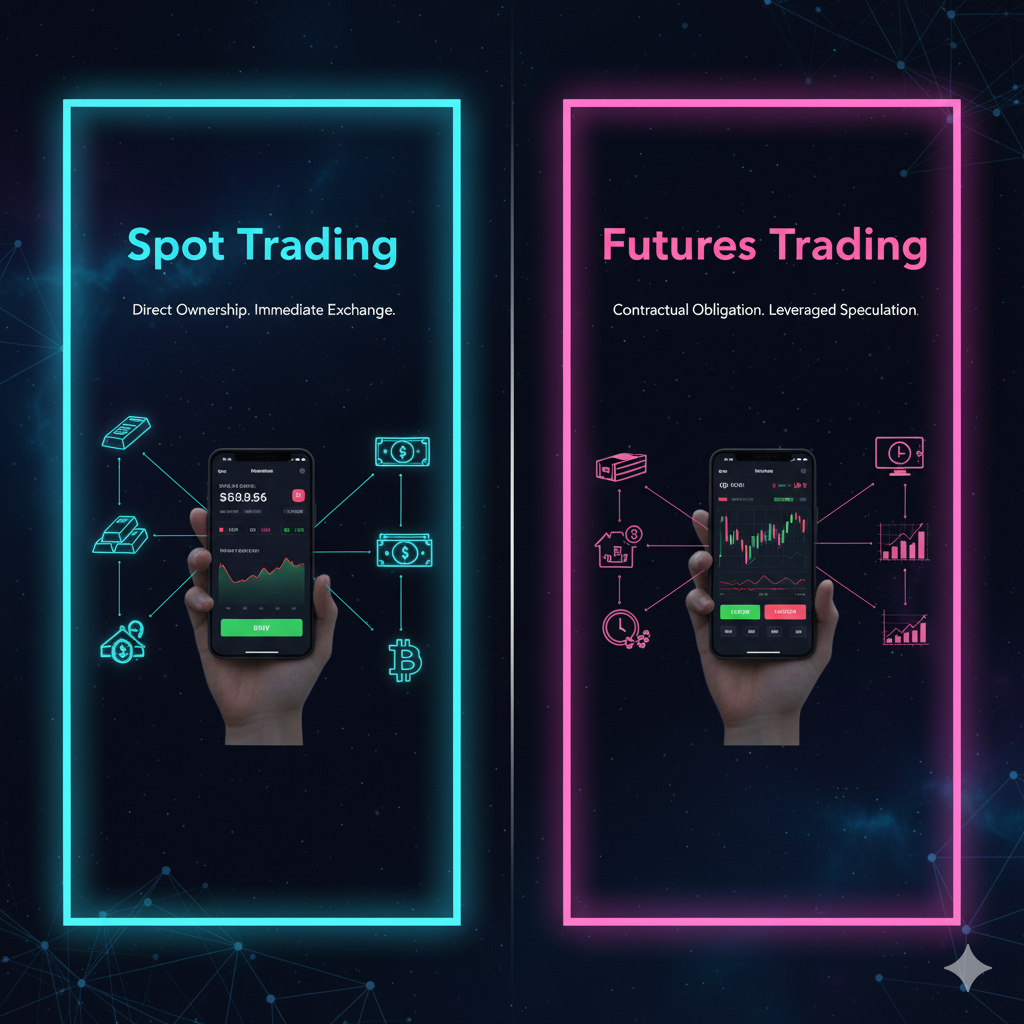
If you’re new to the world of cryptocurrency trading, you’ve likely come across terms like spot trading and futures trading. These are two fundamental ways to buy and sell digital assets like Bitcoin or Ethereum, but they operate quite differently. Understanding the difference between spot trading and futures trading is crucial for beginners looking to navigate the crypto market safely and effectively. In this article, we’ll break down each type of trading in simple language, highlight their key differences, and provide practical examples to help you decide which might suit your trading style. Whether you’re interested in ETH/USD pairs or general crypto strategies, this guide will equip you with the knowledge to get started.
What is Spot Trading?
Spot trading is the most straightforward form of trading in the cryptocurrency market. It involves buying or selling an asset at its current market price, with the transaction settling almost immediately. The term “spot” refers to the “on-the-spot” nature of the deal—you pay for and receive the asset right away.
In crypto, spot trading means you’re actually owning the cryptocurrency. For instance, if you buy Bitcoin on a spot market, the BTC is transferred to your wallet or exchange account instantly (or within a short settlement period, usually T+0 on centralized exchanges; note that in traditional securities the U.S. moved to T+1 settlement in May 2024). This is similar to buying goods at a store: you see the price, pay for it, and take it home.
Learn more about spot market fundamentals on Investopedia.
Spot trades occur on exchanges like Binance, Coinbase, or Poloniex, where buyers and sellers match orders in real time. The price is determined by supply and demand, fluctuating constantly based on market conditions. According to the Bank for International Settlements, the overall FX market averaged $7.5 trillion per day in April 2022, but the spot segment itself was about $2.1 trillion/day. View the BIS triennial survey data for detailed market statistics.
How Spot Trading Works in Practice
To execute a spot trade, you typically:
- Deposit funds (like USD or USDT) into your exchange account. If you’re using Binance, check out our complete step-by-step Binance tutorial for 2025 to learn how to set up your account properly.
- Select a trading pair, such as ETH/USD.
- Place a market order to buy or sell at the current price, or a limit order to set your desired price.
- Once matched, the trade settles, and you own the asset.
For beginners, spot trading is ideal because it doesn’t involve complex contracts or predictions about future prices. However, it requires you to have the full amount of capital upfront. If Ethereum is priced at $3,000, you’ll need $3,000 (plus fees) to buy one ETH. If you’re interested in purchasing Ethereum, our guide on how to buy Ethereum safely in 2025 walks you through the entire process. To learn more about Ethereum’s performance and metrics, explore our article on Ethereum in numbers: key stats and charts every investor should know.
What is Futures Trading?
Futures trading, on the other hand, is more advanced and involves contracts rather than direct asset ownership. A futures contract is an agreement to buy or sell a cryptocurrency at a predetermined price on a specific future date. This allows traders to speculate on price movements without actually holding the underlying asset.
In the crypto world, futures are popular on platforms like Binance Futures or Bybit. Unlike spot trading, futures use leverage, meaning you can control a larger position with a smaller amount of capital. For example, with 10x leverage, a $1,000 deposit could control a $10,000 position. This amplifies both profits and losses. Major venues offer high maximum leverage; for example, Binance lists up to 125x leverage on some pairs.
Futures contracts have expiration dates, after which they settle—either through cash (common for regulated crypto futures like those on CME) or physical delivery (rare). Perpetual futures (no expiration) use funding rates, periodic payments between longs and shorts that help keep the contract price anchored to spot. For a deeper understanding of how perpetual contracts work, read our comprehensive guide on perpetual trading explained simply. Learn more about CME Bitcoin and Ethereum futures and their specifications.
On regulation: in the U.S., the CFTC oversees commodity derivatives (futures, options, swaps), including Bitcoin/Ether futures on registered exchanges; oversight of offshore crypto derivatives varies by jurisdiction.
How Futures Trading Works in Practice
Here’s a basic step-by-step:
- Fund your futures account (often separate from spot).
- Choose a contract, like BTC/USD perpetual futures.
- Decide on long (betting price will rise) or short (betting it will fall).
- Apply leverage and set your position size.
- Monitor and close the position before or at expiration to realize gains/losses.
Futures are used for hedging (protecting against price drops) or speculation. If you think ETH will rise, you go long; if fall, short. But beware: leverage can lead to liquidation if the market moves against you.
Key Differences Between Spot Trading and Futures Trading
While both involve cryptocurrencies, spot and futures trading differ in several core aspects. Let’s compare them side by side for clarity:
| Aspect | Spot Trading | Futures Trading |
|---|---|---|
| Settlement | Immediate (T+0 or T+1) | Future date or perpetual |
| Ownership | Yes, actual asset transferred | No, just a contract |
| Leverage | Usually none (1:1) | Yes, up to 100x+ on some venues |
| Capital Required | Full value of the asset | Fraction (margin) due to leverage |
| Risk Level | Lower, limited to invested amount | Higher, due to leverage and volatility |
| Profit Opportunities | Primarily in bull markets (long) | Bull or bear (long/short) |
| Liquidity | Good, varies by asset | Often higher for majors; crypto derivatives comprise the majority of trading volume market-wide |
| Fees | Trading fees only | Trading fees plus funding rates (for perps) |
| Purpose | Holding or short-term trading | Speculation, hedging |
Important notes:
- Perpetual futures’ funding payments between longs and shorts are integral to keeping prices near spot. Read more about perpetual futures funding rates on Binance Academy.
- In crypto, derivatives account for the majority of total trading. According to Kaiko research, derivatives represent over 70% of market share in 2025, with BTC perpetuals comprising approximately 68% of Bitcoin trading volume. This means futures on major pairs often show deeper liquidity than spot.
These differences stem from the fundamental nature of each: spot is about current prices and ownership, while futures focus on future expectations and leverage. For example, in spot trading ETH/USD, you buy ETH at $3,000 and sell later at $3,500 for a $500 profit per ETH. In futures, the same $500 move yields $500 profit per 1-ETH contract—leverage reduces required margin but does not multiply the per-unit price move; it magnifies return on margin and liquidation risk.
Investopedia’s comprehensive guide emphasizes that spot trades are for immediate exposure, while futures suit strategies without direct ownership. In crypto, futures often have better liquidity for pairs like BTC/USDT due to the market’s derivatives dominance.
Pros and Cons of Spot Trading
Pros:
- Simplicity: Easy to understand—no contracts or expirations.
- Ownership: You can transfer, stake, or use the crypto (e.g., ETH for DeFi). Once you purchase your cryptocurrency, you’ll need a secure place to store it—check out our guide on the top 10 crypto wallets for beginners in 2025 to find the best wallet for your needs.
- Lower Risk: No leverage means losses are capped at your investment.
- No Funding Fees: Unlike futures, no ongoing costs for holding positions.
Cons:
- Capital Intensive: Need full funds upfront.
- Limited Profits: Can’t short sell easily; profits mainly from price increases.
- Market Volatility: Crypto prices can swing wildly, affecting holdings.
For more foundational knowledge, see Investopedia’s guide to spot trading and settlement cycles.
Pros and Cons of Futures Trading
Pros:
- Leverage: Amplify returns on capital committed (margin).
- Flexibility: Profit in rising or falling markets.
- Hedging: Protect spot holdings against downturns.
- High Liquidity: Easier to enter/exit large positions on major pairs.
Cons:
- High Risk: Leverage can lead to total loss or liquidation.
- Complexity: Involves margins, funding rates, and expirations (unless perpetual). If you’re new to perpetual contracts, our beginner’s guide to perpetual futures explains these concepts in detail.
- Fees: Higher costs from leverage and funding for perps.
- No Ownership: Can’t use the asset for staking/utility while in the contract.
For detailed explanations of perpetual funding mechanics, visit Binance Academy’s guide to perpetual contracts.
When to Choose Spot Trading vs Futures Trading
Your choice depends on your goals and risk tolerance. Use spot trading if:
- You’re a long-term holder (HODLer) believing in crypto’s future.
- You want to own and use the asset (e.g., staking ETH).
- You’re new and prefer simplicity.
Opt for futures if:
- You want to speculate on short-term price moves.
- You’re hedging a portfolio (e.g., short futures to offset spot losses).
- You have limited capital but want larger exposure (accepting higher risk).
In crypto, many start with spot and later learn futures. Always start small and consider demo/sandbox environments.
Real-World Examples in Crypto Trading
Spot Example: You buy 1 ETH at $3,000 using spot trading. If it rises to $3,500 in a week, you sell for a $500 profit (minus fees). You owned the ETH and could have used it meanwhile.
Futures Example: With a perpetual ETH/USD futures contract at 10x leverage, you post $300 margin to open a 1-ETH long at $3,000 notional. If ETH rises to $3,500, your profit is $500 (same price move per ETH); your return on margin is approximately 167% before fees/funding. If it drops to around $2,700, your unrealized loss is approximately $300 and you approach liquidation (exact price depends on exchange risk parameters and fees). Learn more about leverage trading on Binance.
Hedging: If you hold 10 ETH spot and fear a drop, you can short approximately 10 ETH via futures; a 10% spot loss is partly or fully offset by futures gains. Institutions commonly use cash-settled futures like CME’s crypto derivatives.
Risks and Best Practices for Beginners
Both trading types carry risks due to crypto’s volatility. Spot risks include market crashes; futures add leverage risks and funding costs. Always:
- Research with reputable primers (e.g., Binance Academy; Investopedia).
- Use stop-loss orders.
- Diversify and never invest more than you can lose.
- Stay updated via reliable news; avoid hype.
- Remember: In the U.S., derivatives are regulated by the CFTC; globally, crypto rules are uneven, which affects venue safety and recourse.
Conclusion
Spot trading vs futures trading boils down to immediate ownership versus future speculation. Spot is simple and ownership-focused, perfect for beginners building a portfolio. Futures offer leverage and flexibility but come with higher risks, suiting active traders. By understanding these differences, you can make informed decisions in the crypto space, whether trading ETH/USD or other pairs. Remember, education is key—start with spot, experiment with futures demos, and always trade responsibly.
Related Resources: