
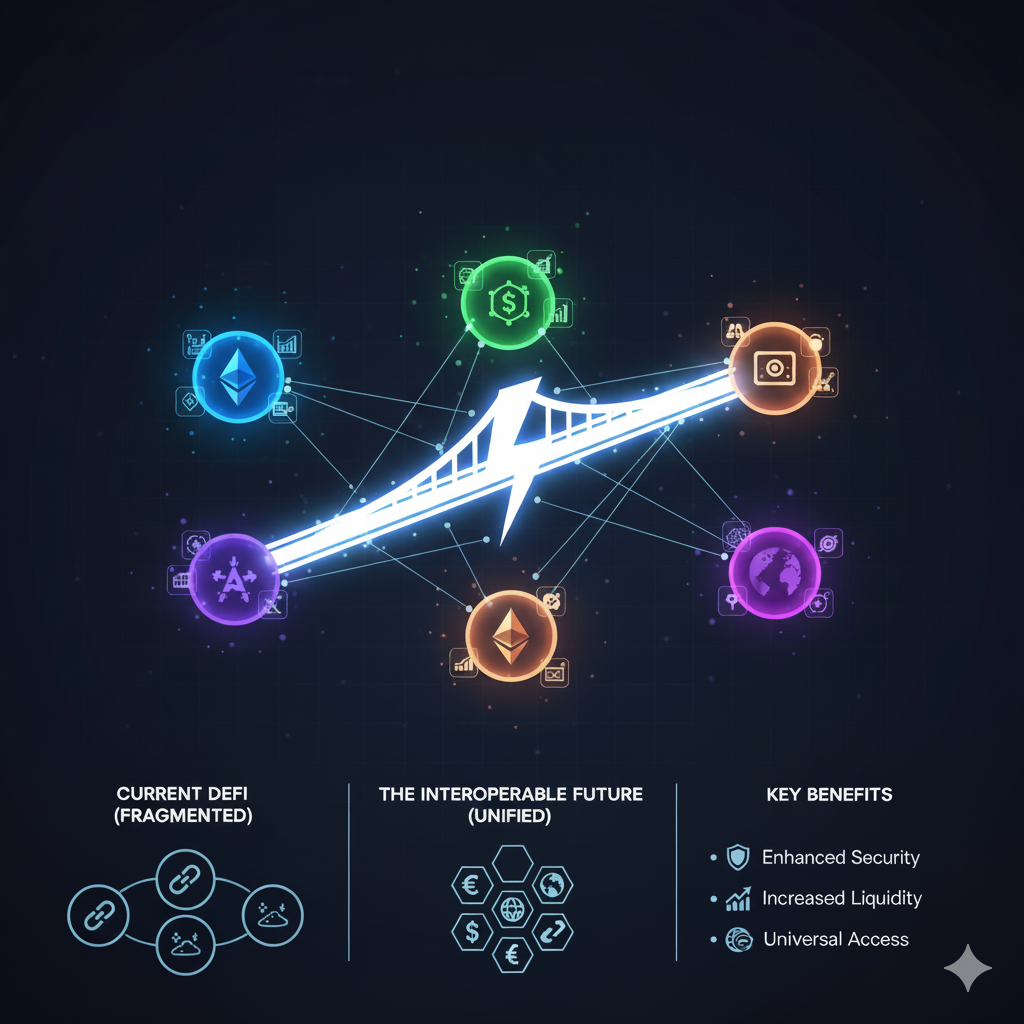
In the world of decentralized finance (DeFi), innovation moves at lightning speed. But one major hurdle has held it back: blockchain silos. Imagine trying to send money from one country to another without any exchange system—it’s inefficient and limiting. That’s where blockchain interoperability comes in. This technology allows different blockchains to “talk” to each other, share data, and move assets seamlessly. As DeFi grows, interoperability isn’t just a nice-to-have; it’s set to transform how we lend, borrow, trade, and invest in crypto.
This article explores how interoperability will reshape DeFi, making it more accessible, efficient, and powerful. We’ll break it down in simple terms, with real-world examples, so even beginners can grasp the big picture. By the end, you’ll see why experts believe this shift could drive mass adoption of DeFi.
What Is Blockchain Interoperability?
At its core, blockchain interoperability is the ability for separate blockchain networks to communicate and interact. Think of blockchains like Ethereum, Solana, and Binance Smart Chain as isolated islands. Without bridges, assets and data can’t move between them easily. Interoperability builds those bridges, enabling cross-chain transactions without needing intermediaries.
There are a few key ways this happens:
Cross-Chain Bridges: Tools like Wormhole or the BNB Chain Bridge let users transfer tokens between networks. Wormhole commonly uses a lock-and-mint model that issues wrapped representations on the destination chain. To learn more about the most secure options available today, check out our guide on cross-chain bridges in 2025.
Protocols for Communication: Systems such as Cosmos’ Inter-Blockchain Communication (IBC) or Polkadot’s XCM/XCMP allow secure message passing for data and asset transfers. These two ecosystems take different approaches to solving interoperability—learn more in our comparison of Cosmos vs Polkadot: Different Paths to Interoperability.
Wrapped Assets: Projects like Wrapped Bitcoin (WBTC) represent assets from one chain (Bitcoin) on another (Ethereum), making them usable in DeFi apps.
Why does this matter for DeFi? DeFi includes services like lending (Aave), trading (Uniswap), and yield farming. Right now, these are often locked to single chains, fragmenting liquidity and users. Interoperability changes that by creating a connected ecosystem.
The Current Challenges in DeFi Without Interoperability
DeFi has exploded, with billions locked in protocols according to DeFiLlama. But fragmentation creates problems:
Limited Liquidity: If you’re on Ethereum, you can’t easily access Solana’s fast, cheap trades. This splits capital pools, leading to higher slippage and worse prices.
Poor User Experience: Switching chains means dealing with multiple wallets, bridges, and fees. Beginners often get frustrated and stick to centralized exchanges like Binance or Coinbase.
Innovation Barriers: Developers build in silos, reinventing features instead of combining the best from each chain.
Security Risks: Manual bridging can expose users to hacks or scams. Bridge exploits have historically been a major vector in crypto, as documented by Investopedia and Chainalysis.
These issues slow DeFi’s growth. As one expert notes, “Siloed blockchains are holding DeFi back.” Interoperability addresses them head-on, paving the way for a more unified financial system.
Key Benefits of Interoperability in DeFi
Interoperability brings tangible advantages that could supercharge DeFi. Here’s how:
Enhanced Liquidity: Assets flow freely across chains, creating deeper pools. For example, a user could provide liquidity on Ethereum and borrow against it on Solana, boosting overall efficiency.
Better Capital Efficiency: Funds aren’t trapped. You can move collateral seamlessly, maximizing yields without high costs. This is particularly important for lending protocols that manage risk across multiple chains.
Improved User Experience: No more chain-hopping headaches. Interoperable wallets like MetaMask and Phantom are evolving to let you interact with DeFi as if it’s one big network.
Increased Innovation: Developers mix and match protocols. Imagine a lending app on one chain using price oracles from another for accurate rates.
Broader Access: More users, including institutions, can join. Cross-chain solutions like Chainlink CCIP provide standardized rails for compliant, scalable flows.
These benefits aren’t theoretical. As DeFi evolves, interoperability fosters novel financial products and improves access according to industry research from Messari and The Block.
How Interoperability Will Transform DeFi
Interoperability isn’t just about moving tokens—it’s about reimagining finance.
Revolutionizing Liquidity and Trading
Today, DeFi trading is chain-specific. Interoperability creates unified liquidity pools across networks. For instance, automated market makers (AMMs) like Uniswap could pull liquidity from multiple chains, reducing spreads and improving prices.
Skate is developing an AMM that maintains a single, canonical pricing curve across multiple chains (e.g., Solana and Ethereum), aiming for seamless trades with unified liquidity.
Enabling Cross-Chain Lending and Borrowing
Lending protocols like Aave are multi-chain, but true interoperability takes it further. Users could collateralize assets on one chain and borrow on another, optimizing for the best rates. Understanding how lending protocols manage risk in DeFi becomes even more critical in a cross-chain environment.
Blend Capital is a Stellar-based lending protocol enabling customizable lending pools; in practice it integrates within Stellar’s payments/stablecoin ecosystem rather than serving as a general cross-chain borrowing hub.
Boosting Innovation and New Use Cases
Interoperability unlocks composability—where protocols “plug in” to each other. A user might deposit into an AMM, use LP tokens as collateral for a loan, and stake the borrowed assets elsewhere, all cross-chain.
Real-world applications include:
- Cross-Chain NFTs: You can bridge or issue NFTs using “omnichain” standards (e.g., LayerZero ONFT) to move or list representations across networks; it’s not a direct sale of the original Ethereum NFT on a Solana marketplace without bridging.
- Scalability Solutions: Offload transactions to faster chains while anchoring to secure ones—helped by cross-chain messaging frameworks (e.g., Chainlink CCIP, LayerZero). Projects like NEAR Protocol have also made significant strides in solving scalability through innovative sharding solutions.
- Institutional DeFi: Tools like idOS focus on portable identity and onboarding across apps/chains, supporting compliant capital flows.
As one post highlights, “Interoperability bridges the gap for institutional DeFi.”
Enhancing Security and Scalability
While bridges have faced hacks, projects are working on more trust-minimized designs (e.g., zero-knowledge-secured interoperability layers like Union). To be precise, these aim to reduce trust assumptions rather than eliminate all risk. Layer-2s (e.g., Optimism, Arbitrum) can pair with interoperability rails for faster, cheaper transactions, as covered by Blockworks.
Optimism’s approach to scaling Ethereum through its Superchain ecosystem demonstrates how layer-2 solutions can work together seamlessly, creating an interconnected network of chains that share security and liquidity. This scalability push could handle trillions in value, making DeFi a real alternative to traditional banks.
Real-World Examples of Interoperability Projects in DeFi
Several projects are leading the charge:
Cosmos IBC: Connects chains in its ecosystem for secure asset transfers; IBC v2 (2025) simplifies connectivity and expands routing beyond Cosmos to other stacks. Cosmos Hub serves as the central hub for this interconnected network.
Polkadot XCM/XCMP: A messaging format for communication between consensus systems; XCMP underpins parachain-to-parachain interactions. To understand the philosophical and technical differences, read our detailed analysis on Cosmos vs Polkadot.
Wormhole (Portal Token Bridge): A widely used cross-chain messaging/bridging stack; its Token Bridge typically locks the source asset and mints a wrapped asset on the target chain. See how it ranks among the top 10 most secure cross-chain bridges in 2025.
Persistence One: Building Bitcoin-centric interoperability (“BTCfi”) to bring BTC into DeFi use cases.
Chainlink: Beyond oracles, CCIP provides cross-chain messaging and token movement rails adopted by multiple ecosystems including Avalanche, Polygon, and others.
Optimism Superchain: An emerging model where multiple Layer-2 chains share the same bridge, security, and communication layer, enabling native interoperability between chains in the ecosystem. Learn more about Optimism’s Superchain vision.
These examples show interoperability in action, from basic transfers to advanced financial products.
Challenges and Solutions in Implementing Interoperability
No tech is perfect. Key challenges include:
Security Risks: Bridges can be vulnerable; designs using minimized trust assumptions (including ZK proofs) are in development to strengthen guarantees, as discussed on Blockworks and CoinDesk. For a comprehensive overview of the safest options, consult our guide on cross-chain bridges in 2025.
Complexity: Developers need convenient standards and APIs. For instance, EIP-7930 (Interoperable Addresses) is a proposed standard to describe addresses across chains—useful, but still evolving.
Regulatory Hurdles: Cross-chain compliance is tricky, but privacy-preserving identity layers (e.g., idOS) aim to address reusable KYC/identity across apps and chains.
Solutions are emerging, with infrastructure platforms like Enso Finance building unified execution/”shortcuts” layers that orchestrate complex multi-step DeFi flows across protocols and chains, as reported by Delphi Digital.
The Future Outlook: DeFi’s Interconnected Era
By 2025 and beyond, many expect interoperability to become “the new standard” according to analysis from Coin Bureau and Bankless. We’ll see:
- Unified ecosystems where chains specialize (e.g., Solana for speed, Ethereum for security), while cross-chain rails stitch them together.
- Mass adoption as users enjoy seamless experiences without needing to understand the underlying complexity.
- Integration with AI and RWAs (Real World Assets) for smarter, more inclusive finance, as discussed by a16z crypto.
As one analyst puts it, “Interoperability isn’t a feature—it’s diplomacy.” It prevents “chain wars” and builds a collaborative Web3.
In summary, interoperability will make DeFi more liquid, user-friendly, and innovative. For beginners, it’s like upgrading from isolated apps to a fully connected internet of finance. As projects mature, watch for explosive growth. If you’re new to DeFi, start exploring multi-chain wallets—the future is cross-chain.
Key Takeaways
- Blockchain interoperability enables different networks to communicate and share assets seamlessly
- Current DeFi fragmentation limits liquidity, user experience, and innovation potential
- Cross-chain bridges, protocols like IBC and XCM, and wrapped assets are making interoperability possible
- Benefits include enhanced liquidity, better capital efficiency, improved UX, and increased innovation
- Leading projects like Cosmos, Polkadot, Wormhole, Chainlink, and Optimism Superchain are pioneering interoperable solutions
- Security challenges remain, but trust-minimized designs and standards are evolving
- The future of DeFi is interconnected, with specialized chains working together through cross-chain infrastructure