
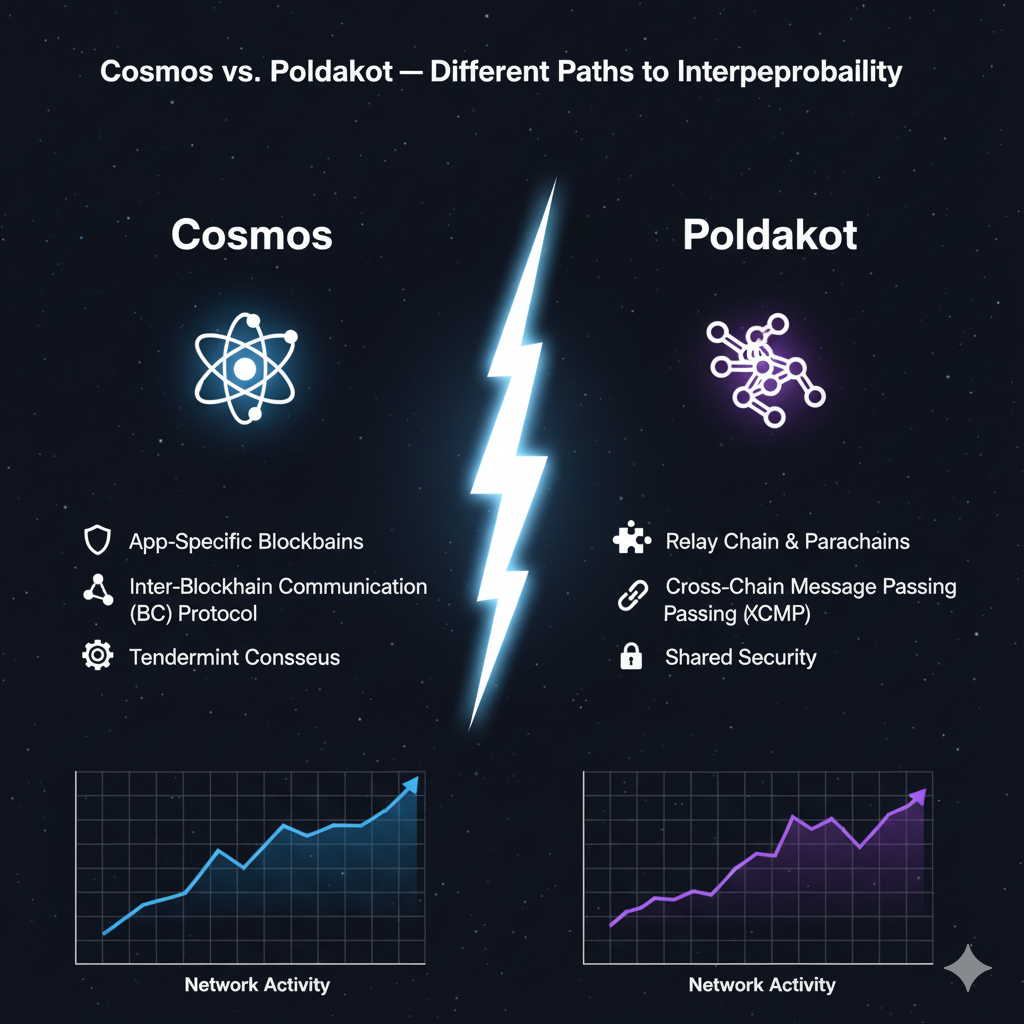
In the rapidly evolving world of blockchain technology, interoperability stands out as a critical feature for connecting isolated networks. Cosmos and Polkadot are two leading platforms addressing this challenge, each offering unique solutions to enable seamless communication between blockchains. This article explores Cosmos vs Polkadot, highlighting their approaches to blockchain interoperability. Written for beginners, it uses simple explanations while drawing on verified facts from reliable sources like official websites and industry reports. Whether you’re curious about how these platforms work or considering them for development, this guide breaks down the essentials.
Blockchain interoperability allows different chains to exchange data and assets efficiently, much like how the internet connects various websites. As of 2025, with thousands of blockchains in existence, projects like Cosmos and Polkadot are pivotal in building a more connected ecosystem.
What is Blockchain Interoperability?
Blockchain interoperability is the ability of separate blockchain networks to interact and share information without relying on centralized intermediaries. Think of it as a universal language that lets different systems “speak” to each other. For example, it enables transferring a token from one chain to another without high fees or delays.
This matters because early blockchains, like Bitcoin and Ethereum, function in isolation, leading to fragmented markets and inefficiencies. Interoperability boosts scalability, reduces costs, and enhances user experience by pooling liquidity across chains. According to official Cosmos documentation, the IBC protocol has connected over 115 chains as of early 2025, demonstrating rapid ecosystem growth. Similarly, the Polkadot ecosystem counts hundreds of projects actively building on its infrastructure.
To achieve interoperability, blockchain networks rely on various technologies including cross-chain bridges, which facilitate asset transfers between different networks while maintaining security.
For beginners: Imagine blockchains as countries with their own currencies. Interoperability is like a global exchange system that lets you trade without borders.
Introduction to Cosmos
Cosmos, launched in 2019, positions itself as the “Internet of Blockchains.” It provides a framework for creating independent, sovereign blockchains that can connect via standardized protocols. The core is the Cosmos Hub, which acts as a central coordinator, but the ecosystem prioritizes app-specific chains (appchains) tailored for particular uses, like decentralized exchanges or gaming.
Cosmos focuses on developer-friendly tools, allowing customization while ensuring interoperability. Cosmos chains commonly feature low transaction fees and fast block times, typically around 1-2 seconds. Recent developments include the launch of IBC v2 (“Eureka”) pilots aiming to extend IBC beyond Cosmos to ecosystems like Ethereum—an expansion effort currently rolling out across the industry.
Key Features of Cosmos
Cosmos SDK: This is an open-source framework for developing custom blockchains. The SDK itself is written in Go, while smart contracts in the Cosmos ecosystem are typically built via CosmWasm in Rust. Projects such as Osmosis and Celestia build on this stack, with Celestia’s consensus layer utilizing CometBFT and Cosmos-stack components.
IBC Protocol: The Inter-Blockchain Communication (IBC) protocol is Cosmos’s core technology for interoperability. It allows trustless transfers of tokens and data between chains using light clients—no third-party trust required. As of early-to-mid 2025, IBC connects approximately 115-120+ chains. For a deeper understanding of how IBC enables seamless blockchain connectivity, see our comprehensive guide on how IBC actually connects blockchains in the Cosmos ecosystem.
Emerging initiatives are bringing IBC to additional ecosystems, including EVM-compatible chains like Oasys through projects such as TOKI and Datachain.
CometBFT Consensus: Formerly known as Tendermint Core, CometBFT is the replication engine used by many Cosmos-stack chains, providing fast finality and high throughput for appchains.
Smart Contracts and Sovereignty: Cosmos supports WebAssembly (WASM) smart contracts on chains like Neutron and Osmosis. An important distinction: chains do not automatically inherit security from the Cosmos Hub. Rather, some may opt into shared or replicated security arrangements through Interchain Security (ICS). Neutron serves as a key smart-contract hub in this model, though governance discussions around smart contract deployment continue to evolve in 2025.
Recent 2025 updates include IBC v2 (Eureka) development and enterprise-oriented interoperability efforts, with ecosystem initiatives focusing on programmable finance and sovereign blockchain applications.
For beginners: Cosmos is like a Lego set—you build your own blockchain pieces and connect them easily.
Introduction to Polkadot
Polkadot, founded by Ethereum co-founder Gavin Wood and launched in 2020, is a multi-chain platform emphasizing shared security and scalability. It uses a central Relay Chain to coordinate “parachains”—specialized blockchains that plug into the network for enhanced performance.
Polkadot aims for a unified ecosystem where chains share resources, making it resilient against attacks. According to official Polkadot statistics, the network features approximately $5.1 billion in staked economic security and a Nakamoto Coefficient of 185, indicating strong decentralization. Key 2025 upgrades include Asynchronous Backing, Agile Coretime, and Elastic Scaling (collectively known as Polkadot 2.0), which together underpin its scaling roadmap.
Key Features of Polkadot
Relay Chain and Parachains: The Relay Chain handles security and consensus, while parachains are customizable slots for specific applications—shared security covers all connected chains. The ecosystem spans hundreds of projects, with counts changing as auctions, migrations, and development cycles progress. For an in-depth look at how parachains function within the Polkadot ecosystem, check out our detailed explanation of Polkadot parachains in 2025.
XCM Protocol: Cross-Consensus Messaging (XCM) enables interoperability by allowing messages and assets to move between parachains and, via bridges, to external chains. It’s designed for secure, programmable cross-chain interactions.
Substrate Framework: Like Cosmos SDK for Cosmos, Substrate lets developers build chains with on-chain governance, runtime upgrades, and WebAssembly execution, providing flexibility and customization options.
Governance and Upgrades: Polkadot uses OpenGov, an on-chain governance system with broad community participation. OpenGov regularly passes treasury and network-upgrade proposals, with token-economic topics debated directly on-chain.
Recent developments focus on AI integrations, Decentralized Physical Infrastructure Networks (DePIN), and multi-chain use cases, including Bifrost’s liquid staking expansions and other ecosystem projects advancing throughout 2025.
For beginners: Polkadot is like a bustling city with a central government (Relay Chain) providing security to neighborhoods (parachains).
Comparing Cosmos and Polkadot
When comparing Cosmos vs Polkadot, both pursue blockchain interoperability but differ in philosophy and execution. This comparison is particularly relevant when evaluating different blockchain architectures, similar to comparing Ethereum vs Solana vs Polygon for DeFi applications.
Similarities
- Both use modular frameworks (Cosmos SDK vs. Substrate) for custom chain building
- They enable cross-chain communication: IBC in Cosmos and XCM in Polkadot
- Focus on scalability and developer tools, supporting languages like Rust for smart contracts and chain development
- Growing ecosystems: Cosmos with approximately 115-120+ IBC-connected chains; Polkadot with hundreds of active projects
Differences
Security Model: Polkadot emphasizes shared security via the Relay Chain, where all parachains benefit from collective validator protection. Cosmos prioritizes sovereignty—chains manage their own validators and governance and may opt into shared security via Interchain Security, but they do not automatically inherit Cosmos Hub security.
Interoperability Approach: Cosmos’s IBC is light-client based and permissionless, allowing any compatible chain to connect. Polkadot’s XCM coordinates within a unified system with tight integration, using bridges to connect to external ecosystems. As of 2025, Cosmos leads in the count of active IBC-connected chains, while Polkadot advances with Agile Coretime and Elastic Scaling to integrate diverse workloads.
Performance and Cost: Cosmos offers low transaction fees and configurable performance across its sovereign chains. Polkadot’s benchmark tests have demonstrated high transaction throughput capabilities, with the Nakamoto Coefficient of 185 indicating strong network decentralization.
Market Position: Both DOT and ATOM tokens maintain significant positions in the cryptocurrency market, though rankings fluctuate with market conditions and should be verified at current time of reference.
In 2025 analyses, Cosmos leads in live cross-chain connectivity counts through IBC adoption, while Polkadot advances with integrated upgrades like Elastic Scaling and Asynchronous Backing.
Comparison Table
| Aspect | Cosmos | Polkadot |
|---|---|---|
| Security | Sovereign per chain (ICS optional) | Shared via Relay Chain |
| Interoperability | IBC (~115-120+ chains, 2025) | XCM (tight integration) |
| Framework | Cosmos SDK (Go) + CosmWasm (Rust) | Substrate (Rust) |
| Focus | Flexibility and appchains | Scalability and unity |
| 2025 Updates | IBC v2/Eureka pilots beyond Cosmos | Polkadot 2.0 (Agile Coretime, Elastic Scaling) |
Real-World Applications
Cosmos powers decentralized finance (DeFi) platforms like Osmosis and has initiatives to connect gaming ecosystems like Oasys to IBC via TOKI and Datachain projects. Polkadot supports DePIN applications, DAOs, and cross-chain DeFi through projects like Bifrost and numerous other ecosystem participants.
Both platforms are used extensively in finance and Web3 applications. Cosmos’s IBC v2/Eureka work targets broader Ethereum connectivity, while Polkadot’s bridge infrastructure (including projects like Snowbridge) forms part of its pathway to external ecosystem integration. Understanding the most secure cross-chain bridges in 2025 is crucial when evaluating interoperability solutions across these platforms.
Future Prospects
Looking ahead, Cosmos plans broader IBC adoption through v2/Eureka rollouts and enterprise-friendly interoperability solutions, with anticipated growth in AI and Web3 applications. Polkadot’s 2025 “2.0” upgrades aim for accelerated growth via Agile Coretime and Elastic Scaling, with EVM support and faster execution continuing to evolve across its parachains.
The multi-chain future also includes scaling solutions on established networks. For instance, Optimism’s Superchain represents another approach to ecosystem scaling, demonstrating that interoperability strategies extend beyond just Cosmos and Polkadot.
Industry analysts generally expect interoperability to remain a key driver for both platforms, as the blockchain ecosystem matures and demands for cross-chain functionality increase. Both Cosmos and Polkadot are positioned to play significant roles in shaping the multi-chain future of decentralized technology.
Conclusion
Cosmos vs Polkadot showcases diverse paths to blockchain interoperability: Cosmos with sovereign freedom and flexible appchain architecture, Polkadot with shared security and unified integration. Choosing between them depends on specific development needs—flexibility and independence with Cosmos, or integrated security and coordinated scaling with Polkadot.
As the blockchain space matures in 2025 and beyond, both platforms continue to contribute meaningfully to a more connected blockchain future, benefiting developers, enterprises, and users alike. Understanding their distinct approaches helps developers and organizations make informed decisions about which platform best serves their interoperability requirements.
Key Resources: