Home Blog Page 13

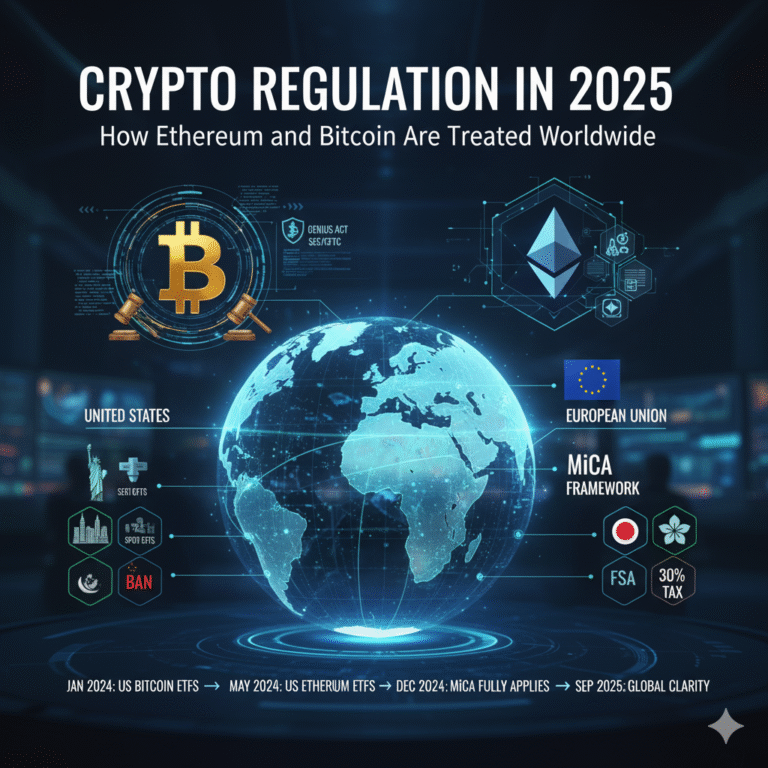
Crypto Regulation in 2025: How Bitcoin and Ethereum Are Regulated Worldwide – Complete Guide

Cryptocurrencies like Bitcoin (BTC) and Ethereum (ETH) have evolved from niche digital assets to mainstream financial instruments in 2025. With global crypto market capitalization exceeding $2 trillion, governments worldwide are implementing comprehensive regulatory frameworks to balance innovation with consumer protection.

This definitive guide covers current crypto regulations across major jurisdictions, helping investors, businesses, and developers navigate the complex legal landscape of digital assets in 2025.

What Are Bitcoin and Ethereum?

Bitcoin: Digital Gold Standard

Bitcoin, launched in 2009 by the pseudonymous Satoshi Nakamoto, remains the world’s largest cryptocurrency by market cap. Often called “digital gold,” this pioneering cryptocurrency serves as:

  • Store of value asset for long-term wealth preservation
  • Peer-to-peer payment system enabling borderless transactions
  • Hedge against inflation in uncertain economic climates
  • Portfolio diversification tool for institutional and retail investors

Furthermore, Bitcoin’s decentralized nature makes it resistant to government control and censorship. Learn more about Bitcoin’s fundamentals at Bitcoin.org.

Ethereum: Programmable Blockchain Platform

In contrast to Bitcoin’s focus on payments, Ethereum, created by Vitalik Buterin in 2015, extends far beyond simple value transfers. Specifically, it offers:

  • Smart contract functionality automating trustless agreements
  • Decentralized applications (DApps) powering Web3 services
  • DeFi protocol infrastructure enabling permissionless finance
  • NFT marketplace backbone supporting digital ownership

Additionally, Ethereum’s programmability has made it the foundation for thousands of innovative blockchain projects. Explore Ethereum’s capabilities at Ethereum.org.

Both cryptocurrencies operate on decentralized networks, meaning no single entity controls their operations—a feature that creates unique regulatory challenges worldwide.

Why Cryptocurrency Regulation Matters

Consumer Protection

Regulatory frameworks serve several critical functions for everyday users. First and foremost, they:

  • Prevent fraud and market manipulation in digital asset markets
  • Ensure proper custody of digital assets by qualified entities
  • Mandate transparent fee structures across platforms
  • Provide legal recourse for disputes and losses

Moreover, clear regulations help distinguish legitimate projects from fraudulent schemes, thereby protecting inexperienced investors.

Financial Stability

Beyond individual protection, regulators focus on systemic concerns. Consequently, well-designed crypto regulations:

  • Reduce systemic risk to traditional banking systems
  • Prevent money laundering and terrorist financing
  • Maintain monetary policy effectiveness across jurisdictions
  • Protect national currencies from destabilization

In particular, stablecoin regulations address concerns about runs on reserve assets that could trigger broader financial crises.

Innovation Balance

Nevertheless, effective regulation doesn’t stifle innovation. Instead, thoughtful frameworks:

  • Encourage technological advancement in blockchain
  • Attract institutional investment with clear rules
  • Create clear compliance pathways for startups
  • Support blockchain entrepreneurship globally

Ultimately, the goal is fostering innovation while maintaining essential safeguards for market participants.

United States Crypto Regulations 2025

The US crypto regulatory landscape has significantly matured since 2024, with multiple agencies coordinating oversight. As a result, market participants now have clearer guidance than ever before.

Bitcoin Regulations in America

Legal Classification

First and foremost, the Commodity Futures Trading Commission (CFTC) classifies Bitcoin as a commodity, and US courts have reaffirmed that status in recent rulings. This classification provides important legal clarity for market participants. View official guidance at CFTC.gov.

Bitcoin ETF Revolution

Meanwhile, the Securities and Exchange Commission (SEC) approved the first spot Bitcoin ETFs in January 2024, including products from BlackRock (IBIT), Fidelity (FBTC) and others. Subsequently, these funds have attracted very large assets under management through 2025, with IBIT alone nearing the $100B AUM mark. This milestone represents unprecedented mainstream adoption. Read more at The Wall Street Journal and BlackRock.

Strategic Bitcoin Reserve

Furthermore, a March 6, 2025 Executive Order established a federal Strategic Bitcoin Reserve framework, with subsequent congressional efforts to codify it through the BITCOIN Act. This initiative signals government recognition of Bitcoin’s strategic importance. Track legislative developments at Congress.gov.

Ethereum Regulations in the US

Status and ETFs

Similarly to Bitcoin, the CFTC and federal courts have treated Ether as a commodity in enforcement and litigation contexts. However, the SEC allowed spot ETH ETFs to launch in July 2024 but has not issued a definitive rule universally declaring ETH a commodity or security. Therefore, some regulatory ambiguity remains. Check current status at CFTC.gov.

Smart Contract / DeFi Oversight

Additionally, the SEC’s internal “Project Crypto” has featured DeFi roundtables and staff workstreams aimed at policy development. Nevertheless, these are exploratory and consultative rather than a finalized rulebook for all dApps.

Federal Stablecoin Legislation

GENIUS Act (Enacted July 18, 2025)

Notably, the GENIUS Act provides a federal regime for payment stablecoins, including 1:1 reserve requirements, regular independent audits, consumer protections, and a pathway to deposit-insurance eligibility. Consequently, this legislation brings much-needed clarity to the stablecoin sector. Full text available at Congress.gov.

STABLE Act

On the other hand, the STABLE Act is under consideration as a complementary proposal and has not been enacted as of October 2025. Follow updates at Sidley.com.

European Union MiCA Regulation

The Markets in Crypto-Assets (MiCA) Regulation became fully applicable on December 30, 2024, with the stablecoin title taking effect earlier in June 2024. As a result, Europe now has the world’s most comprehensive crypto framework. Read about MiCA at Wikipedia – MiCA.

Bitcoin Under MiCA

Classification and Requirements

Under this framework, Bitcoin is classified as a “crypto-asset” under MiCA. Furthermore, Crypto-asset service providers (CASPs) face authorization and conduct rules under MiCA and must meet EU AML/KYC obligations under the EU anti-money laundering framework. More details at The Block.

Investment Products

Accordingly, European Bitcoin exposure commonly occurs via exchange-traded products (ETPs), exchange-traded notes (ETNs), and other structures permitted at the Member State level within MiCA’s perimeter.

Ethereum and Smart Contracts Under MiCA

DeFi Regulatory Gap

Interestingly, MiCA does not comprehensively regulate fully decentralized DeFi where no identifiable issuer or provider exists. Currently, national and EU authorities are studying DeFi for potential future rules. Learn more at European Banking Authority.

EU Data Act Implications

In parallel, the EU Data Act (2023) imposes certain safeguards for smart contracts used in data-sharing, though this is not a general MiCA audit mandate for all Ethereum contracts.

Exchange Adjustments

As a result of these regulations, some EU exchanges adjusted listings for USDT to align with MiCA and e-money token (EMT) supervision. For instance, OKX delisted USDT in the European Economic Area, and Kraken reviewed its EU stablecoin offering in 2024-2025. Follow updates at SEC.gov.

MiCA Review and Evolution

Looking ahead, the European Securities and Markets Authority (ESMA) and European Banking Authority (EBA) have ongoing Level-2 and Level-3 work, with a MiCA effectiveness review planned by December 2025. Visit ESMA for updates.

Asia-Pacific Crypto Laws

Asia represents the world’s largest crypto trading volume, with diverse regulatory approaches across the region. Importantly, each jurisdiction has developed unique frameworks reflecting local priorities.

Singapore: Innovation-Friendly Framework

Notably, the Monetary Authority of Singapore (MAS) treats BTC and ETH as Digital Payment Tokens (DPTs) under the Payment Services Act. Moreover, recent 2024-2025 measures include:

  • Enhanced custody and segregation rules for service providers
  • Phased consumer-protection guidelines (bans on retail incentives, leverage and credit card restrictions)
  • Risk awareness tests for retail investors

Consequently, Singapore has positioned itself as a leading crypto hub while maintaining strong consumer protections. Comprehensive guidance available at MAS.gov.sg, Morgan Lewis, and Bovill Newgate.

Hong Kong: Global Crypto Hub Ambitions

Similarly ambitious, Hong Kong launched Asia’s first spot Bitcoin and Ether ETFs on April 30, 2024 via ChinaAMC, Harvest, and Bosera/HashKey. Subsequently, approvals and listings expanded through 2024-2025, solidifying Hong Kong’s position as a regional leader. Read coverage at Reuters and ChinaAMC.

Japan: Mature Regulatory Environment

In contrast, Japan’s Financial Services Agency (FSA) maintains a public register of licensed crypto-asset exchange service providers under the Payment Services Act, updated periodically. Additionally, policymakers in 2025 floated proposals to grant crypto assets financial-product status under the Financial Instruments and Exchange Act (FIEA) by 2026. Check the official registry at FSA.go.jp.

India: Heavy Taxation Approach

Taking a different approach, India applies a 30% flat tax on crypto gains and a 1% Tax Deducted at Source (TDS) on certain transfers. Meanwhile, the Reserve Bank of India and government advisories remain cautious regarding cryptocurrency adoption.

China: Continued Prohibition

Conversely, China continues its comprehensive ban on domestic crypto trading, mining, and initial coin offering (ICO) fundraising through 2025, maintaining one of the world’s strictest stances.

Other Notable Jurisdictions

Remarkably, Bitcoin remains legal tender in El Salvador, but merchant acceptance was made voluntary after a January 29, 2025 legislative amendment aligned with International Monetary Fund (IMF) program conditions. Nevertheless, the state continues Bitcoin reserve activity; for example, 21 BTC were added on September 8, 2025. Coverage at Reuters and Yahoo Finance.

Brazil: Emerging Crypto Power

Similarly progressive, Law 14.478/2022 recognizes crypto as a means of payment and establishes a Virtual Asset Service Provider (VASP) regime under Central Bank of Brazil oversight. Currently, full implementation phases continue into late-2025. Details at SEC.gov.

Belarus: Crypto-Friendly Jurisdiction

In Eastern Europe, Belarus maintains crypto tax exemptions through 2025 via the High-Tech Park regime, fostering blockchain innovation. More at Blockchain.com.

Kazakhstan: Blockchain & Mining Hub

Meanwhile in Central Asia, Kazakhstan operates licensed mining and regulated digital-asset pilots through the Astana International Financial Centre (AIFC) with sandbox initiatives and defined permits. Updates at X (formerly Twitter).

Global Stablecoin and DeFi Regulations

Stablecoin Frameworks Worldwide

United States

As mentioned earlier, the GENIUS Act requires 1:1 reserve backing, independent audits, consumer protections, and provides a pathway to deposit-insurance eligibility for qualifying issuers. Full details at Congress.gov.

European Union

In comparison, MiCA distinguishes between e-money tokens (EMTs) and asset-referenced tokens (ARTs) with strict licensing and reserve/issuance controls. Official documentation at Wikipedia – MiCA.

Decentralized Finance (DeFi) Oversight

Importantly, DeFi—largely built on Ethereum—faces growing supervisory attention, often via sandboxes and pilots rather than blanket rules:

United Kingdom

For example, the Digital Securities Sandbox (DSS) remains open through 2028 for distributed ledger technology (DLT) market-infrastructure pilots. Learn more at Bank of England.

Singapore and Japan

Likewise, innovation frameworks and sandboxes continue under MAS and FSA programs, though comprehensive DeFi rules remain evolving. Visit MAS.gov.sg for Singapore updates.

Investment Strategies and Compliance

Tax Considerations by Jurisdiction

United States

Generally speaking, capital gains tax applies to cryptocurrency transactions. Specifically, Form 8949 reporting and accounting methods such as First-In-First-Out (FIFO) or Last-In-First-Out (LIFO) are commonly used. Nevertheless, consult a qualified tax professional for personalized guidance.

European Union

In contrast, tax treatment varies by Member State. Typically capital gains tax applies, while professional trading may incur income tax. Additionally, Common Reporting Standard (CRS) reporting can apply to international holdings.

Asia-Pacific

Regional tax approaches vary significantly:

  • Singapore: Generally no capital gains tax for individuals
  • Japan: Progressive tax brackets can reach high rates for crypto income
  • India: 30% flat tax plus 1% TDS on transactions
  • Hong Kong: No capital gains tax (assessed case-by-case for business income)

Best Practices for Compliance

Choose Licensed Platforms

Above all, always use regulated exchanges and custodians in your jurisdiction:

  • US: SEC-registered or state-licensed entities
  • EU: MiCA-authorized CASPs
  • Singapore: MAS-licensed DPT providers
  • Japan: FSA-registered exchanges

Maintain Detailed Records

Furthermore, keep comprehensive transaction records including timestamps, prices, fees, wallet addresses. Additionally, integrate specialized crypto tax software for accurate reporting.

Stay Informed on Regulatory Changes

Finally, subscribe to regulator updates, follow policy trackers like CoinDesk, and consult qualified legal counsel regularly.

Regulatory Challenges and Risks

Compliance Cost Burden

Undoubtedly, MiCA and US regulatory obligations can strain smaller firms with limited resources. Read analysis at Wikipedia – MiCA.

Jurisdictional Inconsistencies

Moreover, cross-border complexity persists as different nations adopt varying approaches to digital asset regulation.

Market Concentration Risks

Additionally, rapid growth of large US spot BTC ETFs magnifies concentration considerations for market stability. Analysis available at Financial Times.

2025 Crypto Regulation Outlook

United States: Innovation-Friendly Trajectory

Looking forward, GENIUS Act implementation is underway, with ongoing SEC-CFTC coordination and clearer DeFi guidance expected. Furthermore, the Strategic Bitcoin Reserve framework exists via Executive Order, with codification bills under congressional debate. Track at Congress.gov.

European Union: Framework Refinement

Similarly, MiCA effectiveness review scheduled for December 2025, plus Level-2 and Level-3 technical standards and coordination across Member States. Updates at ESMA.

Asia-Pacific: Continued Divergence

Meanwhile, Singapore and Hong Kong deepen innovation initiatives. Simultaneously, Japan advances financial-product treatment proposals. In contrast, India maintains heavy taxation approach, while China’s prohibition remains unchanged. Coverage at Reuters and SEC.gov.

Ultimately, expect more international coordination, standardized compliance baselines, stronger consumer protections, and accelerating institutional adoption across jurisdictions.

Key Takeaways for 2025

For Investors

  • First, research local regulations before trading any cryptocurrency
  • Then, use only licensed platforms and custodians in your jurisdiction
  • Additionally, maintain thorough tax records for all transactions
  • Moreover, diversify across compliant assets and jurisdictions
  • Finally, monitor legal changes through official sources

For Businesses

  • Initially, secure all required licenses before launching services
  • Subsequently, implement robust AML/KYC programs that exceed minimum standards
  • Furthermore, engage experienced legal counsel early in planning
  • Additionally, track compliance costs and budget accordingly
  • Finally, plan strategically for regulatory evolution

For Developers

  • First, understand securities-law implications for token launches
  • Next, design compliance-friendly smart contracts with audit trails
  • Additionally, engage regulatory sandboxes where available
  • Furthermore, consider jurisdiction-specific deployments
  • Lastly, track DeFi policy developments closely

Final Thoughts: A Maturing Digital Asset Ecosystem

The cryptocurrency regulatory landscape in 2025 represents a dramatic maturation from the “Wild West” era of the 2010s. Indeed, with clear frameworks in major jurisdictions, Bitcoin and Ethereum now operate within increasingly defined legal parameters that support both innovation and consumer protection.

Success in this environment requires staying informed, choosing regulated service providers, and maintaining rigorous compliance practices. Whether you’re an investor, business operator, or developer, understanding the regulatory landscape is no longer optional—it’s essential for long-term success.

Pro Tip: Bookmark this guide and check back regularly—crypto regulations evolve rapidly as regulators respond to market developments and technological innovations.


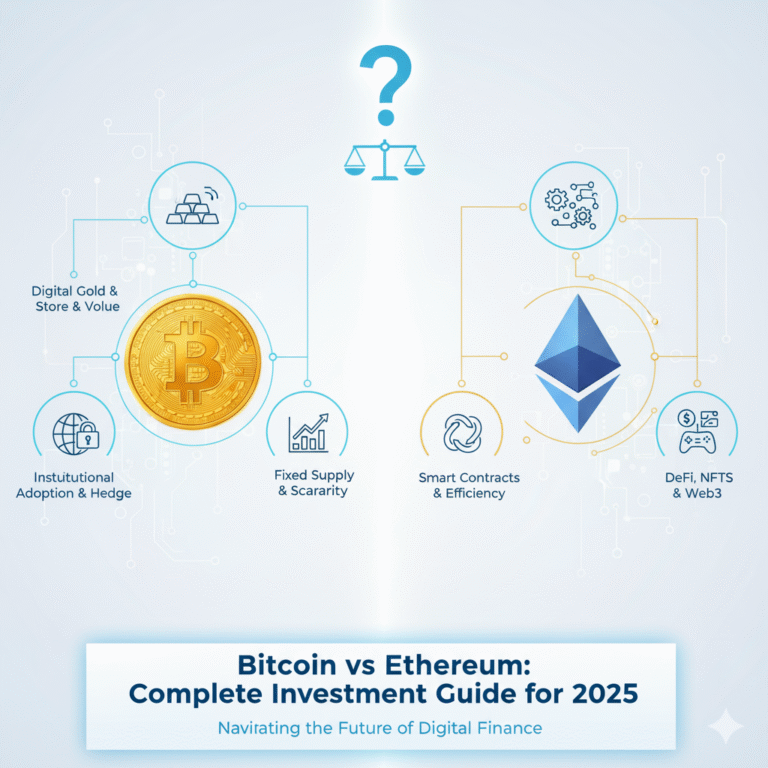
Read also: Bitcoin vs Ethereum.


Disclaimer: This guide is for informational purposes only and does not constitute legal or financial advice. Cryptocurrency regulations vary by jurisdiction and change frequently. Always consult qualified legal and financial professionals for jurisdiction-specific guidance before making investment decisions or launching crypto-related businesses.
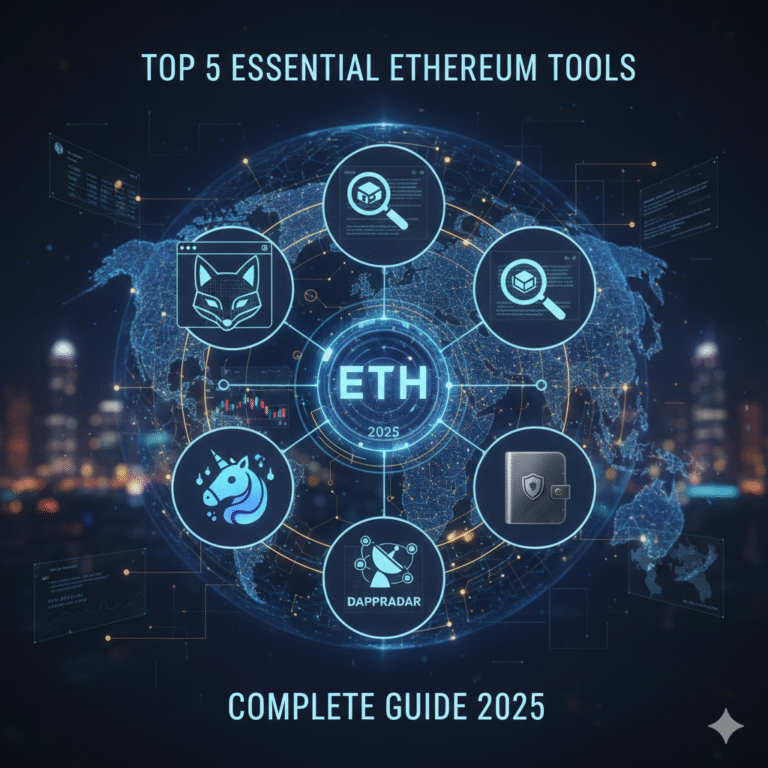
Top 5 Essential Ethereum Tools Every User Must Know: Complete Guide

2

Why Ethereum Dominates the Crypto Space in 2025

Ethereum remains the world’s leading smart contract platform and decentralized ecosystem. Unlike Bitcoin, which primarily serves as digital money, Ethereum powers an entire universe of decentralized applications (dApps), including:

  • DeFi protocols worth billions in total value locked (TVL)
  • NFT marketplaces like OpenSea and Blur
  • Web3 gaming platforms and metaverse projects
  • DAO governance systems for decentralized organizations

In 2025, Ethereum strengthened its position with the successful Pectra upgrade launch on May 7, 2025. Furthermore, with around 6,000 monthly active developers and growing institutional adoption—including the launch of spot ETH-ETFs in the US in July 2024—Ethereum continues to be the backbone of Web3 innovation.

Whether you’re a newcomer looking to buy your first ETH or an experienced trader exploring advanced DeFi strategies, having the right tools is crucial for success. Consequently, this comprehensive guide covers the five essential Ethereum tools that every user should master in 2025.

Learn more about Ethereum:


1. MetaMask: Your Gateway to the Ethereum Ecosystem

What Is MetaMask?

MetaMask is the world’s most popular Ethereum wallet, serving as your digital bridge to Web3. Available as a browser extension for Chrome, Firefox, Edge, and Brave, plus mobile apps for iOS and Android, MetaMask enables you to store and manage ETH and ERC-20 tokens, interact with thousands of dApps seamlessly, connect to Layer 2 networks like Arbitrum and Polygon, and sign transactions and smart contracts securely.

Why MetaMask Is Essential in 2025

With over 100 million users globally, MetaMask has become the go-to Web3 wallet platform, offering unparalleled compatibility with the Ethereum ecosystem. Moreover, its user-friendly interface makes complex blockchain interactions accessible to everyone, from DeFi beginners to NFT collectors.

Key Benefits:

  • Universal dApp Compatibility: Works with virtually every Ethereum-based application
  • Multi-Chain Support: Access Ethereum mainnet plus 100+ compatible networks
  • Enhanced Security: Industry-standard encryption and private key management
  • Regular Updates: Continuous improvements and new feature additions

How to Set Up MetaMask (Step-by-Step)

  1. Download Safely: Visit metamask.io and download the official extension or app
  2. Create Your Wallet: Choose “Create a Wallet” and set a strong password
  3. Secure Your Seed Phrase: Write down your 12-word recovery phrase offline (never store digitally!)
  4. Add ETH: Purchase ETH from exchanges like Coinbase or Binance and transfer to your MetaMask address
  5. Explore dApps: Start with popular platforms like Uniswap or OpenSea

Pro Tips for MetaMask Users

  • Hardware Wallet Integration: Connect your Ledger for maximum security on large amounts
  • Layer 2 Networks: Use Arbitrum or Optimism to reduce gas fees significantly
  • Transaction Management: Additionally, use the Etherscan Gas Tracker to monitor gas prices before confirming transactions
  • Portfolio Tracking: Similarly, use MetaMask Portfolio to view all your assets across different networks

Official resources:


2. Etherscan: The Ultimate Ethereum Blockchain Explorer

What Is Etherscan?

Etherscan.io is Ethereum’s most trusted blockchain explorer, functioning as a powerful search engine for the entire network. Essentially, this indispensable tool allows you to track transaction status and history in real-time, verify smart contract addresses and source code, monitor wallet balances and token holdings, analyze network statistics and gas price trends, and explore bridge activity including TVL by bridges.

Why Every Ethereum User Needs Etherscan

Transparency is Ethereum’s superpower, and Etherscan makes this transparency accessible to everyone. Indeed, whether you’re verifying a suspicious transaction or researching a new DeFi protocol, Etherscan provides the data you need to make informed decisions.

Essential Features:

  • Transaction Verification: Confirm pending, successful, or failed transactions
  • Smart Contract Analysis: Read contract code and verify legitimacy
  • Token Tracker: Monitor ERC-20 and ERC-721 token movements
  • Gas Tracker: Real-time gas price recommendations
  • Bridge Dashboards: Track deposits/withdrawals and TVL across L2/L1 bridges

Mastering Etherscan: Advanced Usage Guide

  • Transaction Tracking: Paste any transaction hash to see detailed execution data
  • Address Investigation: Enter wallet addresses to view complete transaction history
  • Contract Verification: Always check if smart contracts are verified before interacting
  • Gas Optimization: Furthermore, use the Gas Tracker to time your transactions for lower fees
  • Network Monitoring: Watch the Charts section for congestion patterns

Security Best Practices with Etherscan

  • Verify Contracts: Only interact with verified smart contracts showing a green checkmark
  • Check Transaction Fees: Review gas usage before confirming expensive transactions
  • Monitor Your Assets: Regularly check your addresses for unexpected token transfers
  • Research New Projects: Meanwhile, use Etherscan to find official contract addresses

Access Etherscan:


3. Uniswap: The King of Decentralized Exchanges 🦄

What Is Uniswap?

Uniswap revolutionized cryptocurrency trading as the leading decentralized exchange (DEX) on Ethereum. Built entirely on smart contracts, Uniswap enables permissionless token trading—swap any ERC-20 token without registration, liquidity provision where you earn fees by providing liquidity to trading pairs, automated market making to trade against algorithmic liquidity pools, and cross-chain swaps/bridging via Uniswap’s interface and UniswapX integrations.

Uniswap’s Market Dominance in 2025

Uniswap remains the largest spot DEX by market share; in August 2025 its share was approximately 36% with monthly volume around $112 billion. Notably, on separate high-volume days, daily volume reached nearly $9 billion.

Platform Highlights:

  • Peak $8B+ Daily Volume: Massive liquidity on volatile days
  • 1000+ Trading Pairs: Access to both mainstream and emerging tokens
  • V4 Protocol: Latest version with advanced features and reduced gas costs released in January 2025
  • Multi-Chain Support: Available on Polygon, Arbitrum, and other L2 networks

Complete Uniswap Trading Guide

For Beginners: Your First Token Swap

First, connect your wallet. Next, select the tokens you want to swap. Then, review the exchange rates carefully. After that, confirm the swap. Finally, track your transaction on Etherscan.

For Advanced Users: Liquidity Provision

Initially, choose a liquidity pool that matches your strategy. Subsequently, provide liquidity to receive LP tokens. As a result, you’ll earn fees from trades. However, remember to monitor impermanent loss regularly.

Uniswap Safety and Best Practices

  • Slippage Settings: Adjust slippage tolerance based on market volatility
  • Token Verification: Always verify token contract addresses on Etherscan
  • Gas Optimization: In addition, trade during low network congestion for cheaper fees
  • Impermanent Loss: Understand this concept before providing liquidity
  • Price Impact: Avoid large trades that significantly move token prices

Start trading on Uniswap:


4. Ledger: Fort Knox for Your Cryptocurrency

What Is Ledger?

Ledger creates the world’s most secure cryptocurrency hardware wallets, including the popular Ledger Nano X and Ledger Stax. Specifically, these “cold storage” devices keep your private keys completely offline, providing an additional layer of protection.

Why Hardware Wallets Are Critical in 2025

Cyber threats targeting cryptocurrency users continue to evolve. Consequently, hardware wallets provide an air-gapped layer that’s extremely hard to compromise remotely.

Security Advantages:

  • Offline Key Storage: Private keys never touch the internet
  • Secure Element Chip: Bank-grade security hardware
  • Transaction Verification: Physically confirm all transactions on device
  • Recovery Options: 24-word seed phrase for wallet restoration
  • Multi-Currency Support: Thousands of coins and tokens supported

Setting Up Your Ledger Hardware Wallet

Initial Setup Process:

First, purchase only from official sellers to avoid tampered devices. Next, initialize your device following the on-screen instructions. Then, carefully record your 24-word phrase on the provided recovery sheet. After that, install Ledger Live on your computer. Finally, transfer small amounts to test the setup before moving larger funds.

Advanced Configuration:

Begin by installing apps for the cryptocurrencies you’ll use. Subsequently, connect your Ledger to MetaMask for enhanced security. Additionally, enable 2FA for Ledger Live for extra protection. Moreover, update firmware regularly to benefit from the latest security patches.

Maximizing Your Ledger Security

  • Store device and seed phrase separately in different secure locations
  • Test recovery with small amounts first before trusting large balances
  • Always verify addresses on device screen to prevent address poisoning attacks
  • Never enter seed phrase on websites or digital devices
  • Consider metal backup solutions for seed phrase storage to protect against fire and water damage

Get your Ledger wallet:


5. DappRadar: Your Web3 Discovery Platform

What Is DappRadar?

DappRadar provides analytics and a catalog for Web3 with over 10,000 dApps across 50+ blockchains, real-time analytics on user activity and volume, trending projects and emerging opportunities, portfolio tracking and performance metrics, plus airdrop opportunities and token launches.

Why DappRadar Is Essential for Web3 Navigation

DappRadar helps find top dApps, NFT collections, games, DeFi protocols and view TVL/metrics across networks and protocols. Furthermore, it also includes tools for token security assessment through Token Security Scoring, helping users identify potential risks before investing.

Key Platform Features:

  • dApp Rankings: Discover top applications by users, volume, and activity
  • Security/Token Scoring: Risk assessments for tokens and projects
  • Portfolio Management: Track your multi-chain DeFi positions
  • NFT Analytics: Monitor floor prices and collection trends
  • Airdrop Radar: Find eligible airdrops and governance token distributions

Using DappRadar Effectively

For Beginners:

Start by exploring different categories to understand the Web3 landscape. Next, check rankings to identify the most popular applications. Then, verify security scores before interacting with any project. Finally, start with minimal amounts to test the platform safely.

For Advanced Users:

Initially, analyze trends to identify emerging opportunities early. Subsequently, conduct competitive analysis across similar projects. In addition, study tokenomics to understand value accrual mechanisms. Furthermore, discover airdrop opportunities by monitoring new project launches. Ultimately, research early-stage projects for potentially higher returns.

Explore Web3 with DappRadar:


Honorable Mentions: Additional Essential Tools

CoinGecko — Market Intelligence Platform

Real-time pricing data, market metrics, exchange rankings, and comprehensive cryptocurrency information. Additionally, CoinGecko offers portfolio tracking and price alerts to help you stay informed.

Visit: CoinGecko.com

Lido — Liquid Staking Solution

Liquid staking without the 32 ETH minimum requirement; stETH can be used in DeFi while earning staking rewards. As a result, you can maximize capital efficiency while still participating in network security.

Visit: Lido.fi

Alchemy — Developer Infrastructure

RPC infrastructure for developers, APIs, educational courses, and monitoring tools for building on Ethereum. Moreover, Alchemy provides detailed analytics and debugging tools for professional developers.

Visit: Alchemy.com


Ethereum Security Best Practices for 2025

Wallet Security Fundamentals

First and foremost, keep seed phrases offline with metal backups to protect against digital threats. Additionally, use Ledger hardware wallet for amounts over $1,000 to minimize exposure. Furthermore, audit connected dApps regularly to revoke unnecessary permissions. Finally, implement multi-signature wallets for treasury management to prevent single points of failure.

Transaction Safety Guidelines

  • Always verify addresses character-by-character before sending funds
  • Use Etherscan Gas Tracker for optimal fee timing to save money
  • Manage slippage settings appropriately based on market conditions
  • Only interact with verified smart contracts to avoid malicious code

Avoiding Common Scams

  • Phishing Protection: Bookmark official sites and never click suspicious links from unknown sources
  • Social Engineering: Be skeptical of urgent messages or “too good to be true” offers that pressure quick decisions
  • Token Verification: Check contract addresses on Etherscan before purchasing any new token
  • Project Research: Verify team credentials and tokenomics before investing your funds

The Future of Ethereum: What’s Coming Next

Layer 2 Scaling Solutions

Fast and cheap transactions on L2 with Ethereum’s security, convenient bridges between networks, and specialized features for gaming, NFTs, and enterprise applications. Consequently, Layer 2 solutions are making Ethereum accessible to millions of new users.

Upcoming Upgrades and Improvements

  • Proto-Danksharding (EIP-4844): Already implemented in March 2024 (Dencun upgrade), continuing to reduce L2 transaction costs significantly
  • Account Abstraction: Further UX improvements building on ERC-4337 with Pectra enhancements for better wallet experiences
  • Verkle Trees: Future optimization for node storage and efficiency, making it easier to run full nodes
  • MEV Protection: Development of built-in mechanisms to reduce MEV risks and protect users from sandwich attacks

Spot ETH-ETFs launched in the US in July 2024, opening the flow of traditional investments into Ethereum. Meanwhile, governments and corporations are exploring and using Ethereum-compatible infrastructure, often through private or permissioned networks. Moreover, more clear regulatory frameworks in 2024-2025 support innovation, with new standards for ETF listings accelerating product launches.

Stay informed:


Conclusion: Master These Tools to Succeed in Web3

The five tools covered in this comprehensive guide—MetaMask, Etherscan, Uniswap, Ledger, and DappRadar—form the foundation of any successful Ethereum user’s toolkit. Importantly, each serves a crucial role:

  • MetaMask connects you to the Web3 universe seamlessly
  • Etherscan keeps you informed and secure through transparency
  • Uniswap enables decentralized trading and liquidity provision
  • Ledger protects your digital assets with bank-grade security
  • DappRadar helps you discover legitimate opportunities while avoiding scams

As Ethereum continues evolving with upgrades like Pectra and the ongoing effects of EIP-4844, mastering these tools will position you for success in the expanding Web3 economy. Therefore, investing time to learn these platforms thoroughly will pay dividends in your crypto journey.

Getting Started: Your Next Steps

  1. First, set up your MetaMask wallet securely
  2. Next, secure your seed phrase properly using offline storage
  3. Then, purchase a small amount of ETH to test the system
  4. After that, explore transactions on Etherscan to understand how the blockchain works
  5. Subsequently, make a test swap on Uniswap with minimal funds
  6. Following this, research dApps on DappRadar to find interesting projects
  7. Finally, upgrade to hardware wallet as your balance grows beyond $1,000

Essential External Resources

Official Platforms:

Market Data & Analytics:

Educational Resources:


Disclaimer: This article is for educational purposes only and does not constitute financial advice. Cryptocurrency investments carry significant risks, and you should always conduct your own research before making any financial decisions. Never invest more than you can afford to lose.

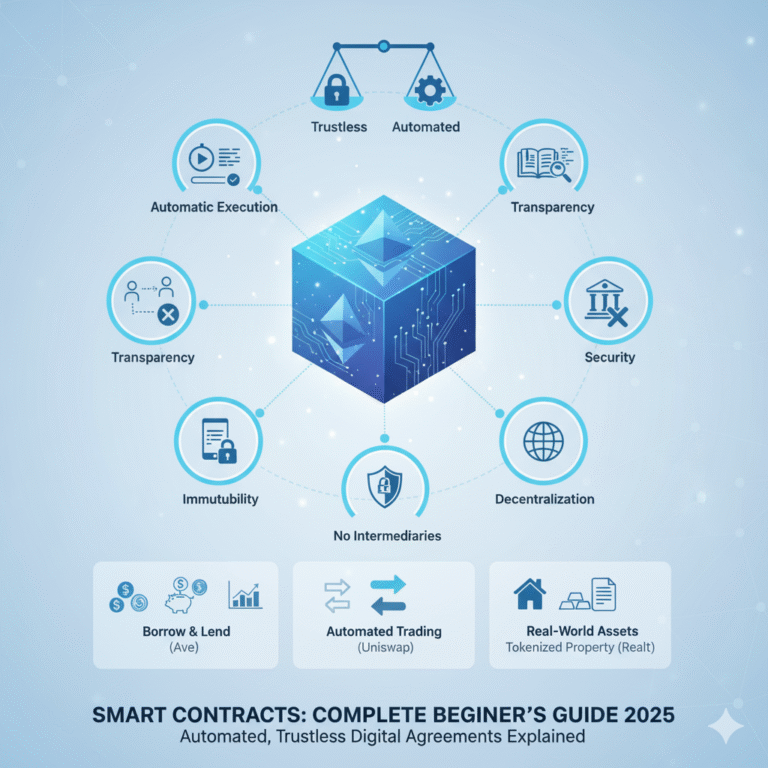
Smart Contracts: Complete Beginner’s Guide 2025 | What Are Smart Contracts?

6

What Are Smart Contracts? Understanding Blockchain Automation

Smart contracts are self-executing digital agreements that automatically run on blockchain networks like Ethereum when predetermined conditions are met. As the backbone of Decentralized Finance (DeFi), smart contracts eliminate intermediaries and enable trustless financial interactions. This comprehensive guide explains everything you need to know about smart contracts in 2025.

Smart Contract Definition: Digital Agreements That Execute Themselves

A smart contract is a computer program stored on a blockchain that automatically executes actions when specific conditions are fulfilled. Think of it as a digital vending machine: you insert money, select an item, and the machine automatically dispenses your purchase without human intervention.

Simple Smart Contract Analogy

Vending Machine = Smart Contract

  • Input: Physical money → Cryptocurrency
  • Condition: Item selection → Code execution
  • Output: Product delivery → Automatic transaction

This automation makes smart contracts revolutionary for creating decentralized applications (dApps) and DeFi protocols.

Related resources:

5 Key Features of Smart Contracts

1. Automatic Execution: Runs without human intervention once conditions are met

2. Transparency: Code is deployed as bytecode on-chain; human-readable source is visible when developers verify the contract on explorers like Etherscan.

3. Trustless Operation: No need for intermediaries or third parties

4. Immutability: Cannot be changed after deployment (note: many production protocols use upgradeable proxy patterns controlled by governance)

5. Decentralization: Operates on distributed blockchain networks

Learn more:

How Do Smart Contracts Work on Ethereum? Step-by-Step Process

Smart Contract Development and Execution Workflow

Smart contracts follow a precise technical process from creation to execution:

  1. Programming Phase: Written in Solidity programming language
  2. Ethereum Deployment: Uploaded to blockchain with unique contract address
  3. User Interaction: Transactions sent via crypto wallets (MetaMask)
  4. Condition Verification: Blockchain validates if requirements are met
  5. Automatic Execution: Contract performs programmed actions
  6. Transaction Recording: Results permanently stored on blockchain

Technical resources:

Understanding Gas Fees in Smart Contracts

Every smart contract operation requires gas fees – small payments in ETH that cover computational costs. Gas prices fluctuate based on network congestion, ranging from $1 to $100+ per transaction during peak periods.

Gas Fee Components:

  • Gas Limit: Maximum computational units allowed
  • Gas Price: Cost per unit in Gwei (1 ETH = 1 billion Gwei)
  • Total Fee: Gas Limit × Gas Price

Track gas prices:

Real-World Smart Contract Example: Automated Betting

Scenario: Two friends bet $10 on weather conditions

Traditional Method: Requires trust or escrow service

Smart Contract Solution:

  1. Both parties deposit $10 in ETH to the contract
  2. Contract is programmed to obtain the weather result via a decentralized oracle (e.g., Chainlink) rather than calling an external API directly
  3. If raining → Money goes to Friend A
  4. If sunny → Money goes to Friend B

Result: Automatic, trustless payout

Why oracle? Smart contracts can’t fetch web APIs by themselves; they need oracles to bring off-chain data on-chain.

Learn about oracles:

Smart Contracts in DeFi: Revolutionary Financial Applications

1. Decentralized Lending Protocols (Aave, Compound)

How It Works: Smart contracts manage liquidity pools for borrowing and lending

Process Flow:

  • Users deposit crypto assets to earn interest
  • Borrowers provide collateral (typically over-collateralized; exact minimums vary by asset/vault)
  • Smart contract automatically calculates interest rates
  • Liquidation triggered if collateral value drops below threshold

Real Example: Deposit 1 ETH in Aave, earn 4-8% APY while others borrow your ETH at 6-12% APR

Benefits: Higher yields than traditional banks, no credit checks required

Explore lending protocols:

2. Decentralized Exchanges (Uniswap, SushiSwap, PancakeSwap)

Technology: Automated Market Maker (AMM) model

Trading Mechanism:

  • Smart contracts hold token pairs in liquidity pools
  • Users trade directly against the pool
  • Prices determined by mathematical formulas (x*y=k)
  • Liquidity providers earn fees according to the pool’s fee tier (Uniswap v3 tiers include 0.01%, 0.05%, 0.3%, 1%)

Example Transaction: Swap 1 ETH for 2,500 USDC through Uniswap’s ETH/USDC pool

Advantages: 24/7 trading, no KYC requirements, global accessibility

Trade on DEXs:

3. Stablecoins: Price-Stable Cryptocurrencies (DAI, USDC)

Concept: Cryptocurrencies pegged to stable assets like USD

DAI Creation Process:

  1. Lock ETH collateral worth $150 (e.g., 0.05 ETH at $3,000)
  2. Generate 100 DAI stablecoins ($1 each)
  3. Use DAI for payments or DeFi activities
  4. Repay 100 DAI + stability fee to unlock ETH collateral

Clarification: Maker vaults have asset-specific liquidation ratios (commonly in the ~150–170%+ range, subject to governance).

Use Cases: Stable store of value, DeFi without volatility exposure

Stablecoin resources:

4. Yield Farming: Earning Passive Income

Definition: Providing liquidity to DeFi protocols in exchange for rewards

Yield Farming Strategies:

  • Liquidity Mining: Add tokens to DEX pools, earn trading fees + governance tokens
  • Lending/Borrowing: Supply assets to protocols like Compound for interest
  • Staking: Lock tokens in proof-of-stake networks for rewards

Potential Returns: 5-100%+ APY (high risk, high reward)

Example: Add $1,000 ETH/USDC to SushiSwap pool, earn $4-8/month in fees + SUSHI tokens

Yield farming platforms:

Benefits of Smart Contracts for Users

Financial Advantages

  • Higher Yields: DeFi protocols offer 3-20%+ returns vs 0.1% traditional savings
  • Lower Fees: Eliminate bank markups and intermediary costs
  • 24/7 Availability: Access financial services anytime, anywhere
  • Global Access: No geographic restrictions or minimum balances

Technological Benefits

  • Programmable Money: Create custom financial logic
  • Instant Settlements: Transactions settle in minutes, not days
  • Composability: Combine multiple protocols (DeFi legos)
  • Transparency: All transactions publicly verifiable

User Empowerment

  • Self-Custody: Full control over your assets
  • Permissionless: No approval needed to use protocols
  • Censorship Resistance: Cannot be shut down by authorities

Smart Contract Risks and Security Considerations

Technical Risks

Smart Contract Bugs and Vulnerabilities

Major Incident: Yam Finance (2020) — community-documented bug in rebase/governance logic; losses around $750,000 were reported and governance was impaired.

Risk Factors:

  • Complex code increases bug probability
  • Immutable contracts cannot be fixed
  • Interdependencies create cascade failures

Protection: Use audited protocols with bug bounty programs

Security audit resources:

Hacking and Exploits

Famous Case: The DAO hack (2016) — ≈$50 million stolen via a reentrancy-style vulnerability; led to the Ethereum/Ethereum Classic split.

Common Attack Vectors:

  • Reentrancy: Multiple function calls before state updates
  • Flash Loan Attacks: Manipulate prices with borrowed funds
  • Oracle Manipulation: Feed false price data to contracts

Prevention: Choose protocols with multiple security audits

Read about DeFi security:

Smart Contract Immutability Issues

Problem: Cannot fix bugs after deployment

Mitigation Strategies:

  • Proxy Patterns: Upgradeable contract architecture
  • Timelocks: Delayed implementation of changes
  • Multi-signature: Require multiple approvals for updates

Economic and Market Risks

High Gas Fees During Network Congestion

Solutions:

  • Layer 2 Networks: Arbitrum, Optimism, Polygon zkEVM (significantly cheaper; many L2 swaps cost cents vs dollars on L1)
  • Alternative Blockchains: BNB Chain, Avalanche
  • Gas Price Optimization: Time transactions during low activity

Compare L2 costs:

Impermanent Loss in Liquidity Pools

Explanation: Temporary loss when token prices diverge in LP pairs

Example: Provide ETH/USDC liquidity, ETH price doubles, you have less ETH than holding

Mitigation:

  • Use correlated asset pairs (ETH/wETH)
  • Monitor pool performance regularly
  • Calculate opportunity cost vs holding

Understand impermanent loss:

Smart Contract and Protocol Risks

  • Governance Risks: Protocol changes can affect user positions
  • Regulatory Risks: Government actions may impact DeFi protocols
  • Liquidity Risks: Difficulty exiting positions during market stress

How to Start Using Smart Contracts: Complete Tutorial

Step 1: Set Up Your Crypto Wallet

  1. Download MetaMask from official website
  2. Create New Wallet and securely store seed phrase
  3. Add Ethereum Network (usually default)
  4. Fund Wallet with ETH for gas fees

Get started:

Step 2: Buy Cryptocurrency

Centralized Exchanges: Coinbase, Binance, Kraken

Decentralized Options: Use fiat on-ramps like Ramp, MoonPay

Exchange platforms:

Step 3: First Smart Contract Interaction

  1. Visit Uniswap (app.uniswap.org)
  2. Connect MetaMask wallet
  3. Select Trading Pair (e.g., ETH → USDC)
  4. Set Slippage Tolerance (0.5-1% for stablecoins)
  5. Review Transaction and confirm gas fee
  6. Execute Swap and receive tokens

Step 4: Explore Advanced DeFi

  • Lending: Try Aave or Compound for earning interest
  • Yield Farming: Provide liquidity to earn rewards
  • Derivatives: Explore Synthetix or dYdX for advanced trading

DeFi platforms:

Step 5: Security Best Practices

  • Start Small: Test with $10-50 initially
  • Verify Addresses: Always double-check contract addresses
  • Use Hardware Wallets: Ledger or Trezor for large amounts
  • Stay Informed: Follow protocol announcements and security updates

Hardware wallet options:

Technological Developments

Layer 2 Scaling Solutions

Impact: 10–100x reduction in transaction costs vs L1 under typical conditions; many L2 actions now cost cents.

Leading Solutions:

  • Optimistic Rollups: Arbitrum, Optimism
  • ZK-Rollups: Polygon zkEVM, Starknet
  • Sidechains: Polygon PoS, BNB Chain

Explore Layer 2:

Cross-Chain Interoperability

Trend: Multi-chain DeFi ecosystem

Technologies: Bridges, wrapped tokens, cross-chain protocols

Examples: Thorchain, Cosmos IBC, Polkadot parachains

Cross-chain projects:

AI-Enhanced Smart Contracts

Innovation: Machine learning integration

Applications: Dynamic pricing, risk assessment, automated strategies

Projects: Numerai, Ocean Protocol, Fetch.ai

AI blockchain platforms:

Emerging Use Cases

Real Estate Tokenization

Concept: Fractional ownership via smart contracts

Benefits: Global liquidity, 24/7 trading, lower minimums

Platforms: RealT, Centrifuge, Roofstock onChain

Tokenized real estate:

Decentralized Insurance

Model: Parametric insurance via smart contracts

Coverage: DeFi protocols, crop insurance, flight delays

Projects: Nexus Mutual, InsurAce (note: Cover Protocol shut down in 2021)

DeFi insurance:

Supply Chain Management

Application: Track products from manufacture to consumer

Features: Authenticity verification, logistics optimization

Examples: VeChain, OriginTrail, Walmart blockchain

Supply chain blockchains:

Decentralized Governance (DAOs)

Structure: Community-controlled organizations

Voting: Token-weighted decision making

Examples: MakerDAO, Compound governance, Uniswap governance

Learn about DAOs:

Regulatory Landscape Evolution

  • Institutional Adoption: Banks exploring DeFi integration
  • CBDC Development: Central bank digital currencies
  • Compliance Tools: KYC/AML solutions for DeFi

Smart Contracts vs Traditional Finance: Comprehensive Comparison

FeatureSmart ContractsTraditional Finance
Operating Hours24/7/365Business hours only
Geographic AccessGlobal, permissionlessRestricted by location
Transaction SpeedMinutes to hoursDays to weeks
Fees$1–100+ gas fees$10–1000+ service fees
IntermediariesNone requiredBanks, brokers, clearinghouses
TransparencyFully open, auditable (bytecode on-chain; source if verified)Limited visibility
CustomizationHighly programmableStandard products only
Regulatory OversightMinimal, evolvingHeavy regulation
Technical RequirementsBasic crypto knowledgeNone for users
CustodySelf-custody optionsThird-party custody

Frequently Asked Questions (FAQ)

Do I need programming skills to use smart contracts?

No. Modern DeFi applications provide user-friendly interfaces. Basic cryptocurrency knowledge is sufficient for most users.

What’s the minimum amount needed to start?

$50–100 minimum recommended, including gas fees. Start with small amounts to learn without significant risk.

Can I lose all my money with smart contracts?

Yes, risks are substantial. Potential losses from hacks, bugs, impermanent loss, and market volatility. Never invest more than you can afford to lose.

Which smart contract platforms are most secure?

Battle-tested protocols: Uniswap, Aave, Compound, MakerDAO have years of operation and multiple security audits.

How do I avoid smart contract scams?

Due Diligence Checklist:

  • Verify official contract addresses
  • Check security audit reports
  • Review team backgrounds
  • Assess community activity and documentation
  • Avoid “too good to be true” yields

What happens if Ethereum fails?

Multi-chain strategy: Diversify across blockchains (Ethereum, Polygon, Solana, Avalanche). Smart contract technology will persist across platforms.

Top Smart Contract Platforms in 2025

Ethereum — The Original Smart Contract Platform

Market Cap: ≈$500B (Oct 9, 2025 snapshot)

Advantages: Largest ecosystem, most developers, maximum decentralization

Challenges: High gas fees, network congestion

Best For: Established protocols, maximum security needs

Official resources:

BNB Smart Chain — Low-Cost Alternative

Transaction Costs: $0.10–1.00 per transaction (typical)

Advantages: Fast transactions, EVM compatibility

Trade-offs: More centralized than Ethereum

Best For: Cost-sensitive applications, beginners

Learn more:

Polygon — Ethereum Layer 2 / Sidechain Solution

Performance: High throughput with low fees. Polygon PoS operates as an EVM-compatible sidechain that checkpoints to Ethereum.

Growth: Major brand partnerships, enterprise adoption

Best For: Scaling Ethereum dApps

Official documentation:

Solana — High-Performance Blockchain

Speed: Up to ~50,000 TPS (theoretical capacity); block times ~400ms per Solana Foundation materials.

Innovation: Proof of History (a cryptographic timekeeping mechanism) combined with Proof-of-Stake — PoH is not a standalone “consensus,” it augments PoS.

Ecosystem: Growing DeFi and NFT platforms

Considerations: Historical stability concerns

Explore Solana:

Smart Contract Investment Strategies for 2025

Conservative Approach (Lower Risk)

Portfolio Allocation:

  • 40% Blue-chip DeFi tokens (UNI, AAVE, COMP)
  • 30% Stablecoins in lending protocols
  • 20% Ethereum staking (post-Merge Ethereum; “ETH 2.0” naming is deprecated)
  • 10% Layer 2 tokens (MATIC, OP, ARB)

Expected Returns: 8–15% annually

Risk Level: Moderate

Aggressive Growth Strategy (Higher Risk)

Portfolio Allocation:

  • 25% Emerging DeFi protocols
  • 25% Yield farming opportunities
  • 20% Cross-chain bridge tokens
  • 15% DAO governance tokens
  • 15% NFT and GameFi projects

Expected Returns: 30–100%+ annually

Risk Level: High (possible 50%+ losses)

Dollar-Cost Averaging (DCA) Strategy

Method: Regular purchases regardless of price

Benefits: Reduces timing risk, builds positions gradually

Implementation: Weekly/monthly buys of major DeFi tokens

Timeframe: 12–24 months minimum

Conclusion: The Future Is Built on Smart Contracts

Smart contracts represent a fundamental shift in how we interact with financial systems, creating unprecedented opportunities for:

  • Global Financial Inclusion: Access for the unbanked population
  • Programmable Money: Custom financial logic and automation
  • Disintermediation: Removing costly middlemen
  • Innovation Acceleration: Rapid development of new financial products

Key Takeaways for 2025

  • Mass Adoption: Institutional players entering DeFi space
  • Infrastructure Maturation: Better UX, lower costs, higher security
  • Regulatory Clarity: Clearer rules enabling mainstream adoption
  • Cross-Chain Future: Multi-blockchain ecosystem integration

Your Next Steps

  • Education: Continue learning about blockchain technology
  • Practice: Start with small amounts on testnet or mainnet
  • Community: Join Discord/Telegram groups of major protocols
  • Patience: Build knowledge and positions gradually over time

Smart contracts are revolutionizing finance. Don’t miss the opportunity to be part of this transformation.


Disclaimer: This content is for educational purposes only and does not constitute financial advice. Always conduct your own research (DYOR) before making financial decisions. Cryptocurrency investments carry substantial risk.

Additional Educational Resources:

What Is DeFi on Ethereum? A Complete Beginner’s Guide 2025

6

Decentralized Finance (DeFi) represents one of the most revolutionary developments in blockchain technology. This comprehensive guide explains DeFi on Ethereum, smart contracts, and how to get started with crypto wallets and DeFi applications.

What Is DeFi? Understanding Decentralized Finance

DeFi (Decentralized Finance) eliminates traditional financial intermediaries like banks by using blockchain technology. Instead of relying on centralized institutions, DeFi enables peer-to-peer financial transactions through smart contracts.

Traditional banking requires credit checks, paperwork, and approval processes. DeFi applications allow instant borrowing, lending, and trading without middlemen, offering greater accessibility and often higher returns for certain financial activities.

Why Ethereum Powers Most DeFi Applications

Ethereum dominates the DeFi ecosystem because it pioneered smart contracts—self-executing programs that automatically enforce agreements. While other blockchains like Binance Smart Chain and Polygon support DeFi, Ethereum remains the largest DeFi platform with roughly $93 billion in total value locked (TVL) as of October 2025, though this figure changes daily based on market conditions.

Smart contracts work like digital vending machines: insert the correct input, and the contract automatically executes the programmed outcome without human intervention. This automation removes the need for banks, lawyers, or other intermediaries to validate transactions.

For current TVL data, visit DeFiLlama, which provides real-time analytics across DeFi protocols.

Essential DeFi Components

To participate in DeFi, you need three fundamental elements:

Crypto Wallet: MetaMask, Trust Wallet, or Coinbase Wallet serve as your gateway to DeFi protocols. These non-custodial wallets give you full control over your private keys and assets.

Cryptocurrency: ETH or ERC-20 tokens are required to interact with Ethereum-based DeFi protocols. ETH specifically is needed to pay transaction fees (gas fees) on the network.

Internet Connection: Access DeFi protocols through web browsers by connecting your wallet to decentralized applications (dApps).

Top DeFi Use Cases and Platforms

1. Lending and Borrowing Protocols

Popular platforms like Aave and Compound have transformed how cryptocurrency holders access capital. These protocols allow users to deposit cryptocurrency to earn interest or borrow against collateral without credit checks or lengthy approval processes.

Interest rates are variable and algorithmic, adjusting based on the utilization of each lending pool. For major assets on large markets, supply APY often ranges from sub-1% to low-single-digits, while smaller or more volatile assets can offer higher rates. Always check live market rates before depositing funds.

Real-world example: When you deposit 1 ETH into Aave’s lending pool, you earn a variable supply rate determined by borrower demand. Borrowers accessing that liquidity pay a higher variable rate based on pool utilization.

The decentralized nature means rates respond to real-time market dynamics rather than centralized bank decisions. However, borrowers must maintain sufficient collateralization ratios to avoid liquidations if their collateral value drops.

2. Decentralized Exchanges (DEXs)

Leading DEXs like Uniswap and SushiSwap enable cryptocurrency trading directly from your wallet without account registration or identity verification.

These platforms use automated market makers (AMMs) instead of traditional order books. AMMs rely on liquidity pools funded by users, enabling instant token swaps at algorithmically determined prices. This innovation solved the liquidity problem that plagued early decentralized exchanges.

Benefits of DEXs include permissionless access, resistance to censorship, and elimination of custodial risk since your assets never leave your wallet until the trade executes.

3. Stablecoins for Price Stability

Major stablecoins like USDC and DAI provide the utility of cryptocurrency without price volatility, targeting a stable $1.00 value.

DAI is overcollateralized and governed by MakerDAO, a decentralized autonomous organization. Users generate DAI by locking up cryptocurrency collateral in smart contracts, maintaining stability through algorithmic mechanisms.

USDC is issued by Circle and backed by cash reserves and short-term U.S. Treasury bonds, offering a more centralized but highly liquid stablecoin option.

Stablecoins serve as the backbone of DeFi, enabling users to lock in profits, avoid volatility, and move value between protocols without converting back to traditional fiat currency.

4. Yield Farming and Liquidity Mining

Yield farming involves providing liquidity to trading pairs on decentralized exchanges to earn trading fees and sometimes additional token rewards. Returns vary widely and are not guaranteed—they depend on trading volume, fee structure, and protocol incentives.

A common strategy involves providing liquidity to ETH/USDC pools on platforms documented in Uniswap’s guides. Liquidity providers earn a percentage of trading fees generated by the pool.

Critical Risk Consideration: Impermanent loss occurs when token prices diverge significantly from when you deposited them. If ETH doubles in price relative to USDC, you would have been better off simply holding ETH rather than providing liquidity. Use reputable impermanent loss calculators and thoroughly research pool behavior before committing capital.

5. DeFi Insurance

Platforms like Nexus Mutual and InsurAce provide protection against smart contract failures and other specified risks in the DeFi ecosystem.

These protocols operate differently from traditional insurance—Nexus Mutual functions as a discretionary mutual where members assess claims, while InsurAce offers parametric coverage options.

Coverage can protect against smart contract exploits, oracle failures, and severe depeg events. Always read policy terms carefully and review claim histories before purchasing coverage, as the DeFi insurance sector is still maturing.

DeFi Benefits vs Traditional Finance

FeatureDeFiTraditional Finance
AccessGlobal, 24/7 availabilityLimited by location and banking hours
ApprovalPermissionless participationCredit checks and approval required
Interest RatesMarket-driven; can be competitiveTypically lower for deposit accounts
ControlFull self-custody possibleBank custody and control
TransparencyPublic blockchain verificationPrivate ledgers

DeFi’s composability allows protocols to integrate seamlessly—you can borrow from Aave, swap on Uniswap, and provide liquidity to Curve, all in minutes. This “money lego” functionality creates unprecedented financial flexibility.

Critical DeFi Risks to Understand

Smart Contract Vulnerabilities

Code bugs can cause permanent fund loss, as blockchain transactions are irreversible. Even audited protocols have suffered exploits resulting in millions of dollars in losses.

Review security audits from multiple firms (not just one), check for active bug bounty programs, and prioritize protocols with proven track records. Platforms like Aave publish their audit reports and maintain substantial bug bounties to incentivize security research.

Impermanent Loss

Liquidity providers face impermanent loss when token prices change relative to each other. This “loss” is impermanent because it only becomes permanent when you withdraw liquidity.

The more volatile the price movement, the greater the potential impermanent loss. Use calculators to model different scenarios before providing liquidity, especially for volatile trading pairs.

Regulatory Uncertainty

Government policies regarding DeFi continue evolving, with potential impacts on protocol access and compliance requirements. Different jurisdictions are taking varied approaches to DeFi regulation.

Follow reputable sources like DeFiLlama for data and analytics, and publications like The Defiant and Bankless for industry news and regulatory developments.

Gas Fees on Ethereum

After Ethereum’s 2024 Dencun upgrade implementing EIP-4844, average Layer 1 fees have often fallen under $1 during normal network conditions, though they spike during periods of high demand.

Layer 2 scaling solutions like Arbitrum and Optimism offer significantly lower transaction costs while maintaining Ethereum’s security guarantees. Check current gas prices on Etherscan or YCharts before executing transactions.

For frequently interacting with DeFi protocols, consider using Layer 2 networks where transaction costs are often measured in cents rather than dollars.

Step-by-Step Guide: Getting Started with DeFi

Step 1: Set Up Your Crypto Wallet

Download the MetaMask browser extension from the official website. MetaMask serves as your gateway to Ethereum DeFi applications.

Create a new wallet and securely store your 12-word seed phrase—this is your master key to recovering your wallet. Write it down on paper and store it in a secure location. Never share your private keys or seed phrase with anyone, as this gives complete control over your funds.

Step 2: Buy ETH

Purchase ETH on centralized exchanges like Coinbase, Binance, or Kraken. These platforms accept traditional payment methods including bank transfers and credit cards.

After purchasing, transfer ETH to your MetaMask wallet address. You’ll need ETH both as an asset and to pay gas fees for transactions on Ethereum.

Step 3: Choose Reputable DeFi Protocols

Start with established platforms that have proven track records:

  • Trading: Uniswap for decentralized token swaps
  • Lending: Aave for earning interest on deposits
  • Stablecoins: Convert ETH to USDC on Uniswap for price stability

For a comprehensive overview of the best protocols across different blockchains, check out our guide on top DeFi protocols in 2025.

Prioritize protocols with significant total value locked, multiple security audits, and active development communities.

Step 4: Start Small and Learn

Begin with small amounts ($50-200) to understand how protocols work without risking substantial capital. Each transaction will teach you about wallet connections, transaction confirmation, gas fee estimation, and protocol interfaces.

Follow educational resources like Bankless and The Defiant for ongoing DeFi education, protocol reviews, and industry analysis.

Advanced DeFi Strategies

Yield Optimization

Platforms like Yearn Finance offer automated vault strategies that shift capital among various yield opportunities to optimize returns.

These vaults employ sophisticated strategies including lending, liquidity provision, and yield farming across multiple protocols. Understanding the difference between real yield and unsustainable tokenomics is crucial before depositing. Understand the specific strategy risks, performance fees, and withdrawal terms before committing capital.

Cross-Chain DeFi

Explore opportunities beyond Ethereum on networks like Polygon, Avalanche, and Solana for lower transaction fees and different yield profiles.

Each blockchain offers unique advantages—Polygon provides Ethereum compatibility with lower costs, Avalanche emphasizes transaction speed, and Solana offers high throughput for specific applications. Research bridge security and protocol reputation before moving assets cross-chain.

DeFi Analytics and Research Tools

Track your portfolio and discover new opportunities using specialized tools:

Portfolio Tracking: Zapper and DeBank provide comprehensive dashboards showing your positions across multiple protocols and chains.

Protocol Analytics: DeFiLlama offers broad, current TVL data and protocol comparisons across the entire DeFi ecosystem.

Yield Comparisons: DeFi Rate provides curated lists of yield opportunities and educational content for evaluating strategies.

These tools aggregate data from hundreds of protocols, saving hours of manual research and helping you identify emerging opportunities.

The Future of DeFi on Ethereum

DeFi continues evolving with Ethereum’s post-Merge roadmap. EIP-4844 (proto-danksharding) launched in 2024 and reduced data costs for Layer 2 solutions, with full danksharding on the roadmap to further scale throughput.

Major companies are integrating blockchain rails into traditional finance. Visa has piloted USDC settlement programs, while PayPal launched PYUSD, its own stablecoin. Traditional financial institutions are experimenting with tokenization and on-chain finance infrastructure.

Since The Merge in September 2022, Ethereum has operated on proof-of-stake, cutting energy consumption by approximately 99.95%. Future scaling focuses on danksharding and Layer 2 rollups rather than increasing Layer 1 capacity.

The “Ethereum 2.0” terminology is outdated—Ethereum now runs as a unified proof-of-stake network with ongoing upgrades focused on scalability, security, and sustainability.

Getting Started Today

DeFi represents the future of finance—open, transparent, and globally accessible. While risks exist, starting with small amounts on established platforms like Uniswap and Aave provides valuable hands-on experience with this transformative technology.

Remember these key principles:

  • Never invest more than you can afford to lose completely. DeFi remains an emerging sector with technical and market risks.
  • Always research protocols thoroughly by reviewing audits, checking TVL on DeFiLlama, and reading community feedback.
  • Keep learning through reputable educational resources, staying current with protocol updates and security best practices.

The decentralized finance revolution is just beginning. By understanding these fundamentals and starting cautiously, you can participate in reshaping how the world handles money, loans, and financial markets—without relying on traditional intermediaries.

Ethereum for Business: Real-World Use Cases in 2025

2

Ethereum has grown far beyond digital money to become a game-changing business platform in 2025. Today, companies worldwide are using Ethereum’s blockchain technology to solve real-world problems, cut costs, and boost security. In this detailed guide, we’ll explore how companies are actually using ETH and why it’s reshaping entire industries.

What Is Ethereum and Why It Matters for Business

First and foremost, Ethereum is a decentralized blockchain platform created by Vitalik Buterin in 2015. Unlike Bitcoin, which mainly serves as digital currency, Ethereum works as a global computer. As a result, it lets businesses build decentralized apps (dApps) and run smart contracts—self-running digital deals that automatically enforce terms when set conditions are met. Therefore, this removes middlemen, cuts costs, and boosts transaction speed and security.

Top 7 Ethereum Business Use Cases in 2025

1. Supply Chain Transparency and Management

To begin with, leading luxury brands have embraced Ethereum-based blockchain solutions for product checking and tracking. For example, the Aura Blockchain Consortium, founded by LVMH, Prada, and Cartier, uses ConsenSys Quorum—a private Ethereum-based platform—to give customers verified product history and fake-product protection.

On the other hand, while major retailers like Walmart and Unilever use blockchain for food tracking, their programs run on IBM Food Trust (Hyperledger Fabric) rather than public Ethereum. Nevertheless, the luxury sector’s use of Ethereum-stack solutions shows the technology’s real-world value.

Key Benefits:

  • Real-time product tracking across complex supply chains
  • Strong protection against fake products through permanent records
  • Automated supplier payments via smart contracts that trigger upon delivery
  • Better consumer trust through clear product journey records

2. Decentralized Finance (DeFi) Revolution

Moreover, DeFi platforms built on Ethereum are changing business finance completely. In particular, platforms like Aave and Uniswap allow businesses to access lending, borrowing, and trading services without traditional banks. Furthermore, peer-reviewed research in academic journals shows that Ethereum-based exchanges like Uniswap can greatly reduce working costs for currency exchange and cash management.

Business Uses:

  • Instant cross-border payments that settle within minutes rather than days
  • Automated loan processing with programmable collateral needs
  • Treasury management using stablecoins for efficient cash flow
  • Much lower financial middleman costs through direct deals

3. Digital Identity and Data Security

In addition, Ethereum enables self-sovereign identity solutions that give businesses and people better control over personal data. Specifically, the did:ethr (Ethereum-based identity method) has been widely added to enterprise identity tools and registries. This is documented by the Decentralized Identity Foundation and used across various GitHub projects.

Meanwhile, although Microsoft’s ION network runs on Bitcoin’s Sidetree protocol, Ethereum-based identity methods have gained strong enterprise adoption. This is mainly due to robust tools and developer support.

Enterprise Benefits:

  • Much lower data breach risks through decentralized identity management
  • Faster customer onboarding with verified credentials
  • GDPR compliance support through user-controlled data sharing
  • Better privacy protection via selective disclosure tools

4. Healthcare Data Management

Similarly, Ethereum and Ethereum-based private networks can secure sensitive medical data while allowing authorized sharing between healthcare providers. In practice, common enterprise uses include secure electronic health record sharing, automated insurance claim processing, and clinical trial data checking. Typically, these are set up via private EVM (Ethereum Virtual Machine) networks or healthcare groups.

As a result, these solutions address critical healthcare challenges including system compatibility, patient privacy, and administrative waste while maintaining HIPAA compliance.

5. Asset Tokenization and Investment

Additionally, JPMorgan’s Tokenized Collateral Network represents a real institutional use case. In fact, it has tokenized BlackRock money-market fund shares for collateral transfers on JPMorgan’s Quorum/Onyx platform—an Ethereum-based private blockchain. Although JPM Coin itself works as a private deposit token for wholesale payments rather than public-Ethereum tokenization, these projects show blockchain’s power to transform traditional finance through tokenization of real-world assets.

Business Opportunities:

  • Fractional real estate ownership enabling smaller investors to access premium properties
  • Corporate share tokenization for better liquidity and 24/7 trading
  • Intellectual property monetization through programmable royalty payments
  • Better fundraising options via security token offerings (STOs)

6. Decentralized Autonomous Organizations (DAOs)

Furthermore, DAOs represent an innovative business structure where decisions are made collectively through blockchain-based voting. Indeed, Ethereum’s DAO ecosystem has grown rapidly in 2025, with organizations managing billions in assets through smart contract governance.

Corporate Uses:

  • Transparent governance systems with permanent voting records
  • Community-driven project funding with programmable treasury allocation
  • Automated organizational processes reducing bureaucratic overhead
  • Lower administrative costs through smart contract execution

7. International Payments and Remittances

What’s more, major payment networks have integrated blockchain technology for better settlement. For instance, Visa has expanded USDC (USD Coin) settlement to more networks and merchant acquirers, as detailed in their investor communications. At the same time, Mastercard is testing its Multi-Token Network (MTN) for programmable, cross-border, and B2B settlements. Ultimately, these are concrete blockchain integrations reshaping enterprise payments infrastructure.

Business Benefits:

  • 24/7 transaction processing without banking hour limits
  • Lower currency exchange fees through direct cryptocurrency conversion
  • Faster settlement times—minutes instead of days for international transfers
  • Better payment transparency with real-time transaction tracking

Why Businesses Choose Ethereum in 2025

Technical Benefits

Scalability: First of all, Layer-2 rollup solutions like Arbitrum and Optimism have greatly reduced transaction costs versus Ethereum Layer-1 while increasing speed. Additionally, solutions like Base by Coinbase have made Ethereum more accessible for businesses. Post-Merge upgrades including EIP-4844 (proto-danksharding) further reduced data costs for Layer-2 networks. Learn more about how these Layer-2 solutions scale Ethereum for enterprise adoption.

Security: In terms of security, Ethereum’s decentralized design with thousands of validator nodes minimizes single points of failure. Thus, it creates resilient infrastructure for mission-critical business uses.

Interoperability: Beyond that, broad EVM tooling across public and private networks simplifies integration with legacy enterprise systems. As a result, this reduces setup complexity and costs.

Economic Benefits

Cost Reduction: By removing middlemen through smart contracts, businesses reduce working expenses across payment processing, contract execution, and administrative workflows.

Revenue Opportunities: At the same time, businesses can create new business models through asset tokenization, DeFi integration, and programmable value transfer.

Global Market Access: Finally, 24/7 blockchain operation enables worldwide business expansion without geographical or time limits.

Overcoming Ethereum Implementation Challenges

Scalability Solutions

Rather than referencing outdated “Ethereum 2.0” terminology, businesses should understand the post-Merge roadmap. Specifically, The Merge transitioned Ethereum to proof-of-stake in September 2022, Shanghai enabled validator withdrawals in 2023, and EIP-4844 launched in 2024-2025. Combined with Layer-2 solutions like Arbitrum and Optimism that batch and compress transactions, these upgrades have made enterprise adoption much more viable. This is explained in Investopedia’s blockchain coverage.

Regulatory Compliance

On the regulatory front, the Enterprise Ethereum Alliance (EEA) connects businesses, publishes technical specs, and brings stakeholders together. Its board includes major firms like JP Morgan, Microsoft, ConsenSys, and EY as of 2025. However, while the EEA works as an industry body rather than a regulator, it provides valuable frameworks for compliance with evolving rules across jurisdictions.

Integration Complexity

Fortunately, professional blockchain development services and enterprise-grade tools are simplifying integration. In particular, private Ethereum variants like Quorum (documented by JPMorgan) are making it easier for traditional businesses to transition to blockchain infrastructure.

Future Outlook: Ethereum’s Business Ecosystem

Looking ahead, the Enterprise Ethereum Alliance continues driving business adoption through collaboration between major enterprises and web3 organizations. Key 2025 trends include:

Industry-Specific Solutions: First, tailored blockchain uses are addressing unique needs in healthcare, finance, supply chain, and manufacturing sectors.

Hybrid Cloud Integration: Second, seamless connection between private Ethereum networks (like Quorum-based setups) and public Ethereum infrastructure enables flexible deployment options.

AI and IoT Integration: Third, smart contracts increasingly interact with connected devices and machine learning-driven workflows. This creates autonomous business processes.

Carbon-Neutral Operations: Lastly, Ethereum’s transition to proof-of-stake reduced energy usage by roughly 99.95% versus proof-of-work. Therefore, it supports corporate sustainability goals and ESG commitments, as reported by financial education platforms including Investopedia.

Getting Started with Ethereum for Business

In conclusion, companies interested in Ethereum adoption should follow this strategic approach:

Assess Use Cases: Initially, identify specific business processes that benefit from transparency, automation, or removing middlemen—areas where blockchain provides genuine competitive advantage.

Partner with Experts: Next, work with experienced blockchain developers and consultants who understand both Ethereum technology and enterprise needs. Consider working with firms like ConsenSys, EY, or other EEA members.

Start Small: Then, launch pilot projects to validate technical feasibility and business value before committing to full-scale setup.

Stay Informed: Finally, follow Ethereum Foundation updates, industry developments, and the Enterprise Ethereum Alliance’s specs to remain current with evolving best practices.

Conclusion

In summary, Ethereum is fundamentally changing how businesses operate in 2025, offering unprecedented opportunities for efficiency, transparency, and innovation. From luxury supply chain checking to institutional asset tokenization, smart contracts are automating processes and reducing costs across industries.

Moving forward, as regulatory frameworks mature and technical solutions continue improving, Ethereum adoption will accelerate throughout the global economy. Therefore, businesses that strategically embrace this technology position themselves for sustainable competitive advantages in tomorrow’s digital economy. Whether you’re exploring blockchain for the first time or expanding existing setups, Ethereum provides robust infrastructure for next-generation business solutions.

Ultimately, the critical question facing every industry isn’t whether blockchain will drive transformation—it’s how quickly organizations will adapt to leverage its revolutionary potential for operational excellence, cost reduction, and market differentiation.


External Resources

Bitcoin vs Ethereum: Complete Investment Guide for 2025

The cryptocurrency market continues to evolve rapidly in 2025. Bitcoin (BTC) and Ethereum (ETH) remain the dominant forces in digital finance. As of October 9, 2025, the crypto market stands at approximately $4.1 trillion. Investors now face a crucial decision: which digital asset offers better investment potential?

Understanding Bitcoin and Ethereum

Bitcoin: Digital Gold Standard

Bitcoin launched in 2009 by the mysterious Satoshi Nakamoto. It revolutionized digital finance as the world’s first cryptocurrency. Operating on a decentralized blockchain network, it functions as “digital gold.” This creates a store of value independent of traditional banks.

Key Bitcoin Features:

The coin has a fixed supply capped at 21 million. It uses a Proof of Work system that is energy-intensive but highly secure. Market dominance remains strong with over $2.3–$2.5 trillion in market cap at recent October 2025 prices. The primary use centers on value storage and peer-to-peer transactions.

Ethereum: The World Computer

Vitalik Buterin created Ethereum in 2015. This platform extends beyond simple cryptocurrency transactions. The blockchain enables smart contracts and decentralized applications (dApps). It powers the DeFi ecosystem and NFT markets.

Key Ethereum Features:

Smart contracts execute agreements automatically through code. The network operates on an energy-efficient Proof of Stake system since 2022. This shift reduced energy use by roughly 99.95%. Unlike Bitcoin, there’s no fixed supply cap. Base fees are burned, making net supply mildly inflationary or deflationary based on activity. The platform serves dApps, DeFi, and Web3 applications.

Why Invest in Cryptocurrency in 2025?

Institutional adoption has accelerated significantly:

U.S. spot Bitcoin ETFs received approval on January 10, 2024. Spot Ether ETFs began trading on July 23, 2024. These mark major regulatory milestones. Companies like Strategy (formerly MicroStrategy) hold massive BTC treasuries. Reports show approximately 640,000 BTC as of October 2025.

El Salvador adopted Bitcoin as legal tender in 2021. This demonstrated government-level recognition. Many investors view scarce digital assets as a hedge against currency loss. Recent safe-haven flows support this narrative. Understanding how Bitcoin and Ethereum are regulated worldwide is crucial for informed investment decisions.

Bitcoin Investment Analysis 2025

Bitcoin Strengths

The coin maintains market leadership as the largest cryptocurrency by value. Strong brand recognition and institutional trust remain key advantages. Approximately 19.8 million of the 21 million total coins are already in circulation as of Q2 2025.

Institutional infrastructure has strengthened dramatically. Spot BTC ETFs saw very large inflows and assets under management in 2024–2025. BlackRock’s IBIT is nearing $100 billion in AUM. The network has operated for over 15 years without a protocol-level security breach.

Bitcoin Limitations

Scalability remains a challenge. On-chain throughput generally limits to 3–7 transactions per second. Energy consumption stays significant. Recent estimates place annual usage around 138 TWh according to 2025 Cambridge analysis.

Functionality is limited compared to programmable platforms. The focus stays on payments and value storage rather than broader applications.

Bitcoin Price Outlook

The coin reached new all-time highs above $125,000 in October 2025. ETF inflows and post-halving dynamics drove this growth. Forward price targets vary across analysts. Treat forecasts cautiously.

Ethereum Investment Analysis 2025

Ethereum Strengths

The platform demonstrates clear ecosystem dominance. It hosts thousands of dApps across DeFi, NFTs, and stablecoins. Energy efficiency improved dramatically after the 2022 Merge to Proof of Stake. Usage dropped approximately 99.95%.

Layer-2 scaling solutions now handle a large share of network activity. Arbitrum, Base, and Optimism enable very high throughput with low fees. Staking offers typical yields of 3%–5% APY depending on setup and MEV opportunities.

Developer engagement remains high. Millions of smart contracts have been deployed on the network.

Ethereum Challenges

Competition comes from alternatives like Solana that offer high throughput and low fees. Complexity creates challenges. Smart-contract risks can introduce attack vectors.

Fee volatility persists. Mainnet gas prices can still spike during congestion periods. Layer-2 solutions mitigate most of this impact.

Ethereum Price Outlook

ETH traded in the $4,100–$4,500 range in late September and early October 2025. Banks’ year-end targets vary. Citi’s baseline projection sits at $4,300. Some institutions forecast higher levels.

Investment Strategy Comparison

Choose Bitcoin If:

You are a risk-averse investor seeking digital asset exposure. An inflation hedge against fiat currency loss appeals to you. Long-term wealth preservation is your focus. You prefer a simple investment without technological complexity.

Choose Ethereum If:

You believe in Web3 and DeFi platform growth potential. Higher risk tolerance for potentially greater returns suits your profile. Earning staking income interests you. Exposure to innovation across dApps, NFTs, and Layer-2 systems appeals to your strategy.

Portfolio Diversification Strategy

Many experts prefer a balanced approach with various allocation models:

  • 60% BTC / 40% ETH for stability-focused investors
  • 40% BTC / 60% ETH for growth-oriented portfolios
  • 50/50 for balanced exposure

These allocation examples are illustrative rather than specific advice.

Key Investment Risks

Market volatility presents significant challenges. Double-digit percentage swings are possible within weeks. Both BTC and ETH experienced this in September–October 2025.

Regulatory uncertainty creates ongoing concerns. Policy shifts can materially affect pricing and access. Technology risks include smart-contract bugs and network upgrade challenges.

Ongoing competition exists as new blockchain platforms challenge established leaders. Scaling models continue to evolve.

How to Invest Safely

Choose reputable exchanges like Coinbase, Kraken, or Binance. For those just starting out, explore the top crypto exchanges for beginners to find the platform that best suits your needs.

Secure long-term holdings in hardware wallets such as Ledger or Trezor. Learn more about the best crypto wallets for beginners to protect your investments. Start with small amounts you can afford to lose completely.

Stay informed through reputable sources like CoinDesk and Reuters. Employ dollar-cost averaging with fixed-amount purchases. This reduces timing risk.

2025 Market Outlook

The cryptocurrency market is maturing with record institutional participation. Spot ETFs for both BTC and ETH show rising assets under management. Layer-2 ecosystems continue improving cost efficiency and throughput. Stablecoin adoption supports increasing on-chain activity.

Key Trends:

Growing institutional access through regulated ETFs for both coins. Rising stablecoin usage across the technology stack. Layer-2 scaling solutions offload a significant share of transactions from the main network.

Final Investment Considerations

Neither coin represents a guaranteed investment opportunity. Success depends on market conditions, technological developments, and regulatory environments beyond investor control.

Before investing, conduct thorough research using multiple sources. Understand your risk tolerance and investment timeline. Consider consulting qualified financial advisors. Only invest funds you can afford to lose completely.

Both coins continue shaping the future of digital finance in 2025. One offers stability and broad institutional acceptance. The other provides innovation exposure and ecosystem growth potential. The optimal choice depends on your investment objectives, risk tolerance, and conviction in long-term crypto adoption.

Success in the volatile cryptocurrency market requires patience, research, and disciplined risk management.


External Resources

Regulatory & Market Data:

Research & Analysis:

Technical Resources:

Trading & Storage:


Disclaimer: This content is for informational purposes only and does not constitute financial advice. Cryptocurrency investments carry significant risks, including total loss of capital. Always conduct your own research and consult with qualified financial professionals before making investment decisions.

NFTs on Ethereum: Still Relevant or Already Dead?

1

Short answer: NFTs on Ethereum aren’t dead — they’ve matured. Speculation has cooled, but real use cases are emerging, and Ethereum still handles a substantial slice of the market.

What Is an NFT (and Why Ethereum)?

A Non-Fungible Token (NFT) is a unique digital certificate stored on blockchain, proving provable ownership or provenance of a digital or physical asset. Ethereum pioneered this model via ERC-721 and ERC-1155 standards, enabling trustless secondary marketplaces and composability across decentralized applications.

The Ethereum blockchain became the natural home for NFTs because its smart contract functionality allowed developers to create programmable, interoperable tokens. Unlike fungible tokens where each unit is identical, NFTs represent distinct items — whether digital art, virtual real estate, or membership credentials.

From Boom to Correction: The NFT Market Evolution

The 2021 Peak

The NFT market surged to approximately $25.1 billion in sales during 2021, with Beeple’s $69 million Christie’s auction becoming an iconic cultural moment. Major brands, gaming companies, and celebrities rushed into the space, treating NFTs as the next frontier of digital ownership.

The 2022-23 Downturn

Trading volumes fell sharply as speculative interest waned. While some sources claimed 95% of NFT collections became inactive or “worthless,” that statistic stems from narrow studies examining specific collection samples and should be qualified. What actually occurred was market consolidation — weak projects disappeared while serious builders remained.

The NFT Landscape in 2025

Current Market Metrics

Based on current market data from sources like CoinLedger and DappRadar, the NFT landscape in 2025 shows these key metrics:

  • The global NFT market is estimated at approximately $49 billion in 2025
  • NFT sales in the first half of 2025 totaled $2.82 billion, representing only a 4.6% decline from late 2024, while the number of sales climbed nearly 80%
  • Ethereum continues to dominate, powering nearly 62% of all NFT transactions in 2025
  • OpenSea remains the top marketplace with over 2.4 million monthly active users in Q2 2025
  • Gaming NFTs have surged, accounting for 38% of total transaction volume this year
  • The average sale price for NFTs has stabilized at around $940, indicating maturing buyer behavior

Chain Distribution in 2025

Solana powers around 18% of NFT traffic in 2025, known for its fast and low-cost transactions, while BNB Chain supports a variety of DeFi-NFT hybrids with around 6% market share. Ethereum Layer-2 solutions Arbitrum and Optimism together account for nearly 9% of transaction volume due to scaling benefits. For a detailed comparison of how Ethereum and Solana NFT ecosystems stack up, check out our guide on Ethereum vs Solana NFTs.

Marketplace Dynamics

While OpenSea maintains strong brand recognition and user base, the marketplace landscape has become more competitive. Blur, Magic Eden, and Rarible now serve different niches, from gaming-focused marketplaces to luxury brand NFT drops. To understand which platform best fits your needs, read our comprehensive NFT marketplaces comparison guide.

Why Some Say “NFTs Are Dead” — But Not Quite

Several factors contribute to the “NFTs are dead” narrative:

Low liquidity in many collections. A majority of collections display minimal trade activity — typical behavior in a matured market where consolidation occurs naturally.

Scams, hacks, and wallet exploits dent trust. Security hygiene remains critical, with phishing attacks and contract vulnerabilities continuing to pose risks to collectors.

Environmental criticisms are outdated for Ethereum. After The Merge, the average NFT mint on Ethereum now consumes 99.95% less energy than pre-2022, making NFTs more eco-friendly. The NFT sector has reduced its estimated carbon footprint by over 75% between 2021 and 2025.

Overhype versus tech failure. The correction weeded out weak projects while Ethereum’s infrastructure continues evolving. The shift suggests fewer speculative bubbles and more consistent adoption, with long-term holders dominating activity.

Where Real Utility Is Emerging

Gaming and Metaverse Assets

Gaming NFTs account for 38% of total NFT transaction volume in 2025, though actual developer adoption remains limited. Only 7% of game developers are very interested in incorporating NFTs into their work, with a dominant 70% not interested. Play-to-earn models continue evolving, with platforms like Axie Infinity and The Sandbox leading in-game NFT integration, though scaling remains a challenge. To understand how blockchain gaming actually works and why NFTs play a crucial role, read our in-depth guide on Ethereum gaming and blockchain games.

NFTs in Decentralized Finance

Projects like BendDAO, JPEG’d, and others enable using NFTs as collateral or accessing credit/liquidity. These protocols allow NFT holders to access DeFi services without selling their assets.

Fractional Ownership

Fractional ownership protocols enable multiple investors to own shares of high-value NFTs, improving accessibility to blue-chip collections that would otherwise be out of reach for individual collectors.

Digital Identity and Credentials

ENS (Ethereum Name Service) serves as a unified web3 identifier. Protocols like Sign-In with Ethereum (SIWE) and Ethereum Attestation Service tie identity, authentication, and attestation to NFT-like records, creating portable digital identity systems across platforms.

Tokenized Real-World Assets (RWAs)

According to RWA.xyz, the real-world asset tokenization market reached $24 billion in size in mid-2025, having grown 380% in three years. With an on-chain value reaching $30 billion in 2025, representing a massive 400% growth over three years, RWA tokenization has transitioned to scaled institutional adoption. The market encompasses tokenization of real estate, bonds, stocks, commodities, and other physical or financial assets onto blockchain platforms.

Private credit has become a dominant segment, commanding 58% of the RWA market with approximately $14 billion in tokenized value, while US Treasuries represent the second-largest category at 34% market share. Major institutions like BlackRock and Franklin Templeton have launched tokenized fund products. Learn more about how enterprises are leveraging Ethereum in our article on Ethereum for business use cases in 2025.

Technological Drivers and Infrastructure

Dencun Upgrade and EIP-4844

EIP-4844, also known as “Proto-Danksharding,” was introduced in the Dencun upgrade on March 13, 2024, enabling Layer 2 rollups to use blob transactions that store data temporarily in the beacon node. According to analysis from Blocknative, the Dencun update had an immediate impact on Layer 2 fees, which were reduced by a factor of 100 to 200, with fees dropping from an average of around $1 to less than $0.01 on some second-layer networks.

This infrastructure upgrade drastically reduced transaction costs for NFT interactions on Layer-2 solutions like Base, making NFT minting, trading, and transferring more affordable for users.

Royalties and EIP-2981

The ERC-2981 standard defines metadata for royalty information, establishing a standardized way for NFT contracts to communicate royalty payment data to marketplaces. However, enforcement depends on marketplace support. Many platforms now allow creators to set royalty percentages when minting, but marketplaces ultimately control whether these royalties are honored, as some platforms allow optional bypass of creator royalties to remain competitive. For a deep dive into how NFT royalties work in 2025, read our complete guide for digital artists and creators.

Future Upgrades: Pectra

Future Ethereum upgrades like Pectra (Prague-Electra) have design goals that include UX improvements, validator enhancements, and further efficiency gains, though specific timelines remain subject to change as development progresses. Stay updated on the Ethereum roadmap.

Market Outlook and Forecasts

Market forecasts vary significantly depending on the source and methodology. According to various market research firms, the NFT market size is projected to grow from $43.08 billion in 2024 to $61.01 billion in 2025, with projections reaching $247.41 billion by 2029. Grand View Research anticipates the global non-fungible token market size to reach $211.7 billion by 2030, registering a CAGR of 34.5% from 2024 to 2030.

Statista offers more conservative projections, while McKinsey and BCG provide varying forecasts for tokenization markets broadly.

Given the wide variance in projections—ranging from conservative estimates in the tens of billions to aggressive forecasts exceeding $200 billion by 2030—it’s safer to conclude that NFT markets in the next five years may span tens to low hundreds of billions, depending heavily on adoption rates, regulatory clarity, and utility-driven traction rather than speculative trading.

Smart Approaches for Investors in 2025

Start small, investigate thoroughly. Focus on projects demonstrating real utility, credible teams, transparent tokenomics, and sustainable business models—not just hype or celebrity endorsements. Use resources like CryptoSlam for NFT market analytics.

Use trusted security tools. Hardware wallets like Ledger and Trezor protect private keys from online threats. Contract audits from reputable firms like OpenZeppelin and CertiK provide assurance about smart contract security. Positive community signals and transparent developer communication indicate healthier projects.

Evaluate liquidity carefully. Always consider exit strategies. Blue-chip collections typically offer better liquidity than newly launched projects. Use tools like NFT Price Floor and Nansen to track market trends. Understand that many NFTs may be difficult to resell quickly.

Understand protocol risks. DeFi-NFT hybrid protocols carry additional risks including smart contract vulnerabilities, liquidation scenarios, and platform-specific risks. Never invest more than you can afford to lose. Read Ethereum’s security best practices.

Get started safely with Ethereum. If you’re new to the Ethereum ecosystem and want to participate in NFT markets, it’s essential to understand how to acquire ETH securely. Check out our beginner’s guide on how to buy Ethereum safely in 2025 to get started on the right foot.

Final Take

Ethereum-based NFTs in 2025 have transcended the boom-bust hype cycles of previous years. While speculative trading has diminished, a leaner and more robust market persists—anchored by genuine utility, blockchain composability, and continuously evolving infrastructure. Ethereum maintains its position commanding a significant share of NFT trading volume, supported by technological upgrades like EIP-4844 that dramatically reduced transaction costs on Layer-2 solutions.

The future favors projects combining real-world utility with disciplined execution and sound risk management. Gaming integrations, tokenized real-world assets, digital identity systems, and DeFi applications represent areas where NFTs demonstrate practical value beyond collectibles. Hype alone won’t sustain projects—utility, proper execution, and robust risk controls will determine long-term success.

For participants in the 2025 NFT ecosystem, success requires moving beyond speculation toward understanding fundamentals, evaluating genuine use cases, and making informed decisions based on project quality rather than market sentiment alone.


BNB in 2025: The Ultimate Guide to Binance Coin for Beginners and Experts

From gas fees to staking, growth drivers to pitfalls — a clear, up-to-date guide for both beginners and crypto natives.

Introduction

BNB (Binance Coin) has evolved far beyond its original purpose as a trading fee discount token. By 2025, it stands as one of the fundamental pillars of the Web3 ecosystem, driving the BNB Chain infrastructure while powering decentralized finance, NFT marketplaces, and tokenized real-world asset applications. This comprehensive guide examines BNB’s current role, acquisition methods, utility, and genuine risk factors that every investor should understand.

What Is BNB?

BNB serves as the native cryptocurrency of BNB Chain, a unified blockchain ecosystem that merged the original Binance Chain (Beacon) with BNB Smart Chain (BSC). The token’s journey began in 2017 when it launched as an ERC-20 token on the Ethereum network before migrating to Binance’s proprietary blockchain infrastructure.

Today’s BNB ecosystem supports multiple critical functions:

Core Network Operations: The token powers gas fees and transaction processing across the entire BNB Chain network, making it essential for any on-chain activity.

Network Security: Users can stake or delegate BNB to validators, contributing to the blockchain’s proof-of-stake consensus mechanism and earning rewards in return.

Governance Participation: Various protocols built on BNB Chain utilize the token for decentralized governance decisions.

Cross-Platform Utility: BNB facilitates operations across decentralized applications, payment systems, DeFi protocols, and cross-chain bridges.

Supply Mechanics and Deflationary Model

BNB operates with a fixed maximum supply of 200 million tokens. The protocol implements an Auto-Burn mechanism each quarter, removing tokens from circulation permanently. This burn process consumes 50% of gas fees plus additional adjustments, creating deflationary pressure on the token supply over time.

As of mid-2025, approximately 139 million BNB tokens remain in circulation. The quarterly burn events progressively reduce this number, with the protocol targeting long-term deflation based on network usage patterns.

External Source: CoinMarketCap BNB Overview

Key Metrics and Ecosystem Health in 2025

On-Chain Activity and Trading Volume

The BNB ecosystem demonstrates robust growth metrics, with PancakeSwap processing approximately $2.12 billion in daily decentralized exchange volume during Q1 2025, capturing over 90% of BNB Chain’s total DEX activity. This concentration illustrates both the platform’s dominance and the ecosystem’s reliance on flagship applications.

External Source: Messari BNB Chain Analysis

Stablecoin Adoption

The stablecoin market capitalization on BNB Chain reached approximately $7 billion in Q1 2025, predominantly driven by USDT, USDC, and emerging synthetic or algorithmic stablecoin projects. This substantial stablecoin presence indicates strong DeFi infrastructure and trading activity within the ecosystem.

Market Performance and Volatility

BNB’s market valuation has experienced significant movements, with the ecosystem adding substantial value in recent periods, approaching new price highs. However, the journey hasn’t been uniformly positive. In early 2025, BNB’s market capitalization experienced approximately a 14.8% decline during broader cryptocurrency market corrections. These fluctuations underscore the volatility inherent in cryptocurrency markets.

External Source: Binance Market Updates

Token Burn Progress

As of July 2025, the protocol has permanently removed tens of millions of BNB tokens through its burn mechanism, progressing toward medium-term deflation targets. These burns represent a concrete reduction in available supply, though their impact on price depends heavily on corresponding demand dynamics.

Why BNB Remains Relevant in 2025

Understanding BNB’s competitive position requires examining both its advantages and limitations:

Transaction Efficiency with Realistic Limitations

BNB Chain maintains fast block times with a target of approximately 0.75 seconds, supported by Layer 2 scaling solutions, positioning it among the most efficient blockchain networks. This speed advantage enables rapid transaction confirmation for users.

However, transaction costs can fluctuate based on network congestion and token price volatility, potentially raising effective fees during peak usage periods. The low-cost narrative requires context about network conditions. For a deeper comparison of how BNB Chain’s efficiency stacks up against its primary competitor, see our analysis of Ethereum vs BNB Chain DeFi ecosystems.

Deflationary Economics: Supply Reduction Alone Isn’t Enough

The Auto-Burn mechanism ensures gradual supply reduction as long as network usage remains robust. Each quarter, the protocol removes tokens from circulation, creating scarcity economics. This approach shares some philosophical similarities with Ethereum’s EIP-1559 burn mechanism, though the implementation and impact differ significantly.

Yet there’s a crucial caveat: if user demand stagnates, token burning alone cannot sustain price appreciation. Deflation works as a tailwind, not a guarantee.

Developer Ecosystem and Competitive Pressure

Thousands of decentralized applications spanning gaming, NFT marketplaces, and cross-chain bridges operate within the BNB ecosystem. This diversity provides multiple use cases and revenue streams.

The competitive reality is harsh: BNB faces intense competition from Ethereum Layer 2 solutions, Arbitrum, Solana, and other blockchain platforms. Developer mindshare is finite, and rivals continue innovating aggressively. Questions about whether BNB Smart Chain remains a powerhouse or has become overly centralized remain central to the ecosystem’s long-term viability.

Institutional Access and Regulatory Positioning

The potential approval of a BNB exchange-traded fund (ETF) and increasingly clear regulatory frameworks make the token more accessible for institutional capital. Traditional finance institutions prefer regulated investment vehicles.

However, ETF approvals remain uncertain, and centralization concerns within the BNB Chain governance structure may cause hesitation among regulators. Past regulatory challenges with Binance add complexity to this narrative.

Stablecoin Infrastructure and Payment Rails

BNB Chain’s emphasis on native stablecoins like USD1 and USDT, combined with gas-subsidized transfer mechanisms, reduces friction for users and merchants. Lower barriers to entry can drive adoption in payments and remittances.

The risk factor: if stablecoin demand migrates toward competing blockchain platforms, BNB loses a critical leverage point for ecosystem growth. Stablecoin users show platform agnosticism when better options emerge.

External Source: BNB Chain Official Documentation

How to Acquire BNB: Step-by-Step Methods

Centralized Exchange Route

Binance Platform: Binance serves as the primary exchange for BNB purchases, offering high liquidity, familiar user interface, and reduced trading fees for BNB holders. The native platform provides the most straightforward access. For newcomers to the platform, our complete Binance tutorial for 2025 walks through every step of the buying, selling, and trading process.

Kraken Exchange: Kraken enabled spot BNB trading in 2025, providing access in jurisdictions where Binance faces restrictions. This alternative matters for users in regulated markets.

Coinbase Limitation: As of 2025, spot BNB trading is not available on Coinbase US, though some international users may access BNB derivatives products. Always verify local availability before initiating deposits.

Purchase Process:

  1. Complete account registration with identity verification (KYC requirements)
  2. Deposit fiat currency or stablecoins to your exchange account
  3. Navigate to BNB trading pairs (BNB/USDT, BNB/USD, etc.)
  4. Execute your purchase order
  5. Withdraw to self-custody wallet if desired (recommended for long-term holdings)

External Source: Kraken BNB Trading

Decentralized Exchange Alternative

Users can acquire BNB through PancakeSwap and other BNB Chain decentralized exchanges using wallet applications like Trust Wallet, MetaMask with BNB Chain support, or hardware wallets like Ledger. This permissionless approach eliminates intermediaries.

Decentralized swaps require paying gas fees in BNB tokens, creating a bootstrap problem for first-time users (you need BNB to pay for BNB transactions). Some exchanges offer small BNB amounts through faucets or initial wallet funding.

Strategic Tip: Implement dollar-cost averaging to minimize timing risk when building a position. Regular small purchases smooth out volatility compared to lump-sum investments.

External Source: PancakeSwap Exchange

Staking BNB: Generating Passive Income with Clear-Eyed Risk Assessment

BNB staking enables token holders to earn rewards, though yields and risk profiles vary significantly across different staking methods. Those interested in comparing staking options across different blockchains should review our comprehensive comparison of top staking platforms for ETH, which provides insights applicable to evaluating BNB staking opportunities as well.

Exchange-Based Staking Programs

Characteristics:

  • Highly convenient, hands-off approach
  • Generally lower annual percentage yields compared to native staking, depending on exchange terms
  • Ideal for beginners prioritizing simplicity over maximum returns

Native Staking Through Validators

Process Requirements:

  • Select a validator, evaluating their commission rates and historical performance metrics
  • Delegate your BNB tokens to the chosen validator
  • Account for a typical unbonding period of approximately seven days when withdrawing

Yield Expectations: Advertised yields of 10-12% APY are achievable but not guaranteed, varying by validator selection.

Risk Factors: Potential validator downtime, slashing penalties (rare but possible), and technical misconfigurations can impact returns.

Practical Example: Staking 10 BNB at a 10% annual yield would generate approximately 1 BNB per year before accounting for compounding effects or fees.

External Source: BNB Chain Staking Guide

Real-World Utility Beyond Speculation

BNB’s practical applications extend across multiple use cases:

Exchange Fee Optimization: Holding BNB provides trading fee discounts on the Binance platform.

DeFi Ecosystem: Users can swap assets, borrow funds, and participate in yield farming through protocols like PancakeSwap and Venus.

Payment Infrastructure: Binance Pay and integrated merchant networks enable BNB-based payments and cross-border remittances.

NFT and Gaming: The token facilitates minting, trading, and participation in blockchain-based gaming economies.

Token Launch Platforms: Many blockchain projects utilize BNB as capital for initial token sales and launchpad events.

Cross-Chain and RWA Integration: BNB Chain positions itself as a hub for cross-chain bridges and tokenization of real-world assets.

External Source: Binance Pay Merchants

Critical Risks Every Investor Must Consider

Price Volatility Reality

Price fluctuations of ±10-20% or greater are common occurrences in BNB markets. Cryptocurrency volatility can create substantial gains or losses within short timeframes. Position sizing becomes crucial for risk management.

Centralization and Governance Concerns

A limited number of validators or Binance itself wields disproportionate influence over network governance and operations. This centralization differs from the decentralized ideal many blockchain advocates champion. Concentration of control introduces single points of failure and decision-making bottlenecks.

Regulatory Uncertainty

Despite resolving SEC litigation, new regulations affecting cryptocurrency exchanges, stablecoins, or ETF products could disrupt BNB’s ecosystem. The regulatory landscape remains fluid across jurisdictions, with potential for sudden policy shifts.

Security and Custody Responsibilities

Self-custody means users bear complete responsibility for asset security. While hardware wallets improve safety, smart contract vulnerabilities and phishing attacks remain persistent threats. The “be your own bank” philosophy comes with significant accountability.

Competitive Blockchain Landscape

Ethereum Layer 2 solutions, Solana, Arbitrum, and other blockchain platforms wage fierce competition for users and developers. If competing chains out-innovate BNB, market share could erode. Network effects can shift, sometimes rapidly.

External Source: CoinDesk Cryptocurrency Regulation Coverage

Price Outlook: Scenarios Without Guarantees

Cryptocurrency price predictions vary wildly, from bearish corrections to exponential growth projections. Models incorporate token burns, ecosystem expansion, and speculative ETF demand, but forecasting remains inherently uncertain.

Established Facts:

Quarterly token burns represent real and incremental supply reduction, gradually decreasing available tokens over time.

Institutional interest, particularly ETF filing activity, can serve as a price catalyst, though approval certainty remains elusive.

Macroeconomic factors including interest rate policies, regulatory developments, and overall cryptocurrency market sentiment will significantly influence price movements.

Bottom Line: Treat price forecasts as potential scenarios rather than guaranteed outcomes. Risk management requires acknowledging uncertainty rather than assuming specific futures.

External Source: CoinGecko BNB Price Charts

Final Analysis: Monitoring the Right Indicators

BNB in 2025 occupies a position between genuine utility and speculative momentum. Its long-term viability depends on real-world usage across gas fees, payment systems, token bridges, and DeFi protocols rather than speculation around burns or ETF headlines alone.

Key Performance Indicators to Track

Quarterly Burn Data: Monitor the volume of tokens removed from circulation each quarter as an indicator of network usage.

Daily Transaction Metrics: Track daily transaction counts and active addresses to gauge actual blockchain utilization.

Validator Decentralization: Observe validator distribution and commission rate spreads as measures of network health.

ETF and Regulatory Developments: Follow exchange-traded fund filings and regulatory announcements that could impact institutional access.

Stablecoin Adoption Trends: Monitor the growth of USD1, USDT, and other stablecoins on BNB Chain as indicators of payment infrastructure development.

BNB’s future trajectory will ultimately reflect its ability to maintain developer interest, process real economic activity, and adapt to competitive pressures from alternative blockchain platforms. Investors should focus on fundamental usage metrics rather than short-term price movements when evaluating long-term potential.

External Source: DeFi Llama BNB Chain Analytics


This article provides educational information about BNB and cryptocurrency markets. It does not constitute financial advice. Cryptocurrency investments carry substantial risk, including potential loss of principal. Always conduct thorough research and consider consulting financial professionals before making investment decisions.

Ethereum Security Guide: 10 Essential Rules to Protect Your Crypto in 2025

0

Ethereum remains the leading smart-contract platform powering decentralized finance (DeFi), non-fungible tokens (NFTs), and decentralized autonomous organizations (DAOs) — but that prominence also makes it a prime target for hackers and scammers. In the cryptocurrency world, one wrong click can cost you everything. Here’s how to protect yourself and your digital assets.

Why Security Isn’t Optional in the Ethereum Ecosystem

Blockchain transactions are irreversible by design — once you send funds, there’s no “undo” button or customer service line to call. Users have collectively lost billions of dollars to scams and exploits in recent years, making security knowledge essential rather than optional. Protecting your crypto means protecting your financial future in an increasingly digital economy.

1️⃣ Guard Your Private Keys and Seed Phrases Like Your Life Depends on It

Your private keys and seed phrases are the master passwords to your cryptocurrency wealth. Never share your seed phrase or private key with anyone — not with supposed support staff, friends asking for “help,” or any online contact claiming to be from a legitimate service.

Modern cryptocurrency wallets generate 12 to 24-word BIP-39 seed phrases that serve as the recovery mechanism for your funds. Write these phrases down offline on paper or engrave them on metal plates designed for cryptocurrency storage, but never store them in cloud services, email drafts, or digital note-taking apps.

For enhanced protection, consider adding a passphrase (sometimes called the “25th word”) to your seed phrase and store it separately from your main recovery words. This creates an additional layer of security even if someone discovers your seed phrase.

Critical reminder: If anyone asks for your keys or seed phrase — whether through email, direct message, phone call, or website popup — it’s always a scam without exception.

External resources:

2️⃣ Use Hardware Wallets for Cold Storage of Significant Funds

For holdings you don’t need to access daily, hardware wallets like Ledger, Trezor, or other reputable cold storage devices offer the highest level of security. These specialized devices ensure your private keys never touch the internet, and all transaction signatures occur on the physical device itself.

Always purchase hardware wallets directly from the manufacturer’s official website or verified authorized retailers. Never buy second-hand devices from online marketplaces or unknown sellers, as these could be tampered with to steal your funds.

When choosing between different wallet options, understanding the advantages and limitations of each type is crucial. Our comprehensive guide on the best Ethereum wallets in 2025 compares hardware, software, and mobile options to help you make an informed decision based on your security needs and usage patterns.

External resources:

3️⃣ Enable Two-Factor Authentication (But Avoid SMS-Based Methods)

Add app-based two-factor authentication (2FA) using Google Authenticator, Aegis Authenticator, or Authy to all critical accounts including email, cryptocurrency exchanges, wallet services, and password managers. This single security measure blocks over 99% of automated hacking attempts.

However, avoid SMS-based 2FA whenever possible. SIM-swapping attacks — where hackers convince mobile carriers to transfer your phone number to their device — have become increasingly common and sophisticated. App-based authenticators don’t rely on your phone number and remain secure even if your SIM is compromised.

External resources:

4️⃣ Double-Check Every Ethereum Address Before Sending

Ethereum addresses are intentionally long (42 characters starting with “0x”) for security reasons. Before sending any transaction:

  • Copy wallet addresses only from official, verified sources
  • Check multiple parts of the address, not just the first and last few characters
  • Use QR codes or Ethereum Name Service (ENS) names when available to reduce manual entry errors
  • For large amounts or new recipients, always send a small test transaction first

Be especially vigilant about address-poisoning attacks, where scammers send tiny amounts from fake addresses that visually mimic your recent transaction history. Users have lost substantial funds by accidentally copying these poisoned addresses from their transaction history instead of the legitimate recipient. Always verify addresses on Etherscan before confirming transactions.

External resources:

5️⃣ Recognize That Phishing Attacks Are Everywhere

Phishing remains one of the most successful attack vectors in cryptocurrency. Protect yourself by:

  • Bookmarking official websites for all services you use regularly
  • Ignoring “urgent” direct messages, giveaway claims, or unsolicited support messages
  • Never entering your seed phrase or signing transactions you don’t fully understand
  • Verifying URLs carefully before connecting your wallet to any decentralized application

If a popup window, email, or message demands your private key or seed phrase — even if it appears to be from legitimate support — it’s always theft in progress, never genuine assistance. Tools like MetaMask’s phishing detection can help identify malicious websites before you interact with them.

External resources:

6️⃣ Stick to Reputable Platforms With Proven Track Records

For wallet software, consider established options like MetaMask, Trust Wallet, or Rainbow Wallet. If you’re new to cryptocurrency wallets, our detailed beginner’s guide on how to set up and use MetaMask safely walks you through the setup process with security best practices at every step.

For those looking beyond Ethereum-specific solutions, check out our ranking of the top 10 crypto wallets in 2025 for multi-chain support options that maintain high security standards across different blockchains.

For centralized exchanges, platforms like Coinbase, Kraken, and Gemini have established reputations (though this isn’t an endorsement of any specific service). If you’re just starting your crypto journey and need to purchase Ethereum, our guide to the top 10 crypto exchanges for beginners in 2025 helps you choose user-friendly platforms with strong security measures.

Always check the regulatory status and licensing of any platform in your jurisdiction, and read recent user feedback and security audit reports on platforms like CoinMarketCap. Remember the fundamental cryptocurrency principle: self-custody in your own wallet beats keeping funds on exchanges whenever practical for your situation.

External resources:

7️⃣ Keep All Software and Firmware Updated

Outdated software creates security vulnerabilities that hackers actively exploit. Regularly update your wallet applications, browser extensions, operating system, antivirus software, and hardware wallet firmware.

Enable automatic updates wherever the option exists, and make checking for updates part of your monthly security routine for critical cryptocurrency software. Major wallet providers like Ledger and Trezor regularly release firmware updates that patch security vulnerabilities.

External resources:

8️⃣ Back Up Your Wallet Properly — and Test Your Backups

Create physical backups of your seed phrase by writing it on paper or engraving it on metal backup devices designed for cryptocurrency storage. Store duplicate copies in two separate, secure locations — ideally in fireproof safes or safety deposit boxes.

Never keep digital backups in cloud storage services like Google Drive, Dropbox, or iCloud, as these create attack vectors for hackers. Perhaps most importantly, test your backup on a spare device or wallet to confirm you can actually recover your funds before you need to in an emergency.

Metal backup solutions like Cryptosteel or Billfodl provide fireproof and waterproof protection for your seed phrases, offering superior durability compared to paper backups.

External resources:

9️⃣ Understand the Threat Landscape: Scams and On-Chain Risks

Common scam types include:

  • Fake airdrop websites or “claim sites” requesting your seed phrase
  • Rug pull projects and Ponzi-scheme yield farming platforms
  • “Double your ETH” giveaway scams impersonating celebrities or projects on Twitter/X and Discord

On-chain technical risks include:

  • Maximal extractable value (MEV) sandwich attacks and front-running
  • Malicious smart-contract token approvals that drain wallets
  • Vulnerable smart contracts in DeFi protocols

For advanced users exploring Ethereum’s evolving ecosystem, understanding newer protocols is equally important. Learn about EigenLayer and the rise of restaking to unlock new staking opportunities while maintaining security awareness about the additional smart contract risks involved.

Protective tools:

  • Revoke.cash — audit and revoke dangerous token permissions
  • Etherscan — monitor wallet activity and set up watchlist alerts
  • Scam Sniffer — detect phishing sites and malicious contracts
  • DeFiLlama — track DeFi protocols and identify risks

🔟 Maintain Ongoing Vigilance and Continue Learning

Security isn’t a one-time setup — it’s an ongoing habit and mindset. Follow official Ethereum communication channels and reputable cryptocurrency news sources like CoinDesk, The Block, and Decrypt to stay informed about emerging threats.

Review connected decentralized applications (dApps) and your token approval permissions monthly using tools like Revoke.cash. Monitor your wallets for unusual activity on Etherscan, and refresh your security knowledge regularly as new attack vectors emerge.

External resources:

💡 Pro Tips for Advanced Users Managing Large Holdings

  • Deploy multisignature wallets like Safe (formerly Gnosis Safe) that require multiple approvals for transactions
  • Set timelocks on significant transfers to create a safety window for catching mistakes
  • Maintain separate wallets: one hot wallet for daily transactions, one cold wallet for long-term storage
  • Consider cryptocurrency insurance products from providers like Nexus Mutual or institutional custodial solutions like Fireblocks for substantial asset holdings
  • Use Flashbots Protect RPC to prevent MEV attacks and front-running

External resources:

✅ Essential Security Checklist for Ethereum Users

  • ✓ Hardware wallet purchased directly from the manufacturer
  • ✓ Seed phrase stored offline on paper or steel with duplicates in secure locations
  • ✓ App-based two-factor authentication enabled on all accounts
  • ✓ Official URLs bookmarked for frequently used services
  • ✓ Token approvals reviewed monthly using Revoke.cash
  • ✓ Wallet software, firmware, and operating system updated regularly
  • ✓ Backup recovery tested successfully on a spare device

The Bottom Line: You Are Your Own Security Department

In cryptocurrency, you function as your own bank — which means you’re also your own security department, compliance officer, and fraud prevention team. The decentralized nature of Ethereum that provides financial freedom also places complete responsibility for security on your shoulders.

Follow these ten fundamental rules, maintain your security habits consistently, and commit to continuous learning about emerging threats. By doing so, you’ll stay multiple steps ahead of scammers and protect your digital assets in the rapidly evolving Ethereum ecosystem.

For more guidance on securing your digital assets, explore our comprehensive resources on setting up MetaMask safely, choosing the best Ethereum wallets, and selecting secure crypto exchanges.

Remember: The cryptocurrency you save through good security practices is your own.

What Is Ethereum? Smart Contracts Explained for Beginners

2

Ethereum is a programmable blockchain launched on July 30, 2015, designed for more than just digital money. While Bitcoin focuses on secure peer-to-peer payments, Ethereum enables developers to build decentralized applications (dApps) powered by smart contracts — self-executing agreements that run automatically when conditions are met.

What Makes Ethereum Unique

Proposed by Vitalik Buterin in 2013 and built by a global open-source community, Ethereum introduced the concept of a world computer — a network where code, not corporations, enforces rules. As a result, every transaction and contract is recorded on a shared ledger maintained by thousands of independent nodes. This approach ensures transparency and censorship resistance.

Learn more about Ethereum’s origins at the Ethereum Foundation.

Smart Contracts — The Core Innovation

The idea of “smart contracts” was coined by cryptographer Nick Szabo in the 1990s. However, Ethereum turned that vision into reality by creating a platform where these digital agreements could execute on their own.

How Smart Contracts Work

Written in Code: First, developers use the Solidity programming language to create smart contracts. Solidity documentation is available at docs.soliditylang.org.

Deployed on Blockchain: Once written, the contract lives at a permanent Ethereum address where anyone can interact with it.

Self-Executing: When set conditions are met, the contract runs on its own — no middlemen, lawyers, or banks required.

Immutable & Transparent: All contract activity is publicly viewable and tamper-proof. Moreover, it’s recorded forever on the blockchain.

As a result, smart contracts serve as the building blocks behind decentralized finance (DeFi), non-fungible tokens (NFTs), and decentralized autonomous organizations (DAOs). To learn more about how smart contracts work in detail, check out our complete beginner’s guide to smart contracts.

Real-World Use Cases in 2025

Decentralized Finance (DeFi)

Currently, Ethereum powers an open-finance system where anyone with internet access can lend, borrow, and trade cryptocurrency. Furthermore, they can do this without traditional banking institutions.

  • Aave operates as a peer-to-peer lending system where users earn interest on deposits or borrow assets.
  • Uniswap functions as a decentralized exchange (DEX) using automated liquidity pools instead of order books.
  • Compound provides algorithmic money markets for earning interest on crypto assets.

Together, Ethereum-based DeFi platforms hold tens of billions USD in total value locked (TVL). In fact, they represent over 50% of the global DeFi market. Track current DeFi statistics at DeFi Llama.

For a comprehensive introduction to this ecosystem, read our guide on what is DeFi on Ethereum.

NFTs and Digital Ownership

Ethereum’s ERC-721 token standard enables the creation of unique, non-fungible digital assets. These assets prove ownership and authenticity.

  • OpenSea allows artists and collectors to trade verifiable digital art on the blockchain.
  • Game developers tokenize in-game items. As a result, players get true ownership of digital assets they can trade or sell outside the game.
  • Real estate experiments like the Aspen Coin project explore fractional property rights through blockchain tokenization.

DAOs (Decentralized Autonomous Organizations)

DAOs use smart contracts for governance and treasury management. Consequently, communities can make decisions together without centralized leadership.

  • MakerDAO governs the DAI stablecoin through token-holder voting. In doing so, it shows on-chain governance at scale.
  • Investment and charity DAOs pool member funds and vote on spending decisions. Additionally, they maintain complete on-chain transparency.

To understand how these organizations work, explore our article explaining DAOs simply and how people run companies on Ethereum. For those interested in the financial side, we also have a comprehensive guide to DAO treasury management.

Benefits of Ethereum Smart Contracts

Decentralization — No single entity controls the network. Therefore, this eliminates single points of failure.

Transparency — All code and transactions are publicly auditable on the blockchain.

Global Access — Anyone with internet access can participate. This applies regardless of location or banking status.

Security — Cryptographic consensus mechanisms prevent unauthorized tampering. In addition, they ensure network integrity.

Composability — Developers can combine existing contracts like “money legos.” As a result, they can build complex apps from simple components.

Note: Layer-1 gas fees can spike during network congestion. However, most cost-efficient activity now happens on Layer-2 scaling solutions.

Current Challenges & Solutions

High Fees and Scalability

Ethereum’s base-layer transactions can become expensive during periods of high network demand.

Solutions implemented:

  • Layer-2 rollups like Optimism, Arbitrum, and Base process transactions off-chain. Then, they batch them to Ethereum, dramatically reducing costs.
  • The Dencun upgrade (March 2024) introduced EIP-4844 (proto-danksharding). This reduced data storage costs for rollups by creating temporary data blobs.
  • Future roadmap: Full danksharding promises massive throughput gains. In fact, it could enable millions of transactions per second across the Ethereum system.

Security Risks

Smart-contract bugs can lead to significant financial losses when exploited.

Best practices:

  • First, use audited, open-source protocols with proven track records.
  • Second, start with small transaction amounts when learning.
  • Third, never share private keys or seed phrases with anyone.
  • Finally, verify contract addresses before interacting with dApps.

Environmental Impact

After The Merge on September 15, 2022, Ethereum moved from energy-heavy Proof-of-Work to efficient Proof-of-Stake consensus. As a result, energy use dropped by around 99.95%. This represents one of the most dramatic sustainability improvements in technology history.

Read more about Ethereum’s energy use at the Ethereum Energy Consumption page.

Enterprise & Web3 Adoption

  • PayPal’s PYUSD stablecoin runs on Ethereum’s ERC-20 token standard. Therefore, it brings traditional finance onto blockchain infrastructure.
  • Visa is actively testing on-chain USDC settlement for cross-border payments.
  • Startups worldwide are building identity verification, supply-chain tracking, and gaming solutions using Ethereum smart contracts.

For more details on how businesses are leveraging this technology, read our article on Ethereum for business and real-world use cases in 2025.

Getting Started with Ethereum

Create a Wallet

First, use MetaMask, the most popular browser extension wallet. Alternatively, explore other options at ethereum.org/wallets.

Buy ETH

Ethereum’s native currency ETH is available on major exchanges. These include Coinbase, Binance, and Kraken.

Explore dApps

Next, try DeFi dashboards or NFT platforms to understand how decentralized apps work.

Stay Updated

Follow the Ethereum Foundation Blog for official news about network upgrades and research updates.

Safety Tips

  • Double-check URLs before connecting your wallet to any website.
  • Use a hardware wallet like Ledger or Trezor for storing large amounts.
  • Beware of phishing attacks and unsolicited “airdrop” offers that request wallet permissions.
  • Verify contract addresses on blockchain explorers like Etherscan before transactions.

The Future of Ethereum

Ethereum’s development roadmap in 2025 focuses on three key areas:

Scaling: First, completing the danksharding rollout and improving rollup economics to handle mainstream adoption.

Enterprise Integration: Second, more traditional companies are integrating public blockchain infrastructure into their operations.

Web3 Expansion: Finally, giving users control over their data, digital identity, and online assets rather than centralized platforms.

Why Ethereum Matters for the Future of Technology

Ethereum is not merely a digital currency — it’s the programmable foundation of Web3, the next evolution of the internet. Smart contracts enable transparent, trust-free coordination across finance, digital art, governance, and countless other sectors.

With Proof-of-Stake consensus, Layer-2 scaling solutions, and a vibrant global developer community, Ethereum continues pushing the boundaries of what decentralized technology can achieve. Moreover, the platform shows that software can enforce agreements and manage value without requiring trusted middlemen.

In conclusion, the future of digital infrastructure is being built on Ethereum — one block, one smart contract, one innovation at a time.