
Introduction: Ethereum’s Traffic Jam
Picture a crowded coffee shop at rush hour. One barista, long lines, and rising prices. Ethereum sometimes feels the same way: it’s a global computer for decentralized applications (dApps), but with limited capacity that creates significant user experience challenges.
Ethereum’s Current Limitations:
Throughput Bottleneck: Ethereum mainnet typically handles 15–30 transactions per second (TPS), far below traditional payment networks like Visa, which process over 65,000 TPS
High Transaction Fees: During network congestion, average gas fees have historically spiked above $50-100 per transaction
Slow Confirmation Times: Transaction confirmations can stretch from minutes to hours during peak usage
For everyday users, DeFi participants, or those in emerging markets, these barriers make Ethereum prohibitively expensive. Fortunately, the solution exists in the form of Layer 2 (L2) scaling solutions—networks built on top of Ethereum that process transactions off-chain while inheriting Ethereum’s robust security model.
Among these solutions, Optimism stands as one of the most important and widely-adopted Layer 2 platforms addressing these challenges.
What Are Layer 2 Solutions?
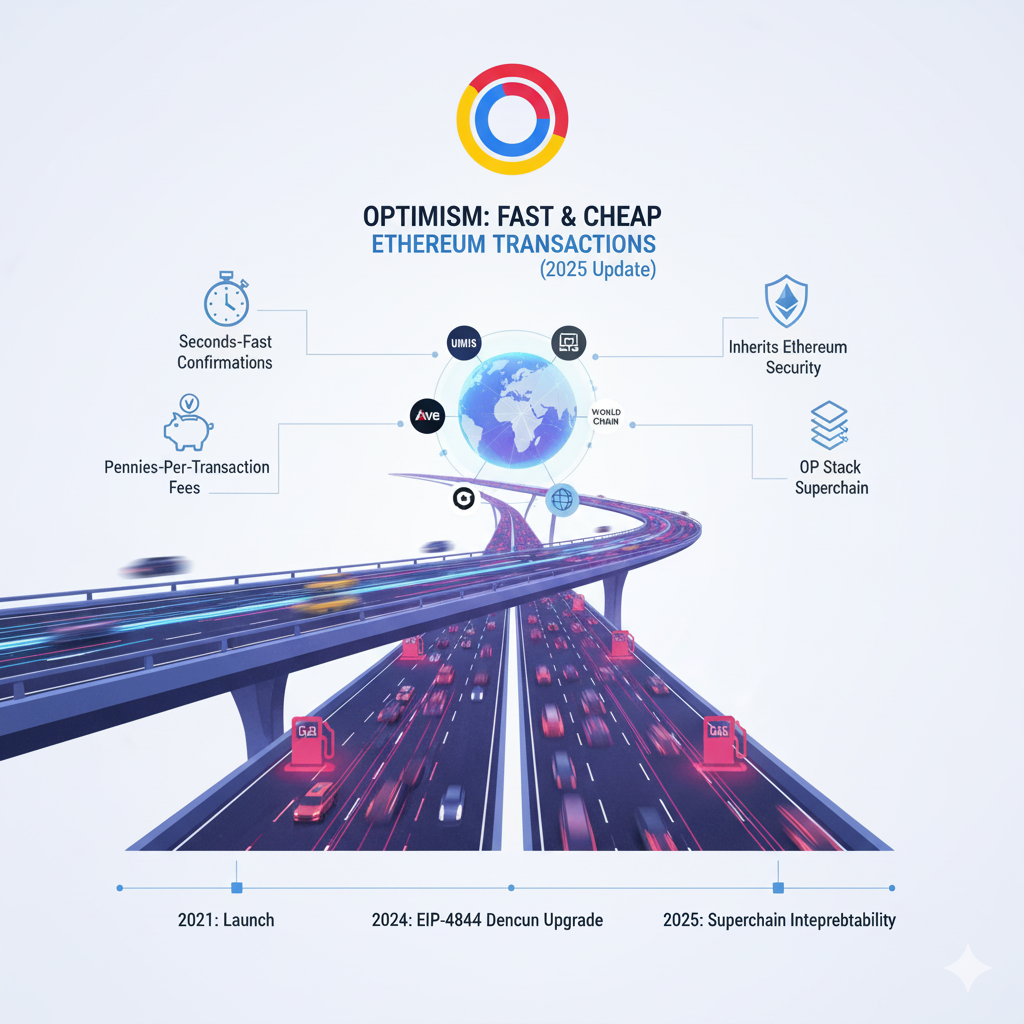
Think of Ethereum as Layer 1 (L1), the secure foundation. In contrast, Layer 2 networks build on top like express lanes above a busy highway, processing transactions faster and cheaper while periodically settling on the main chain.
Two Major Rollup Technologies:
Optimistic Rollups (like Optimism and Arbitrum):
- Assume transactions are valid by default
- Allow a challenge period for fraud proofs
- Examples: Optimism, Arbitrum One, Base
Zero-Knowledge (ZK) Rollups (like Polygon zkEVM and zkSync):
- Use cryptographic proofs to verify every batch immediately
- No challenge period required
- Examples: Polygon zkEVM, zkSync Era, Starknet
Both approaches dramatically reduce costs and increase transaction speed without compromising Ethereum’s security guarantees. For a comprehensive comparison of these technologies, explore our complete guide to Ethereum Layer 2 solutions in 2025.
What Is Optimism?
Optimism is a pioneering optimistic rollup Layer 2 network launched in 2021, now powering one of the largest L2 ecosystems in the cryptocurrency space.
Key Components of the Optimism Ecosystem:
OP Stack: A modular, open-source toolkit enabling developers to launch their own Layer 2 chains with minimal technical overhead (Learn more)
Superchain: A network of 50+ interconnected chains built on OP Stack that share infrastructure, users, and liquidity pools (Superchain overview)
Current Scale: Processing over 17 million daily transactions and securing $22+ billion in total value locked (TVL)
Major Adopters Using OP Stack:
- Base – Coinbase’s consumer-focused L2 chain
- World Chain – Worldcoin’s identity-focused blockchain
- Soneium – Sony’s entertainment and gaming blockchain
- Unichain – Uniswap’s upcoming dedicated DEX chain
The Optimism Superchain ecosystem represents one of the most ambitious visions for blockchain interoperability and scalability.
How Optimistic Rollups Work
Imagine a party where everyone shares stories. Instead of fact-checking every story immediately, you trust them unless someone disputes a detail. That’s Optimism’s “optimistic” philosophy in action.
The Four-Step Process:
- Transaction Execution: Users submit transactions to the Optimism network
- Batch Processing: Subsequently, a sequencer collects and bundles transactions into rollup batches
- L1 Settlement: Following this, transaction data plus a security bond gets published to Ethereum mainnet
- Challenge Period: Finally, anyone has approximately 7 days to submit fraud proofs
If a batch contains invalid transactions, it gets reverted and the sequencer loses their bond. On the other hand, if no challenges occur, the batch achieves final settlement.
This design achieves up to 99% lower fees than Ethereum L1 while maintaining near-instant user confirmations and Ethereum-level security.
Key Benefits
For End Users:
Lightning Speed: Transaction confirmations in under 2 seconds
Minimal Costs: Typical fees range from $0.01-0.10 per transaction
Ethereum Security: All transaction data stored on Ethereum L1
Seamless Experience: Works with existing MetaMask and other Ethereum wallets
For Developers:
EVM Compatibility: Existing Ethereum smart contracts work without modification
Mature Tooling: Full support for Hardhat, Truffle, and other development frameworks
Scalable Infrastructure: Support millions of users without performance degradation
Environmental Benefits: Significantly lower energy consumption per transaction
For DeFi Users:
Affordable Trading: DEX swaps, lending, and yield farming without prohibitive gas fees
NFT Accessibility: Mint, trade, and transfer NFTs for cents instead of dollars
Gaming Integration: Enable blockchain gaming with micro-transactions
Getting Started with Optimism
Step-by-Step Setup Guide:
1. Install a Compatible Wallet
- Download MetaMask browser extension or mobile app
- Alternatives: Coinbase Wallet, Rainbow, Trust Wallet
2. Add Optimism Network
- Visit Chainlist.org and search “Optimism”
- Click “Add to MetaMask” for one-click network addition
- Manual setup: RPC URL
https://mainnet.optimism.io
3. Bridge Assets to Optimism
- Use the official Optimism Bridge
- Deposit ETH, USDC, or other supported tokens
- Standard deposits finalize in 1-3 minutes
- Third-party bridges: Hop Protocol, Across
4. Explore the Ecosystem
- DEXs: Uniswap, Velodrome, Curve
- Lending: Aave, Sonne Finance
- Derivatives: Synthetix, Perp Protocol
- NFTs: OpenSea, Quix
Withdrawing to Ethereum L1
Standard bridge withdrawal takes approximately 7 days for security purposes. However, fast bridges are available with additional trust assumptions. Additionally, always verify official contract addresses.
Security Reminder: Always double-check URLs, start with small amounts, and use official bridges when possible.
The Superchain in 2025
Optimism’s vision extends beyond a single blockchain. Instead, the Superchain represents an interconnected network of OP Stack chains with native interoperability, eliminating the need for third-party bridges between compatible chains.
Recent Major Developments:
EIP-4844 Integration: Proto-danksharding implementation reduced L2 data costs by 90%+
Explosive Growth: Base alone processes over 50 million transactions monthly
Decentralization Progress: Chains advancing from Stage-0 to Stage-1 and Stage-2 rollup maturity
Shared Security Model: All Superchain members benefit from collective security guarantees
Superchain Interoperability Features:
Native Asset Transfers: Move tokens between OP chains without external bridges
Shared Liquidity Pools: Access deeper liquidity across the entire ecosystem
Cross-Chain Contract Calls: Enable complex multi-chain dApp architectures
Unified Developer Experience: Deploy once, scale across multiple chains
As a result, this infrastructure positions the Superchain to onboard the next 100 million crypto users with a seamless, affordable experience.
Risks and Considerations
Technical Risks:
Withdrawal Delays: Standard L1 exits require 7-day challenge period
Sequencer Centralization: Most OP Stack chains currently rely on single sequencers (decentralization roadmap in progress)
Smart Contract Risk: Rollup contracts, though audited, remain complex systems
Bridge Security: Third-party fast bridges introduce additional trust assumptions
Economic Considerations:
Fee Variability: L2 costs still correlate with Ethereum L1 data pricing during extreme congestion
Liquidity Fragmentation: Assets may have different liquidity profiles across chains
Governance Risks: Protocol upgrades controlled by OP token holders
Best Practices:
Start Small: Test with minimal funds before large commitments
Use Official Resources: Verify all contract addresses and bridge URLs
Diversify: Don’t put all assets on a single L2 solution
Stay Informed: Follow Optimism’s official blog for updates
Frequently Asked Questions
Is Optimism Safe?
Optimism inherits Ethereum’s security through its rollup design. All transaction data is stored on Ethereum L1, and the 7-day challenge period allows dispute resolution. Nevertheless, like all crypto protocols, smart contract risks exist.
How Much Does Optimism Cost?
Transaction fees typically range from $0.01-0.10, representing 95-99% savings compared to Ethereum mainnet during congestion periods.
Can I Use My Existing Ethereum Wallet?
Yes! Moreover, Optimism is fully compatible with MetaMask, Coinbase Wallet, and other Ethereum wallets. Simply add the Optimism network.
What’s the Difference Between Optimism and Arbitrum?
Both are optimistic rollups with similar security models. However, key differences include fraud proof mechanisms, sequencer decentralization timelines, and ecosystem focus. For a detailed analysis, check out our Layer 2 comparison: Arbitrum vs Optimism vs Base.
Conclusion
Optimism transforms Ethereum from a congested highway into a high-speed expressway—delivering the same security and functionality without the delays and high costs. It’s like upgrading a single-barista coffee shop with self-service kiosks: the same quality coffee, but without the long waits or premium pricing.
Whether you’re:
- A newcomer exploring DeFi for the first time
- An NFT creator looking to mint affordably
- A DeFi trader seeking lower transaction costs
- A developer building the next generation of dApps
Optimism provides an accessible gateway to Ethereum’s full ecosystem potential. Furthermore, the Superchain vision of interconnected, interoperable blockchains positions Optimism at the forefront of crypto’s mainstream adoption wave.
Ready to get started? Visit the official Optimism portal, bridge some ETH, and experience Layer 2 scaling firsthand. Start with small amounts, explore the ecosystem, and discover how Optimism unlocks Ethereum’s true potential.
Additional Resources
- Official Documentation: Optimism Docs
- Network Statistics: Optimism Explorer
- Ecosystem Overview: L2Beat Optimism Analysis
- Developer Resources: OP Stack Documentation
- Community: Optimism Discord
Sources: Ethereum.org, Optimism.io, Dune Analytics, EIP-4844 Documentation, L2Beat, Official OP Stack and Base announcements (2024–2025).