
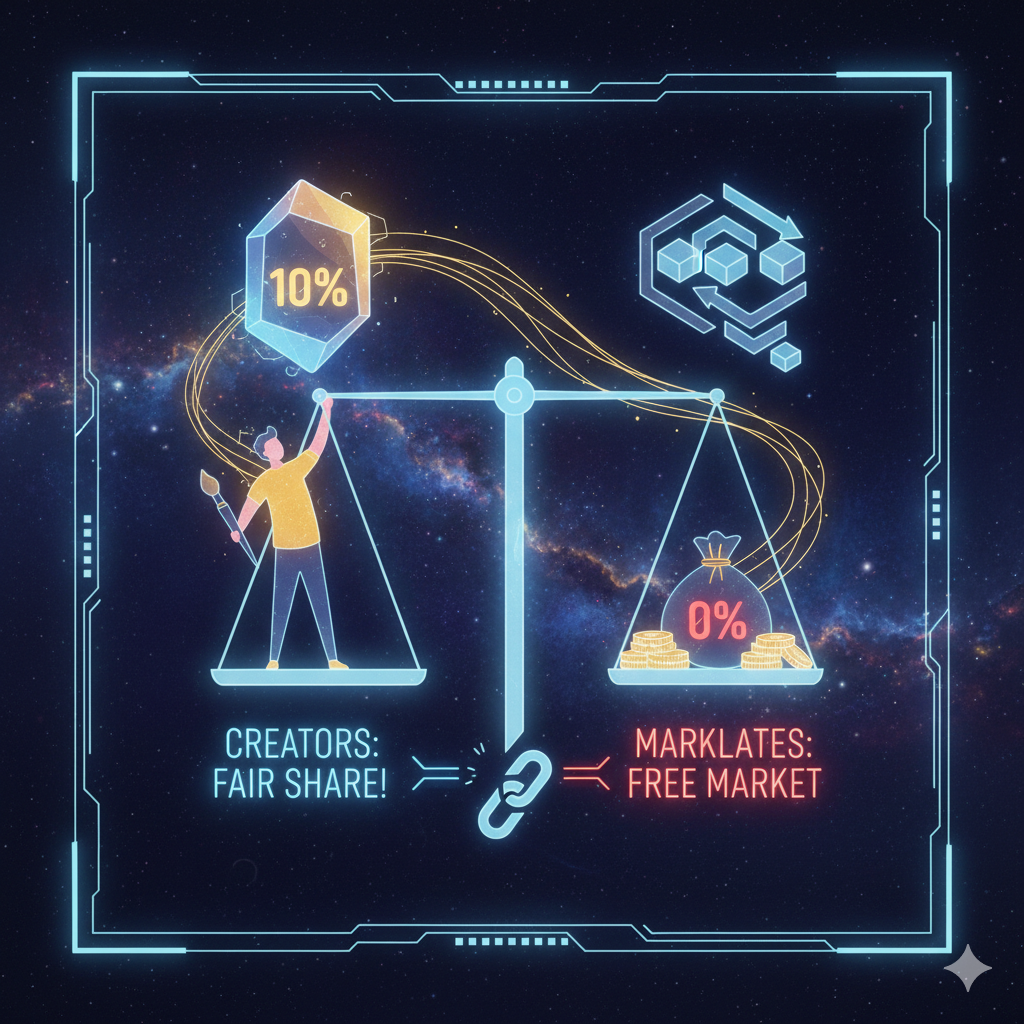
In the fast-evolving world of NFTs (Non-Fungible Tokens), one debate continues to divide the community: NFT royalties. Should creators automatically earn a cut from every resale of their work? Or do marketplaces and traders have the right to skip those fees for smoother, cheaper trading? This clash between creators and marketplaces has shaped the NFT ecosystem since its early days.
If you’re new to NFTs, think of royalties like a built-in tip jar. When someone buys your digital art or collectible for the first time, that’s your initial sale. But every time it gets resold – potentially dozens of times – you get a small percentage (usually around 5–10%). It’s passive income that keeps creators rewarded long-term.
In this comprehensive guide, we’ll break it down simply: What are NFT royalties? The history of the debate, arguments from both sides, the current 2025 landscape, enforcement tips, and what’s next. Backed by verified data from top sources, this article helps beginners understand why NFT royalties matter and how they impact leading NFT marketplaces like OpenSea, Blur, and Magic Eden.
What Are NFT Royalties? A Beginner-Friendly Explainer
NFT royalties are fees paid to the original creator on secondary sales (resales after the first purchase). Here’s how it works:
Creator mints an NFT: You upload art, music, or a collectible to a blockchain like Ethereum or Solana.
Set your royalty rate: Typically around 5–10%, signaled via standards like Ethereum’s EIP-2981 (ERC-721 itself doesn’t define royalties; EIP-2981 does). Learn more about EIP-2981 on Yahoo Finance
Buyer purchases: They pay full price.
Resale happens: On marketplaces that honor royalties, the specified percentage goes to the creator (minus gas/fees). Note that honoring is marketplace-dependent on most chains. Galaxy Research analysis
Example for beginners: Imagine selling a $1,000 painting. If resold for $10,000, you get $500. Resold again for $50,000? Another $2,500. Without royalties, you’d earn zero after the first sale.
Typical levels: Many ecosystems cluster around approximately 6% average creator fee; some sources put the 2025 “average” near 6.1% and note broad use of royalty fields in new contracts, but enforcement still depends on marketplaces. Crypto Council for Innovation report
For digital artists looking to maximize their royalty earnings, check out our complete guide to NFT royalties in 2025, which covers everything from smart contract implementation to best practices for setting your rates.
The History: How the NFT Royalties Debate Exploded
NFT royalties started as a game-changer in 2021. Platforms like OpenSea initially enforced them by default, fueling a “creative economy.”
2022 shift: New marketplaces like Blur launched with a pro-trader stance. In 2023, Blur introduced a 0.5% minimum on collections without blocklists and encouraged creators to block competing venues to get higher enforcement. Mirror analysis
2023 policy changes: OpenSea temporarily reduced its own fees and set a 0.5% floor for non-enforced collections in February 2023, then in August 2023 moved to optional creator fees and retired its Operator Filter (the tool creators had used to block non-honoring markets). DappRadar coverage | Decrypt report | Yahoo Finance update
Magic Eden (launching on Solana) also made royalties optional during the 2022–2023 shift and later added creator tooling; by 2025, it offers optional royalties across multiple chains. The Defiant analysis
2025 today: On major Ethereum/Solana venues, royalties are generally optional and honored by convention/UX, not by force of L1 protocol — with exceptions on some chains that support protocol-level royalties (see Hedera/Radix below). Market size forecasts for 2025 cluster around mid-double-digit billions (approximately $49B), with signs of renewed activity in early 2025. CoinLaw market report
Context on Yuga Labs: Lower effective royalties on trader-focused venues materially cut royalty revenue for big brands in 2023, which fueled the backlash. The Block analysis
The shifting landscape of marketplace policies has profound implications for both creators and collectors. To understand how these three major platforms compare in depth, read our comprehensive comparison of OpenSea vs Blur vs Magic Eden.
Creators’ Side: Why Royalties Are Essential for Sustainability
NFT creators argue royalties are the heart of Web3 art. Without them:
No passive income: Artists must keep dropping new work instead of creating sustainally.
Broken incentives: Collectors capture flips; creators get nothing after mint.
Real impact: Projects that manage to keep royalties honored can build steadier revenue, creating sustainable community economies where value flows back to creators over time.
Regulatory clarity note: In May 2025, SEC Commissioner Hester Peirce said many NFTs — including those designed to pay creator royalties on resale — are not securities. That doesn’t guarantee any specific project’s status, but it undercuts the claim that royalties themselves make NFTs securities. SEC official statement
Marketplaces & Traders’ Side: Royalties Kill Volume and Liquidity
Marketplaces and flippers say enforced royalties hurt everyone:
Higher fees can reduce trading: A 5–10% take from the seller changes margins for frequent traders.
Competition drives policy: Blur’s low-friction approach helped it overtake OpenSea by volume during parts of 2023–2024, prompting others to relax enforcement. Fortune coverage
2025 reality: Leading platforms keep royalties optional to stay competitive, though creator-friendly UX (showing “preferred creator fee”) persists.
Current Landscape: Best NFT Marketplaces for Royalties in 2025
Key takeaway: Rankings move month to month. Across 2024–2025, Blur and OpenSea have traded top spots by volume, while Magic Eden leads cross-chain/Ordinals niches. Avoid absolute rank claims; rely on current dashboards (DappRadar/The Block) for up-to-date standings. DappRadar marketplace rankings
| Marketplace | Royalty Policy (2025) | Notable Use Case |
|---|---|---|
| OpenSea | Optional creator fees; Operator Filter retired in 2023 The Block | Beginners, variety, multi-chain |
| Blur | Optional with 0.5% minimum on certain collections Mirror | Pro traders, depth/liquidity |
| Magic Eden | Optional; strong cross-chain support including SOL/BTC NFT Plazas | Solana & gaming; Ordinals |
| LooksRare / others | Mostly optional | Rewards-focused / niche |
Chain share: Estimates in 2025 often show Ethereum at approximately 60%+ of transactions; treat as directional and check current data. Vancelian analytics
The blockchain you choose for minting can significantly impact your royalty enforcement options. While Ethereum remains dominant, Solana has emerged as a major contender. Explore the pros and cons of each in our detailed analysis: Ethereum vs Solana NFTs: Which Ecosystem Wins in 2025?
How Creators Can Enforce NFT Royalties Today
Use standards: Implement EIP-2981 (and similar metadata fields on Solana via Metaplex). It signals royalties; marketplaces decide whether to honor. Cube.Exchange developer guide
Understand limits of blocklists: OpenSea’s Operator Filter was retired in August 2023, so hard blocking non-honoring venues via that path is no longer available for new collections. The Block report
Choose creator-centric platforms/tools: Zora/Manifold emphasize creator control, but cannot force third-party enforcement on Ethereum; they help you publish and signal consistently. Manifold Substack
Consider protocol-level options:
- Hedera: Royalties configured at the token service level (custom royalty fees with fallback) — harder to bypass at the marketplace layer. Hedera documentation | Hedera technical specs
- Radix (Babylon): Ledger-enforced royalty mechanisms for components/blueprints (developer-level royalties baked into the engine). Applicability differs from typical NFT resale royalties, but it shows on-ledger enforcement approaches. Radix Wiki
Pricing levers: If royalties won’t be honored everywhere, some teams raise mint prices or add holder rewards to balance economics (market-dependent; not legal/financial advice).
Due diligence: Check Dune/Dapp dashboards for a collection’s royalty compliance and where it’s trading before you buy/sell. Dune Analytics
Despite the ongoing debate around royalties, Ethereum continues to evolve with layer-2 solutions and improved standards. For a deeper look at whether Ethereum NFTs remain relevant in today’s market, see our analysis: NFTs on Ethereum: Still Relevant or Already Dead?
The Future of NFT Royalties: Enforcement 2.0
On-chain standards: EIP-2981 adoption remains widespread for signaling royalties. True cross-market enforcement on Ethereum still isn’t universal. Galaxy Research
Lower-cost rails: Ethereum L2s (e.g., Base) cut transaction costs after Dencun/EIP-4844, which helps micro-royalty economics even if enforcement is optional. Galaxy infrastructure report
ZK infrastructure: Emerging zk coprocessors (e.g., Brevis) can prove off-chain logic across chains. Promising for cross-chain accounting, but it’s early to claim robust, universal royalty enforcement from these alone. Business Insider Markets
Sentiment signals: Industry voices (e.g., Pudgy Penguins’ CEO Luca Netz) have argued that even a 1% minimum on a major platform could catalyze an NFT rebound — a viewpoint, not a policy. Blockworks coverage
Market outlook: 2025 reports show renewed volumes versus 2024, with market size projected in the tens of billions; exact figures vary by methodology (always check source definitions). CoinLaw market forecast
Conclusion: Finding Balance in the NFT Royalties Debate
The creators vs. marketplaces fight boils down to trade-offs: Royalties build sustainable art economies but can slow trading for high-frequency markets. In 2025, optional royalties remain the default on major marketplaces, while protocol-level solutions (Hedera, and different kinds on Radix) demonstrate how enforcement can be embedded deeper in the stack.
Creators: Implement standards, pick venues consciously, and communicate preferred fees. For detailed implementation strategies, consult our complete NFT royalties guide for digital artists.
Traders: Price in creator fees when present and recognize the role of royalties in ecosystem health. Understanding the nuances of different platforms is crucial—review our marketplace comparison guide before choosing where to trade.
Beginners: When possible, buy/sell on platforms that clearly display and honor your favorite creators’ preferred fees. The choice between Ethereum and Solana can also significantly impact your experience with royalty enforcement.
NFT royalties aren’t dead — they’re evolving. As the space matures, we’re seeing new models emerge that balance creator sustainability with marketplace liquidity. Whether through protocol-level enforcement, community-driven standards, or innovative token economics that turn communities into economies, the future of NFT royalties will likely look very different from both the mandatory enforcement of 2021 and the optional systems of today.
Related Resources: