
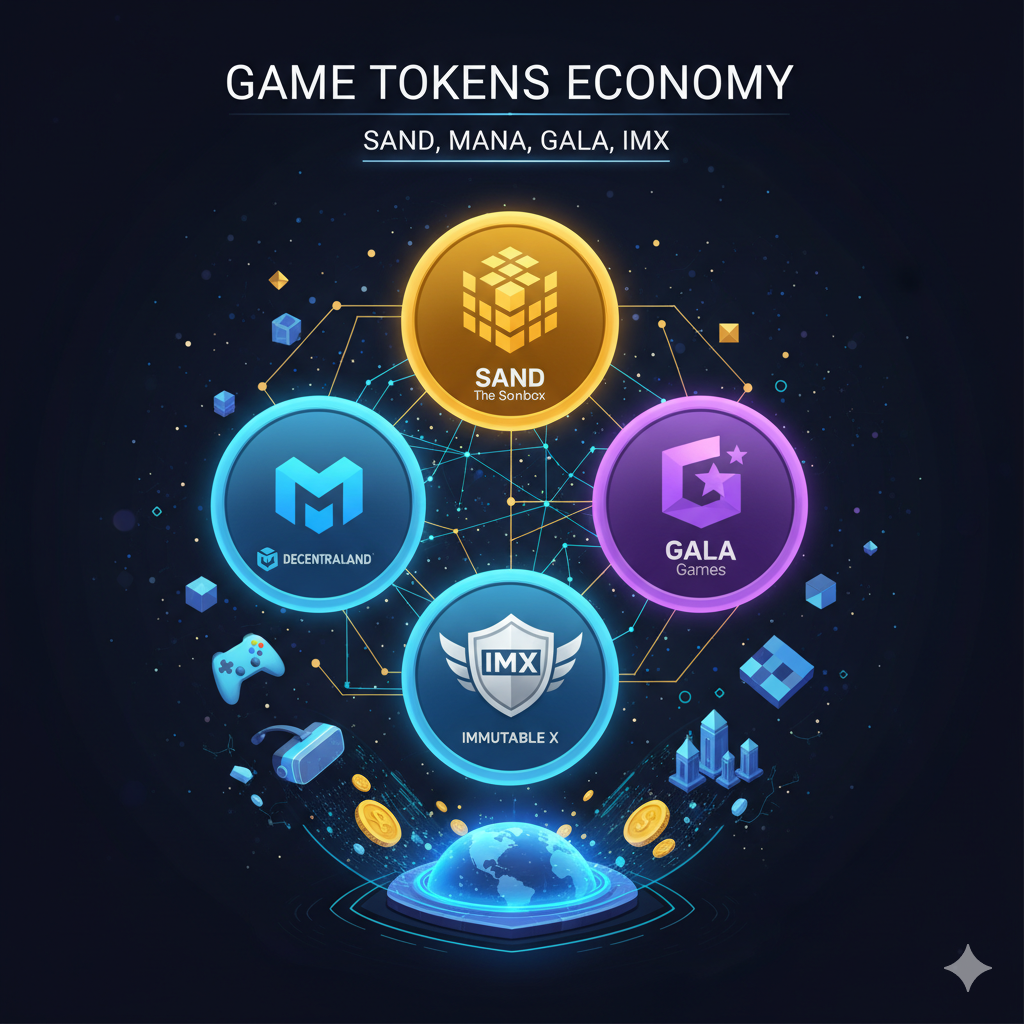
In the exciting world of blockchain gaming, game tokens like SAND, MANA, GALA, and IMX are at the heart of it all. These digital currencies power virtual worlds where players don’t just play—they own, earn, and trade assets. Imagine turning your gaming skills into real value: buying land, customizing avatars, or earning rewards while battling monsters. This is the game tokens economy—a multi-billion-dollar sector blending fun with finance.
For beginners, it’s simple: these tokens fuel play-to-earn (P2E) models, NFT marketplaces, and decentralized metaverses. No more centralized companies owning your progress. With blockchain, your sword, land, or skin is yours forever. As of late 2025, these four tokens sit among the higher-profile gaming tokens by market cap. You can track gaming cryptocurrencies on CoinMarketCap’s Gaming category.
This guide breaks it down expert-style but beginner-friendly. Throughout this article, we’ll explore each token’s economy—how supply works, what you spend it on, and how to earn it—using verified facts from official sources. Ready to level up? Let’s dive in.
What Is the Game Tokens Economy?
Game tokens are cryptocurrencies designed specifically for gaming platforms. Moreover, they solve old problems that have plagued traditional gaming for years:
True ownership: NFTs for items, powered by tokens that give players actual property rights.
Earning potential: Players can complete quests, win battles, and get paid in tokens for their time and skill.
Interoperability: These tokens work across different games, allowing you to sell assets on open markets regardless of where you earned them.
To understand how these economies function within broader blockchain gaming infrastructure, it’s essential to grasp their key mechanics.
Key Mechanics That Power Game Token Economies
Spending: Players buy in-game items, virtual land, or entry fees to premium content.
Earning: Through gameplay, staking tokens, or hosting events, users receive rewards that have real-world value.
Governance: Token holders vote on platform updates via DAOs (Decentralized Autonomous Organizations), giving communities actual decision-making power.
Deflation: Some platforms burn tokens to reduce supply, which can potentially increase value over time.
Consequently, these create circular economies: Players spend → Platforms earn fees → Fees fund rewards → More players join. SAND, MANA, GALA, and IMX exemplify this model, each with unique twists that cater to different gaming preferences. Additionally, these tokens represent a shift toward social tokens that turn communities into economies, where participants actively shape the ecosystem.
The Sandbox (SAND): Create, Play, and Monetize
The Sandbox is a user-generated metaverse where anyone builds games on virtual LAND (NFTs). The franchise originates from Pixowl (founded 2011) with the mobile game released in 2012; the blockchain metaverse pivot began 2018–2020, according to Messari’s research. SAND is its native utility token on Ethereum and Polygon.
For those interested in understanding how Ethereum gaming actually works, The Sandbox provides an excellent case study in token utility and NFT integration.
SAND Token Economy Basics
Max Supply: The total cap stands at 3 billion tokens, as confirmed by Messari.
Circulating Supply: Approximately 2.61 billion tokens are currently in circulation as of late 2025, per CoinMarketCap data.
Vesting: Most allocations were scheduled to fully vest by 2025 per project materials available at Forgd.
How The Sandbox Economy Works
Spend SAND:
- Purchase avatars, equipment, or experiences (mini-games) directly within the platform
- Trade NFTs on the marketplace, including LAND parcels and various digital assets
- Example for beginners: Want a cool voxel sword? Simply pay 10 SAND to acquire it
Earn SAND:
- Participate in play-to-earn rewards from seasonal content and quests
- Generate passive income through staking on Polygon (mSAND staking) to earn yield, as detailed in The Sandbox staking documentation
- Leverage the creator economy by building and selling unique experiences to other players
Governance: Furthermore, SAND holders can vote in The Sandbox DAO proposals, influencing the platform’s future direction.
Pro Tip: Bridge SAND between Ethereum and Polygon to significantly reduce transaction fees when interacting on Polygon’s network.
Beginner Example: New players can start free, earn SAND from alpha games, and later buy a small LAND plot on secondary markets to rent out. However, passive income depends on demand and footfall (not guaranteed).
Visit The Sandbox official site to get started today.
Decentraland (MANA): The Original Virtual Land Rush
Decentraland pioneered the metaverse concept back in 2017, creating a 90,601-parcel world owned entirely by users, as documented on Decentraland’s official website. MANA powers it all as an ERC-20 token on Ethereum, serving as the backbone of this virtual economy.
MANA Token Economy Basics
Total/Circulating Supply: Currently, approximately 1.97 billion MANA tokens are in circulation as of late 2025. Notably, MANA has no fixed max supply listed on CoinMarketCap, as historic burns reduced the total from early levels.
LAND Supply: In contrast to the token supply, LAND is fixed at exactly 90,601 parcels in “Genesis City,” per Decentraland documentation.
How Decentraland’s Economy Works
Spend MANA:
- Buy wearables, emotes, and customized names for your avatar; marketplace purchases may involve additional fees
- Acquire LAND through secondary markets today (the initial land auctions that burned MANA have concluded), according to Decentraland’s documentation
Earn MANA:
- Host engaging events on your LAND parcels and monetize experiences you create
- Trade valuable NFTs with other community members
- Participate actively in DAO governance (via MANA/wMANA and LAND voting power), as outlined in Decentraland’s governance structure
Deflation Notes: Historically, LAND auctions burned MANA tokens; similarly, name registrations also burned MANA (policy subject to DAO proposals), per Decentraland’s official sources.
Beginner Example: Buy a modest LAND parcel on the marketplace, build a simple venue, and charge visitors for access in MANA. Nevertheless, results depend on visitor traffic—no guaranteed revenue exists.
Explore the metaverse at Decentraland.org and experience virtual world ownership firsthand.
Gala Games (GALA): Play-to-Earn for Everyone
Gala Games is a comprehensive gaming and entertainment ecosystem spanning games, music, and film, where GalaChain serves as its Layer-1 blockchain infrastructure. GALA rewards node operators and fuels the entire ecosystem, as explained in GalaChain’s documentation.
If you’re exploring the return of play-to-earn in 2025, Gala Games represents one of the most accessible entry points for newcomers.
GALA Token Economy Basics
Max Supply: The maximum supply is set at 50 billion GALA tokens, confirmed by Gala News.
Circulating Supply: Approximately 46 billion tokens are currently circulating as of late 2025, per CoinGecko.
Major burn: Significantly, approximately 20.9 billion GALA were burned in May 2023 during the v2 transition and supply cleanup, as reported in Gala’s official announcement.
How Gala Games Economy Works
Spend GALA:
- Purchase NFTs including characters, land parcels, and in-game items
- Access premium experiences within the ecosystem
- Utilize GALA within GalaChain dApps and marketplace platforms (e.g., GalaSwap), per Gala Blog
Earn GALA:
- Run Founder’s Nodes to receive regular GALA distributions per the network schedule, as noted on CoinGecko
- Collect P2E rewards that vary by game (e.g., Town Star historically offered such rewards), according to Kraken’s research
Unique Twist: Nodes help decentralize infrastructure; meanwhile, Gala is actively migrating activity to its own GalaChain L1, per GalaChain documentation.
Beginner Example: Try a Gala title and accumulate in-game rewards organically; however, add a Founder’s Node only if you thoroughly understand costs and potential returns (they fluctuate significantly).
Start playing at Gala Games and discover the entertainment ecosystem.
Immutable (IMX): Scalable NFTs for AAA Games
Immutable provides cutting-edge NFT-first infrastructure specifically designed for games. The ecosystem has evolved from Immutable X to Immutable zkEVM, which now supports IMX staking and fee capture while powering popular games like Gods Unchained, as detailed on Immutable’s official site.
For a deeper dive into blockchain gaming platforms including Immutable, explore how different chains compare in performance and scalability.
IMX Token Economy Basics
Max Supply: The total supply is capped at 2 billion IMX, with scheduled unlocks continuing into 2025 (i.e., not “fully unlocked”), according to Binance Research.
Staking/Fees: Notably, 20% of protocol fees are allocated directly to IMX stakers (fees stem from a 2% protocol trading fee), as outlined on Immutable’s documentation.
Gas on zkEVM: For EOA wallets, gas is paid in IMX; alternatively, Immutable Passport can sponsor gas for a gas-free user experience, per Gods Unchained documentation.
How Immutable’s Economy Works
Spend IMX:
- Pay trading and protocol fees (directly in IMX or via automatic swap from the trade currency), according to TokenInsight
- Build projects on zkEVM; developers integrate IMX seamlessly within their applications
Earn IMX:
- Stake IMX on zkEVM to receive rewards funded by protocol fees, as detailed on Immutable’s staking page
- Benefit from trader rebates and rewards programs that arise from staking participation rules
Beginner Example: Trade NFTs on an Immutable marketplace, bridge IMX to zkEVM, stake your tokens, and subsequently earn a share of protocol-fee rewards, per Immutable’s official guide.
Visit Immutable’s marketplace to start trading NFTs today.
Comparing SAND, MANA, GALA, and IMX Economies
| Token | Max Supply | Key Utility | Earn Methods | Chain Focus | Best For |
|---|---|---|---|---|---|
| SAND | 3B | Marketplace, experiences, LAND ecosystem | Staking, seasonal rewards, creator sales | Ethereum / Polygon | Creators & UGC |
| MANA | No fixed max on CMC | LAND/world economy, wearables, DAO | Events, trading, governance | Ethereum | Virtual landlords & event hosts |
| GALA | 50B | NFTs, ecosystem currency, GalaChain gas/fees | P2E rewards (by game), node rewards | GalaChain (L1) | Casual players & node operators |
| IMX | 2B | Protocol/staking, gas on zkEVM (EOA) | Protocol-fee staking rewards | Immutable zkEVM | Traders & infra-minded gamers |
Sources: SAND supply and vesting data from Messari and CoinMarketCap; Decentraland’s 90,601 LAND parcels from Decentraland.org; GALA 50B cap and 20.9B burn from Gala News; IMX 2B cap and staking details from Immutable and Gods Unchained portal.
Quick Insight: GALA carries the highest nominal supply among the four; in contrast, IMX uses fee-funded staking (not inflation) and IMX as gas for EOAs on zkEVM, with Passport enabling gas-sponsored UX, per Immutable’s documentation.
Getting Started: Your First Steps in Game Tokens
Wallet: Set up MetaMask or another EVM-compatible wallet; alternatively, consider Immutable Passport for a smoother zkEVM UX.
Buy Tokens: Use reputable exchanges to purchase tokens (listings vary; therefore, check your preferred venue for availability).
Play:
- The Sandbox: sandbox.game
- Decentraland: decentraland.org
- Gala: games.gala.com
- Immutable marketplaces (zkEVM): marketplace.immutable.com
Stake/Earn: Follow official guides carefully (especially for IMX staking on zkEVM from June 2025), available at Immutable’s staking page.
Risk Note: Tokens are highly volatile—always DYOR (Do Your Own Research) before investing.
The Road Ahead for Game Tokens
SAND, MANA, GALA, and IMX form a crucial backbone of Web3 gaming infrastructure and economies. AAA adoption is becoming increasingly real (for instance, the Ubisoft x Immutable partnership announced in 2025 demonstrates mainstream interest), and fee-funded reward models (like IMX) aim for long-term sustainability over pure inflation, according to Immutable’s announcements.
Beginner Action: Pick one ecosystem and learn it thoroughly end-to-end. For a gentle start, Immutable’s gas-sponsored UX and staking clarity are particularly friendly; conversely, for building creative content, Sandbox’s creator tools are highly accessible; for pure metaverse real estate investment, Decentraland offers a straightforward approach; finally, for a broader entertainment stack, watch GalaChain’s developments closely.
Whether you’re a gamer looking to monetize your skills, a creator seeking new revenue streams, or an investor exploring Web3 opportunities, game tokens offer a fascinating intersection of entertainment and economics. Start small, learn continuously, and always remember that blockchain gaming is still evolving—consequently, what you learn today will position you for the innovations of tomorrow.