
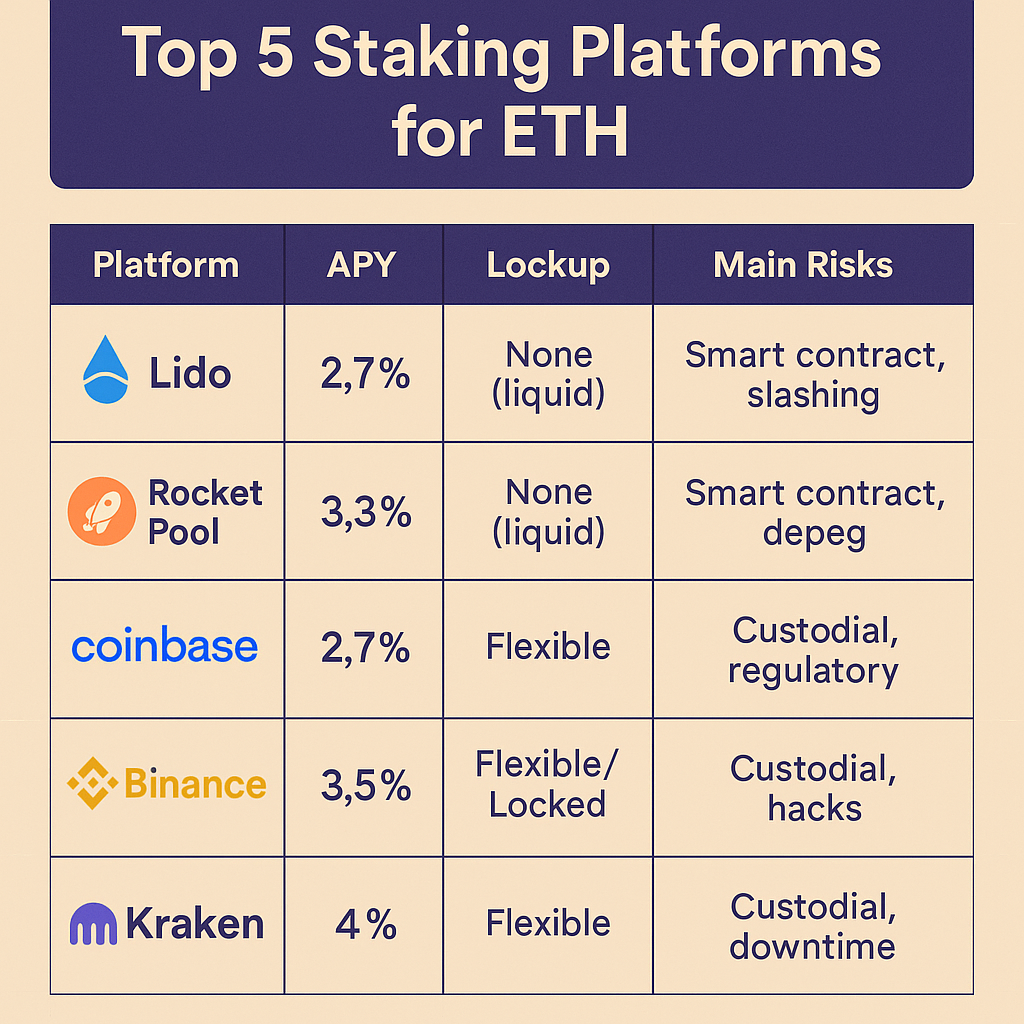
(As of 2025 — always double-check live data before staking!)
Introduction to Ethereum Staking in 2025
Ethereum’s transition to Proof-of-Stake with The Merge in September 2022 fundamentally changed how the network operates and opened up lucrative opportunities for passive income through staking. Instead of energy-intensive mining, validators now lock ETH to secure the network and validate transactions, earning rewards in return.
By 2025, Ethereum staking has reached remarkable maturity with over 35 million ETH staked (approximately 28–30% of total supply). Current staking yields typically range between 2–4% APY (net of platform fees), though rates fluctuate based on network activity, validator performance, and total staked amount.
Staking allows ETH holders to generate passive income without selling their assets, but it’s essential to understand the nuances: lockup periods, smart contract risks, potential slashing penalties, liquidity considerations, and platform trustworthiness. This comprehensive guide examines five leading ETH staking platforms to help you make informed decisions.
1. Lido — The Industry-Leading Liquid Staking Protocol
Lido Finance has emerged as the dominant liquid staking solution, commanding the largest market share in decentralized staking.
How Lido Works
Deposit any amount of ETH and instantly receive stETH (standard) or wstETH (wrapped) tokens that represent your staked ETH plus accrued rewards. These liquid staking tokens (LSTs) can be freely traded, used as collateral, or deployed across DeFi protocols while your original ETH continues earning staking rewards.
Key Metrics
- Total Value Locked: 8.5–9 million ETH ($27–30 billion USD equivalent)
- APY (approximate): 2.5–3.2% (varies with network conditions and validator performance)
- Minimum stake: No minimum — stake any amount
Lockups & Liquidity
- No lockup period — stETH/wstETH are immediately liquid and tradable on major DEXs
- To redeem stETH directly for ETH through Lido, expect 1–5 days processing time under normal network exit queue conditions
- Alternatively, swap stETH for ETH instantly on Curve, Uniswap, or other DEXs (subject to market liquidity)
Fees & Economics
- 10% performance fee on staking rewards (split between node operators and the Lido DAO treasury)
- Net user APY is already calculated after this fee deduction
Risk Factors
- Smart contract risk: Despite multiple audits, vulnerabilities could exist
- Temporary de-pegging: stETH can temporarily trade below 1:1 with ETH during market stress (as seen in June 2022)
- Slashing risk: Low probability due to diversified, professional validator set (30+ operators)
- Regulatory uncertainty: Liquid staking derivatives face evolving regulatory scrutiny
Best For
Users seeking maximum liquidity, DeFi composability, and passive staking rewards without operational overhead. Ideal if you want to leverage your staked ETH across multiple protocols simultaneously.
Learn more: Lido Documentation
Related reading: Lido vs Rocket Pool: Who Rules ETH Staking in 2025?
2. Rocket Pool — Decentralized, Community-Driven Staking
Rocket Pool champions decentralization by enabling anyone to become a validator with reduced capital requirements while offering liquid staking for regular users.
How Rocket Pool Works
Users can either run their own “minipool” validator node with just 8 ETH (plus RPL collateral) or simply stake any amount of ETH to receive rETH tokens. Unlike stETH, rETH is a reward-bearing token that increases in value relative to ETH over time rather than increasing in quantity.
Key Metrics
- Total Value Locked: ~1.8–2.2 million ETH
- APY (approximate): 2.6–3.5% (net of node operator commission)
- Validator nodes: ~2,900+ independent node operators
Lockups & Liquidity
- rETH is fully liquid and tradable on major DEXs
- Direct redemption to ETH follows the standard Ethereum exit queue (typically 1–5 days)
- rETH can trade at a slight premium or discount to its underlying ETH value
Commission & Fees
- Node operators earn ~14% commission from staking rewards (paid by stakers)
- No additional protocol fees for rETH holders
- Net APY reflects commission deduction
Risk Factors
- Smart contract vulnerabilities: Multiple audits conducted but risk remains
- rETH price dynamics: Can trade at premium/discount to NAV based on supply/demand
- Slashing risk: Distributed across diverse, independent validators
- RPL token risk: Node operators must maintain RPL collateral exposure
Best For
ETH holders who prioritize decentralization, want to support permissionless validation, and value community governance over maximum yield. Excellent choice for those concerned about staking centralization risks.
Learn more: Rocket Pool Documentation
Related reading: Lido vs Rocket Pool: Who Rules ETH Staking in 2025?
3. Coinbase — Institutional-Grade Custodial Staking
Coinbase offers the most accessible on-ramp for newcomers, combining regulated custody with optional liquid staking through cbETH.
How Coinbase Staking Works
Stake ETH directly through your Coinbase account with zero technical knowledge required. Optionally convert your staked position to cbETH, a liquid token tradable across DeFi platforms and centralized exchanges.
Key Metrics
- Total staked: Coinbase manages billions in staked ETH (exact figures proprietary)
- APY (approximate): 2.7–3.0% net to users (varies by subscription tier)
- Regulatory status: Publicly traded company (NASDAQ: COIN), SEC-registered
Lockups & Liquidity
- Flexible unstaking available with variable processing times
- cbETH provides instant liquidity — trade on Coinbase, Uniswap, or other platforms
- Actual ETH redemption timing depends on network exit queue load
Fees & Commission
- Up to 35% commission on staking rewards for regular users
- Lower fees for Coinbase One subscribers (reduced to ~25%)
- Fees are automatically deducted from displayed APY
Risk Factors
- Custodial risk: Coinbase maintains full control over your staked ETH
- Regulatory exposure: Subject to U.S. securities regulations and potential policy changes
- cbETH basis risk: Token may trade at premium/discount to underlying ETH value
- Platform risk: Exchange outages, account restrictions, or business disruption
Best For
Crypto newcomers wanting a trusted, zero-maintenance staking experience with regulatory protections. Ideal if you value brand recognition, customer support, and regulated operations over maximum yields or decentralization.
Learn more: Coinbase Staking Guide
4. Binance — High-Liquidity Exchange Staking
Binance leverages its position as the world’s largest crypto exchange to offer integrated staking with competitive rates and deep liquidity.
How Binance Staking Works
Stake ETH through your Binance account and receive WBETH (Wrapped Beacon ETH), a liquid staking token whose exchange rate against ETH gradually increases as rewards accumulate.
Key Metrics
- Total staked: Significant portion of centralized exchange staking market
- APY (approximate): 3.0–5.0% (displayed rates are net to users after internal fees)
- Available in: 100+ countries (with regional restrictions)
Lockups & Liquidity
- WBETH is fully liquid — trade, use as collateral, or transfer freely
- Direct ETH redemption aligns with Ethereum protocol exit queue
- Deep liquidity on Binance’s spot markets for instant conversions
Fees & Economics
- Variable internal fees already factored into displayed APY
- Binance’s fee structure is less transparent than decentralized alternatives
- Promotional rates occasionally offered for new stakers
Risk Factors
- Custody and operational risk: Binance controls all staked assets
- Regulatory uncertainty: Facing regulatory challenges in multiple jurisdictions
- Geographic restrictions: Not available in U.S., U.K., and other restricted territories
- WBETH deviation risk: Token price dynamics when used as collateral or in trading
Best For
Active Binance traders seeking seamless integration between trading and staking operations. Ideal if you already maintain significant assets on Binance and want to maximize capital efficiency.
Learn more: Binance ETH Staking
Related reading: Binance Tutorial 2025: Complete Step-by-Step Guide for Beginners
5. Kraken — Security-Focused Exchange with Flexible Options
Kraken distinguishes itself through flexible staking options, strong security practices, and transparent operations.
How Kraken Staking Works
Choose between Flexible Staking (lower rates, easier exit) or Bonded Staking (higher rates, fixed commitment period). Rewards are automatically distributed to your account.
Key Metrics
- APY (approximate):
- Flexible: 1.5–3.0%
- Bonded: 3.0–6.0% (depending on term length and region)
- Track record: Operating since 2011 with no major security breaches
Lockups & Liquidity
- Flexible Staking: Unstake anytime with 2–7 day processing
- Bonded Staking: Fixed terms (3, 6, or 12 months) with higher yields but no early withdrawal
- No liquid staking token available (direct custody model)
Fees & Economics
- Variable commission rates depending on staking product chosen
- Transparent fee disclosure in staking interface
- Competitive rates for U.S. and European users
Risk Factors
- Custodial risk: Kraken holds your private keys
- No liquidity tokens: Cannot use staked ETH in DeFi or as collateral
- Regulatory compliance costs: May affect yield compared to decentralized alternatives
- Geographic availability: Limited in certain jurisdictions
Best For
Users prioritizing established security track record, regulatory compliance, and flexible staking options over liquid tokens or maximum yields. Good for conservative investors comfortable with centralized custody.
Learn more: Kraken Staking
Platform Comparison Summary
| Platform | APY Range | Minimum | Liquidity Token | Custody Type | Best Feature |
|---|---|---|---|---|---|
| Lido | 2.5–3.2% | None | stETH/wstETH | Non-custodial | DeFi composability |
| Rocket Pool | 2.6–3.5% | None | rETH | Non-custodial | Decentralization |
| Coinbase | 2.7–3.0% | None | cbETH | Custodial | User-friendly |
| Binance | 3.0–5.0% | None | WBETH | Custodial | Exchange integration |
| Kraken | 1.5–6.0% | Varies | None | Custodial | Security track record |
How to Choose the Right Platform for You
1. Define Your Primary Goal
Maximum Yield
If pure APY is your priority, compare current rates across platforms but understand that higher yields often come with increased risks or tradeoffs.
Liquidity & Flexibility
Need access to your capital? Prioritize platforms offering liquid staking tokens (Lido, Rocket Pool, Binance, Coinbase) over bonded staking.
Decentralization & Security
If you value censorship resistance and reducing single points of failure, lean toward Lido or Rocket Pool over centralized exchanges.
Simplicity & Support
New to crypto? Coinbase or Kraken provide the smoothest onboarding with customer support and regulatory protections.
2. Assess Your Risk Tolerance
Conservative Approach
- Prioritize regulated, custodial platforms (Coinbase, Kraken)
- Avoid maximum leverage of liquid tokens in DeFi
- Accept lower yields for peace of mind
Moderate Approach
- Mix custodial and non-custodial platforms
- Use liquid staking tokens conservatively
- Diversify across 2–3 platforms
Aggressive Approach
- Maximize DeFi opportunities with liquid tokens
- Explore yield-stacking strategies with protocols like EigenLayer
- Accept smart contract risks for higher potential returns
3. Consider Your ETH Holdings
Small Holdings (< 1 ETH)
Any liquid staking platform works. Prioritize low fees and accessibility (Lido, Rocket Pool).
Medium Holdings (1–10 ETH)
Diversify across 2 platforms to balance convenience and decentralization.
Large Holdings (10+ ETH)
- Seriously consider solo staking if technically capable (requires 32 ETH per validator)
- Split across multiple platforms to reduce concentration risk
- Explore institutional services for holdings > 100 ETH
4. Evaluate Geographic and Regulatory Factors
- U.S. users: Coinbase and Kraken are most accessible; Binance restricted
- EU users: Most platforms available; check local tax treatment
- Asia-Pacific: Binance typically offers best integration
- Restricted jurisdictions: VPN usage violates platform ToS—seek local compliant alternatives
5. Test Before Committing
Before staking significant amounts:
- Start with small test deposits
- Verify the unstaking process
- Monitor reward accrual for 1–2 weeks
- Test liquid token swaps if using LSTs
- Review platform communications and transparency
Advanced Staking Strategies for 2025
Liquid Staking + DeFi Yield Stacking
Maximize returns by using liquid staking tokens in DeFi protocols:
- Stake ETH → Receive stETH/rETH
- Deposit LST as collateral on Aave or Compound
- Borrow stablecoins at low interest
- Deploy stablecoins in yield-generating protocols
Risks: Liquidation risk if LST/ETH ratio changes, smart contract vulnerabilities, complexity
Learn more: DeFi 2025: Top 10 Protocols Across All Chains
Restaking for Additional Yield
Platforms like EigenLayer allow you to “restake” liquid staking tokens to secure additional protocols, earning supplementary rewards.
Benefits: Enhanced yield without additional capital Risks: Increased slashing conditions, additional smart contract exposure
Learn more: EigenLayer and the Rise of Restaking
Liquid Restaking Tokens (LRTs)
Next-generation tokens that combine liquid staking with restaking benefits, offered by protocols like EtherFi, Renzo, and Puffer Finance.
Benefits: Maximum capital efficiency, simplified restaking exposure Risks: Additional complexity layer, newer protocols with less battle-testing
Learn more: Liquid Restaking Tokens (LRTs) Explained
Diversification Strategy
Don’t put all your staked ETH in one basket. Suggested allocation for risk-conscious investors:
- 40%: Liquid staking protocols (Lido + Rocket Pool)
- 30%: Exchange staking (partial allocation for convenience)
- 30%: Solo staking if you have 32+ ETH and technical expertise
Important Considerations Before Staking
1. Never Stake More Than You Can Afford to Lock Up
While liquid staking offers flexibility, market conditions can create temporary liquidity constraints. Maintain emergency funds in fully liquid assets.
2. Understand the Exit Queue Dynamics
During network stress or mass unstaking events (like May 2023), exit queues can extend to weeks rather than days. Plan accordingly.
3. Monitor Your Positions Regularly
Set calendar reminders to:
- Review validator performance
- Check for platform announcements
- Verify reward accrual rates
- Assess liquid token price dynamics
4. Be Aware of Fee Structures
Platform fees directly impact your net returns:
- Lido: 10% of rewards
- Rocket Pool: ~14% node operator commission
- Coinbase: Up to 35% commission
- Binance: Opaque but competitive
- Kraken: Variable by product
5. Diversify Across Platforms
Risk mitigation strategy:
- Liquid staking protocols (Lido + Rocket Pool)
- Exchange staking (partial allocation for convenience)
- Solo staking if you have 32+ ETH and technical expertise
6. Understand Tax Implications
Staking rewards are typically taxable events in most jurisdictions. Consult with tax professionals familiar with cryptocurrency. Track:
- Reward distribution dates and values
- Token conversion events
- Liquid token trading activity
7. Stay Informed About Network Upgrades
Ethereum continues evolving with upgrades like Pectra (expected 2025) that may affect:
- Validator mechanics and requirements
- Exit queue dynamics
- Staking reward rates
- Smart contract functionality
Follow official sources:
- Ethereum Foundation Blog
- EthStaker Community
- Platform-specific announcement channels
Understanding Staking Risks in Detail
Smart Contract Risk
Decentralized staking protocols rely on smart contracts that, despite audits, could contain vulnerabilities. Historical precedents include:
- Protocol exploits resulting in fund loss
- Upgrade bugs affecting reward distribution
- Oracle manipulation impacting liquid token values
Mitigation: Diversify across platforms, monitor security disclosures, use audited platforms with bug bounty programs.
Slashing Risk
Validators face penalties (“slashing”) for:
- Double-signing: Validating conflicting blocks
- Downtime: Extended periods offline
- Malicious behavior: Attempting network attacks
Professional staking services typically maintain <0.01% slashing rates, but risk exists.
Mitigation: Choose platforms with proven validator performance, geographic distribution, and redundant infrastructure.
Liquidity Risk
While liquid staking tokens offer flexibility, they can:
- Trade at discounts during market stress
- Experience reduced DEX liquidity
- Face smart contract risks in DeFi integrations
Mitigation: Understand that LSTs are not equivalent to ETH, maintain emergency liquidity reserves, avoid over-leveraging liquid tokens.
Regulatory Risk
Staking services face evolving regulatory scrutiny:
- SEC classification debates (security vs. commodity)
- Licensing requirements for custodial services
- Geographic restrictions and compliance burdens
Mitigation: Use regulated platforms for large sums, maintain tax compliance, diversify across jurisdictions when possible.
The Future of Ethereum Staking in 2025 and Beyond
Ongoing Network Improvements
Pectra Upgrade Expected in 2025, Pectra will introduce:
- Increased validator efficiency
- Improved reward distribution mechanisms
- Enhanced security features
Layer 2 Scaling Impact As Layer 2 solutions (Arbitrum, Optimism, Base) mature, main-net congestion decreases, potentially affecting:
- MEV opportunities for validators
- Overall staking yields
- Gas costs for liquid token operations
Market Dynamics
With ~30% of ETH already staked, the network approaches healthy equilibrium. Key trends:
- Yield compression: More stakers = lower per-validator returns
- Quality competition: Platforms competing on security, UX, and integrated features rather than pure yield
- Institutional adoption: Growing interest from traditional finance institutions
- Restaking innovation: Protocols like EigenLayer enabling additional yield layers
Frequently Asked Questions
Can I stake less than 32 ETH?
Yes! All platforms reviewed allow staking with any amount. Solo validation requires 32 ETH, but liquid staking protocols and exchanges have no minimums.
How are staking rewards taxed?
Tax treatment varies by jurisdiction. In most countries, staking rewards are taxable income when received. Consult local tax professionals for specific guidance.
What happens if the platform gets hacked?
- Decentralized protocols: Smart contract insurance products available (e.g., Nexus Mutual)
- Custodial platforms: Some offer insurance, but terms vary—read disclosures carefully
Can I lose my staked ETH?
Yes, through:
- Platform hacks or vulnerabilities
- Validator slashing (minimal risk with professional operators)
- Custodial platform insolvency or seizure
- Smart contract exploits
How long does unstaking take?
- Liquid tokens: Instant via DEX swaps (subject to market conditions)
- Direct protocol redemption: 1–5 days typical (varies with exit queue)
- Exchange unstaking: Platform-dependent (minutes to days)
Final Thoughts: Staking as a Long-Term Strategy
Ethereum staking represents one of the most sustainable yield-generation strategies in cryptocurrency. Unlike speculative trading or high-risk DeFi protocols, staking provides:
✅ Predictable returns based on network economics ✅ Network contribution supporting Ethereum’s security and decentralization ✅ Tax-efficient income in many jurisdictions (compared to frequent trading) ✅ Alignment with ecosystem growth as network adoption increases
The platforms reviewed here span the spectrum from maximum decentralization (Rocket Pool) to regulated simplicity (Coinbase/Kraken) to integrated trading efficiency (Binance) to DeFi composability (Lido).
Your optimal choice depends on:
- Risk tolerance (custody vs. smart contract risk)
- Liquidity needs (immediate access vs. higher yields)
- Technical comfort level (DeFi interactions vs. custodial services)
- Values (decentralization priority vs. convenience)
As 2025 progresses with continued Ethereum upgrades, Layer 2 maturation, and institutional adoption, the staking landscape will continue evolving. The fundamental principle remains: participate as a long-term supporter of the network, understand your chosen platform thoroughly, and never stake more than you can afford to lock up.
Additional Resources
Official Ethereum Resources
Research & Analytics
- DeFi Llama — Track liquid staking TVL
- Rated Network — Validator performance data
- Dune Analytics — Staking dashboards
Security
- DeFi Safety — Protocol security ratings
- Rekt News — Security incident tracking
Related BlockTown Guides
- Lido vs Rocket Pool: Who Rules ETH Staking in 2025?
- DeFi 2025: Top 10 Protocols Across All Chains
- Binance Tutorial 2025: Complete Step-by-Step Guide
- EigenLayer and the Rise of Restaking
- Liquid Restaking Tokens (LRTs) Explained
Disclaimer: This guide provides educational information only and does not constitute financial advice. Cryptocurrency staking involves risks including but not limited to loss of capital, smart contract vulnerabilities, regulatory changes, and market volatility. Always conduct your own research, understand the risks, verify current platform terms, and consult with qualified financial advisors before making investment decisions. Past performance does not guarantee future results. All APY figures are estimates and subject to change based on network conditions.
Happy staking—may your ETH rewards compound wisely! 🚀
Last updated: October 2025 | Always verify current rates and terms on official platform websites before staking