
What is Arbitrum Orbit? A Beginner’s Guide to Building Custom Chains on Ethereum
In the fast-evolving world of blockchain technology, scalability remains one of the biggest challenges for Ethereum, the leading smart contract platform. As more users and applications flock to Ethereum, the network often faces congestion, leading to high transaction fees and slower processing times. This is where layer-2 (L2) solutions like Arbitrum come into play, offering ways to offload some of the heavy lifting from Ethereum’s main layer-1 (L1) network. Among Arbitrum’s innovative tools is Arbitrum Orbit, a framework that empowers developers to create their own custom chains.
If you’re new to blockchain or just dipping your toes into Ethereum scaling solutions, this article will break down Arbitrum Orbit and custom chains in simple terms. We’ll explore what it is, how it works, its benefits, customization options, and real-world examples—all based on verified information from official sources. By the end, you’ll understand why Arbitrum Orbit is gaining traction for building performant, tailored blockchains. Let’s dive in.
Understanding the Basics: What is Arbitrum Orbit?
Imagine Ethereum as a busy highway where everyone competes for space, causing traffic jams. Arbitrum Orbit is like creating your own dedicated lane or even a separate road that connects back to the main highway. Officially, Arbitrum Orbit is a permissionless framework that allows developers to launch their own customizable chains using the Arbitrum Nitro technology stack. This stack includes features like interactive fraud proofs for security, advanced data compression to reduce costs, and compatibility with the Ethereum Virtual Machine (EVM), plus extensions via Stylus for languages like Rust.
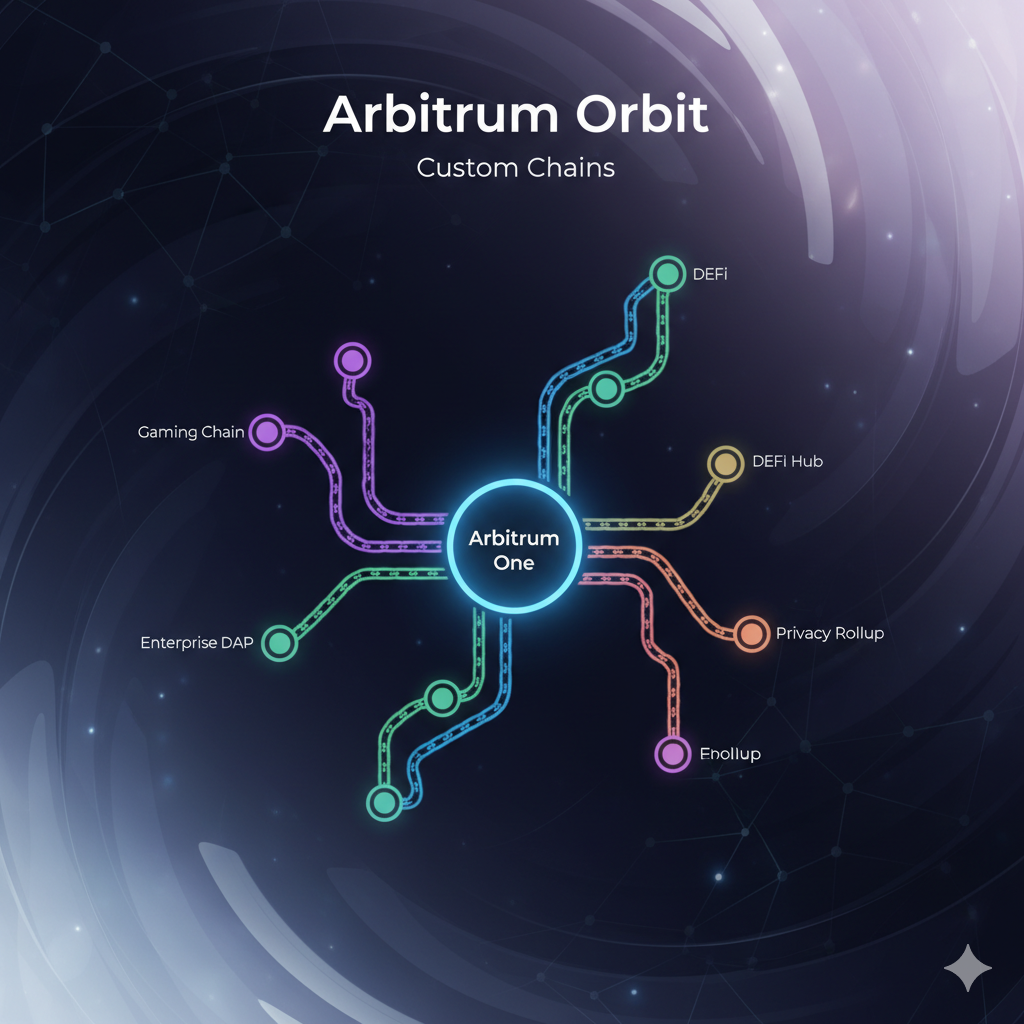
At its core, Arbitrum Orbit enables the creation of “Arbitrum chains,” which can act as L2 chains settling directly to Ethereum or L3 chains settling to another L2 like Arbitrum One. Unlike public chains like Arbitrum One, which are governed by the Arbitrum DAO, Orbit chains give you full control over governance, allowing you to own and decentralize your chain as needed. This means you can tailor the chain to specific use cases, whether for a single application, multiple apps, or an entire ecosystem.
For beginners, think of it this way: Traditional blockchains are one-size-fits-all, but Orbit lets you build a blockchain that’s as unique as your project. It addresses Ethereum’s congestion by offloading transactions to a dedicated network of nodes, providing dedicated throughput without competing for space on the main network.
Learn more at the official Arbitrum website and Arbitrum documentation.
How Does Arbitrum Orbit Work?
Arbitrum Orbit builds on Arbitrum’s optimistic rollup technology, where transactions are processed off-chain and then batched and posted back to Ethereum for final settlement. This reduces costs and increases speed while inheriting Ethereum’s security. Understanding how rollups differ from sidechains is crucial when evaluating whether Orbit chains are right for your project.
The key innovation is the Nitro stack, which powers Orbit chains. It ensures EVM+ compatibility, meaning your chain supports standard Ethereum smart contracts plus additional features like Stylus’ WebAssembly (WASM) virtual machine for faster execution in non-EVM languages. Orbit chains also benefit from ongoing Arbitrum upgrades (e.g., the BoLD dispute protocol that enables permissionless validation once activated), without needing to fork the code.
Orbit chains can settle to Ethereum L1 or other L2s, promoting a multi-chain ecosystem. Data availability is configurable: Orbit supports (1) Rollup mode posting data to the parent chain (and ultimately Ethereum), (2) AnyTrust using a Data Availability Committee (DAC), and (3) Celestia as an external DA option.
In simple terms, launching an Orbit chain involves configuring the Nitro software to your specs, deploying it via the official Orbit deployment portal, and connecting it to the Arbitrum ecosystem. This setup allows for high performance, with block times marketed as low as ~250 milliseconds.
Note on interoperability: Developers can integrate third-party bridges/routers, but native Orbit-to-Orbit bridging isn’t built-in (you route via the parent chain). Understanding cross-chain liquidity solutions like LayerZero, Wormhole, and Synapse becomes important when planning your chain’s connectivity strategy.
Explore technical details in the Arbitrum Orbit documentation.
Types of Orbit Chains: Rollup vs. AnyTrust
When building with Arbitrum Orbit, you have two main chain types to choose from, each suited to different needs.
Rollup Chains
These post all transaction data directly to the parent chain (like Ethereum or Arbitrum One), ensuring maximum security and decentralization. They’re ideal for high-value applications like decentralized finance (DeFi) where trustlessness is paramount (you can also enable blob-based posting). Costs are higher because of L1 data requirements. If you’re interested in how different Layer-2 solutions work, understanding the tradeoffs between security and cost is essential.
AnyTrust Chains
Designed for high-volume, low-cost scenarios, AnyTrust uses a Data Availability Committee to store data off-chain, relying on a mild trust assumption—commonly explained as “at least 2 honest members” out of the committee (e.g., 2 of 20). This reduces fees significantly, making it attractive for gaming or social apps with frequent transactions. (Historical note: Reddit’s Community Points previously ran on Arbitrum Nova, an AnyTrust chain, before Reddit sunset the program in October 2023.)
Choosing between them depends on your priorities: Rollup for ultimate security, AnyTrust for efficiency and affordability.
Read more about chain types at Arbitrum Docs and Medium.
Key Benefits of Arbitrum Orbit for Custom Chains
Dedicated Throughput and Performance
Your chain gets its own resources, avoiding congestion from other users. Arbitrum markets industry-leading performance with ~250ms block times. This performance advantage is particularly notable when comparing Arbitrum to other Layer-2 solutions like Optimism and Base in the current competitive landscape.
Customization and Autonomy
Tailor governance and economics. Orbit supports custom gas tokens on AnyTrust chains (and on Rollup chains with specific constraints such as BoLD enabled and exchange-rate “pricer” configuration). This flexibility allows projects to create economic models that align with their specific needs, whether that’s using native project tokens for gas or integrating stablecoins.
Interoperability and Ecosystem Access
Leverage Arbitrum tooling, plus partner bridges/routers. Just remember: no native Orbit-to-Orbit bridge; you usually route via the parent chain. For projects requiring seamless cross-chain communication, exploring various cross-chain liquidity protocols becomes essential.
Security Inherited from Ethereum
Optimistic fraud proofs settle disputes on L1; BoLD upgrades unlock permissionless validation for Arbitrum chains, ensuring your custom chain maintains the security guarantees that make Ethereum Layer-2 solutions trustworthy and battle-tested.
Cost Efficiency
Lower fees than L1, with further savings in AnyTrust mode; DA options now include Celestia. The ability to choose between different data availability solutions means you can optimize costs based on your application’s specific requirements.
Visit the Arbitrum Foundation website for ecosystem information.
Customization Options: Making Your Chain Unique
One of Orbit’s standout features is its flexibility. You can customize parameters and, if needed, the State Transition Function by modifying the Nitro code (advanced).
Deployment Configuration
In the official deployment portal you set chain ID, name, challenge period, gas token, stake token, base stake, and owner. These configuration options give you unprecedented control over your blockchain’s fundamental parameters.
Gas and Tokens
- AnyTrust: You can use a custom ERC-20 for gas if it meets requirements (e.g., 18 decimals; no rebasing/transfer fees; native deployment on the parent chain).
- Rollup: Custom gas tokens are supported for L2s posting to Ethereum with BoLD enabled; you must configure a fee-token pricer to reimburse the batch poster for L1 costs.
Data Availability
Choose Rollup (L1), AnyTrust (DAC), or Celestia. AnyTrust lets the chain owner select the DAC membership, providing a middle ground between fully trustless rollups and more efficient but trust-minimized solutions.
Performance Tweaks
Arbitrum documents ~250ms block times and discusses considerations below ~100ms. Use Timeboost and related features carefully to optimize performance for your specific use case.
Interop caveat (again): Cross-Orbit messaging isn’t native yet; plan bridging via the parent chain or a third-party solution.
Configure your chain at the Arbitrum Orbit Portal.
Step-by-Step Guide to Launching an Orbit Chain
Prepare Your Wallet
Use the Arbitrum Sepolia testnet (bridge Sepolia → Arbitrum Sepolia; faucets available at the Arbitrum Bridge). Testing on Sepolia allows you to experiment with configurations without risking real assets.
Access the Deployment Portal
Visit orbit.arbitrum.io and connect your wallet to configure and deploy base contracts. The portal provides a user-friendly interface that simplifies the deployment process.
Configure Parameters
Set chain ID, name, challenge period, tokens, etc. For production, use a secure owner (e.g., multisig wallet from Safe). Security should be your top priority when deploying production chains.
Deploy Contracts & Run Nodes
Submit via the portal (your wallet pays L2 gas). If you’re modifying the STF, build custom Nitro images and run nodes with your configuration. The deployment process is streamlined but requires careful attention to security best practices.
Fraud Proofs / Validation
Track and adopt BoLD as it’s rolled out to enable permissionless validation on your chain. This ensures your chain maintains decentralization and security guarantees.
For production launches, many teams use RaaS (Rollup-as-a-Service) providers like QuickNode, Caldera, Conduit, and Gelato listed by Arbitrum. These providers handle infrastructure management, allowing teams to focus on their applications.
Follow the complete guide at Arbitrum Docs.
Real-World Use Cases and Examples
Arbitrum highlights multiple Orbit-powered projects across categories, demonstrating the versatility of the framework:
Gaming
Xai and Proof of Play’s Pirate Nation demonstrate how Orbit enables high-throughput gaming experiences with dedicated blockchain infrastructure. Gaming applications require high transaction volumes and low latency, making Orbit’s performance characteristics particularly attractive.
Social/Consumer
Blackbird leverages Orbit for restaurant loyalty and payments, showcasing real-world blockchain applications beyond traditional crypto use cases. This demonstrates how Orbit can power consumer-facing applications with mainstream appeal.
AI and DePIN
Capx and Huddle01 utilize Orbit’s infrastructure for decentralized AI and physical infrastructure networks. These emerging sectors benefit from dedicated chains that can be optimized for their specific computational and economic requirements.
NFTs and Creators
RARI Chain creates a royalties-centric environment for digital creators, addressing one of the most contentious issues in the NFT space. By running on Orbit, RARI Chain can implement custom logic for creator royalties without being constrained by general-purpose chain limitations.
Ecosystem/Identity
Galxe operates Gravity Alpha mainnet on Orbit infrastructure, powering Web3 identity and credential solutions. Identity applications require high performance and customizable governance, making Orbit an ideal choice.
(Historical Context) Reddit’s Community Points ran on Arbitrum Nova (AnyTrust) before the program was sunset in October 2023, demonstrating early adoption of AnyTrust technology for high-volume social applications.
Discover more projects at Arbitrum.io, CoinMarketCap, and The Block.
The Future of Arbitrum Orbit and Custom Chains
As blockchain adoption grows, tools like Orbit will drive a multi-chain future where projects have sovereign, scalable infrastructure. Upcoming and ongoing upgrades—Stylus (MultiVM) and BoLD (permissionless validation)—expand performance and decentralization capabilities. The Arbitrum Foundation also operates funding programs for ecosystem growth, supporting developers building on Orbit.
In the broader context of Ethereum’s Layer-2 scaling race between Arbitrum, Optimism, and Base, Arbitrum Orbit represents a unique approach that empowers developers to create their own scaling solutions while remaining connected to the Arbitrum ecosystem. This positions Arbitrum not just as a single Layer-2 solution, but as an entire framework for building customized blockchain infrastructure.
The introduction of Stylus enables developers to write smart contracts in languages like Rust and C++, dramatically expanding the developer base beyond Solidity experts. Meanwhile, BoLD (Bounded Liquidity Delay) will enable truly permissionless validation, allowing anyone to challenge invalid state transitions without needing permission from the Arbitrum DAO.
In summary, Arbitrum Orbit democratizes chain creation, making it accessible for beginners while offering expert-level customization. Whether you’re building a game, social app, or DeFi protocol, it provides the tools to scale securely on Ethereum. If you’re ready to start, head to the official docs and portal—your custom chain awaits.