
Introduction: Understanding Blockchain Transaction Costs
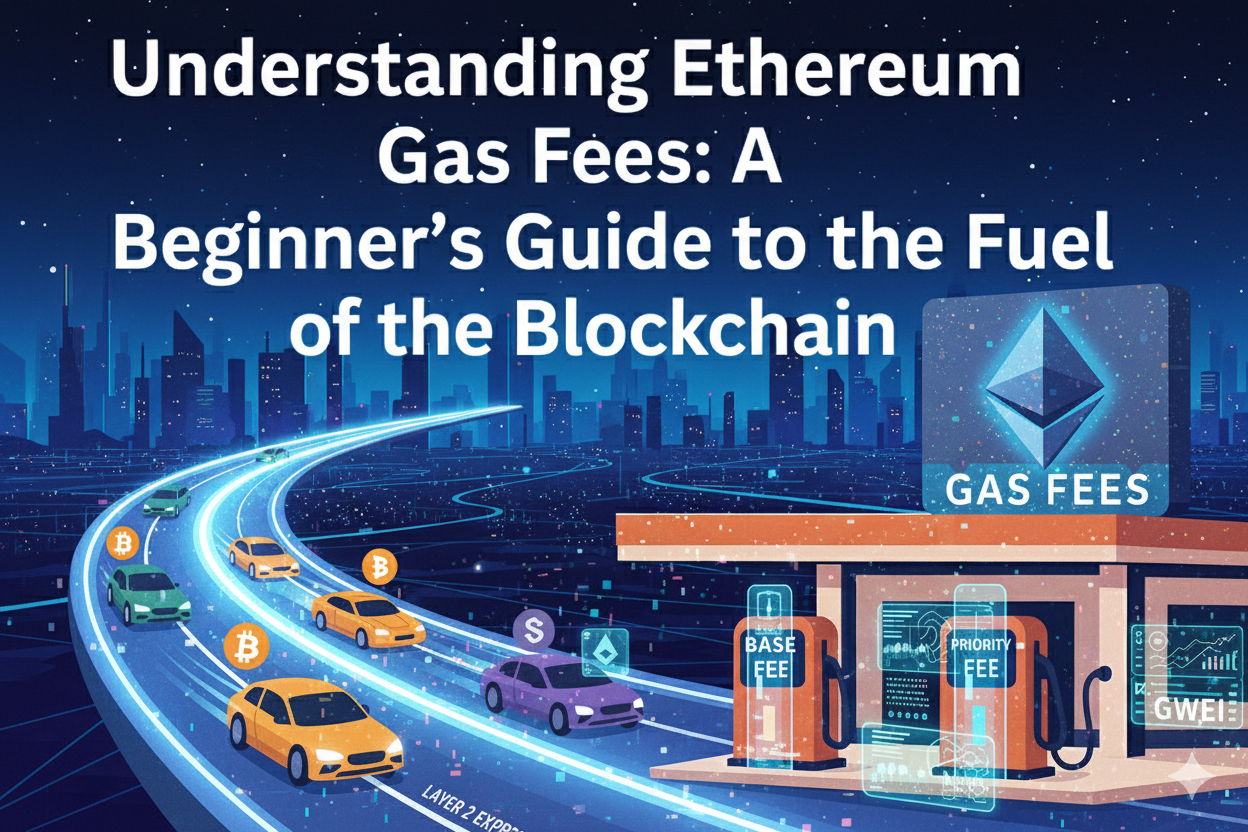
Imagine you’re driving a car on a busy highway. To keep moving, you need fuel—gasoline. Without it, your car stops. Now, picture the Ethereum blockchain as that highway, where millions of people are “driving” their digital transactions, like sending money or interacting with apps. The “fuel” here isn’t gasoline; it’s called “gas,” and the cost to buy it is known as gas fees. These fees keep the Ethereum network running smoothly, securely, and fairly.
Ethereum, launched in 2015, offers more than just cryptocurrency like Bitcoin. Developers use this decentralized platform to build smart contracts—self-executing programs that power everything from decentralized finance (DeFi) apps to non-fungible tokens (NFTs) and games. Every action on this network requires computation, and that’s where gas comes in. Gas fees compensate validators for processing and verifying transactions.
For newcomers, gas fees can seem confusing or frustrating, especially when they spike during high demand. Why do they exist? How does the protocol calculate them? And how can you avoid overpaying? This guide explains everything in simple terms, using 2025 data and the latest Ethereum upgrades.
What You’ll Learn
By the end, you’ll understand:
- What gas is and why it exists
- How gas fees are calculated after EIP-1559
- The impact of upgrades like Dencun and Pectra
- Practical strategies to minimize costs
As of late 2025, typical Layer-2 (L2) fees are often under $0.02, thanks to the Dencun upgrade, while Layer-1 (L1) fees on mainnet remain variable (commonly tens of cents) depending on demand.
What Is Ethereum Gas?
Gas is a unit that measures the computational work required for a transaction or smart-contract execution. Think of it like paying for electricity to run your computer—every task uses energy, and every blockchain action consumes gas.
Why Ethereum Measures in Gas
Ethereum acts as a global computer maintained by thousands of nodes. Without fees, spammers could overload the network with junk transactions. Gas fees ensure that every operation has a cost, discouraging abuse.
Gas itself isn’t money—it’s a measure. Actual payment is in Ether (ETH), denominated in gwei, where 1 gwei = 0.000000001 ETH.
How Gas Protects the Network
For example, a simple ETH transfer uses about 21,000 gas units. If the base fee is 10 gwei, the cost is 210,000 gwei (0.00021 ETH). Users set a gas limit, the maximum gas they are willing to consume. If a transaction runs out of gas, it reverts, but you still pay for the work already done.
How Gas Fees Work
The total fee equals gas units × gas price. Since the London upgrade in 2021, the gas price consists of:
- Base fee: Minimum required per gas, set automatically each block and adjusted by up to 12.5 % depending on how full the previous block was (target 50 % of max gas). This base fee is burned, reducing ETH supply.
- Priority fee (tip): Optional extra paid to validators to prioritize your transaction.
- Max fee per gas: The ceiling you’re willing to pay. If the actual base + tip is lower, you’re refunded the difference.
Example: sending 1 ETH might require 21,000 gas. If base fee = 8 gwei and tip = 1 gwei, you pay 21,000 × 9 gwei = 189,000 gwei (≈ 0.000189 ETH).
Different actions use different gas. Minting an NFT or trading on Uniswap might consume 100,000+ gas units.
EIP-1559: The Game Changer
Implemented in August 2021, EIP-1559 replaced the old first-price auction model with a base-fee mechanism.
Benefits:
- Predictable fees and fewer bidding wars
- Automatic burning of base fees, which creates deflationary pressure on ETH
- Smooth integration with Ethereum’s Proof-of-Stake (since the 2022 Merge).
Factors Influencing Gas Fees
- Network congestion: NFT drops or DeFi surges can still push L1 fees up.
- Transaction complexity: A simple transfer costs far less than a multi-step contract call.
- Timing: Prices often dip during weekends or late-night UTC hours.
- Layer choice: Moving to L2 networks such as Arbitrum, Optimism, Polygon, or Immutable zkEVM typically cuts fees by 90–99 %.
- ETH price: Fees are in gwei, so a rising ETH price can raise the dollar cost even if gwei stays constant.
Use tools like Etherscan Gas Tracker or Blocknative to monitor real-time fees.
Recent Upgrades and Their Impact
Dencun (EIP-4844)
Activated March 2024, Dencun introduced proto-danksharding, adding low-cost “blobs” of data for rollups.
Result: L2 transaction costs plunged by up to 95 %, with many routine transfers now costing only a few cents.
Pectra (Prague-Electra)
Activated May 2025, Pectra (not “end-of-2025” as some early plans suggested) brought EIP-7702, allowing externally owned accounts to gain temporary smart-contract abilities—a key step toward account abstraction and easier wallet UX.
Full danksharding is still in development and will further improve scalability, but it’s too early to promise “near-zero” L1 fees.
How to Keep Gas Costs Low
- Use L2 networks whenever possible for 90 %+ savings.
- Time transactions for off-peak hours (e.g., weekends UTC).
- Use accurate gas estimates from trusted trackers to avoid overbidding.
- Batch carefully: combining actions can reduce overhead, but only if contracts are optimized.
- Monitor ETH price to understand dollar costs.
The Road Ahead
Layer-2 ecosystems now handle the majority of Ethereum activity. With account abstraction and future sharding, the user experience will keep improving. Major DeFi, NFT, and gaming applications are already defaulting to L2 for cost efficiency.
Gas will never fully disappear—it’s fundamental to Ethereum’s security and spam protection—but for most users it’s becoming an invisible, minimal expense.
Conclusion
Gas fees are the invisible engine of Ethereum. They deter spam, pay validators, and help maintain a deflationary ETH supply. After EIP-1559, the Merge, and Dencun, fees are far more predictable and, on L2s, astonishingly low.
Understand how base fee, tips, and network demand interact, and you’ll know how to transact smarter—whether you’re swapping tokens, minting NFTs, or exploring the next wave of decentralized apps.