
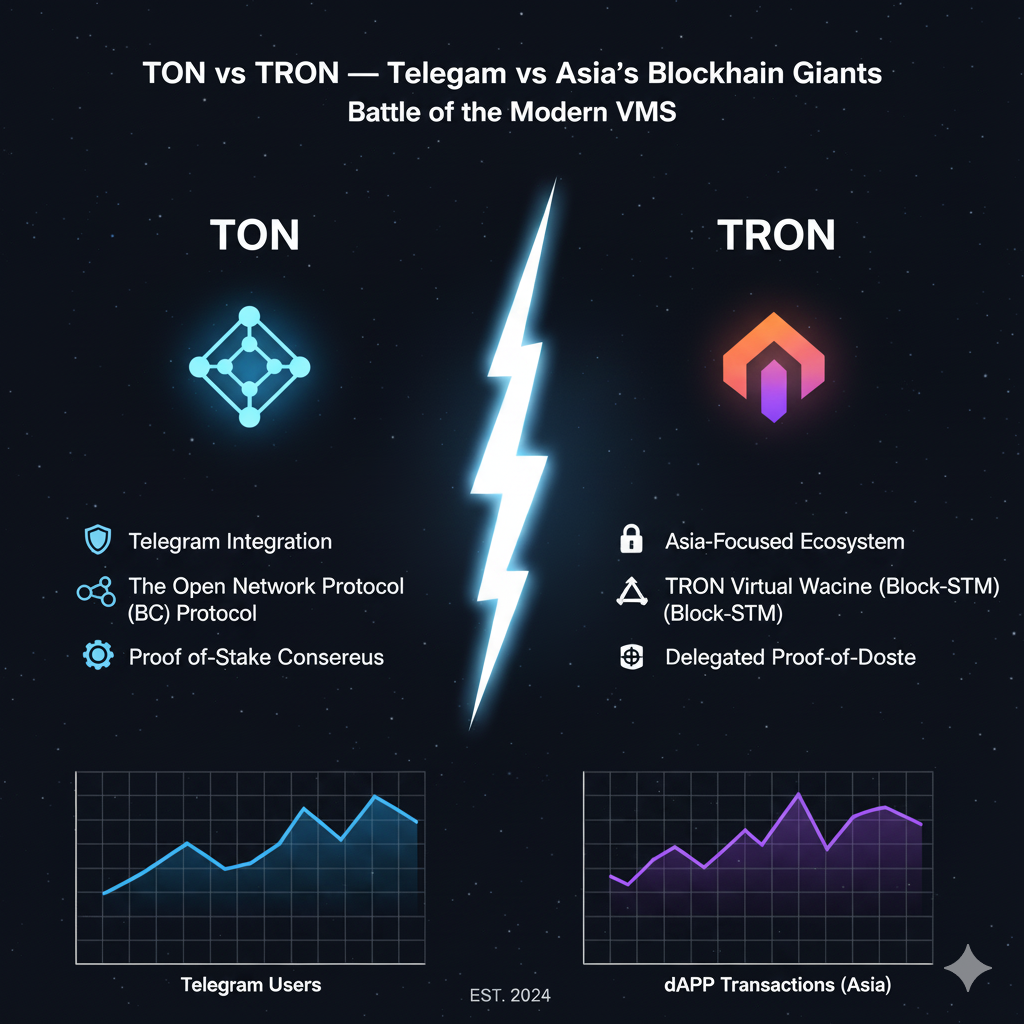
In the fast-evolving world of cryptocurrencies and blockchain technology, two platforms stand out for their unique approaches to scalability, adoption, and real-world utility: TON (The Open Network) and TRON. TON, closely tied to the popular messaging app Telegram, brings blockchain to millions through seamless integrations, while TRON has carved a niche as a powerhouse in Asia’s blockchain scene, focusing on high-speed transactions and stablecoin settlements. This comparison explores their histories, technologies, strengths, and differences, helping beginners understand why these networks matter in 2025.
Whether you’re new to crypto or looking to diversify, this TON vs TRON guide breaks it down simply, using verified facts from reliable sources.
Understanding TON: Telegram’s Gateway to Blockchain
TON, or The Open Network, is a decentralized layer-1 blockchain designed for speed and efficiency. Originally conceived by Telegram’s founders in 2018, the project faced regulatory hurdles from the U.S. Securities and Exchange Commission, leading Telegram to step back in 2020. According to SEC documentation, Telegram settled with the SEC in June 2020, agreeing to return approximately $1.2 billion to investors and pay an $18.5 million penalty. Today, TON is maintained by the independent TON Foundation, a community-driven organization that allowed the network to evolve without corporate oversight.
For a deeper dive into how TON transformed from Telegram’s ambitious project into a Web3 ecosystem, check out our comprehensive guide on TON blockchain: from Telegram’s ambition to a Web3 super app in 2025.
TON’s Technical Foundation
At its core, TON uses a Proof-of-Stake (PoS) consensus mechanism, where validators stake Toncoin (TON) to secure the network and earn rewards. What sets TON apart is its multi-blockchain architecture with dynamic sharding. As explained by Serokell’s technical analysis, sharding splits the blockchain into smaller “shards” to handle more transactions simultaneously, making it scalable for mass adoption. For beginners, think of sharding like dividing a busy highway into multiple lanes—it reduces congestion and speeds things up.
The Telegram Advantage
TON’s biggest edge comes from its integration with Telegram, which surpassed 1 billion monthly active users in March 2025. According to TechCrunch reporting and Telegram’s official documentation, features like Telegram Mini Apps allow developers to build lightweight applications that run directly in the app, supporting seamless crypto payments via TON Connect.
Users can play games like Hamster Kombat or Notcoin, earn tokens, and transfer them without leaving Telegram. This integration has boosted TON’s user base significantly, with CoinDesk covering how viral mini-apps demonstrate blockchain going mainstream.
TON’s 2025 Metrics
In 2025, TON’s ecosystem shows strong growth. According to DeFiLlama and Chainspect data:
- Total Value Locked (TVL): ~$110 million
- Stablecoin market cap: ~$860+ million
- Toncoin market capitalization: ~$5.4 billion
- 24-hour trading volume: ~$140–150 million
- Real-time throughput: ~19 TPS
- Transaction fees: Remain low, often fractions of a cent to a few cents
TON’s roadmap includes work on TON Payments, featuring payment channels that aim to improve throughput and user experience for micro-transactions through off-chain processing. To understand how TON compares with other rising blockchain platforms, read our analysis on Solana and TON: why these chains are rising but still can’t kill Ethereum.
Exploring TRON: Asia’s Blockchain Powerhouse
TRON, launched in 2017 by entrepreneur Justin Sun, started as a platform for decentralized content sharing but has grown into a global settlement layer for payments and DeFi. It’s known for its high throughput and low costs, making it a favorite in regions with high crypto adoption.
TRON’s Technical Architecture
TRON uses a Delegated Proof-of-Stake (DPoS) system, where users vote for 27 “super representatives” to validate transactions. This setup is energy-efficient and fast, differing from traditional mining models. According to TRON’s developer documentation, the network supports smart contracts compatible with Ethereum’s tooling (TVM ≈ EVM), allowing relatively easy migration of decentralized applications.
Real-World Utility Focus
For newcomers, TRON’s appeal lies in its focus on real-world utility. The network has become a leader in stablecoins like USDT, handling very large payment volumes. According to Chainalysis research, in Asia—where crypto adoption is booming—TRON dominates with low fees and high speeds, enabling everything from remittances to DeFi lending. The network’s share of retail USDT transfers under $1,000 was estimated around 65% in some analyses.
Enterprises are increasingly exploring blockchain technology for business applications, and platforms like TRON play a significant role in payment infrastructure. Learn more about corporate blockchain adoption in our article on Ethereum in business: how companies are actually using ETH.
TRON’s 2025 Metrics
By Q3 2025, TRON demonstrates substantial network activity according to TRONSCAN:
- Total Value Locked (TVL): ~$5.8–6.0 billion
- Total accounts: ~339 million
- Total transactions: ~11.7+ billion
- Real-time TPS: ~140
- Market capitalization: ~$30–31 billion
- Daily active addresses: ~2.6–2.7 million
Transaction Fees in 2025
While TRON transactions are inexpensive compared to some networks, average fees have generally been in the $0.50–$0.70 range mid-2025, after a network vote cut some fee components by approximately 60%, as reported by Brave New Coin.
A significant 2025 development: Cointelegraph reported that MetaMask added support for TRON, improving wallet access for millions of users.
Key Differences: TON vs TRON Head-to-Head
Technology and Consensus Mechanisms
TON employs PoS with dynamic sharding for parallel processing, as detailed in Serokell’s technical overview. This makes it adaptable for future scaling but adds complexity for developers new to the space.
TRON uses DPoS with 27 super representatives. Fast and efficient, developers can reuse EVM-style tooling on TVM, as explained in TRON’s developer hub.
Winner for Beginners: TRON, due to simpler mechanics and mature tooling.
Scalability and Performance
Scalability is crucial in blockchain. Measured real-time TPS in 2025 are:
- TON: ~19 TPS
- TRON: ~140 TPS (approximately 7–8× higher)
While TRON currently demonstrates higher throughput, TON’s sharding architecture promises significant future scaling gains as the technology matures.
Transaction Fees and Speed
TON: Fees are low and predictable, often fractions of a cent to a few cents depending on the action and wallet settings. Confirmations are quick, as noted by Pantani e Conti’s analysis.
TRON: Fees are low but typically in the tens of cents range on average in 2025 (around $0.50–$0.70), according to Medium reporting, with confirmations in seconds.
Example: Sending $10 in USDT on TRON might cost well under $1 and settle quickly. On TON, it can be even cheaper, with similarly fast user experience when using Telegram-integrated flows or TON Payments channels for off-chain micro-transactions.
Adoption and Community
TON leverages Telegram’s massive 1 billion+ user base and Mini Apps for organic growth. The integration with Telegram provides unprecedented access to potential blockchain users through an app they already use daily. TechCrunch’s coverage highlights this unique distribution advantage.
TRON excels in Asia, powering retail stablecoin transfers and DeFi. The network regularly shows ~2.6–2.7 million daily active addresses in recent snapshots, demonstrating sustained engagement from its user base.
Use Cases and Ecosystems
TON excels in Telegram-integrated applications, micropayments, and emerging DeFi. TON Payments enables fast, off-chain transfers via payment channels, perfect for gaming and social media monetization.
TRON dominates stablecoin transfers and hosts more mature DeFi and NFT ecosystems. The TVL comparison (~$5.8–6.0 billion for TRON vs ~$110 million for TON) shows TRON’s significantly more developed DeFi base. Both networks feature promising DeFi protocols—explore the broader landscape in our guide to DeFi 2025: top 10 protocols across all chains.
For investors interested in maximizing returns within blockchain ecosystems, staking and restaking strategies have become increasingly important. Learn about advanced yield strategies in our beginner’s guide to liquid restaking tokens (LRTs): maximizing your crypto yields.
Getting Started: Trading TON and TRON
If you’re interested in acquiring Toncoin (TON) or TRX tokens, the first step is choosing a reliable cryptocurrency exchange. Both tokens are widely available on major platforms that support beginners with user-friendly interfaces, security features, and educational resources. For detailed guidance on selecting the right platform, check out our comprehensive review of the top 10 crypto exchanges for beginners in 2025.
When choosing an exchange for TON or TRON trading, consider factors like:
- Availability: Ensure the exchange supports both TON and TRX trading pairs
- Fees: Compare trading fees, withdrawal fees, and deposit options
- Security: Look for exchanges with strong security track records and insurance funds
- User experience: Beginner-friendly interfaces make the learning curve easier
- Liquidity: Higher liquidity means better prices and faster execution
Challenges and Future Outlook for TON and TRON
Both networks face distinct hurdles. TON deals with ongoing regulatory scrutiny tied to its historical Telegram origins, though it’s now structurally separate via the TON Foundation. The SEC settlement marked a turning point that enabled community governance.
TRON has faced criticism around illicit finance risks alongside efforts to improve compliance, common challenges for networks focused on peer-to-peer transfers.
In 2025, TON’s roadmap focuses on payments infrastructure, performance improvements, and transparency upgrades. TRON emphasizes retail payment optimization and wallet integrations, exemplified by the MetaMask addition expanding accessibility.
Conclusion: Choosing Between TON and TRON
TON vs TRON isn’t about one being objectively better—it’s about which platform fits your needs. If you’re interested in social applications and already use Telegram, TON offers easy entry with low fees and viral distribution potential through Mini Apps. For high-volume transfers, Asian market exposure, or established DeFi opportunities, TRON’s proven throughput and stablecoin dominance shine.
Both platforms represent blockchain’s shift toward real-world accessibility. TON bridges social media and crypto in an unprecedented way, while TRON powers Asia’s digital economy with battle-tested infrastructure. As crypto matures in 2025, watching these giants for innovations could provide insights into blockchain’s mainstream future.
External Sources:
- SEC Press Release on Telegram Settlement
- TON Documentation
- Serokell TON Technical Analysis
- Telegram Core Documentation
- TechCrunch: Telegram Reaches 1B Users
- CoinDesk: Telegram Mini-App Gaming
- DeFiLlama TON Chain Data
- Chainspect TON Analytics
- TRON Developer Hub
- TRONSCAN Network Statistics
- Chainalysis Asia Crypto Report
- Brave New Coin: TRON Fee Reduction
- Cointelegraph: MetaMask Adds TRON
- Medium: TRON DAO Fee Reduction
- Pantani e Conti: TON Blockchain Analysis