
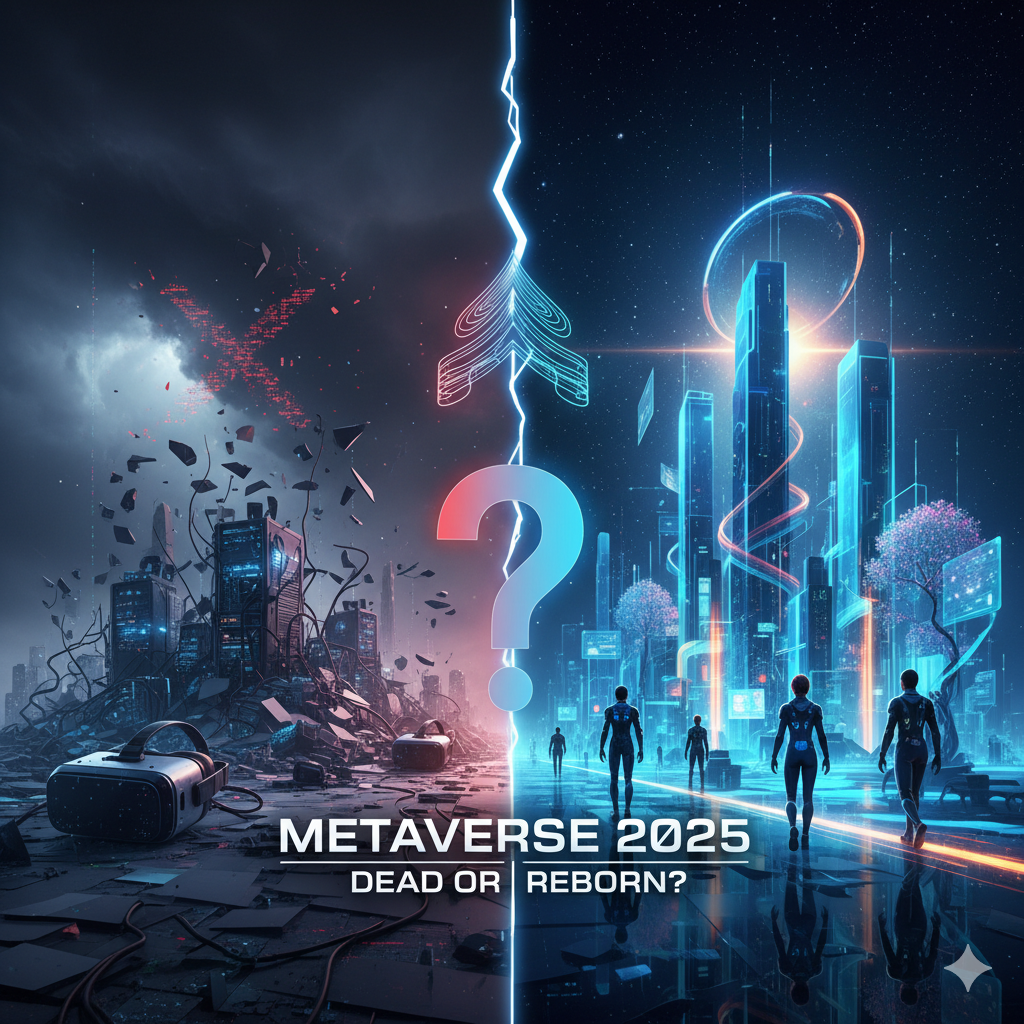
In 2021, the metaverse exploded onto the scene with promises of immersive virtual worlds where people could live, work, and play. Mark Zuckerberg rebranded Facebook to Meta, pouring billions into VR headsets and digital realms. Fast forward to 2025: Is the Metaverse dead? Or is it reborn in smarter, more practical ways? This article dives into verified data, market stats, and real developments to answer the burning question about the metaverse in 2025. Spoiler alert: It’s not dead—it’s evolving into something more practical and sustainable.
What Is the Metaverse? A Quick Primer
If you’re new to this concept, think of the metaverse as a shared 3D internet experience. Instead of scrolling through flat screens, you step into virtual spaces using VR glasses, AR apps, or even your smartphone. Digital avatars let you chat with friends, shop for virtual goods, or attend live concerts. It’s essentially like a video game that never ends, blending entertainment, commerce, and social interaction.
The Hype Cycle: From Boom to Bust to Reality
The metaverse boom peaked dramatically in 2021-2022. Meta’s Horizon Worlds and blockchain platforms like Decentraland hyped virtual land sales worth millions of dollars. Investors and tech enthusiasts rushed to claim their stake in digital real estate. But by 2023, a harsh reality check arrived:
Massive Financial Losses: Meta’s Reality Labs division (its VR and AR arm) has hemorrhaged over $70 billion cumulatively since 2020. In Q3 2025 alone, Reality Labs posted a staggering $4.4 billion operating loss on approximately $470 million in revenue, according to Meta’s official investor relations disclosures.
Low Consumer Adoption: Early consumer-focused visions flopped spectacularly. People wanted fun, seamless experiences—not clunky headsets or empty virtual worlds. Horizon Worlds never reached the “tens of millions” of users that Meta anticipated. Public reporting showed fewer than 200,000 monthly active users in 2022. No credible evidence supports tens of millions in 2025.
Crypto Market Collapse: NFT-based virtual land in Decentraland and The Sandbox tanked following the 2022 cryptocurrency bear market. According to DappRadar, daily unique active wallets across blockchain gaming platforms fell dramatically. Approximately 4.66 million daily unique active wallets were recorded across games in Q3 2025. For context on how blockchain gaming platforms actually function, check out Ethereum gaming and how blockchain games work.
Real-World Example: Imagine purchasing a virtual plot of land for $10,000 in 2021, expecting it to become “digital real estate gold.” By 2023, those values had plummeted by 90% as the hype evaporated. The lesson? Speculation drove those early valuations, not genuine utility or demand.
Yet despite these setbacks, 2025 data reveals the metaverse isn’t buried. Instead, it’s shifting from flashy dreams to practical, real-world applications.
Metaverse Market Size and Growth in 2025: The Numbers Tell the Story
Forget the rumors and speculation—here’s what reputable market research firms report:
Global Market Valuation: The metaverse market reached approximately $105.4 billion in 2024. Long-term forecasts project growth to roughly $936.6 billion by 2030. This represents a compound annual growth rate (CAGR) of approximately 46% from 2025 to 2030, according to Grand View Research.
Hardware Reality Check: Annual AR and VR headset shipments remained in the single-digit millions in 2024, per IDC guidance reported by Reuters. The 2025 unit outlook varies significantly by analyst. Some expect a pause in growth while others forecast a rebound. Either way, the industry is nowhere near shipping 65 million Meta headsets annually.
Important Note on 2025 Estimates: Many 2025 market snapshots found online conflict wildly. Where precise 2025 totals aren’t directly reported by primary research firms, treat them as directional indicators at best. Consider them rough guides rather than definitive figures.
User Numbers: Who’s Actually Using the Metaverse in 2025?
The term “metaverse” spans game-like worlds, social VR platforms, and mobile or PC-based 3D environments. Total user figures in headlines often combine disparate platforms (apples and oranges). Here are the credible, platform-specific numbers:
Roblox: Approximately 111.8 million daily active users (DAU) in Q2 2025, officially reported to Reuters. Roblox creators earned roughly $598 million in the first half of 2025. This implies over $1 billion annualized if momentum holds. Roblox functions effectively as a metaverse platform, particularly popular among younger users and increasingly attracting adults.
Fortnite (including Creative mode): Approximately 110 million monthly active users (MAU) is the commonly cited 2025 figure from industry tracking sources. Epic Games does not publicly disclose MAU data monthly. External MAU estimates should be treated accordingly. Registered accounts number far higher.
Meta Horizon Worlds: There is no credible evidence supporting claims of 98 million MAU. The best available public reporting placed usage well under 1 million users. Fewer than 200,000 in 2022 were documented, and no official announcements of 2025 MAU reaching tens of millions exist.
Blockchain-Based Metaverse Activity: Approximately 4.66 million daily unique active wallets across blockchain gaming platforms in Q3 2025, per DappRadar. Important caveat: wallet counts don’t equal individual people. Users often maintain multiple wallets. Understanding the underlying blockchain infrastructure matters—compare Ethereum vs. Solana vs. Polygon vs. TON chain metrics to see how different networks handle metaverse applications.
Bottom Line: Hundreds of millions of active users engage with game-centric 3D platforms like Roblox and Fortnite. Dedicated social VR platforms remain substantially smaller in user base.
Demographics Note: User demographics differ dramatically by platform. For example, according to Backlinko, a majority of Roblox users are under 16 years old. Cross-platform demographic averages lack reliability without unified panel research.
Key Players Driving the Metaverse in 2025
Meta: Still Betting Big Despite Losses
Meta continues investing heavily despite sustained losses. The Q3 2025 Reality Labs loss of $4.4 billion on approximately $470 million in revenue comes straight from Meta’s investor relations reports.
Ray-Ban Meta smart glasses (AI-assisted, without full AR displays in most current models) retail in the $299–$499 range. Pricing depends on model and country. Display-equipped models have been reported with pricing around $799–$1,400 depending on configuration. Pricing continues evolving, according to Android Central and other tech publications.
Gaming Giants: Roblox and Fortnite Lead the Way
Roblox effectively functions as a metaverse platform for youth and increasingly for adults. It boasts approximately 111.8 million DAU in Q2 2025. Creators earned roughly $598 million in H1 2025, per Reuters reporting.
Fortnite sustains approximately 110 million MAU according to industry trackers from Backlinko. Massive usage spikes occur during special in-game events and concerts.
Blockchain Worlds: Decentraland and The Sandbox
Claims of “$42 billion in NFT sales in 2025” lack supporting evidence from current research. More conservative estimates from CoinLedger indicate NFT market revenue of approximately $600–700 million annually for 2024–2025. Q1 2025 trading volume across all NFT categories reached approximately $8.2 billion.
Similarly, claims of “$9.1 billion in virtual real estate transactions with 75,000 properties sold” lack primary source backing. Industry research from The Business Research Company places the metaverse real estate market size at approximately $2.33 billion in 2025 (market value, not necessarily annual transaction volume). The technology behind these platforms varies significantly—explore NEAR vs. Aptos vs. Sui to understand how modern virtual machines power next-generation metaverse experiences.
Beyond Gaming: Real-World Applications Gaining Traction in 2025
Medical Training Shows Dramatic Results
There is peer-reviewed evidence of significant VR training benefits in healthcare. One widely cited study from UCLA and Osso VR reported approximately 230% improvement in overall surgical performance versus traditional training methods, according to Osso VR. This research specifically addresses surgical training rather than general metaverse applications.
Enterprise Collaboration Tools
Immersive collaboration platforms like Microsoft Mesh and Meta Workrooms are actively deployed in enterprise settings. While specific public user figures for these platforms aren’t reliably available, corporate adoption continues steadily. Remote collaboration and training purposes drive this growth.
Retail and Education Experiments
Many brands and educational institutions experiment with virtual stores, campus tours, and immersive training environments. However, the metaverse market remains concentrated in gaming and entertainment. Other sectors are still in experimental phases, per Grand View Research market analysis.
Challenges: Why Mainstream Adoption Remains Elusive
Hardware Limitations Persist
Comfort issues, motion sickness, and price points remain significant barriers. IDC and industry analysts via XR Today and EE Times Asia show 2024 shipments in single-digit millions. The 2025 outlook is mixed. Some analysts forecast a pause before hardware rebounds. Cheaper devices under $500 are emerging. Premium devices still face substantial adoption friction.
Privacy and Safety Concerns
Ongoing scrutiny around user safety continues, particularly regarding minors on platforms like Horizon Worlds. Business Insider reporting highlights these issues. Mainstream trust requires addressing these concerns before widespread adoption occurs.
Blockchain User Experience Hurdles
Latency, throughput limitations, and complex wallet user experiences remain obstacles for blockchain-based virtual worlds. DappRadar activity data shows growth in certain pockets but also significant volatility in user engagement. For those interested in DeFi aspects of metaverse economies, comparing Ethereum vs. BNB Chain DeFi ecosystems provides insight into which platforms might power future virtual economies.
The Future: Reborn and Building Toward Mass Adoption
2025 Verdict: Reborn. The metaverse is transforming from “consumer fantasy” to a combination of enterprise utility and game-platform reality. This evolution is underpinned by robust 2D/3D platforms like Roblox and Fortnite. Steady enterprise pilot programs continue expanding. Hardware is on a slow but steady grind toward mainstream acceptance.
Future Projections and Trends
Significant uncertainty exists in long-term forecasts. Some market trackers estimate metaverse users in the hundreds of millions today with projections reaching billions by 2030, according to DemandSage. However, methodology varies widely across sources. Treat these as scenario ranges rather than certainties. The blockchain infrastructure supporting these platforms will be crucial—questions like will Ethereum still be #1 in 2030 directly impact which metaverse platforms can scale successfully.
AI Integration with Metaverse Technologies
Meta and competitors are fusing AI assistants with glasses and headsets. Today’s Ray-Ban Meta smart glasses don’t feature full AR displays in most models but already integrate AI capabilities, per Meta’s official product pages. Display-equipped models with higher pricing are rumored. Industry sources continue reporting on these developments.
How to Get Started with the Metaverse in 2025
Free Entry Points: Roblox and Fortnite offer easy on-ramps to “metaverse-like” experiences accessible on computers and mobile devices. Roblox maintains approximately 111.8 million DAU. Fortnite sustains roughly 110 million MAU, per Reuters and industry trackers.
Cryptocurrency-Based Worlds: Explore SAND (The Sandbox) or MANA (Decentraland) tokens only if you thoroughly understand cryptocurrency volatility. Recognize that actual usage remains far below initial hype. Blockchain gaming sees approximately 4.66 million daily unique active wallets across numerous titles, according to DappRadar. Not all qualify as “metaverse” experiences.
Professional VR Hardware: Quest-class headsets provide immersive experiences for serious users. Calibrate expectations appropriately. Shipments remain modest. Comfort plus price considerations matter significantly, per XR Today industry analysis.
Conclusion: The Metaverse’s Evolution Continues
The metaverse in 2025 isn’t the revolutionary overnight transformation promised in 2021. Instead, it’s experiencing a more realistic evolution—shedding unsustainable hype while building practical applications. Gaming, enterprise training, and collaborative work environments lead the way.
Market valuations exceed $100 billion with projections approaching $1 trillion by 2030. Significant capital and innovation continue flowing into metaverse technologies. The question isn’t whether the metaverse is dead—it’s clearly alive and evolving. The real question is how long mainstream adoption will take. Which applications will ultimately define its success remains to be seen.
For now, the metaverse remains reborn: more grounded, more practical, and potentially more sustainable than its hype-driven origins suggested.