
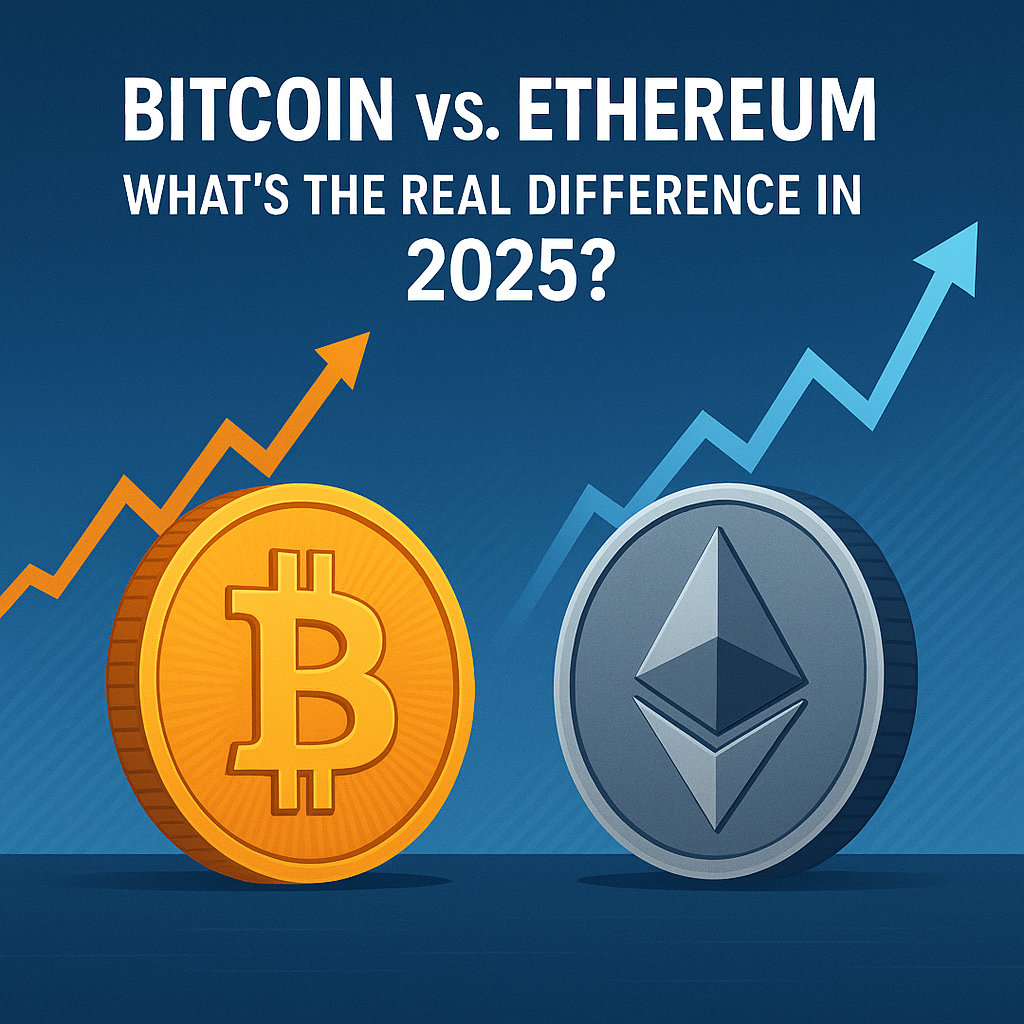
TL;DR: Bitcoin is “digital gold”—a reliable, simple store of value. Ethereum is a programmable network—fueling apps, finance, NFTs, and tokenized real-world assets. In 2025, both are appreciating, but for very different reasons: BTC on scarcity and institutional demand, ETH on upgrades, yield, and utility.
Market Snapshot: Where Bitcoin and Ethereum Stand in Mid-2025
The cryptocurrency market in 2025 continues to evolve with remarkable momentum. Currently, Bitcoin is trading around $110,000, with mining difficulty and hash rate hitting record levels as miner margins tighten. Meanwhile, Ethereum has reached new all-time highs near $4,900, riding momentum from continuing network improvements and growing institutional interest.
Furthermore, the Bitcoin ETF landscape has matured significantly, with U.S. Bitcoin ETFs currently holding approximately $150–160 billion in assets under management. In contrast, Ethereum ETFs, though smaller, have gained substantial ground with $25–35 billion in AUM. However, flow patterns remain volatile—some weeks see massive BTC inflows, while other weeks ETH leads the charge.
Origins & Purpose: Simple Money vs On-Chain Infrastructure
Bitcoin: The Original Cryptocurrency
Launched in 2009 by the pseudonymous Satoshi Nakamoto, Bitcoin was created as a peer-to-peer electronic cash system. Over time, however, it evolved into a store-of-value asset with a hard cap of 21 million BTC. Notably, the 2024 halving event reduced the block reward to 3.125 BTC, further constraining new supply and reinforcing Bitcoin’s scarcity narrative.
Ethereum: The World Computer
In contrast, Ethereum launched in 2015, conceived by Vitalik Buterin and co-founders as a blockchain with native programmability. Unlike Bitcoin’s focus on simple transfers, Ethereum introduced smart contracts—self-executing code that enables decentralized applications (dApps), automated finance, and complex digital agreements.
If Bitcoin is a vault, Ethereum is a development platform.
Consensus Mechanisms: Proof-of-Work vs Proof-of-Stake
Bitcoin’s Proof-of-Work Security
Bitcoin operates on Proof-of-Work (PoW), where miners expend computational energy to secure the network. Key characteristics include:
- Block time of approximately 10 minutes
- Throughput of roughly 7 transactions per second (TPS)
- Extremely robust and battle-tested security model
- Energy-intensive but highly decentralized
As a result, the Bitcoin mining network continues to set new hash rate records, demonstrating unparalleled security.
Ethereum’s Proof-of-Stake Evolution
Following The Merge in September 2022, Ethereum transitioned to Proof-of-Stake (PoS), where validators stake ETH instead of burning energy. Consequently, this transformation brought:
- Reduced energy consumption by ~99.95%
- Mainnet throughput of approximately 15–20 TPS
- Validator staking rewards of typically 2–4% annually
Moreover, the 2024 Dencun upgrade (EIP-4844) introduced “blobs”—cheap data availability for rollups—dramatically lowering Layer-2 (L2) costs. Therefore, L2 solutions like Arbitrum and Optimism now push effective throughput into the thousands of TPS, with transaction costs often below $0.01.
Tokenomics: Scarcity vs Dynamic Supply
Bitcoin’s Fixed Supply Model
Bitcoin’s monetary policy is refreshingly simple: a hard cap of 21 million coins with predictable issuance via halvings every four years. Indeed, this scarcity—and the certainty around it—forms a core narrative for both retail holders and institutional investors seeking a digital equivalent to gold.
Ethereum’s Deflationary Mechanism
On the other hand, Ethereum has no fixed supply cap, but EIP-1559 burns a portion of transaction fees with every block. Post-Merge, ETH often runs close to zero net issuance or even slightly deflationary, depending on network activity. As a result, this creates a dynamic supply model where high usage actually reduces the total ETH supply over time.
Additionally, stakers earn yield—typically 2–4% annually from validator rewards and MEV (Maximal Extractable Value), making Ethereum an income-generating asset. Learn more about Ethereum’s key statistics and performance metrics.
Performance, Fees & Transaction Speed
Despite its reliability, Bitcoin remains rock solid but isn’t optimized for micro-transactions at scale. Nevertheless, the Lightning Network offers a Layer-2 solution for instant, cheap payments, though adoption and usability remain fragmented.
In comparison, Ethereum, especially with Layer-2 rollups, offers near-instant, ultra-low-cost transfers. Specifically, many L2 networks now charge less than $0.01 per transaction. Furthermore, network activity across Ethereum rollups often exceeds Bitcoin’s daily transaction volume, demonstrating Ethereum’s superior throughput capabilities.
Use Cases: Store of Value vs Programmable Infrastructure
Bitcoin’s Core Use Case
Primarily, Bitcoin serves as a store of value and macro reserve asset. Institutions acquire BTC via ETFs, corporations add it to their treasuries (like MicroStrategy’s holdings), and nation-states explore it as a reserve currency alternative.
Ethereum’s Ecosystem Dominance
In contrast, Ethereum powers the backbone of Web3 infrastructure:
- DeFi (Decentralized Finance): Ethereum leads by total value locked (TVL) across lending protocols, decentralized exchanges, and yield farming platforms
- NFTs and Digital Collectibles: Most major NFT marketplaces operate on Ethereum
- Tokenized Real-World Assets (RWA): Real estate, bonds, and commodities increasingly tokenize on Ethereum
- DAOs (Decentralized Autonomous Organizations): Governance and community coordination
- Stablecoins: Major issuers like USDC use Ethereum extensively
While networks like Tron compete aggressively in USDT issuance, Ethereum remains the dominant chain for innovation and new protocol development.
What’s New in 2025: Upgrades and Headwinds
Bitcoin in 2025
Currently, mining difficulty and hash rate have reached record highs—a double-edged sword. While this demonstrates unparalleled network security, it simultaneously compresses miner profit margins, potentially forcing less efficient operations offline.
Ethereum’s Recent Developments
Notably, the Pectra upgrade (May 2025) delivered significant protocol optimizations and user experience improvements. Additionally, ongoing rollup adoption and Layer-2 consolidation continue driving network usage and fee burns, strengthening Ethereum’s deflationary mechanics.
Risks to Monitor
For Bitcoin:
- Future halving cycles may threaten miner viability if price appreciation doesn’t offset reduced rewards
- Quantum computing threats (though still largely speculative and years away)
- Regulatory scrutiny around energy consumption
For Ethereum:
- If network usage drops sharply, the burn mechanism could revert to positive issuance
- Staker concentration among large participants could raise centralization concerns
- Competition from newer Layer-1 blockchains offering similar smart contract functionality
For more insights on the regulatory landscape, check out our guide on crypto regulation in 2025.
Bitcoin vs Ethereum: Strengths and Weaknesses
| Feature | Bitcoin — “Digital Gold” | Ethereum — “Programmable Money” |
|---|---|---|
| Core Strengths | Simplicity, scarcity (21M cap), robustness, clear narrative | Staking yield, flexibility, broad use cases, network effects |
| Key Weaknesses | Low throughput (7 TPS), high energy cost, limited utility beyond storage | Complexity, potential centralization risks, variable issuance |
| Primary Use Case | Store of value, hedge against inflation | DeFi, smart contracts, tokenization, Web3 infrastructure |
| Transaction Costs | Higher on-chain, cheaper via Lightning | Ultra-low on Layer-2 rollups (<$0.01) |
The Flippening Debate: Competition or Coexistence?
The “flippening”—the hypothetical moment when Ethereum overtakes Bitcoin in market capitalization—remains a popular talking point in crypto communities. However, the more probable outcome is sustainable coexistence:
- Bitcoin continues as a reserve-grade, simple store of value with maximum decentralization
- Meanwhile, Ethereum evolves as the infrastructure layer for financial primitives, applications, and tokenized real assets
Ultimately, these cryptocurrencies serve different investment theses and use cases—they’re not necessarily direct rivals, but rather complementary pillars of the digital economy.
Which Cryptocurrency Should You Choose in 2025?
The decision between Bitcoin and Ethereum ultimately depends on your investment goals and risk tolerance. For a comprehensive analysis, see our complete investment guide for Bitcoin vs Ethereum.
Choose Bitcoin if you want:
- Stability and simplicity
- A clear scarcity narrative (fixed 21M supply)
- Maximum security through Proof-of-Work
- A “set it and forget it” store of value
- Exposure to institutional adoption via Bitcoin ETFs
Choose Ethereum if you want:
- Participation in smart contract infrastructure
- Staking yield (2–4% annually)
- Exposure to DeFi, NFTs, and Web3 innovation
- Cheap, programmable transactions via Layer-2
- A deflationary asset with growing utility
Or consider both. Many sophisticated investors hold both BTC and ETH, recognizing that they serve different purposes in a diversified crypto portfolio. Essentially, Bitcoin offers stability and simplicity; Ethereum offers growth potential and utility.
To get started with purchasing and storing these assets, explore our guides on top crypto exchanges for beginners and the best crypto wallets.
Final Thoughts: Bitcoin and Ethereum in the Evolving Crypto Landscape
In 2025, both Bitcoin and Ethereum matter—for very different reasons. Specifically, Bitcoin has cemented its position as digital gold, a reliable store of value backed by institutional adoption and unwavering scarcity. Simultaneously, Ethereum has established itself as the programmable foundation of decentralized finance and Web3 applications.
Moreover, the cryptocurrency market has matured beyond the “one coin to rule them all” mentality. Smart investors recognize the unique value propositions of both assets. Therefore, whether you prioritize scarcity and simplicity or programmability and yield, understanding these fundamental differences is crucial for making informed investment decisions.
Always conduct your own research using resources like CoinMarketCap, Messari, and Ethereum.org. Balance wisdom with ambition, and never invest more than you can afford to lose in these volatile but revolutionary assets.
Read also: StarkNet Roadmap 2025.