
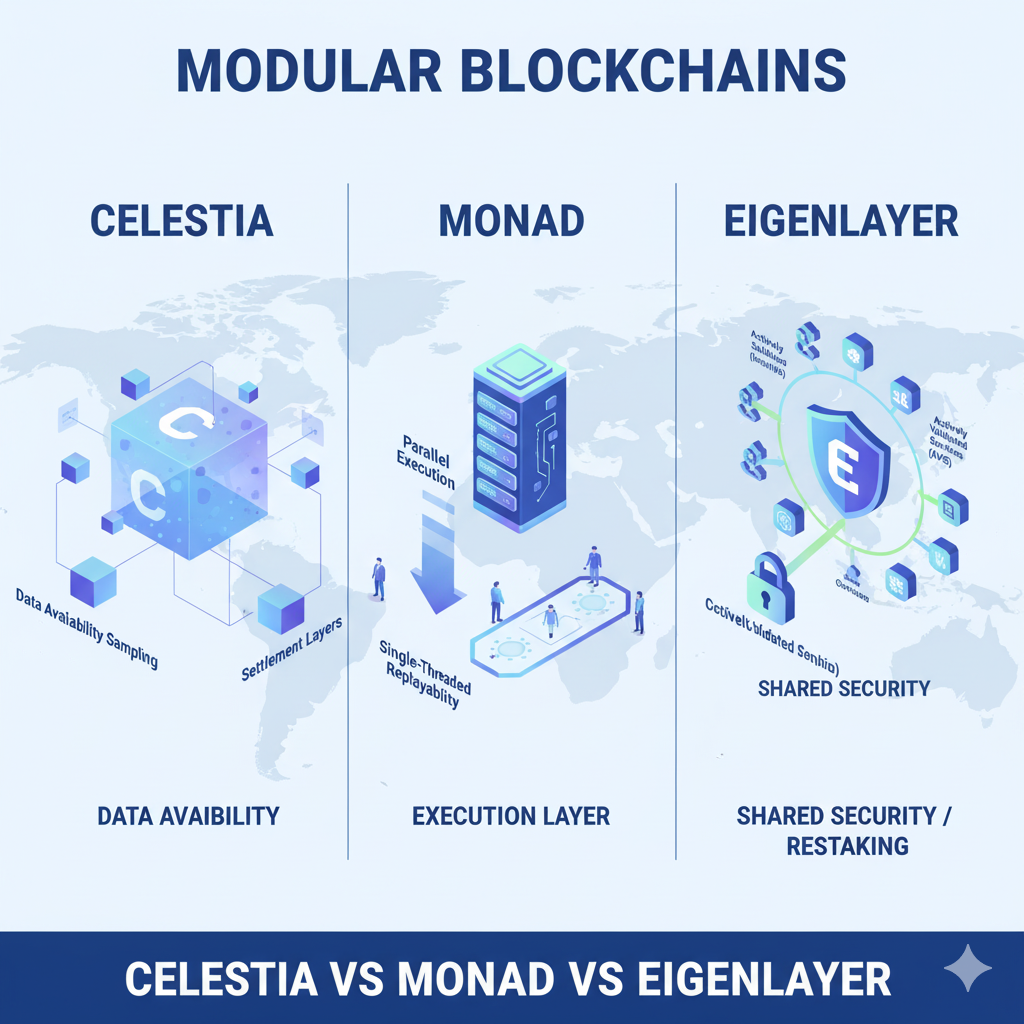
In the rapidly evolving world of blockchain technology, modular blockchains are gaining traction as a solution to scalability issues. Traditional networks like Ethereum have struggled with these challenges for years. However, modular blockchains take a different approach. Instead of handling all functions in a single layer, they separate tasks into specialized layers. As a result, this design offers greater flexibility, efficiency, and scalability.
Three projects stand out in this space: Celestia, Monad, and EigenLayer. Each addresses specific challenges in blockchain design. Moreover, they represent different facets of the modular ecosystem. Whether you’re a beginner curious about crypto or an enthusiast exploring blockchain innovations, this guide will help you understand their unique contributions.
What Are Modular Blockchains?
First, let’s establish the fundamentals. Traditional monolithic blockchains, such as Bitcoin or early Ethereum versions, perform all core functions on one chain. Consequently, this integrated approach creates significant bottlenecks. As more users join the network, transaction speeds slow down. Additionally, fees skyrocket, and overall scalability suffers.
Modular blockchains solve these problems by “unbundling” blockchain functions into specialized layers:
Execution: This layer runs smart contracts and processes transactions. Essentially, it serves as the computational engine that powers decentralized applications.
Consensus: This mechanism determines how nodes agree on the blockchain’s current state. Therefore, it ensures all participants maintain a synchronized view of the network.
Settlement: This layer finalizes transactions and resolves any disputes. Ultimately, it provides the final source of truth.
Data Availability (DA): This component ensures that transaction data remains accessible and verifiable. Importantly, it achieves this without requiring every node to download the entire blockchain history.
By specializing these functions, modular designs enable horizontal scaling. In other words, networks can add more layers or chains instead of overloading a single network. For example, Ethereum is transitioning toward modularity with rollups. These Layer 2 solutions offload execution while relying on the main chain for security and data availability.
Notably, Celestia focuses exclusively on data availability. Meanwhile, Monad enhances execution in a high-performance Layer 1 environment. At the same time, EigenLayer provides shared security through an innovative restaking mechanism. These projects complement each other rather than compete directly.
Celestia: The Data Availability Specialist
Celestia launched in 2023 as a pioneering modular blockchain. Specifically, developers designed it for data availability and consensus. Furthermore, it makes launching new blockchains or rollups significantly easier. The platform decouples data availability from execution. As a result, developers can build sovereign rollups that handle their own logic while relying on Celestia for secure data storage.
Key Features of Celestia
Data Availability Sampling (DAS): Nodes don’t need to download full blocks. Instead, they sample small portions to verify data integrity. Consequently, this makes the network lightweight and scalable. Even resource-limited devices can participate in network verification thanks to this innovative approach.
Consensus Mechanism: Celestia uses proof-of-stake (PoS) with CometBFT (formerly Tendermint). Additionally, it maintains an average block time of around 5–6 seconds. This consensus model successfully balances speed with security and decentralization.
TIA Token: Users stake the TIA token, participate in governance, and pay for data availability (“blobspace”) via PayForBlobs. Moreover, the token creates economic incentives that align network participants toward maintaining data availability.
Integrations: Celestia works with Ethereum rollups and Cosmos-SDK chains. For instance, Blobstream makes Celestia’s data availability usable for Ethereum-settled rollups. Similarly, platforms like Dymension integrate with Celestia for data availability and Rollup-as-a-Service (RaaS).
Think of Celestia as a massive, secure cloud storage system for blockchain data. Unlike monolithic chains where every node stores everything, Celestia ensures data remains available without overwhelming network resources. This proves particularly crucial for rollups, which post transaction data to Celestia to prove validity without congesting Ethereum.
Celestia fits perfectly into the modular narrative by focusing solely on data availability. Meanwhile, it leaves execution to other layers. As of 2025, the platform has integrated with projects like Dymension for rollup deployment.
Learn more: Celestia Documentation | Celestia Blog
Monad: High-Performance Execution in an EVM-Compatible L1
Monad represents an EVM-compatible Layer 1 blockchain that emphasizes extreme performance. At the same time, it maintains decentralization. Unlike pure modular layers, Monad sparks debate in the modular versus monolithic discussion. While it functions as a single-shard Layer 1, it uses modular software architecture. Specifically, it decouples consensus and execution via pipelining and parallelism.
Key Features of Monad
EVM Compatibility: Monad maintains bytecode compatibility with Ethereum. Therefore, developers can deploy existing smart contracts without changes. This compatibility removes technical barriers for developers migrating from Ethereum.
Performance Claims: Monad targets approximately 10,000 transactions per second (TPS). Furthermore, it aims for block times around 0.4 seconds and finality of approximately 800 milliseconds. Simultaneously, it maintains low fees. These performance targets represent a significant improvement over traditional blockchain networks.
MonadDB: The platform uses a custom database with a Patricia Trie structure. This structure organizes state and enables efficient access. Notably, developers optimized this specialized database architecture for blockchain-specific data patterns.
Parallel & Asynchronous Execution: Transactions execute in parallel with sequential verification. As a result, this boosts throughput while preserving determinism. This approach maximizes hardware use without sacrificing the predictability that smart contracts require.
Ecosystem Programs: Monad supports builders through residencies and hackathons. For example, Monad Madness offers $1 million in prizes.
Think of Monad as a supercharged version of Ethereum. While Ethereum can experience high fees during peak usage periods, Monad redesigns the underlying engine for speed. Nevertheless, it maintains compatibility. This resembles upgrading from a single-core to a multi-core processor.
In the modular ecosystem debate, Monad argues that monolithic designs can scale effectively if developers properly optimize execution. Consequently, this challenges the pure modularity approach. As of October 2025, mainnet remains pending with testnet live. Additionally, developers scheduled a token airdrop claims portal for October 14, 2025.
Learn more: Monad Official Website | Monad Documentation
EigenLayer: Shared Security Through Restaking
EigenLayer differs from the previous two platforms. Rather than being a standalone blockchain, it functions as a restaking protocol on Ethereum. Specifically, it enables “shared security” for modular networks. The platform launched in phases since 2023–2024. Moreover, it allows users to restake staked ETH (or liquid staking tokens) to secure other services. Therefore, it extends Ethereum’s security to sidechains, rollups, and more.
Key Features of EigenLayer
Restaking Mechanism: Users can restake ETH or liquid staking tokens (such as stETH) to secure Actively Validated Services (AVSs). These services include oracles or bridges. This innovative approach lets Ethereum stakers earn additional yields. Simultaneously, they support the broader ecosystem.
EigenDA: EigenDA provides a data availability service. Currently, operators run it via a committee/DAC-style model. However, developers published a version 2 design. This design aims for a more decentralized data availability network and higher throughput.
Operators & Slashing: Operators run AVS software. If they misbehave, the system can slash them (now live on mainnet). Consequently, this aligns incentives with security. This economic mechanism ensures that participants have skin in the game.
EIGEN Token: Users employ the EIGEN token for governance and intersubjective security. For instance, it enables fork-based slashing for non-objective faults. Thus, it complements ETH restaking for objectively verifiable faults. Notably, it is not a gas or fee token.
Integrations: Many projects use EigenLayer to back Ethereum Layer 2 solutions and services. For example, Aevo uses EigenDA for data availability.
Think of EigenLayer as renting out your staked ETH for additional jobs. Normally, staking secures Ethereum. However, restaking allows it to secure other networks simultaneously. As a result, users earn more rewards while bootstrapping new chains with Ethereum-level economic security.
EigenLayer enhances modularity by providing economic security. Importantly, it does this without requiring each chain to build its own validator set from scratch. Therefore, it addresses the fragmented security issue that can arise in modular designs.
Learn more: EigenLayer Documentation | EigenLayer Official Website
Key Differences Between Celestia, Monad, and EigenLayer
Understanding how these three platforms differ is essential. Consequently, let’s examine their roles in the blockchain ecosystem:
Core Function:
- First, Celestia serves as a data availability and consensus layer
- Second, Monad functions as an execution-optimized Layer 1 with a full stack
- Third, EigenLayer operates as a security layer via Ethereum restaking
Architecture:
- Celestia follows a pure modular design with no execution layer
- In contrast, Monad represents a monolithic Layer 1 that decouples consensus and execution in its software architecture
- Meanwhile, EigenLayer exists as a protocol built on Ethereum that enables shared security for Actively Validated Services
Performance & Use:
- Celestia provides scalable data availability for rollups. Additionally, it maintains approximately 5–6 second blocks
- Monad targets high throughput (around 10,000 TPS) for decentralized applications
- Similarly, EigenLayer offers low-cost shared security. Furthermore, EigenDA provides high-throughput data availability via its committee design
Ecosystem Fit:
- Celestia and EigenLayer often integrate within Ethereum ecosystems. For example, they work through Blobstream and EigenDA pathways
- On the other hand, Monad stands alone as a performant EVM-compatible alternative
Pros and Cons: A Balanced View
Celestia
Pros: First, Celestia offers lightweight, cost-effective data availability. Second, it enables easy blockchain launches. Third, it provides security via Data Availability Sampling.
Cons: Since Celestia focuses only on data availability, it needs other layers for execution and settlement. Additionally, it maintains block times of approximately 5–6 seconds.
Monad
Pros: First, Monad delivers high speed and low fees. Second, it offers full EVM compatibility. Third, developers designed it to run on consumer-grade hardware.
Cons: As of October 2025, mainnet is still pending. Moreover, the performance figures represent targets from public materials.
EigenLayer
Pros: First, EigenLayer boosts yields via restaking. Second, it provides shared security. Third, slashing is now live on mainnet. Finally, EigenDA offers high-throughput data availability.
Cons: The committee-style data availability approach introduces potential centralization trade-offs. Furthermore, the concept can be complex for beginners to understand.
Use Cases and Future Outlook
Different platforms excel in different scenarios. For instance, Celestia shines in rollup ecosystems. Specifically, it powers sovereign chains for DeFi or NFTs. Meanwhile, Monad proves ideal for high-frequency trading applications or games needing low latency. At the same time, EigenLayer secures bridges, oracles, and Layer 2 solutions. Consequently, it reduces bootstrap costs.
As blockchain adoption accelerates, modular designs like these could become the dominant architecture. Notably, Ethereum is leading this transition. However, debates continue within the blockchain community. Is pure modularity always superior? Or can optimized monolithic designs like Monad effectively compete?
The answer likely depends on specific use cases and requirements. For applications requiring maximum decentralization and composability, pure modular approaches may prove preferable. Conversely, for applications demanding the highest performance, optimized monolithic designs might offer advantages.
Conclusion: The Future of Modular Blockchains
Celestia, Monad, and EigenLayer each advance modular blockchain architecture in unique ways. Specifically, they contribute through data availability specialization, performance-optimized execution, and shared security mechanisms respectively. These platforms demonstrate that blockchain design doesn’t have a one-size-fits-all solution.
For those new to the space, consider exploring their documentation first. Additionally, participate in testnets or make small initial investments to learn more. The future of cryptocurrency and blockchain technology lies in innovations like these. Ultimately, they make blockchains faster, more affordable, and increasingly accessible to users worldwide.
As the modular blockchain landscape continues to evolve, these three platforms will likely play significant roles. Indeed, they will shape how developers build and scale decentralized networks in the years ahead.
Additional Resources: