
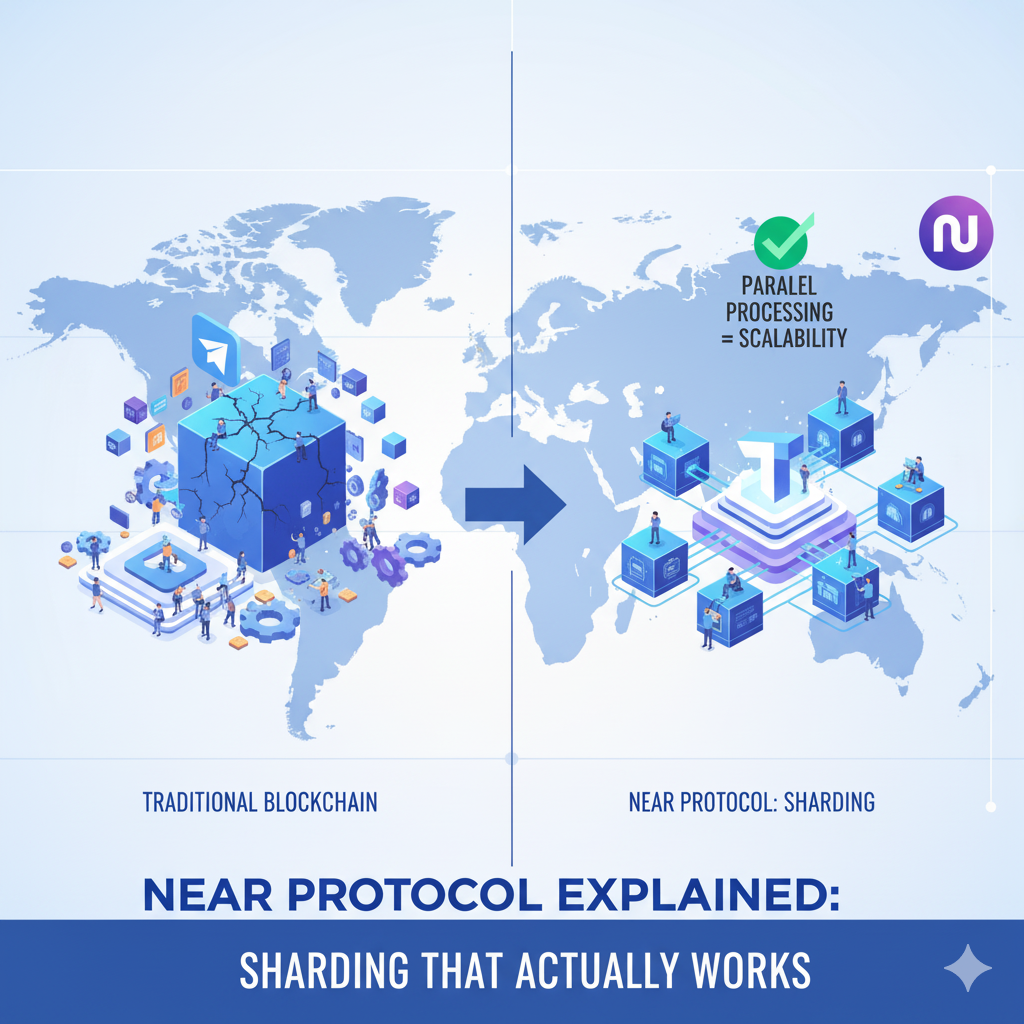
The blockchain industry has long grappled with a fundamental problem: how to scale without sacrificing security or decentralization. Most networks force every node to process every transaction, creating severe bottlenecks. However, NEAR Protocol has implemented a sharding solution that actually works in production.
The Blockchain Scalability Problem
Traditional blockchain architectures face insurmountable limitations. Every validator must process every transaction. Consequently, networks hit hard ceilings in three critical areas: computational capacity, storage requirements, and bandwidth consumption. This creates the infamous blockchain trilemma. Therefore, developers must compromise between security, decentralization, and scalability.
Most attempted solutions have fallen short. Partial sharding implementations only address data availability. Meanwhile, execution bottlenecks remain intact. Other networks sacrifice decentralization by reducing validator counts. Alternatively, they compromise security through weaker consensus mechanisms.
What Makes NEAR Different
NEAR Protocol represents a fundamentally different approach to blockchain architecture. The network was founded by Illia Polosukhin and Alexander Skidanov. Notably, Polosukhin co-authored the groundbreaking Transformer paper that changed artificial intelligence. Similarly, Skidanov brought experience from Microsoft and MemSQL. As a result, the network was built from the ground up with scalability as a core requirement.
NEAR operates as a Layer-1 Proof-of-Stake blockchain. It combines academic rigor with practical engineering. The team recognized an important truth early on. True scalability requires sharding not just data, but also state and execution. Furthermore, this challenge has defeated numerous blockchain projects.
Learn more about NEAR’s founding vision: NEAR Protocol Official Website
Nightshade: Sharding Architecture That Scales
NEAR’s breakthrough comes from Nightshade. This is a sharding architecture that maintains a single canonical chain. At the same time, it enables parallel transaction processing. Unlike systems that create separate shard chains, Nightshade treats the blockchain differently. Specifically, it works like a book where each block represents a page. Each page contains multiple chapters—one chunk per shard.
Core Technical Innovations
The architecture achieves linear scalability through several interconnected mechanisms. Let’s explore each one:
Unified Chain Structure: Every block incorporates chunks from all shards. Consequently, this maintains a single source of truth. Moreover, it avoids fragmenting the network into isolated chains.
Asynchronous Communication: Cross-shard transactions work through a receipt-based system. First, Shard A executes a transaction that affects Shard B. Then, it generates a receipt that Shard B processes later. As a result, this eliminates the need for synchronous cross-shard coordination.
Erasure Coding for Data Availability: Each chunk’s data gets split and distributed across the network. Therefore, this ensures recoverability even if some validators go offline. Additionally, this approach balances data availability with reasonable storage requirements.
Hidden Validator Assignment: Validators don’t know which shards they’ll validate immediately. Instead, they learn this shortly before block production. Consequently, this prevents targeted attacks where bad actors could concentrate resources on corrupting specific shards.
Fisherman Network: Specialized nodes monitor for invalid chunks. They detect and penalize bad behavior. Importantly, this doesn’t require every validator to check every shard.
Since May 2025, this architecture delivers impressive performance. Block times average approximately 600 milliseconds. Furthermore, finality occurs in roughly 1.2 seconds. As a result, these metrics enable genuinely real-time blockchain applications.
Technical deep dive: NEAR Protocol Documentation
Nightshade 2.0: Stateless Validation Revolution
In August 2024, NEAR deployed Nightshade 2.0. This introduced stateless validation—a major shift in how validators operate. Traditional blockchain validators must store complete copies of the blockchain state. Consequently, this requires substantial storage infrastructure. Moreover, it creates barriers to decentralization.
Stateless validation eliminates this requirement. Now, validators fetch only the specific state data needed for transaction validation. They do this on demand. This change reduces hardware requirements dramatically. Additionally, it improves execution performance by an estimated four times.
The implications extend beyond cost reduction. Lower hardware requirements mean more potential validators. Therefore, this strengthens decentralization. Furthermore, faster execution enables the network to scale to more shards without slowing down.
The network has already expanded significantly. It grew from six shards in 2024 to eight shards in 2025. Moreover, the technical foundation now supports continued horizontal scaling.
User Experience Innovations
NEAR Protocol distinguishes itself through features that dramatically improve blockchain usability. Let’s examine the key innovations:
Human-Readable Account Names: Traditional wallets use cryptographic addresses. For example, something like “0x742d35Cc6634C0532925a3b844Bc9e7595f0bEb” is typical. In contrast, NEAR users create accounts such as “alice.near.” Consequently, this simple change removes a major barrier to mainstream adoption.
Predictable Low Fees: Gas prices remain minimal and stable. Therefore, users avoid the fee spikes that plague networks like Ethereum during congestion. Additionally, predictable costs enable developers to build sustainable business models.
Chain Abstraction Technology: This is perhaps the most revolutionary feature. NEAR’s smart contracts can sign transactions on other blockchains. Meanwhile, a multichain gas relayer covers transaction fees on the user’s behalf. As a result, users no longer need to hold multiple different tokens. Furthermore, they don’t need to understand which blockchain they’re using. The complexity simply gets hidden away.
This chain abstraction approach represents a fundamental reimagining of blockchain connectivity. It moves beyond simple token bridges. Instead, it delivers seamless cross-chain functionality.
Explore NEAR’s ecosystem: NEAR Ecosystem
AI Integration and Future Direction
NEAR positions itself as “the blockchain for AI.” This recognizes that artificial intelligence and blockchain technology will increasingly converge. The network supports user-owned intelligent agents. Additionally, it enables intent-based applications. Here, users specify desired outcomes rather than manually executing transactions.
This AI-native direction leverages co-founder Illia Polosukhin’s deep expertise in machine learning. The combination delivers powerful capabilities. Fast finality, low costs, and chain abstraction work together. Consequently, this creates an ideal foundation for AI agents. These agents need to execute numerous small transactions across multiple blockchains.
Comparative Performance Analysis
NEAR’s technical specifications place it among the fastest Layer-1 blockchains. Let’s compare key metrics:
Finality Speed: The approximately 1.2 second finality is impressive. It’s achieved through Doomslug consensus with Ed25519 signatures. Moreover, this rivals or exceeds competing networks. As a result, it enables applications that require near-instant confirmation.
Comprehensive Sharding: Many projects plan to shard only data availability. For instance, Ethereum’s future implementations follow this approach. In contrast, NEAR already shards state, execution, and data. Furthermore, it does this behind a unified chain structure.
Decentralization Metrics: The network maintains approximately 254 active validators as of Q1 2025. Validator sets rotate every 12 hours. Therefore, this ensures fairness and prevents centralization. Additionally, this balance between decentralization and performance exceeds many competing networks.
Cross-Chain Capabilities: Chain abstraction delivers smoother experiences than traditional bridge-based approaches. However, some complex cross-chain state access still requires messaging protocols.
Learn about NEAR staking: NEAR Staking Guide
Security Considerations and Limitations
NEAR Protocol operates under standard Byzantine Fault Tolerance assumptions. The network maintains safety under specific conditions. All honest validators must agree on transaction ordering. This works provided fewer than one-third of validators by stake act maliciously.
Additionally, the network needs liveness. This is the ability to continue processing transactions. It requires at least two-thirds of validators to remain active and honest.
These security guarantees match industry standards for Proof-of-Stake networks. However, like all blockchain systems, NEAR faces inherent tradeoffs:
Performance Variability: Claimed throughput metrics reflect optimal network conditions. Real-world performance varies. This depends on transaction complexity, cross-shard communication patterns, and network congestion.
Chain Abstraction Scope: Chain abstraction dramatically simplifies user experience. Nevertheless, it doesn’t eliminate all technical complexity. Some cross-chain operations still require dedicated messaging layers or bridge protocols.
Validator Centralization Risks: Validators need relatively high performance requirements. This remains true even after stateless validation improvements. Consequently, this could potentially limit geographical and organizational diversity among validators.
The Path Forward
NEAR Protocol demonstrates that theoretical sharding architectures can deliver practical results in production. The progression from initial launch through Nightshade 2.0 shows continuous innovation. Specifically, stateless validation has removed previous scalability bottlenecks.
The network’s trajectory points toward exciting developments. Further horizontal scaling through additional shards is planned. Moreover, deeper AI integration is coming. Additionally, expanded chain abstraction capabilities are in development.
Web3 applications demand higher throughput and better user experiences. Therefore, NEAR’s architectural choices position it well. It serves as infrastructure for the next generation of apps.
For developers building intelligent, interconnected applications, NEAR Protocol offers compelling advantages. It provides fast finality and seamless cross-chain functionality. Furthermore, it’s production-ready. Consequently, it balances the blockchain trilemma more successfully than previous attempts.
Start building on NEAR: NEAR Developer Portal
Conclusion: Practical Innovation Over Theoretical Promises
The blockchain industry has seen countless projects promise revolutionary scalability breakthroughs. Many deliver underwhelming results. Others fail entirely. However, NEAR Protocol stands apart. It ships working technology that delivers measurable improvements in speed, usability, and scalability.
NEAR offers sub-second block times. It provides comprehensive sharding that actually functions in production. Additionally, it includes user experience innovations that remove blockchain complexity. Therefore, NEAR proves that the blockchain trilemma can be addressed. This happens through thoughtful engineering rather than compromised shortcuts.
Decentralized applications grow more sophisticated daily. AI agents require blockchain infrastructure that can keep pace with machine-speed decision making. Consequently, NEAR’s combination of technical performance and developer-friendly design positions it strongly. It serves as foundational infrastructure for practical, modular, and genuinely scalable Web3 innovation.
Join the NEAR community: NEAR Official Blog
Note: Performance metrics and network statistics reflect data current as of Q1 2025. Blockchain networks continuously evolve. Therefore, readers should verify current specifications for the most up-to-date information.