
What is Ethereum Dencun? A Beginner-Friendly Explanation
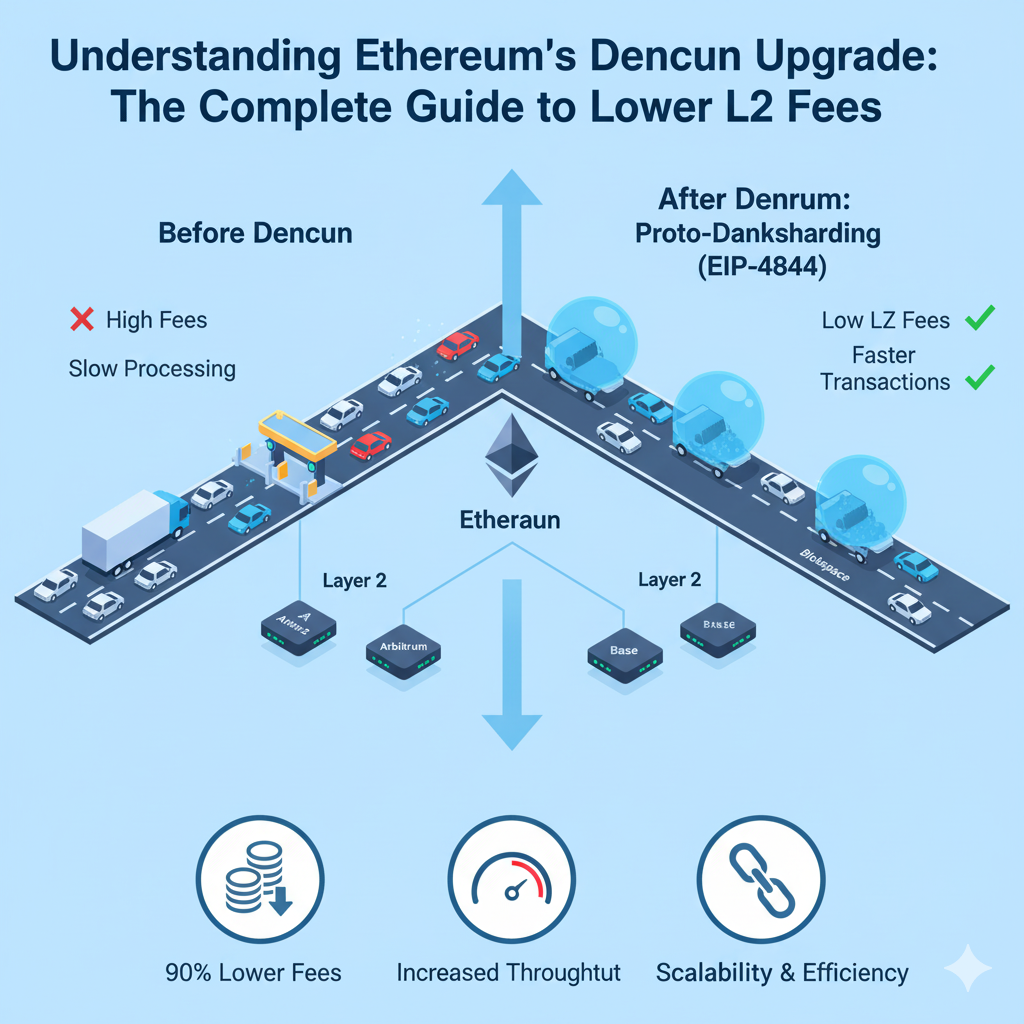
Ethereum’s Dencun upgrade (March 13, 2024) represents one of the most significant scaling improvements in blockchain history. Furthermore, this landmark update combined two simultaneous upgrades—Deneb (consensus layer) and Cancun (execution layer)—to dramatically reduce transaction costs on Ethereum Layer 2 networks.
The upgrade activated at epoch 269,568 on March 13, 2024, at 13:55 UTC, introducing EIP-4844 (proto-danksharding) as its headline feature. As a result, this technical improvement slashed Layer 2 fees by 60-99%, often reducing transaction costs to mere pennies.
Learn more about Ethereum upgrades on ethereum.org
EIP-4844: The Game-Changing Blob Technology
What Are Ethereum Blobs?
Blobs (Binary Large Objects) are a revolutionary new data type introduced by EIP-4844. Specifically, these temporary data attachments allow Ethereum rollups like Arbitrum, Optimism, Base, and zkSync to post transaction data cheaply and securely.
Technical Specifications of Blobs
Key blob specifications:
- Size: Approximately 128 KiB per blob
- Block limits: 3 blobs per block (target), 6 blobs maximum (at launch)
- Retention period: ~18 days (4096 epochs) before automatic pruning
- Storage location: Consensus (Beacon) layer, not accessible directly by EVM contracts
Why Blobs Make Ethereum Layer 2 Networks Cheaper
Before Dencun, rollup protocols stored their data in expensive calldata—permanent storage that competed with all other Ethereum transactions. Consequently, this created high costs that were passed to users. Understanding how Ethereum gas fees work is crucial to appreciating this improvement.
The Blob Advantage
Post-Dencun improvements:
- First and foremost, blobs create a separate, dedicated fee market for rollup data
- Additionally, temporary storage eliminates permanent blockchain bloat
- Moreover, rollups no longer compete with Layer 1 transactions for block space
- As a result, independent blob pricing mechanism reduces L2 transaction costs by up to 99%
Explore EIP-4844 technical specifications
Complete List of Dencun EIPs: Nine Improvements in One Upgrade
Core Scaling Improvement
EIP-4844 (Proto-Danksharding): Introduces blob transactions for massive Layer 2 cost reductions. This represents the first phase of Ethereum’s danksharding roadmap.
Developer Experience Enhancements
Gas Optimization Updates
EIP-1153 (Transient Storage Opcodes): Initially, this adds TSTORE and TLOAD operations for temporary per-transaction storage. Subsequently, it reduces gas costs for specific patterns, contributing to gas optimization across DeFi.
EIP-5656 (MCOPY Instruction): Similarly, this implements efficient memory copying for smart contracts, thereby improving execution speed.
EIP-6780 (SELFDESTRUCT Modification): In contrast to previous behavior, this restricts the SELFDESTRUCT opcode to only work within the same transaction as contract creation. Therefore, it reduces security vulnerabilities.
EIP-7516 (BLOBBASEFEE Opcode): Meanwhile, this enables contracts to read current blob base fees, which is essential for Layer 2 accounting systems.
Consensus and Staking Improvements
Network Stability Enhancements
EIP-4788 (Beacon Block Root in EVM): Notably, this exposes consensus layer data to the execution layer. Thus, it simplifies bridges and restaking protocols.
EIP-7044 (Perpetually Valid Signed Exits): Furthermore, this makes validator voluntary exit signatures valid across future forks.
EIP-7045 (Increase Attestation Slot Inclusion Range): In addition, this extends the window for including attestations. Consequently, it improves network robustness.
EIP-7514 (Add Max Epoch Churn Limit): Finally, this caps validator entry/exit rate to manage network growth sustainably.
Read ConsenSys’s complete Dencun technical overview
Ethereum Dencun Upgrade Impact: Real-World Results
Layer 2 Fee Reductions (March 2024 Data)
Multiple independent sources documented dramatic cost improvements immediately after the Dencun mainnet activation. Indeed, the results exceeded many expectations.
Network-by-Network Breakdown
- Arbitrum: In particular, transaction fees dropped from ~$0.50 to under $0.01
- Optimism: Likewise, average costs reduced by approximately 95%
- Base: Similarly, fees fell to pennies per transaction
- zkSync Era: Correspondingly, this network saw 90%+ reductions across operations
Important clarification: Nevertheless, Dencun primarily affects Layer 2 fees, not Ethereum mainnet (Layer 1) gas prices. In fact, the blob fee market operates separately from the standard L1 transaction fee market.
Track current L2 fees on L2Fees.info
2025 Pectra Upgrade: Expanding Blob Capacity
Building on Dencun’s success, the Ethereum Pectra upgrade (2025) further increased blob capacity:
Enhanced Blob Parameters
- Target blobs: Specifically, increased from 3 to 6 per block
- Maximum blobs: Additionally, raised from 6 to 9 per block
- Result: Therefore, even more headroom for rollup data, supporting continued Layer 2 growth
Ethereum Dencun vs Other Upgrades: How It Fits the Roadmap
The Path to Full Danksharding
Dencun implements proto-danksharding (EIP-4844), which is phase one of Ethereum’s complete danksharding vision. Ultimately, this roadmap consists of multiple stages:
Scaling Progression
- Proto-danksharding (Dencun, 2024): First, introduces blob format and separate fee market
- Full danksharding (future): Subsequently, will implement complete data sharding across the network for even greater scalability
Previous Major Ethereum Upgrades
Historical Context
- The Merge (September 2022): Initially, transitioned to Proof-of-Stake
- Shanghai-Capella (April 2023): Then, enabled staking withdrawals
- Dencun (March 2024): Next, introduced blobs for Layer 2 scaling
- Pectra (2025): Finally, expanded blob capacity
Dencun Upgrade Myths Debunked: Common Misconceptions
Token Upgrade Scams
❌ “I need to upgrade my ETH tokens”
Reality: On the contrary, no action is required from ETH holders. Moreover, beware of scams claiming otherwise.
Layer 1 vs Layer 2 Confusion
❌ “Dencun makes all Ethereum transactions cheap”
Reality: Instead, Dencun primarily reduces Layer 2 rollup fees. In fact, Layer 1 Ethereum gas fees remain largely unchanged, though they may decrease slightly as rollups stop competing for calldata space.
Data Storage Misunderstanding
❌ “Blobs are stored permanently like calldata”
Reality: Actually, blobs are automatically pruned after approximately 18 days. Nevertheless, cryptographic commitments remain for verification.
Smart Contract Access
❌ “Smart contracts can read blob data directly”
Reality: Rather, blobs exist on the consensus layer. Therefore, contracts can only verify blob commitments, not access raw blob data.
How to Benefit from Dencun: Step-by-Step Guide
For Everyday Users
Getting Started with Layer 2
- Choose a Layer 2 network: First, select from Arbitrum, Optimism, Base, zkSync Era, or others. Compare networks in our comprehensive Layer 2 guide.
- Set up a Web3 wallet: Next, install MetaMask, Rainbow, or Coinbase Wallet
- Bridge ETH to L2: Then, use official bridges or aggregators like Jumper Exchange
- Enjoy low fees: Finally, try DeFi swaps, NFT minting, or transfers for pennies
For Developers
Building on Post-Dencun Ethereum
- Build on L2: Initially, deploy contracts to rollups that leverage Dencun’s blob data
- Optimize for blobs: Subsequently, design applications assuming cheap data availability
- Monitor blob fees: Moreover, use EIP-7516’s BLOBBASEFEE opcode for dynamic pricing
- Prepare for scaling: Ultimately, anticipate continued blob capacity increases
Start building on Ethereum L2s – Developer documentation
Ethereum Blob Economics: Understanding the Fee Market
How Blob Fees Work
Blobs use EIP-1559-style pricing with a separate base fee that adjusts based on blob demand. Specifically, this mechanism ensures predictable costs:
Fee Adjustment Mechanism
- Target: First, 3 blobs per block keeps fees stable
- Below target: Consequently, blob base fee decreases
- Above target: Conversely, blob base fee increases
- Maximum: Finally, 6 blobs per block (hard cap at launch, increased in Pectra)
Blob Data Retention and Availability
Storage Requirements
- Full nodes: Primarily, must store blobs for ~18 days minimum
- After pruning: However, only KZG commitments remain on-chain
- Challenge period: Importantly, 18 days exceeds all major rollup challenge windows
- Security model: Nevertheless, fraud/validity proofs remain verifiable indefinitely
Ethereum Dencun Technical Resources
Official Documentation
Primary Sources
Educational Resources
Learning Materials
Data and Analytics
Tracking Tools
Dencun Upgrade Timeline: Key Dates
Development and Testing Phase
- February 2023: Initially, EIP-4844 finalized in Ethereum improvement process
- January 17, 2024: Subsequently, Goerli testnet activation
- January 30, 2024: Then, Sepolia testnet activation
- February 7, 2024: Following that, Holesky testnet activation
Mainnet Launch
- March 13, 2024, 13:55 UTC: Finally, Mainnet Dencun activation at epoch 269,568
Future Developments
- 2025: Moreover, Pectra upgrade increases blob capacity
The Bottom Line: Why Dencun Matters for Ethereum’s Future
The Dencun upgrade represents Ethereum’s most significant Layer 2 scaling milestone to date. Indeed, by introducing blob transactions via EIP-4844, Ethereum has achieved remarkable improvements that strengthen its position in the ongoing Ethereum vs Solana debate:
Key Achievements
✅ First, reduced Layer 2 transaction costs by 60-99%
✅ Furthermore, maintained Ethereum’s security guarantees
✅ Additionally, enabled mass adoption of rollup technology
✅ Moreover, set the foundation for full danksharding
✅ Finally, supported sustainable network growth without centralization
While Layer 1 Ethereum gas fees remain unchanged, Dencun has nevertheless achieved its core mission: making the scaling solutions that serve millions of users—rollups—dramatically more affordable and accessible.
The future of Ethereum scaling is here, and consequently, it’s cheaper than ever.
Frequently Asked Questions About Dencun
Timing and Implementation
Q: When did the Dencun upgrade happen?
A: Specifically, March 13, 2024, at 13:55 UTC (epoch 269,568)
Q: What does Dencun stand for?
A: In particular, Deneb (consensus layer) + Cancun (execution layer)
Cost and Performance
Q: How much did L2 fees decrease after Dencun?
A: Notably, between 60-99% depending on the network and transaction type
Q: Do blobs make Ethereum Layer 1 cheaper?
A: Actually, no—blobs primarily benefit Layer 2 rollups with their own fee market
Technical Details
Q: How long are blobs stored?
A: Specifically, approximately 18 days (4096 epochs) before pruning
Q: Is Dencun the same as danksharding?
A: Rather, Dencun implements proto-danksharding (EIP-4844), the first step toward full danksharding
For more insights on Ethereum’s evolution, explore our guides on danksharding, gas fees, and Layer 2 solutions.