
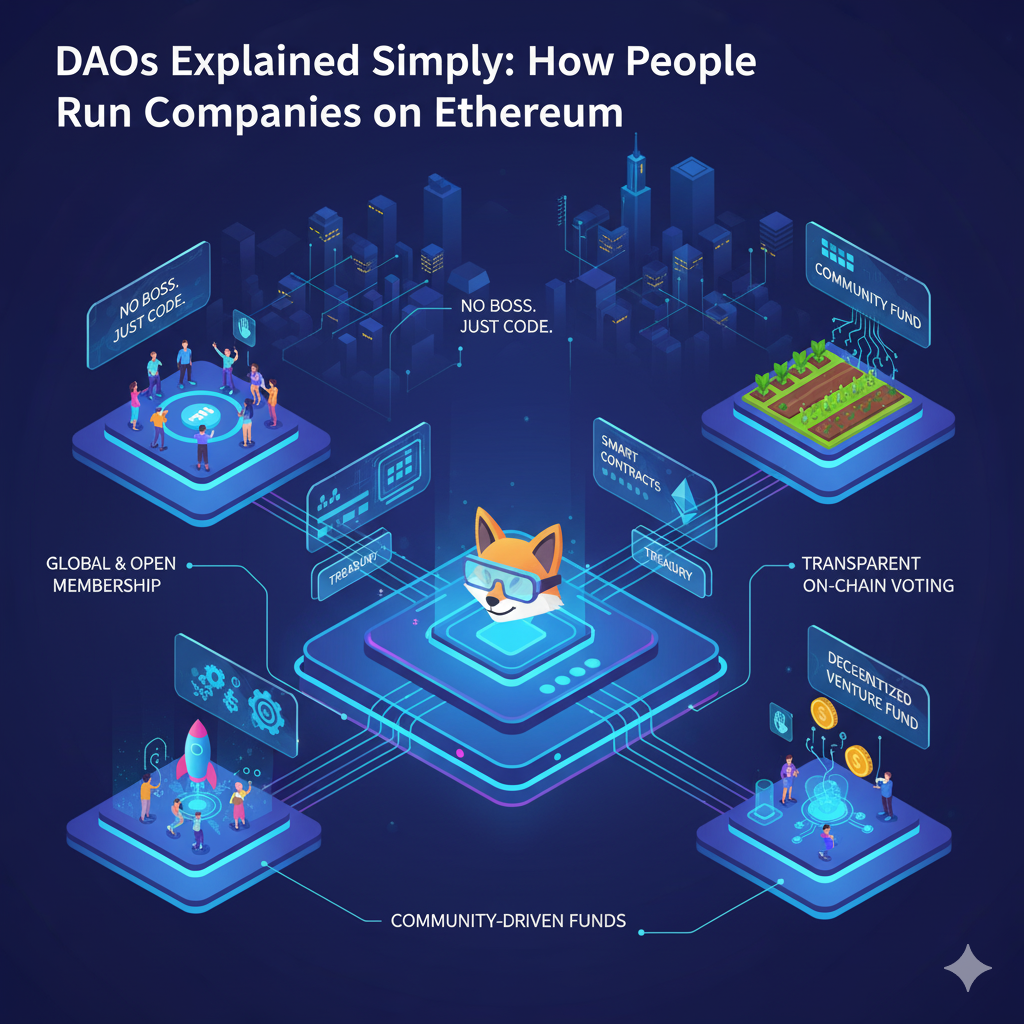
Imagine a company where there’s no boss, no central office, and no traditional hierarchy. Instead, a group of people from all over the world works together, makes decisions as a team, and manages everything using the internet and blockchain technology. This is what a DAO (Decentralized Autonomous Organization) is all about.
In this comprehensive guide, we’ll break down what DAOs are, how they work on the Ethereum blockchain, and why they’re exciting for anyone curious about the future of work and decentralized governance.
What Is a DAO?
A DAO is a digital organization that runs on rules written in computer code called smart contracts. Instead of a CEO or board of directors making decisions, everyone who’s part of the DAO gets a say through voting mechanisms.
Key Characteristics of DAOs:
- Decentralized: No single person or group controls the organization
- Autonomous: The organization runs itself using code with minimal human intervention
- Organization: A group of people working together toward common goals—funding projects, building products, or managing communities
Simple Example:
A group of friends wants to start a community garden. Instead of one person deciding everything, they create a DAO. Everyone contributes funds, votes on what to plant, and the rules are encoded in a smart contract that ensures fairness and transparency.
Why Ethereum?
Ethereum is the primary blockchain that makes most DAOs possible. Unlike Bitcoin, which mainly handles peer-to-peer transactions, Ethereum supports smart contracts—self-executing programs that follow predefined rules automatically.
How Smart Contracts Power DAOs:
A smart contract might specify: “If 60% of members vote yes, automatically release $1,000 from the treasury to buy equipment.” Once deployed, nobody can cheat or secretly rewrite the rules—everything is transparent and immutable.
While DAOs increasingly use Layer-2 networks like Arbitrum or Base for lower transaction costs, Ethereum remains the foundation because it offers:
- Battle-tested security
- Largest developer community
- Most established infrastructure
- Wide token compatibility (ERC-20, ERC-721)
How Does a DAO Work?
1. Set the Rules
The community codes governance rules into a smart contract. Membership is typically based on:
- ERC-20 governance tokens
- NFT passes
- Shares (like in MolochDAO)
2. Launch the DAO
The smart contract is deployed to Ethereum. It’s publicly visible, and any updates require collective voting approval.
3. Make Decisions Together
Members propose ideas and vote on them. Many DAOs use:
- Snapshot for off-chain voting (gas-free)
- SafeSnap for executing results on-chain
- Tally for on-chain governance tracking
4. Treasury Management
DAO funds typically sit in a Safe (formerly Gnosis Safe) multisignature wallet. This requires multiple signers to approve transactions, adding security.
5. Transparency
All key decisions, rules, and spending are visible on the blockchain. While some discussions happen off-chain (Discord, forums), execution is always on-chain and verifiable.
6. Adapt and Grow
Through governance proposals, members can:
- Change rules and parameters
- Add new features
- Allocate budgets
- Split into new DAOs if needed
Real-World Examples
The DAO (2016)
The first major DAO, created as a decentralized venture capital fund. It raised approximately $150 million but was exploited due to a smart contract vulnerability, losing $50-60 million. This led to Ethereum’s controversial hard fork, creating Ethereum Classic.
Lesson: Security audits and formal verification are critical.
MakerDAO
MakerDAO manages DAI, a decentralized stablecoin pegged to $1 USD. Governance is conducted by MKR token holders who vote on:
- Stability fees
- Collateral types
- Risk parameters
In 2024, Maker announced its “Endgame” rebrand to Sky, introducing optional upgrades (DAI → USDS, MKR → SKY).
ConstitutionDAO (2021)
ConstitutionDAO raised $47 million in just days to bid on a rare copy of the U.S. Constitution at Sotheby’s auction. Though they lost to billionaire Ken Griffin, the project demonstrated how quickly DAOs can mobilize global communities.
MolochDAO
MolochDAO is a grants-focused DAO funding Ethereum infrastructure projects. Its minimalist design inspired numerous forks and became the foundation for DAOhaus and similar frameworks.
Challenges of DAOs
1. Technical Complexity
Smart contract development is challenging, and bugs can be catastrophic. Regular security audits from firms like Certora, OpenZeppelin, or Trail of Bits are essential.
2. Slow Decision-Making
With thousands of members, reaching consensus takes time. Many DAOs struggle with voter apathy—often less than 10% of token holders participate.
3. Plutocracy Risk
Voting power often concentrates with large token holders (whales). Solutions include:
- Quadratic voting
- Reputation-based systems
- Delegated voting
4. Legal Uncertainty
Governments are experimenting with DAO legislation:
- Wyoming, USA: Created DAO LLCs in 2021
- Utah: Introduced the DAO Act effective 2024
- Marshall Islands: Legalized DAO LLCs in 2022
However, regulators (like the U.S. CFTC in the Ooki DAO case) still treat DAOs as potentially liable entities.
5. Security Risks
Treasury exploits and governance attacks remain common. Best practices include:
- Multisig wallets (Safe)
- Timelocks for proposal execution
- Regular audits
- Bug bounty programs via Immunefi
How to Get Started with DAOs
1. Learn the Basics
2. Get a Crypto Wallet
Use MetaMask, Rainbow, or Coinbase Wallet to hold ETH and interact with DAOs.
3. Explore DAO Platforms
- DeepDAO – DAO analytics and rankings
- DAOhaus – Launch and manage DAOs
- Aragon – DAO creation toolkit
- Colony – DAO infrastructure
4. Join and Participate
Find DAOs on:
- Discord communities
- Twitter/X crypto communities
- Commonwealth forums
Some DAOs require token or NFT membership, others are open to contributors.
5. Start Small
Many DAOs welcome contributors with minimal funds or just time and skills. Look for:
- Working groups needing help
- Bounty programs
- Community moderation roles
The Future of DAOs
DAOs are experimental but growing rapidly. They’re central to Web3’s vision of user-owned, transparent, global systems.
Potential Applications:
- Municipal Governance: Cities using DAOs for participatory budgeting
- Philanthropic Organizations: Donors directly controlling fund allocation
- Decentralized Companies: Teams running billion-dollar protocols without traditional corporate structures
- Creator Economies: Artists and communities co-owning platforms
Notable DAO Frameworks:
- Aragon
- Compound Governor
- Snapshot + Safe
- Colony
DAOs won’t replace all traditional organizations, but they’re proving that the future of coordination can be borderless, transparent, and community-driven.
Conclusion
DAOs are digital democracies running on Ethereum. They enable people to coordinate money, ideas, and projects without CEOs or boards. By using smart contracts, DAOs maintain fair and transparent rules that nobody can unilaterally change.
Whether funding startups through Moloch-style grants, managing DeFi protocols like MakerDAO, or pooling resources to bid at auctions like ConstitutionDAO, DAOs empower communities to act collectively.
Ready to Get Started?
- Set up a MetaMask wallet
- Explore DAOs on DeepDAO
- Join conversations on Discord
Start voting and shaping the future of decentralization today!