
Why Ethereum Dominates the Crypto Space in 2025
Ethereum remains the world’s leading smart contract platform and decentralized ecosystem. Unlike Bitcoin, which primarily serves as digital money, Ethereum powers an entire universe of decentralized applications (dApps), including:
- DeFi protocols worth billions in total value locked (TVL)
- NFT marketplaces like OpenSea and Blur
- Web3 gaming platforms and metaverse projects
- DAO governance systems for decentralized organizations
In 2025, Ethereum strengthened its position with the successful Pectra upgrade launch on May 7, 2025. Furthermore, with around 6,000 monthly active developers and growing institutional adoption—including the launch of spot ETH-ETFs in the US in July 2024—Ethereum continues to be the backbone of Web3 innovation.
Whether you’re a newcomer looking to buy your first ETH or an experienced trader exploring advanced DeFi strategies, having the right tools is crucial for success. Consequently, this comprehensive guide covers the five essential Ethereum tools that every user should master in 2025.
Learn more about Ethereum:
- Official documentation: Ethereum.org
- Network statistics: Etherscan.io
1. MetaMask: Your Gateway to the Ethereum Ecosystem
What Is MetaMask?
MetaMask is the world’s most popular Ethereum wallet, serving as your digital bridge to Web3. Available as a browser extension for Chrome, Firefox, Edge, and Brave, plus mobile apps for iOS and Android, MetaMask enables you to store and manage ETH and ERC-20 tokens, interact with thousands of dApps seamlessly, connect to Layer 2 networks like Arbitrum and Polygon, and sign transactions and smart contracts securely.
Why MetaMask Is Essential in 2025
With over 100 million users globally, MetaMask has become the go-to Web3 wallet platform, offering unparalleled compatibility with the Ethereum ecosystem. Moreover, its user-friendly interface makes complex blockchain interactions accessible to everyone, from DeFi beginners to NFT collectors.
Key Benefits:
- Universal dApp Compatibility: Works with virtually every Ethereum-based application
- Multi-Chain Support: Access Ethereum mainnet plus 100+ compatible networks
- Enhanced Security: Industry-standard encryption and private key management
- Regular Updates: Continuous improvements and new feature additions
How to Set Up MetaMask (Step-by-Step)
- Download Safely: Visit metamask.io and download the official extension or app
- Create Your Wallet: Choose “Create a Wallet” and set a strong password
- Secure Your Seed Phrase: Write down your 12-word recovery phrase offline (never store digitally!)
- Add ETH: Purchase ETH from exchanges like Coinbase or Binance and transfer to your MetaMask address
- Explore dApps: Start with popular platforms like Uniswap or OpenSea
Pro Tips for MetaMask Users
- Hardware Wallet Integration: Connect your Ledger for maximum security on large amounts
- Layer 2 Networks: Use Arbitrum or Optimism to reduce gas fees significantly
- Transaction Management: Additionally, use the Etherscan Gas Tracker to monitor gas prices before confirming transactions
- Portfolio Tracking: Similarly, use MetaMask Portfolio to view all your assets across different networks
Official resources:
- Download MetaMask: metamask.io
- Support documentation: MetaMask Support
2. Etherscan: The Ultimate Ethereum Blockchain Explorer
What Is Etherscan?
Etherscan.io is Ethereum’s most trusted blockchain explorer, functioning as a powerful search engine for the entire network. Essentially, this indispensable tool allows you to track transaction status and history in real-time, verify smart contract addresses and source code, monitor wallet balances and token holdings, analyze network statistics and gas price trends, and explore bridge activity including TVL by bridges.
Why Every Ethereum User Needs Etherscan
Transparency is Ethereum’s superpower, and Etherscan makes this transparency accessible to everyone. Indeed, whether you’re verifying a suspicious transaction or researching a new DeFi protocol, Etherscan provides the data you need to make informed decisions.
Essential Features:
- Transaction Verification: Confirm pending, successful, or failed transactions
- Smart Contract Analysis: Read contract code and verify legitimacy
- Token Tracker: Monitor ERC-20 and ERC-721 token movements
- Gas Tracker: Real-time gas price recommendations
- Bridge Dashboards: Track deposits/withdrawals and TVL across L2/L1 bridges
Mastering Etherscan: Advanced Usage Guide
- Transaction Tracking: Paste any transaction hash to see detailed execution data
- Address Investigation: Enter wallet addresses to view complete transaction history
- Contract Verification: Always check if smart contracts are verified before interacting
- Gas Optimization: Furthermore, use the Gas Tracker to time your transactions for lower fees
- Network Monitoring: Watch the Charts section for congestion patterns
Security Best Practices with Etherscan
- Verify Contracts: Only interact with verified smart contracts showing a green checkmark
- Check Transaction Fees: Review gas usage before confirming expensive transactions
- Monitor Your Assets: Regularly check your addresses for unexpected token transfers
- Research New Projects: Meanwhile, use Etherscan to find official contract addresses
Access Etherscan:
- Main explorer: Etherscan.io
- Gas tracker: Etherscan Gas Tracker
3. Uniswap: The King of Decentralized Exchanges 🦄
What Is Uniswap?
Uniswap revolutionized cryptocurrency trading as the leading decentralized exchange (DEX) on Ethereum. Built entirely on smart contracts, Uniswap enables permissionless token trading—swap any ERC-20 token without registration, liquidity provision where you earn fees by providing liquidity to trading pairs, automated market making to trade against algorithmic liquidity pools, and cross-chain swaps/bridging via Uniswap’s interface and UniswapX integrations.
Uniswap’s Market Dominance in 2025
Uniswap remains the largest spot DEX by market share; in August 2025 its share was approximately 36% with monthly volume around $112 billion. Notably, on separate high-volume days, daily volume reached nearly $9 billion.
Platform Highlights:
- Peak $8B+ Daily Volume: Massive liquidity on volatile days
- 1000+ Trading Pairs: Access to both mainstream and emerging tokens
- V4 Protocol: Latest version with advanced features and reduced gas costs released in January 2025
- Multi-Chain Support: Available on Polygon, Arbitrum, and other L2 networks
Complete Uniswap Trading Guide
For Beginners: Your First Token Swap
First, connect your wallet. Next, select the tokens you want to swap. Then, review the exchange rates carefully. After that, confirm the swap. Finally, track your transaction on Etherscan.
For Advanced Users: Liquidity Provision
Initially, choose a liquidity pool that matches your strategy. Subsequently, provide liquidity to receive LP tokens. As a result, you’ll earn fees from trades. However, remember to monitor impermanent loss regularly.
Uniswap Safety and Best Practices
- Slippage Settings: Adjust slippage tolerance based on market volatility
- Token Verification: Always verify token contract addresses on Etherscan
- Gas Optimization: In addition, trade during low network congestion for cheaper fees
- Impermanent Loss: Understand this concept before providing liquidity
- Price Impact: Avoid large trades that significantly move token prices
Start trading on Uniswap:
- Main interface: Uniswap.org
- Documentation: Uniswap Docs
4. Ledger: Fort Knox for Your Cryptocurrency
What Is Ledger?
Ledger creates the world’s most secure cryptocurrency hardware wallets, including the popular Ledger Nano X and Ledger Stax. Specifically, these “cold storage” devices keep your private keys completely offline, providing an additional layer of protection.
Why Hardware Wallets Are Critical in 2025
Cyber threats targeting cryptocurrency users continue to evolve. Consequently, hardware wallets provide an air-gapped layer that’s extremely hard to compromise remotely.
Security Advantages:
- Offline Key Storage: Private keys never touch the internet
- Secure Element Chip: Bank-grade security hardware
- Transaction Verification: Physically confirm all transactions on device
- Recovery Options: 24-word seed phrase for wallet restoration
- Multi-Currency Support: Thousands of coins and tokens supported
Setting Up Your Ledger Hardware Wallet
Initial Setup Process:
First, purchase only from official sellers to avoid tampered devices. Next, initialize your device following the on-screen instructions. Then, carefully record your 24-word phrase on the provided recovery sheet. After that, install Ledger Live on your computer. Finally, transfer small amounts to test the setup before moving larger funds.
Advanced Configuration:
Begin by installing apps for the cryptocurrencies you’ll use. Subsequently, connect your Ledger to MetaMask for enhanced security. Additionally, enable 2FA for Ledger Live for extra protection. Moreover, update firmware regularly to benefit from the latest security patches.
Maximizing Your Ledger Security
- Store device and seed phrase separately in different secure locations
- Test recovery with small amounts first before trusting large balances
- Always verify addresses on device screen to prevent address poisoning attacks
- Never enter seed phrase on websites or digital devices
- Consider metal backup solutions for seed phrase storage to protect against fire and water damage
Get your Ledger wallet:
- Official store: Ledger.com
- Ledger Live app: Download Ledger Live
5. DappRadar: Your Web3 Discovery Platform
What Is DappRadar?
DappRadar provides analytics and a catalog for Web3 with over 10,000 dApps across 50+ blockchains, real-time analytics on user activity and volume, trending projects and emerging opportunities, portfolio tracking and performance metrics, plus airdrop opportunities and token launches.
Why DappRadar Is Essential for Web3 Navigation
DappRadar helps find top dApps, NFT collections, games, DeFi protocols and view TVL/metrics across networks and protocols. Furthermore, it also includes tools for token security assessment through Token Security Scoring, helping users identify potential risks before investing.
Key Platform Features:
- dApp Rankings: Discover top applications by users, volume, and activity
- Security/Token Scoring: Risk assessments for tokens and projects
- Portfolio Management: Track your multi-chain DeFi positions
- NFT Analytics: Monitor floor prices and collection trends
- Airdrop Radar: Find eligible airdrops and governance token distributions
Using DappRadar Effectively
For Beginners:
Start by exploring different categories to understand the Web3 landscape. Next, check rankings to identify the most popular applications. Then, verify security scores before interacting with any project. Finally, start with minimal amounts to test the platform safely.
For Advanced Users:
Initially, analyze trends to identify emerging opportunities early. Subsequently, conduct competitive analysis across similar projects. In addition, study tokenomics to understand value accrual mechanisms. Furthermore, discover airdrop opportunities by monitoring new project launches. Ultimately, research early-stage projects for potentially higher returns.
Explore Web3 with DappRadar:
- Main platform: DappRadar.com
- DeFi analytics: DappRadar DeFi
Honorable Mentions: Additional Essential Tools
CoinGecko — Market Intelligence Platform
Real-time pricing data, market metrics, exchange rankings, and comprehensive cryptocurrency information. Additionally, CoinGecko offers portfolio tracking and price alerts to help you stay informed.
Visit: CoinGecko.com
Lido — Liquid Staking Solution
Liquid staking without the 32 ETH minimum requirement; stETH can be used in DeFi while earning staking rewards. As a result, you can maximize capital efficiency while still participating in network security.
Visit: Lido.fi
Alchemy — Developer Infrastructure
RPC infrastructure for developers, APIs, educational courses, and monitoring tools for building on Ethereum. Moreover, Alchemy provides detailed analytics and debugging tools for professional developers.
Visit: Alchemy.com
Ethereum Security Best Practices for 2025
Wallet Security Fundamentals
First and foremost, keep seed phrases offline with metal backups to protect against digital threats. Additionally, use Ledger hardware wallet for amounts over $1,000 to minimize exposure. Furthermore, audit connected dApps regularly to revoke unnecessary permissions. Finally, implement multi-signature wallets for treasury management to prevent single points of failure.
Transaction Safety Guidelines
- Always verify addresses character-by-character before sending funds
- Use Etherscan Gas Tracker for optimal fee timing to save money
- Manage slippage settings appropriately based on market conditions
- Only interact with verified smart contracts to avoid malicious code
Avoiding Common Scams
- Phishing Protection: Bookmark official sites and never click suspicious links from unknown sources
- Social Engineering: Be skeptical of urgent messages or “too good to be true” offers that pressure quick decisions
- Token Verification: Check contract addresses on Etherscan before purchasing any new token
- Project Research: Verify team credentials and tokenomics before investing your funds
The Future of Ethereum: What’s Coming Next
Layer 2 Scaling Solutions
Fast and cheap transactions on L2 with Ethereum’s security, convenient bridges between networks, and specialized features for gaming, NFTs, and enterprise applications. Consequently, Layer 2 solutions are making Ethereum accessible to millions of new users.
Upcoming Upgrades and Improvements
- Proto-Danksharding (EIP-4844): Already implemented in March 2024 (Dencun upgrade), continuing to reduce L2 transaction costs significantly
- Account Abstraction: Further UX improvements building on ERC-4337 with Pectra enhancements for better wallet experiences
- Verkle Trees: Future optimization for node storage and efficiency, making it easier to run full nodes
- MEV Protection: Development of built-in mechanisms to reduce MEV risks and protect users from sandwich attacks
Institutional Adoption Trends
Spot ETH-ETFs launched in the US in July 2024, opening the flow of traditional investments into Ethereum. Meanwhile, governments and corporations are exploring and using Ethereum-compatible infrastructure, often through private or permissioned networks. Moreover, more clear regulatory frameworks in 2024-2025 support innovation, with new standards for ETF listings accelerating product launches.
Stay informed:
- Ethereum roadmap: Ethereum.org Roadmap
- Upgrade information: ConsenSys Knowledge Base
Conclusion: Master These Tools to Succeed in Web3
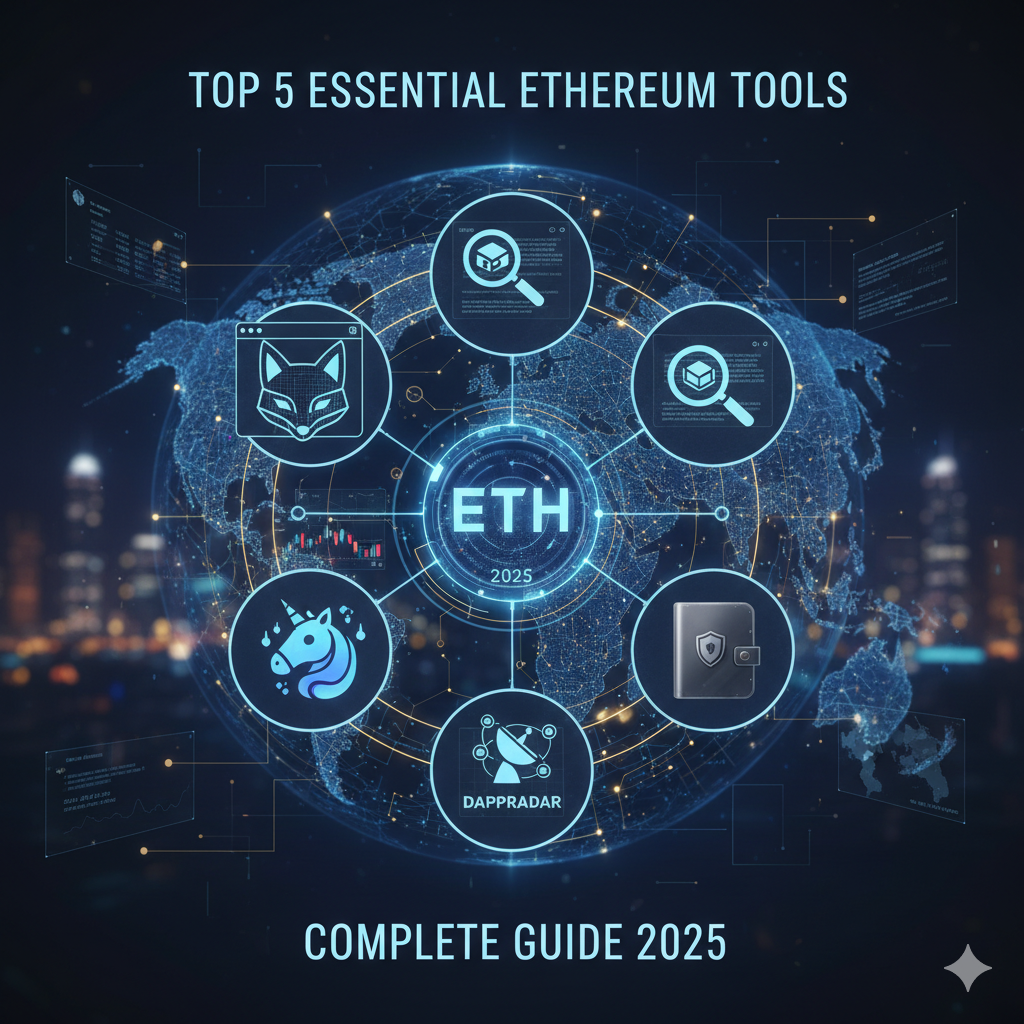
The five tools covered in this comprehensive guide—MetaMask, Etherscan, Uniswap, Ledger, and DappRadar—form the foundation of any successful Ethereum user’s toolkit. Importantly, each serves a crucial role:
- MetaMask connects you to the Web3 universe seamlessly
- Etherscan keeps you informed and secure through transparency
- Uniswap enables decentralized trading and liquidity provision
- Ledger protects your digital assets with bank-grade security
- DappRadar helps you discover legitimate opportunities while avoiding scams
As Ethereum continues evolving with upgrades like Pectra and the ongoing effects of EIP-4844, mastering these tools will position you for success in the expanding Web3 economy. Therefore, investing time to learn these platforms thoroughly will pay dividends in your crypto journey.
Getting Started: Your Next Steps
- First, set up your MetaMask wallet securely
- Next, secure your seed phrase properly using offline storage
- Then, purchase a small amount of ETH to test the system
- After that, explore transactions on Etherscan to understand how the blockchain works
- Subsequently, make a test swap on Uniswap with minimal funds
- Following this, research dApps on DappRadar to find interesting projects
- Finally, upgrade to hardware wallet as your balance grows beyond $1,000
Essential External Resources
Official Platforms:
- Ethereum Foundation: Ethereum.org
- MetaMask Wallet: MetaMask.io
- Etherscan Explorer: Etherscan.io
- Uniswap DEX: Uniswap.org
- Ledger Hardware Wallets: Ledger.com
- DappRadar Analytics: DappRadar.com
Market Data & Analytics:
- CoinGecko: CoinGecko.com
- DeFi TVL Data: DappRadar DeFi
- Gas Price Tracker: Etherscan Gas Tracker
Educational Resources:
- Ethereum Documentation: Ethereum.org Docs
- ConsenSys Learning: ConsenSys.io
- Uniswap Documentation: Uniswap Docs
Disclaimer: This article is for educational purposes only and does not constitute financial advice. Cryptocurrency investments carry significant risks, and you should always conduct your own research before making any financial decisions. Never invest more than you can afford to lose.