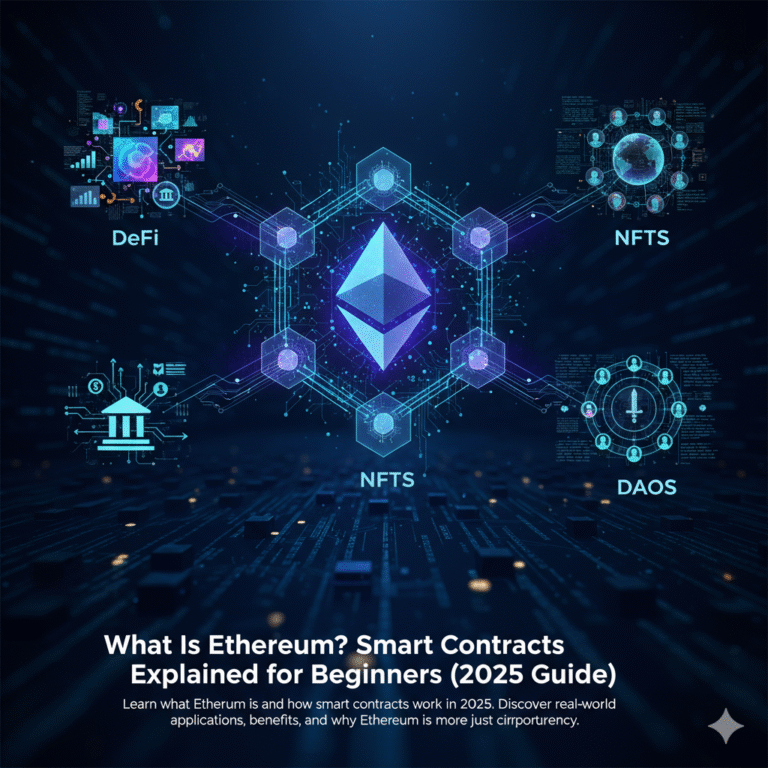
Ethereum is a programmable blockchain launched on July 30, 2015, designed for more than just digital money. While Bitcoin focuses on secure peer-to-peer payments, Ethereum enables developers to build decentralized applications (dApps) powered by smart contracts — self-executing agreements that run automatically when conditions are met.
What Makes Ethereum Unique
Proposed by Vitalik Buterin in 2013 and built by a global open-source community, Ethereum introduced the concept of a world computer — a network where code, not corporations, enforces rules. As a result, every transaction and contract is recorded on a shared ledger maintained by thousands of independent nodes. This approach ensures transparency and censorship resistance.
The idea of “smart contracts” was coined by cryptographer Nick Szabo in the 1990s. However, Ethereum turned that vision into reality by creating a platform where these digital agreements could execute on their own.
How Smart Contracts Work
Written in Code: First, developers use the Solidity programming language to create smart contracts. Solidity documentation is available at docs.soliditylang.org.
Deployed on Blockchain: Once written, the contract lives at a permanent Ethereum address where anyone can interact with it.
Self-Executing: When set conditions are met, the contract runs on its own — no middlemen, lawyers, or banks required.
Immutable & Transparent: All contract activity is publicly viewable and tamper-proof. Moreover, it’s recorded forever on the blockchain.
As a result, smart contracts serve as the building blocks behind decentralized finance (DeFi), non-fungible tokens (NFTs), and decentralized autonomous organizations (DAOs). To learn more about how smart contracts work in detail, check out our complete beginner’s guide to smart contracts.
Real-World Use Cases in 2025
Decentralized Finance (DeFi)
Currently, Ethereum powers an open-finance system where anyone with internet access can lend, borrow, and trade cryptocurrency. Furthermore, they can do this without traditional banking institutions.
Aave operates as a peer-to-peer lending system where users earn interest on deposits or borrow assets.
Uniswap functions as a decentralized exchange (DEX) using automated liquidity pools instead of order books.
Compound provides algorithmic money markets for earning interest on crypto assets.
Together, Ethereum-based DeFi platforms hold tens of billions USD in total value locked (TVL). In fact, they represent over 50% of the global DeFi market. Track current DeFi statistics at DeFi Llama.
Decentralization — No single entity controls the network. Therefore, this eliminates single points of failure.
Transparency — All code and transactions are publicly auditable on the blockchain.
Global Access — Anyone with internet access can participate. This applies regardless of location or banking status.
Security — Cryptographic consensus mechanisms prevent unauthorized tampering. In addition, they ensure network integrity.
Composability — Developers can combine existing contracts like “money legos.” As a result, they can build complex apps from simple components.
Note: Layer-1 gas fees can spike during network congestion. However, most cost-efficient activity now happens on Layer-2 scaling solutions.
Current Challenges & Solutions
High Fees and Scalability
Ethereum’s base-layer transactions can become expensive during periods of high network demand.
Solutions implemented:
Layer-2 rollups like Optimism, Arbitrum, and Base process transactions off-chain. Then, they batch them to Ethereum, dramatically reducing costs.
The Dencun upgrade (March 2024) introduced EIP-4844 (proto-danksharding). This reduced data storage costs for rollups by creating temporary data blobs.
Future roadmap: Full danksharding promises massive throughput gains. In fact, it could enable millions of transactions per second across the Ethereum system.
Security Risks
Smart-contract bugs can lead to significant financial losses when exploited.
Best practices:
First, use audited, open-source protocols with proven track records.
Second, start with small transaction amounts when learning.
Third, never share private keys or seed phrases with anyone.
Finally, verify contract addresses before interacting with dApps.
Environmental Impact
After The Merge on September 15, 2022, Ethereum moved from energy-heavy Proof-of-Work to efficient Proof-of-Stake consensus. As a result, energy use dropped by around 99.95%. This represents one of the most dramatic sustainability improvements in technology history.
First, use MetaMask, the most popular browser extension wallet. Alternatively, explore other options at ethereum.org/wallets.
Buy ETH
Ethereum’s native currency ETH is available on major exchanges. These include Coinbase, Binance, and Kraken.
Explore dApps
Next, try DeFi dashboards or NFT platforms to understand how decentralized apps work.
Stay Updated
Follow the Ethereum Foundation Blog for official news about network upgrades and research updates.
Safety Tips
Double-check URLs before connecting your wallet to any website.
Use a hardware wallet like Ledger or Trezor for storing large amounts.
Beware of phishing attacks and unsolicited “airdrop” offers that request wallet permissions.
Verify contract addresses on blockchain explorers like Etherscan before transactions.
The Future of Ethereum
Ethereum’s development roadmap in 2025 focuses on three key areas:
Scaling: First, completing the danksharding rollout and improving rollup economics to handle mainstream adoption.
Enterprise Integration: Second, more traditional companies are integrating public blockchain infrastructure into their operations.
Web3 Expansion: Finally, giving users control over their data, digital identity, and online assets rather than centralized platforms.
Why Ethereum Matters for the Future of Technology
Ethereum is not merely a digital currency — it’s the programmable foundation of Web3, the next evolution of the internet. Smart contracts enable transparent, trust-free coordination across finance, digital art, governance, and countless other sectors.
With Proof-of-Stake consensus, Layer-2 scaling solutions, and a vibrant global developer community, Ethereum continues pushing the boundaries of what decentralized technology can achieve. Moreover, the platform shows that software can enforce agreements and manage value without requiring trusted middlemen.
In conclusion, the future of digital infrastructure is being built on Ethereum — one block, one smart contract, one innovation at a time.
Ethereum remains the leading blockchain for decentralized applications (dApps), powering everything from DeFi platforms like Uniswap to NFT marketplaces like OpenSea. However, Ethereum’s limitations—processing only 15-30 transactions per second (TPS) with gas fees that can spike above $50—create significant barriers for mainstream adoption.
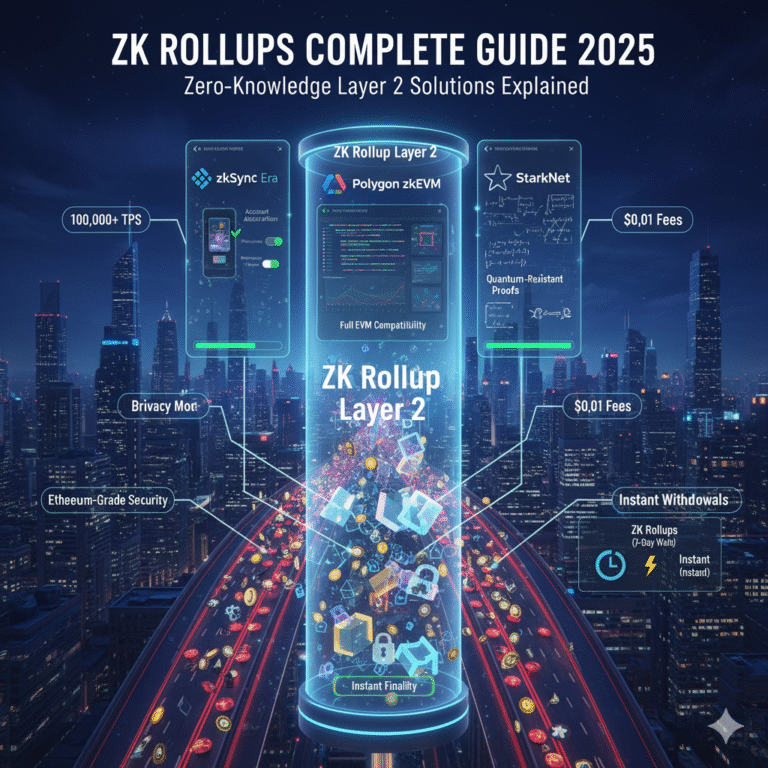
Zero-Knowledge Rollups (ZK Rollups) represent the most promising Layer 2 scaling solution, offering lightning-fast transactions, minimal fees, and Ethereum’s battle-tested security. Furthermore, this comprehensive guide explores ZK Rollups technology, leading projects like zkSync, Polygon zkEVM, and StarkNet, along with practical steps to get started. Additionally, we’ll examine real-world use cases and future developments in this rapidly evolving space.
What Are ZK Rollups?
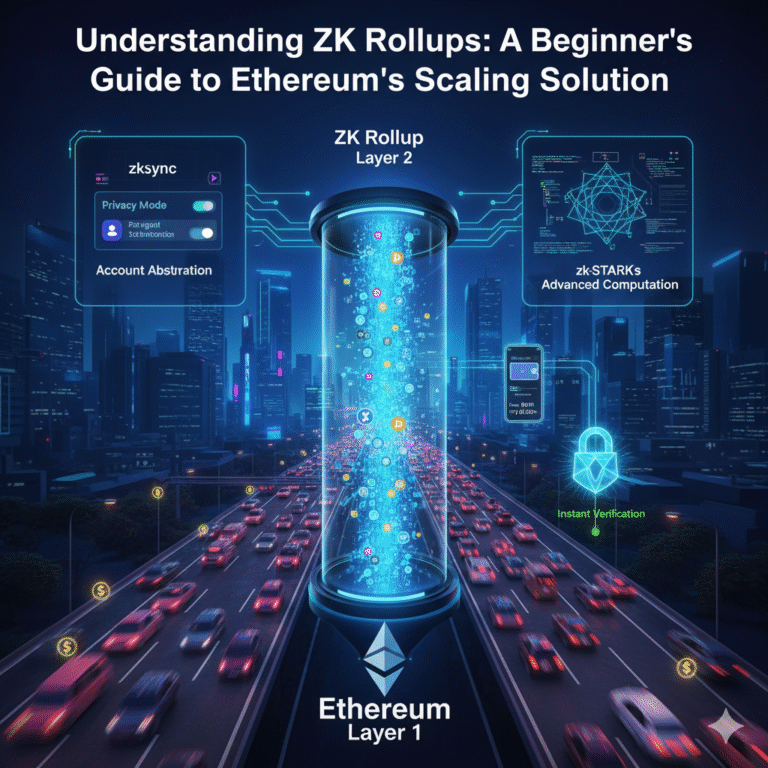
ZK Rollups are advanced Layer 2 (L2) scaling solutions that process thousands of transactions off Ethereum’s main chain while maintaining full security through cryptographic proofs. Moreover, they “roll up” multiple transactions into single batches and submit compact summaries to Ethereum, using zero-knowledge proofs to verify correctness without revealing transaction details.
Key Advantages Over Competitors
Unlike Optimistic Rollups (Arbitrum, Optimism), which assume transactions are valid and require 7-day challenge periods, ZK Rollups prove validity upfront, thereby enabling instant withdrawals. In contrast, sidechains like Polygon PoS operate independently with reduced security, whereas ZK Rollups maintain tight integration with Ethereum’s consensus mechanism. Consequently, this architectural difference provides superior security guarantees for high-value transactions.
Understanding ZK Rollup mechanics requires examining their multi-step process. Indeed, the technology represents one of the most sophisticated innovations in blockchain scalability.
Transaction Submission and Sequencing
Users submit transactions to the ZK Rollup network instead of Ethereum mainnet. Subsequently, a sequencer—specialized nodes responsible for transaction ordering—collects and organizes these transactions for batch processing. In essence, this creates an efficient queue management system for high-throughput operations.
Off-Chain Execution Environment
Transactions within ZK-Rollups are executed in separate computation environments, most often compatible with zkEVM (zero-knowledge Ethereum Virtual Machine). Notably, these environments replicate Ethereum’s rules but operate much faster. Furthermore, they do not require validation by thousands of mainnet validators, which dramatically reduces latency.
Transaction Batching and Compression
The sequencer aggregates hundreds or thousands of transactions into single batches. Additionally, advanced compression techniques reduce data requirements—for example, 1,000 token swaps might compress into just a few kilobytes of data. Therefore, this compression is crucial for maintaining cost-effectiveness at scale.
Zero-Knowledge Proof Generation
The technical core involves generating zk-SNARKs (Zero-Knowledge Succinct Non-Interactive Arguments of Knowledge) or zk-STARKs (Scalable Transparent Arguments of Knowledge). Consequently, these proofs, typically just hundreds of bytes, mathematically verify that all batched transactions follow Ethereum’s consensus rules without revealing individual transaction details. Moreover, this cryptographic guarantee provides unparalleled security assurances.
Two critical components are submitted to Ethereum:
State Root: A cryptographic hash representing the new rollup state
Validity Proof: The zero-knowledge proof confirming all transactions’ legitimacy
Verification and Finality
Ethereum’s smart contracts verify the ZK proof within seconds. As a result, upon successful verification, the batch achieves finality, updating user balances and contract states. Subsequently, this process eliminates challenge periods, thereby enabling near-instant withdrawals to Layer 1. In particular, this represents a massive improvement over Optimistic Rollup architectures.
Zero-knowledge proofs represent breakthrough cryptographic technology enabling privacy and scalability simultaneously. Indeed, they form the mathematical foundation of ZK Rollup security.
Core Concept and Philosophy
Imagine proving you solved a complex puzzle without revealing your solution method—only the correct answer. In essence, zero-knowledge proofs achieve exactly this: mathematically demonstrating statement validity without exposing underlying data. Furthermore, this property makes them invaluable for both privacy and scaling applications.
Generating zero-knowledge proofs demands significant computational resources. Specifically, the process typically requires:
Hardware: High-end GPUs or specialized ASICs
Time: Seconds to minutes depending on batch size
Cost: Currently the primary bottleneck for ZK Rollup economics
However, verification remains extremely efficient, allowing Ethereum to quickly validate proofs regardless of batch complexity. Moreover, ongoing hardware acceleration research promises to reduce these costs by 90%+ within the next 2-3 years.
Benefits of ZK Rollups
ZK Rollups deliver transformative improvements across multiple dimensions. Indeed, they represent the most comprehensive scaling solution available today.
Unmatched Scalability
In production environments, ZK-Rollups handle approximately 100–2,000 transactions per second (TPS), with theoretical limits exceeding 100,000 TPS. Remarkably, such performance rivals traditional payment networks like Visa (~24,000 TPS), thereby making real-time gaming, high-frequency trading, and large-scale consumer adoption possible. Furthermore, this scalability doesn’t compromise on security or decentralization.
Dramatic Cost Reduction
By batching thousands of transactions into single Ethereum submissions, ZK Rollups reduce fees to $0.01-$0.10 per transaction. Consequently, this cost structure makes microtransactions viable—purchasing coffee, small NFTs, or frequent DeFi interactions become economically feasible. In addition, users can finally engage with complex smart contracts without worrying about prohibitive gas fees.
Through mathematical proofs, ZK-Rollups inherit Ethereum’s full security model. As a result, invalid transactions cannot be included in any batch, and user funds stay safe even if rollup operators face downtime or act maliciously. Moreover, this security guarantee is cryptographically enforced rather than economically incentivized, providing stronger protection than fraud-proof based systems.
Compare security models at L2Beat for comprehensive analysis.
Near-Instant Finality
Unlike Optimistic Rollups’ 7-day withdrawal periods, ZK Rollups offer near-instant finality. Therefore, users can withdraw funds to Ethereum Layer 1 within minutes, which is crucial for arbitrage opportunities and capital efficiency. Additionally, this eliminates the frustrating waiting periods that plague other Layer 2 solutions.
Privacy Features
Zero-knowledge technology inherently supports privacy-preserving transactions. Consequently, certain ZK Rollups enable users to conduct financial activities without exposing transaction details publicly. Furthermore, this privacy capability attracts institutional users requiring confidential business operations while maintaining regulatory compliance.
Ethereum Compatibility
The best ZK Rollups support EVM equivalence or compatibility, allowing developers to deploy existing Solidity smart contracts with minimal modifications. Therefore, this reduces development complexity and accelerates ecosystem growth. Additionally, tools like Hardhat and Foundry work seamlessly with compatible ZK Rollups.
Leading ZK Rollup Projects
The ZK Rollup landscape features several major players, each with unique strengths and ecosystems. Indeed, competition drives rapid innovation and improvement across all platforms.
zkSync Era: User-Friendly Scaling
zkSync Era, developed by Matter Labs, stands as one of the most mature ZK Rollup implementations. Notably, the platform emphasizes user experience and developer accessibility.
Technical Specifications:
Technology: zk-SNARKs with recursive proof aggregation
Throughput: 100+ TPS currently, scaling to 1,000+ TPS
Transaction Costs: $0.01-$0.05 per transaction
EVM Compatibility: Full EVM equivalence via custom zkEVM implementation
Launch Date: March 2023 mainnet launch
Key Features:
Account Abstraction: Native implementation enables social recovery, gasless transactions, and improved UX
Privacy: Optional transaction privacy through encrypted mempools (in development)
Developer Tools: Comprehensive SDK with TypeScript/JavaScript support, Hardhat plugins
Ecosystem Growth: 200+ dApps including SyncSwap, Mute.io, and zkSync Name Service
Unique Advantages:
zkSync leads in account abstraction implementation, allowing smart contract wallets as first-class citizens. Moreover, this enables features impossible on other chains, such as paying gas fees in any token or enabling multisig wallets without additional complexity. Furthermore, zkSync’s Hyperchains framework allows launching interconnected ZK chains for specific use cases.
Polygon zkEVM, backed by Polygon Labs, prioritizes full Ethereum equivalence. Importantly, this approach minimizes development friction for existing Ethereum developers.
Technical Specifications:
Technology: zk-SNARKs with innovative PIL (Polynomial Identity Language)
Throughput: 100-300 TPS with ongoing optimizations
Transaction Costs: $0.03-$0.08 per transaction
EVM Compatibility: Type 2 zkEVM – nearly complete opcode equivalence
Launch Date: March 2023 mainnet beta
Key Features:
True EVM Equivalence: Supports virtually all Ethereum opcodes without modifications
Developer Experience: Existing Ethereum tools (Remix, Hardhat, Truffle) work natively
Security: Multiple audits by top firms including Hexens and Spearbit
Interoperability: Seamless connection with Polygon PoS and broader Polygon ecosystem
Unique Advantages:
Polygon zkEVM’s greatest strength lies in its developer-first approach. Consequently, existing Ethereum dApps deploy with zero code changes in most cases. Furthermore, Polygon’s established ecosystem (53K+ deployed dApps) provides immediate network effects and liquidity. Additionally, Polygon’s aggressive partnership strategy brings major projects directly to zkEVM.
Ecosystem Projects:
QuickSwap – High-performance DEX with concentrated liquidity
Balancer – Automated portfolio manager and trading platform
StarkNet, developed by StarkWare, takes a unique approach with custom programming language Cairo and zk-STARK technology. Notably, this architecture prioritizes long-term scalability and decentralization.
Technical Specifications:
Technology: zk-STARKs with transparent proofs (no trusted setup)
Understanding the differences between major ZK Rollups helps users and developers choose the right platform for their needs. Indeed, each solution optimizes for different priorities.
For a comprehensive comparison of Layer 2 networks including fees and speed benchmarks, visit our Ethereum Layer 2 solutions guide.
Feature Comparison Matrix
Platform
Technology
TPS
Fees
EVM Compatible
Quantum Resistant
Maturity
zkSync Era
zk-SNARKs
100+
$0.01-$0.05
Full
No
High
Polygon zkEVM
zk-SNARKs
100-300
$0.03-$0.08
Very High
No
High
StarkNet
zk-STARKs
100+
$0.02-$0.10
Limited (Cairo)
Yes
Medium
Security Considerations
All three platforms inherit Ethereum’s base security, but implementation details differ:
zkSync: Multiple audits by OpenZeppelin and ABDK, $200K bug bounty
Polygon zkEVM: Extensive security reviews by Hexens and Spearbit, $2M bug bounty
For Beginners: zkSync Era offers the smoothest onboarding experience
For Existing Ethereum Developers: Polygon zkEVM requires zero learning curve
For Maximum Decentralization: StarkNet provides quantum resistance and proven cryptography
For Privacy: zkSync’s upcoming features lead in transaction privacy
For Long-term Scalability: StarkNet’s architecture supports highest theoretical throughput
Real-World Use Cases
ZK Rollups enable applications previously impossible or impractical on Ethereum Layer 1. Indeed, numerous successful projects demonstrate production-ready scalability.
Decentralized Finance (DeFi)
DeFi represents the largest use case, where high throughput and low fees unlock new possibilities:
High-Frequency Trading
Platforms like zkSync’s SyncSwap and StarkNet’s JediSwap enable rapid trades without prohibitive gas costs. Consequently, arbitrage opportunities become accessible to retail users, not just well-funded bots. Moreover, complex trading strategies involving multiple swaps become economically viable.
Yield Farming Optimization
Low transaction costs allow users to compound yields daily or even hourly. Therefore, small investors can now compete with whales in yield optimization strategies. Additionally, gas costs no longer erode farming returns, making smaller positions profitable.
Lending Protocols
Platforms like Aave (deploying on Polygon zkEVM) benefit from instant finality. Consequently, liquidations occur more efficiently, reducing protocol risk. Furthermore, users can adjust collateral positions frequently without worrying about gas fees.
On-Chain Derivatives
Projects like dYdX (built on StarkEx) prove ZK technology’s capability for complex financial instruments. Specifically, perpetual swaps and options trading require millisecond-level performance. Moreover, ZK Rollups’ throughput makes these applications comparable to centralized exchanges while maintaining self-custody.
Non-Fungible Tokens (NFTs)
NFT ecosystems benefit dramatically from ZK Rollup efficiency:
High-Volume Minting
Projects launching 10,000+ NFT collections can mint entire collections for under $100 total cost. Consequently, creators no longer need to pass massive gas costs to buyers. Furthermore, dynamic NFTs that update frequently become practical.
Gaming Assets
Blockchain games require constant NFT transfers, trades, and updates. Therefore, ZK Rollups make in-game economies viable. Additionally, players can trade items between games seamlessly at minimal cost.
Fractional Ownership
Low fees enable fractional NFT trading, making expensive art accessible to more collectors. Moreover, frequent trading of fractions becomes economically sensible.
NFT Marketplaces
Platforms like Mintsu on zkSync and Element on StarkNet demonstrate marketplace viability. Specifically, listing, bidding, and purchasing NFTs cost mere cents. Furthermore, creators receive royalties automatically without expensive smart contract executions.
Gaming and Metaverse
Blockchain gaming demands performance impossible on Layer 1:
Real-Time Gaming
Games requiring instant transaction confirmation benefit from ZK finality. Consequently, player actions occur without noticeable delays. Moreover, competitive games can implement blockchain mechanics without compromising user experience.
In-Game Economies
ZK Rollups support thousands of daily microtransactions per player. Therefore, complex economic systems with frequent trades, crafting, and resource management become feasible. Additionally, play-to-earn mechanics distribute rewards efficiently.
Metaverse Interactions
Virtual world platforms require continuous state updates as users interact. Consequently, ZK Rollups enable persistent, blockchain-based metaverses with acceptable performance. Furthermore, interoperability between different virtual worlds becomes practical.
Payment Systems
ZK Rollups approach traditional payment network performance:
Microtransactions
Content creators can receive payments of cents for articles, videos, or digital goods. Consequently, subscription models charging per day or per use become viable. Moreover, tipping and small donations no longer lose value to fees.
Merchant Adoption
Businesses can accept cryptocurrency payments without worrying about volatility of transaction costs. Therefore, more merchants consider blockchain payments seriously. Additionally, instant finality improves cash flow certainty.
Remittances
International transfers cost dramatically less than traditional systems. Consequently, workers sending money home retain more of their earnings. Furthermore, transfers settle in minutes rather than days.
Getting Started with ZK Rollups
Entering the ZK Rollup ecosystem requires proper setup and understanding of best practices. Indeed, following security protocols ensures safe exploration.
Setting Up Your Wallet
Essential Wallet Options
MetaMask:
The most popular Ethereum wallet supports all major ZK Rollups. Importantly, MetaMask’s familiar interface reduces learning curve. Moreover, extensive browser extension and mobile app support provides flexibility.
Polygon zkEVM: Network Name “Polygon zkEVM”, RPC URL “https://zkevm-rpc.com“, Chain ID 1101
StarkNet: Requires dedicated wallet (see below)
Argent X (StarkNet):
StarkNet’s unique architecture requires specialized wallets. Consequently, Argent X provides the best mobile-first experience with built-in security features.
Features:
Native account abstraction support
Biometric authentication
Social recovery (recover wallet using trusted contacts)
For amounts exceeding $1,000, use hardware wallets like Ledger or Trezor. Consequently, private keys never touch internet-connected devices. Moreover, transaction signing occurs on physical devices requiring button confirmation.
Recovery Phrase Protection
Write recovery phrases on paper or metal, never digitally. Therefore, store multiple copies in separate secure locations. Additionally, consider splitting phrases using Shamir’s Secret Sharing for maximum security.
Bridging Assets to ZK Rollups
Moving funds from Ethereum to ZK Rollups requires understanding bridge mechanics and security:
Bungee: Multi-chain bridge aggregator finding cheapest routes. Consequently, users save on cross-chain transfers. Moreover, supports direct bridges between different ZK Rollups.
Orbiter Finance: Specialized in ZK Rollup bridging with instant transfers. Therefore, provides better user experience for frequent movers. Additionally, supports more exotic token pairs.
Across Protocol: Optimistic bridge with capital-efficient design. Specifically, offers competitive rates for popular tokens. Furthermore, insurance fund protects against bridge failures.
Always verify bridge URLs match official documentation exactly. Consequently, avoid phishing sites impersonating legitimate bridges. Moreover, bookmark official URLs to prevent typos.
Amount Testing
Bridge small amounts first (e.g., $10-50) to verify correct operation. Therefore, learn the process without risking significant funds. Additionally, confirm receiving addresses are correct.
Contract Verification
Only interact with verified smart contracts on block explorers. Consequently, check Etherscan verification status before approving transactions.
Slippage Settings
Set appropriate slippage tolerance (0.5-1%) for DEX trades to prevent MEV attacks. Moreover, understand that wider slippage tolerances increase sandwich attack risk.
Approval Management
Regularly audit and revoke unnecessary token approvals via Revoke.cash. Consequently, reduce attack surface by removing unused permissions. Furthermore, use time-limited approvals when available.
Finding and Using dApps
Each ZK Rollup ecosystem offers diverse applications:
zkSync Ecosystem
DeFi:
SyncSwap – Leading DEX with concentrated liquidity pools, yield farming
Mute.io – Privacy-focused trading and liquidity provision
Velocore – Next-gen AMM with single-sided liquidity
Maximizing safety and efficiency requires following established guidelines:
Transaction Management
Gas Optimization
Batch multiple transactions when possible. Consequently, save on overhead costs. Moreover, use protocols supporting multicall functionality.
Timing Considerations
Execute transactions during low-activity periods for better rates. Therefore, avoid peak hours (US afternoon/evening). Additionally, monitor gas trackers like Etherscan Gas Tracker.
Confirmation Patience
Wait for full confirmation before assuming transaction success. Consequently, avoid double-spending attempts. Moreover, use block explorers to track transaction status.
Security Protocols
Wallet Hygiene
Use separate wallets for different activities:
Hot Wallet: Small amounts for daily transactions
Warm Wallet: Medium amounts for weekly usage
Cold Wallet (Hardware): Long-term holdings and large amounts
Consequently, compromise of one wallet doesn’t affect others. Moreover, practice separation of concerns for different risk levels.
Smart Contract Interactions
Contract Verification – Only interact with verified smart contracts on block explorers
Slippage Settings – Set appropriate tolerance (0.5-1%) for DEX trades to prevent MEV attacks
Revoke Approvals – Regularly audit and revoke token approvals via Revoke.cash
Smart Contract Security
Auditing Standards
Leading audit firms specializing in ZK Rollup security provide comprehensive reviews:
Trail of Bits – Cryptographic and smart contract audits with formal verification
ConsenSys Diligence – Ethereum security specialists with 300+ audits completed
OpenZeppelin – Security-focused development tools and comprehensive audit services
Certik – AI-powered security analysis with Skynet monitoring
Zellic – Specialized in ZK circuit audits and cryptographic reviews
Bug Bounty Programs
Major ZK Rollup projects maintain active bug bounty programs with substantial rewards:
Zero-Knowledge Rollups represent the most promising path to Ethereum’s mass adoption, combining unprecedented scalability, minimal costs, and uncompromised security. As we progress through 2025, ZK technology is maturing rapidly, with leading projects like zkSync, Polygon zkEVM, and StarkNet demonstrating real-world viability at scale.
Key Takeaways for 2025
For Users: ZK Rollups enable affordable DeFi participation, instant NFT trading, and privacy-preserving applications previously impossible on Ethereum mainnet. Moreover, transaction costs have dropped 95%+ compared to Layer 1.
For Developers: Improving tooling and EVM compatibility make ZK Rollups increasingly attractive for dApp deployment, with massive scalability benefits. Furthermore, development grants exceeding $500M are available across ecosystems.
For Investors: The ZK Rollup ecosystem represents significant growth opportunity, with total value locked projected to exceed $50 billion by year-end. Additionally, institutional adoption is accelerating rapidly.
For the Future: ZK Rollups align perfectly with Ethereum’s roadmap, positioning them as the dominant scaling solution for the next decade. Subsequently, expect 100,000+ TPS within 3-5 years.
The zero-knowledge revolution is just beginning. As computational costs decrease, developer tooling improves, and ecosystems mature, ZK Rollups will transform not just Ethereum, but the entire blockchain landscape. Whether you’re a curious beginner or experienced developer, now is the perfect time to explore this transformative technology.
Q: What makes ZK Rollups better than Optimistic Rollups?
A: ZK Rollups provide instant withdrawal finality (minutes vs. 7 days), higher security through mathematical proofs rather than fraud proofs, and potential privacy features. However, Optimistic Rollups currently have larger ecosystems and easier development. Consequently, the choice depends on your specific priorities—security and speed versus ecosystem maturity. Furthermore, ZK Rollups are more future-proof with quantum resistance options.
Q: Are ZK Rollups safe to use?
A: Yes, ZK Rollups inherit Ethereum’s security model while adding cryptographic proof verification. Moreover, funds are secured by smart contracts on Ethereum, and invalid transactions cannot be processed due to zero-knowledge proof requirements. Nevertheless, always conduct your own research, start with small amounts, and use official bridges. Additionally, major projects have undergone multiple security audits by top firms like Trail of Bits and OpenZeppelin.
Q: Which ZK Rollup should I choose?
A: The choice depends on your needs:
zkSync Era – Best for beginners, excellent wallet integration, privacy features, $0.01-$0.05 fees
Polygon zkEVM – Ideal for developers, large ecosystem with 53K+ dApps, full EVM compatibility
StarkNet – Suited for advanced applications, quantum-resistant, custom Cairo programming language
Furthermore, consider your specific needs: security priority, development ease, or cutting-edge features. Additionally, you can use multiple rollups simultaneously for different purposes.
Technical and Practical Questions
Q: How much do ZK Rollup transactions cost?
A: ZK Rollup fees typically range from $0.01 to $0.10 per transaction, compared to $1-$50 on Ethereum mainnet. However, exact costs depend on network congestion and transaction complexity. Additionally, simple transfers cost less than complex smart contract interactions. Moreover, costs have decreased 90% since the Dencun upgrade. Track live fees at L2Fees.info and CryptoFees.
Q: Can I lose money using ZK Rollups?
A: While ZK Rollups are generally secure, risks include smart contract bugs, bridge vulnerabilities, and user errors. Therefore, always start with small amounts, use official bridges like zkSync Bridge or StarkGate, and never share private keys. Moreover, understand that all crypto investments carry inherent risks. Furthermore, enable 2FA, use hardware wallets for large amounts, and regularly review approvals on Revoke.cash.
Q: What is the future of ZK Rollups?
A: ZK Rollups are positioned to become the dominant Ethereum scaling solution. Furthermore, with Ethereum’s upcoming upgrades (full danksharding by 2026-2027), ZK Rollups will achieve even greater performance exceeding 100,000 TPS. Consequently, major institutions like Coinbase, Fidelity, and enterprises are increasingly adopting this technology for long-term scalability. Additionally, quantum-resistant zk-STARKs provide future-proofing against quantum computing threats.
Q: How do I bridge funds to ZK Rollups?
A: Use official bridges for maximum security: zkSync Bridge, Polygon Bridge, or StarkGate. Alternatively, consider aggregators like Bungee, Orbiter Finance, or Across Protocol. However, always verify URLs match official documentation exactly. Moreover, start with small test amounts before bridging large sums.
Disclaimer: This guide is for educational purposes only. Always conduct your own research and consult with financial advisors before making investment decisions.
Ethereum continues to power the world’s largest ecosystem of decentralized applications, from DeFi protocols to NFT marketplaces and Web3 gaming platforms. However, the network’s fundamental scalability constraints remain a critical challenge—processing only 15–30 transactions per second on average, with gas fees occasionally exceeding $50 during periods of high network congestion.
By October 2025, Layer 2 scaling solutions have matured significantly, with rollups securing approximately $48.6 billion in total value. This comprehensive guide examines how these technologies work, recent developments, and practical considerations for choosing between them.
⚠️ Important Disclaimer: This content is strictly educational. Cryptocurrency investments involve substantial risk. Always conduct thorough research and seek professional financial advice before making investment decisions.
The Current State of Ethereum Scaling (October 2025)
Rollup Ecosystem Growth
The rollup ecosystem has experienced remarkable growth, with major platforms including Arbitrum One holding approximately $21 billion in total value secured, Base with around $16 billion, and platforms like OP Mainnet, Linea, and zkSync Era also managing billions in assets.
Transaction Activity Surge
Rollup networks now process hundreds of millions of transactions monthly, with daily usage measured in unique operations (UOPS) averaging around 242—representing more than a twelvefold increase since 2024. Base currently leads in daily transaction volume, followed by Arbitrum and OP Mainnet.
The Fusaka upgrade, scheduled for deployment on December 3, 2025, represents the most significant Ethereum enhancement since Proto-Danksharding was introduced.
Core Technical Improvements
Peer Data Availability Sampling (PeerDAS) allows validators to sample data blobs rather than downloading them entirely, substantially reducing operational costs and expanding rollup data capacity. Additional enhancements include increased blob capacity per block, gas limit expansion, and Verkle Trees implementation for more efficient storage and bandwidth utilization.
Testing Progress
The Holesky testnet successfully completed testing in October 2025, with ongoing evaluations continuing on Sepolia and Hoodi testnets before the mainnet deployment.
Expected Impact
Following the Fusaka upgrade, rollup transaction fees are projected to decrease to fractions of a cent, substantially narrowing the cost differential that has historically favored sidechains.
Rollups execute transactions off the main Ethereum chain and submit compressed data or cryptographic proofs back to the mainnet, thereby inheriting significant portions of Ethereum’s security guarantees. To explore how Ethereum Layer 2 works in detail, including the specific mechanisms behind Arbitrum, Optimism, and zkSync, check out our comprehensive technical breakdown.
Optimistic Rollup Architecture
Optimistic rollups, exemplified by platforms like Arbitrum, Optimism, and Base, operate under an assumption-of-validity model where transactions are considered legitimate unless challenged during a dispute window lasting approximately seven days. Security is maintained through fraud proof mechanisms and economic incentive structures, though withdrawals require up to seven days to complete.
Zero-Knowledge Rollup Technology
ZK-rollups, including zkSync Era, Polygon zkEVM, and StarkNet, utilize cryptographic proofs such as zk-SNARKs or zk-STARKs to mathematically guarantee transaction correctness. This approach provides mathematically assured security and enables withdrawals in minutes to hours rather than days. For those new to this technology, our beginner’s guide to understanding zk-rollups breaks down these complex cryptographic concepts into digestible explanations, while our complete guide to zk-rollups in 2025 covers the latest developments and implementations.
Data Availability Mechanism
Both rollup types maintain independent state trees and periodically submit state roots to Ethereum’s mainnet, with data availability guaranteed by posting transaction data directly to Layer 1.
Sidechain Architecture Explained
Fundamental Design
Sidechains function as independent blockchains operating parallel to Ethereum, connected through bridge protocols that lock assets on Ethereum and mint equivalent representations on the sidechain. To dive deeper into understanding Ethereum sidechains, how they work, and why they matter, explore our dedicated guide that covers their architecture, use cases, and trade-offs in detail.
Consensus and Security Model
Most sidechains employ Proof of Stake or Proof of Authority consensus mechanisms, with security depending on validator integrity and bridge contract code rather than inheriting Ethereum’s security properties. Notable examples include Polygon PoS, Gnosis Chain, and Ronin Network.
Value Proposition
Sidechains continue to offer extremely low transaction fees and straightforward deployment processes, though they require accepting higher trust assumptions compared to rollups.
Comprehensive Comparison: Rollups vs Sidechains
Performance Metrics
Rollups deliver hundreds to thousands of transactions per second, with capacity continuing to increase following the Fusaka upgrade. Sidechains can achieve high throughput levels depending on validator configuration.
Transaction Economics
Rollup transaction costs are declining toward low-cent or sub-cent levels post-Fusaka implementation, while sidechain fees typically remain below one cent.
Security Characteristics
Rollups inherit Ethereum’s security properties, with ZK-rollups offering the strongest guarantees, though risks include sequencer centralization and emerging economic attack vectors. Sidechains rely on independent security models vulnerable to bridge exploits and validator collusion.
Settlement Speed
ZK-rollups enable withdrawals in minutes to hours, while optimistic rollups require multiple days for finalization. Sidechain withdrawal times range from minutes to hours depending on bridge implementation.
Development Environment
Rollups benefit from mature development toolchains with improving ZK stack capabilities, whereas sidechains typically offer complete EVM compatibility and straightforward deployment processes.
Liquidity Considerations
Rollups face liquidity fragmentation across multiple networks, with emerging standards like UAT20 attempting to address interoperability. Sidechains utilize bridges to unify liquidity but introduce additional trust requirements.
Critical Security Considerations for 2025
Economic Attack Vectors
Recent research demonstrates that attackers can execute pricing or fee saturation attacks by flooding rollup networks with low-fee, high-data transactions designed to delay proof generation. For technical details, see arXiv research papers.
Builder Advantage Concerns
The free option problem associated with enshrined proposer-builder separation (ePBS) may grant block builders unfair strategic advantages as Ethereum upgrades this mechanism.
Bridge Vulnerability
The $600 million Ronin Network hack serves as a stark reminder of bridge exploit risks inherent to sidechain architectures.
Centralization Risks
Many rollup platforms currently operate with single centralized sequencers, though decentralization efforts are progressing but not yet complete.
Strategic Decision Framework
When Rollups Are Optimal
Choose rollup solutions when managing high-value DeFi applications or treasury assets, requiring Ethereum-level censorship resistance, or seeking to leverage post-Fusaka cost reductions.
When Sidechains Make Sense
Sidechains remain appropriate for gaming applications, micropayment systems, social platforms, or scenarios prioritizing ultra-low fees and transaction speed over maximum security, as well as projects requiring rapid deployment with acceptable validator and bridge trust assumptions.
Hybrid Architecture Approach
Consider hybrid strategies utilizing sidechains for high-volume operations and rollups for final settlement, connected through interoperability protocols including LayerZero, Hop Protocol, or Polygon’s AggLayer.
Practical Implementation Guide
Deploying on Arbitrum Rollup
To get started with Arbitrum: add the Arbitrum network through Chainlist, bridge ETH using bridge.arbitrum.io, and explore decentralized applications such as Uniswap, GMX, and Radiant.
Begin testing with $10–50 allocations before committing larger capital to any new platform or protocol.
Future Developments to Monitor (Late 2025-2026)
Key upcoming developments include the Fusaka mainnet launch on December 3, 2025, rollout of decentralized sequencers and data availability committees across major rollup platforms, emergence of cross-rollup composability and liquidity standards such as CRATE and UAT20, potential sidechain consolidation as rollup cost advantages diminish, and new economic and MEV-based attack methodologies targeting both rollups and sidechains.
Final Analysis
By October 2025, rollups have transitioned from experimental technology to the primary scaling infrastructure for Ethereum, with the Fusaka upgrade and PeerDAS implementation promising enhanced affordability and scalability despite ongoing challenges including economic attack vectors and sequencer centralization.
Sidechains retain value for ultra-low-cost, high-speed applications but are experiencing erosion of their historical cost advantage as rollup technology matures.
Strategic Recommendations
For security-critical and high-value DeFi applications, rollups provide superior guarantees; for microtransactions and gaming use cases, sidechains continue to excel; developers should carefully evaluate security requirements against cost and user experience factors while monitoring emerging interoperability standards.
This ecosystem evolves rapidly—always verify current data, follow L2BEAT analytics, reference Ethereum.org Layer 2 documentation, and regularly update your technical assumptions.
Remember: Cryptocurrency markets and technologies change rapidly. This guide reflects October 2025 conditions. Always conduct independent research before making technical or investment decisions.
As of 2025, Binance remains one of the largest and most liquid cryptocurrency exchanges in the world, offering access to a broad range of tokens, derivatives, and income products. However, “big” does not mean “safe by default.” This guide walks you through registering, funding, trading, and withdrawing — with strong emphasis on security and real risks.
What Is Binance — And Why Many Use It
Platform Overview
Binance is a crypto exchange where users can buy, sell, and trade numerous digital assets including Bitcoin, Ethereum, and altcoins via order books or simpler conversion tools. The platform also provides access to derivatives, margin trading, staking or “Earn” products, and other advanced features, though availability depends on your region.
Users can utilize local fiat deposit and withdrawal options if supported in their jurisdiction, making it accessible to traders worldwide.
Why People Choose Binance
The platform offers several advantages that have contributed to its popularity:
High Liquidity & Volume — Binance’s massive trading volume results in tighter spreads and faster order fills, which is particularly important for active traders who need to enter and exit positions quickly.
Large Asset Universe — With hundreds of tokens and numerous trading pairs available, users have extensive options for portfolio diversification and trading strategies. If you’re specifically interested in Ethereum trading, check out our guide on how to buy Ethereum safely in 2025.
Reasonable Fee Structure — Base spot trading fees hover around 0.10% for both makers and takers, with various discount opportunities available through BNB usage and higher trading volumes.
Additional Yield Options — Beyond simple trading, Binance offers staking, Binance Earn savings products, and other passive income opportunities for crypto holders. For those interested in maximizing returns on Ethereum, our top 5 staking platforms for ETH comparison provides detailed insights on APY rates and risk factors.
Key Risks & Drawbacks
The platform’s feature-rich interface can be overwhelming for newcomers, with complex navigation and numerous product offerings that require time to understand fully.
Regulatory and legal risks remain significant considerations. Some features may not work or could be disabled in your country due to local regulations. Richard Teng currently serves as Binance’s CEO following leadership changes in the organization.
Even major exchanges face security challenges, regulatory pressure, and compliance issues. Users should never treat cryptocurrency trading as a guaranteed path to wealth, but rather as a tool with both benefits and substantial dangers. For beginners looking to compare different platforms, our top 10 crypto exchanges for beginners in 2025 guide offers comprehensive comparisons.
Account Setup & Identity Verification (KYC)
Step 1: Create an Account
Visit the official Binance website by carefully verifying the URL, SSL certificate, and browser security indicators to avoid phishing sites. Click the Register button and choose your preferred registration method using either email or phone number. Set a strong, unique password that combines uppercase and lowercase letters, numbers, and special characters. Complete the CAPTCHA verification to proceed.
Step 2: Confirm & Verify
You’ll receive a verification code via your chosen method (email or SMS). Enter this code to confirm your account. To unlock full platform features including higher limits, withdrawal capabilities, and derivatives access, you’ll typically need to complete Know Your Customer (KYC) verification.
The KYC process requires uploading government-issued identity documents such as a passport, national ID card, or driver’s license, plus completing a liveness check through selfie or video verification. Without completing KYC, many functions remain limited or completely blocked.
Step 3: Lock Down Security
Immediately after registration, implement these critical security measures:
Enable Two-Factor Authentication (2FA) using Google Authenticator, Authy, or similar authenticator apps. SMS-based 2FA is available but considered less secure than app-based authentication.
Set an Anti-Phishing Code so that genuine Binance emails include your personal code, helping you identify legitimate communications from the exchange.
Enable Withdrawal Whitelist to restrict crypto withdrawals to only preapproved addresses, adding an extra layer of protection against unauthorized transfers.
Monitor Account Activity regularly by checking login history, connected devices, and IP addresses to detect any suspicious access attempts.
These security steps aren’t optional recommendations — they’re essential protections that help safeguard your funds if something goes wrong.
Depositing Funds
Three Common Methods
Bank Transfer / Wire / Local Rails — Access this through the Buy Crypto → Bank Deposit section. This method typically offers lower fees and works well for larger amounts, though transactions may take several days to process. Availability varies significantly by country and region.
Credit / Debit Card — Found under Buy Crypto → Card, this option provides fast, easy access for newcomers who want to get started quickly. However, fees are notably higher than bank transfers, and regional restrictions apply based on card issuer policies and local regulations.
P2P / Local Trading — Located under Trade → P2P, peer-to-peer trading often provides the best local rates and works when traditional banking options are limited. However, users must carefully verify the reputation and history of their trading counterpart, as scam risks are higher in P2P transactions.
Always verify which deposit methods Binance supports in your specific country before attempting to add funds.
Important Note on BUSD to FDUSD Transition
Binance discontinued BUSD operations, automatically converting all BUSD balances to FDUSD at a 1:1 ratio. The exchange disabled BUSD withdrawals and removed BUSD from most trading pairs. Because of this significant shift, users should now rely primarily on USDT, USDC, or FDUSD for their stablecoin needs.
Buying Cryptocurrency
You have two main approaches to acquire crypto on Binance:
A. Convert (Quick & Simple)
The Convert feature allows you to swap fiat currency or stablecoins directly into cryptocurrency. This method is fast, straightforward, and hides the complexity of traditional order mechanics. However, the implicit spread (built-in fee) may be larger than what you’d pay using traditional spot trading.
B. Spot Trading (More Control)
Navigate to Trade → Spot and select your desired trading pair, such as BTC/USDT or ETH/USDT. You’ll have access to several order types:
Market Order — Executes immediately at the current market price, guaranteeing execution but not price. Best for when you need to enter or exit a position quickly.
Limit Order — You specify your desired price, and the order only executes if the market reaches that level. This gives you price control but no execution guarantee.
Stop-Limit / Stop-Loss Orders — Conditional orders that trigger based on price movements, useful for automated risk management and trading strategies.
Start with small market orders to familiarize yourself with the interface and execution process. Once comfortable with basic mechanics, graduate to limit and stop orders for better control. Before making any trades, reviewing Ethereum’s key statistics and charts can help inform your investment decisions.
Selling & Withdrawing
Selling Your Crypto
You can use the Convert feature to quickly turn your cryptocurrency holdings into USDT, FDUSD, or fiat currency (if supported in your region). Alternatively, use the Spot trading interface to place a Sell order, choosing between market orders for immediate execution or limit orders for price control.
Withdrawing Funds
First, convert your cryptocurrency to the required asset format for withdrawal, whether that’s a stablecoin or fiat currency. Navigate to Fiat & Spot → Withdraw and select your preferred withdrawal method from available options including bank transfer, P2P, or direct crypto withdrawal to an external wallet.
Confirm the transaction using your 2FA authentication and complete any additional security checks Binance requires. Withdrawal methods, processing times, and associated fees depend heavily on your country and banking relationships.
Fees & How to Lower Them
Spot Trading Fees
Standard fees for new users typically run around 0.10% for both maker and taker orders. However, several discount opportunities exist:
Using BNB (Binance Coin) to pay trading fees provides an automatic discount. Achieving higher trading volumes or reaching VIP tiers unlocks progressively lower fee rates. Maker orders, which add liquidity to the order book, often carry lower fees than taker orders.
Derivatives / Futures Fees
Derivatives products operate under separate fee structures that include funding rates for perpetual contracts. Always review the complete fee schedule before entering any leveraged position.
Tips to Reduce Costs
Maintain a BNB balance specifically reserved for paying trading fees. Plan your trading strategy to favor maker orders when possible. Watch for Binance promotions, fee vouchers, or reduced-fee trading windows. Always review the fees summary before confirming any trade — Binance displays projected costs before execution.
To better understand BNB’s role in the Binance ecosystem and its potential as an investment, read our comprehensive BNB guide for beginners and experts.
Risk Management — Don’t Be Reckless with Money
Position Sizing — Never risk capital you cannot afford to lose completely. Start with small position sizes while learning. Dollar-Cost Averaging (DCA) distributes entry risk more safely than lump-sum investments.
Use Stop-Loss / Conditional Orders — Implement stop-limit orders to automatically protect your downside and limit potential losses on positions.
Diversification — Avoid concentrating your entire portfolio in one coin, token, or crypto sector. Spread risk across different assets and categories.
Trade Journal & Analysis — Maintain detailed records of every entry, exit, and the reasoning behind each decision. Review your history regularly to learn from both successes and mistakes.
Control Emotions — Resist the urge to chase Fear Of Missing Out (FOMO) rallies, and avoid panic-selling during market dips. Stick to your predetermined rules rather than making emotional decisions.
Common Mistakes & How to Avoid Them
Buying at a Top (FOMO) — Many traders buy at peak prices driven by excitement, only to watch prices fall afterward. Set price alerts and wait for pullbacks before entering positions.
Panic Selling — Emotional reactions to short-term volatility often cause traders to realize losses prematurely. Pre-set stop-loss orders and commit to following your trading plan regardless of market noise.
Neglecting Security — A single security breach can wipe out your entire portfolio. Always enable 2FA, use withdrawal whitelists, and implement anti-phishing measures without exception.
Jumping into Obscure Altcoins Without Research — Many low-cap tokens are scams or suffer from extremely low liquidity. Thoroughly investigate the development team, liquidity metrics, and project roadmap before investing.
Overtrading — Excessive trading activity erodes gains through accumulated fees and slippage. Trade selectively based on solid reasoning rather than constantly buying and selling.
Advanced Features (When You’re Ready)
Once comfortable with basic trading mechanics, Binance offers several advanced products:
Futures and Derivatives Trading — Highly leveraged products that magnify both gains and losses. Only use these instruments after thorough education and paper trading practice.
Binance Earn / Staking / Savings — Passive income products that allow you to earn yield on crypto holdings through various mechanisms. For Ethereum holders specifically, exploring dedicated ETH staking platforms may offer more competitive returns.
NFT Marketplace — Trading and collecting non-fungible tokens, with availability varying by region.
Launchpad / Token Offerings / IEOs — Opportunities to participate in new token launches and initial exchange offerings.
Margin Trading — Borrowing funds to increase position sizes. This dramatically increases risk and should only be used by experienced traders who fully understand leverage mechanics.
Fact Checks, Ambiguities & What to Watch
Richard Teng serves as Binance’s CEO as of 2025, leading the organization through an evolving regulatory landscape. Binance completed the conversion of all BUSD balances to FDUSD at a 1:1 ratio and removed BUSD from most trading pairs.
The platform lists hundreds of cryptocurrency tokens, though the exact count fluctuates as new tokens are added and others are delisted. Many features depend heavily on your country of residence, with some functionalities potentially blocked due to local regulations.
While Binance implements robust security measures, no exchange is immune to hacking attempts, regulatory pressure, or internal operational issues. Users must maintain realistic expectations about platform stability.
Conclusion & Key Takeaways
Binance provides powerful trading tools, but success requires respecting risk, understanding regulation, and navigating complexity. Security measures including 2FA, anti-phishing codes, and withdrawal whitelists are mandatory, not optional features.
Start with small positions to learn through practical experience rather than risking large sums immediately. Always verify what features and services are available in your specific country, as deposit methods, withdrawal options, trading pairs, and derivative access vary significantly by jurisdiction.
For those just starting their cryptocurrency journey, consider reviewing our guide on top crypto exchanges for beginners to ensure you’ve chosen the best platform for your needs.
Patience and continuous learning are essential. Study market dynamics, practice with small amounts, and iteratively refine your trading approach based on real results rather than speculation or emotion.
Ethereum has become the backbone of decentralized finance, NFTs, and countless blockchain experiments. But there’s a catch: the base layer prioritizes security over speed, which means during peak demand, transactions can crawl and fees can skyrocket. This is where Layer 2 solutions step in—and among them, Zero-Knowledge Rollups (ZK rollups) are stealing the spotlight.
ZK rollups handle the heavy computational lifting off Ethereum’s main chain, then prove everything was done correctly using advanced cryptographic methods. No trust required, just pure mathematics. Let’s break down how these systems work, why they’re transforming Ethereum’s scalability story, and what the leading platforms offer right now.
What Exactly Is a ZK Rollup?
Think of a ZK rollup as a smart delegation system. Instead of processing every transaction on Ethereum’s main network, a ZK rollup executes thousands of transactions off-chain, bundles them together, and then submits a compact validity proof along with minimal summary data back to Ethereum.
Ethereum doesn’t need to re-run every single transaction. It simply verifies the cryptographic proof—if the math checks out, the state update gets accepted. This architecture allows massive throughput improvements while maintaining Ethereum’s rock-solid security guarantees.
The “zero-knowledge” component is a cryptographic technique that proves something is valid without revealing all the underlying details. It’s a privacy-preserving method used far beyond blockchain applications, from secure authentication to confidential transactions.
Understanding the L2 landscape requires knowing how different scaling solutions stack up:
Optimistic rollups take a “trust but verify” approach—they assume transactions are valid unless someone raises a challenge. This creates a withdrawal waiting period of roughly seven days. ZK rollups verify correctness upfront through mathematical proofs, enabling much faster withdrawals once the proof lands on Ethereum’s main chain.
Sidechains are entirely separate blockchains connected to Ethereum through bridges. They don’t inherit Ethereum’s security by default—they rely on their own validator sets. Rollups, by contrast, derive their security directly from Ethereum Layer 1.
Here’s the step-by-step process in plain language:
Transaction submission: Users send transactions to the rollup network, typically through a component called a “sequencer” that orders incoming transactions.
Off-chain execution: The rollup processes these transactions in a virtual machine environment—sometimes EVM-compatible, sometimes using custom languages like Cairo.
Batching: Thousands of individual transactions get bundled into a single batch, often called a “rollup block.”
Proof generation: The rollup generates a succinct cryptographic proof (either a zk-SNARK or zk-STARK) demonstrating that the entire batch was executed correctly.
Posting to Ethereum: The rollup publishes summary data and the validity proof to Ethereum’s main chain—typically a Merkle root plus the cryptographic proof.
Verification and finality: Ethereum verifies the proof mathematically. If valid, the rollup’s new state becomes finalized on Layer 1.
Because Ethereum handles only verification rather than execution, users get Layer 1 security with dramatically higher throughput and lower costs.
Dramatically lower fees: Ethereum’s Dencun upgrade in March 2024 introduced EIP-4844, which added “blob” space—a cheaper data availability option specifically for Layer 2 networks. Since then, transaction fees on ZK rollups have routinely dropped to the cents range, though exact figures fluctuate with network demand.
Faster withdrawals: Validity proofs eliminate the week-long challenge window that optimistic rollups require. Many ZK rollups finalize withdrawals in hours or less, depending on their proof aggregation schedule.
Security inheritance: Data and proofs get posted directly to Ethereum Layer 1, so you’re not trusting a separate validator committee like you would with sidechains.
Privacy potential: While most production ZK rollups today aren’t private by default, the underlying cryptographic techniques enable confidential transactions when explicitly designed for privacy.
The metrics below use Total Value Secured (TVS) from L2BEAT—the standard measurement for capital bridged or natively secured on Layer 2 networks. Data is current as of October 5, 2025.
zkSync Era (Matter Labs)
zkSync Era is a general-purpose ZK-EVM rollup with built-in account abstraction features. This means apps can subsidize user fees (through “paymasters”) or allow users to pay gas in tokens other than ETH. The proving infrastructure, called Boojum, generates validity proofs that Ethereum verifies on-chain.
Security and fees: Validity proofs ensure Ethereum-grade security. Post-Dencun blob data dramatically reduced transaction costs. Withdrawals are proof-dependent, typically completing within hours based on batch frequency.
Ecosystem: Total Value Secured is approximately $1.20 billion.
Polygon zkEVM delivers an EVM-equivalent experience, meaning Ethereum applications can migrate with minimal code changes. It’s part of the broader Polygon ecosystem, which underwent a token migration from MATIC to POL.
Ecosystem: Total Value Secured stands at approximately $19.8 million—notably smaller than Polygon PoS, which is a separate network entirely.
Why it matters: Developers get familiar Solidity tooling with zero-knowledge security. Fees typically range in the cents post-Dencun, varying with network load.
Starknet uses zk-STARKs—hash-based proofs that require no trusted setup and are widely considered post-quantum-resistant at the proof-system level. Rather than Solidity, Starknet uses the Cairo programming language for enhanced performance and flexibility.
Ecosystem: Total Value Secured is approximately $770.8 million. Note that dYdX v3 previously used StarkWare’s StarkEx technology, but dYdX migrated to its own Cosmos-based app-chain (v4) in 2023.
Withdrawal flow: Bridging happens through StarkGate, with finality tied to proof verification on Ethereum Layer 1.
Transaction costs: Since EIP-4844’s implementation, Layer 2 data availability expenses dropped substantially. You’ll commonly see fees ranging from single-digit cents to low tens of cents on active ZK rollups, though prices fluctuate based on blob space demand and Ethereum Layer 1 gas costs. Always check live dashboards for current rates.
Withdrawal timing: Unlike optimistic rollups with their seven-day waiting periods, ZK rollups finalize much faster. zkSync documents typical finalization within hours, with variability based on network activity and proof aggregation cycles. Each network has its own cadence.
Sequencer centralization: Most rollups currently operate a single sequencer, creating potential liveness and censorship vulnerabilities. Projects are actively developing decentralized sequencer networks and “escape hatches,” but these solutions remain works in progress. L2BEAT provides detailed risk assessments explaining operator assumptions for each network.
Privacy isn’t automatic: ZK technology enables privacy, but most production ZK rollups publish transaction data publicly for Layer 1 verification. Privacy requires explicit protocol-level design choices—projects like Aztec focus specifically on this.
Throughput reality check: Marketing materials often claim hundreds of thousands of transactions per second. Real-world throughput depends on proving capacity, data availability costs, and Layer 1 conditions. Always cross-reference with neutral analytics platforms.
Compatibility considerations: Starknet uses Cairo instead of Solidity, so porting applications requires engineering effort. Even zkEVMs that aim for EVM equivalence can differ in edge cases.
Choose a compatible wallet: MetaMask works across most platforms. Argent X is popular for Starknet. Many networks offer native wallets or detailed setup guides in their official documentation.
Bridge with caution: Use only official bridges—zkSync’s native bridge, Polygon zkEVM’s bridge, or StarkGate for Starknet. Start with a small test transfer before moving significant funds.
Monitor costs in real-time: While post-Dencun fees are generally low, they remain dynamic. Check live fee trackers before initiating transactions.
Confirm finality: Don’t expect instant Layer 1 accessibility. Wait for proof verification to complete—check the bridge interface or block explorer for status updates.
Prioritize security: Use audited applications, monitor token approvals regularly, and review L2BEAT’s risk analysis for your chosen network.
“Privacy rollup” doesn’t mean private by default: ZK proofs can enable privacy, but most ZK Layer 2s publish transaction data for Layer 1 verification. Privacy requires specific architectural choices with different trade-offs.
dYdX statements may be outdated: dYdX v3 used StarkEx, but v4 has run on a Cosmos app-chain since 2023. Outdated claims still circulate.
TVS numbers change rapidly: Treat any figure as a point-in-time snapshot. Always verify current data on L2BEAT before citing statistics.
Sequencer centralization remains an issue: Most rollups still depend on a single sequencer today. The industry is researching decentralized alternatives and emergency withdrawal mechanisms, but these aren’t widely deployed yet.
ZK rollups scale Ethereum without sacrificing Ethereum’s security guarantees. Through validity proofs, they dramatically reduce costs, accelerate withdrawals, and create pathways to privacy-preserving applications when explicitly designed for that purpose.
In 2025, zkSync Era, Polygon zkEVM, and Starknet represent three major implementations, each with distinct trade-offs: EVM equivalence versus Cairo performance, ecosystem maturity versus cutting-edge technology, developer familiarity versus advanced features.
For beginners, the safest approach is straightforward: use official bridges, start with small amounts, monitor fees through live trackers, and rely on neutral analytics platforms like L2BEAT for risk assessments and TVS data.
As the leading smart-contract platform, Ethereum continues driving innovation in decentralized finance (DeFi), NFTs, and Web3 gaming. However, network congestion during peak periods can result in frustratingly slow transactions and gas fees ranging from $20 to $100. Fortunately, Ethereum sidechains offer a solution: independent blockchains running parallel to Ethereum that deliver faster speeds, lower costs, and improved scalability.
This comprehensive guide explores what Ethereum sidechains are, how they function, and examines three prominent networks in 2025: Polygon PoS, Gnosis Chain (formerly xDai), and Ronin. All information presented comes from verified sources including official project documentation and trusted blockchain analytics platforms.
What Are Ethereum Sidechains?
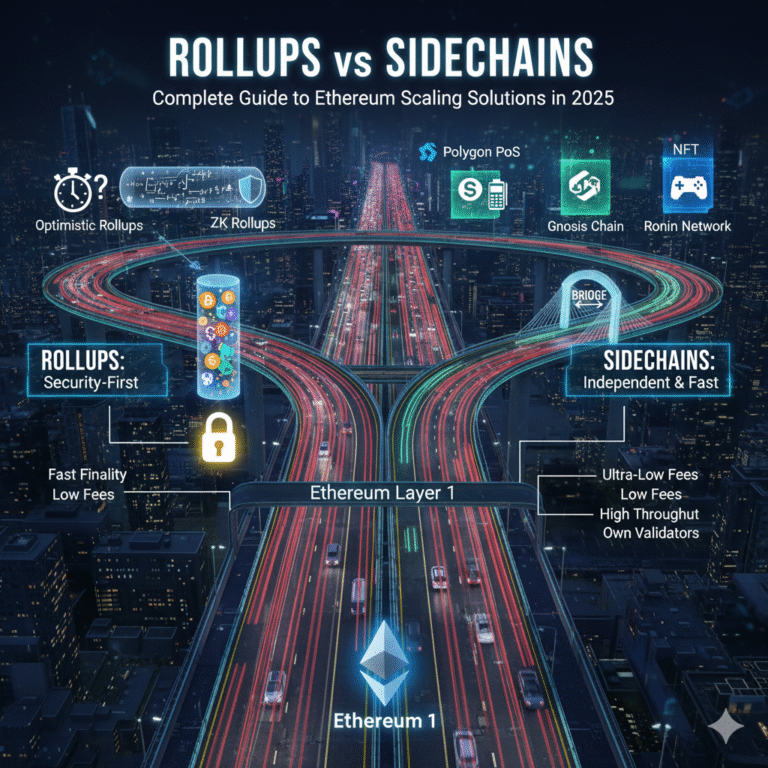
Imagine Ethereum as a major highway—highly secure but frequently congested. In contrast, sidechains function as parallel routes designed to ease traffic. These networks maintain their own validators, block production times, and consensus mechanisms. At the same time, they connect to Ethereum through bridge protocols that enable cross-chain asset transfers.
Unlike Layer-2 rollups such as Arbitrum or zkSync, which batch transactions and post them to Ethereum mainnet, sidechains operate with complete independence. Specifically, they handle their own block validation and security infrastructure. To understand the key differences between these approaches, check out our complete guide to rollups vs sidechains.
Key advantages include:
Lower transaction costs: Typically, fees stay under $0.01 per transaction
Enhanced speed: Moreover, processing capabilities reach hundreds to thousands of transactions per second (TPS)
Greater flexibility: As a result, these networks are perfect for gaming, payments, and community apps where cost-efficiency and speed outweigh maximum decentralization
The security trade-off: On the flip side, sidechains use smaller validator sets compared to Ethereum, making them more prone to validator collusion or security breaches. Additionally, bridge issues can result in stolen funds, as shown by several high-profile exploits across the blockchain industry.
Learn more about blockchain scaling solutions at Ethereum.org.
How Ethereum Sidechains Function
In essence, sidechains interact with Ethereum through a four-step process:
Asset bridging: First, a smart contract on Ethereum locks your ETH or tokens. Meanwhile, the sidechain mints matching wrapped assets for use on its network.
Independent transaction processing: Next, the sidechain validates transactions through its own Proof-of-Stake or Delegated Proof-of-Stake consensus method.
Periodic checkpointing: Furthermore, some sidechains send state snapshots to Ethereum for transparency purposes, though they work independently of Ethereum validators.
Return bridging: Finally, when withdrawing, the sidechain burns wrapped tokens and the Ethereum bridge releases your original assets.
This design enables great speed and low costs while sacrificing some of Ethereum’s built-in security guarantees. For a deeper dive into zero-knowledge scaling alternatives, explore our beginner’s guide to zk-rollups.
Polygon PoS — The Multi-Purpose Sidechain Leader
Launch date: 2019 (initially as Matic Network) Consensus mechanism: Proof of Stake Active validators: Up to 105 Transaction fees: Approximately $0.001–$0.01
Polygon PoS ranks as the most widely used Ethereum sidechain. Importantly, full EVM compatibility allows developers to deploy Ethereum apps without changing code.
Technical Operations
Bridge infrastructure: To begin, the Polygon PoS Bridge locks ETH or ERC-20 tokens on Ethereum and issues wrapped versions (WETH, USDC) on Polygon.
Transaction throughput: In addition, it processes hundreds of TPS in real-world conditions, supporting DeFi platforms, NFT marketplaces, and gaming apps.
Checkpoint system: Finally, state summaries post to Ethereum every few hours for easy auditing.
Ecosystem Overview
Notably, Polygon powers major platforms including Aave, QuickSwap, and OpenSea’s NFT marketplace. Beyond that, corporate projects like Reddit Collectible Avatars and Starbucks Odyssey have used Polygon infrastructure. For an in-depth comparison of how Polygon stacks up against other major chains, see our Ethereum vs Solana vs Polygon DeFi comparison.
Currently, Polygon is moving from MATIC to POL under its Polygon 2.0 upgrade. As such, POL serves for gas fee payments and network staking.
Strengths and Limitations
Advantages: Wide ecosystem with strong developer support, plus seamless MetaMask integration
Considerations: On the other hand, PoS bridge withdrawals can take several hours, and a smaller validator set compared to Ethereum means lower security
Gnosis Chain (Formerly xDai) — The Stablecoin-Optimized Network
Launch date: 2018 Consensus mechanism: Proof of Stake (POSDAO, merged with Gnosis Beacon Chain in 2022) Validator count: Tens of thousands (highly decentralized) Transaction fees: Less than $0.001
Gnosis Chain was built for fast, clear transactions using xDAI, a USD-pegged stablecoin, as its native gas token.
Technical Framework
Bridge protocols: To start, users move assets via the xDai Bridge or OmniBridge connecting Ethereum and Gnosis Chain.
Stable gas mechanism: In addition, transactions paid in xDAI provide clear costs independent of ETH price swings.
Governance structure: Meanwhile, validators stake GNO tokens for network security and governance input.
Application Ecosystem
Gnosis serves payment systems, DAOs, and community projects. Notable applications include Circles UBI, Honeyswap, and the widely-used Safe (formerly Gnosis Safe) multisig wallet.
Advantages: Extremely low and stable transaction fees, large post-merge validator network
Considerations: Smaller ecosystem compared to Polygon, primarily optimized for payments rather than high-volatility DeFi
Ronin — The Gaming-Focused Sidechain
Launch date: 2021 by Sky Mavis (Axie Infinity creators) Consensus mechanism: Delegated Proof of Stake (DPoS) Active validators: Approximately 22 Transaction fees: Near-zero for end users
Ronin was purpose-built for blockchain gaming, offering EVM compatibility designed to process massive volumes of in-game microtransactions without imposing prohibitive gas fees on players.
Technical Architecture
Bridge system: Players transfer ETH and tokens through the Ronin Bridge.
Transaction speed: Capable of exceeding 1,000 TPS in production environments, essential for real-time gaming experiences.
Security enhancements: Following a 2022 bridge exploit resulting in approximately $600 million in losses, Ronin strengthened its validator model and implemented community governance.
Gaming Ecosystem
Ronin continues powering Axie Infinity and newer titles like Pixels, attracting millions of users through streamlined onboarding and the Ronin Wallet, which provides gas-free starter transactions.
Sidechains vs Layer-2 Rollups: Understanding the Difference
Aspect
Sidechains
Layer-2 Rollups
Security model
Independent validators (reduced security)
Inherits Ethereum’s security
Speed and cost
Faster, cheaper
Now also affordable post-EIP-4844
Bridge characteristics
Fast but higher risk
Slower, more secure
Optimal use cases
Gaming, payments, low-value transactions
High-value DeFi, enterprise applications
Ethereum’s 2024 Dencun upgrade (EIP-4844) significantly reduced data costs for rollups, bringing many Layer-2 networks to near-sidechain pricing levels. However, sidechains maintain advantages in simplicity and architectural flexibility. Learn more about advanced zero-knowledge solutions in our complete zk-rollups guide for 2025.
Bridge vulnerabilities: Billions in losses have occurred from past exploits. Always utilize official bridges and limit exposure.
Validator centralization: Fewer validators increase risks of collusion or network downtime.
Misleading TPS claims: Theoretical figures like “7,000 TPS” or “100,000 TPS” often don’t reflect reality. Focus on verified real-world throughput and fee data.
Ecosystem fragmentation: Each sidechain operates in isolation, making interoperability tools like Hop Protocol or LayerZero increasingly important.
The Evolution of Ethereum Sidechains
Sidechains continue rapid development. Projects such as Polygon zkEVM and zkSync Era blur traditional boundaries between sidechains and rollups, combining affordable fees with Ethereum-grade security. Meanwhile, cross-chain communication protocols are improving asset and data mobility between networks.
Expect hybrid architectures to dominate future scaling solutions—chains operating as independent sidechains while periodically anchoring cryptographic proofs to Ethereum for enhanced security.
Key Takeaways for 2025
Sidechains represent an essential component of Ethereum’s scaling infrastructure. They make blockchain applications accessible and affordable for mainstream users, despite not fully replicating Ethereum’s security model.
Recommendations for newcomers:
For trading and DeFi: Start with Polygon
For stable payments: Use Gnosis Chain
For gaming: Explore Ronin
Important reminder: Always research bridge security, validator decentralization, and withdrawal timeframes before transferring significant funds. The Ethereum ecosystem continues advancing toward faster, more affordable transactions—and sidechains remain the frontier where innovation happens first.
Are you ready to buy your first Bitcoin (BTC) or Ethereum (ETH) but unsure where to start? Choosing the right cryptocurrency exchange is the first and most important step in your crypto journey. The best platforms for beginners make it simple to buy and sell digital assets safely, without confusing charts or hidden fees.
In 2025, Bitcoin reached new all-time highs above $125,000, and Ethereum remains the backbone of decentralized finance (DeFi), non-fungible tokens (NFTs), and smart contracts. With increased global regulation and institutional adoption, crypto trading has become safer and more accessible than ever before.
This comprehensive guide ranks the top 10 crypto exchanges for beginners in 2025, focusing on platforms that are secure, user-friendly, and ideal for Bitcoin and Ethereum investors.
What Is a Crypto Exchange and Why Does It Matter?
A crypto exchange is an online marketplace where you can buy, sell, or trade cryptocurrencies using traditional fiat currency (like USD or EUR) or other digital assets. Think of it as a digital version of a stock exchange, but specifically designed for Bitcoin, Ethereum, and thousands of other cryptocurrencies.
For beginners entering the crypto space, not all exchanges are created equal. Some platforms are overloaded with professional trading tools and complex terminology that can overwhelm newcomers. The best beginner-friendly exchanges make your entry into cryptocurrency investing smooth and stress-free.
Essential Features to Look for in a Beginner Crypto Exchange
Ease of use: Clean mobile app interface with simple buy and sell options
Low fees: Transparent pricing structure that won’t erode your initial investment
Security: Two-factor authentication (2FA), cold storage solutions, and proof-of-reserves audits
Education: Learning resources explaining Bitcoin, Ethereum, and blockchain fundamentals
Regulation: Compliance with your country’s financial laws for safer trading
1. Coinbase — The Most Beginner-Friendly Crypto Exchange
Founded: 2012 Users: Over 100 million Headquarters: San Francisco, USA
Coinbase remains the top choice for cryptocurrency beginners in 2025 thanks to its intuitive interface and trusted reputation in the industry. The sign-up process takes just minutes, and you can purchase BTC or ETH instantly using a debit card or bank transfer.
Trading Fees: 0.05–0.60% taker / 0.00–0.40% maker (Coinbase Advanced) Security Features: 98% of customer assets held in offline cold storage, FDIC-style insurance coverage for USD balances
Important Note: The “Learn & Earn” rewards program officially ended in May 2025.
Best for: U.S. beginners who prioritize maximum transparency and regulatory compliance Official Website:coinbase.com
2. Kraken — Old-School Reliability With Industry-Leading Security
Founded: 2011 Users: Over 10 million Headquarters: San Francisco, USA
Kraken is one of the oldest and most respected cryptocurrency exchanges globally. The platform is renowned for its security track record—never hacked in over a decade of operation—and offers a simplified “Kraken Lite” version specifically designed for newcomers to crypto trading.
Trading Fees: Approximately 0.16% maker / 0.26% taker Security Features: Regular proof-of-reserves audits, full asset coverage guarantees Additional Features: ETH staking options (availability varies by country and U.S. state)
Best for: Users who value safety and strong customer support above all else Official Website:kraken.com
3. Gemini — Trust and Transparency First
Founded: 2014 by the Winklevoss twins Users: Over 13 million Headquarters: New York, USA
Gemini is a fully regulated U.S. cryptocurrency exchange with a clean, beginner-friendly mobile app. The platform is certified under SOC 2 security standards and maintains all customer assets in cold storage for maximum protection.
Best for: Users who prioritize regulatory compliance and safety over the lowest possible fees Official Website:gemini.com
4. Binance.US — Lowest Trading Fees for Active Beginners
Founded: 2019 (U.S. branch of Binance Global) Users: Over 5 million Headquarters: Miami, USA
Binance.US delivers an incredibly competitive low-cost trading experience, including zero-fee trading on select Bitcoin and Ethereum pairs. The platform’s “Lite” mode is perfectly tailored for first-time crypto traders.
Trading Fees: 0% on selected BTC/ETH trading pairs; 0.1% standard trading fee Security Features: Two-factor authentication, emergency insurance fund Educational Resources: Free learning center through Binance Academy
Best for: Budget-conscious beginners seeking the lowest trading costs in the market Official Website:binance.us
5. eToro — Learn by Copying Experienced Crypto Traders
Founded: 2007 Users: Over 35 million Headquarters: London, UK
eToro combines cryptocurrency trading with a unique social network experience. The platform’s CopyTrader feature allows you to automatically replicate professional traders’ Bitcoin and Ethereum portfolios—an ideal learning method for newcomers who prefer learning by example.
Trading Fees: Approximately 1% per trade (incorporated into the spread) Special Features: Demo account for risk-free practice before trading real money Security: Regulated in multiple jurisdictions including the United States and European Union
Best for: Beginners who want to learn cryptocurrency trading by following experienced investors Official Website:etoro.com
6. Crypto.com — Best All-in-One Mobile Crypto App
Founded: 2016 Users: Over 80 million Headquarters: Singapore
Crypto.com has developed a comprehensive global crypto super-app. The platform enables you to buy, sell, and spend Bitcoin or Ethereum, earn staking rewards, and even receive cashback rewards with the Crypto.com Visa Card.
Trading Fees: Approximately 0.4% trading fee Security Features: $750 million insurance policy, ISO-certified security systems Additional Features: Ethereum staking, DeFi wallet integration, educational content hub
Best for: Mobile-first users who want comprehensive crypto services in one application Official Website:crypto.com
7. OKX — Transparency and Proof-of-Reserves Champion
Founded: 2017 Users: Over 50 million Headquarters: Seychelles / expanding U.S. operations
OKX is recognized for its advanced proof-of-reserves system utilizing zk-STARK cryptography, which enables anyone to independently verify that user assets are fully backed. The platform’s beginner mode offers an intuitive and cost-effective trading experience.
Founded: 2011 Users: Over 4 million Headquarters: Luxembourg / London
Bitstamp holds the distinction of being Europe’s oldest cryptocurrency exchange and has maintained an impeccable reliability record throughout its history. Following its acquisition by Robinhood in 2025, the platform continues to offer beginner-friendly tools with a clean, uncluttered interface.
Trading Fees: Starting at 0.5% and decreasing with higher trading volumes Security Features: Fully licensed, insured operations, cold storage implementation Additional Features: Advanced charting tools for traders looking to grow their skills
Best for: Users in Europe or the United Kingdom seeking a trustworthy, straightforward exchange Official Website:bitstamp.net
9. Robinhood Crypto — Stocks and Crypto in One Platform
Founded: 2013 Users: Over 25 million Headquarters: Menlo Park, USA
If you’re already investing in traditional stocks, Robinhood’s integrated crypto section provides a convenient next step. You can purchase Bitcoin and Ethereum directly within the same app—commission-free, though trading spreads do apply.
Supported Coins: Bitcoin, Ethereum, and select additional cryptocurrencies Minimum Investment: Just $1 Security Note: Crypto holdings are not SIPC-insured (insurance applies only to securities)
Best for: Stock market investors exploring cryptocurrency for the first time Official Website:robinhood.com
10. Cash App — Easiest Way to Buy Bitcoin for Beginners
Owned by: Block (formerly Square) Users: Over 55 million Best for: Bitcoin-only beginners
Cash App is designed with maximum simplicity in mind. The platform focuses exclusively on Bitcoin, which eliminates decision paralysis for first-time buyers. You can purchase BTC instantly and even send it via the Lightning Network for near-zero transaction fees.
Supported Coins: Bitcoin only (no Ethereum support) Minimum Investment: $1 Security Features: PIN protection, two-factor authentication, cold storage through Block’s infrastructure
Best for: Newcomers who want to start their crypto journey exclusively with Bitcoin Official Website:cash.app
How to Choose the Right Crypto Exchange for Your Needs
Not every exchange is suitable for every investor. Here’s a practical decision-making checklist to help you select the best platform:
Check regional availability. Coinbase, Kraken, and Gemini work best in the United States; Bitstamp and OKX are dominant in Europe; Crypto.com operates in nearly every country worldwide.
Compare fee structures. For smaller investment amounts, avoid expensive “instant buy” options. Instead, use the exchange’s “Advanced” or “Spot” trading mode for significantly lower costs.
Prioritize security features. Look for platforms with cold-storage policies and transparent proof-of-reserves programs. Once you’ve accumulated a significant amount of crypto, consider transferring your assets to a secure hardware wallet for enhanced protection.
Start with small amounts. Purchase a modest amount of BTC or ETH initially to learn how the system functions without significant risk.
Enable two-factor authentication immediately. This security measure serves as your first line of defense against unauthorized access.
Track tax obligations. In most countries, cryptocurrency trading is a taxable event—tools like Koinly or CoinTracking can help you maintain accurate records.
Key Takeaways: Best Crypto Exchanges by Category
Best overall for beginners: Coinbase
Best for lowest fees: Binance.US
Best for security: Kraken and Gemini
Best all-in-one mobile app: Crypto.com
Best Bitcoin-only platform: Cash App
Best for European traders: Bitstamp
Remember to start small, learn continuously, and never invest more capital than you can afford to lose completely. Cryptocurrency rewards patience and education, not speculation based on hype.
Final Thoughts on Choosing a Crypto Exchange in 2025
The cryptocurrency market in 2025 has matured significantly and offers more user-friendly options than ever before. Whether you’re purchasing your first $50 of Bitcoin or establishing regular Ethereum investment purchases, these ten exchanges provide safe and accessible entry points into the crypto ecosystem.
Take sufficient time to understand each platform’s fee structure and features before committing. Prioritize security, education, and self-custody principles from day one. Most importantly, approach cryptocurrency as a long-term learning journey and investment strategy, not a get-rich-quick scheme.
Additional Resources for Crypto Beginners
Bitcoin Resources:
Bitcoin.org – Official Bitcoin information and resources
Disclaimer: This article is intended for educational purposes only and does not constitute financial advice. Cryptocurrency investments carry significant risk, and you should conduct your own research before making any investment decisions.
Ethereum is one of the most popular blockchains in the world. It’s like a giant, decentralized computer that runs smart contracts—small programs that automate agreements without needing a middleman. Think of it as the backbone for things like decentralized finance (DeFi), non-fungible tokens (NFTs), and even games. But Ethereum has a big problem: it’s slow and expensive. During busy times, sending a simple transaction can cost you $50 or more, and it might take minutes to confirm. This is where Layer 2 solutions come in. They’re like adding extra lanes to a highway to make traffic flow faster without rebuilding the entire road.
In this article, we’ll break down what Layer 2 (L2) is, how it works, and dive into three popular ones: Arbitrum, Optimism, and zkSync. We’ll keep things simple, so even if you’re new to crypto, you’ll get it. By the end, you’ll understand why these tools are game-changers for Ethereum. Let’s start with the basics.
Why Does Ethereum Need Layer 2?
First, a quick recap on Ethereum. The main Ethereum network is called Layer 1 (L1). Every transaction on L1 has to be verified by thousands of computers (nodes) around the world. This makes it super secure and decentralized, but it’s also why it’s slow. Ethereum can only handle about 15-30 transactions per second (TPS), compared to Visa’s 24,000 TPS. Plus, as more people use it, the fees (called “gas”) skyrocket because everyone competes for space in the next block.
Layer 2 solutions build on top of Ethereum to fix this. They process transactions off the main chain (off-chain) but still rely on Ethereum’s security. It’s like doing most of your work in a side office and only checking in with the headquarters when needed. This way, L2s can handle thousands of TPS at a fraction of the cost, while keeping your funds safe on Ethereum. Learn more about Ethereum’s Layer 2 landscape and how different networks compare in our comprehensive guide.
There are two main types of L2s: rollups and sidechains. Rollups bundle (or “roll up”) many transactions into one and post a summary back to Ethereum. Sidechains are separate blockchains that connect to Ethereum but have their own rules. We’ll focus on rollups because Arbitrum, Optimism, and zkSync are all rollups—the most secure and popular kind right now.
Rollups come in two flavors: Optimistic Rollups and Zero-Knowledge (ZK) Rollups. Optimistic ones assume transactions are valid unless proven otherwise, like trusting someone until they lie. ZK Rollups use math proofs to prove everything is correct upfront, like showing a receipt before anyone asks. Both reduce congestion on Ethereum by doing the heavy lifting elsewhere. If you want to dive deeper into how ZK Rollups work and their unique advantages, we’ve got you covered.
Now, let’s see how these work in practice with our three examples.
Arbitrum: The Speedy Optimistic Rollup
Arbitrum, launched by Offchain Labs in 2021, is one of the biggest L2s. It’s an Optimistic Rollup, which means it optimistically processes transactions and only checks for fraud if challenged.
Here’s how it works step by step:
Transaction Submission: You send your transaction to Arbitrum’s network instead of directly to Ethereum. Arbitrum has its own validators (called sequencers) that quickly bundle these into batches.
Off-Chain Processing: Arbitrum runs a virtual machine that’s compatible with Ethereum’s (EVM-compatible). This means developers can copy-paste their Ethereum apps here without changes. Transactions happen fast and cheap because they’re not fighting for space on L1.
Posting to Ethereum: Once a batch is ready, Arbitrum posts a compressed summary (called a “rollup block”) to Ethereum. This includes a hash—a unique fingerprint—of all the transactions. But it doesn’t post every detail to save space and fees.
Fraud Proofs: Here’s the optimistic part. For seven days (the challenge window), anyone can dispute the batch if they think it’s fraudulent. If challenged, Arbitrum uses a clever system called “interactive proving” where the disputer and the sequencer narrow down the issue to a single step. Ethereum then verifies that step. If fraud is found, the bad actor loses a stake (like a deposit), and the chain rolls back.
Finality: After the window, the batch is considered final, and you can withdraw funds back to Ethereum if needed.
Arbitrum shines in speed: it can do over 40,000 TPS in theory, though real-world is around 100-500 TPS depending on usage. Fees are often under $0.10, making it great for everyday stuff like trading on DEXes (decentralized exchanges) or playing blockchain games. Check Arbitrum’s activity dashboard on Dune Analytics for live stats.
A fun fact: Arbitrum has its own token, ARB, used for governance. Users vote on updates, like the recent “Arbitrum Nova” for even cheaper data storage. Popular apps on Arbitrum include GMX (a perpetual trading platform) and Treasure DAO (for NFT gaming). If you’re a beginner, try bridging some ETH to Arbitrum via their official bridge—it’s straightforward and secure.
But it’s not perfect. The seven-day withdrawal delay can be annoying if you need funds back on L1 quickly. Also, if no one challenges a bad batch, fraud could slip through (though economic incentives make this unlikely).
Optimism: The Community-Focused Optimistic Rollup
Optimism, created by the Optimism Foundation, is another Optimistic Rollup. It launched in 2021 and is very similar to Arbitrum, but with a few twists that make it stand out for developers and users. Learn more about Optimism’s unique approach to scaling Ethereum in our detailed breakdown.
Let’s break it down:
Transaction Flow: Like Arbitrum, you submit to Optimism’s sequencer. It processes in an EVM-compatible environment, so Ethereum dApps work seamlessly.
Batching and Posting: Transactions are batched and a Merkle root (a tree-like hash structure) is posted to Ethereum. This root proves the state without revealing everything.
Challenge Mechanism: Optimism uses fraud proofs too. During the seven-day window, challengers can submit proofs. But Optimism’s system is more modular—it uses “cannon,” a tool that simulates the disputed transaction on Ethereum to verify.
Unique Features: Optimism is all about “retroactive public goods funding.” A portion of fees goes to projects that benefit the ecosystem, like open-source tools. This has funded things like Etherscan for Optimism or educational resources.
Governance and Token: OP token holders govern the chain. Recently, they introduced “Superchain,” a vision to connect multiple L2s like Base (from Coinbase) under one umbrella for shared security and easy cross-chain movement.
Optimism handles around 100 TPS in practice, with fees often below $0.05. It’s home to apps like Synthetix (for synthetic assets) and Velodrome (a DEX). For newbies, Optimism’s bridge is user-friendly, and tools like Hop Protocol make hopping between L2s easy.
Compared to Arbitrum, Optimism is more idealistic—focusing on community over pure speed. But it shares the same drawbacks: withdrawal delays and reliance on watchdogs for security.
One cool upgrade is “Bedrock” in 2023, which made Optimism cheaper and more compatible with Ethereum’s upcoming changes like Danksharding (a way to store more data cheaply on L1).
zkSync: The Privacy-Preserving ZK Rollup
zkSync, developed by Matter Labs, is a Zero-Knowledge Rollup. Launched in 2020, it’s different from the optimistic ones because it proves validity upfront, not after. For a comprehensive comparison of ZK rollup technologies, check out our zkSync vs StarkNet analysis.
Here’s the simple explanation:
ZK Proofs Basics: Zero-Knowledge proofs are math magic. They let you prove something is true without showing how. Like proving you know a password without saying it.
Transaction Processing: You send to zkSync’s network. It uses zkEVM (a ZK version of Ethereum’s VM) to run smart contracts.
Batching with Proofs: zkSync bundles transactions and generates a ZK proof that everything is correct. This proof is tiny—much smaller than posting all data—and gets verified on Ethereum in seconds.
Posting to L1: The batch summary and proof go to Ethereum. No challenge window needed because the proof guarantees no fraud. Withdrawals can happen almost instantly (after a short finality period).
Privacy Bonus: ZK tech adds privacy. For example, zkSync’s “account abstraction” lets you pay fees in any token or use social logins instead of seed phrases.
zkSync can theoretically hit 100,000 TPS, but currently, it’s around 200-500 TPS. Fees are super low, often under $0.01. It has two versions: zkSync Lite (simpler, for payments) and zkSync Era (full smart contracts). To understand the broader implications of this technology, explore our complete guide to ZK Rollups.
Popular on zkSync: SyncSwap (DEX) and Mute.io (privacy-focused trading). The ZK token governs the ecosystem, and recent airdrops rewarded early users.
Pros: Faster finality (no waiting a week), better privacy, and it’s more secure by default since proofs catch errors immediately. Cons: ZK proofs are computationally heavy, so generating them takes more power (though improving). Also, zkEVM is newer, so some Ethereum features might lag.
zkSync is part of a bigger ZK wave, with competitors like Polygon zkEVM and StarkNet.
Comparing Arbitrum, Optimism, and zkSync
All three make Ethereum faster and cheaper, but let’s compare:
Type: Arbitrum and Optimism are Optimistic; zkSync is ZK.
Speed and Fees: All are fast (100+ TPS) and cheap (<$0.10), but zkSync edges out with instant finality.
Security: All inherit Ethereum’s security. Optimistic rely on economic games; ZK on math.
Developer Ease: All EVM-compatible, but zkSync requires learning ZK tools.
TVL (Total Value Locked): Arbitrum leads with over $10B, Optimism $5B, zkSync $1B (as of mid-2025 estimates).
Use Cases: Arbitrum for gaming/DeFi; Optimism for social good; zkSync for privacy.
For beginners: Start with Arbitrum or Optimism if you’re into DeFi. Try zkSync for private transactions.
The Future of Layer 2 and Ethereum
Layer 2 is evolving fast. Ethereum’s Dencun upgrade in 2024 made L2s even cheaper by introducing “blobs” for data storage. Soon, we might see “Layer 3” apps built on L2s for ultra-specific uses.
But challenges remain: Fragmentation (funds split across L2s) and centralization risks (sequencers could be points of failure). Solutions like shared sequencers and cross-chain bridges are coming.
In summary, Arbitrum, Optimism, and zkSync are making Ethereum usable for everyone—not just whales. They solve scalability without sacrificing decentralization. If you’re new, grab a wallet like MetaMask, bridge some ETH, and experiment. The crypto world is more accessible than ever.
A crypto wallet doesn’t actually hold your coins — your funds live on the blockchain. What the wallet stores are your private keys, the digital codes that prove you own those coins.
Below are the 10 best wallets for beginners in 2025, reviewed for usability, safety, and real multi-chain support.
1. Coinbase Wallet
Best for absolute beginners
Pros: Clean interface and seamless link with the Coinbase ecosystem (if you already use the exchange). Supports Bitcoin, Ethereum/EVM chains, Solana, and others. Works on both mobile and browser extension.
Cons: Network (gas) fees still apply. Many users confuse Coinbase Wallet with the Coinbase exchange — they’re separate products.
Pros: Supports 100+ blockchains and millions of tokens. Built-in staking and token swaps. Integrates with Ledger hardware wallets.
Cons: The in-app dApp browser is restricted on iOS due to App Store policy; many users connect via WalletConnect or the desktop extension. Interface can feel a bit crowded for brand-new users.
Pros: The go-to wallet for Ethereum and EVM chains (Polygon, BNB Chain, Avalanche, etc.). Works with Ledger and Trezor. Massive ecosystem and dApp compatibility.
Cons / Notes: No native Bitcoin support yet; access via Snaps or third-party modules (official Bitcoin integration is rolling out in 2025). Beware of phishing — always verify URLs and consider pairing with hardware for large amounts. If you’re new to MetaMask, our step-by-step setup and security guide walks you through safe configuration.
Pros: Uses multi-party computation (MPC) — no seed phrase to lose. “3FA” system (email/device + 3D FaceLock + Recovery Kit). 24/7 support; covers BTC, ETH, and major EVM networks.
Cons: Fewer blockchains supported than big multi-chain wallets. Some advanced features require a paid plan.
Pros: Private keys stay offline — top-tier security. Works with Ledger Live and third-party wallets like MetaMask. Supports thousands of assets; priced ≈ $79.
Cons: Must buy and set up a device. Less convenient for frequent transactions — best paired with a hot wallet.
Pros: Fully open-source firmware and software. Color touchscreen with Shamir Backup and passphrase support. Uses an EAL6+ secure element for chip-level protection.
Cons: Higher price (~ $169). Mobile support is limited; desktop Trezor Suite offers the full experience.
Pros: Combines a free mobile app with an air-gapped hardware wallet (QR-based). Supports 200+ blockchains and staking/swaps/NFTs. Hardware uses an EAL6+ security chip; affordable.
Cons: Interface can overwhelm total beginners. No full desktop app; mobile is the primary experience.
Pros: Originally Solana-only, now supports Bitcoin, Ethereum, Polygon, Base, Sui, and more. Built-in scam/spam-NFT protection. Works with Ledger hardware.
Cons: Still Solana-centric in design. EVM DeFi users may find MetaMask more feature-rich.
Picking your first wallet doesn’t have to be scary. Start with a trusted hot wallet like Coinbase Wallet, Trust Wallet, Phantom, or MetaMask to learn the ropes. As your portfolio grows, add a hardware wallet such as Ledger or Trezor for serious storage.
And remember: if something promises “zero fees” or “guaranteed safety,” read the fine print first. Skeptics keep their coins longer.
Best Ethereum Wallets in 2025: Hardware vs Software vs Mobile
In the ever-evolving world of cryptocurrency, Ethereum remains a cornerstone for decentralized finance (DeFi), non-fungible tokens (NFTs), and smart contracts. As we step into 2025, securing your ETH and ERC-20 tokens is more crucial than ever, with rising threats like phishing and hacks. Choosing the right Ethereum wallet can make all the difference—whether you’re a beginner dipping your toes into crypto or an experienced user managing a diverse portfolio.
This comprehensive guide breaks down the best Ethereum wallets available in 2025, comparing hardware, software, and mobile options. Furthermore, we’ll explore their features, pros, cons, and how they stack up for security, usability, and compatibility. By the end, you’ll have the knowledge to pick a wallet that fits your needs, optimizing for Ethereum wallet security and ease of use.
What Is an Ethereum Wallet?
An Ethereum wallet is essentially a digital tool that stores your private keys, allowing you to send, receive, and manage ETH and Ethereum-based assets like ERC-20 tokens or NFTs. Unlike traditional bank accounts, these wallets give you full control—meaning you’re responsible for security.
There are three main types:
Hardware Wallets: Physical devices that keep keys offline (cold storage) for maximum protection.
Software Wallets: Apps or browser extensions connected to the internet (hot storage) for quick access.
Mobile Wallets: Smartphone apps that blend convenience with on-the-go functionality, often overlapping with software wallets.
Each type has trade-offs. For instance, hardware offers top-tier security but less convenience, while software and mobile prioritize ease but require vigilance against online risks. In 2025, Ethereum wallets must support EVM-compatible networks like Polygon or Arbitrum for broader usability. If you’re new to cryptocurrency, check out our guide on top 10 crypto wallets for beginners in 2025 to understand the fundamentals before diving deeper.
Hardware Wallets: The Gold Standard for Security
Hardware wallets are ideal for long-term storage of large ETH amounts, as they isolate private keys from the internet. Moreover, they’re tamper-resistant and often feature secure chips certified to high standards like EAL6+. However, they cost more (typically $50–$200) and require physical handling.
Top Hardware Wallets for Ethereum in 2025
Ledger Nano X
This Bluetooth-enabled device supports over 5,500 cryptocurrencies, including ETH, ERC-20 tokens, and NFTs. Additionally, key features include a large screen for transaction verification, Ledger Live app for staking and swapping, and a CC EAL5+ secure element chip.
Advantages: Mobile compatibility via Bluetooth, extensive asset support, and user-friendly for DeFi interactions.
Drawbacks: Not fully open-source, occasional app glitches, priced around $149.
Ideal for: Users who want seamless mobile access without compromising security.
A card-like NFC device without batteries or screens, it uses a tap-to-phone system for transactions. Notably, this wallet supports 16,000+ assets including Ethereum, with EAL6+ certification and seedless backups via multiple cards.
Benefits: Extremely portable and affordable ($54–$70 for a set), simple setup in under 3 minutes, and resilient to physical damage.
Downsides: Relies on phone security, limited calldata display without the app.
Featuring a large touchscreen, fingerprint sensor, and air-gapped QR signing, this device supports ETH dApps and has EAL6+ secure elements. Additionally, wireless (Qi) charging is supported for enhanced convenience.
Advantages: Offline security with wireless charging, good for multi-chain use.
Cons: Around $170, not fully reproducible open-source yet.
Best suited for: Tech-savvy users who value biometric features.
An air-gapped wallet with a touchscreen and QR connectivity, this option offers open-source firmware with reproducible builds and displays EIP-712 (typed data) when integrated with MetaMask. However, reviewers note inconsistent call-data decoding on some flows.
Positive aspects: Strong offline model and MetaMask integration; QR signing reduces attack surface.
Negative points: Inconsistent calldata decoding reported by independent testers; typically priced $150+.
Optimal for: Users focused on offline transaction signing.
Hardware wallets shine in protecting against hacks, but always buy from official sites to avoid tampered devices. For a broader perspective on wallet options, explore our comprehensive review of top 10 crypto wallets in 2025 covering Bitcoin, Ethereum, and multi-chain support.
Software Wallets: Convenience for Everyday Use
Software wallets run on your computer or browser, making them perfect for frequent transactions like trading ETH/USD pairs. Consequently, they’re free but “hot,” so they’re vulnerable to malware—use them for smaller amounts.
Top Software Wallets for Ethereum in 2025
MetaMask
A browser extension with mobile support, MetaMask connects to dApps, swaps tokens, and manages NFTs on Ethereum networks like Polygon. Currently, this popular wallet reports approximately 30 million monthly active users.
Key strengths: Seamless Web3 integration, customizable gas fees.
Main limitations: Native Bitcoin support has been announced for 2025 but isn’t universally available as of October 2025; treat as pending/rolling out.
Most suitable for: DeFi enthusiasts and NFT collectors.
If you’re setting up MetaMask for the first time, our detailed tutorial on how to set up and use MetaMask safely provides step-by-step instructions to ensure maximum security from day one. Additionally, if you’re interested in trading NFTs, check out our complete comparison guide of NFT marketplaces including OpenSea, Blur, and Magic Eden.
MyEtherWallet (MEW)
A free, open-source web wallet for ETH and ERC-20 tokens, MEW provides NFT management and staking available via MEW Portfolio integrations.
Primary benefits: Versatile across platforms, cross-chain swaps, no custody of keys.
Notable drawbacks: Susceptible to phishing, limited non-Ethereum support.
Designed for: Users who want full control without apps.
Software wallets are great for quick ETH trades but pair them with hardware for large holdings. Before purchasing ETH to store in your wallet, read our guide on how to buy Ethereum safely in 2025 to avoid common pitfalls.
Mobile Wallets: On-the-Go Accessibility
Mobile wallets are apps for smartphones, offering portability for scanning QR codes or mobile payments. Nevertheless, they’re hot wallets, so security relies on device protection.
Top Mobile Wallets for Ethereum in 2025
Trust Wallet
Trust Wallet supports 10M+ assets across 100+ chains, with in-app DEX and NFT viewing capabilities.
Core strengths: User-friendly interface, biometric authentication for enhanced security.
Potential issues: The wallet includes a built-in dApp browser on iOS in current releases; historically its availability varied. WalletConnect is an alternative if needed.
Perfect match for: Mobile-first users with broad asset needs.
The mobile version of the popular extension provides token swaps and dApp access on the go.
Key benefits: Syncs seamlessly with desktop version.
Important caveats: Phishing risks remain present, no desktop app available.
Optimized for: On-the-go Web3 interactions.
Exodus Mobile
Exodus Mobile mirrors the desktop version with swaps and staking on the go.
Main highlights: Sleek design with multi-platform sync capability.
Trade-offs: Lacks traditional 2FA protection.
Well-suited for: Casual mobile users.
Mobile wallets excel in convenience, but remember to use device locks and avoid public Wi-Fi for enhanced security.
Hardware vs Software vs Mobile: A Comparison
Category
Security Level
Usability
Cost
Best For
Examples
Hardware
High (Offline)
Moderate
$50–$200
Long-term storage
Ledger Nano X, Trezor Safe 5
Software
Medium (Online)
High
Free
Daily transactions
MetaMask, Exodus
Mobile
Medium (Online)
High
Free
Portability
Trust Wallet, Zengo
Hardware wins for security in 2025, especially with Ethereum’s high value, but software/mobile suit active trading.
How to Choose the Right Ethereum Wallet in 2025
Consider your needs carefully when selecting the perfect Ethereum wallet:
Beginners should start with Zengo or Tangem for simplicity and ease of use.
Security-conscious users will benefit most from hardware options like Trezor Safe 5 offering maximum protection.
Active DeFi traders need MetaMask or Trust Wallet for excellent dApp access and seamless interactions.
Budget considerations matter—weigh free software/mobile options against paid hardware solutions based on your holdings.
Always check compatibility with Ethereum updates like upcoming sharding. Furthermore, test with small amounts first to familiarize yourself with the interface. To maximize your Ethereum experience, explore our guide on essential Ethereum tools every user must know including block explorers, gas trackers, and DeFi platforms.
Security Best Practices for Ethereum Wallets
Protecting your Ethereum assets requires multiple layers of security. First and foremost, implement strong PINs and biometric authentication whenever possible to prevent unauthorized access.
Additionally, enable 2FA where available (note: some self-custody wallets don’t support traditional 2FA) for an extra layer of protection.
Under no circumstances should you share seed phrases with anyone, regardless of their claimed authority or urgency.
Transaction verification is critical—prefer wallets that display EIP-712 typed data clearly for transparency and accuracy.
Regular updates are essential, so keep firmware and apps current to patch security vulnerabilities and improve performance.
Backup storage matters significantly—maintain secure offline copies in multiple physical locations for redundancy and disaster recovery.
In 2025, rumors and a reported $1.5B outflow at Bybit in May 2025 underscored the need for vigilance—even when your funds are self-custodied. Therefore, stay alert to phishing and supply-chain risks at all times. For comprehensive protection strategies, read our Ethereum security guide with 10 essential rules to safeguard your crypto holdings effectively.
Conclusion: Secure Your Ethereum Future
Choosing among the best Ethereum wallets in 2025 boils down to balancing security, convenience, and your usage patterns. Ultimately, hardware options like Ledger Nano X provide peace of mind for hodlers, while software solutions like MetaMask empower daily users. Meanwhile, mobile alternatives like Trust Wallet keep you connected wherever you go. Whichever you pick, prioritize verified sources and best practices to safeguard your ETH. As Ethereum evolves, stay informed—your wallet is your gateway to the blockchain world.