
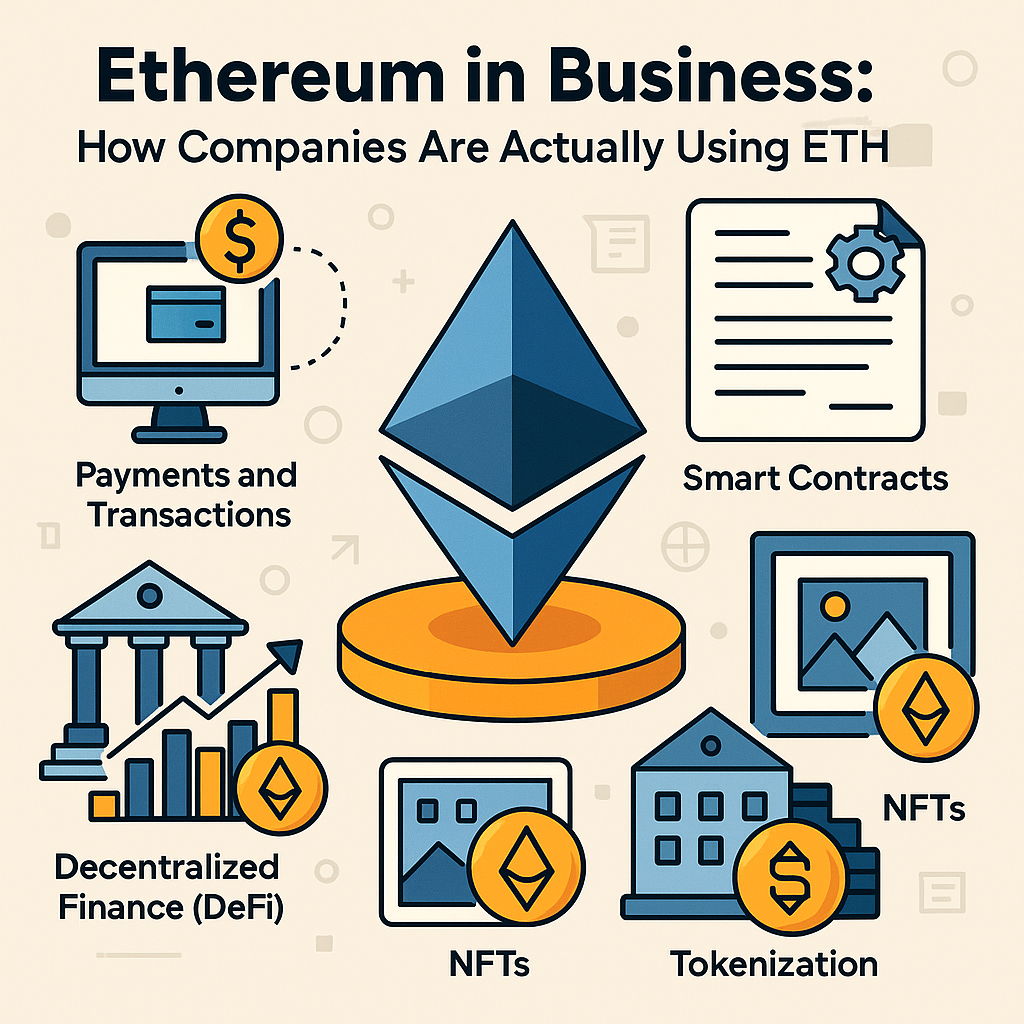
Why Businesses Care About Ethereum
Ethereum is more than just “crypto”—it’s a programmable, shared ledger that enables money, contracts, and data to move with fewer intermediaries. For companies, this translates into lower fees, faster settlement times, automated processes, and auditable records.
A major turning point came with Ethereum’s 2022 Merge to proof-of-stake, which reduced energy consumption by approximately 99.95% compared to the previous proof-of-work system. This dramatic improvement in energy efficiency removed a significant environmental objection that many enterprises had previously cited.
Payments & Settlement: Faster Cashflow, Fewer Intermediaries
Card Networks & Stablecoins
Major payment networks are exploring blockchain-based settlement. Visa piloted a program to settle merchant payments using USDC stablecoin on Ethereum in partnership with Crypto.com, later expanding stablecoin settlement capabilities to additional blockchain networks. This initiative demonstrates how card settlement processes can be shortened and automated using public blockchain infrastructure.
Consumer Payment Platforms
PayPal entered the blockchain space by launching PYUSD, an Ethereum-based U.S. dollar stablecoin. While PayPal added support for a second blockchain in 2024, Ethereum remains the canonical issuance network for PYUSD.
E-Commerce Integration
Shopify merchants can accept cryptocurrency payments, including ETH and various stablecoins, through payment providers like Coinbase Commerce and BitPay. Some merchants have also integrated newer payment rails such as Solana Pay, though Ethereum and its Layer-2 solutions remain core payment pathways for blockchain-based commerce.
Transaction Cost Reductions
The March 13, 2024 Dencun upgrade (EIP-4844) introduced “blobs” that dramatically reduced Layer-2 transaction fees—often to just pennies per transaction. This advancement makes cross-border payments and micro-transactions practical at enterprise scale.
Key Takeaway: For businesses struggling with cross-border payment speed and fees, stablecoin settlement on Ethereum—particularly via Layer-2 solutions—has become a credible, production-ready option.
Smart Contracts: Automating Business Logic
Pharmaceutical Supply Chain Compliance
The MediLedger project, developed by Chronicled, operates on Quorum (an enterprise fork of Ethereum) to help pharmaceutical companies comply with DSCSA requirements, including track-and-trace and returns verification. This represents a leading example of “private Ethereum” implementation for supply chain management using smart contracts.
Banking Infrastructure
J.P. Morgan’s Quorum, later acquired by ConsenSys, underpins multiple bank-grade networks including Onyx. JPM Coin transactions run on permissioned ledgers derived from Ethereum technology, demonstrating the platform’s viability for institutional banking.
Enterprise Privacy Solutions
EY Nightfall combines zero-knowledge proofs with Ethereum, enabling firms to use the public blockchain while keeping transaction details private—addressing one of the key concerns enterprises have about public blockchain adoption.
Telecom Settlements
Zeebu utilizes on-chain smart contracts to automate wholesale telecom payments, showcasing how B2B invoicing can move on-chain. While still early-stage, this represents the direction of automated business-to-business settlements.
Reality Check: Production environments feature both public Ethereum and permissioned Ethereum variants like Quorum. Public Ethereum offers openness and liquidity, while permissioned versions can simplify compliance and data privacy requirements.
DeFi for Treasury & Market Access
Decentralized Finance (DeFi) protocols on Ethereum provide 24/7 lending, market-making, and token swaps with programmable custody and atomic settlement. By September 2025, DeFi’s total value locked rebounded to approximately $160-170 billion across all blockchains, with Ethereum serving as the anchor network.
While not yet reaching trillions in locked value, DeFi has scaled sufficiently for serious corporate pilots and treasury management strategies. Companies can leverage DeFi for on-chain liquidity, automated market operations, or as building blocks for proprietary fintech products. However, smart-contract and market risks require robust risk management controls.
NFTs & Customer Engagement on Ethereum Layer-2s
Brand Activations
Nike launched .SWOOSH on Polygon (an Ethereum Layer-2 network), transforming virtual collections into a recurring customer engagement platform. Other major brands including Adidas and Coca-Cola have launched NFT campaigns, with Coca-Cola deploying on Base (another Ethereum Layer-2).
Loyalty Programs
Starbucks ran Odyssey on Polygon as a collectible-based loyalty pilot program. The company sunset the pilot in 2024, providing a valuable lesson that user experience and program design matter as much as the underlying technology.
Bottom Line: NFTs have evolved from hype to targeted brand utility—encompassing tickets, collectibles, and token-gated perks—with most deployments occurring on Ethereum Layer-2 networks for improved cost efficiency and user experience.
Tokenization: Real-World Assets On-Chain
Institutional Investment Products
BlackRock’s BUIDL, a tokenized U.S. dollar liquidity fund on Ethereum, launched in March 2024 and surpassed $1 billion in assets under management by March 2025. This milestone proves that institutional capital will utilize public blockchain infrastructure when proper regulatory wrappers and compliance frameworks are in place.
Banking Sector Adoption
UBS Asset Management launched uMINT, a tokenized money market fund on Ethereum, following a pilot of a tokenized Variable Capital Company (VCC) fund under the Monetary Authority of Singapore’s Project Guardian. UBS has also completed cross-border repo transactions using natively issued digital bonds on public blockchains.
Significance: Tokenization can compress issuance and settlement cycles while enabling composable finance—such as using fund tokens as collateral. Ethereum’s liquidity and developer tooling make it an attractive platform for these innovations.
Infrastructure: Enterprise Implementation
Managed Node Services
Google Cloud’s Blockchain Node Engine offers managed Ethereum nodes, while AWS Amazon Managed Blockchain (AMB Access) supports Ethereum JSON-RPC endpoints. These services enable teams to deploy blockchain solutions without managing node infrastructure. (Microsoft retired its original “Azure Blockchain Service” in 2021; current Azure blockchain usage primarily occurs through partner solutions and virtual machines.)
Industry Standards & Consortia
The Enterprise Ethereum Alliance continues coordinating specifications and best practices with members spanning technology and finance sectors, facilitating broader enterprise adoption.
Costs & Sustainability
Energy Efficiency
Following the Merge, Ethereum’s energy consumption decreased by approximately 99.95%, addressing a critical ESG concern for many corporations considering blockchain adoption.
Transaction Fees & Throughput
The Dencun upgrade (EIP-4844) reduced Layer-2 data costs significantly. In 2025, the Pectra upgrade further increased blob capacity (target of 6, maximum of 9 per block), pushing Layer-2 fees even lower while increasing throughput capacity.
Interoperability & Multi-Chain Reality
Many enterprise deployments combine Ethereum mainnet, Layer-2 solutions, and sometimes other blockchain networks. Cross-chain communication protocols like Chainlink CCIP (now generally available) and LayerZero connect Ethereum to dozens of networks—essential when partners or users operate across different blockchains.
Practical Implementation Guidance
Choose the Right Approach
For payments and treasury management, start with stablecoins on Ethereum Layer-2 networks. For asset issuance, evaluate tokenization options including custody, KYC/AML requirements, and transfer restrictions.
Public vs. Permissioned Decision
Public Ethereum provides liquidity and composability, while Quorum-style private chains simplify data privacy and compliance. Many organizations use both approaches for different use cases.
Treat Smart Contracts as Critical Software
Implement audits, monitoring systems, incident response playbooks, and kill-switches where appropriate. Smart contracts require the same rigor as any mission-critical software system.
Manage the Risk Stack
Address smart-contract risk, market risk, counterparty risk, and regulatory risk. Don’t deploy DeFi protocols directly into corporate treasury operations without proper controls and governance.
Plan for Interoperability
Expect partners and users on different blockchain networks. Design systems with cross-chain communication protocols like CCIP or LayerZero from the beginning.
The Bottom Line
Ethereum is already operating in production environments for payment settlement, B2B automation, tokenized investment funds, and brand engagement—often utilizing Ethereum Layer-2 networks for cost efficiency and improved user experience.
The technology continues maturing with upgrades like Dencun and Pectra, institutional infrastructure is real with products like BUIDL and uMINT, and managed cloud services reduce operational complexity. This isn’t hype—it’s foundational infrastructure for digital finance and data flows.
For organizations exploring blockchain for business applications, Ethereum (including both public and enterprise variants) represents the default starting point, backed by the largest developer community, most extensive tooling ecosystem, and proven institutional adoption.
Related Resources
Note: Blockchain technology involves risks. Organizations should conduct thorough due diligence and consult with legal, compliance, and technical experts before implementation.