
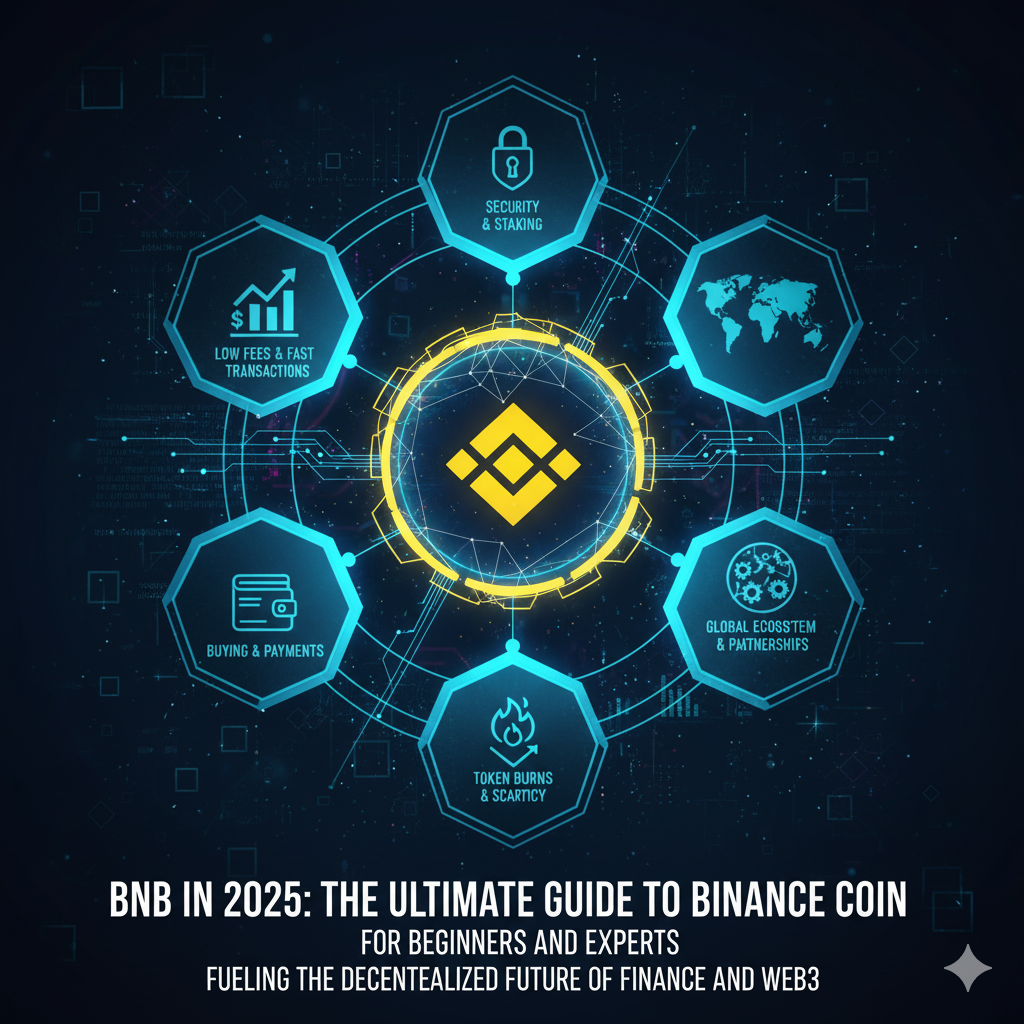
From gas fees to staking, growth drivers to pitfalls — a clear, up-to-date guide for both beginners and crypto natives.
Introduction
BNB (Binance Coin) has evolved far beyond its original purpose as a trading fee discount token. By 2025, it stands as one of the fundamental pillars of the Web3 ecosystem, driving the BNB Chain infrastructure while powering decentralized finance, NFT marketplaces, and tokenized real-world asset applications. This comprehensive guide examines BNB’s current role, acquisition methods, utility, and genuine risk factors that every investor should understand.
What Is BNB?
BNB serves as the native cryptocurrency of BNB Chain, a unified blockchain ecosystem that merged the original Binance Chain (Beacon) with BNB Smart Chain (BSC). The token’s journey began in 2017 when it launched as an ERC-20 token on the Ethereum network before migrating to Binance’s proprietary blockchain infrastructure.
Today’s BNB ecosystem supports multiple critical functions:
Core Network Operations: The token powers gas fees and transaction processing across the entire BNB Chain network, making it essential for any on-chain activity.
Network Security: Users can stake or delegate BNB to validators, contributing to the blockchain’s proof-of-stake consensus mechanism and earning rewards in return.
Governance Participation: Various protocols built on BNB Chain utilize the token for decentralized governance decisions.
Cross-Platform Utility: BNB facilitates operations across decentralized applications, payment systems, DeFi protocols, and cross-chain bridges.
Supply Mechanics and Deflationary Model
BNB operates with a fixed maximum supply of 200 million tokens. The protocol implements an Auto-Burn mechanism each quarter, removing tokens from circulation permanently. This burn process consumes 50% of gas fees plus additional adjustments, creating deflationary pressure on the token supply over time.
As of mid-2025, approximately 139 million BNB tokens remain in circulation. The quarterly burn events progressively reduce this number, with the protocol targeting long-term deflation based on network usage patterns.
External Source: CoinMarketCap BNB Overview
Key Metrics and Ecosystem Health in 2025
On-Chain Activity and Trading Volume
The BNB ecosystem demonstrates robust growth metrics, with PancakeSwap processing approximately $2.12 billion in daily decentralized exchange volume during Q1 2025, capturing over 90% of BNB Chain’s total DEX activity. This concentration illustrates both the platform’s dominance and the ecosystem’s reliance on flagship applications.
External Source: Messari BNB Chain Analysis
Stablecoin Adoption
The stablecoin market capitalization on BNB Chain reached approximately $7 billion in Q1 2025, predominantly driven by USDT, USDC, and emerging synthetic or algorithmic stablecoin projects. This substantial stablecoin presence indicates strong DeFi infrastructure and trading activity within the ecosystem.
Market Performance and Volatility
BNB’s market valuation has experienced significant movements, with the ecosystem adding substantial value in recent periods, approaching new price highs. However, the journey hasn’t been uniformly positive. In early 2025, BNB’s market capitalization experienced approximately a 14.8% decline during broader cryptocurrency market corrections. These fluctuations underscore the volatility inherent in cryptocurrency markets.
External Source: Binance Market Updates
Token Burn Progress
As of July 2025, the protocol has permanently removed tens of millions of BNB tokens through its burn mechanism, progressing toward medium-term deflation targets. These burns represent a concrete reduction in available supply, though their impact on price depends heavily on corresponding demand dynamics.
Why BNB Remains Relevant in 2025
Understanding BNB’s competitive position requires examining both its advantages and limitations:
Transaction Efficiency with Realistic Limitations
BNB Chain maintains fast block times with a target of approximately 0.75 seconds, supported by Layer 2 scaling solutions, positioning it among the most efficient blockchain networks. This speed advantage enables rapid transaction confirmation for users.
However, transaction costs can fluctuate based on network congestion and token price volatility, potentially raising effective fees during peak usage periods. The low-cost narrative requires context about network conditions. For a deeper comparison of how BNB Chain’s efficiency stacks up against its primary competitor, see our analysis of Ethereum vs BNB Chain DeFi ecosystems.
Deflationary Economics: Supply Reduction Alone Isn’t Enough
The Auto-Burn mechanism ensures gradual supply reduction as long as network usage remains robust. Each quarter, the protocol removes tokens from circulation, creating scarcity economics. This approach shares some philosophical similarities with Ethereum’s EIP-1559 burn mechanism, though the implementation and impact differ significantly.
Yet there’s a crucial caveat: if user demand stagnates, token burning alone cannot sustain price appreciation. Deflation works as a tailwind, not a guarantee.
Developer Ecosystem and Competitive Pressure
Thousands of decentralized applications spanning gaming, NFT marketplaces, and cross-chain bridges operate within the BNB ecosystem. This diversity provides multiple use cases and revenue streams.
The competitive reality is harsh: BNB faces intense competition from Ethereum Layer 2 solutions, Arbitrum, Solana, and other blockchain platforms. Developer mindshare is finite, and rivals continue innovating aggressively. Questions about whether BNB Smart Chain remains a powerhouse or has become overly centralized remain central to the ecosystem’s long-term viability.
Institutional Access and Regulatory Positioning
The potential approval of a BNB exchange-traded fund (ETF) and increasingly clear regulatory frameworks make the token more accessible for institutional capital. Traditional finance institutions prefer regulated investment vehicles.
However, ETF approvals remain uncertain, and centralization concerns within the BNB Chain governance structure may cause hesitation among regulators. Past regulatory challenges with Binance add complexity to this narrative.
Stablecoin Infrastructure and Payment Rails
BNB Chain’s emphasis on native stablecoins like USD1 and USDT, combined with gas-subsidized transfer mechanisms, reduces friction for users and merchants. Lower barriers to entry can drive adoption in payments and remittances.
The risk factor: if stablecoin demand migrates toward competing blockchain platforms, BNB loses a critical leverage point for ecosystem growth. Stablecoin users show platform agnosticism when better options emerge.
External Source: BNB Chain Official Documentation
How to Acquire BNB: Step-by-Step Methods
Centralized Exchange Route
Binance Platform: Binance serves as the primary exchange for BNB purchases, offering high liquidity, familiar user interface, and reduced trading fees for BNB holders. The native platform provides the most straightforward access. For newcomers to the platform, our complete Binance tutorial for 2025 walks through every step of the buying, selling, and trading process.
Kraken Exchange: Kraken enabled spot BNB trading in 2025, providing access in jurisdictions where Binance faces restrictions. This alternative matters for users in regulated markets.
Coinbase Limitation: As of 2025, spot BNB trading is not available on Coinbase US, though some international users may access BNB derivatives products. Always verify local availability before initiating deposits.
Purchase Process:
- Complete account registration with identity verification (KYC requirements)
- Deposit fiat currency or stablecoins to your exchange account
- Navigate to BNB trading pairs (BNB/USDT, BNB/USD, etc.)
- Execute your purchase order
- Withdraw to self-custody wallet if desired (recommended for long-term holdings)
External Source: Kraken BNB Trading
Decentralized Exchange Alternative
Users can acquire BNB through PancakeSwap and other BNB Chain decentralized exchanges using wallet applications like Trust Wallet, MetaMask with BNB Chain support, or hardware wallets like Ledger. This permissionless approach eliminates intermediaries.
Decentralized swaps require paying gas fees in BNB tokens, creating a bootstrap problem for first-time users (you need BNB to pay for BNB transactions). Some exchanges offer small BNB amounts through faucets or initial wallet funding.
Strategic Tip: Implement dollar-cost averaging to minimize timing risk when building a position. Regular small purchases smooth out volatility compared to lump-sum investments.
External Source: PancakeSwap Exchange
Staking BNB: Generating Passive Income with Clear-Eyed Risk Assessment
BNB staking enables token holders to earn rewards, though yields and risk profiles vary significantly across different staking methods. Those interested in comparing staking options across different blockchains should review our comprehensive comparison of top staking platforms for ETH, which provides insights applicable to evaluating BNB staking opportunities as well.
Exchange-Based Staking Programs
Characteristics:
- Highly convenient, hands-off approach
- Generally lower annual percentage yields compared to native staking, depending on exchange terms
- Ideal for beginners prioritizing simplicity over maximum returns
Native Staking Through Validators
Process Requirements:
- Select a validator, evaluating their commission rates and historical performance metrics
- Delegate your BNB tokens to the chosen validator
- Account for a typical unbonding period of approximately seven days when withdrawing
Yield Expectations: Advertised yields of 10-12% APY are achievable but not guaranteed, varying by validator selection.
Risk Factors: Potential validator downtime, slashing penalties (rare but possible), and technical misconfigurations can impact returns.
Practical Example: Staking 10 BNB at a 10% annual yield would generate approximately 1 BNB per year before accounting for compounding effects or fees.
External Source: BNB Chain Staking Guide
Real-World Utility Beyond Speculation
BNB’s practical applications extend across multiple use cases:
Exchange Fee Optimization: Holding BNB provides trading fee discounts on the Binance platform.
DeFi Ecosystem: Users can swap assets, borrow funds, and participate in yield farming through protocols like PancakeSwap and Venus.
Payment Infrastructure: Binance Pay and integrated merchant networks enable BNB-based payments and cross-border remittances.
NFT and Gaming: The token facilitates minting, trading, and participation in blockchain-based gaming economies.
Token Launch Platforms: Many blockchain projects utilize BNB as capital for initial token sales and launchpad events.
Cross-Chain and RWA Integration: BNB Chain positions itself as a hub for cross-chain bridges and tokenization of real-world assets.
External Source: Binance Pay Merchants
Critical Risks Every Investor Must Consider
Price Volatility Reality
Price fluctuations of ±10-20% or greater are common occurrences in BNB markets. Cryptocurrency volatility can create substantial gains or losses within short timeframes. Position sizing becomes crucial for risk management.
Centralization and Governance Concerns
A limited number of validators or Binance itself wields disproportionate influence over network governance and operations. This centralization differs from the decentralized ideal many blockchain advocates champion. Concentration of control introduces single points of failure and decision-making bottlenecks.
Regulatory Uncertainty
Despite resolving SEC litigation, new regulations affecting cryptocurrency exchanges, stablecoins, or ETF products could disrupt BNB’s ecosystem. The regulatory landscape remains fluid across jurisdictions, with potential for sudden policy shifts.
Security and Custody Responsibilities
Self-custody means users bear complete responsibility for asset security. While hardware wallets improve safety, smart contract vulnerabilities and phishing attacks remain persistent threats. The “be your own bank” philosophy comes with significant accountability.
Competitive Blockchain Landscape
Ethereum Layer 2 solutions, Solana, Arbitrum, and other blockchain platforms wage fierce competition for users and developers. If competing chains out-innovate BNB, market share could erode. Network effects can shift, sometimes rapidly.
External Source: CoinDesk Cryptocurrency Regulation Coverage
Price Outlook: Scenarios Without Guarantees
Cryptocurrency price predictions vary wildly, from bearish corrections to exponential growth projections. Models incorporate token burns, ecosystem expansion, and speculative ETF demand, but forecasting remains inherently uncertain.
Established Facts:
Quarterly token burns represent real and incremental supply reduction, gradually decreasing available tokens over time.
Institutional interest, particularly ETF filing activity, can serve as a price catalyst, though approval certainty remains elusive.
Macroeconomic factors including interest rate policies, regulatory developments, and overall cryptocurrency market sentiment will significantly influence price movements.
Bottom Line: Treat price forecasts as potential scenarios rather than guaranteed outcomes. Risk management requires acknowledging uncertainty rather than assuming specific futures.
External Source: CoinGecko BNB Price Charts
Final Analysis: Monitoring the Right Indicators
BNB in 2025 occupies a position between genuine utility and speculative momentum. Its long-term viability depends on real-world usage across gas fees, payment systems, token bridges, and DeFi protocols rather than speculation around burns or ETF headlines alone.
Key Performance Indicators to Track
Quarterly Burn Data: Monitor the volume of tokens removed from circulation each quarter as an indicator of network usage.
Daily Transaction Metrics: Track daily transaction counts and active addresses to gauge actual blockchain utilization.
Validator Decentralization: Observe validator distribution and commission rate spreads as measures of network health.
ETF and Regulatory Developments: Follow exchange-traded fund filings and regulatory announcements that could impact institutional access.
Stablecoin Adoption Trends: Monitor the growth of USD1, USDT, and other stablecoins on BNB Chain as indicators of payment infrastructure development.
BNB’s future trajectory will ultimately reflect its ability to maintain developer interest, process real economic activity, and adapt to competitive pressures from alternative blockchain platforms. Investors should focus on fundamental usage metrics rather than short-term price movements when evaluating long-term potential.
External Source: DeFi Llama BNB Chain Analytics
This article provides educational information about BNB and cryptocurrency markets. It does not constitute financial advice. Cryptocurrency investments carry substantial risk, including potential loss of principal. Always conduct thorough research and consider consulting financial professionals before making investment decisions.