
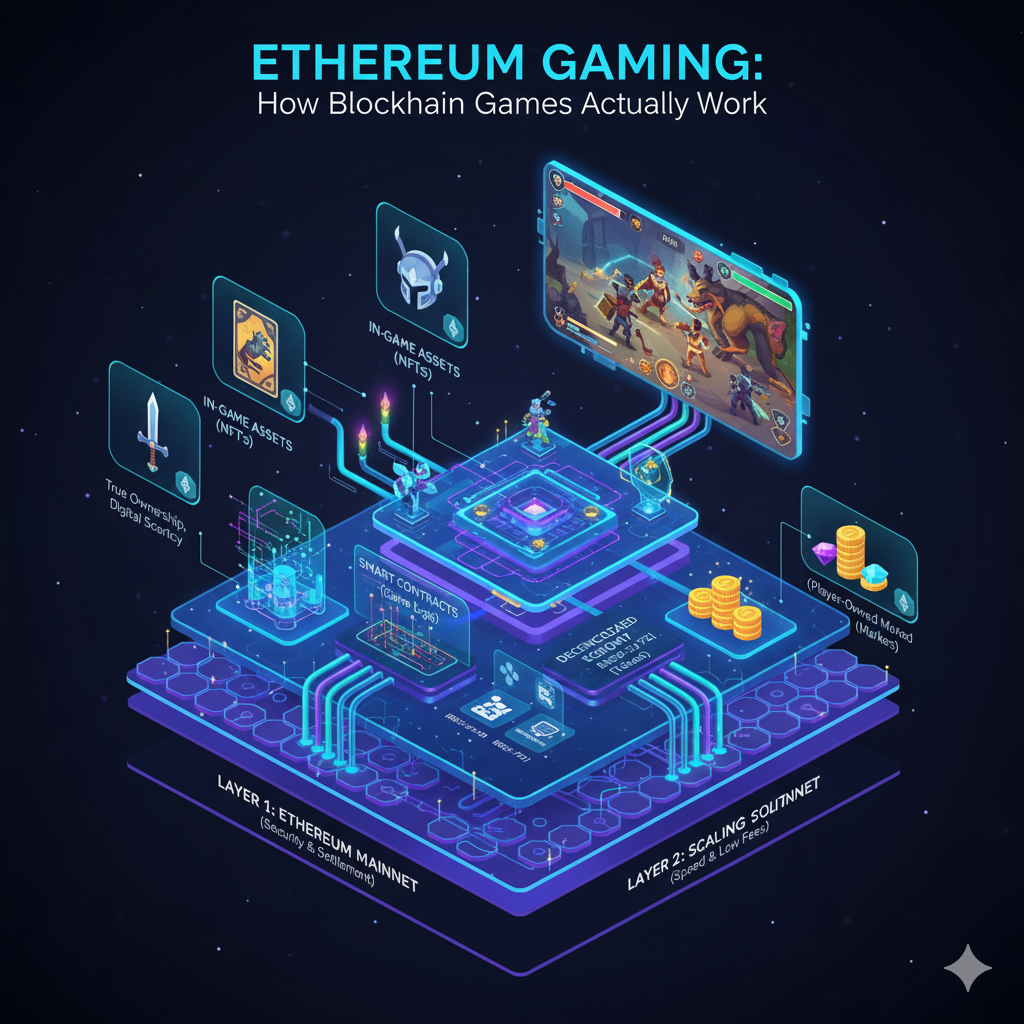
What is blockchain Gaming?
Imagine playing a video game where the legendary sword you find or the unique character you build isn’t just pixels on a screen—it’s a verifiable digital asset you truly own, like a collectible trading card. You can sell it on OpenSea, trade it with friends, or even use it in another compatible game. This isn’t science fiction; it’s Ethereum-based blockchain gaming.
Blockchain gaming is revolutionizing the gaming industry by transforming digital entertainment into verifiable digital property ownership. In this comprehensive 2025 guide, we’ll explain exactly how these games work, what makes Ethereum the leading blockchain platform for gaming, and explore both the exciting opportunities and potential risks ahead.
What Is Blockchain Technology?
A blockchain functions like an unbreakable, transparent public ledger. Thousands of independent computers called nodes maintain identical copies of every transaction record. Each new “block” of transactions cryptographically links to the previous one, making it virtually impossible to alter any record without rewriting the entire chain.
In gaming applications, blockchain technology can permanently store:
- Digital asset ownership records
- Achievement certificates
- In-game transaction history
- Player progression data
However, it’s important to understand that most games store artwork, 3D models, animations, and complex gameplay logic off-chain using solutions like IPFS (InterPlanetary File System) or private servers. This means while the blockchain proves you own an item, its visual and functional components could become inaccessible if those external services disappear.
Understanding Ethereum for Gaming
What Makes Ethereum Special?
Launched in 2015 by Vitalik Buterin, Ethereum is far more than just another cryptocurrency—it’s a programmable, decentralized computer network that powers the majority of blockchain games today.
Ethereum’s revolutionary smart contracts are self-executing pieces of code that automatically enforce game rules and execute transactions without requiring a centralized authority. When specific conditions are met in a game, rewards, trades, or other actions happen instantly and transparently.
Ethereum’s Gaming Currency Ecosystem
While Ethereum’s native currency is Ether (ETH), most games create their own tokens:
- ERC-20 tokens for fungible in-game currencies
- ERC-721 tokens (NFTs) for unique items and characters
- ERC-1155 tokens for both fungible and non-fungible assets
If you’re wondering about the continued relevance of NFTs on Ethereum, the gaming sector provides one of the strongest use cases for blockchain-based digital assets in 2025.
Environmental Impact and Scalability Solutions
The 2022 Ethereum Merge transitioned the network from energy-intensive Proof-of-Work to efficient Proof-of-Stake, reducing energy consumption by approximately 99.95%. Subsequent upgrades like Dencun (EIP-4844) in 2024 significantly lowered transaction fees on Layer-2 networks.
Popular Layer-2 Solutions for Gaming:
- Arbitrum – High-speed transactions with Ethereum security
- Immutable zkEVM – Gaming-focused zero-knowledge rollup
- Polygon – Widely adopted sidechain solution
- Ronin – Gaming-optimized blockchain evolving toward L2
Players can now enjoy blockchain gaming with transaction fees often costing just a few cents, compared to the $50+ fees during Ethereum’s peak congestion periods.
Traditional vs Blockchain Games Comparison
Traditional Gaming Limitations
In conventional video games, players face several ownership restrictions:
- No true ownership: Items exist only on developer servers
- Account dependency: Losing account access means losing all purchases
- No transferability: Cannot sell or trade items outside the game
- Developer control: Companies can modify or remove items at will
- Server shutdowns: Game closure means total asset loss
Blockchain Gaming Revolution
Ethereum-based games fundamentally change this relationship:
| Feature | Traditional Games | Blockchain Games |
|---|---|---|
| Asset Ownership | Platform-controlled | Player-owned NFTs |
| Transferability | Locked to account | Tradeable on markets |
| Transparency | Closed systems | Open, auditable |
| Interoperability | Game-specific | Cross-game potential |
| Monetization | Developer-only | Player-driven economy |
Many modern blockchain games follow a “play-and-earn” or “play-to-own” philosophy, prioritizing engaging gameplay while offering optional earning opportunities. This represents an evolution from the earlier “play-to-earn” model that dominated 2021-2022.
Key Features of Ethereum Gaming
1. True Digital Ownership with NFTs
Non-Fungible Tokens (NFTs) serve as cryptographic certificates of authenticity for unique digital assets. In gaming, NFTs can represent:
- Rare weapons and armor
- Unique characters or pets
- Virtual real estate parcels
- Achievement badges
- Cosmetic items and skins
Players can verify ownership through blockchain explorers like Etherscan.
2. Smart Contract Automation
Smart contracts eliminate the need for intermediaries by automatically:
- Processing battles and determining winners
- Distributing rewards based on performance
- Executing trades in decentralized marketplaces
- Managing tournaments and leaderboards
- Handling governance voting
3. Play-and-Earn Economics
Unlike traditional games where time investment has no monetary return, blockchain games can offer:
- Token rewards for completing quests
- NFT drops for achieving milestones
- Staking rewards for holding game assets
- Tournament prizes in cryptocurrency
- Rental income from lending items to other players
For those interested in leveraging these economic opportunities, understanding what DeFi on Ethereum is becomes essential, as many gaming assets can be integrated into DeFi protocols.
4. Decentralized Autonomous Organizations (DAOs)
Many blockchain games implement DAO governance, allowing token holders to vote on:
- Game development priorities
- Economic parameter changes
- New feature implementations
- Community fund allocation
Popular DAO platforms include Snapshot for off-chain voting and Aragon for on-chain governance.
5. Cross-Game Interoperability
While still limited, some games are beginning to support asset interoperability through:
- Shared NFT standards like EIP-2981 royalties
- Cross-game partnerships and collaborations
- Universal avatar systems
- Shared virtual world infrastructure
How Blockchain Gaming Works: Step-by-Step Guide
Step 1: Setting Up Your Gaming Wallet
Popular Wallet Options:
- MetaMask – Most widely supported browser extension
- WalletConnect – Connect mobile wallets to games
- Coinbase Wallet – User-friendly with built-in DApp browser
- Embedded wallets – Simplified, game-integrated solutions
Step 2: Acquiring Cryptocurrency
Players typically need small amounts of ETH for:
- Gas fees for blockchain transactions
- Purchasing starter packs or characters
- Trading on marketplaces
Where to Buy ETH:
- Coinbase – Beginner-friendly exchange
- Binance – Largest global exchange
- Kraken – Security-focused exchange
- Uniswap – Decentralized exchange
- Gemini – Regulated US exchange
For a comprehensive walkthrough of the purchase process, check out our guide on how to buy Ethereum safely in 2025.
Step 3: Minting and Managing NFTs
When players acquire new items:
- Minting process creates a unique NFT on the blockchain
- Metadata storage links to off-chain assets (images, 3D models)
- Ownership transfer updates the blockchain record
- Wallet display shows the new asset
Step 4: Hybrid On-Chain/Off-Chain Gameplay
Modern blockchain games use a hybrid architecture:
- On-chain: Asset ownership, major transactions, governance
- Off-chain: Real-time gameplay, chat, visual rendering
- State synchronization ensures consistency between systems
Step 5: Economic Participation
Players can participate in game economies through:
- Primary markets: Buying directly from game developers
- Secondary markets: Trading with other players on platforms like OpenSea or Blur
- DeFi integration: Using game assets as collateral in protocols like Aave, Compound, or MakerDAO
When it comes to comparing NFT marketplaces, each platform offers unique advantages for gaming asset trading, with OpenSea providing the broadest selection and Blur offering lower fees for active traders.
Top Ethereum Games in 2025
Collectible and Breeding Games
CryptoKitties
- The pioneering NFT game that introduced blockchain gaming to mainstream audiences
- Features unique cat breeding mechanics with genetic algorithms
- Operates on Ethereum mainnet with Flow integration for scaling
Axie Infinity
- Once the flagship play-to-earn title with 2.7M daily users at peak
- Now runs on Ronin, an EVM-compatible sidechain
- Features creature collection, battling, and breeding mechanics
- Continues active development despite reduced user base from 2021 highs
Virtual Worlds and Metaverse
Decentraland
- Decentralized virtual world with DAO governance
- MANA token and LAND NFTs primarily trade on Polygon for lower fees
- Features user-generated content, virtual events, and digital art galleries
The Sandbox
- Voxel-based gaming metaverse with user-generated content
- SAND token powers the economy
- Land sales and major transactions utilize Polygon scaling
- Partnership with major brands like Adidas and Snoop Dogg
Competitive Strategy Games
Gods Unchained
- Competitive trading card game with tournament prize pools
- Transitioning from Immutable X to Immutable zkEVM for enhanced scalability
- Features deck building, ranked play, and NFT card ownership
- Regular expansions and meta updates keep gameplay fresh
Illuvium
- High-production-value open-world RPG
- Built on Immutable zkEVM for seamless gameplay
- Features creature collection, battle mechanics, and exploration
- AAA-quality graphics rival traditional gaming titles
Emerging Gaming Projects
Might & Magic: Era of Chaos by Ubisoft
- Major publisher entry into blockchain gaming
- Partnership with Immutable for NFT integration
- Combines traditional gaming polish with blockchain benefits
Pros and Cons Analysis
Advantages of Ethereum Gaming
Financial Benefits
- True asset ownership with provable scarcity
- Liquid markets for in-game items
- Passive income opportunities through staking and lending
- Investment appreciation potential for rare items
Gameplay Innovation
- Player-driven economies create emergent gameplay
- Transparent mechanics prevent developer manipulation
- Cross-game compatibility expands asset utility
- Community governance gives players voice in development
Technical Advantages
- Censorship resistance ensures access regardless of location
- Immutable records prevent asset duplication or deletion
- Global accessibility with 24/7 markets
- Programmable assets enable complex interactions
Challenges and Risks
Economic Volatility
- Cryptocurrency market fluctuations affect asset values
- Speculative bubbles can create unsustainable pricing
- Entry barriers due to required cryptocurrency knowledge
- Tax implications vary by jurisdiction and can be complex
Technical Limitations
- Gas fees for Ethereum mainnet interactions
- Transaction speed limitations during network congestion
- Off-chain dependencies create single points of failure
- Wallet security requires user education and responsibility
Regulatory Uncertainty
- Legal status of NFTs and gaming tokens varies globally
- Play-to-earn restrictions in countries like South Korea
- Taxation policies still evolving in many jurisdictions
- Consumer protection frameworks under development
Security Concerns
- Smart contract vulnerabilities can lead to exploits
- Phishing attacks targeting wallet credentials
- Rug pulls and fraudulent projects
- Bridge hacks affecting cross-chain assets
Future of Blockchain Gaming
2025 Market Trends
The blockchain gaming sector is experiencing significant diversification and maturation:
Market Size Projections:
- Conservative estimates: $14 billion annual activity
- Optimistic forecasts: $80+ billion market potential
- Focus shifting from speculation to sustainable gameplay
Mobile Gaming Integration
Mobile-First Blockchain Games are rising in popularity:
- Simplified onboarding with embedded wallets
- Gasless transactions using meta-transaction solutions
- Play-to-earn accessibility in emerging markets
- Integration with existing mobile gaming habits
Artificial Intelligence Integration
AI is enhancing blockchain games through:
- Dynamic NPCs with advanced behavior patterns
- Procedural content generation for unlimited gameplay
- Personalized experiences based on player behavior
- Anti-cheat systems using machine learning detection
Virtual and Augmented Reality
VR/AR Integration promises immersive experiences:
- Virtual real estate with spatial computing
- Haptic feedback for NFT item interactions
- Social gaming in shared virtual spaces
- Mixed reality gaming with blockchain assets
Institutional Adoption
Major gaming companies are entering the space:
- Ubisoft launching blockchain-integrated titles
- Epic Games allowing blockchain games on their store
- Sony exploring NFT integration for PlayStation
- Microsoft investigating blockchain gaming solutions
Technological Advances
Layer-2 Scaling Solutions continue improving:
- Zero-knowledge rollups for instant, cheap transactions
- State channels for real-time gaming
- Cross-chain bridges enabling asset portability
- Account abstraction simplifying user experience
For those curious about the broader ecosystem competition, our analysis of Ethereum vs Solana NFTs explores how different blockchain platforms are approaching gaming and digital assets.
Getting Started: Your First Steps
1. Educational Foundation
Before diving in, understand the basics:
- Read Ethereum.org documentation
- Follow blockchain gaming news on Decrypt, CoinDesk, and The Block
- Join communities like r/EthGamers on Reddit and NFT Gaming
- Watch tutorials on YouTube
2. Wallet Setup and Security
Security Best Practices:
- Use hardware wallets like Ledger for significant holdings
- Never share seed phrases or private keys
- Enable two-factor authentication where available
- Keep software updated and use reputable sources
3. Start Small and Learn
Recommended Beginner Strategy:
- Begin with free-to-play blockchain games
- Invest only what you can afford to lose
- Learn by doing rather than jumping into expensive games
- Participate in game communities and Discord servers
4. Research Before Investing
Due Diligence Checklist:
- Team background and track record
- Smart contract audits by firms like Certik, OpenZeppelin, or ConsenSys Diligence
- Community size and engagement levels on Twitter and Discord
- Tokenomics and sustainability models
Conclusion: The Decentralized Gaming Revolution
Ethereum gaming represents a fundamental shift in how we conceptualize digital ownership and interactive entertainment. By leveraging blockchain technology, players gain unprecedented control over their digital assets while developers can create new economic models that benefit entire gaming communities.
Whether you’re interested in breeding digital creatures, trading virtual real estate, or competing in skill-based tournaments for cryptocurrency prizes, blockchain gaming offers opportunities previously impossible in traditional gaming.
The key to success in this evolving landscape is balancing entertainment value with economic opportunity. The most sustainable blockchain games prioritize fun, engaging gameplay while incorporating meaningful ownership and earning mechanics.
Ready to start your blockchain gaming journey? Set up a wallet, try a free game, and experience firsthand how true digital ownership transforms the gaming experience. The future of interactive entertainment is decentralized, transparent, and built on the foundation of player empowerment.
Frequently Asked Questions
Q: Do I need technical knowledge to play blockchain games?
A: Modern blockchain games have simplified onboarding significantly. Basic computer skills and willingness to learn wallet usage are sufficient.
Q: Are blockchain games expensive to play?
A: Many games offer free-to-play options with optional purchases. Layer-2 solutions have reduced transaction costs to minimal levels.
Q: Can I really make money playing blockchain games?
A: Yes, but approach it as entertainment first. Earnings depend on skill, time investment, and market conditions.
Q: What happens if a blockchain game shuts down?
A: You retain ownership of NFT assets, though their utility may be limited if game servers close. Some assets may retain value for collecting or use in other games.
Q: Are blockchain games environmentally friendly?
A: Ethereum’s transition to Proof-of-Stake and Layer-2 scaling have made blockchain gaming significantly more energy-efficient than early implementations.
Read also: TON Blockchain.