
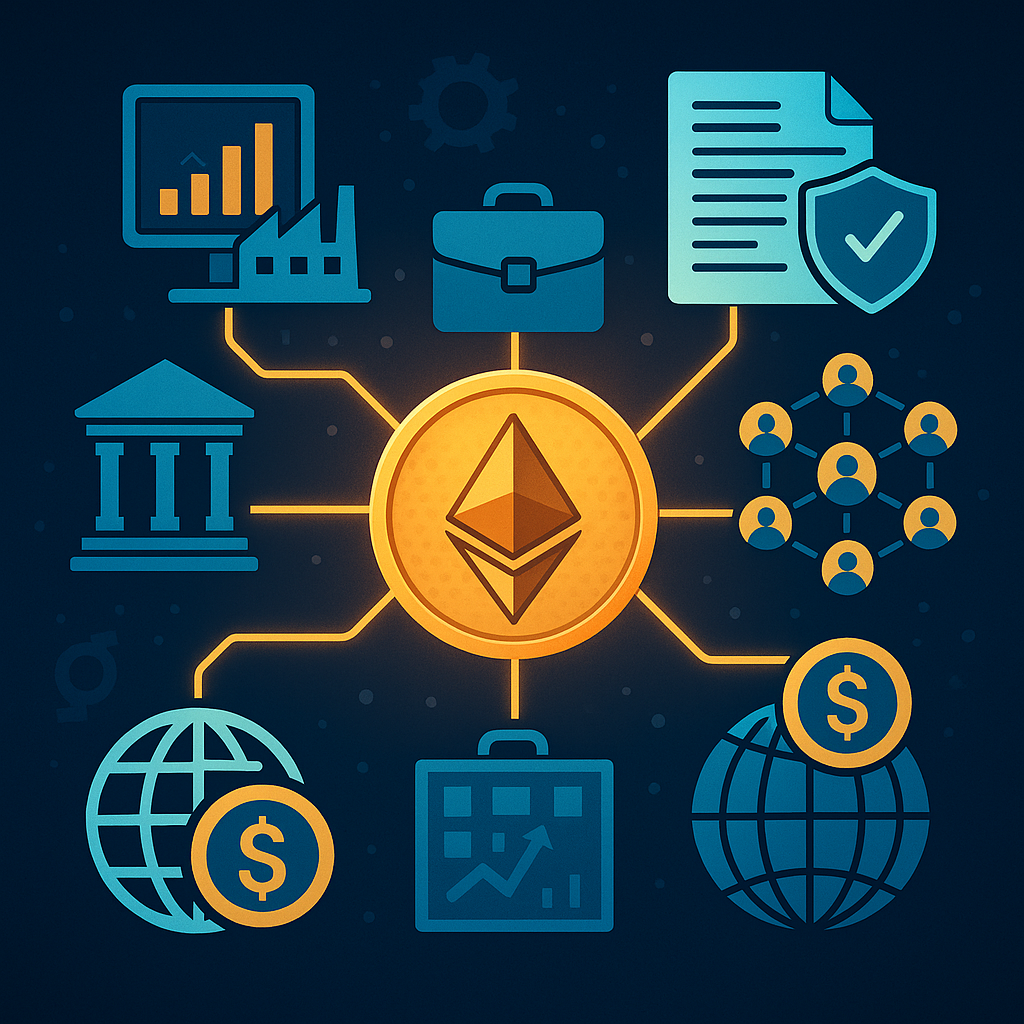
Ethereum has grown far beyond digital money to become a game-changing business platform in 2025. Today, companies worldwide are using Ethereum’s blockchain technology to solve real-world problems, cut costs, and boost security. In this detailed guide, we’ll explore how companies are actually using ETH and why it’s reshaping entire industries.
What Is Ethereum and Why It Matters for Business
First and foremost, Ethereum is a decentralized blockchain platform created by Vitalik Buterin in 2015. Unlike Bitcoin, which mainly serves as digital currency, Ethereum works as a global computer. As a result, it lets businesses build decentralized apps (dApps) and run smart contracts—self-running digital deals that automatically enforce terms when set conditions are met. Therefore, this removes middlemen, cuts costs, and boosts transaction speed and security.
Top 7 Ethereum Business Use Cases in 2025
1. Supply Chain Transparency and Management
To begin with, leading luxury brands have embraced Ethereum-based blockchain solutions for product checking and tracking. For example, the Aura Blockchain Consortium, founded by LVMH, Prada, and Cartier, uses ConsenSys Quorum—a private Ethereum-based platform—to give customers verified product history and fake-product protection.
On the other hand, while major retailers like Walmart and Unilever use blockchain for food tracking, their programs run on IBM Food Trust (Hyperledger Fabric) rather than public Ethereum. Nevertheless, the luxury sector’s use of Ethereum-stack solutions shows the technology’s real-world value.
Key Benefits:
- Real-time product tracking across complex supply chains
- Strong protection against fake products through permanent records
- Automated supplier payments via smart contracts that trigger upon delivery
- Better consumer trust through clear product journey records
2. Decentralized Finance (DeFi) Revolution
Moreover, DeFi platforms built on Ethereum are changing business finance completely. In particular, platforms like Aave and Uniswap allow businesses to access lending, borrowing, and trading services without traditional banks. Furthermore, peer-reviewed research in academic journals shows that Ethereum-based exchanges like Uniswap can greatly reduce working costs for currency exchange and cash management.
Business Uses:
- Instant cross-border payments that settle within minutes rather than days
- Automated loan processing with programmable collateral needs
- Treasury management using stablecoins for efficient cash flow
- Much lower financial middleman costs through direct deals
3. Digital Identity and Data Security
In addition, Ethereum enables self-sovereign identity solutions that give businesses and people better control over personal data. Specifically, the did:ethr (Ethereum-based identity method) has been widely added to enterprise identity tools and registries. This is documented by the Decentralized Identity Foundation and used across various GitHub projects.
Meanwhile, although Microsoft’s ION network runs on Bitcoin’s Sidetree protocol, Ethereum-based identity methods have gained strong enterprise adoption. This is mainly due to robust tools and developer support.
Enterprise Benefits:
- Much lower data breach risks through decentralized identity management
- Faster customer onboarding with verified credentials
- GDPR compliance support through user-controlled data sharing
- Better privacy protection via selective disclosure tools
4. Healthcare Data Management
Similarly, Ethereum and Ethereum-based private networks can secure sensitive medical data while allowing authorized sharing between healthcare providers. In practice, common enterprise uses include secure electronic health record sharing, automated insurance claim processing, and clinical trial data checking. Typically, these are set up via private EVM (Ethereum Virtual Machine) networks or healthcare groups.
As a result, these solutions address critical healthcare challenges including system compatibility, patient privacy, and administrative waste while maintaining HIPAA compliance.
5. Asset Tokenization and Investment
Additionally, JPMorgan’s Tokenized Collateral Network represents a real institutional use case. In fact, it has tokenized BlackRock money-market fund shares for collateral transfers on JPMorgan’s Quorum/Onyx platform—an Ethereum-based private blockchain. Although JPM Coin itself works as a private deposit token for wholesale payments rather than public-Ethereum tokenization, these projects show blockchain’s power to transform traditional finance through tokenization of real-world assets.
Business Opportunities:
- Fractional real estate ownership enabling smaller investors to access premium properties
- Corporate share tokenization for better liquidity and 24/7 trading
- Intellectual property monetization through programmable royalty payments
- Better fundraising options via security token offerings (STOs)
6. Decentralized Autonomous Organizations (DAOs)
Furthermore, DAOs represent an innovative business structure where decisions are made collectively through blockchain-based voting. Indeed, Ethereum’s DAO ecosystem has grown rapidly in 2025, with organizations managing billions in assets through smart contract governance.
Corporate Uses:
- Transparent governance systems with permanent voting records
- Community-driven project funding with programmable treasury allocation
- Automated organizational processes reducing bureaucratic overhead
- Lower administrative costs through smart contract execution
7. International Payments and Remittances
What’s more, major payment networks have integrated blockchain technology for better settlement. For instance, Visa has expanded USDC (USD Coin) settlement to more networks and merchant acquirers, as detailed in their investor communications. At the same time, Mastercard is testing its Multi-Token Network (MTN) for programmable, cross-border, and B2B settlements. Ultimately, these are concrete blockchain integrations reshaping enterprise payments infrastructure.
Business Benefits:
- 24/7 transaction processing without banking hour limits
- Lower currency exchange fees through direct cryptocurrency conversion
- Faster settlement times—minutes instead of days for international transfers
- Better payment transparency with real-time transaction tracking
Why Businesses Choose Ethereum in 2025
Technical Benefits
Scalability: First of all, Layer-2 rollup solutions like Arbitrum and Optimism have greatly reduced transaction costs versus Ethereum Layer-1 while increasing speed. Additionally, solutions like Base by Coinbase have made Ethereum more accessible for businesses. Post-Merge upgrades including EIP-4844 (proto-danksharding) further reduced data costs for Layer-2 networks. Learn more about how these Layer-2 solutions scale Ethereum for enterprise adoption.
Security: In terms of security, Ethereum’s decentralized design with thousands of validator nodes minimizes single points of failure. Thus, it creates resilient infrastructure for mission-critical business uses.
Interoperability: Beyond that, broad EVM tooling across public and private networks simplifies integration with legacy enterprise systems. As a result, this reduces setup complexity and costs.
Economic Benefits
Cost Reduction: By removing middlemen through smart contracts, businesses reduce working expenses across payment processing, contract execution, and administrative workflows.
Revenue Opportunities: At the same time, businesses can create new business models through asset tokenization, DeFi integration, and programmable value transfer.
Global Market Access: Finally, 24/7 blockchain operation enables worldwide business expansion without geographical or time limits.
Overcoming Ethereum Implementation Challenges
Scalability Solutions
Rather than referencing outdated “Ethereum 2.0” terminology, businesses should understand the post-Merge roadmap. Specifically, The Merge transitioned Ethereum to proof-of-stake in September 2022, Shanghai enabled validator withdrawals in 2023, and EIP-4844 launched in 2024-2025. Combined with Layer-2 solutions like Arbitrum and Optimism that batch and compress transactions, these upgrades have made enterprise adoption much more viable. This is explained in Investopedia’s blockchain coverage.
Regulatory Compliance
On the regulatory front, the Enterprise Ethereum Alliance (EEA) connects businesses, publishes technical specs, and brings stakeholders together. Its board includes major firms like JP Morgan, Microsoft, ConsenSys, and EY as of 2025. However, while the EEA works as an industry body rather than a regulator, it provides valuable frameworks for compliance with evolving rules across jurisdictions.
Integration Complexity
Fortunately, professional blockchain development services and enterprise-grade tools are simplifying integration. In particular, private Ethereum variants like Quorum (documented by JPMorgan) are making it easier for traditional businesses to transition to blockchain infrastructure.
Future Outlook: Ethereum’s Business Ecosystem
Looking ahead, the Enterprise Ethereum Alliance continues driving business adoption through collaboration between major enterprises and web3 organizations. Key 2025 trends include:
Industry-Specific Solutions: First, tailored blockchain uses are addressing unique needs in healthcare, finance, supply chain, and manufacturing sectors.
Hybrid Cloud Integration: Second, seamless connection between private Ethereum networks (like Quorum-based setups) and public Ethereum infrastructure enables flexible deployment options.
AI and IoT Integration: Third, smart contracts increasingly interact with connected devices and machine learning-driven workflows. This creates autonomous business processes.
Carbon-Neutral Operations: Lastly, Ethereum’s transition to proof-of-stake reduced energy usage by roughly 99.95% versus proof-of-work. Therefore, it supports corporate sustainability goals and ESG commitments, as reported by financial education platforms including Investopedia.
Getting Started with Ethereum for Business
In conclusion, companies interested in Ethereum adoption should follow this strategic approach:
Assess Use Cases: Initially, identify specific business processes that benefit from transparency, automation, or removing middlemen—areas where blockchain provides genuine competitive advantage.
Partner with Experts: Next, work with experienced blockchain developers and consultants who understand both Ethereum technology and enterprise needs. Consider working with firms like ConsenSys, EY, or other EEA members.
Start Small: Then, launch pilot projects to validate technical feasibility and business value before committing to full-scale setup.
Stay Informed: Finally, follow Ethereum Foundation updates, industry developments, and the Enterprise Ethereum Alliance’s specs to remain current with evolving best practices.
Conclusion
In summary, Ethereum is fundamentally changing how businesses operate in 2025, offering unprecedented opportunities for efficiency, transparency, and innovation. From luxury supply chain checking to institutional asset tokenization, smart contracts are automating processes and reducing costs across industries.
Moving forward, as regulatory frameworks mature and technical solutions continue improving, Ethereum adoption will accelerate throughout the global economy. Therefore, businesses that strategically embrace this technology position themselves for sustainable competitive advantages in tomorrow’s digital economy. Whether you’re exploring blockchain for the first time or expanding existing setups, Ethereum provides robust infrastructure for next-generation business solutions.
Ultimately, the critical question facing every industry isn’t whether blockchain will drive transformation—it’s how quickly organizations will adapt to leverage its revolutionary potential for operational excellence, cost reduction, and market differentiation.