
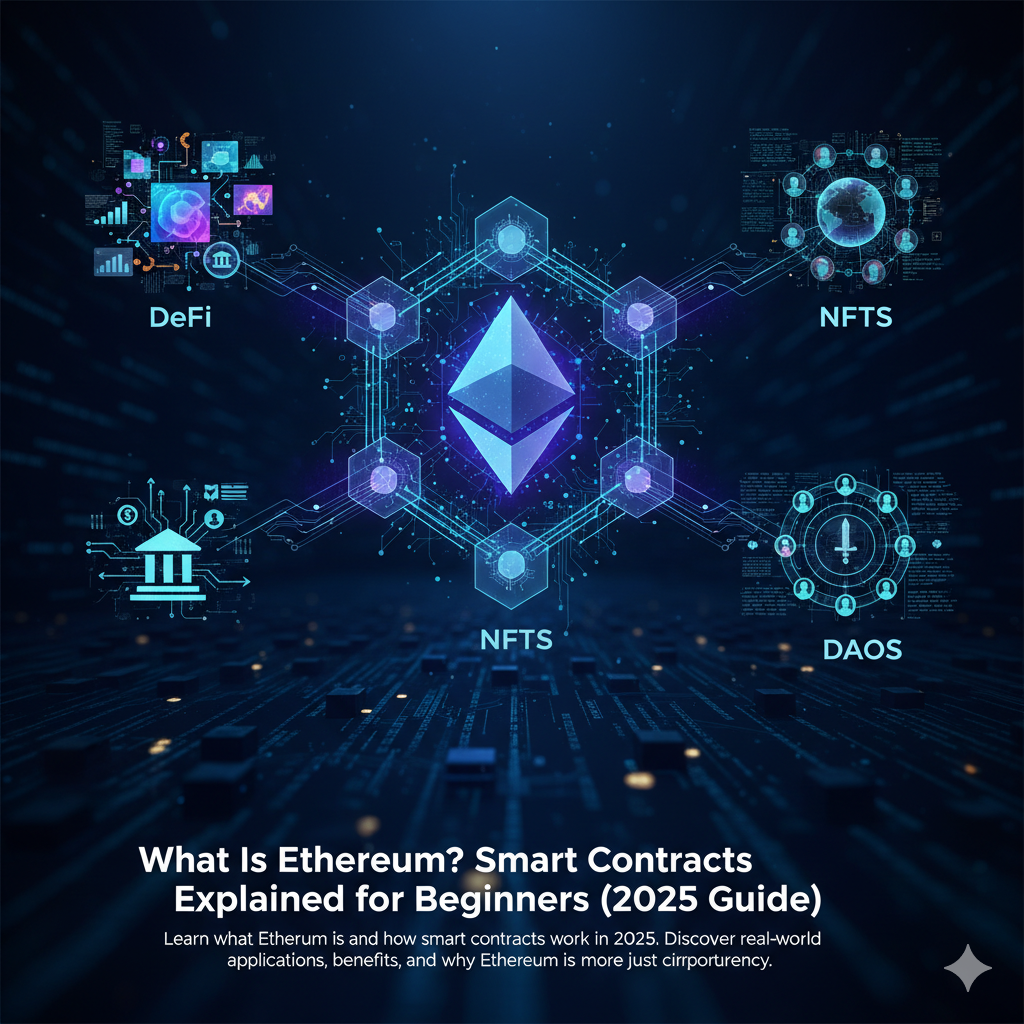
Ethereum is a programmable blockchain launched on July 30, 2015, designed for more than just digital money. While Bitcoin focuses on secure peer-to-peer payments, Ethereum enables developers to build decentralized applications (dApps) powered by smart contracts — self-executing agreements that run automatically when conditions are met.
What Makes Ethereum Unique
Proposed by Vitalik Buterin in 2013 and built by a global open-source community, Ethereum introduced the concept of a world computer — a network where code, not corporations, enforces rules. As a result, every transaction and contract is recorded on a shared ledger maintained by thousands of independent nodes. This approach ensures transparency and censorship resistance.
Learn more about Ethereum’s origins at the Ethereum Foundation.
Smart Contracts — The Core Innovation
The idea of “smart contracts” was coined by cryptographer Nick Szabo in the 1990s. However, Ethereum turned that vision into reality by creating a platform where these digital agreements could execute on their own.
How Smart Contracts Work
Written in Code: First, developers use the Solidity programming language to create smart contracts. Solidity documentation is available at docs.soliditylang.org.
Deployed on Blockchain: Once written, the contract lives at a permanent Ethereum address where anyone can interact with it.
Self-Executing: When set conditions are met, the contract runs on its own — no middlemen, lawyers, or banks required.
Immutable & Transparent: All contract activity is publicly viewable and tamper-proof. Moreover, it’s recorded forever on the blockchain.
As a result, smart contracts serve as the building blocks behind decentralized finance (DeFi), non-fungible tokens (NFTs), and decentralized autonomous organizations (DAOs). To learn more about how smart contracts work in detail, check out our complete beginner’s guide to smart contracts.
Real-World Use Cases in 2025
Decentralized Finance (DeFi)
Currently, Ethereum powers an open-finance system where anyone with internet access can lend, borrow, and trade cryptocurrency. Furthermore, they can do this without traditional banking institutions.
- Aave operates as a peer-to-peer lending system where users earn interest on deposits or borrow assets.
- Uniswap functions as a decentralized exchange (DEX) using automated liquidity pools instead of order books.
- Compound provides algorithmic money markets for earning interest on crypto assets.
Together, Ethereum-based DeFi platforms hold tens of billions USD in total value locked (TVL). In fact, they represent over 50% of the global DeFi market. Track current DeFi statistics at DeFi Llama.
For a comprehensive introduction to this ecosystem, read our guide on what is DeFi on Ethereum.
NFTs and Digital Ownership
Ethereum’s ERC-721 token standard enables the creation of unique, non-fungible digital assets. These assets prove ownership and authenticity.
- OpenSea allows artists and collectors to trade verifiable digital art on the blockchain.
- Game developers tokenize in-game items. As a result, players get true ownership of digital assets they can trade or sell outside the game.
- Real estate experiments like the Aspen Coin project explore fractional property rights through blockchain tokenization.
DAOs (Decentralized Autonomous Organizations)
DAOs use smart contracts for governance and treasury management. Consequently, communities can make decisions together without centralized leadership.
- MakerDAO governs the DAI stablecoin through token-holder voting. In doing so, it shows on-chain governance at scale.
- Investment and charity DAOs pool member funds and vote on spending decisions. Additionally, they maintain complete on-chain transparency.
To understand how these organizations work, explore our article explaining DAOs simply and how people run companies on Ethereum. For those interested in the financial side, we also have a comprehensive guide to DAO treasury management.
Benefits of Ethereum Smart Contracts
Decentralization — No single entity controls the network. Therefore, this eliminates single points of failure.
Transparency — All code and transactions are publicly auditable on the blockchain.
Global Access — Anyone with internet access can participate. This applies regardless of location or banking status.
Security — Cryptographic consensus mechanisms prevent unauthorized tampering. In addition, they ensure network integrity.
Composability — Developers can combine existing contracts like “money legos.” As a result, they can build complex apps from simple components.
Note: Layer-1 gas fees can spike during network congestion. However, most cost-efficient activity now happens on Layer-2 scaling solutions.
Current Challenges & Solutions
High Fees and Scalability
Ethereum’s base-layer transactions can become expensive during periods of high network demand.
Solutions implemented:
- Layer-2 rollups like Optimism, Arbitrum, and Base process transactions off-chain. Then, they batch them to Ethereum, dramatically reducing costs.
- The Dencun upgrade (March 2024) introduced EIP-4844 (proto-danksharding). This reduced data storage costs for rollups by creating temporary data blobs.
- Future roadmap: Full danksharding promises massive throughput gains. In fact, it could enable millions of transactions per second across the Ethereum system.
Security Risks
Smart-contract bugs can lead to significant financial losses when exploited.
Best practices:
- First, use audited, open-source protocols with proven track records.
- Second, start with small transaction amounts when learning.
- Third, never share private keys or seed phrases with anyone.
- Finally, verify contract addresses before interacting with dApps.
Environmental Impact
After The Merge on September 15, 2022, Ethereum moved from energy-heavy Proof-of-Work to efficient Proof-of-Stake consensus. As a result, energy use dropped by around 99.95%. This represents one of the most dramatic sustainability improvements in technology history.
Read more about Ethereum’s energy use at the Ethereum Energy Consumption page.
Enterprise & Web3 Adoption
- PayPal’s PYUSD stablecoin runs on Ethereum’s ERC-20 token standard. Therefore, it brings traditional finance onto blockchain infrastructure.
- Visa is actively testing on-chain USDC settlement for cross-border payments.
- Startups worldwide are building identity verification, supply-chain tracking, and gaming solutions using Ethereum smart contracts.
For more details on how businesses are leveraging this technology, read our article on Ethereum for business and real-world use cases in 2025.
Getting Started with Ethereum
Create a Wallet
First, use MetaMask, the most popular browser extension wallet. Alternatively, explore other options at ethereum.org/wallets.
Buy ETH
Ethereum’s native currency ETH is available on major exchanges. These include Coinbase, Binance, and Kraken.
Explore dApps
Next, try DeFi dashboards or NFT platforms to understand how decentralized apps work.
Stay Updated
Follow the Ethereum Foundation Blog for official news about network upgrades and research updates.
Safety Tips
- Double-check URLs before connecting your wallet to any website.
- Use a hardware wallet like Ledger or Trezor for storing large amounts.
- Beware of phishing attacks and unsolicited “airdrop” offers that request wallet permissions.
- Verify contract addresses on blockchain explorers like Etherscan before transactions.
The Future of Ethereum
Ethereum’s development roadmap in 2025 focuses on three key areas:
Scaling: First, completing the danksharding rollout and improving rollup economics to handle mainstream adoption.
Enterprise Integration: Second, more traditional companies are integrating public blockchain infrastructure into their operations.
Web3 Expansion: Finally, giving users control over their data, digital identity, and online assets rather than centralized platforms.
Why Ethereum Matters for the Future of Technology
Ethereum is not merely a digital currency — it’s the programmable foundation of Web3, the next evolution of the internet. Smart contracts enable transparent, trust-free coordination across finance, digital art, governance, and countless other sectors.
With Proof-of-Stake consensus, Layer-2 scaling solutions, and a vibrant global developer community, Ethereum continues pushing the boundaries of what decentralized technology can achieve. Moreover, the platform shows that software can enforce agreements and manage value without requiring trusted middlemen.
In conclusion, the future of digital infrastructure is being built on Ethereum — one block, one smart contract, one innovation at a time.