
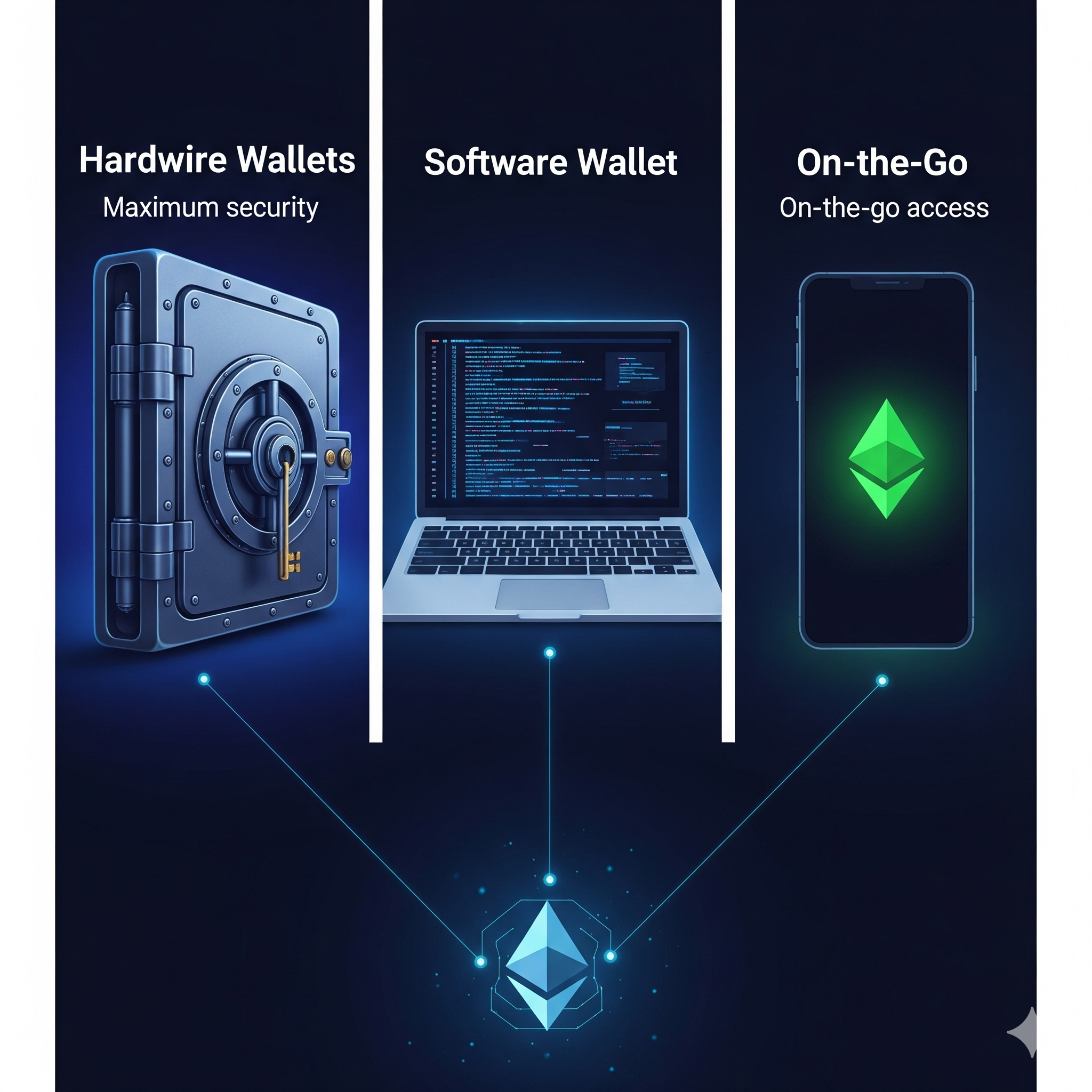
Best Ethereum Wallets in 2025: Hardware vs Software vs Mobile
In the ever-evolving world of cryptocurrency, Ethereum remains a cornerstone for decentralized finance (DeFi), non-fungible tokens (NFTs), and smart contracts. As we step into 2025, securing your ETH and ERC-20 tokens is more crucial than ever, with rising threats like phishing and hacks. Choosing the right Ethereum wallet can make all the difference—whether you’re a beginner dipping your toes into crypto or an experienced user managing a diverse portfolio.
This comprehensive guide breaks down the best Ethereum wallets available in 2025, comparing hardware, software, and mobile options. Furthermore, we’ll explore their features, pros, cons, and how they stack up for security, usability, and compatibility. By the end, you’ll have the knowledge to pick a wallet that fits your needs, optimizing for Ethereum wallet security and ease of use.
What Is an Ethereum Wallet?
An Ethereum wallet is essentially a digital tool that stores your private keys, allowing you to send, receive, and manage ETH and Ethereum-based assets like ERC-20 tokens or NFTs. Unlike traditional bank accounts, these wallets give you full control—meaning you’re responsible for security.
There are three main types:
Hardware Wallets: Physical devices that keep keys offline (cold storage) for maximum protection.
Software Wallets: Apps or browser extensions connected to the internet (hot storage) for quick access.
Mobile Wallets: Smartphone apps that blend convenience with on-the-go functionality, often overlapping with software wallets.
Each type has trade-offs. For instance, hardware offers top-tier security but less convenience, while software and mobile prioritize ease but require vigilance against online risks. In 2025, Ethereum wallets must support EVM-compatible networks like Polygon or Arbitrum for broader usability. If you’re new to cryptocurrency, check out our guide on top 10 crypto wallets for beginners in 2025 to understand the fundamentals before diving deeper.
Hardware Wallets: The Gold Standard for Security
Hardware wallets are ideal for long-term storage of large ETH amounts, as they isolate private keys from the internet. Moreover, they’re tamper-resistant and often feature secure chips certified to high standards like EAL6+. However, they cost more (typically $50–$200) and require physical handling.
Top Hardware Wallets for Ethereum in 2025
Ledger Nano X
This Bluetooth-enabled device supports over 5,500 cryptocurrencies, including ETH, ERC-20 tokens, and NFTs. Additionally, key features include a large screen for transaction verification, Ledger Live app for staking and swapping, and a CC EAL5+ secure element chip.
Advantages: Mobile compatibility via Bluetooth, extensive asset support, and user-friendly for DeFi interactions.
Drawbacks: Not fully open-source, occasional app glitches, priced around $149.
Ideal for: Users who want seamless mobile access without compromising security.
Trezor Safe 5
An upgrade from earlier models, it boasts a color touchscreen, haptic feedback, open-source firmware, and a secure element certified to EAL6+.
Strengths: Excellent calldata visibility for transaction verification, haptic feedback for usability, and strong open-source transparency.
Limitations: No Bluetooth (USB only), higher price at about $169, and navigation can feel unintuitive for raw data checks.
Perfect for: Power users who prioritize open-source code and detailed signature reviews.
Tangem Wallet
A card-like NFC device without batteries or screens, it uses a tap-to-phone system for transactions. Notably, this wallet supports 16,000+ assets including Ethereum, with EAL6+ certification and seedless backups via multiple cards.
Benefits: Extremely portable and affordable ($54–$70 for a set), simple setup in under 3 minutes, and resilient to physical damage.
Downsides: Relies on phone security, limited calldata display without the app.
Recommended for: Beginners seeking hassle-free cold storage.
OneKey Pro
Featuring a large touchscreen, fingerprint sensor, and air-gapped QR signing, this device supports ETH dApps and has EAL6+ secure elements. Additionally, wireless (Qi) charging is supported for enhanced convenience.
Advantages: Offline security with wireless charging, good for multi-chain use.
Cons: Around $170, not fully reproducible open-source yet.
Best suited for: Tech-savvy users who value biometric features.
Keystone 3 Pro
An air-gapped wallet with a touchscreen and QR connectivity, this option offers open-source firmware with reproducible builds and displays EIP-712 (typed data) when integrated with MetaMask. However, reviewers note inconsistent call-data decoding on some flows.
Positive aspects: Strong offline model and MetaMask integration; QR signing reduces attack surface.
Negative points: Inconsistent calldata decoding reported by independent testers; typically priced $150+.
Optimal for: Users focused on offline transaction signing.
Hardware wallets shine in protecting against hacks, but always buy from official sites to avoid tampered devices. For a broader perspective on wallet options, explore our comprehensive review of top 10 crypto wallets in 2025 covering Bitcoin, Ethereum, and multi-chain support.
Software Wallets: Convenience for Everyday Use
Software wallets run on your computer or browser, making them perfect for frequent transactions like trading ETH/USD pairs. Consequently, they’re free but “hot,” so they’re vulnerable to malware—use them for smaller amounts.
Top Software Wallets for Ethereum in 2025
MetaMask
A browser extension with mobile support, MetaMask connects to dApps, swaps tokens, and manages NFTs on Ethereum networks like Polygon. Currently, this popular wallet reports approximately 30 million monthly active users.
Key strengths: Seamless Web3 integration, customizable gas fees.
Main limitations: Native Bitcoin support has been announced for 2025 but isn’t universally available as of October 2025; treat as pending/rolling out.
Most suitable for: DeFi enthusiasts and NFT collectors.
If you’re setting up MetaMask for the first time, our detailed tutorial on how to set up and use MetaMask safely provides step-by-step instructions to ensure maximum security from day one. Additionally, if you’re interested in trading NFTs, check out our complete comparison guide of NFT marketplaces including OpenSea, Blur, and Magic Eden.
MyEtherWallet (MEW)
A free, open-source web wallet for ETH and ERC-20 tokens, MEW provides NFT management and staking available via MEW Portfolio integrations.
Primary benefits: Versatile across platforms, cross-chain swaps, no custody of keys.
Notable drawbacks: Susceptible to phishing, limited non-Ethereum support.
Designed for: Users who want full control without apps.
Exodus
A desktop and browser wallet supporting many networks (plus ETH staking) and in-app swaps.
Top features: Intuitive interface, Trezor integration for added security.
Considerations: No traditional 2FA; not fully open-source (some components are closed-source by design).
Great choice for: Beginners with diverse portfolios.
Coinbase Wallet
Non-custodial with dApp access, this wallet supports all ERC-20 tokens and integrations with exchanges.
Main advantages: Educational quests, biometric security, backed by Coinbase.
Key cons: Limited customization, ties to centralized platform.
Tailored for: New users transitioning from exchanges.
Software wallets are great for quick ETH trades but pair them with hardware for large holdings. Before purchasing ETH to store in your wallet, read our guide on how to buy Ethereum safely in 2025 to avoid common pitfalls.
Mobile Wallets: On-the-Go Accessibility
Mobile wallets are apps for smartphones, offering portability for scanning QR codes or mobile payments. Nevertheless, they’re hot wallets, so security relies on device protection.
Top Mobile Wallets for Ethereum in 2025
Trust Wallet
Trust Wallet supports 10M+ assets across 100+ chains, with in-app DEX and NFT viewing capabilities.
Core strengths: User-friendly interface, biometric authentication for enhanced security.
Potential issues: The wallet includes a built-in dApp browser on iOS in current releases; historically its availability varied. WalletConnect is an alternative if needed.
Perfect match for: Mobile-first users with broad asset needs.
Zengo
Zengo is a keyless wallet using MPC cryptography and biometrics, eliminating the need for seed phrases.
Notable advantages: Beginner-friendly interface, 24/7 customer support.
Things to consider: Independent security ratings vary; focus on MPC/no-seed architecture for evaluation.
Ideal choice for: Those avoiding complex backups.
MetaMask Mobile
The mobile version of the popular extension provides token swaps and dApp access on the go.
Key benefits: Syncs seamlessly with desktop version.
Important caveats: Phishing risks remain present, no desktop app available.
Optimized for: On-the-go Web3 interactions.
Exodus Mobile
Exodus Mobile mirrors the desktop version with swaps and staking on the go.
Main highlights: Sleek design with multi-platform sync capability.
Trade-offs: Lacks traditional 2FA protection.
Well-suited for: Casual mobile users.
Mobile wallets excel in convenience, but remember to use device locks and avoid public Wi-Fi for enhanced security.
Hardware vs Software vs Mobile: A Comparison
| Category | Security Level | Usability | Cost | Best For | Examples |
|---|---|---|---|---|---|
| Hardware | High (Offline) | Moderate | $50–$200 | Long-term storage | Ledger Nano X, Trezor Safe 5 |
| Software | Medium (Online) | High | Free | Daily transactions | MetaMask, Exodus |
| Mobile | Medium (Online) | High | Free | Portability | Trust Wallet, Zengo |
Hardware wins for security in 2025, especially with Ethereum’s high value, but software/mobile suit active trading.
How to Choose the Right Ethereum Wallet in 2025
Consider your needs carefully when selecting the perfect Ethereum wallet:
Beginners should start with Zengo or Tangem for simplicity and ease of use.
Security-conscious users will benefit most from hardware options like Trezor Safe 5 offering maximum protection.
Active DeFi traders need MetaMask or Trust Wallet for excellent dApp access and seamless interactions.
Budget considerations matter—weigh free software/mobile options against paid hardware solutions based on your holdings.
Always check compatibility with Ethereum updates like upcoming sharding. Furthermore, test with small amounts first to familiarize yourself with the interface. To maximize your Ethereum experience, explore our guide on essential Ethereum tools every user must know including block explorers, gas trackers, and DeFi platforms.
Security Best Practices for Ethereum Wallets
Protecting your Ethereum assets requires multiple layers of security. First and foremost, implement strong PINs and biometric authentication whenever possible to prevent unauthorized access.
Additionally, enable 2FA where available (note: some self-custody wallets don’t support traditional 2FA) for an extra layer of protection.
Under no circumstances should you share seed phrases with anyone, regardless of their claimed authority or urgency.
Transaction verification is critical—prefer wallets that display EIP-712 typed data clearly for transparency and accuracy.
Regular updates are essential, so keep firmware and apps current to patch security vulnerabilities and improve performance.
Backup storage matters significantly—maintain secure offline copies in multiple physical locations for redundancy and disaster recovery.
In 2025, rumors and a reported $1.5B outflow at Bybit in May 2025 underscored the need for vigilance—even when your funds are self-custodied. Therefore, stay alert to phishing and supply-chain risks at all times. For comprehensive protection strategies, read our Ethereum security guide with 10 essential rules to safeguard your crypto holdings effectively.
Conclusion: Secure Your Ethereum Future
Choosing among the best Ethereum wallets in 2025 boils down to balancing security, convenience, and your usage patterns. Ultimately, hardware options like Ledger Nano X provide peace of mind for hodlers, while software solutions like MetaMask empower daily users. Meanwhile, mobile alternatives like Trust Wallet keep you connected wherever you go. Whichever you pick, prioritize verified sources and best practices to safeguard your ETH. As Ethereum evolves, stay informed—your wallet is your gateway to the blockchain world.
External Resources: