
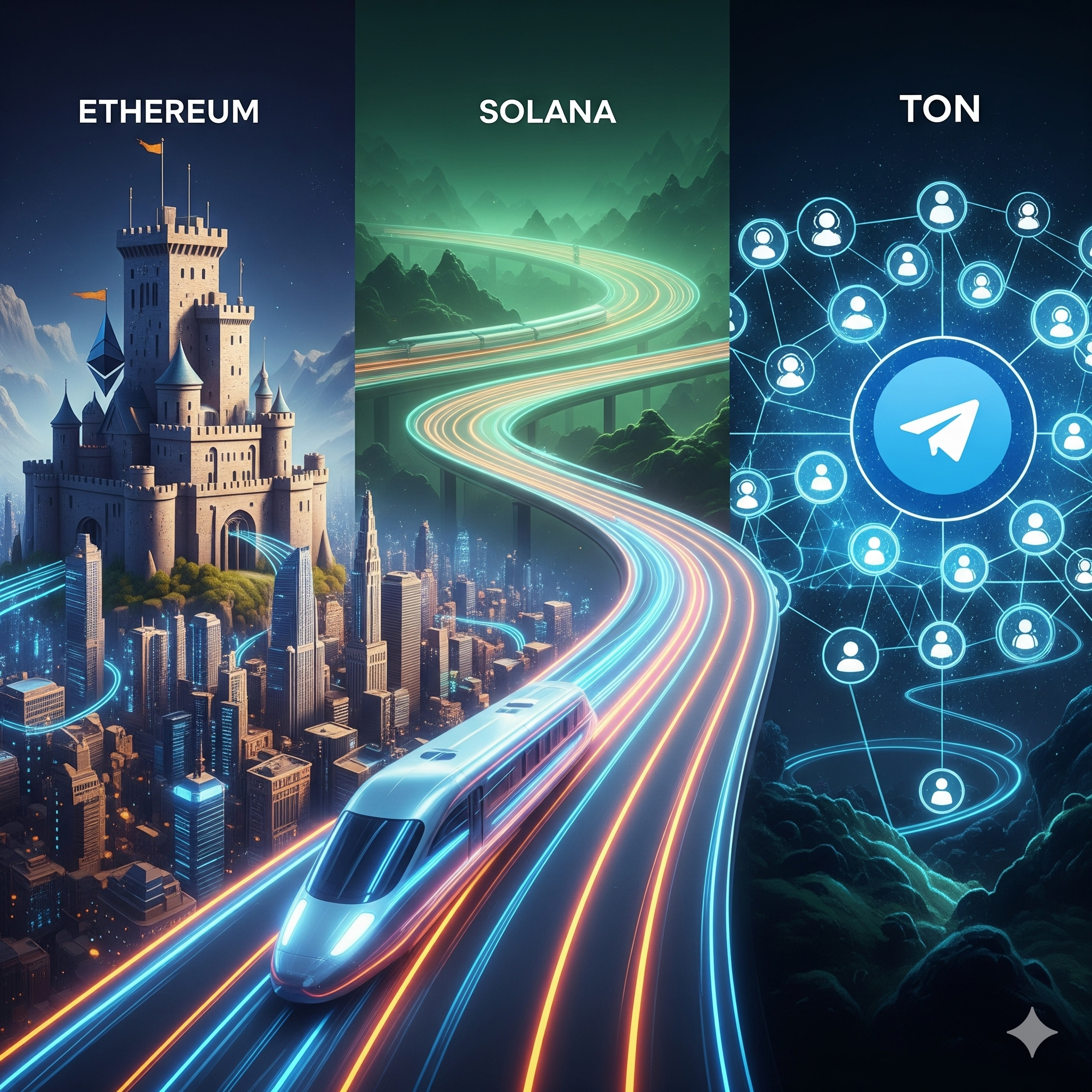
TL;DR: The Blockchain Battle of 2025
Solana and TON are climbing fast thanks to lightning speed, near-zero fees, and user-friendly onboarding. Specifically, Solana dominates high-frequency trading and payments, while TON leverages Telegram’s 1 billion-user network. However, Ethereum still rules where it matters most — decentralization, security, liquidity, and developer ecosystem. Furthermore, after upgrades like Dencun (EIP-4844) and Pectra, Ethereum remains the backbone of decentralized finance.
What Are Solana, TON, and Ethereum? Blockchain Basics Explained
Let’s set the stage with the three major players in today’s blockchain landscape.
Ethereum (Launched 2015) — The Smart Contract Pioneer
Ethereum pioneered programmable blockchain technology, creating the foundation for:
- Decentralized Finance (DeFi) protocols like Uniswap and Aave
- NFT marketplaces such as OpenSea
- Gaming platforms and tokenization systems
- Moreover, smart contracts that power thousands of decentralized applications
Key Stats (2025):
- Over 1 million validators securing the network
- Impressively, $120B+ Total Value Locked (TVL)
- Remarkably, 99.99% uptime since The Merge
Solana (Launched 2020) — The Speed Demon
Solana combines Proof-of-History (PoH) with Proof-of-Stake (PoS) to achieve:
- Theoretical capacity: ~65,000 transactions per second (TPS)
- In practice, real-world average: 3,000–4,000 TPS
- Transaction fees: <$0.01 on average
- Additionally, block time: ~400 milliseconds
Popular Solana Apps:
- Jupiter — Leading DEX aggregator
- Magic Eden — NFT marketplace
- Furthermore, Solana Pay — Payment infrastructure
TON (The Open Network) — The Telegram Integration
Originally developed by Telegram, TON brings blockchain to messaging:
- Dynamic sharding for horizontal scalability
- Seamlessly integrated into Telegram Messenger (1B+ users)
- Chat-based wallets and mini-apps
- Additionally, multi-chain architecture with workchains and shardchains
For a deep dive into TON’s evolution and capabilities, check out TON Blockchain: From Telegram’s Ambition to a Web3 Super App in 2025.
Core Philosophy:
- Solana: Speed and performance
- In contrast, TON: Accessibility and user experience
- Meanwhile, Ethereum: Security and decentralization
All three are Layer 1 blockchains, but their priorities differ significantly. Consequently, understanding these differences is key to choosing the right chain for your needs.
Why Solana Is Rising in 2025: Speed Meets Adoption
Solana’s meteoric rise can be attributed to several key factors that set it apart from competitors.
1. Lightning-Fast Transaction Processing
Solana’s innovative Proof-of-History consensus timestamps transactions before they enter the mempool, enabling:
- Validators to reach consensus faster
- Consequently, parallel transaction processing
- As a result, 400+ million transactions per month in 2025
- Furthermore, sub-second finality for most transactions
Performance Comparison:
- Ethereum base layer: ~15 TPS
- In contrast, Solana: 3,000–4,000 TPS (real-world)
- Meanwhile, TON: Variable based on sharding
2. Near-Zero Transaction Fees
While Ethereum gas fees can spike above $20 during network congestion, Solana maintains:
- Average fee: <$0.01 per transaction
- Consequently, enables micro-transactions for gaming
- Similarly, makes NFT minting economically viable
- Moreover, powers high-frequency DeFi trading
3. Rapidly Expanding Ecosystem
By mid-2025, Solana’s ecosystem includes:
- 1.5+ million active addresses (September 2025)
- In addition, thousands of decentralized applications
- Notably, DEX volumes rivaling Ethereum’s
- Furthermore, growing DeFi TVL approaching $8 billion
Key Projects:
- Jito — MEV infrastructure
- Marinade Finance — Liquid staking
- Moreover, Tensor — NFT trading platform
4. Real-World Enterprise Adoption
Major corporations are integrating Solana:
- Visa — Settlement pilot programs
- PayPal — Exploring stablecoin rails
- Similarly, Shopify — Merchant payment integration via Solana Pay
- Additionally, Solana Mobile — Saga and Seeker phones with built-in crypto wallets
5. Challenges: Reliability Concerns
Solana’s Achilles’ heel remains network stability:
- 5-hour outage on February 6, 2024
- Additionally, multiple smaller disruptions in 2023–2024
- Currently, validator count: ~1,300 (vs. Ethereum’s 1M+)
- Nevertheless, working on Firedancer client for improved resilience
Why TON Is Rising in 2025: The Telegram Advantage
TON’s unique approach to blockchain adoption leverages social messaging in ways never seen before.
1. Instant Access to 1 Billion Users
TON’s integration with Telegram provides:
- No app downloads required
- Consequently, in-chat wallet functionality via @Wallet
- Furthermore, seamless onboarding without seed phrases
- Moreover, social crypto features native to messaging
User Experience Revolution:
- Send Toncoin like sending a text message
- Similarly, access dApps directly in chat
- Additionally, built-in KYC-free payments
2. Infinitely Scalable Architecture
TON’s dynamic sharding system enables:
- Multiple workchains processing transactions in parallel
- Consequently, automatic shardchain creation as demand grows
- As a result, near-instant settlement times
- Furthermore, theoretical unlimited throughput
3. Beyond Finance: Diverse Utilities
TON ecosystem includes:
- TON Storage — Decentralized file storage
- TON DNS — Blockchain domain names
- Moreover, TON Sites — Censorship-resistant websites
- Additionally, TON Payments — Instant micropayments in mini-apps
4. Impressive Market Momentum
Toncoin (TON) Statistics 2025:
- Trading price: ~$5 USD
- Market cap ranking: Top 15 globally
- Additionally, growing DeFi ecosystem with projects like STON.fi
- Notably, millions of first-time crypto users onboarded
5. Challenges: Early-Stage Ecosystem
TON faces growing pains:
- Small DeFi ecosystem compared to Ethereum/Solana
- Limited validator base (few hundred nodes)
- Network congestion issues in August 2024
- Centralization concerns similar to Solana
Why Ethereum Still Leads: The King’s Moat
Despite fierce competition, Ethereum maintains its dominance through fundamental advantages that competitors struggle to replicate.
1. Unrivaled First-Mover Advantage and Liquidity
Ethereum dominates where it matters most:
- $120+ billion TVL in DeFi protocols
- In comparison, Solana: ~$8B TVL
- Meanwhile, TON: <$1B TVL
Blue-Chip DeFi Protocols:
- Uniswap — Leading DEX ($4B+ TVL)
- Aave — Premier lending protocol ($10B+ TVL)
- Similarly, MakerDAO — Decentralized stablecoin leader ($5B+ TVL)
- Additionally, Lido Finance — Dominant liquid staking provider ($33B+ TVL)
To understand how Ethereum maintains its DeFi dominance, read Ethereum vs Solana: Who Leads DeFi Today?
2. Unmatched Decentralization and Security
Network Security Comparison:
- Ethereum: 1,000,000+ validators globally distributed
- In contrast, Solana: ~1,300 validators
- Meanwhile, TON: Few hundred validators
This massive validator network ensures:
- Censorship resistance
- Furthermore, geographic distribution across all continents
- Moreover, attack resistance (would cost billions to compromise)
- Consequently, long-term credibility with institutional investors
3. Layer 2 Revolution: Scaling Without Compromise
Dencun upgrade (EIP-4844) in March 2024 introduced blob transactions, slashing L2 costs by 10x+.
Leading Ethereum L2s:
- Arbitrum — Optimistic rollup leader
- Optimism — OP Stack ecosystem
- Similarly, Base — Coinbase’s L2 network
- Moreover, Polygon zkEVM — Zero-knowledge rollup
- Additionally, zkSync — ZK-rollup innovator
Result: As a consequence, Ethereum L2s now process thousands of TPS for pennies while inheriting Ethereum’s security.
For a detailed comparison of blockchain ecosystems including Polygon, see Ethereum vs Solana vs Polygon: Which Blockchain Wins for DeFi?
4. Proven Reliability and Trust
Ethereum’s track record speaks volumes:
- Nearly a decade of operation since 2015
- Impressively, 99.99% uptime (no major outages)
- Energy-efficient post-Merge (99.95% energy reduction)
- Moreover, often deflationary during high usage thanks to EIP-1559
5. Institutional Adoption and Regulatory Clarity
Why institutions choose Ethereum:
- Majority of tokenized real-world assets (RWAs) on Ethereum
- Additionally, enterprise pilots from JPMorgan, BlackRock
- Furthermore, regulated stablecoin infrastructure (USDC, PYUSD)
- Notably, Spot ETH ETFs approved (U.S. regulatory acceptance)
- Consequently, avoids security classification risks facing SOL
The Multi-Chain Reality: Each Chain Has Its Kingdom
Forget the “Ethereum killer” narrative. Instead, the future is multi-chain specialization.
Blockchain Comparison Table 2025
| Chain | Core Strength | Ideal Use Case | TPS | Avg Fee | TVL |
|---|---|---|---|---|---|
| Ethereum | Security + Liquidity | DeFi, RWAs, Institutions | 15 (base) | $1–20 | $120B+ |
| Solana | Speed + Low Fees | Trading, Payments, NFTs | 3,000–4,000 | <$0.01 | ~$8B |
| TON | Accessibility + UX | Mass onboarding, Telegram | Variable | <$0.01 | <$1B |
For a comprehensive analysis with detailed metrics, explore Ethereum vs Solana vs Polygon vs TON: Chain Metrics Compared.
2025 Market Data Reveals the Pattern
Transaction Volume:
- Solana: 400+ million tx/month
- In contrast, Ethereum: Lower tx count but higher value per transaction
Value Distribution:
- Ethereum: 55%+ of total DeFi TVL
- Furthermore, Ethereum L2s: Rapidly growing share
- Meanwhile, Solana: Strong in retail and payments
- Additionally, TON: Leading in new user acquisition
Why Solana and TON Haven’t “Killed” Ethereum (And Won’t)
Despite impressive growth, both Solana and TON face fundamental challenges that prevent them from displacing Ethereum’s dominance.
1. Reliability Is Non-Negotiable
Track Record Matters:
- Ethereum: 99.99% uptime since genesis
- In contrast, Solana: Multiple outages (Feb 2024: 5 hours)
- Similarly, TON: Minor disruptions during growth phases
For institutional money and critical DeFi infrastructure, downtime is unacceptable. Therefore, reliability becomes a decisive factor for serious capital allocation.
2. Decentralization = Censorship Resistance
Validator Distribution:
- Ethereum’s 1M+ validators spread globally
- Consequently, harder to censor, easier to trust
- Therefore, essential for long-term value preservation
Meanwhile, Solana and TON are improving but can’t match this scale yet.
3. Liquidity Network Effects Are Sticky
Capital flows to where capital exists:
- Ethereum’s DeFi ecosystem has $120B+ for a reason
- Furthermore, composability between protocols creates moats
- As a result, developers build where the users and money are
Example: Building a new lending protocol? Consequently, you’ll integrate with Ethereum’s liquidity pools, not start from scratch elsewhere.
4. Regulatory Comfort Zone
U.S. Securities Law Considerations:
- ETH: Considered a commodity by CFTC, cleared by SEC
- In contrast, SOL: Gray area, potential security classification risk
- Meanwhile, TON: Early-stage regulatory scrutiny
Therefore, institutions prefer regulatory clarity.
5. Ecosystem Depth and Maturity
Ethereum’s 10-year advantage:
- Battle-tested smart contract libraries
- Additionally, extensive auditing infrastructure (OpenZeppelin, Trail of Bits)
- Furthermore, deep developer talent pool
- Moreover, composability standards (ERC-20, ERC-721)
Consequently, this can’t be replicated overnight.
The Road Ahead: 2025–2030 Blockchain Evolution
Each blockchain is charting its own path forward with distinct strategies and priorities.
Solana’s Future Roadmap
Technical Improvements:
- Firedancer client launch for better resilience
- Additionally, client diversity to prevent single-point failures
- Furthermore, enhanced validator infrastructure
Adoption Drivers:
- Expanding Solana Pay merchant network
- Moreover, mobile-first strategy with Saga Phone
- In addition, gaming and NFT ecosystem growth
For insights on how Solana’s NFT ecosystem is performing, read Ethereum vs Solana NFTs: Which Ecosystem Wins in 2025?
TON’s Expansion Strategy
Leveraging Telegram’s Network:
- Launching comprehensive mini-app ecosystems
- Additionally, gaming integration within Telegram
- Furthermore, micropayments for content creators
- Moreover, social finance (SocialFi) features
Key Question: Can TON convert passive chat users into active on-chain users? Ultimately, this will determine its long-term success.
Ethereum’s Consolidation Phase
Upcoming Upgrades:
- Pectra upgrade (2025) — Account abstraction improvements
- Subsequently, Verkle trees — Stateless clients
- Finally, Danksharding — Full data availability scaling
Focus Areas:
- Optimizing L2 ecosystem coordination
- Additionally, improving staking UX and solo staker experience
- Furthermore, PBS (Proposer-Builder Separation) refinements
Practical Guide: Choosing Your Blockchain in 2025
Understanding which blockchain to use depends entirely on your specific needs and use cases. Let’s break it down.
When to Use Each Chain
Choose Solana for:
- ✅ Fast, frequent transactions (day trading)
- ✅ NFT minting and trading at scale
- ✅ Payment applications requiring speed
- ✅ Gaming with microtransactions
- ✅ Consequently, low-cost DeFi experimentation
Choose TON for:
- ✅ Telegram-based applications
- ✅ Specifically, onboarding non-crypto users
- ✅ Social token experiments
- ✅ Mini-apps and bots integration
- ✅ Particularly, regions with high Telegram adoption
Choose Ethereum for:
- ✅ Long-term DeFi investments
- ✅ Secure staking and yield farming
- ✅ Tokenized real-world assets (RWAs)
- ✅ Maximum security requirements
- ✅ Especially, institutional-grade applications
Diversification Strategy: Use All Three
Smart Multi-Chain Approach:
- Core holdings: Ethereum for stability and DeFi
- Active trading: Solana for speed and low fees
- Experiments: TON for new social crypto features
Safety First:
- Test with small amounts initially
- Moreover, use hardware wallets (Ledger, Trezor) for storage
- Additionally, avoid bridges unless absolutely necessary
- Finally, verify smart contracts on Etherscan, Solscan, TONScan
Final Thoughts: Multi-Chain Future is Here
Solana and TON aren’t threats — they’re catalysts.
Their speed, simplicity, and accessibility push Ethereum to evolve faster through L2 innovations and protocol upgrades. Meanwhile, Ethereum’s unmatched security and liquidity provide the stability and trust the entire crypto ecosystem needs. Consequently, the future isn’t about “killing kings” — it’s about building interconnected kingdoms.
Key Takeaways for 2025
- Ethereum remains the DeFi backbone (security + liquidity)
- In comparison, Solana dominates high-speed retail applications
- Meanwhile, TON leads in user acquisition via Telegram
- Furthermore, Layer 2s make Ethereum competitive on speed/cost
- Ultimately, multi-chain usage is the winning strategy
Remember: Test before you trust. Start small. Stay curious. Indeed, in crypto, today’s alternative can become tomorrow’s standard.
Additional Resources
Official Documentation:
- Ethereum Developer Docs — Comprehensive guides
- Solana Documentation — Technical references
- TON Documentation — Protocol specifications
Analytics Platforms:
- DeFiLlama — TVL tracking across chains
- Dune Analytics — On-chain data visualization
- Token Terminal — Crypto metrics and fundamentals
News and Research:
- The Block — Industry news coverage
- Messari Research — In-depth analysis
- Galaxy Digital Research — Market insights