
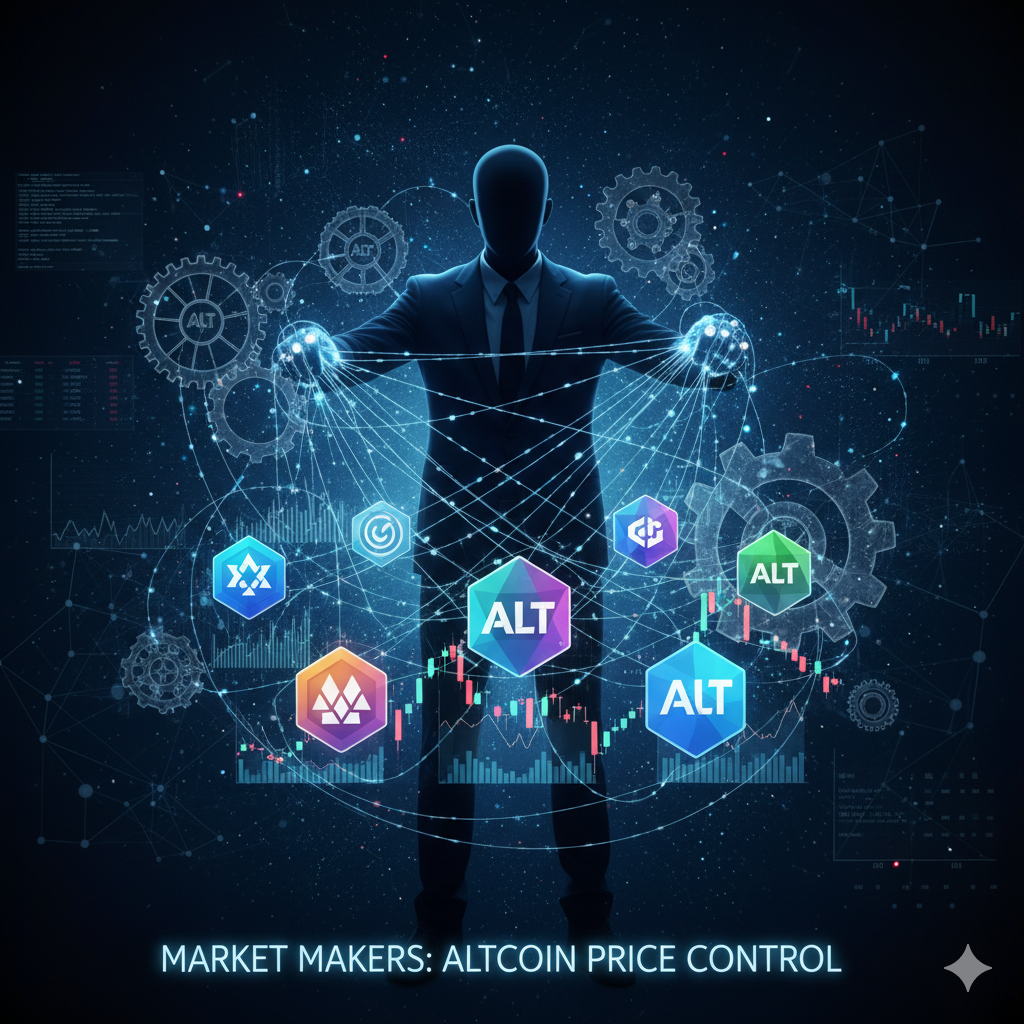
In the fast-paced world of cryptocurrency, altcoins – those digital assets beyond Bitcoin like Ethereum, Solana, or Ripple – often swing wildly in price. If you’ve ever wondered why a promising altcoin suddenly drops or surges without clear news, market makers might be at play. These behind-the-scenes players ensure trades happen smoothly but can also shape prices in ways that affect everyday investors. In this article, we’ll break down how market makers operate in the altcoin space, using simple language to make it accessible for beginners. We’ll explore their roles, strategies, and impacts, drawing from reliable sources to keep things factual.
Whether you’re new to crypto trading or looking to understand why altcoin prices behave unpredictably, this guide will equip you with the knowledge to navigate the market smarter. Let’s dive in.
What Are Market Makers and Why Do They Matter in Crypto?
Imagine a bustling marketplace where buyers and sellers haggle over goods. Without enough participants, deals stall, and prices become erratic. In financial markets, including crypto, market makers act like the reliable vendors who always have stock ready to buy or sell. They are individuals or firms that provide liquidity by continuously quoting buy (bid) and sell (ask) prices for assets, according to Investopedia’s comprehensive guide on market makers.
In traditional finance, market makers like those on stock exchanges commit to these quotes to keep markets efficient. In cryptocurrency, this role is even more crucial because crypto markets operate 24/7 and lack centralized regulation. For altcoins, which often have lower trading volumes than Bitcoin, market makers prevent extreme volatility by ensuring there’s always someone on the other side of a trade.
Top crypto market makers include firms like GSR, Keyrock, and DWF Labs. Note that DWF Labs presents itself as both an investor and a market maker. They partner with exchanges to boost liquidity, especially for newer or less popular altcoins. Without them, trading an altcoin might feel like shouting into an empty room – no responses, wide price gaps, and frustrated users.
For beginners, think of it this way: If you want to sell your altcoin holdings quickly, a market maker buys them at their bid price. They then sell to others at a slightly higher ask price, pocketing the difference (called the bid-ask spread). This spread is their main profit source, incentivizing them to keep markets active, as explained in Investopedia’s market maker overview.
In altcoin markets, where liquidity can dry up fast, market makers are lifelines. They use algorithms to adjust quotes in real-time, stabilizing prices and attracting more traders. Exchanges often incentivize professional liquidity with maker-fee rebates or special market-maker programs, with details varying by venue. Major platforms like Binance and OKX run dedicated programs to attract these liquidity providers. If you’re just getting started, our Binance tutorial can help you understand how these exchanges work.
The Role of Market Makers in Altcoin Liquidity
Altcoins, by nature, are more volatile than Bitcoin due to smaller market caps and fewer participants. Market makers step in to create “depth” – meaning plenty of buy and sell orders at various price levels. This depth ensures that large trades don’t cause massive price swings.
For instance, on a crypto exchange, a market maker might place orders to buy 1,000 units of an altcoin at $0.95 and sell 1,000 at $1.05. This tight spread encourages trading. Many exchanges run formal market-maker or liquidity-provider programs that reward such quoting with benefits like maker rebates and higher API limits. When choosing where to trade, consider checking our guide to the top crypto exchanges for beginners to find platforms with robust liquidity.
In the crypto world, market making isn’t just about fairness; it’s a business. Firms like Kairon Labs publicly describe hedging inventory risk with derivatives like perpetuals, futures, and options across multiple venues, as detailed on their official website.
A common misconception is that market makers always win. In reality, they face risks like sudden market crashes or “adverse selection” – buying high just before a drop. Claims that market makers systematically “suppress prices” during uncertain times are widely discussed on social media but remain anecdotal and shouldn’t be treated as established fact without hard evidence.
How Market Makers Influence Altcoin Prices: The Mechanics
Market makers don’t have a magic wand to set prices arbitrarily – markets are driven by supply and demand. However, their large capital and constant presence give them significant sway, especially in illiquid altcoin markets.
One key way is through order book management. By placing layered orders, they create “walls” that support or resist price movements. For example, a thick buy wall at $0.50 might prevent an altcoin from dropping below that level, signaling stability to traders. Understanding these dynamics is particularly important when buying Ethereum or other major altcoins.
They also use high-frequency trading (HFT) algorithms to adjust quotes milliseconds ahead of the crowd. In altcoins, where news spreads fast via social media, market makers can move quickly on public signals, buying low before a pump or selling high before a dump.
Profit comes from spreads, but also from inventory management. If a market maker accumulates too many altcoins (long position), they might widen the spread to encourage selling, pushing prices down temporarily to buy more cheaply. Conversely, if short, they tighten spreads to attract buyers and offload holdings.
In decentralized finance (DeFi), automated market makers (AMMs) like Uniswap provide liquidity via smart contracts—not human dealers—with prices set by formulas like the constant-product model described in Uniswap’s documentation. Traditional, order-book market makers still dominate centralized exchanges for altcoins by sheer volume share, but AMMs power much of on-chain trading.
Here’s a real-world example: During altcoin seasons, when Bitcoin dominance falls, market makers facilitate rotations by providing liquidity to undervalued altcoins, indirectly boosting their prices as capital flows in. General market behavior varies by cycle and asset, but the pattern remains consistent.
Tactics Market Makers Use to Shape Altcoin Prices
While market makers aim for efficiency, some tactics border on manipulation, trapping retail traders. It’s important to approach these claims with nuance:
Stop Hunts and Liquidity Sweeps: Prices dipping through obvious stop zones do happen in thin order books, but attributing deliberate intent to market makers is speculative unless proven. Thin liquidity itself can cause these price wicks naturally.
Fake Breakouts: Sometimes called “inducement,” these occur when chart patterns fail. However, not every failed breakout represents coordinated manipulation – markets are inherently unpredictable.
Range Traps: Ranges break unpredictably due to market microstructure, not necessarily because of coordinated “traps” set by market makers.
News Manipulation: Coordinated manipulation around news is illegal in regulated markets. In crypto, enforcement exists but remains uneven. There are documented U.S. cases against firms and individuals for wash trading and manipulation in digital-asset markets. For example, Reuters reported on a 2025 U.S. guilty plea involving Gotbit for volume inflation via wash trading.
Wash Trading and Spoofing: These practices are illegal under U.S. law in regulated markets. Spoofing is expressly prohibited by the Dodd-Frank Act, and wash trading is a form of market manipulation explained in detail by Investopedia. Crypto venues have seen enforcement actions in related areas, as documented by financial regulators and educational institutions like NYIF.
Social-media claims that “market makers suppress prices amid good news” should be treated as unverified unless tied to evidence. For XRP specifically, supply concentration is primarily linked to Ripple’s escrow holdings and large exchange or custodial wallets—not demonstrably to “market makers” as a class. Public rich-list and disclosure data from XRPSCAN show Ripple controls a large portion of supply via escrow, and major exchanges hold sizeable balances on behalf of users.
Risks and Myths: Do Market Makers Really “Control” Everything?
A big myth is that market makers dictate prices like puppet masters. In truth, they respond to broader forces like macroeconomic events or whale activity. They can’t ignore genuine demand – if millions buy an altcoin, prices rise regardless. To understand how large holders impact markets, read our article on whale watching and how big wallets move markets.
Risks for market makers include black swan events, like hacks or regulatory crackdowns, wiping out positions. For traders, over-relying on patterns while ignoring order-book dynamics leads to losses.
Another myth: AMMs replace human market makers entirely. AMMs are a different mechanism using smart-contract pools and dominate DEX trading. However, centralized exchanges remain largely order-book based, and despite rising DEX share in 2025, CEXs still command the larger slice of total volume according to data from Kaiko Research.
Social-media frustrations about whales and market makers are common, but evidence must be distinguished from opinion. Not every price movement is manipulation, and confirmation bias can lead traders to see patterns that don’t exist.
Protecting Yourself as a Beginner Trader
To navigate market maker influence effectively, consider these strategies:
Use Limit Orders: Avoid market orders that hit wide spreads. Limit orders give you control over execution price, which is a general best practice consistent with liquidity and spread mechanics as explained by Investopedia.
Watch Order Books: Tools that show market depth help you see buy and sell “walls” in real-time. This visibility lets you understand where major support and resistance levels lie. Most platforms in our crypto exchange comparison offer order book visualization tools.
Diversify: Don’t bet big on one altcoin. This general risk principle applies across all investing, not just crypto. Our complete beginners guide to crypto trading covers portfolio diversification strategies in depth.
Stay Informed: Verify news from official sources rather than relying on social media rumors or unconfirmed reports. Follow reputable crypto news outlets like CoinDesk and Cointelegraph for accurate information.
Learn Patterns: Recognize liquidity sweeps and place smarter stops. Understanding common price action helps you avoid predictable traps.
Remember, market makers enable trading but prioritize profits. Focus on fundamentals like project utility, team credentials, and real-world adoption over short-term price action.
Conclusion: The Double-Edged Sword of Market Makers in Altcoins
Market makers are essential for altcoin ecosystems, providing liquidity and stability in a volatile space. They influence prices through quotes, tactics, and inventory management, but proven manipulation claims require evidence. Where regulators have found it—such as in cases of wash trading and spoofing reported by major news agencies—they’ve taken action.
For beginners, understanding this dynamic demystifies crypto trading. It’s not random; it’s strategic. Market makers play by their own rules, balancing profit motives with the need to maintain orderly markets.
As crypto matures, regulations may curb aggressive tactics, making markets fairer for retail participants. Until then, arm yourself with knowledge to trade wisely. Whether you’re eyeing the next altcoin boom or just dipping your toes into crypto waters, recognizing market maker roles turns confusion into confidence. The key is staying educated, managing risk, and approaching the market with realistic expectations rather than conspiracy theories.
For more resources on getting started with cryptocurrency trading, explore our guides on safely buying Ethereum, using Binance, and understanding crypto trading fundamentals.